


About this worksheet
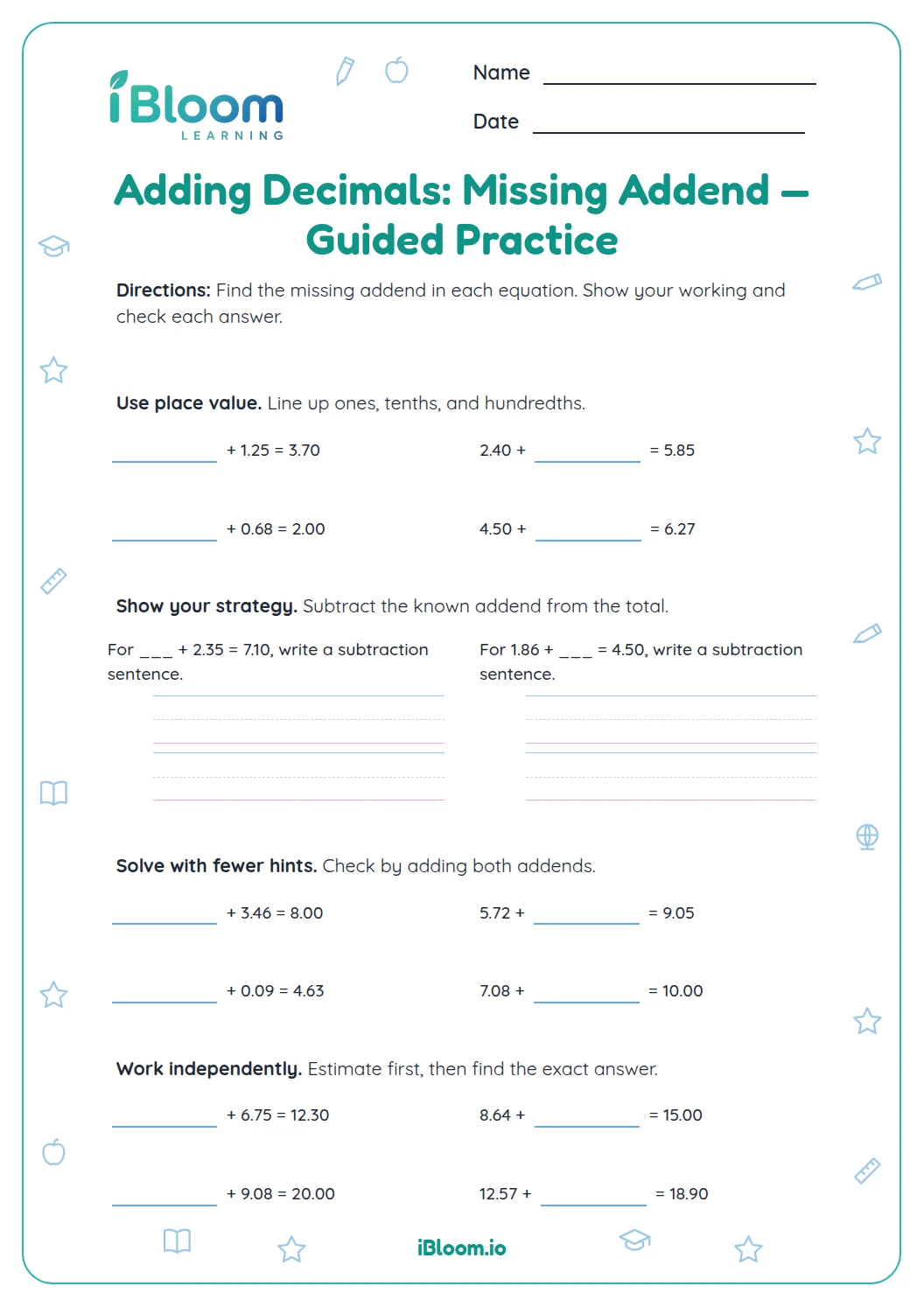
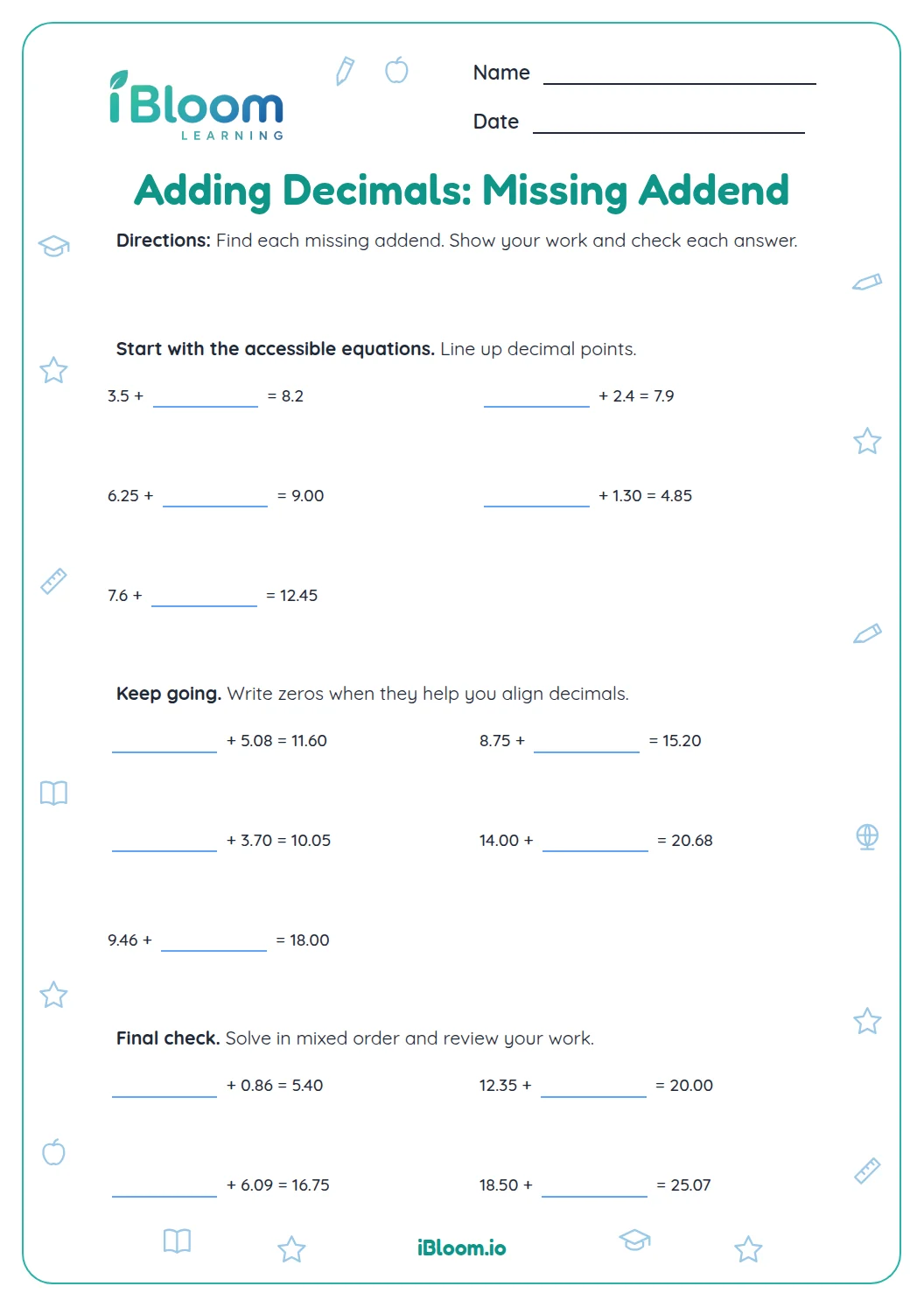
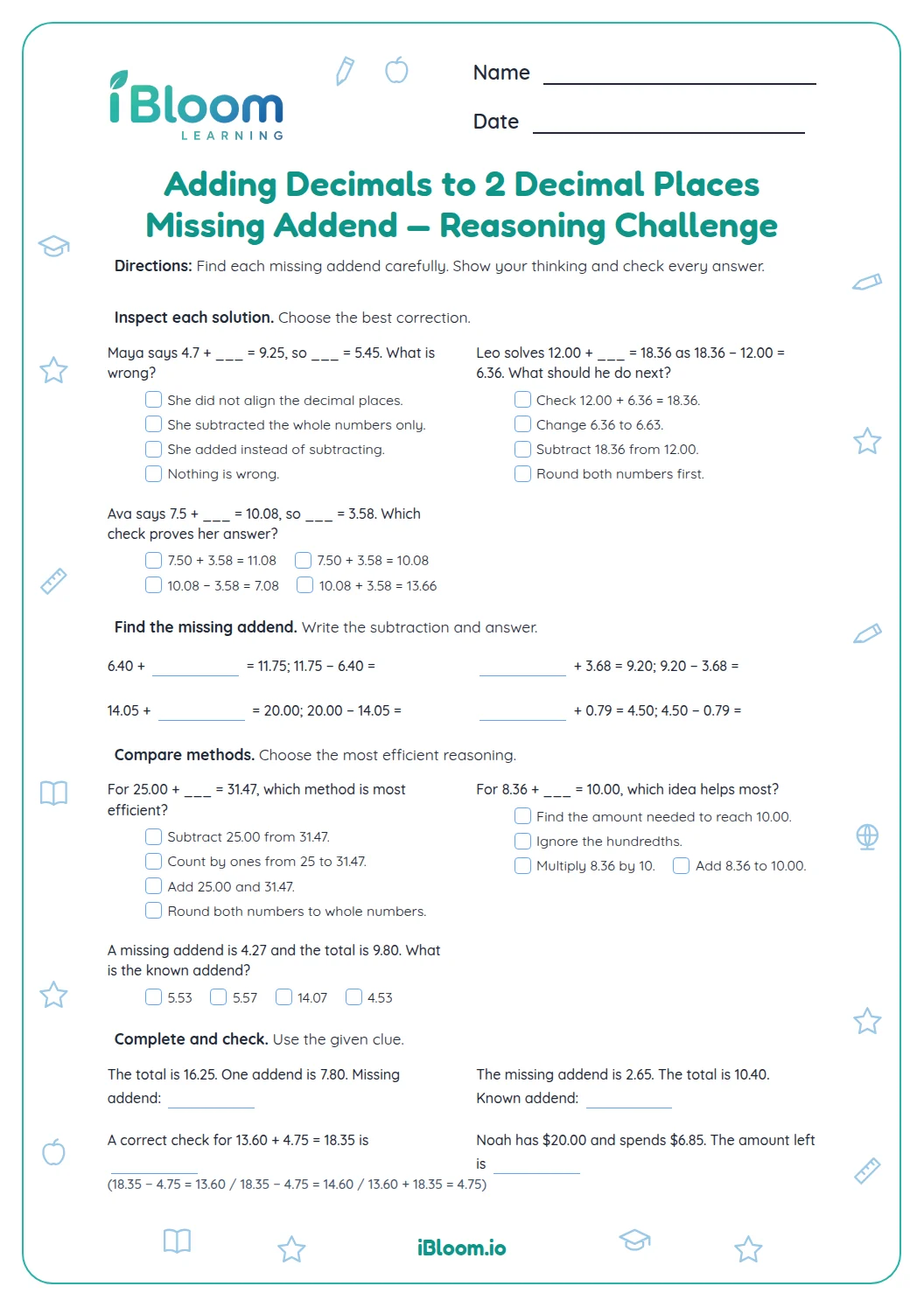
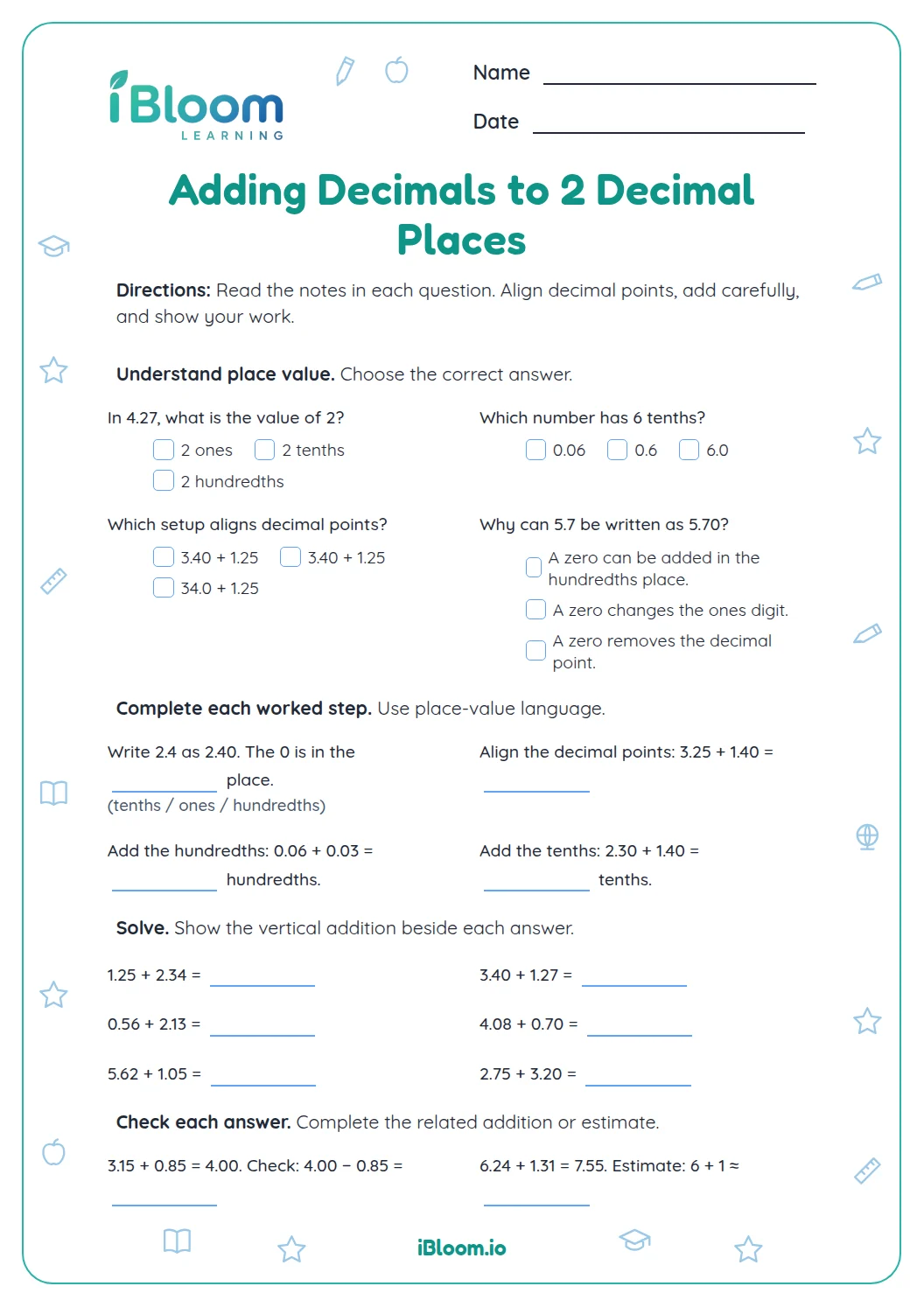
This Grade 6 printable uses 14 money and measurement situations to practice finding a missing decimal addend. The questions pair concise settings with addition equations and answer choices. Learners identify the known amount and total, find the missing part, and check the equation. It practices CCSS 6.EE.B.7.
Aligned to 6.EE.B.7
How do you turn a story into an equation?
First identify what is known and what is unknown. If two costs make a total, write known amount + unknown amount = total. Subtract the known cost from the total to find the missing cost.
Question 1 uses Maya’s purchase: the notebook costs $4.75 and the total is $9.20. The missing pen price is $4.45 because 4.75 + 4.45 = 9.20.
- 14.75 + x = 9.20
- 2x = 9.20 − 4.75
- 3x = 4.45
- 4The pen costs $4.45.
When should you subtract?
Subtract when you know the total and one part. Keep the decimal points aligned and label the answer with dollars, liters, miles, or another unit if the question gives one. If the unknown is a new total, add the known amounts instead.
What kinds of stories appear?
The stories use money, liquid capacity, distance, and familiar errands. Question 1 leaves room to show an equation; the remaining items give compact equation choices tied to those settings.
- Part A begins with Maya’s purchase equation.
- Part B uses concise money and measurement equation choices.
- Part C continues with other units and totals.
How to use this worksheet
- 1Underline the total and the amount you already know.
- 2Decide what the question asks you to find.
- 3Write an addition or subtraction equation with a variable or blank.
- 4Align decimal points and calculate.
- 5Attach the correct unit or dollar sign.
- 6Check that your answer makes sense in the story.
Common mistakes and quick fixes
The mistake
Subtracting the total from the known amount.
The fix
For a missing part, subtract the known part from the total.
The mistake
Treating a remaining amount as the starting amount.
The fix
Draw or label the starting amount, change, and amount left before calculating.
The mistake
Reporting a number with no unit or the wrong unit.
The fix
Copy the unit from the story; dollar amounts use a dollar sign.
Common Core alignment
This worksheet gives focused practice with the standard below.
Represent a missing addend with an equation and solve for it.
On this sheet: The story problems use addition equations with a missing nonnegative decimal amount.
Show the official wordingHide the official wording
Solve real-world and mathematical problems by writing and solving equations of the form x + p = q and px = q for cases in which p, q and x are all nonnegative rational numbers.
What to practice next
Make more practice
Further reading
Questions parents and teachers ask
Should learners write an equation for each story?
Yes. An equation shows the known amount, unknown amount, and total. For question 1, write 4.75 + x = 9.20, then subtract 4.75 from 9.20. Checking by addition confirms the pen price. Represent the unknown with a letter, then verify that the known amount plus answer equals total.
Do these stories use only money?
No. The page uses money, liquid capacity, distances, length, and weight. Keep the unit from each story in the answer when it is given, and use a dollar sign for prices or savings. Represent the unknown with a letter, then verify that the known amount plus answer equals total.
How can you identify the missing addend?
Look for a known amount and a total made from two parts. Represent the missing part with a blank or x, then subtract the known amount from the total. Read carefully to identify which quantity is unknown. Represent the unknown with a letter, then verify that the known amount plus answer equals total.
Why are answers written as decimals?
The story quantities use decimal tenths and hundredths, so decimal answers preserve the measurement or money units. Keep place values aligned during subtraction, and include trailing zeros when they help show hundredths clearly. Represent the unknown with a letter, then verify that the known amount plus answer equals total.
How many stories are included?
The revised sheet has 14 short stories based on this page’s own settings and characters, including Maya, Leo, Ava, Noah, Emma, and Sam. Each asks for an unknown amount that completes an addition relationship. Represent the unknown with a letter, then verify that the known amount plus answer equals total.
Is an answer key included?
Yes. The printable has a separate key with the missing values. Check each answer by adding it to the known amount and confirming that the story’s total is reached. Include the unit when the question gives one. Represent the unknown with a letter, then verify that the known amount plus answer equals total.