



About this worksheet
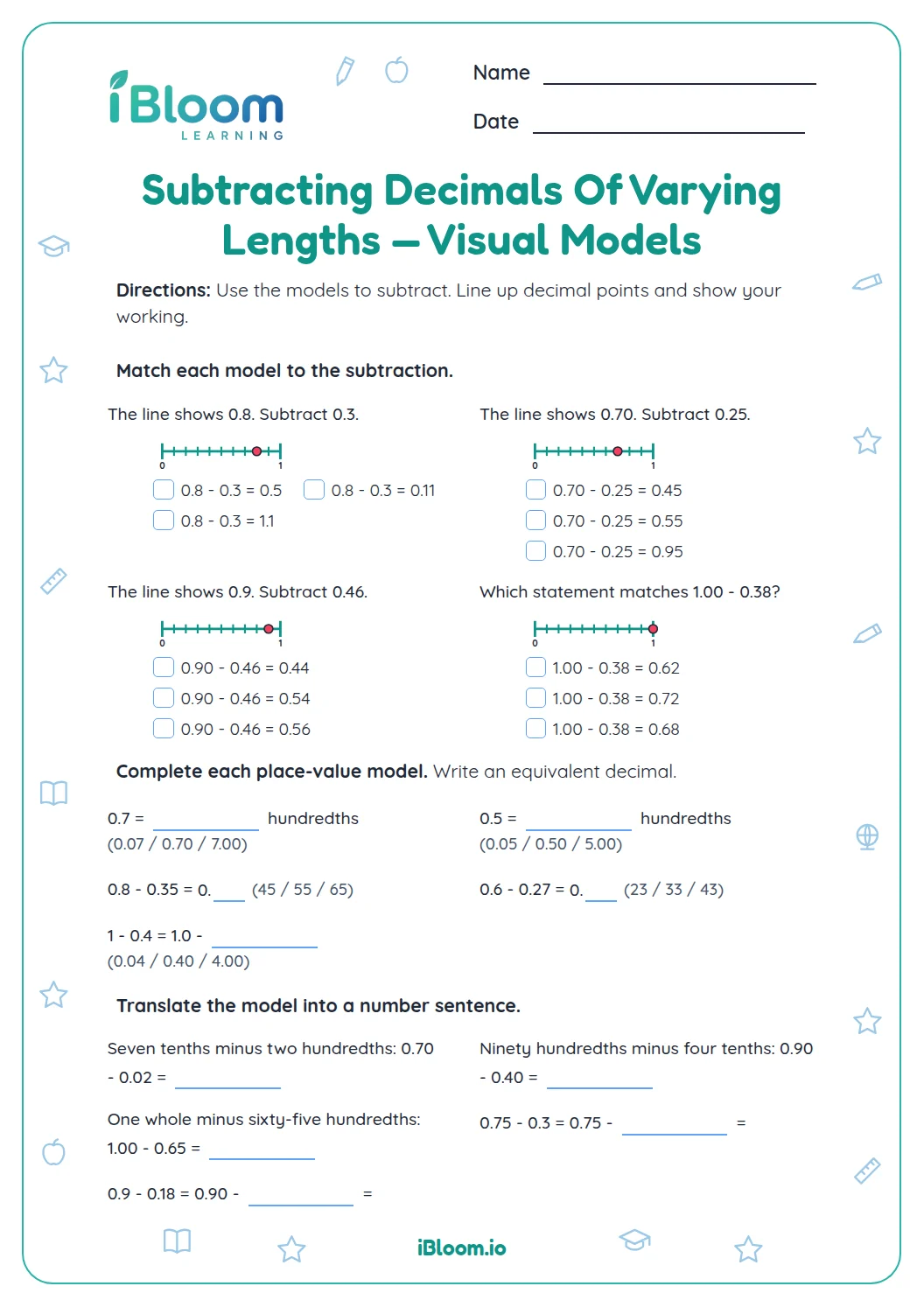
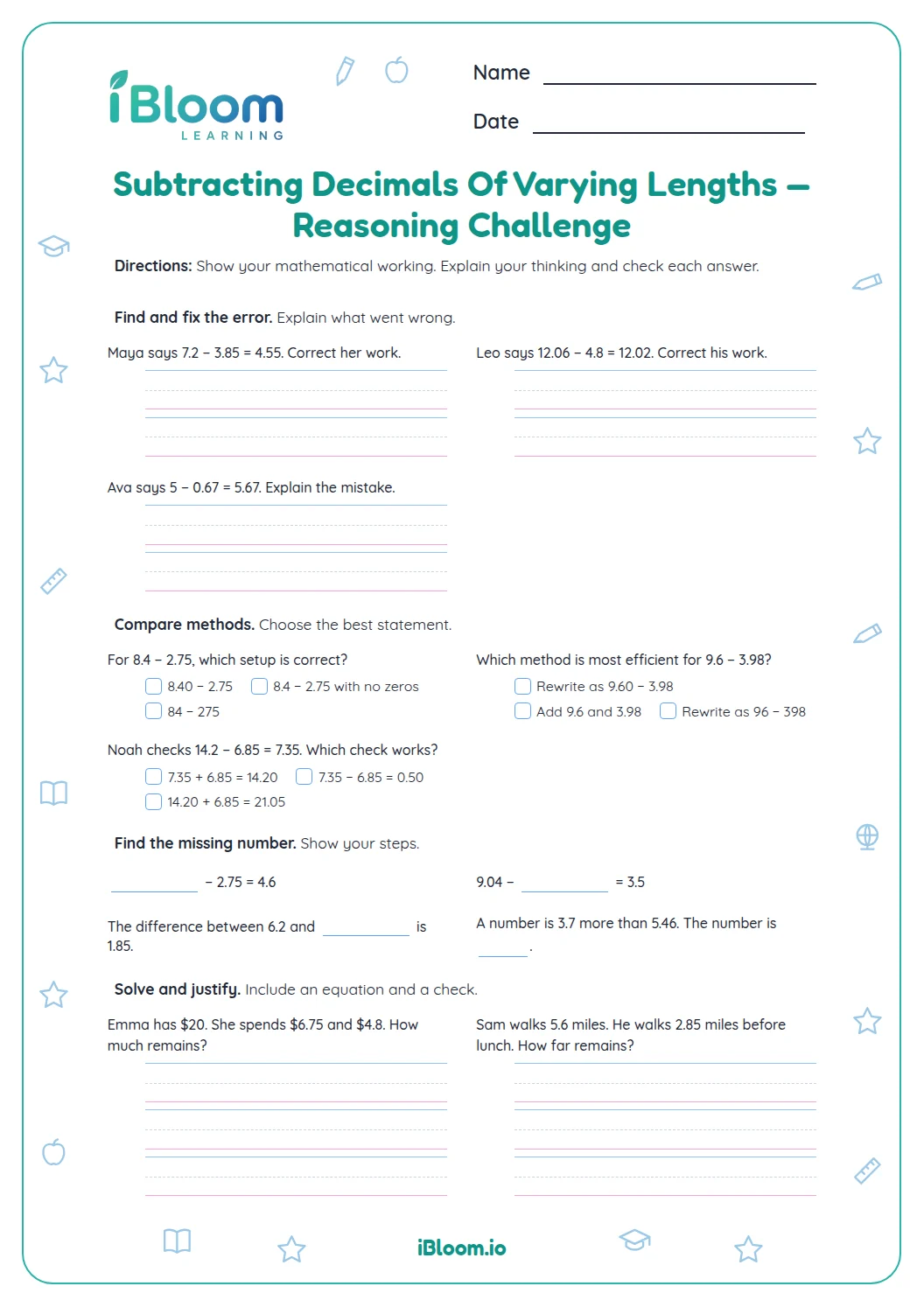
This Grade 6 printable gives students practice subtracting decimals with different numbers of decimal places. Part A has six familiar situations involving money, lengths, and amounts; Part B provides eight subtraction equations for careful place-value alignment. Students can add zeros to show matching place values before subtracting. The answer key is included as a separate page. The work supports Common Core 6.NS.B.3, fluently adding, subtracting, multiplying, and dividing multi-digit decimals using the standard algorithm.
Aligned to 6.NS.B.3
How do you line up decimals before subtracting?
Place each decimal point directly under the other. If one number has fewer decimal places, write zeros to the right so each column has a digit. Subtract by place value, beginning at the right.
In a story, first identify the starting amount and the amount taken away. The difference answers how much remains.
- 12.5 − 0.75
- 2Write 2.5 as 2.50.
- 32.50 − 0.75 = 1.75
- 4Answer: 1.75 liters
What does this worksheet ask students to solve?
Part A contains six measurement, money, and distance stories. Part B has eight decimal subtraction equations, including whole numbers written with decimal amounts and thousandths. Every answer comes from subtraction with aligned place values.
How to use this worksheet
- 1Read the whole story and mark the starting amount.
- 2Choose subtraction when an amount is taken away or a remainder is requested.
- 3Write the numbers with decimal points in one vertical line.
- 4Add zeros to the right when needed; their value does not change the number.
- 5Subtract each column, then include the decimal point and unit.
- 6Estimate to check that the result is smaller than the starting amount.
Common mistakes and quick fixes
The mistake
Subtracting 2.5 − 0.75 as if the digits were whole numbers.
The fix
Rewrite 2.5 as 2.50 so tenths and hundredths line up.
The mistake
Dropping a zero in a place-value column.
The fix
Use a placeholder zero when it helps make columns clear.
The mistake
Reporting the amount used instead of the amount left.
The fix
Reread the question and check whether it asks for the difference or remainder.
Common Core alignment
This page builds accuracy with multi-digit decimal subtraction in measurement and money contexts.
Use the standard algorithm to subtract decimals with different place values.
On this sheet: All 14 questions practice subtracting multi-digit decimals, in stories or direct equations.
Show the official wordingHide the official wording
Fluently add, subtract, multiply, and divide multi-digit decimals using the standard algorithm for each operation.
What to practice next
Make more practice
Further reading
Questions parents and teachers ask
How do you line up decimals with different numbers of digits?
Place the decimal points in one vertical line. Add zeros to the right of the shorter decimal when helpful, such as writing 2.5 as 2.50. Subtract by place value, then place the decimal point in the answer. This keeps tenths, hundredths, and thousandths in their correct columns.
Which real-world situations are on this worksheet?
The six story problems use liters, meters, miles, feet, and dollars. Each gives a starting amount and a quantity removed, spent, cut, or already traveled. Students subtract to find the amount remaining. The questions ask how much is left, so identify the original quantity first.
How many questions and pages are included?
There are 14 questions: six short real-world problems and eight decimal equations. The printable has two worksheet pages and a separate two-page answer key. Students can use the key to compare each computed difference with their own work and units.
How can students check a subtraction answer?
Add the difference to the amount subtracted. The sum should equal the starting amount. An estimate is another check: 2.5 minus about 1 is near 1.5, so an answer of 1.75 is reasonable. This inverse-operation check works for the direct equations as well as the stories.
What should students do when a story uses money?
Keep the dollar amounts in decimal form and align the decimal points before subtracting. For example, $20.00 minus $7.86 leaves $12.14. Include a dollar sign in the answer so the unit stays clear. The worksheet includes a money story alongside measurement and distance examples.