



About this worksheet
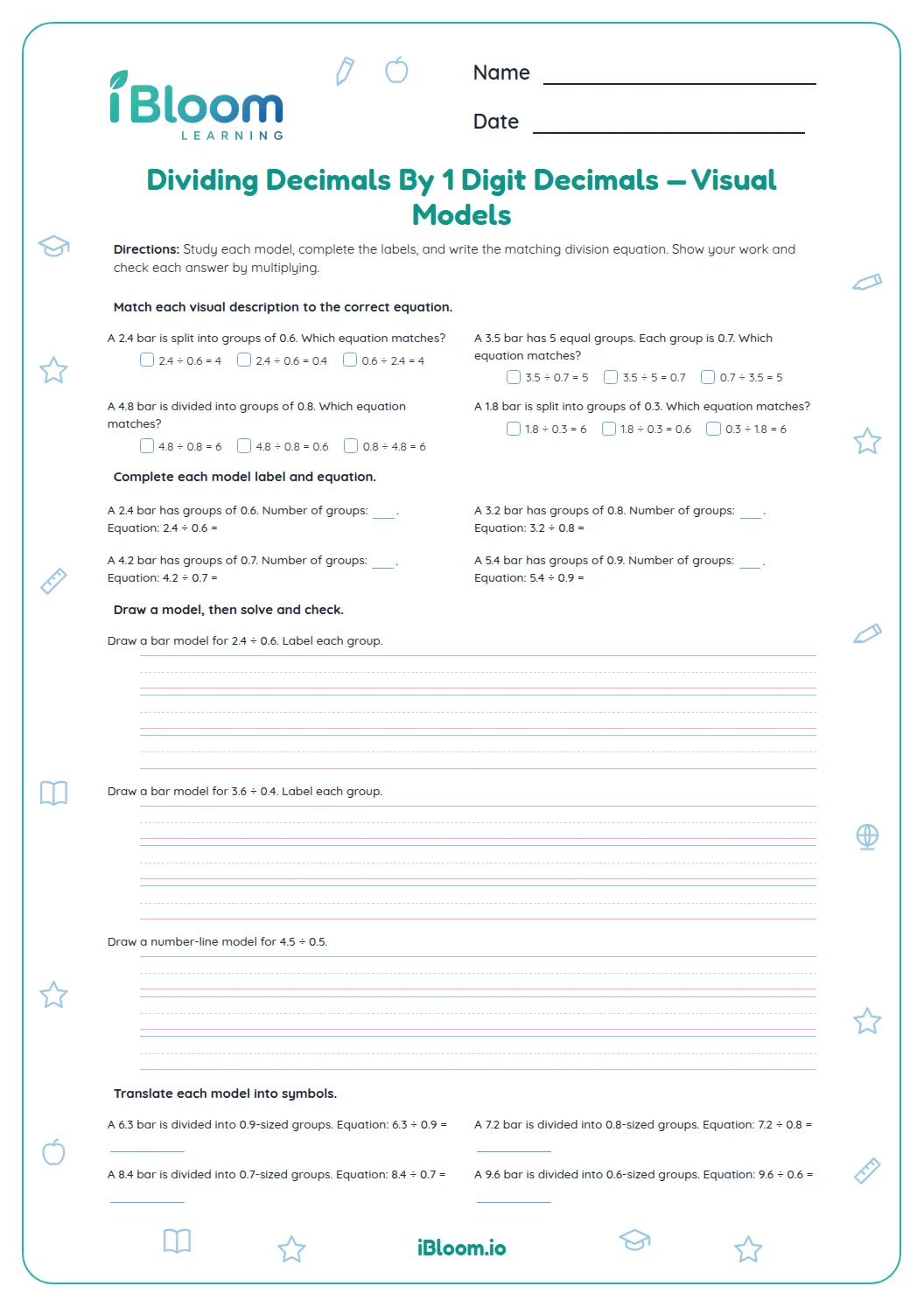
This Grade 6 worksheet uses 16 number lines to connect decimal division with equal groups. Students complete a division equation for each model and explain aloud how the intervals represent groups. Part A uses tenths divisors; Part B uses hundredths divisors. This model-based decimal calculation practices CCSS 5.NBT.B.7. A separate key supplies every quotient.
Aligned to 5.NBT.B.7
What does each decimal division model show?
Each number line starts at zero and ends at the dividend. The divisor in the equation gives the size of one equal interval, so students count intervals to determine the quotient.
Part A has eight tenths models. Part B has eight hundredths models, including endpoints greater than one. Students explain their equal-group reasoning aloud.
How do you count a decimal quotient?
Track each equal segment from zero to the endpoint. The number of segments, rather than the endpoint label, gives the answer.
- 1Question 1 reaches 1.2 in steps of 0.3.
- 2Four jumps reach 1.2, so 1.2 ÷ 0.3 = 4.
How can multiplication check the answer?
Multiply the number of groups by the size of each group. A product that returns to the dividend confirms the quotient.
How to use this worksheet
- 1Read the dividend and divisor in the equation.
- 2Find zero and the dividend endpoint on the number line.
- 3Count intervals, treating each interval as one divisor-sized group.
- 4Write the number of groups in the quotient blank and explain the grouping aloud.
- 5Multiply the quotient by the divisor to check that the product equals the dividend.
Common mistakes and quick fixes
The mistake
Counting tick marks instead of the spaces between them.
The fix
Count each segment between neighboring tick marks as one jump.
The mistake
Reading a hundredths divisor as tenths.
The fix
Check the digits after the decimal point before counting.
The mistake
Using the endpoint as the quotient.
The fix
The endpoint is the dividend; the number of jumps is the quotient.
Common Core alignment
Divide decimals to hundredths using number-line models and explain the equal groups.
On this sheet: Students connect equal intervals to a written decimal division equation and explain their grouping aloud.
Show the official wordingHide the official wording
Add, subtract, multiply, and divide decimals to hundredths, using concrete models or drawings and strategies based on place value, properties of operations, and/or the relationship between addition and subtraction; relate the strategy to a written method and explain the reasoning used.
What to practice next
Make more practice
Further reading
Questions parents and teachers ask
What do the number-line intervals represent?
Each equal interval represents one group the size of the divisor in the equation. The line starts at zero and ends at the dividend. Counting the intervals tells how many groups fit in that amount. Students write that count as the quotient and explain it aloud.
How do the two parts differ?
Part A uses divisors written in tenths, such as 0.3 and 0.6. Part B uses divisors written in hundredths, such as 0.12 and 0.25. Both parts connect equal intervals on a number line to a written division equation with a missing quotient.
How many questions and models are included?
There are 16 questions, each with its own number line and division equation. The two parts have eight questions each. Every quotient is a whole number, so students can count complete intervals from zero to the endpoint. The separate key fills in each missing quotient.
How can students check a quotient?
Multiply the quotient by the divisor and compare the product with the dividend. For question 1, four groups of 0.3 make 1.2, so 1.2 divided by 0.3 equals 4. Students can say the multiplication check aloud after writing the quotient in the blank.
Why might a student count one group too many?
Counting tick marks includes the starting mark at zero, which does not represent a completed group. Ask the student to point to the spaces between neighboring marks instead. Each space is one interval. Starting the count with the first completed interval gives the correct number of groups.