



About this worksheet
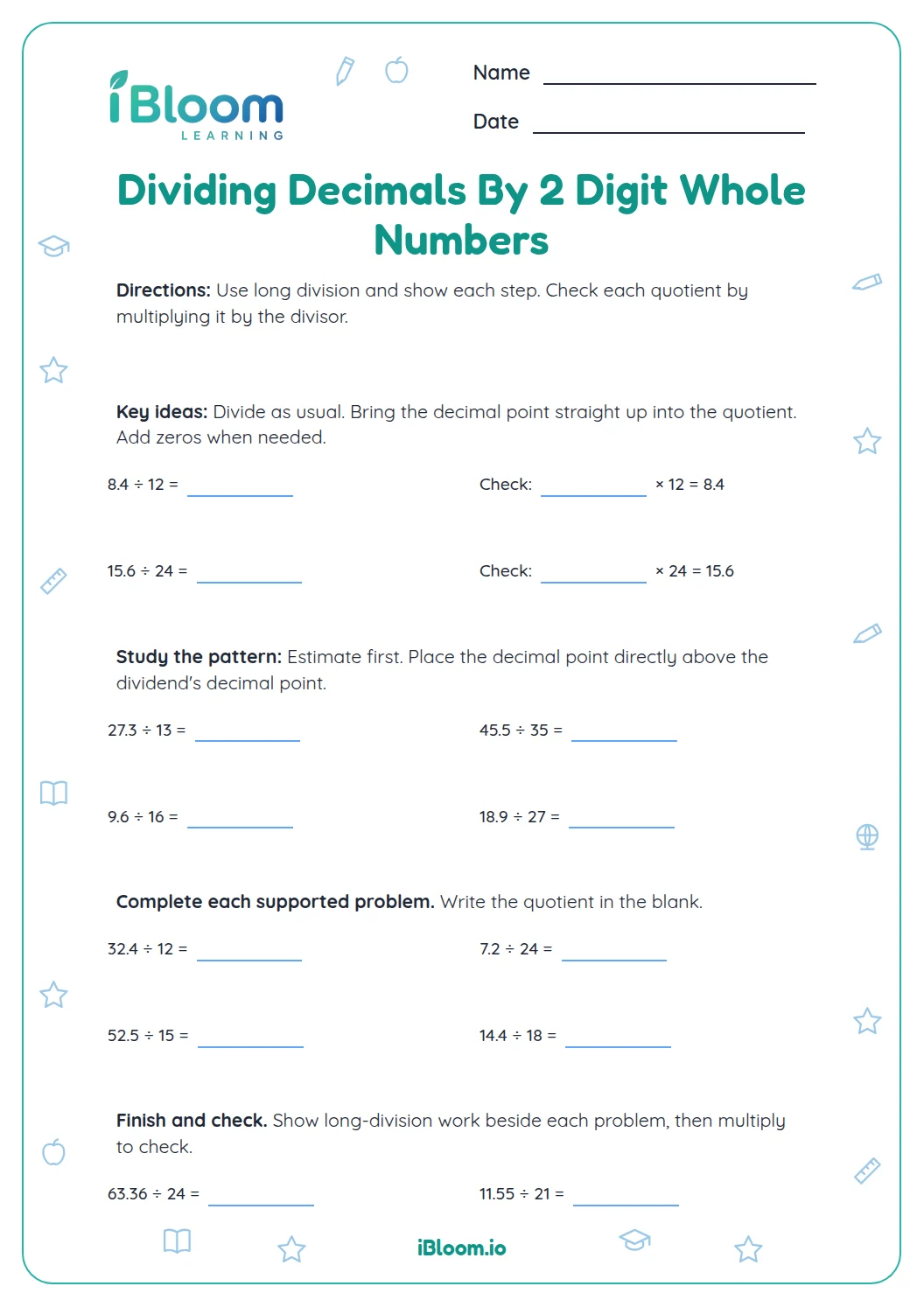
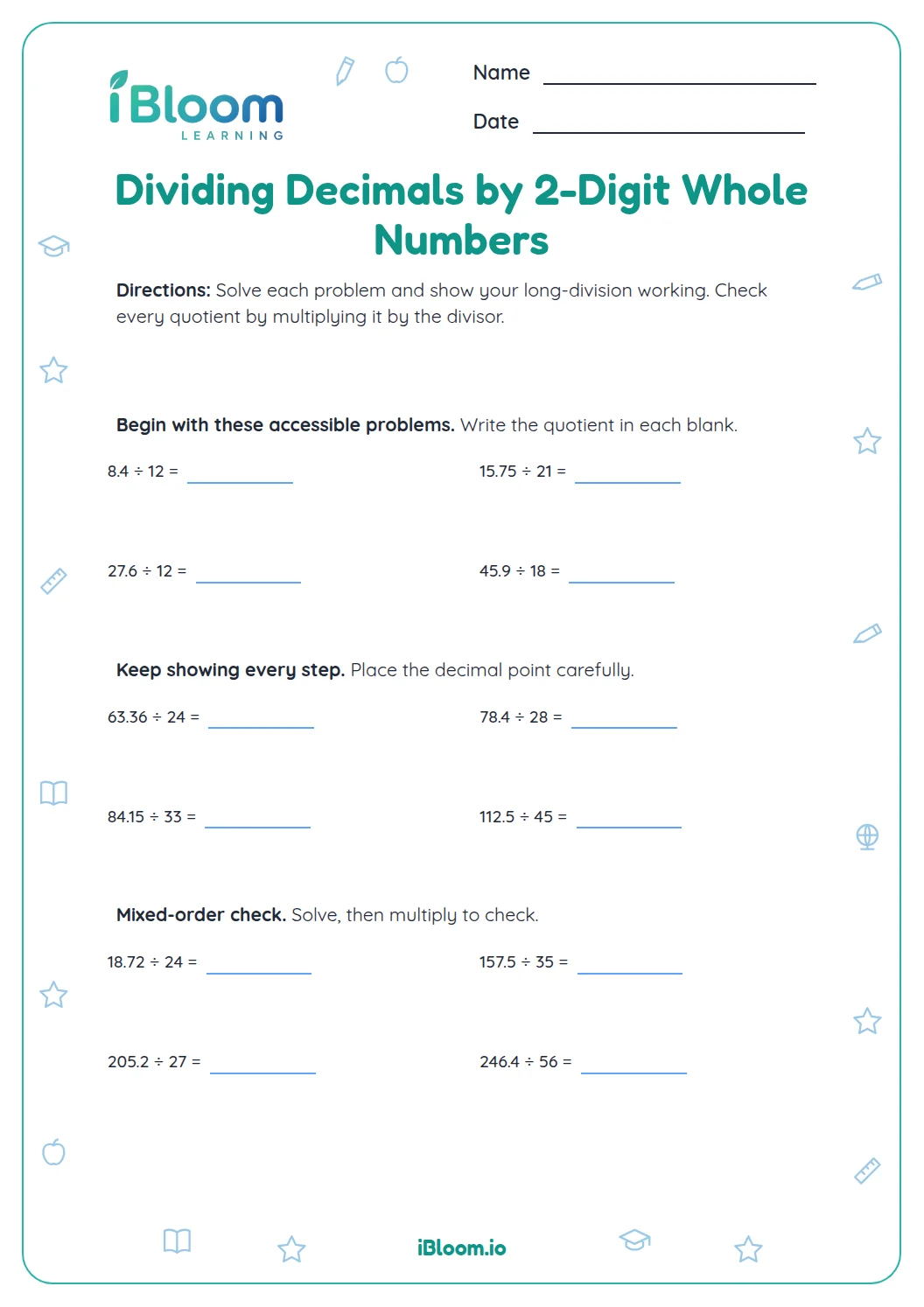
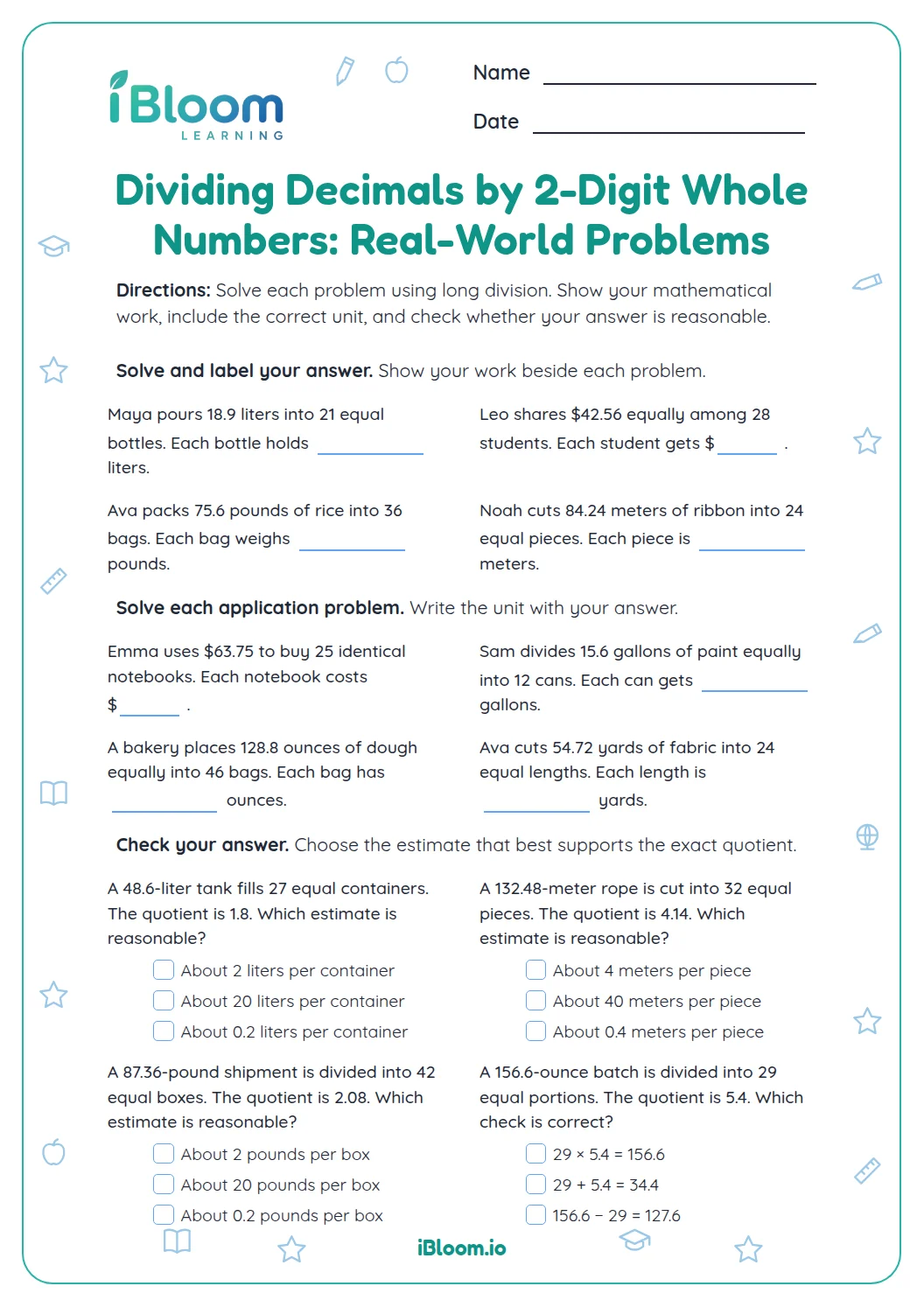
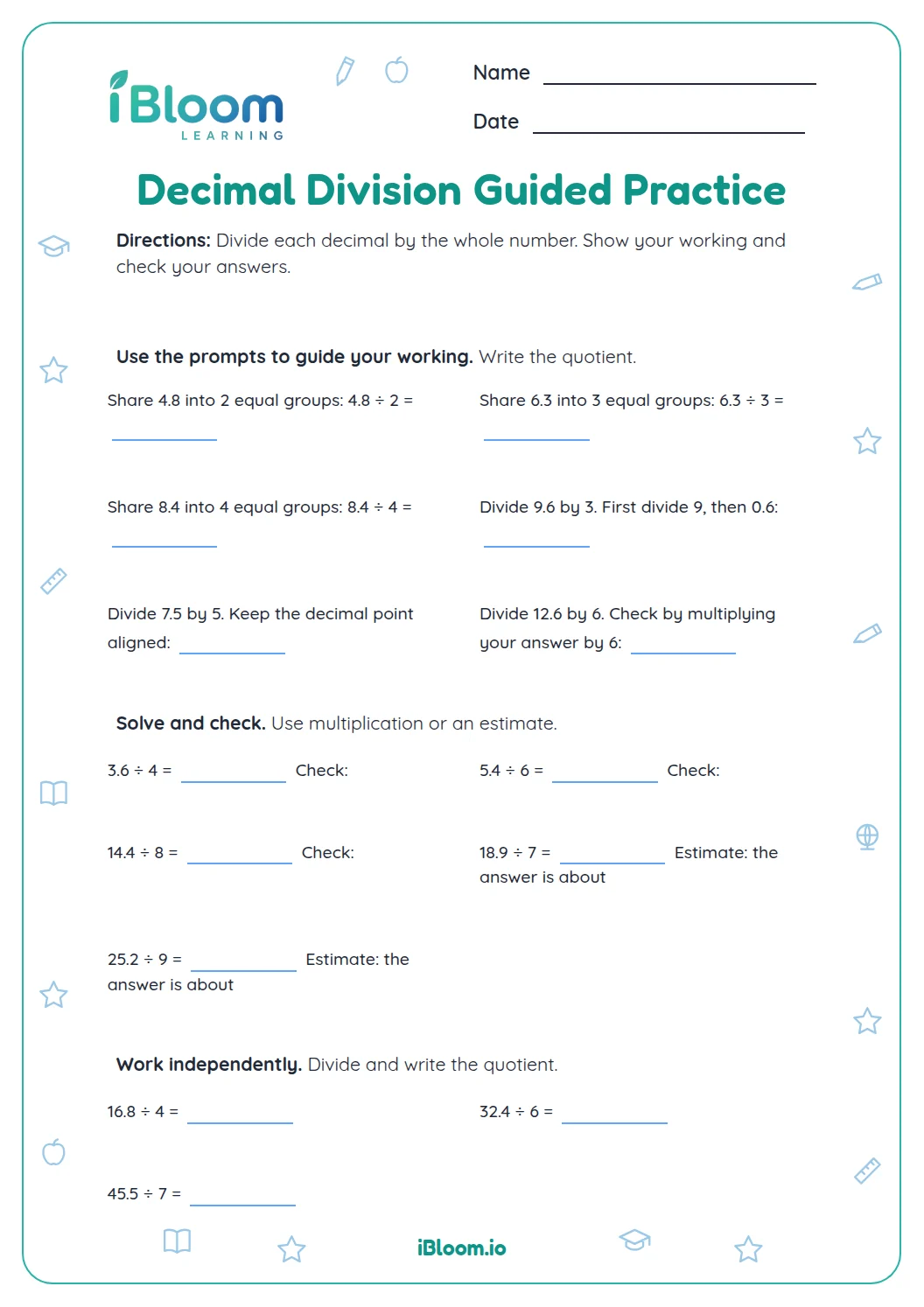
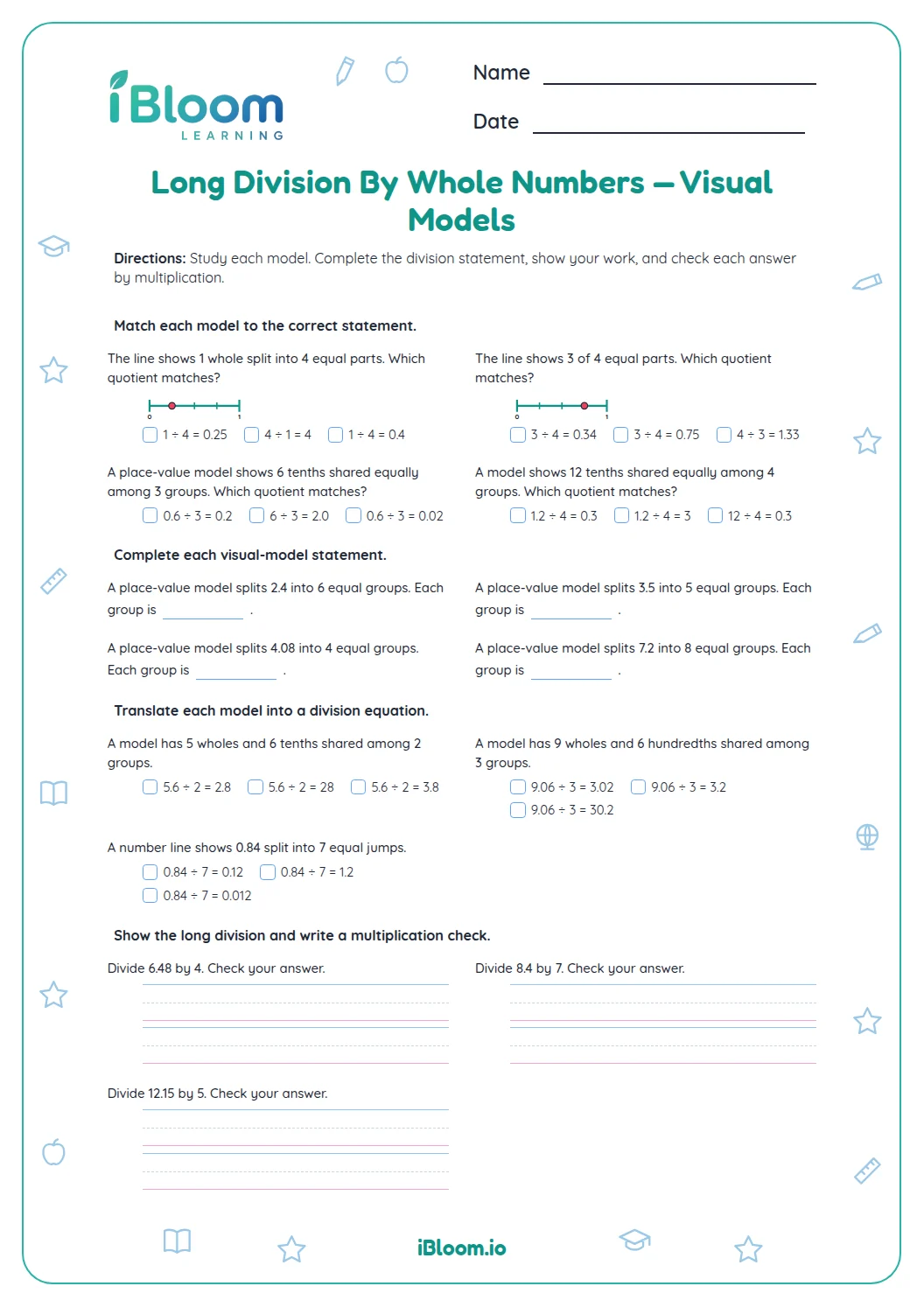
This Grade 6 worksheet practices dividing decimal dividends by two-digit whole numbers. In the first part, hundredths grids represent the decimal quotients so students can connect the result to tenths and hundredths. The next problems ask for quotients and multiplication checks, followed by two measurement situations. A separate key gives all 16 answers, with units for the final pair.
Aligned to 6.NS.B.3
What does the hundredths grid represent?
Each small square represents one hundredth. For question 1, the 30 shaded squares show 0.30, which is the same value as 0.3. Since 12 groups of 0.3 make 3.6, the quotient fits the division sentence. The grid represents the quotient; it does not show twelve separate groups.
- 13.6 ÷ 12
- 2The grid has 30 hundredths: 0.30
- 30.30 = 0.3
- 4Check: 0.3 × 12 = 3.6
How can multiplication check a quotient?
Multiply the quotient by the divisor. The product should match the dividend. This also helps catch a quotient that is ten times too large or too small.
What changes in the later questions?
Part A pairs eight division facts with hundredths grids that show each quotient. Part B adds six equations, including quotients greater than 1. Part C applies decimal division to equal amounts of liquid and ribbon.
How to solve each division problem
- 1Estimate whether the quotient is less than or greater than 1.
- 2Read the dividend’s place value carefully.
- 3Divide using the whole-number divisor.
- 4Place the decimal point so the quotient has the right size.
- 5Multiply the quotient by the divisor to check.
Common mistakes and quick fixes
The mistake
Writing a quotient ten times too large.
The fix
Estimate first and compare the quotient’s size with the dividend.
The mistake
Dropping the decimal place value when regrouping.
The fix
Name each digit as ones, tenths, or hundredths while dividing.
The mistake
Skipping the check.
The fix
Multiply quotient by divisor and compare the product with the dividend.
Common Core alignment
The calculations use the standard algorithm to divide decimals.
Fluently divide multi-digit decimals using the standard algorithm.
On this sheet: Every equation and context problem divides a decimal by a two-digit whole number.
Show the official wordingHide the official wording
Fluently add, subtract, multiply, and divide multi-digit decimals using the standard algorithm for each operation.
What to practice next
Make more practice
Further reading
Questions parents and teachers ask
What does a hundredths grid show on this page?
Each small square is one hundredth. In question 1, 30 shaded squares represent 0.30, which is equal to 0.3. The grid shows the quotient’s place value; the division sentence and multiplication check connect that quotient to the dividend and divisor.
How can I check a decimal quotient?
Multiply the quotient by the divisor. For question 1, 0.3 × 12 = 3.6, which matches the dividend. If the product is too large or too small, check the division and decimal point placement. This check works for the measurement problems too.
Why can a quotient be smaller than the dividend?
Division shares an amount into equal groups. When 3.6 is shared among 12 groups, each group is smaller than 3.6. Here, each group is 0.3 because 12 groups of 0.3 total 3.6. Multiplication confirms that the shares recombine to the starting amount.
Are there measurement problems on the worksheet?
Yes. The final two questions divide 16.8 liters among 24 cans and 27.3 meters of ribbon into 21 equal pieces. The answers are 0.7 liter per can and 1.3 meters per piece, so include the correct unit in each response.
What is in the answer key?
The key gives the quotient for each of the 16 questions and includes the units for the two measurement problems. Students can verify the answers by multiplying each quotient by its whole-number divisor; the product should equal the original decimal dividend.