
About this worksheet
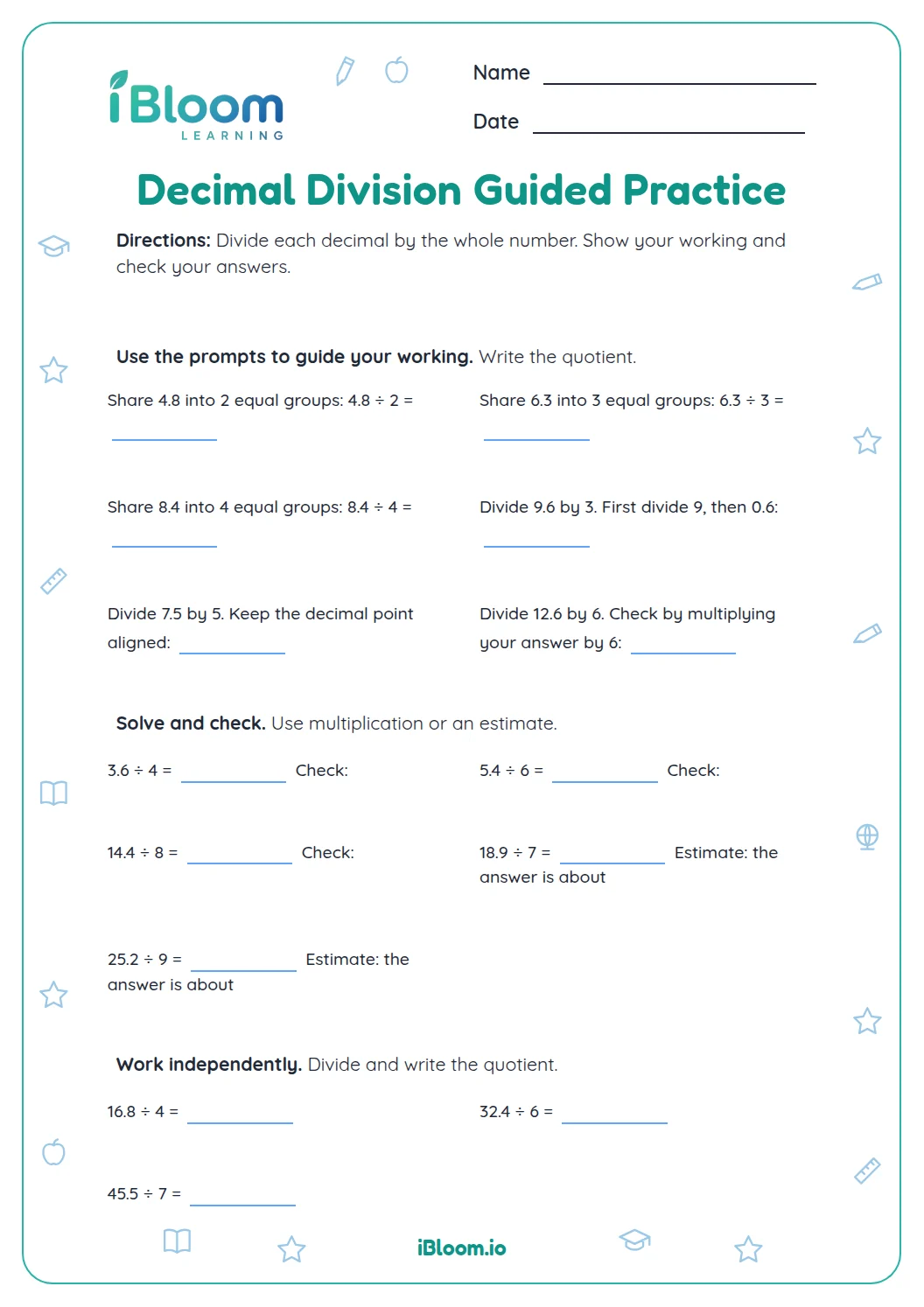
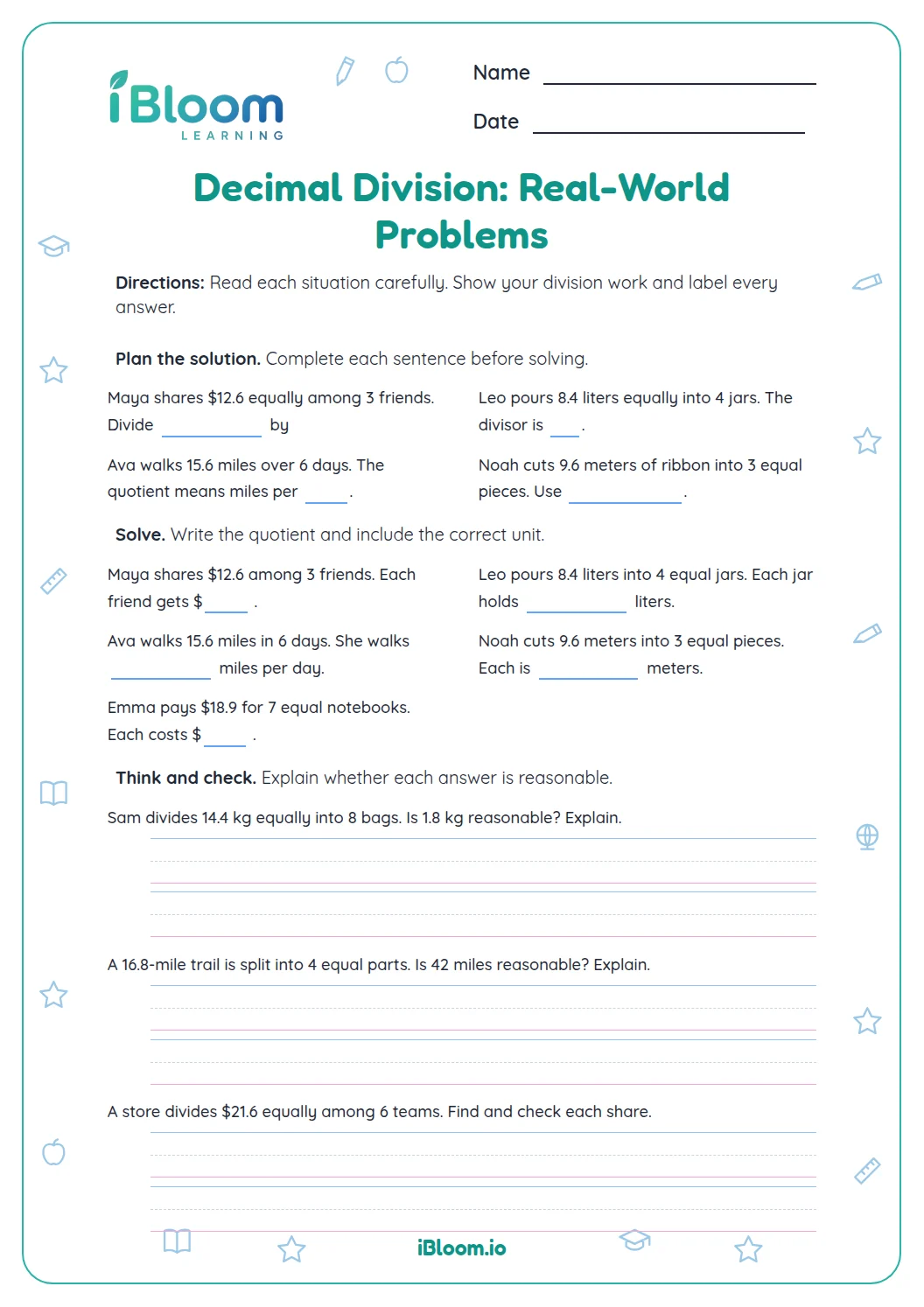
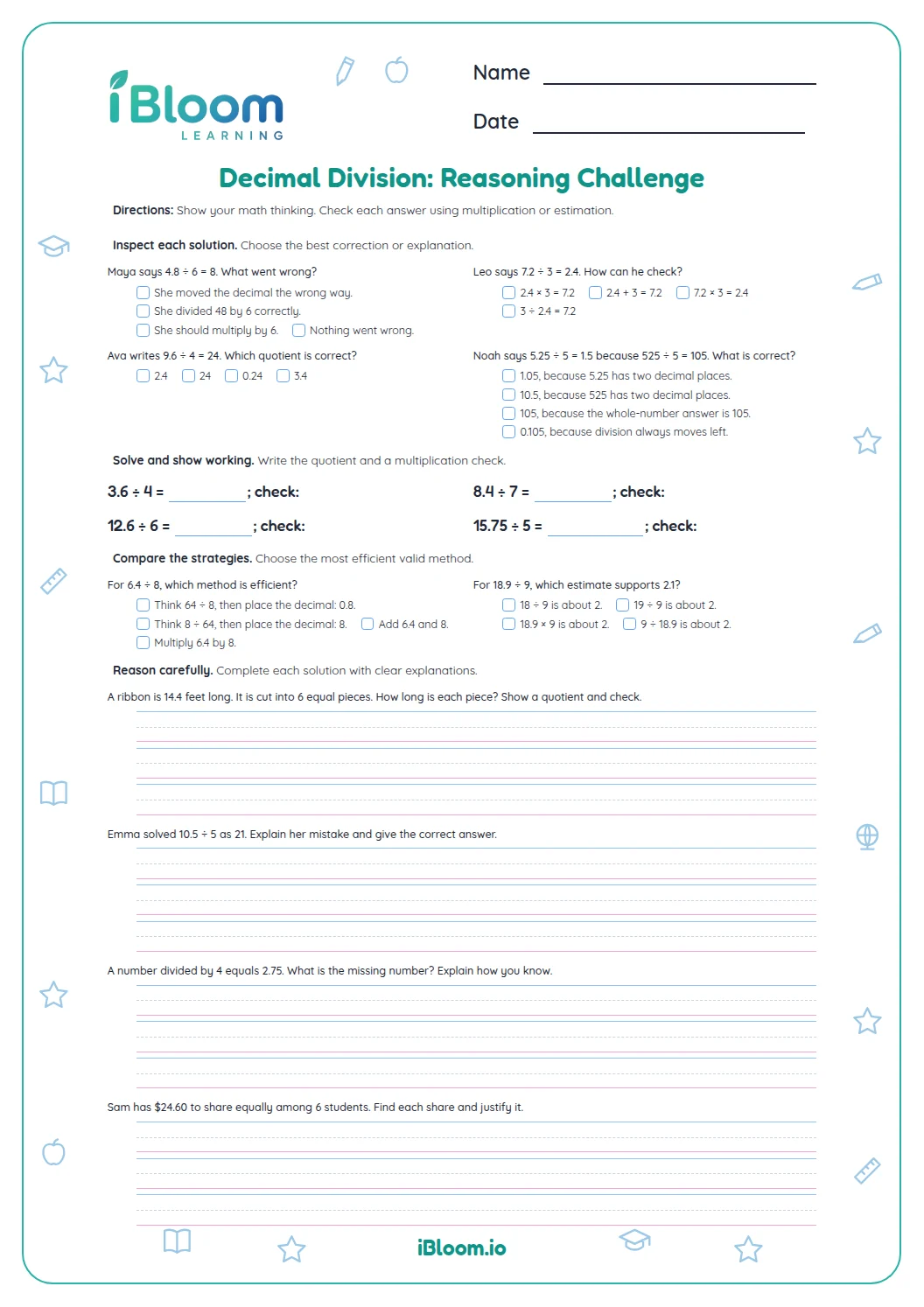
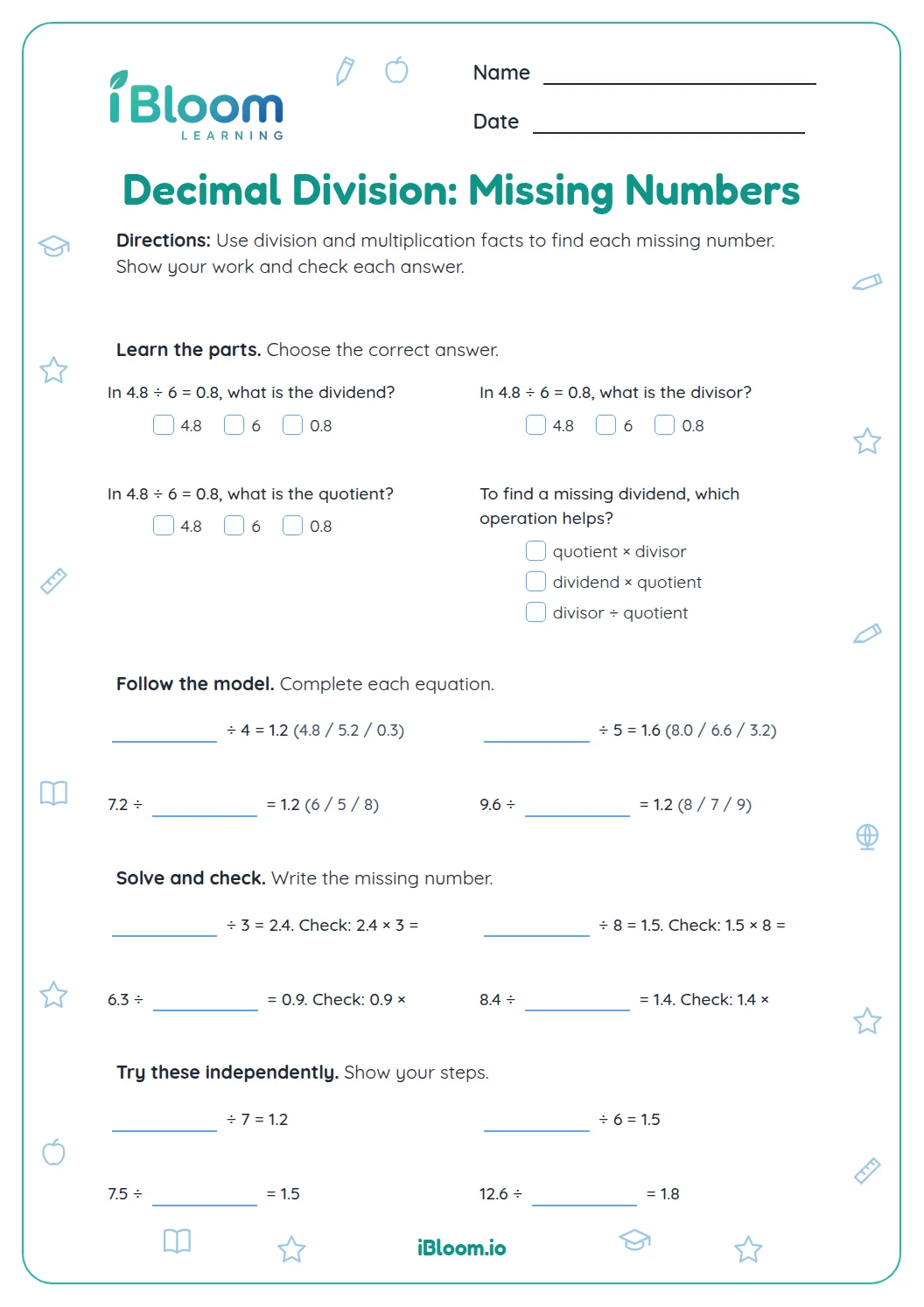
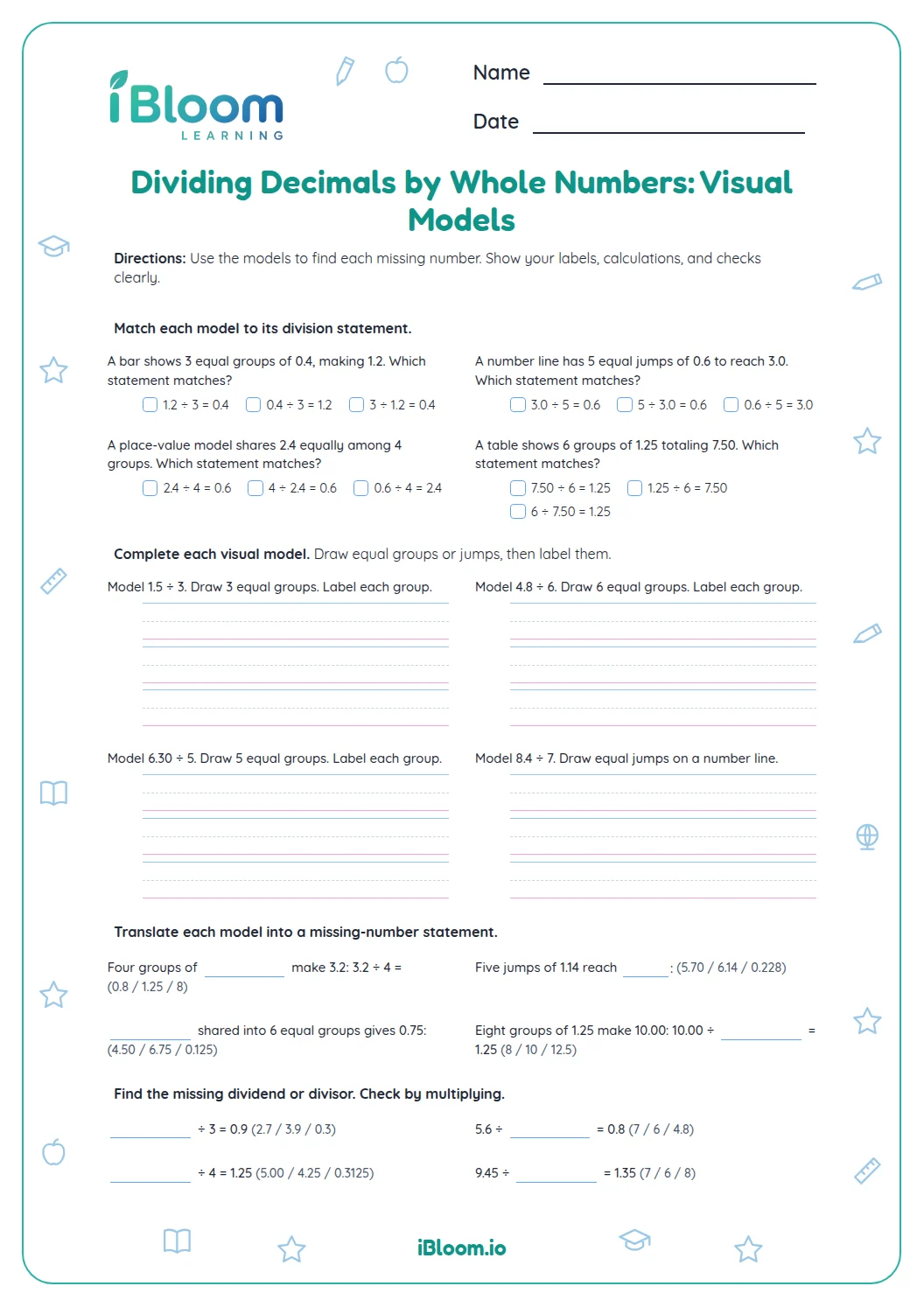
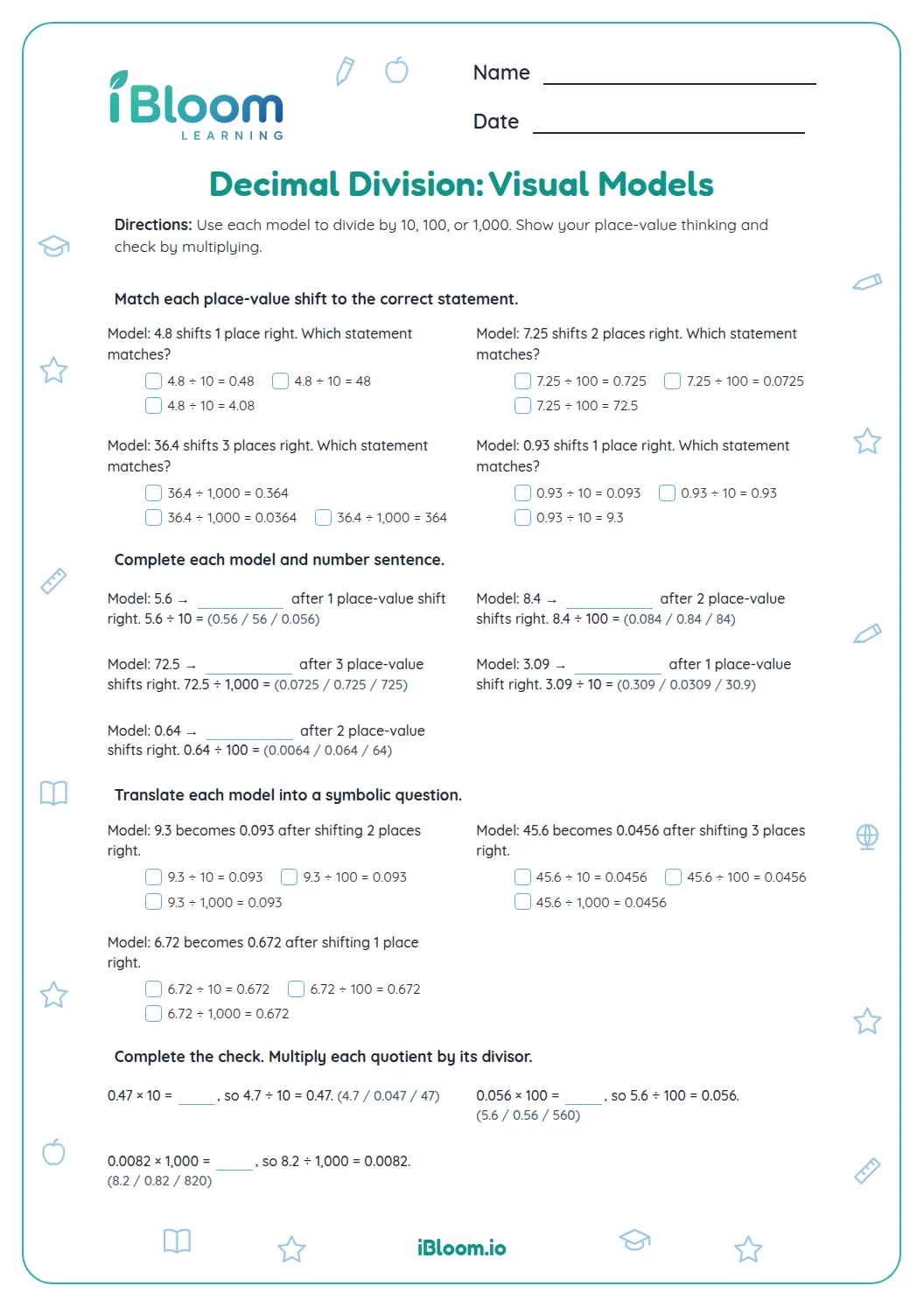
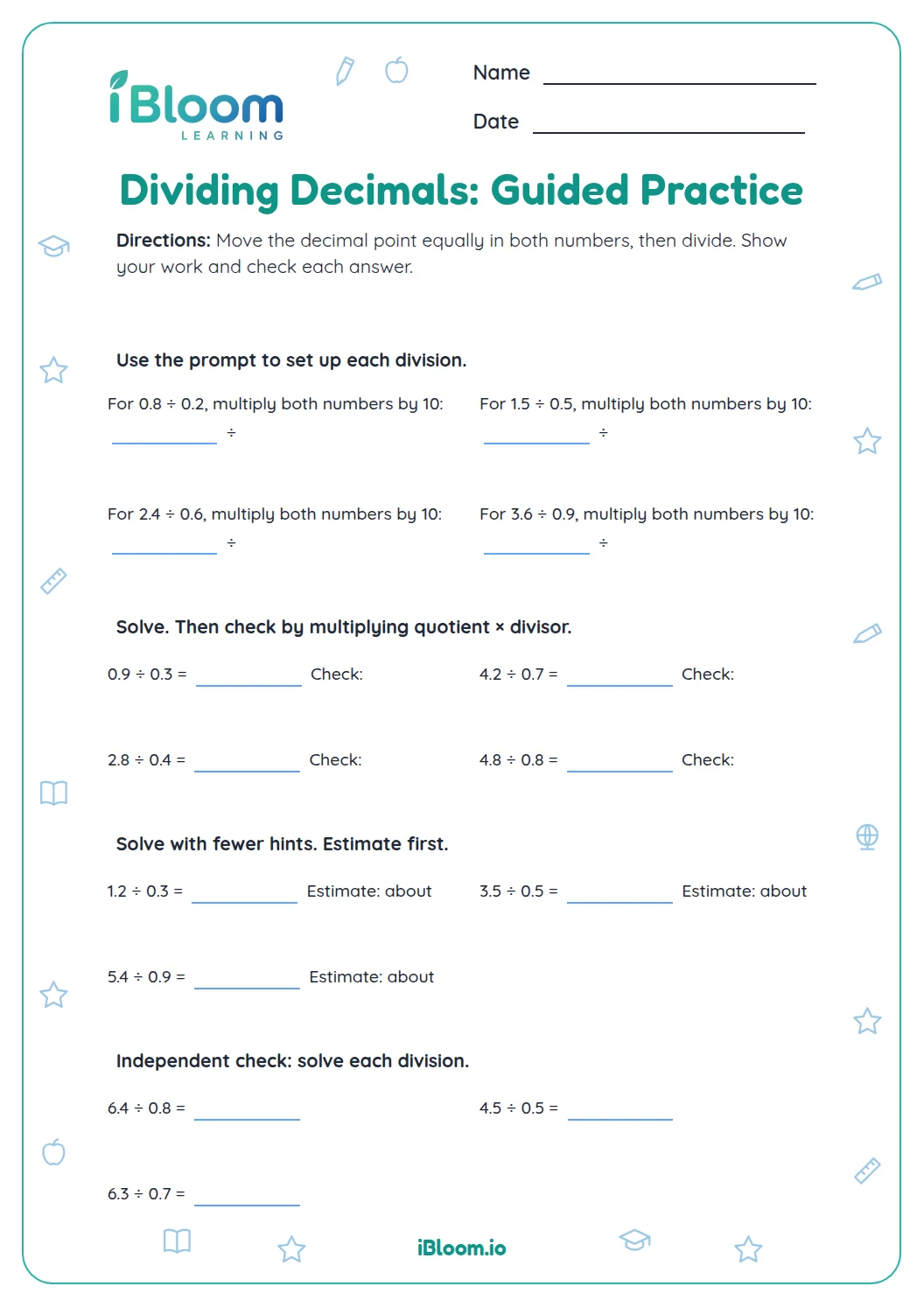
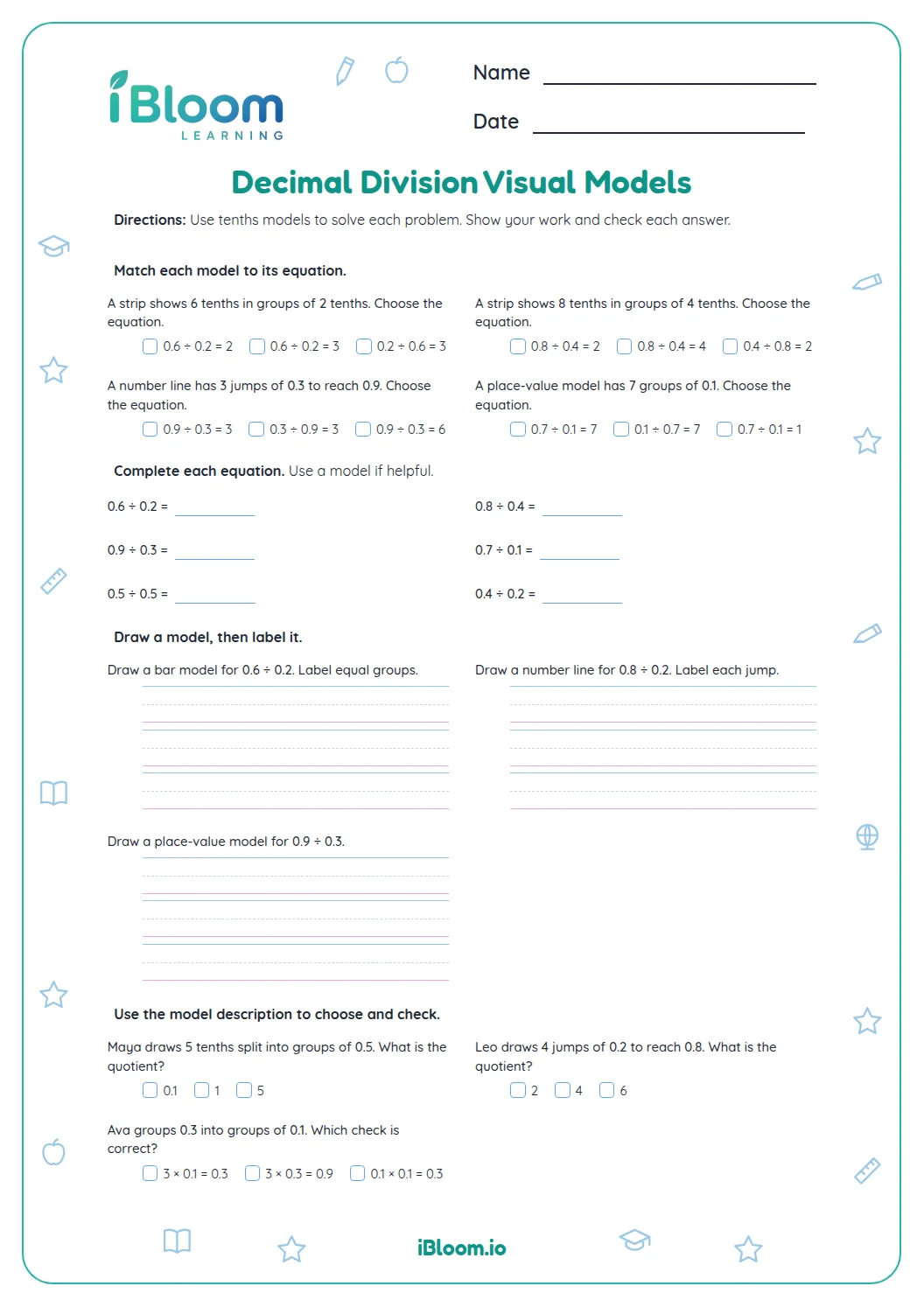
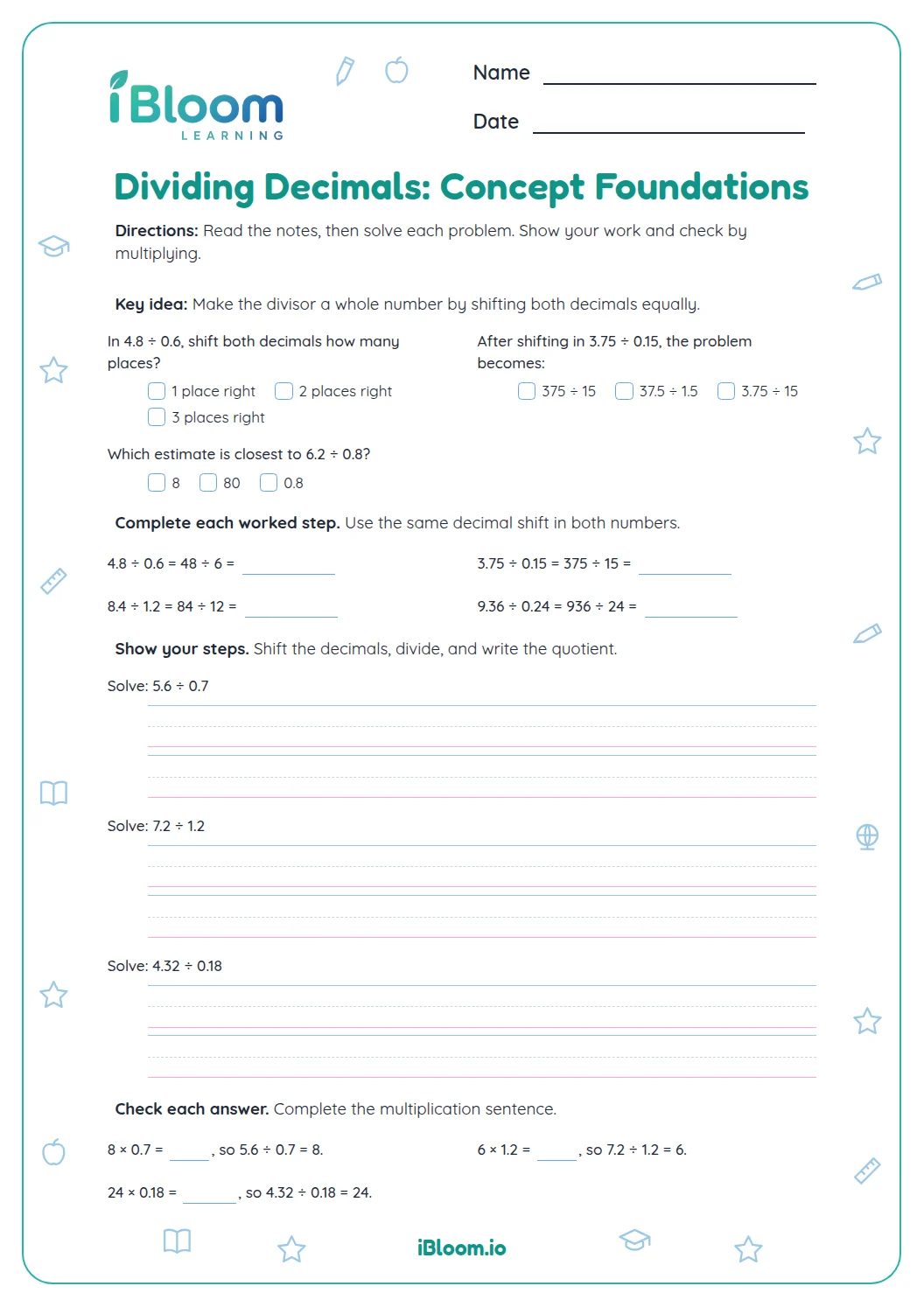
This free Grade 6 printable practices dividing decimals by whole numbers, the skill named in the title. Students begin with 1.2 ÷ 3 on a number line, continue with decimal quotients, then divide measurements into equal shares. The 14 questions are grouped in three practice parts and span two worksheet pages, with a separate two-page key. The page aligns with Common Core 6.NS.B.3.
Aligned to 6.NS.B.3
What does the worksheet practice?
The 14 questions use decimal dividends with one- and two-digit whole-number divisors. Part A starts with a number-line model for 1.2 ÷ 3; Part B builds fluency with decimal quotients; Part C applies the operation to equal-share measurements.
How does the number line represent 1.2 ÷ 3?
The line runs from 0 to 1 and marks the quotient, 0.4, as point A. Three equal groups of 0.4 make 1.2, so the quotient is 0.4. The model gives a visual check on the calculation.
- 11.2 ÷ 3 = ___
- 2Three groups of 0.4 make 1.2.
- 3Answer: 0.4
- 4Check: 0.4 × 3 = 1.2.
What place-value check helps?
Keep the dividend and quotient in the same place-value scale. For 8.4 ÷ 4, think of 84 tenths divided into 4 equal groups: each group has 21 tenths, or 2.1. Multiplying 2.1 by 4 checks the result.
How can students check the measurement problems?
Divide the measured amount by the number of equal groups, then write the same unit beside the quotient. For 12.6 liters shared among 6 groups, each group gets 2.1 liters. Multiplication should recover 12.6 liters.
How to use this worksheet
- 1Read the divisor and dividend before calculating.
- 2Use the number line in Part A to connect three equal groups with 1.2.
- 3Divide by place value and record the decimal point in the quotient.
- 4For a measurement, keep the unit attached to the answer.
- 5Multiply the quotient by the divisor to check.
Common mistakes and quick fixes
The mistake
Moving the decimal in the quotient without changing the dividend and divisor together.
The fix
Scale both numbers by the same power of ten before dividing.
The mistake
Dropping a zero needed to keep place value.
The fix
Line up place values and use a placeholder zero when needed.
The mistake
Stopping without checking.
The fix
Multiply the quotient by the divisor to recover the dividend.
Common Core alignment
These Common Core standards describe the central skills practiced on this page.
Divide multi-digit decimals with the standard algorithm.
On this sheet: The questions divide decimals by whole-number divisors and check quotients.
Show the official wordingHide the official wording
Fluently add, subtract, multiply, and divide multi-digit decimals using the standard algorithm for each operation.
What to practice next
Make more practice
Further reading
Questions parents and teachers ask
What is the answer to 1.2 ÷ 3?
The answer is 0.4. Three groups of 0.4 make 1.2, which is why point A on question 1 is at 0.4. Students can check by multiplying 0.4 by 3; the product returns the dividend, 1.2. Use multiplication to verify the quotient, then compare its size with the original amount.
How many questions and pages are included?
The sheet has 14 questions in three parts across two worksheet pages. The separate answer key also spans two pages. Part A uses a number line, Part B has direct decimal division, and Part C applies division to measurements. Use multiplication to verify the quotient, then compare its size with the original amount.
Why does the quotient sometimes have a whole-number part?
A quotient can be greater than 1 when the dividend is larger than the divisor. For example, 8.4 ÷ 4 is 2.1 because four groups of 2.1 total 8.4. Decimal places show tenths as well as whole units. Use multiplication to verify the quotient, then compare its size with the original amount.
How can I check an answer without the key?
Multiply the quotient by the divisor. If the product matches the original dividend, the division is consistent. In a measurement problem, check the number and keep its unit; for example, liters divided by groups gives liters per group. Use multiplication to verify the quotient, then compare its size with the original amount.
What should students do if the decimal point seems misplaced?
Estimate first: 8.4 divided into 4 groups should be a little more than 2 per group. Then multiply the proposed answer by 4. An answer such as 21 is much too large, while 2.1 returns 8.4. Use multiplication to verify the quotient, then compare its size with the original amount.
What can students practice next?
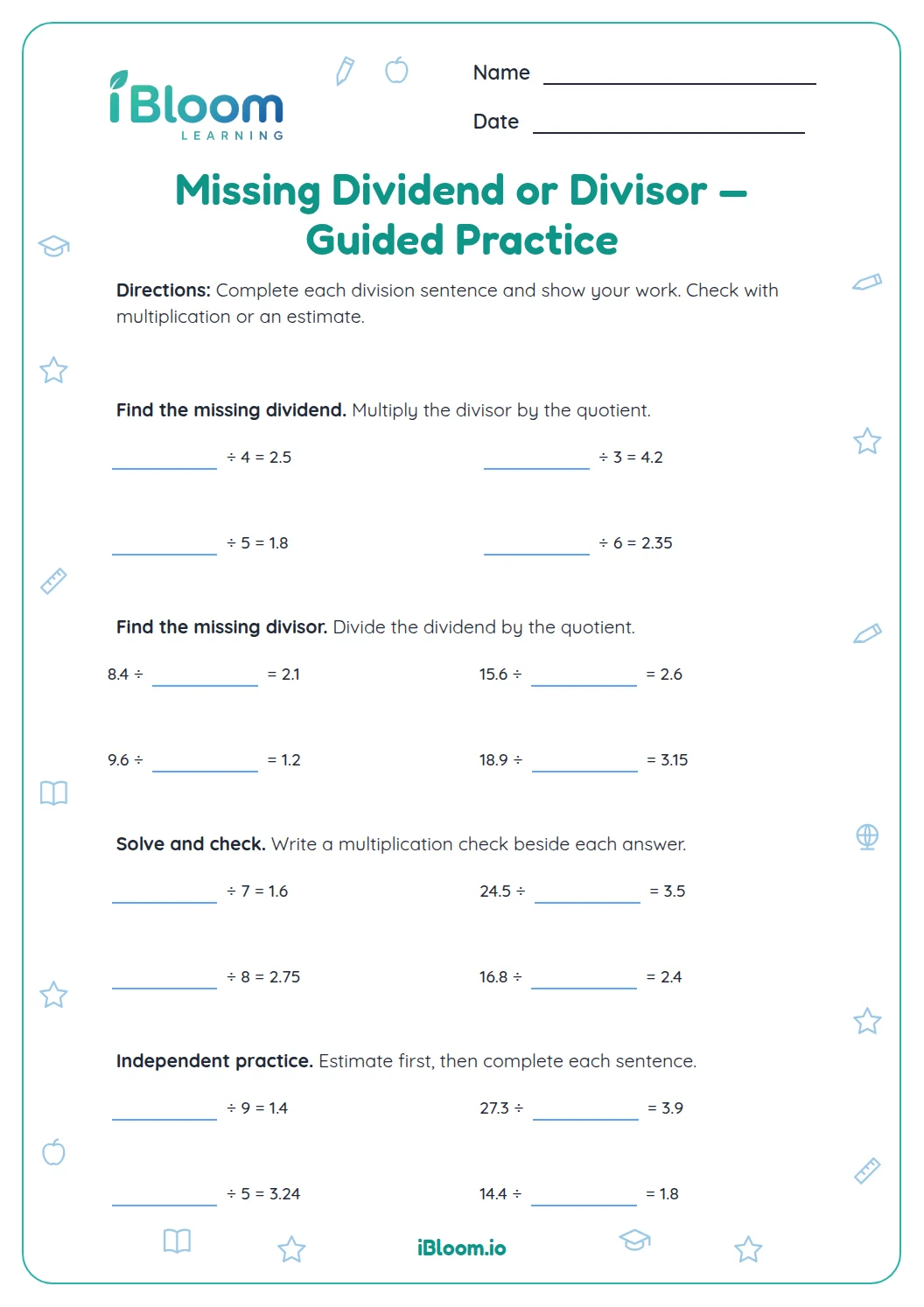
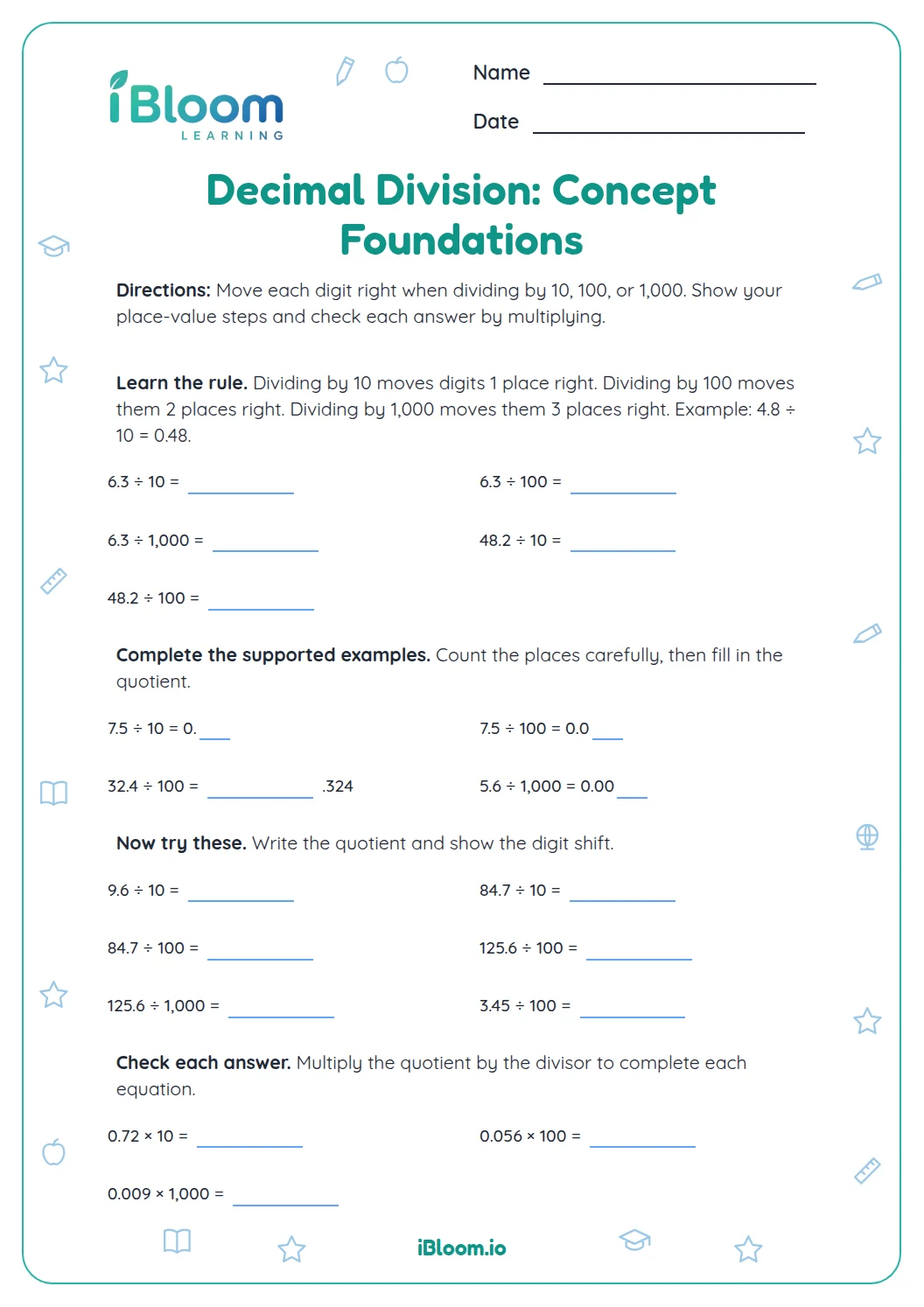
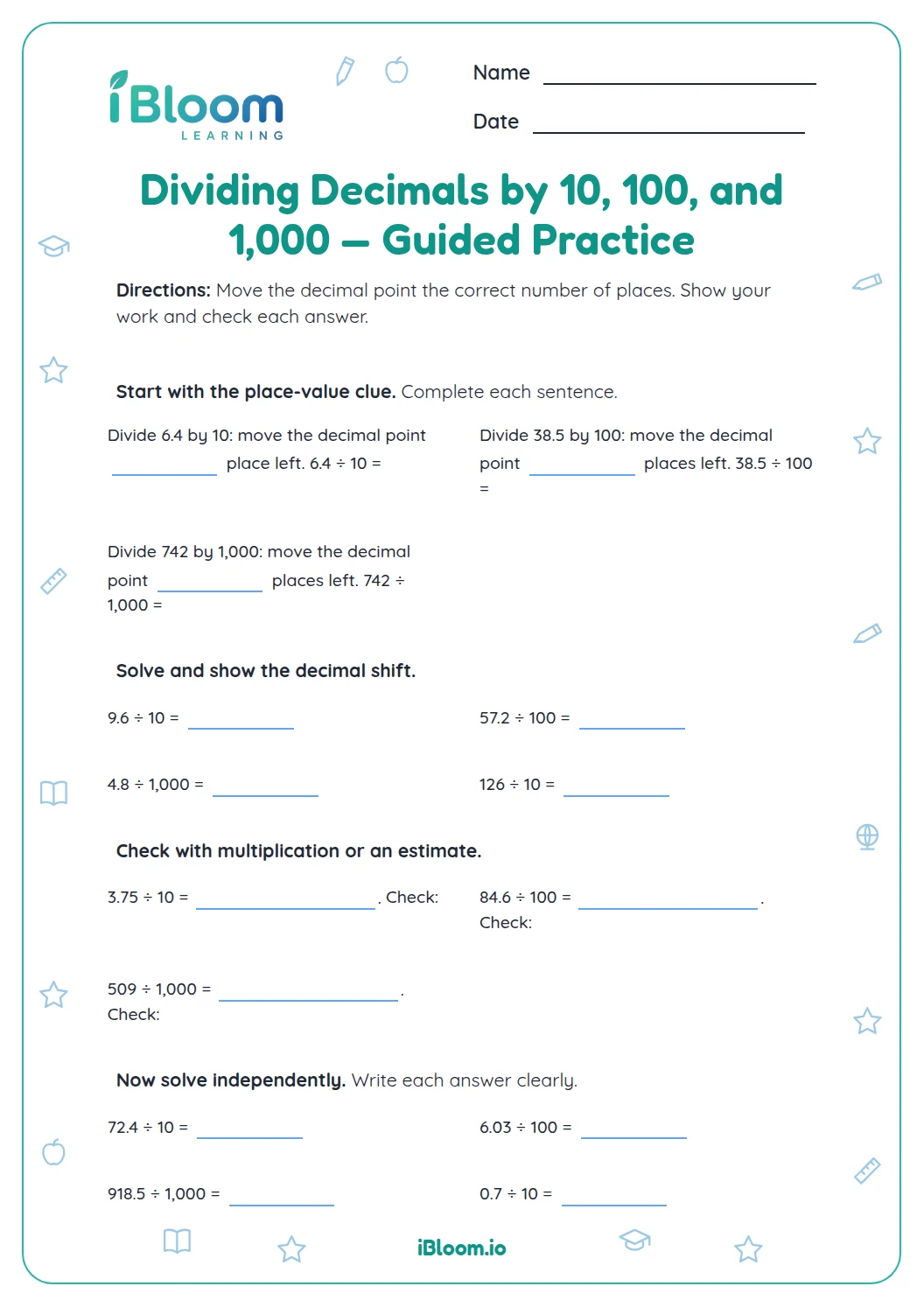
Students who are comfortable dividing decimals by whole numbers can try the linked missing-dividend and missing-divisor page, then decimal division by powers of ten. The decimal generator link can also create additional practice for home or class. Use multiplication to verify the quotient, then compare its size with the original amount.