
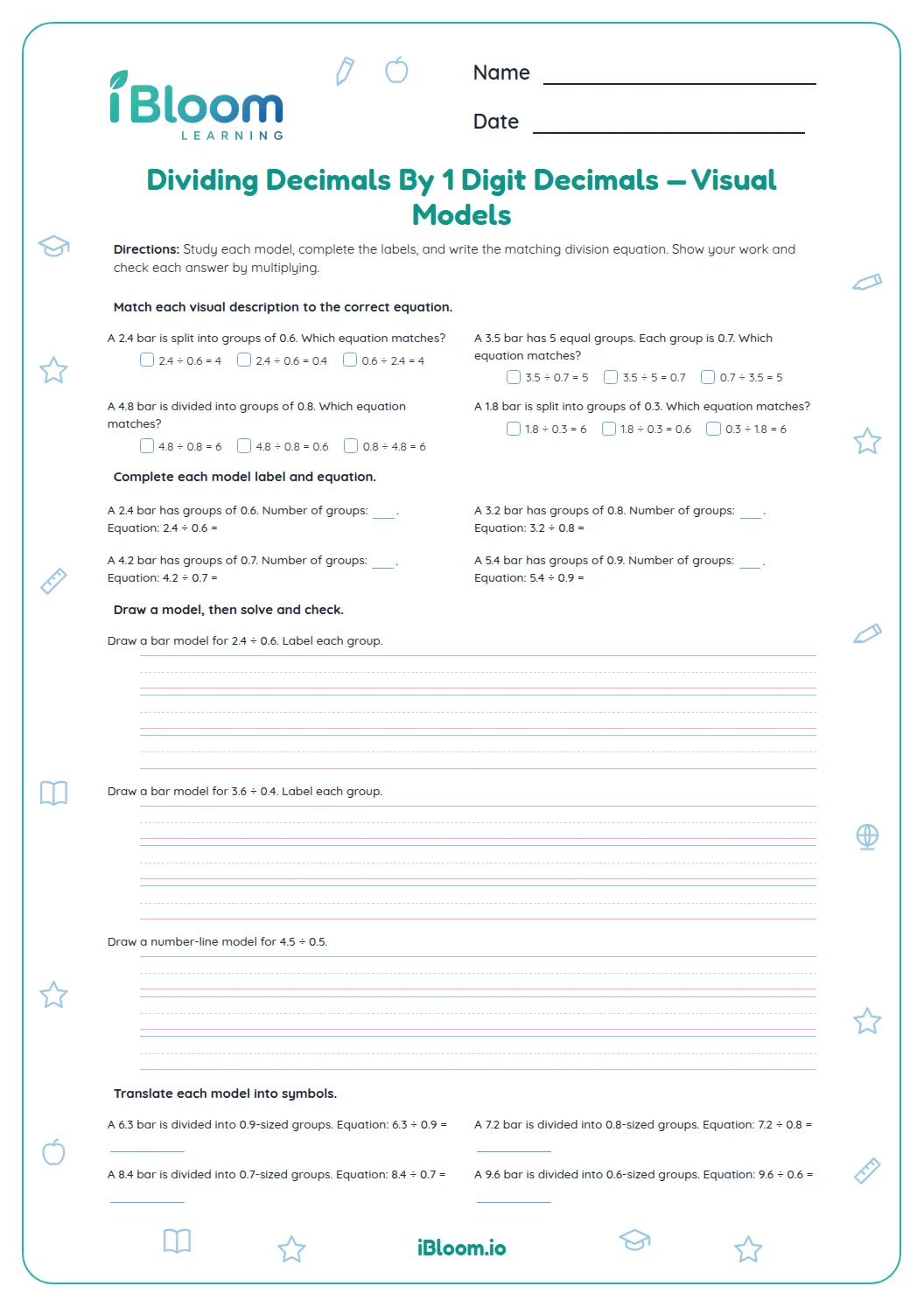

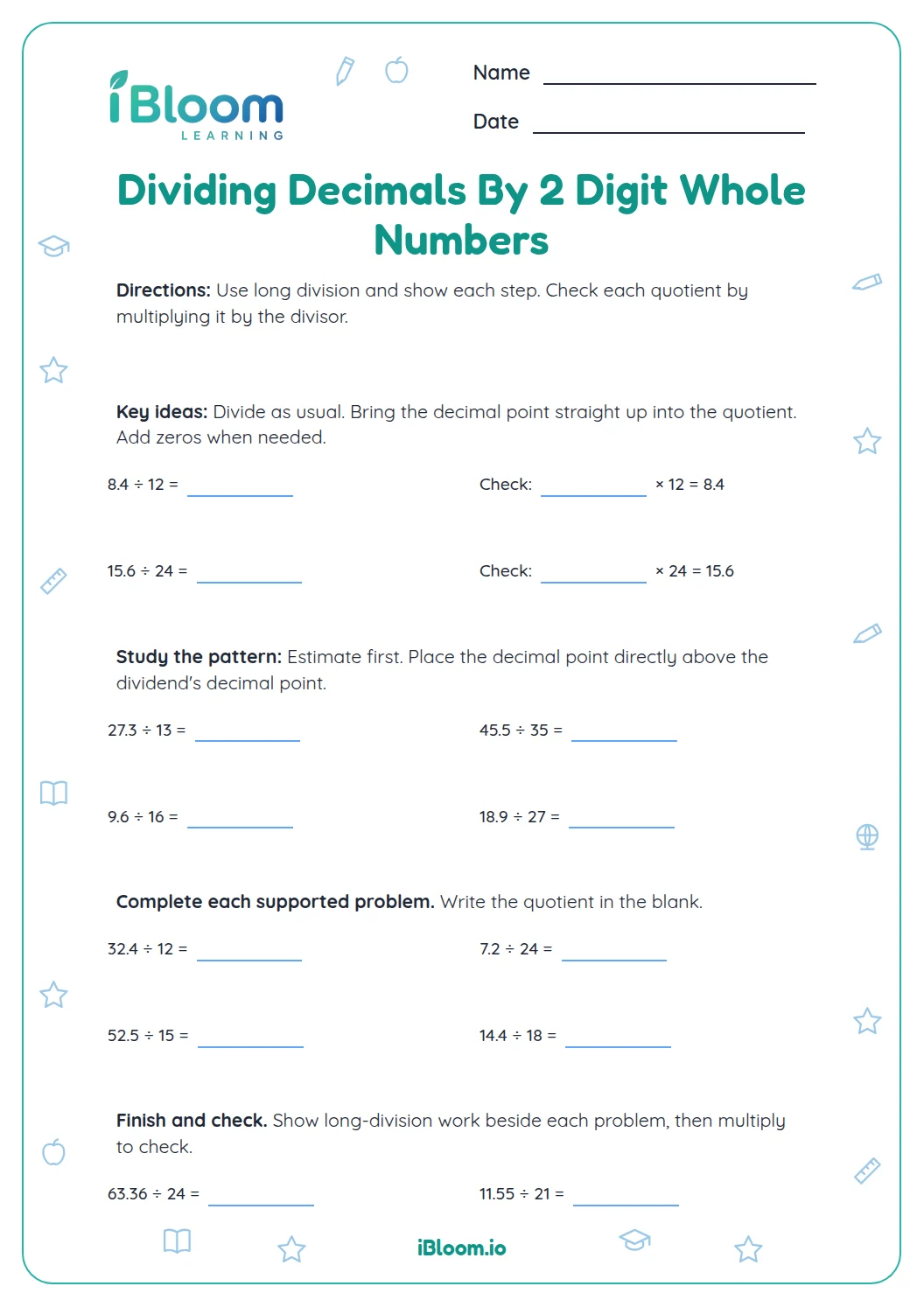

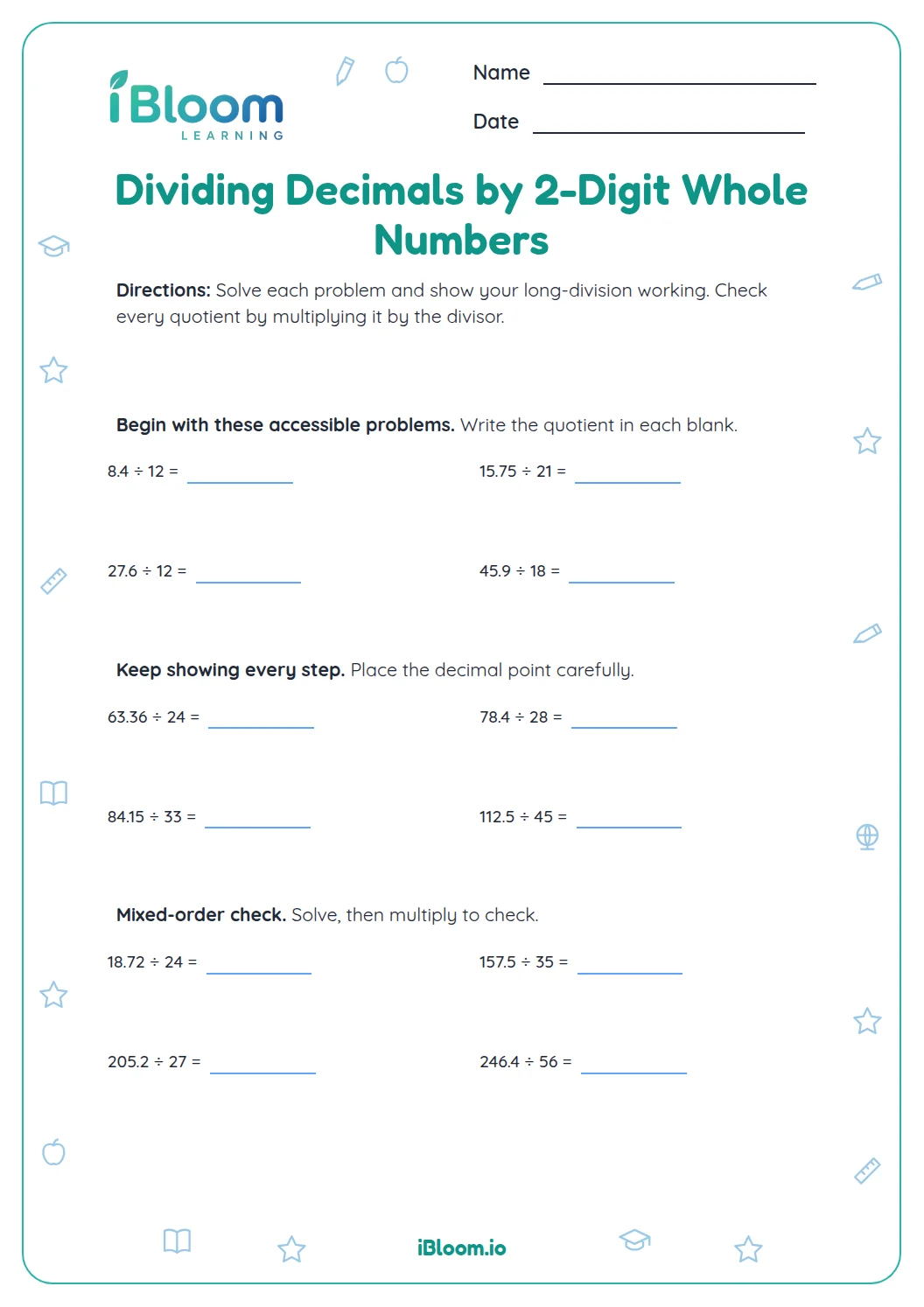
About this worksheet
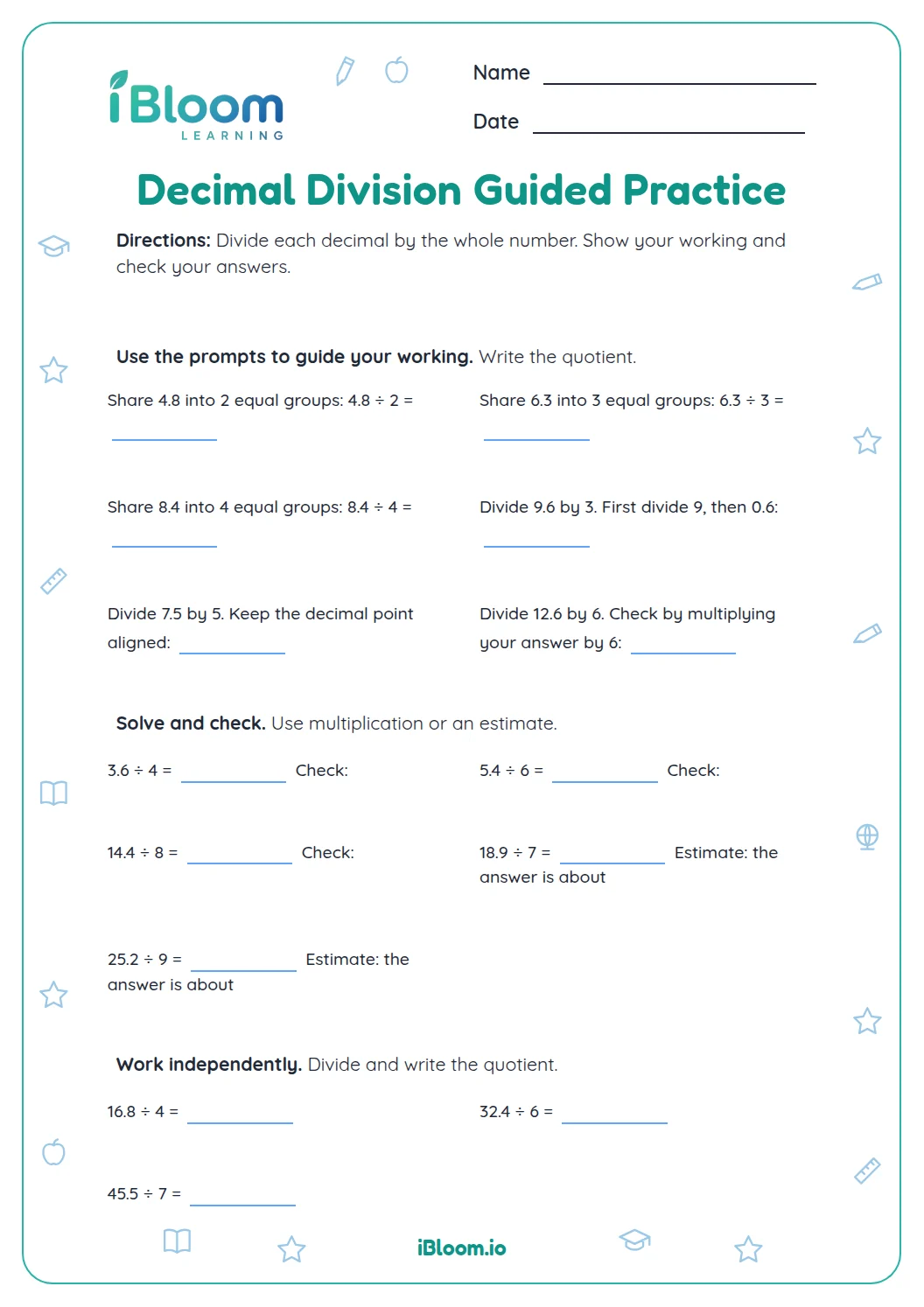
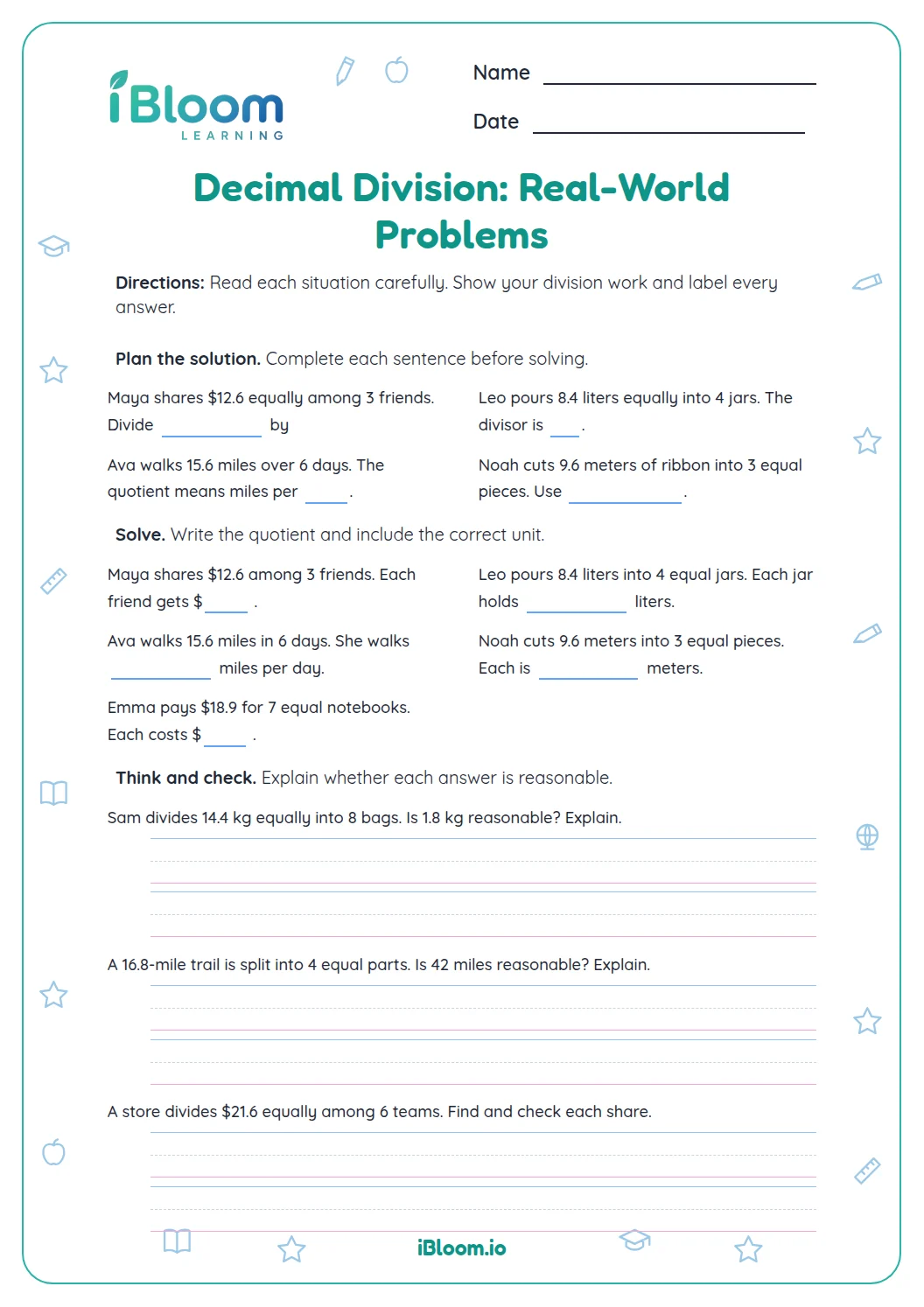
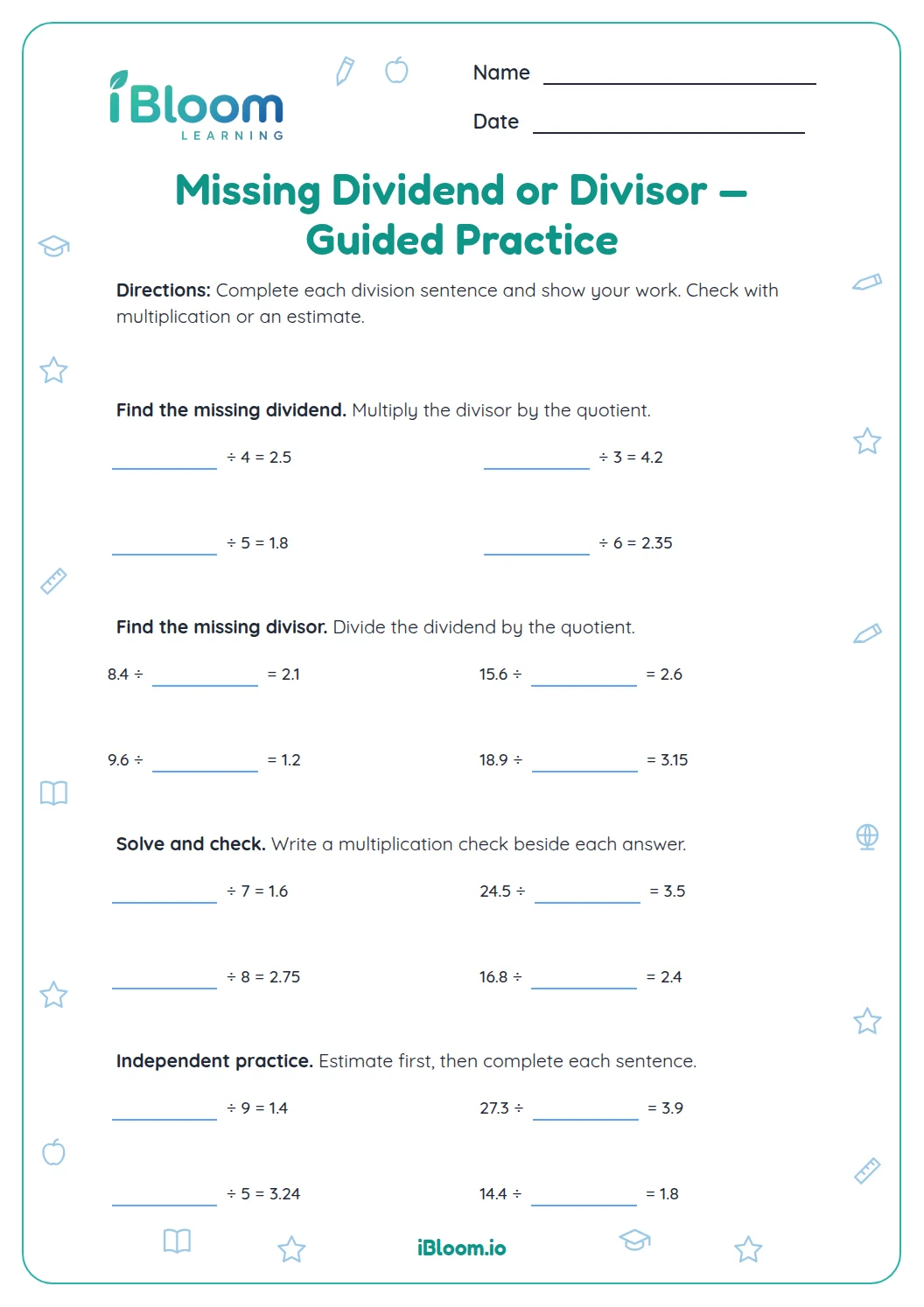
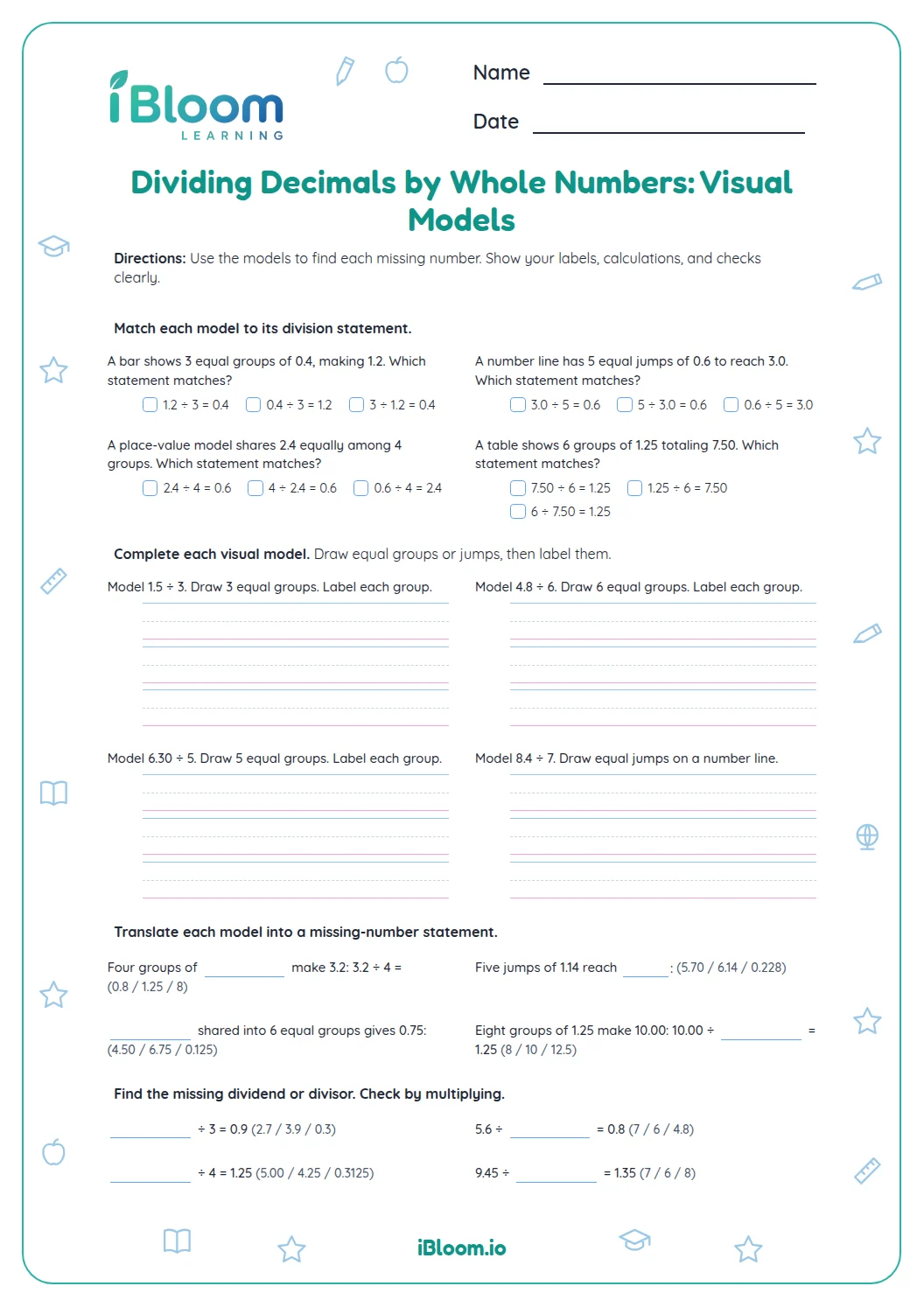
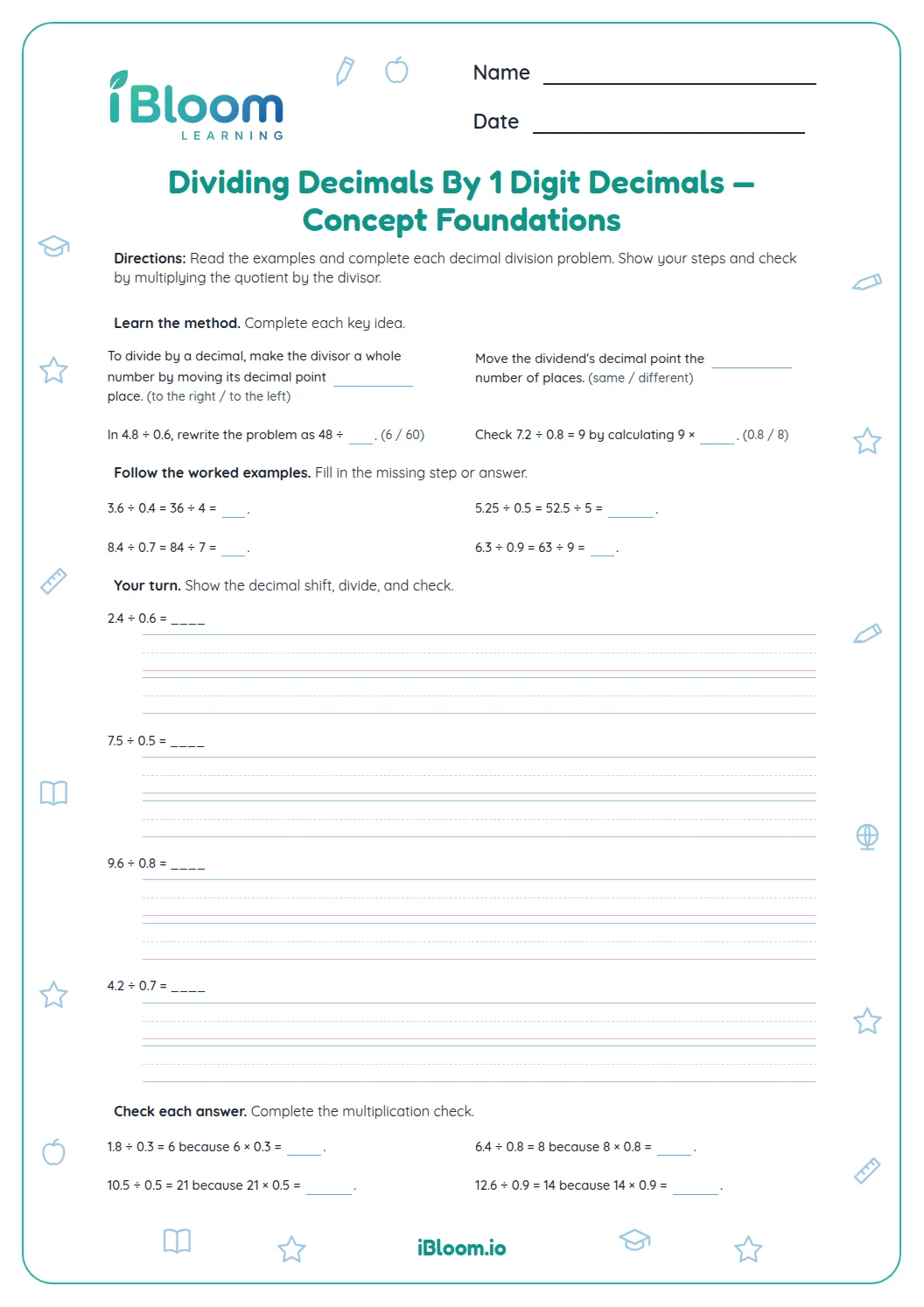
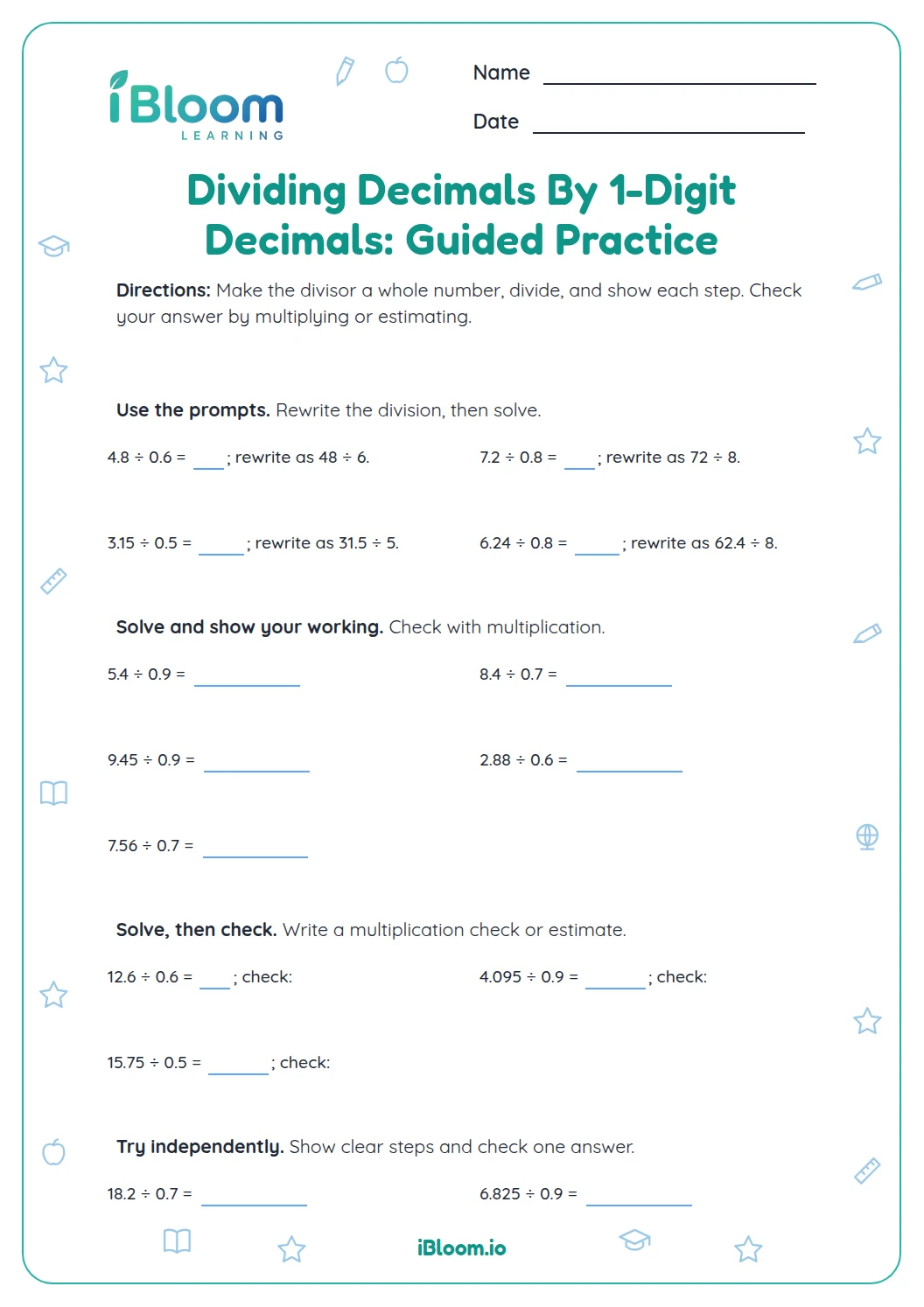
This free printable Grade 6 worksheet gives students independent practice dividing decimals by whole numbers. The first part uses tenths, the second works through hundredths, and the final two questions apply the same skill to equal lengths and amounts. Students can check each quotient by multiplying it by the divisor. A separate answer key makes it easy to review the 16 problems.
Aligned to 6.NS.B.3
Where does the decimal go in a quotient?
Divide the digits as you would with whole numbers, and place the decimal point in the quotient directly above the decimal point in the dividend. Bring down each digit in order.
For question 2, 6.3 ÷ 3: 6 ÷ 3 = 2, then bring down the 3 tenths. 3 tenths ÷ 3 = 1 tenth, so the quotient is 2.1. Check: 2.1 × 3 = 6.3.
- 16.3 ÷ 3
- 26 ÷ 3 = 2
- 33 tenths ÷ 3 = 1 tenth
- 4Quotient: 2.1
- 5Check: 2.1 × 3 = 6.3
How do you divide through hundredths?
Keep bringing down digits until every place in the dividend has been used. In 5.76 ÷ 4, divide 5, then 17 tenths, then 16 hundredths. The quotient is 1.44.
Use multiplication to check: 1.44 × 4 = 5.76. The six hundredths problems give practice with two decimal places and quotients that end in hundredths.
What is on the two-page worksheet?
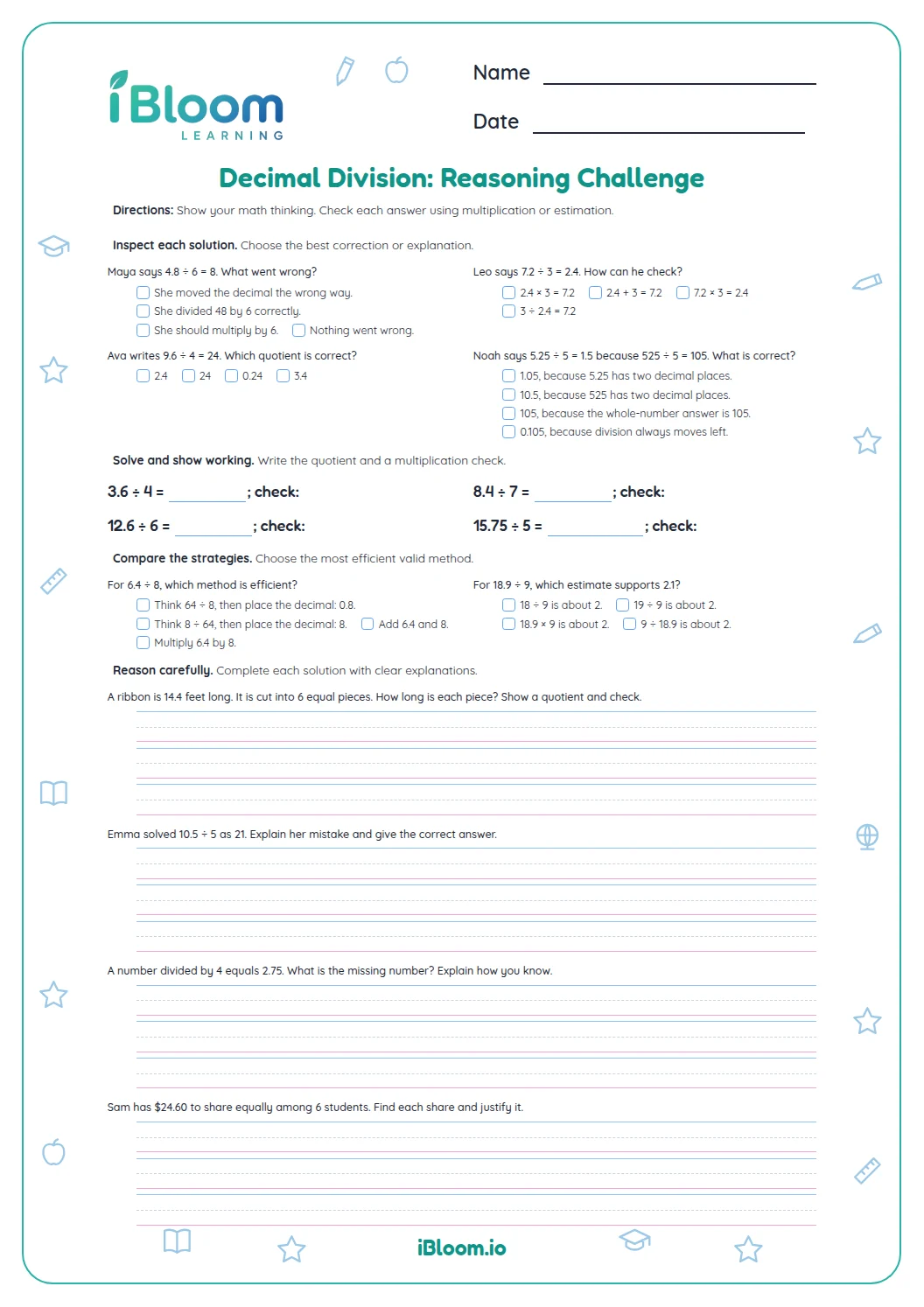
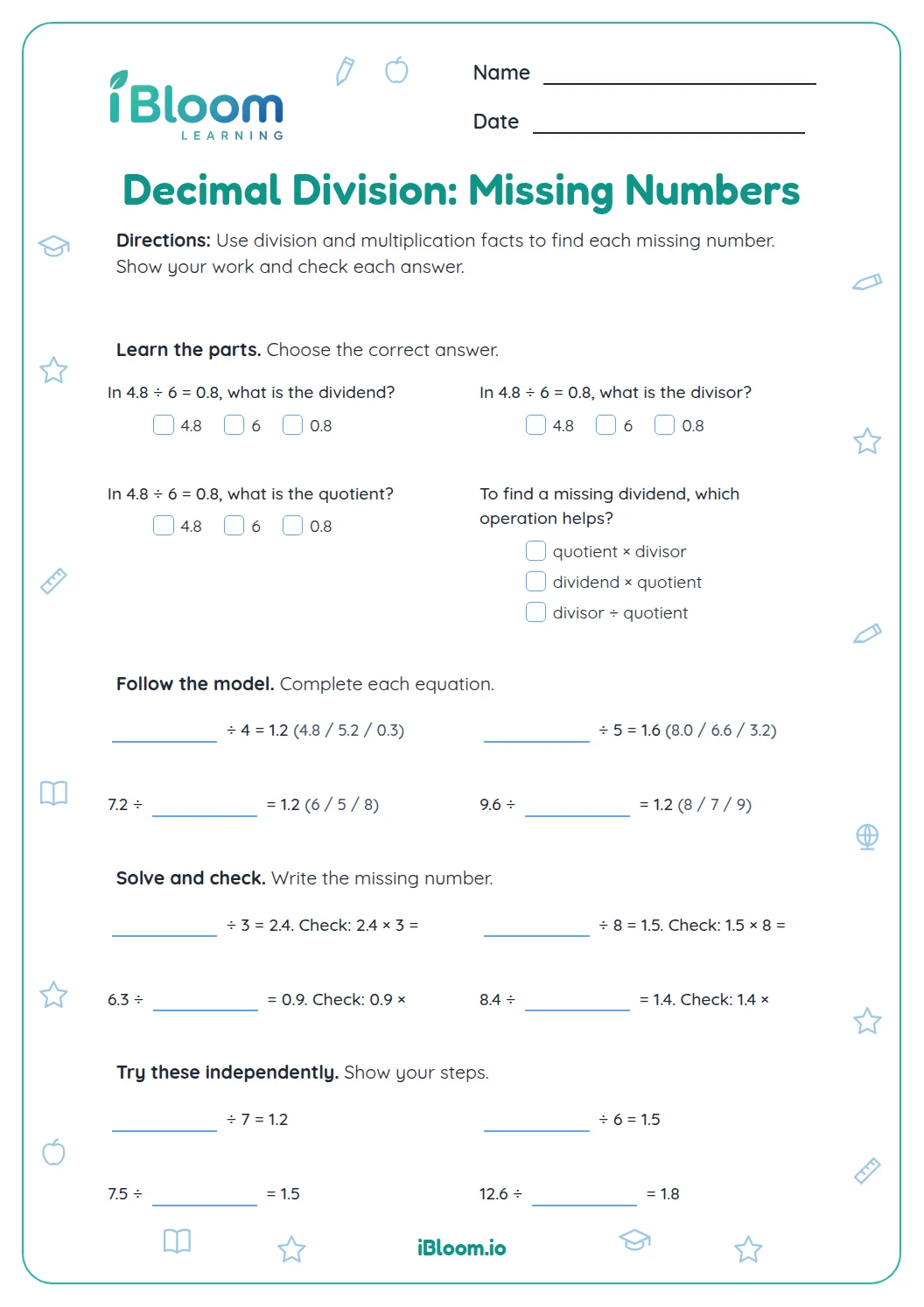
There are 16 questions in three parts. The first eight use tenths, the next six use hundredths, and the last two ask students to divide in a short real-world situation. The answer key is a separate page.
- Part A: 8 tenths problems
- Part B: 6 hundredths problems
- Part C: 2 equal-sharing word problems
How can students use this page?
- 1Read the divisor and dividend before starting each problem.
- 2Estimate whether the quotient should be greater or less than the dividend.
- 3Divide one place at a time and keep the decimal point aligned.
- 4For each hundredths problem, bring down both decimal digits.
- 5Write a division sentence for each context question.
- 6Check answers by multiplying the quotient by the divisor.
Decimal division mistakes to catch
The mistake
Putting the quotient decimal at the end of the answer.
The fix
Line it up with the decimal point in the dividend before dividing.
The mistake
Stopping after dividing the whole-number part.
The fix
Bring down every digit after the decimal point.
The mistake
Giving a quotient larger than the dividend when dividing by a whole number greater than 1.
The fix
Estimate first: sharing into several groups should make each share smaller.
Curriculum alignment
This practice focuses on decimal division using standard written steps.
Divide multi-digit decimals by whole numbers using the standard algorithm.
On this sheet: Fourteen computation items and two equal-sharing problems divide decimals by whole numbers.
Show the official wordingHide the official wording
Fluently add, subtract, multiply, and divide multi-digit decimals using the standard algorithm for each operation.
What to practice next
Make more practice
Further reading
Questions parents and teachers ask
How can a student check a decimal quotient?
Multiply the quotient by the whole-number divisor and compare the product with the dividend. For question 2, 2.1 × 3 = 6.3, so the quotient checks. If the product differs, revisit the division and decimal place. This reverse operation checks the answer.
Why does the quotient decimal line up with the dividend?
The decimal point separates whole-number places from decimal places in both numbers. In 6.3 ÷ 3, six ones make two ones, and three tenths make one tenth. Keeping the decimal in line helps preserve that place-value meaning. The decimal does not move during division.
What is 5.76 divided by 4?
The quotient is 1.44. Four groups of 1.44 make 5.76, so multiplication checks the result. This is question 9, the first hundredths problem on the sheet. This quotient can be checked by multiplying back: 1.44 × 4 equals 5.76 exactly.
What do the word problems ask students to divide?
Question 15 shares 12.6 meters of ribbon equally among 6 pieces, giving 2.1 meters per piece. Question 16 shares 7.56 liters among 4 bottles, giving 1.89 liters per bottle. Both use decimal division by a whole number. Both answers include their measurement units.
How many questions and pages are included?
There are 16 questions: eight tenths quotients, six hundredths quotients, and two equal-sharing problems. The answer key is printed separately. Students can use multiplication to check each quotient, including the answers with units. The answer key follows the two pages of practice.
Should students estimate before dividing?
Yes. An estimate helps catch a misplaced decimal or an unreasonable quotient. Each divisor on this sheet is greater than 1, so the quotient should be smaller than the starting amount. For example, 8.4 ÷ 4 should be a little over 2.