
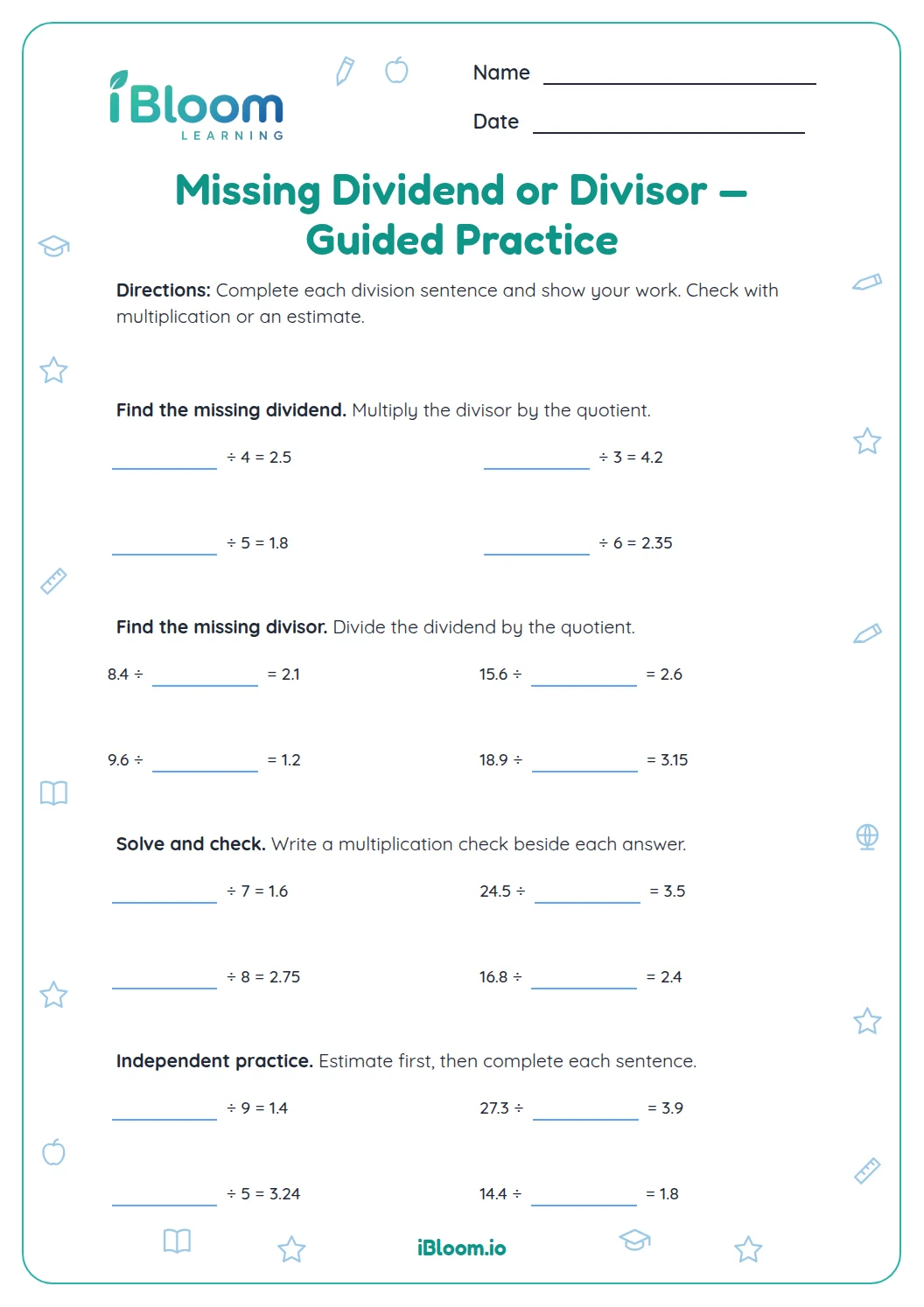
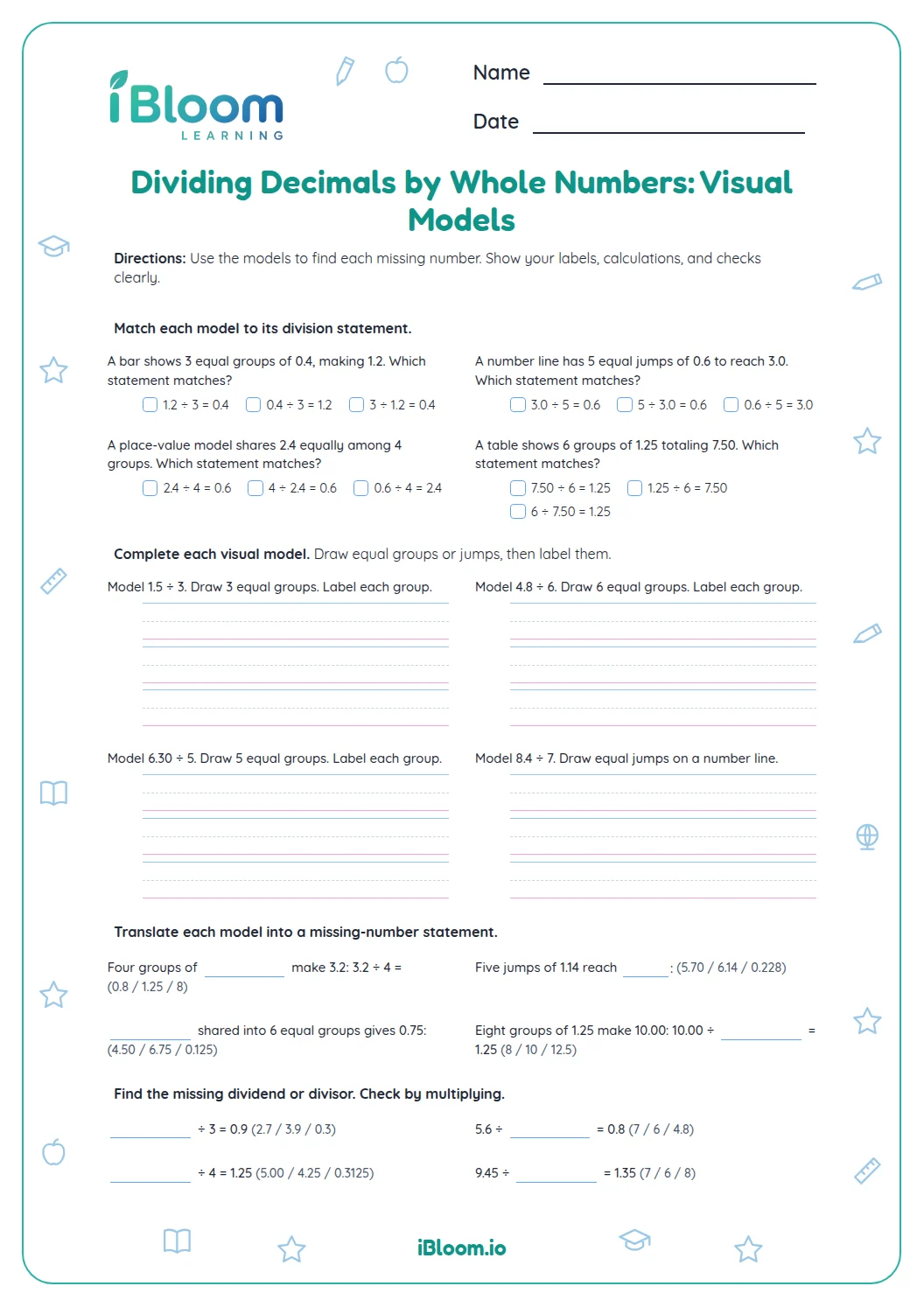
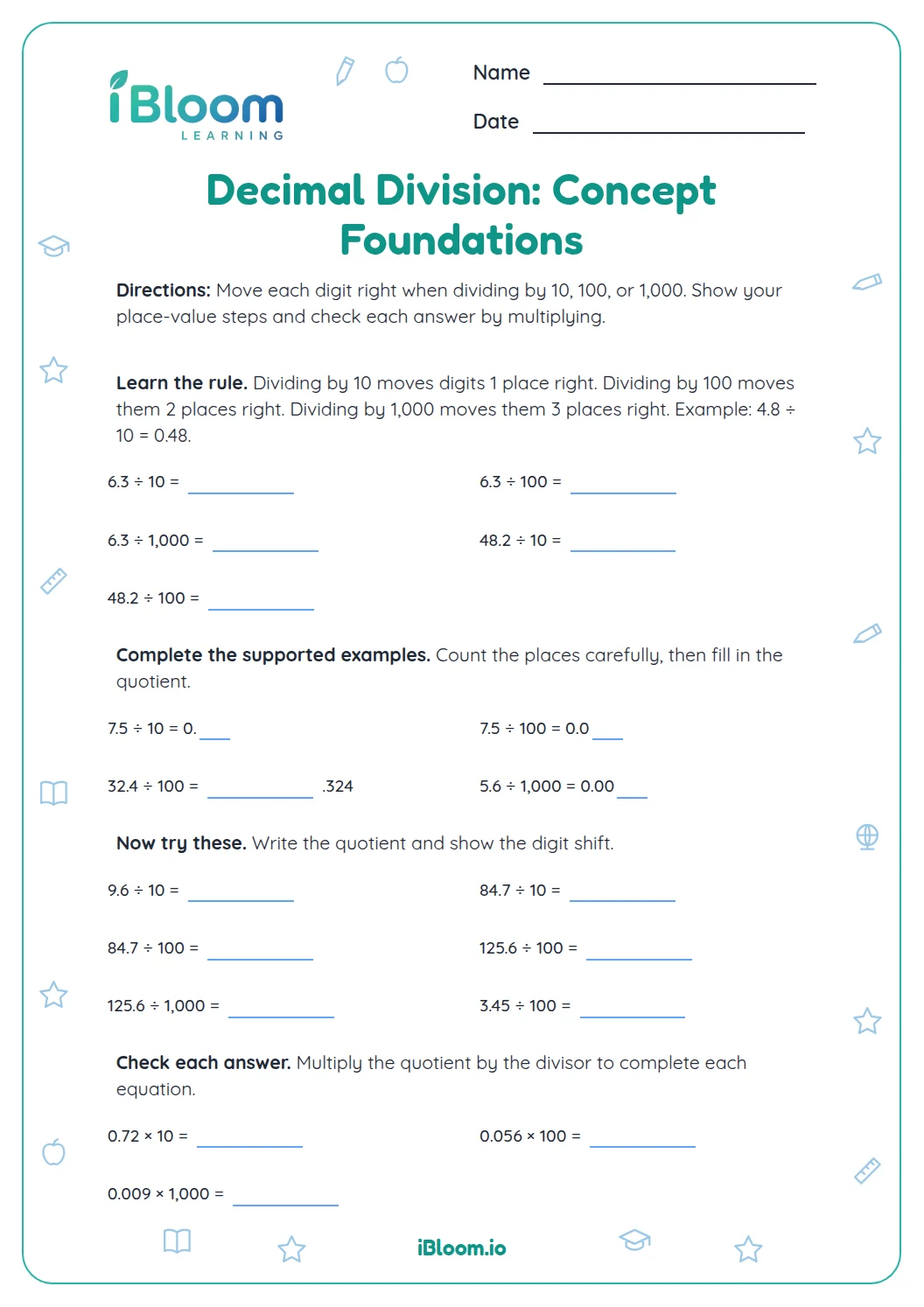
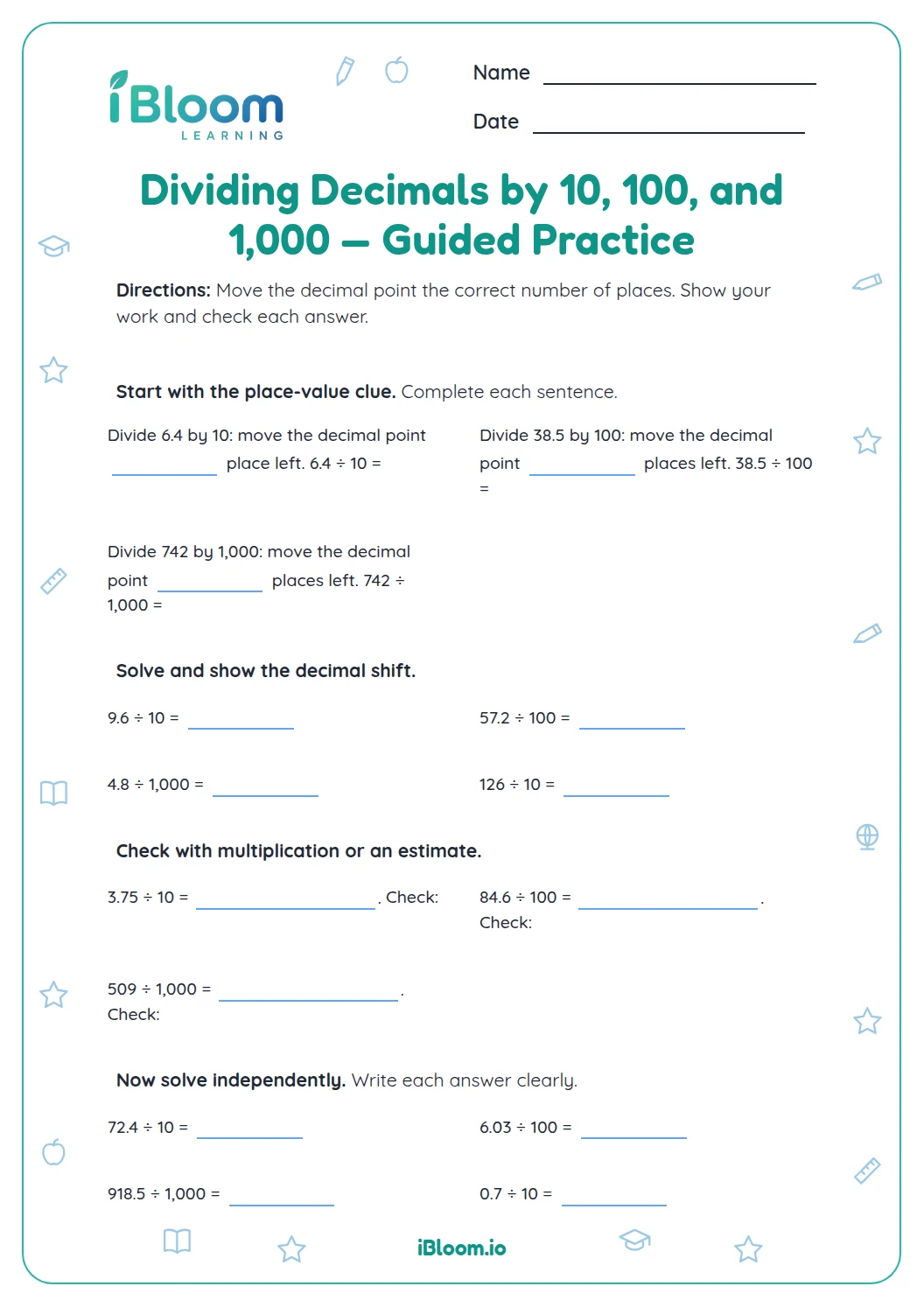
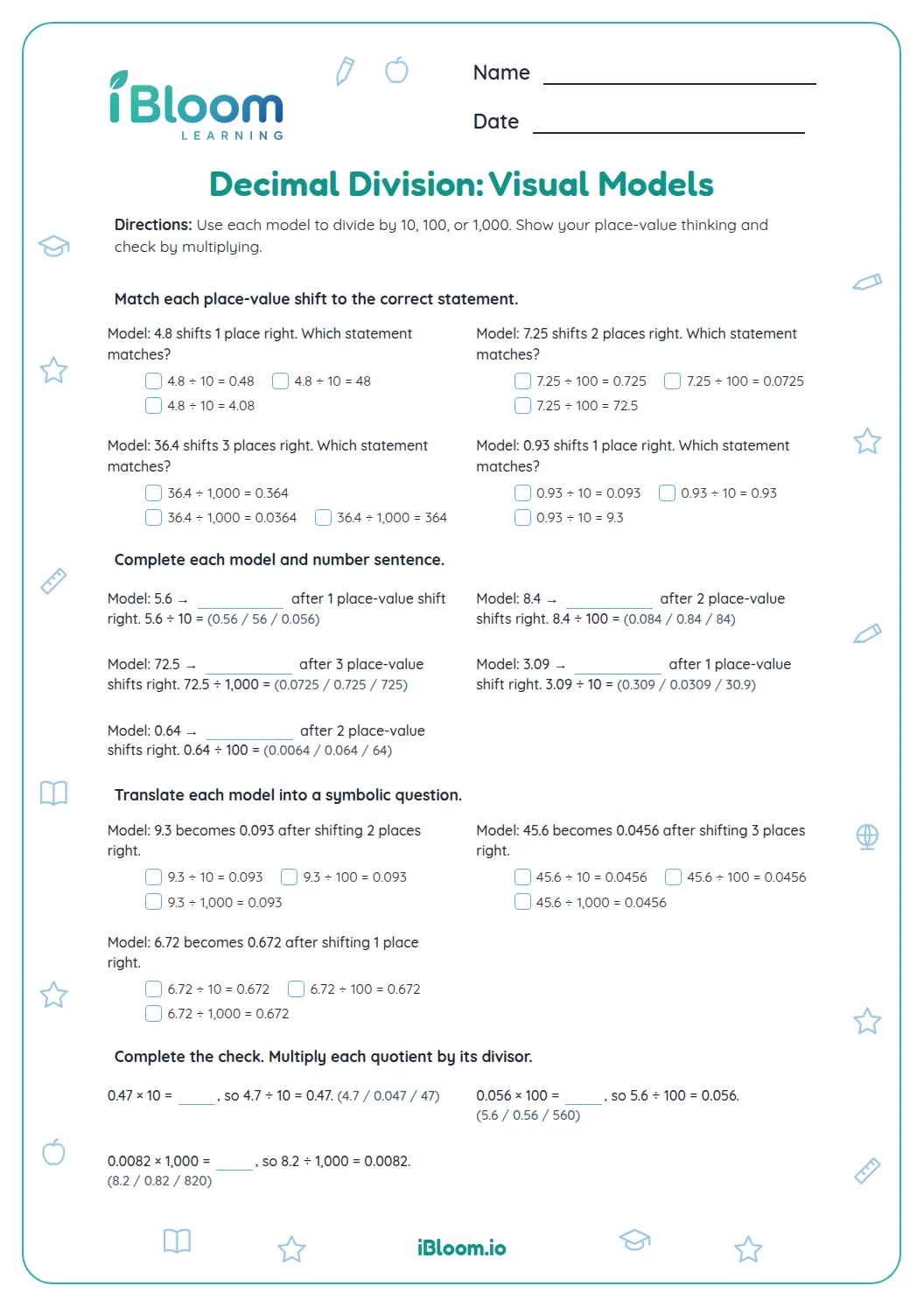
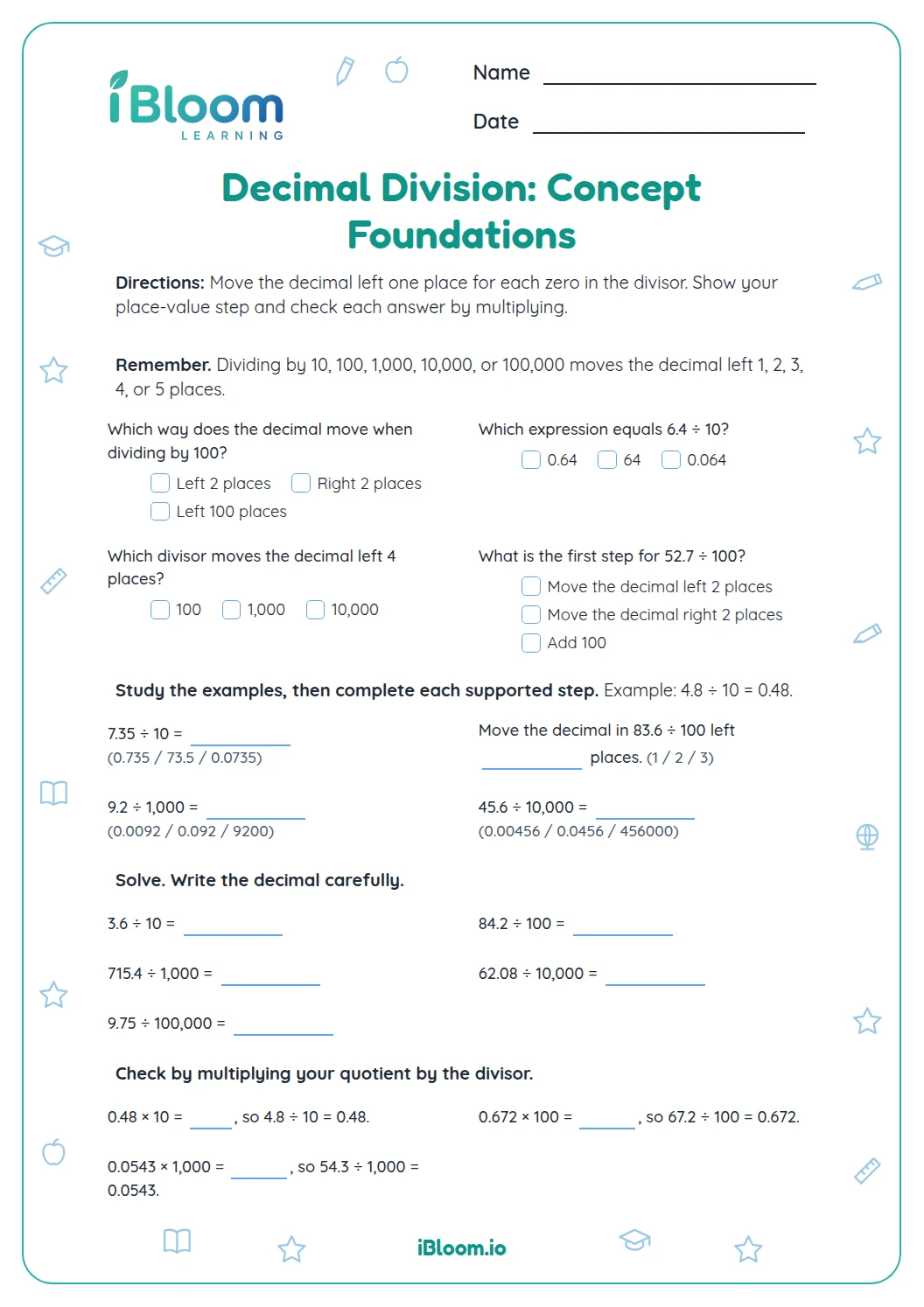
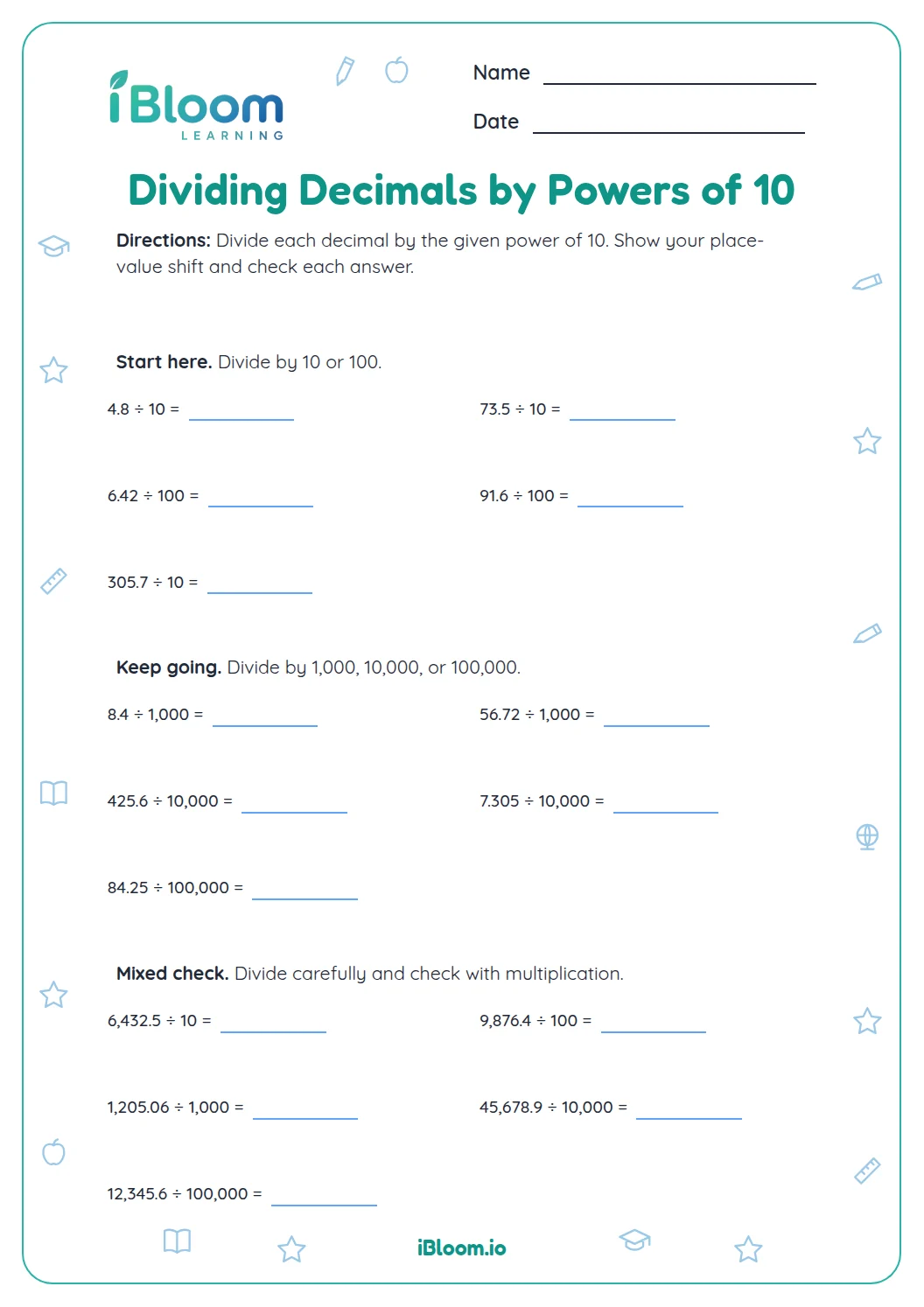
About this worksheet
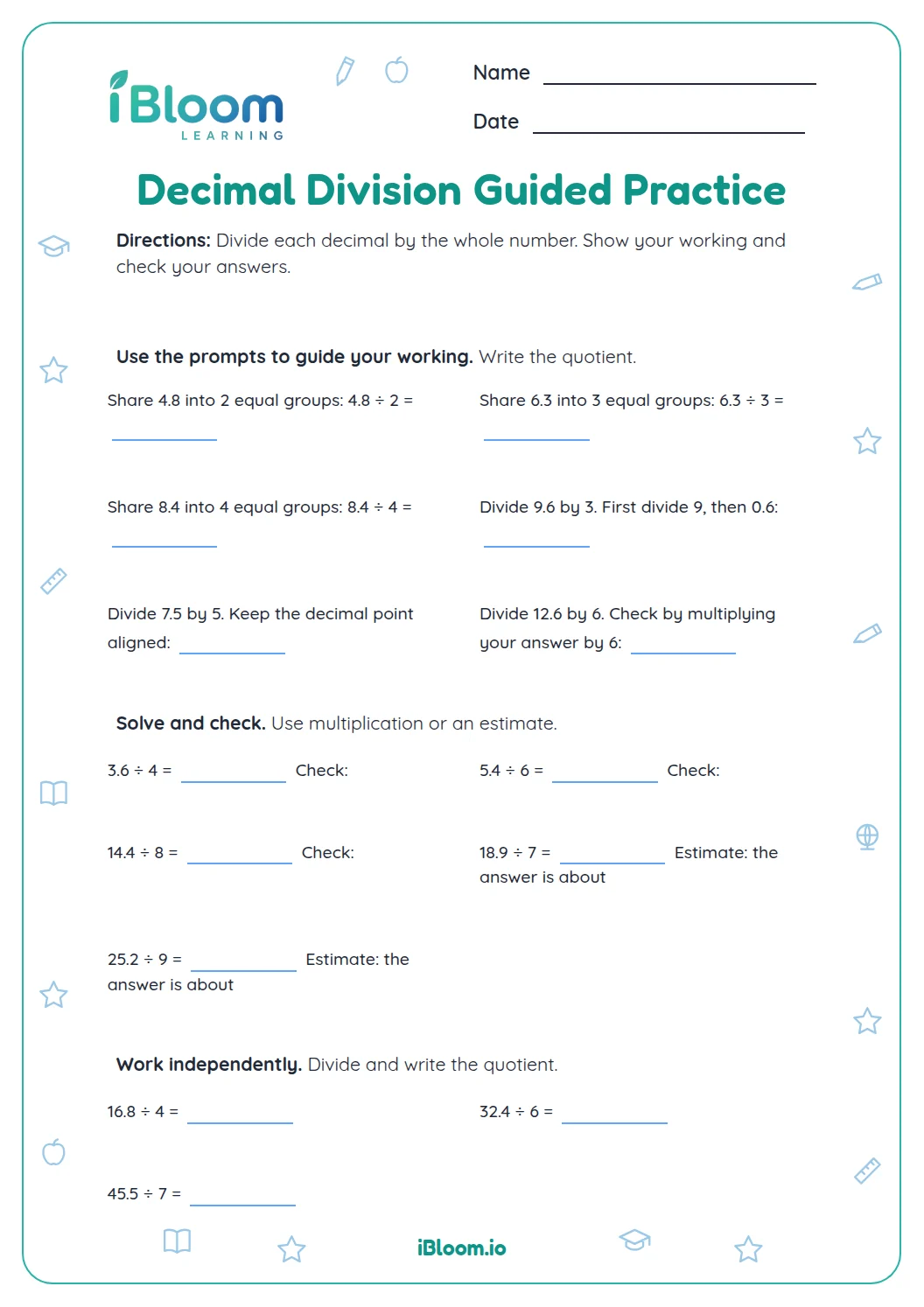
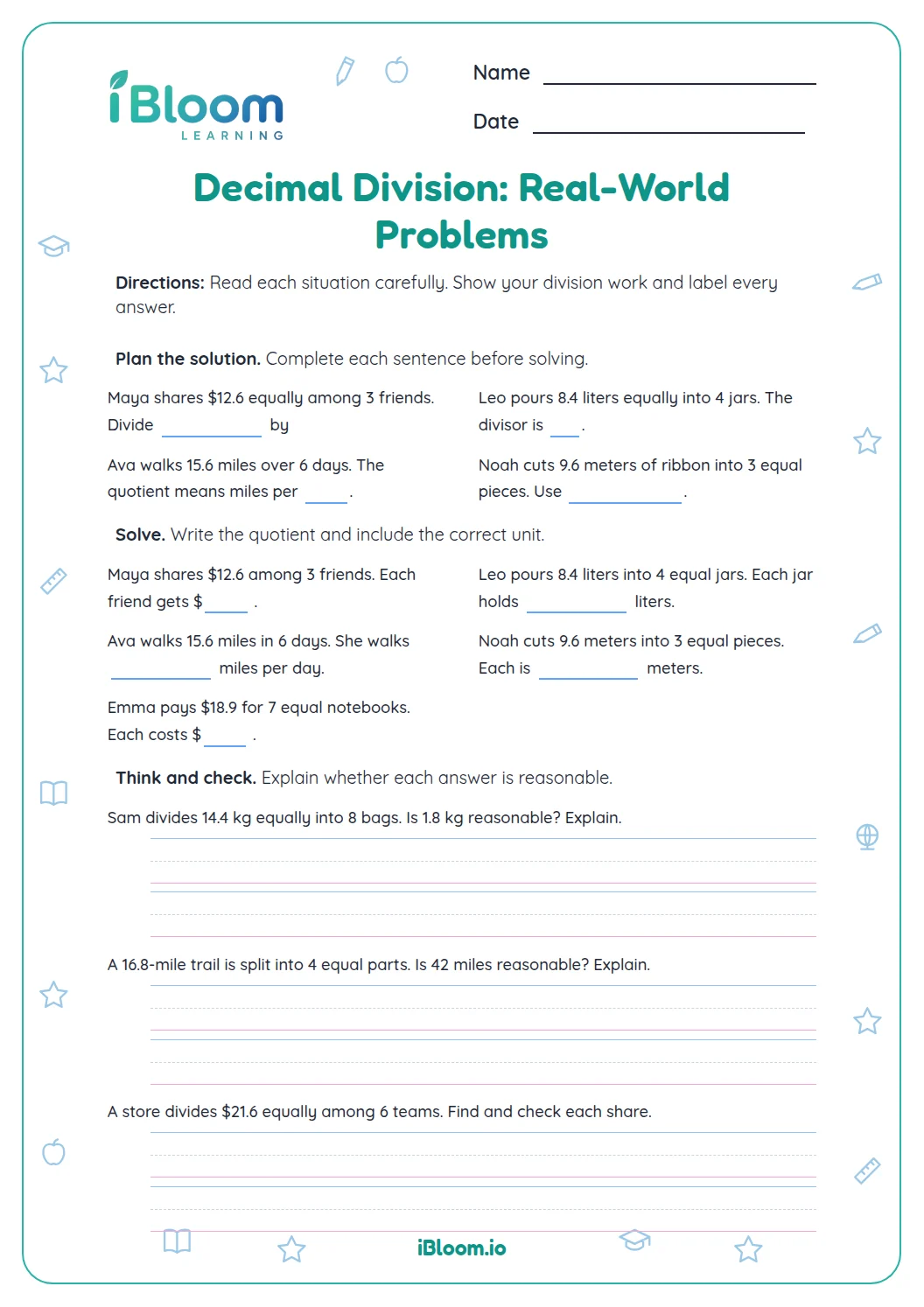
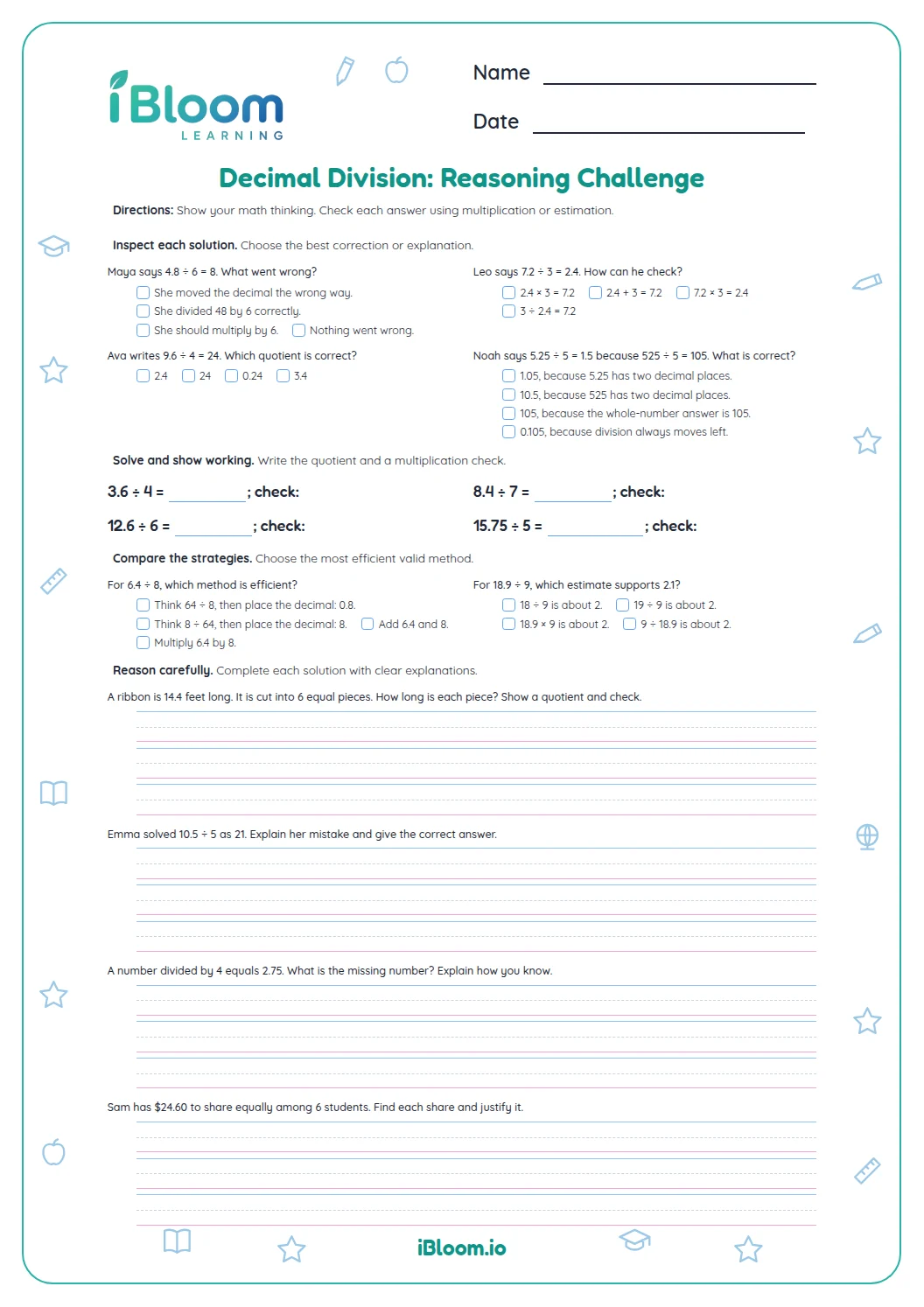
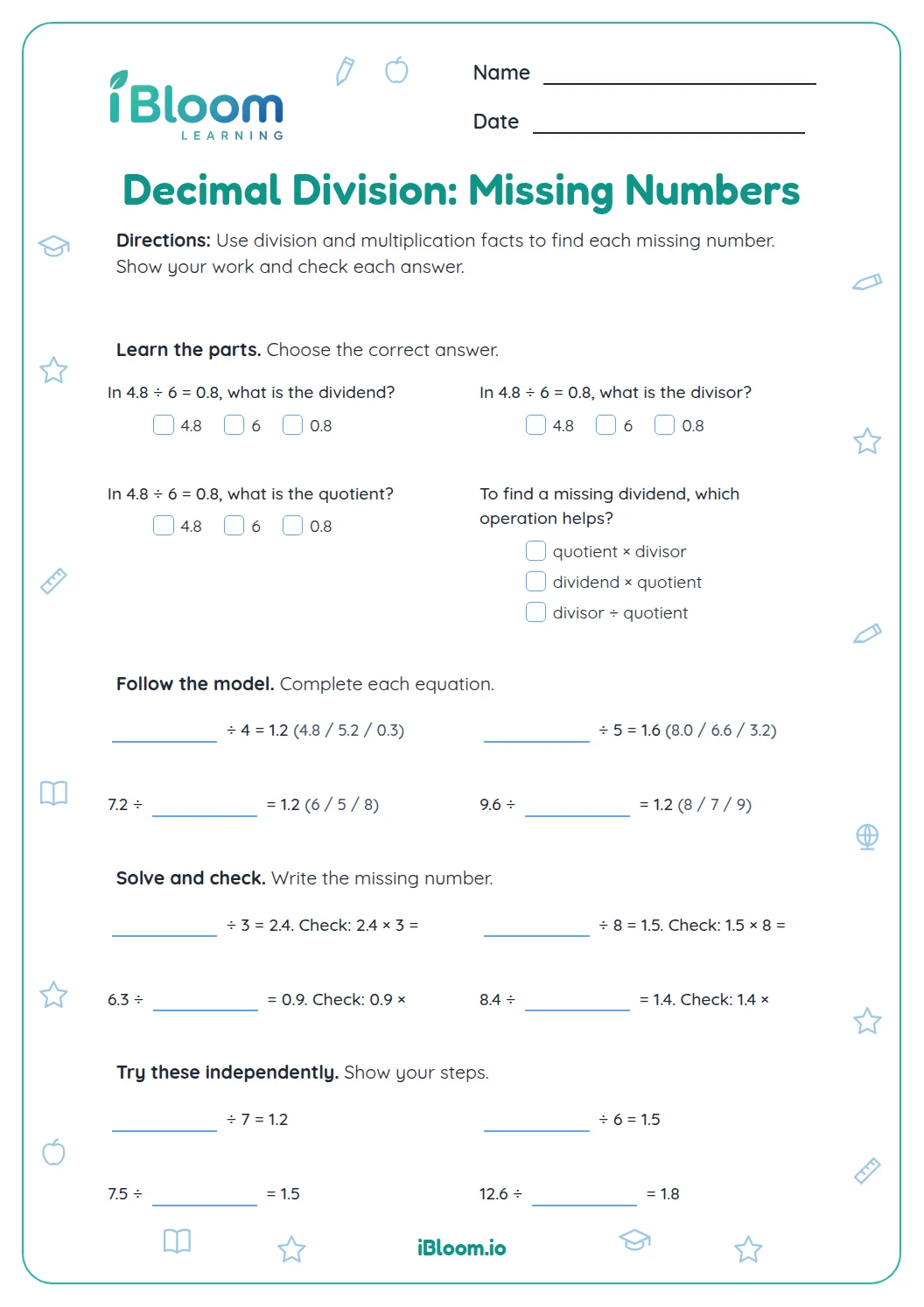
This Grade 6 printable introduces division of decimals by whole numbers through notation, quotient facts, and multiplication checks. Learners identify the divisor and dividend, connect 4.8 ÷ 6 with 48 ÷ 6, solve decimal quotients, and verify two calculations by multiplication. The 14 questions span four parts across two worksheet pages, with a separate two-page answer key. The work practices Common Core 6.NS.B.3 using the standard algorithm to divide decimal numbers.
Aligned to 6.NS.B.3
How can learners work through dividing decimal numbers by whole numbers?
This Grade 6 printable introduces division of decimals by whole numbers through notation, quotient facts, and multiplication checks. Learners identify the divisor and dividend, connect 4.8 ÷ 6 with 48 ÷ 6, solve decimal quotients, and verify two calculations by multiplication. The 14 questions span four parts across two worksheet pages, with a separate two-page answer key. The work practices Common Core 6.NS.B.3 using the standard algorithm to divide decimal numbers.
For example, Solve 6.3 ÷ 7. Show your steps and check. The result is 0.9; check: 0.9 × 7 = 6.3.
- 1Solve 6.3 ÷ 7. Show your steps and check.
- 20.9; check: 0.9 × 7 = 6.3
What is included in this dividing decimal numbers by whole numbers sheet?
The worksheet has 14 questions arranged in short parts. The separate answer key provides an answer for each item.
- Read the division
- Divide tenths
- Divide larger decimals
- Show and check
How can an adult support practice?
Learners divide decimal numbers by whole numbers and check quotients by multiplication. The worksheet starts with the meanings of dividend and divisor, then practices decimal quotients such as 4.8 ÷ 6 and 12.6 ÷ 7. Multiply the quotient by the divisor. For 6.3 ÷ 7 = 0.9, check 0.9 × 7 = 6.3. If the product does not match the dividend, revisit the division.
How to use this worksheet
- 1Identify the dividend and divisor in each division expression.
- 2Use an equivalent whole-number fact when the dividend is in tenths.
- 3Place the quotient decimal point above the dividend’s decimal point.
- 4Solve each quotient and include any needed tenths or ones.
- 5Multiply the quotient by the divisor to check the final problems.
Common mistakes and quick fixes
The mistake
Calling the dividend the divisor.
The fix
The dividend is the amount being divided; the divisor tells how many groups or the group size.
The mistake
Dropping the decimal point in the quotient.
The fix
Line up the quotient decimal point above the dividend’s decimal point.
The mistake
Checking by adding instead of multiplying.
The fix
Multiply quotient × divisor and see whether it returns the dividend.
Common Core alignment
This worksheet practices 6.NS.B.3 through divide multi-digit decimals by whole numbers using place value and check quotients by multiplication.
Divide decimal numbers by whole numbers and check the quotient.
On this sheet: Questions ask learners to divide multi-digit decimals by whole numbers using place value and check quotients by multiplication.
Show the official wordingHide the official wording
Fluently add, subtract, multiply, and divide multi-digit decimals using the standard algorithm for each operation.
What to practice next
Make more practice
Questions parents and teachers ask
What is the main skill on this decimal worksheet?
Learners divide decimal numbers by whole numbers and check quotients by multiplication. The worksheet starts with the meanings of dividend and divisor, then practices decimal quotients such as 4.8 ÷ 6 and 12.6 ÷ 7. The examples use one-digit whole-number divisors throughout the page.
Where does the quotient decimal point go?
Place it directly above the decimal point in the dividend. For example, when dividing 4.8 by 6, use the equivalent fact 48 ÷ 6 = 8 tenths, so the quotient is 0.8. This equal quotient is eight tenths, written as 0.8.
How can learners check a decimal quotient?
Multiply the quotient by the divisor. For 6.3 ÷ 7 = 0.9, check 0.9 × 7 = 6.3. If the product does not match the dividend, revisit the division. The final two questions leave room to show both the quotient and check.
What does the answer key include?
The separate answer key gives the selected responses, quotient values, and multiplication checks for the worksheet. Encourage learners to compare the placement of the decimal point as well as the digits. Each keyed check multiplies the quotient by its original divisor.
How long does this practice take?
About 25 minutes is a reasonable estimate for the four parts. The notation questions are brief; allow more time for the final problems, where learners show division steps and a multiplication check. The page moves from identifying terms to solving and verifying quotients.