


About this worksheet
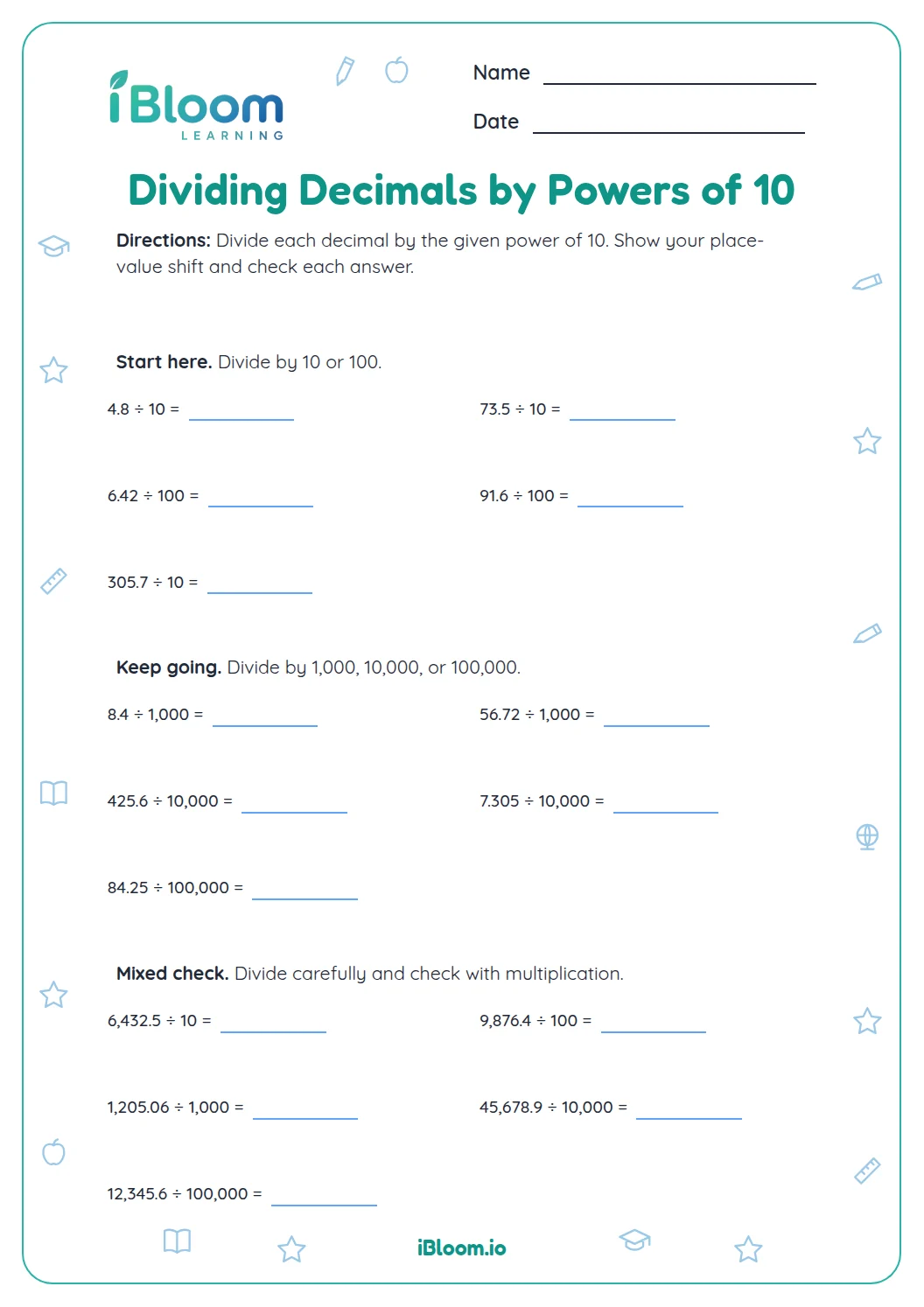
This free printable worksheet gives Grade 6 students independent practice dividing decimals by 10, 100 and 1,000. Part A has six problems that divide by 10, and Part B has six that divide by 100 and 1,000, two of them written as 10² and 10³, where zeros must fill empty places, as in 9.4 ÷ 100 = 0.094. Part C asks for a missing divisor or dividend, and Part D has three word problems with working space. It practices Common Core 5.NBT.A.2. A separate answer key is included.
Aligned to 5.NBT.A.2
Why does the decimal point move when you divide by 10?
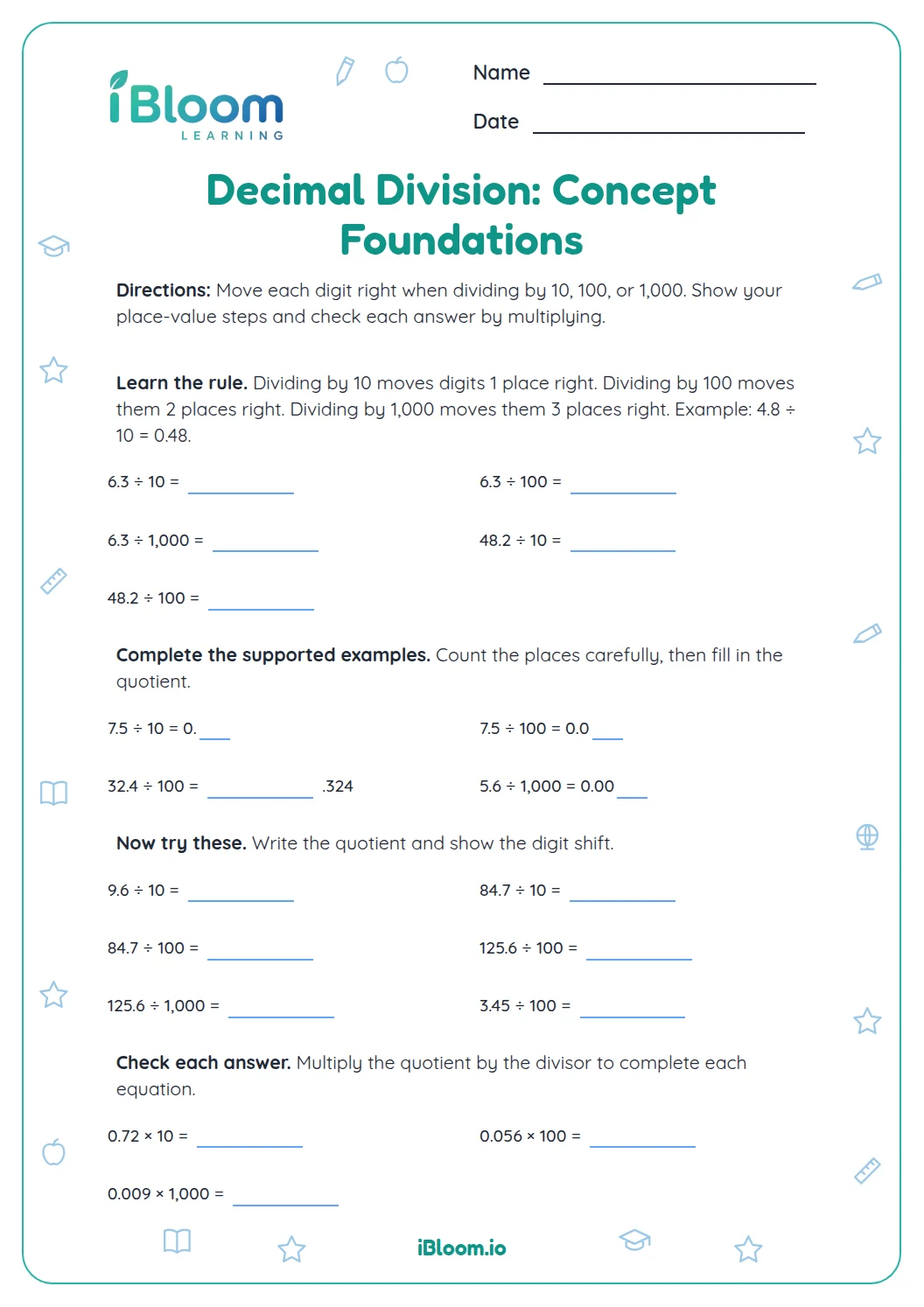
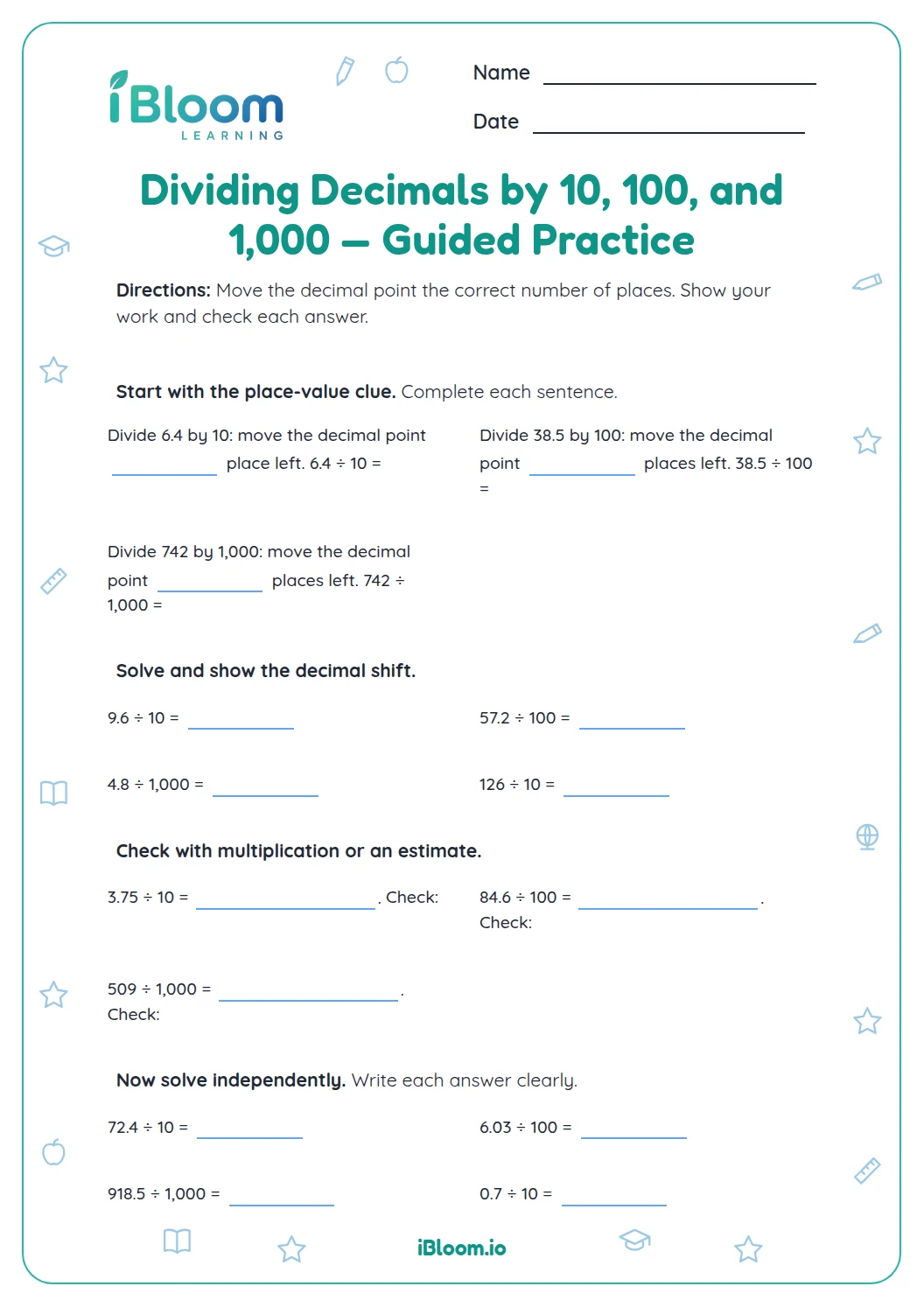
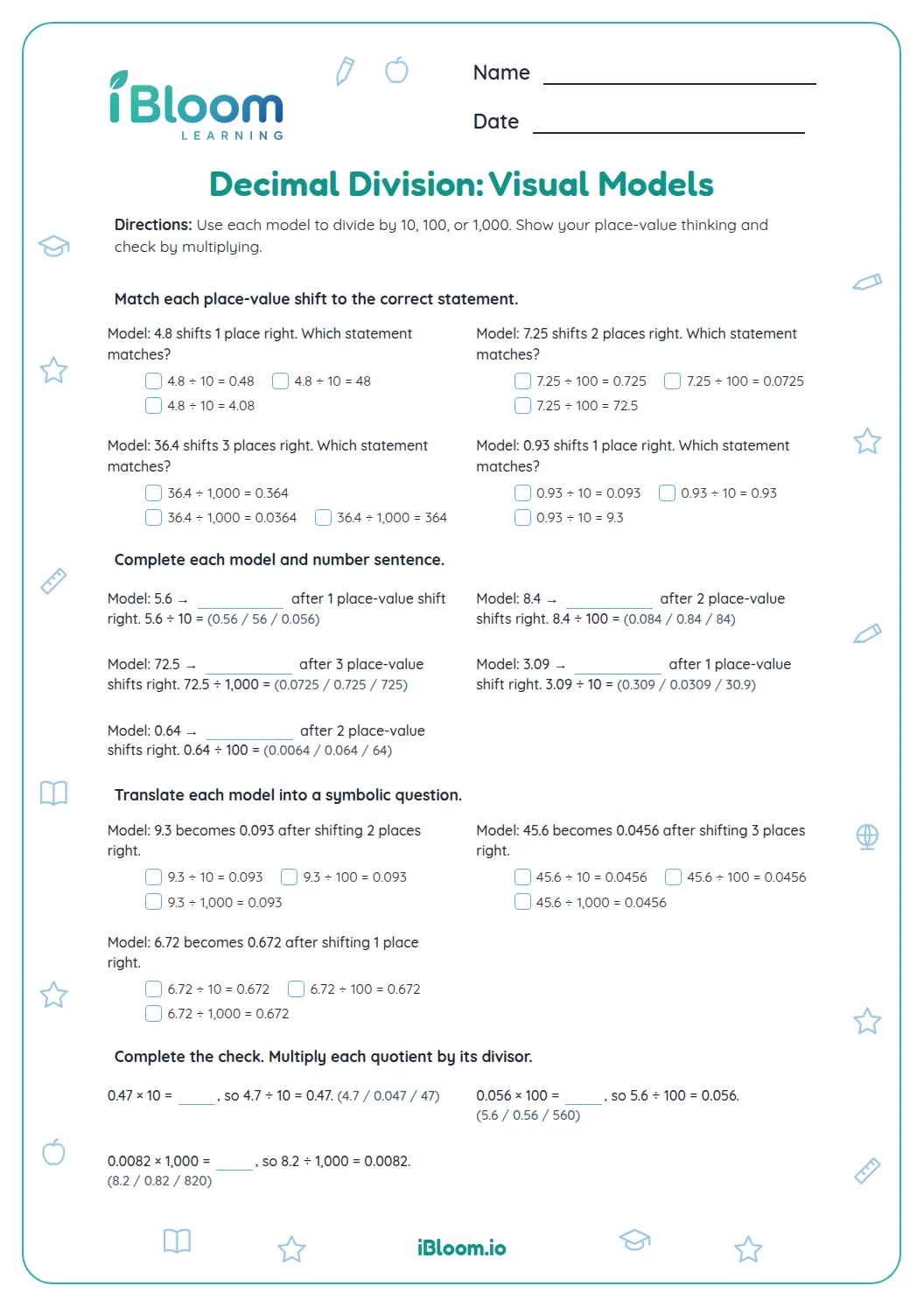
Dividing by 10 makes every digit worth one-tenth as much, so each digit shifts one place to the right. The digits stay the same; their place values change. In 4.8 ÷ 10, the 4 moves from the ones place to the tenths place and the 8 moves from tenths to hundredths, so the answer is 0.48.
Dividing by 100 shifts each digit two places, and dividing by 1,000 shifts it three. The number of zeros in the divisor tells you how many places, and so does the exponent: 10² is 100, a shift of two places, and 10³ is 1,000, a shift of three.
- 15.6 ÷ 1,000 = ___
- 21,000 has 3 zeros, so shift 3 places.
- 35.6 → 0.56 → 0.056 → 0.0056
- 4Zeros fill the empty places.
- 5Answer: 0.0056
When do you need a zero as a placeholder?
Whenever the digits move past the point, the empty places need zeros. In 9.4 ÷ 100, the 9 moves two places and lands in the hundredths place, so the tenths place holds a zero: 0.094. In 0.72 ÷ 10, the answer is 0.072 for the same reason.
Answers smaller than one are easier to read with a 0 in front of the point, as in 0.094 rather than .094.
What is on this worksheet?
Nineteen questions over two pages, in four parts that grow harder. The decimals run from 0.72 and 4.8 up to 608.2, and the answers have up to four decimal places.
- Part A: 6 problems dividing by 10, including 125.6 ÷ 10 and 0.72 ÷ 10
- Part B: 6 problems dividing by 100 and 1,000, such as 305.4 ÷ 100, plus 72.5 ÷ 10² and 43.2 ÷ 10³
- Part C: 4 missing-number sentences, like 63.5 ÷ ___ = 0.635 and ___ ÷ 10 = 4.9
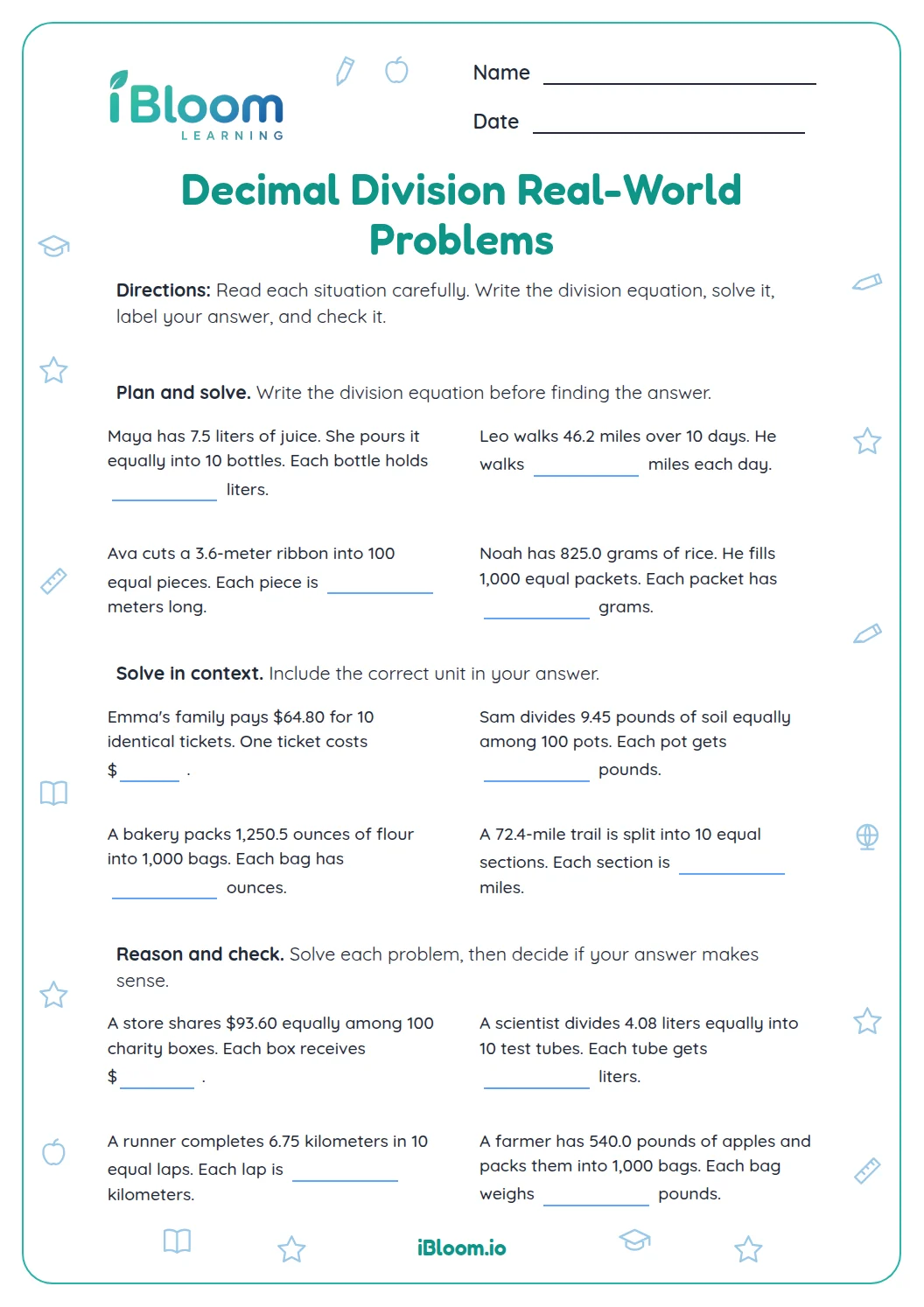
- Part D: 3 word problems (ribbon in meters, flour in kilograms, beads in grams) with working space
- Answer key on its own pages
How do you find a missing divisor or dividend?
Ask which way the digits moved. In 63.5 ÷ ___ = 0.635, the digits moved two places to the right, so the divisor has two zeros: 100. In ___ ÷ 10 = 4.9, work backward by moving the digits one place to the left, which gives 49. Dividing again is a quick check.
How to use this worksheet at home or in class
- 1Warm up with whole numbers: ask for 300 ÷ 10 and 300 ÷ 100, then ask how a decimal should behave in the same way.
- 2Do question 1 together. Write 4.8 in a place-value chart and slide each digit one column to the right.
- 3Let your student do Part A, then check one answer by multiplying it back by 10.
- 4In Part B, have your student count the zeros in each divisor and say the number of places aloud before writing the answer.
- 5For Part C, ask which way the digits moved, then name the missing divisor or dividend.
- 6For Part D, write a number sentence first, solve it, and check that the unit and the size of the answer make sense.
Common mistakes and quick fixes
The mistake
Moving the point the wrong way, so 4.8 ÷ 10 becomes 48.
The fix
Dividing by 10 makes a number smaller. Ask if 48 is smaller than 4.8; if not, move the digits toward the right instead.
The mistake
Treating 100 or 1,000 like 10, so 9.4 ÷ 100 becomes 0.94.
The fix
Count the zeros in the divisor and make that many moves. Writing each step, 0.94 then 0.094, helps.
The mistake
Working the wrong way in Part C, so ___ ÷ 10 = 4.9 becomes 0.49.
The fix
Use the opposite operation. Multiply 4.9 by 10 to get 49, then check that 49 ÷ 10 = 4.9.
Common Core alignment
Place the decimal point correctly when dividing by 10, 100 or 1,000, including 10² and 10³.
On this sheet: Parts A and B place the decimal point for each power of 10, two problems write the divisor as 10² or 10³, and Part C works backward from the quotient.
Show the official wordingHide the official wording
Explain patterns in the number of zeros of the product when multiplying a number by powers of 10, and explain patterns in the placement of the decimal point when a decimal is multiplied or divided by a power of 10. Use whole-number exponents to denote powers of 10.
What to practice next
Make more practice
Further reading
Questions parents and teachers ask
What is 4.8 ÷ 10?
The answer is 0.48. Dividing by 10 makes each digit worth one-tenth as much, so the 4 moves from the ones place to the tenths place and the 8 moves to the hundredths place. The decimal point looks as if it moved one place to the left. Question 1 on this sheet asks exactly this.
Why does 9.4 ÷ 100 equal 0.094 and not 0.94?
Dividing by 100 shifts each digit two places, not one. The 9 moves from the ones place to the hundredths place, past the tenths place, so a zero has to sit in the tenths place as a placeholder. That gives 0.094. The two zeros in 100 tell you how many places to move.
How do I find the missing number in 63.5 ÷ ___ = 0.635?
Compare the two decimals. The digits of 63.5 moved two places to the right to make 0.635, and dividing by 100 does exactly that, so the missing number is 100. Check it: 63.5 ÷ 100 = 0.635. Part C uses this reasoning in all four of its sentences.
Do students need long division for this sheet?
No. Dividing by 10, 100 or 1,000 follows a place-value pattern, so students can reason without long-division steps. A place-value chart can help at first, and students who want a check can multiply their answer by the divisor to see whether they return to the starting number.
Why do the word problems use measurements?
Real quantities show why the answer should get smaller. Putting 8.5 kg of flour into 100 equal bags gives 0.085 kg in each bag, which is less than a tenth of a kilogram, so the size makes sense. Measurements also remind students to write a unit with every answer in Part D.
Is there an answer key, and how long does it take?
Yes, a separate answer key gives all 19 answers, with units for the word problems. Plan on about 20 minutes. Parts A and B go quickly once the pattern is clear, and Part D takes longest because students write a number sentence for each problem, so the sheet can be split across two sittings.