


About this worksheet
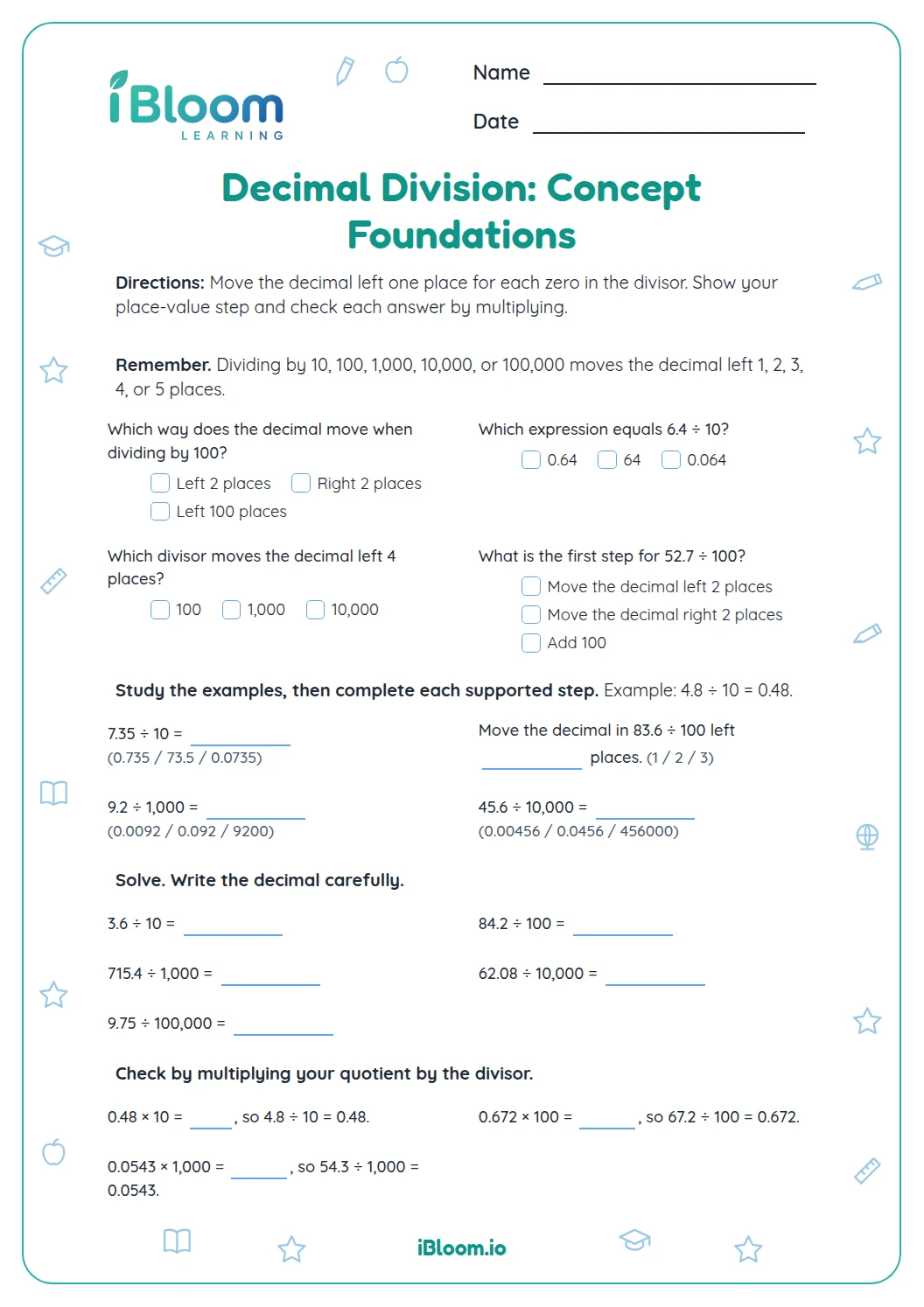
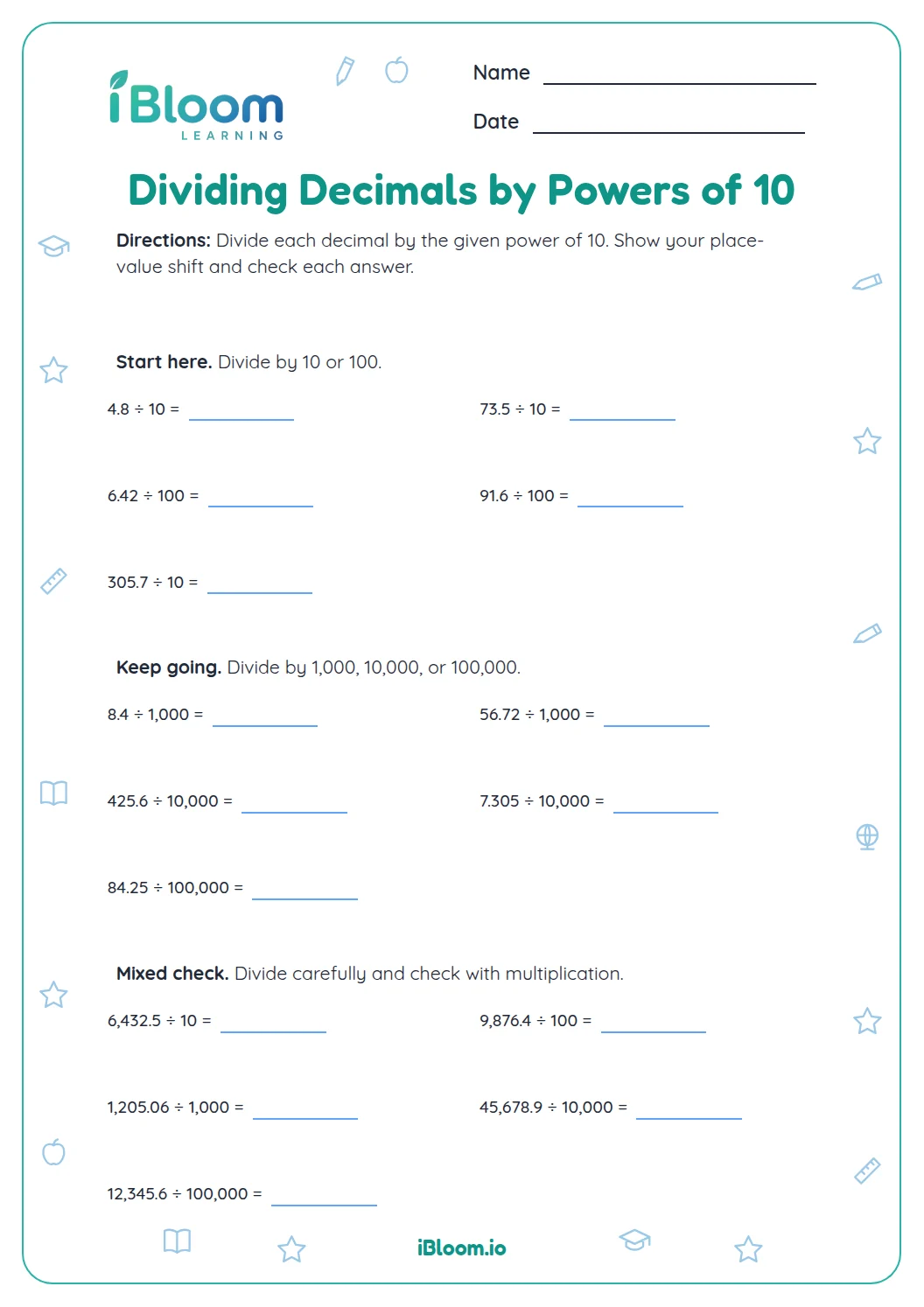
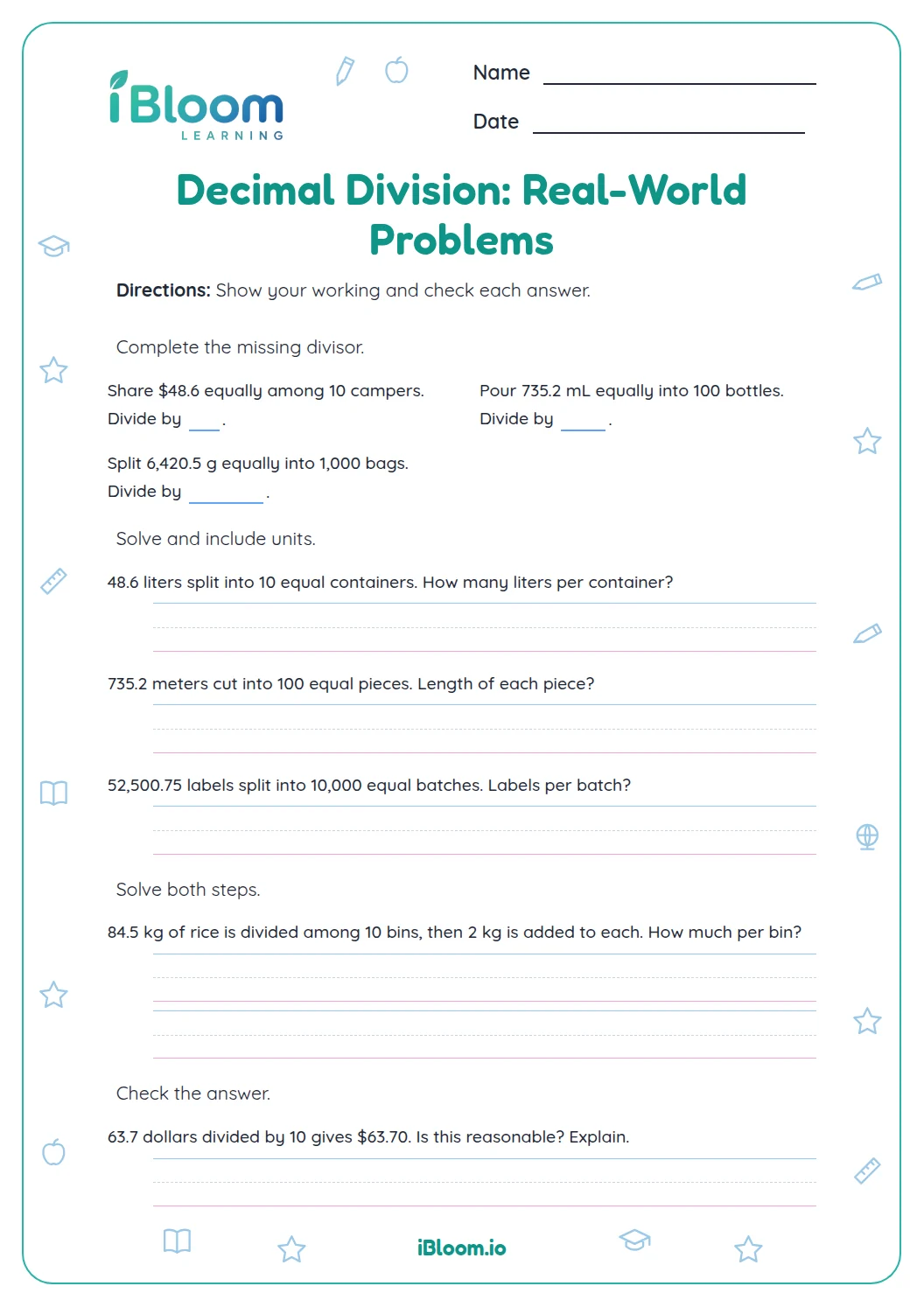
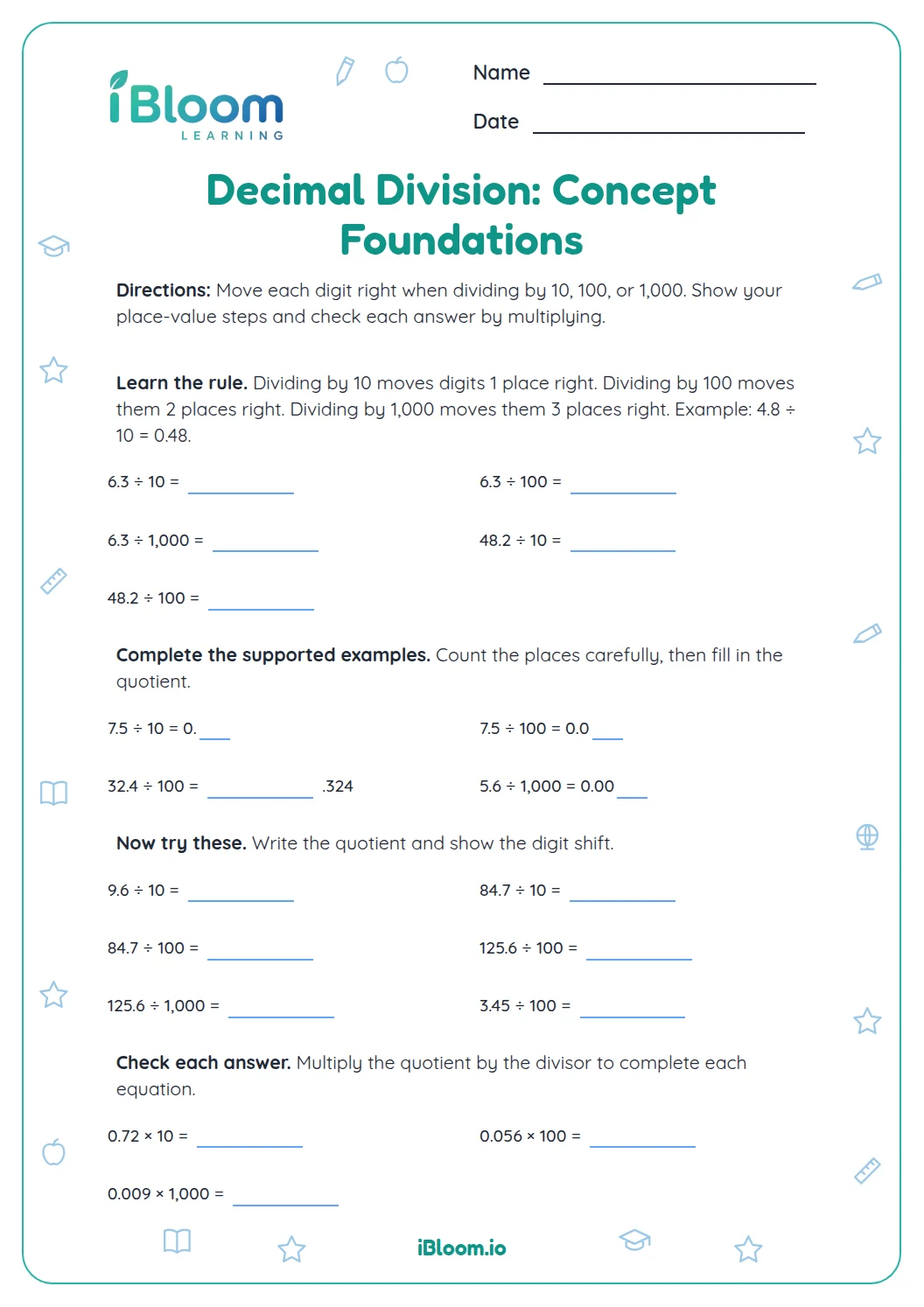
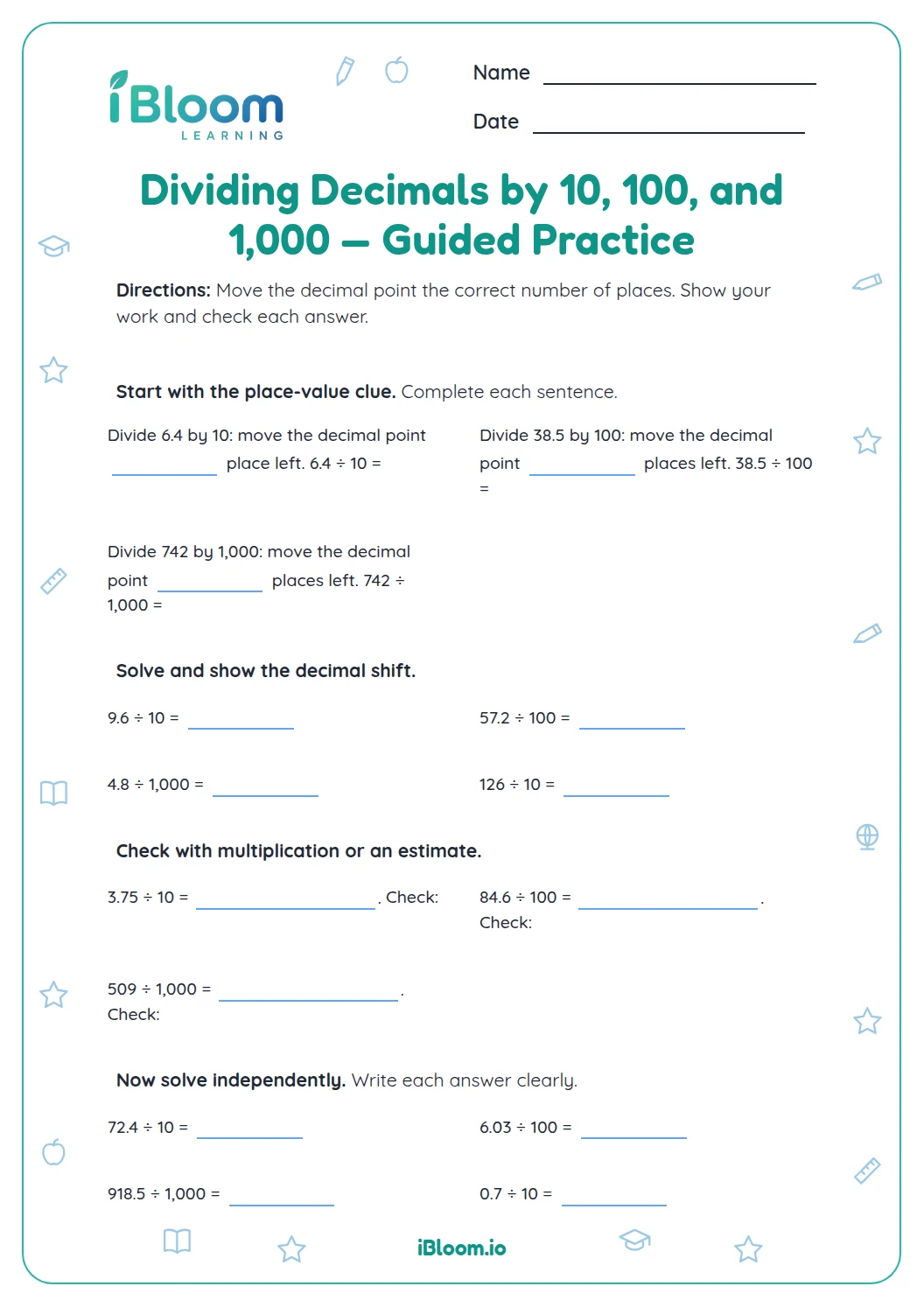
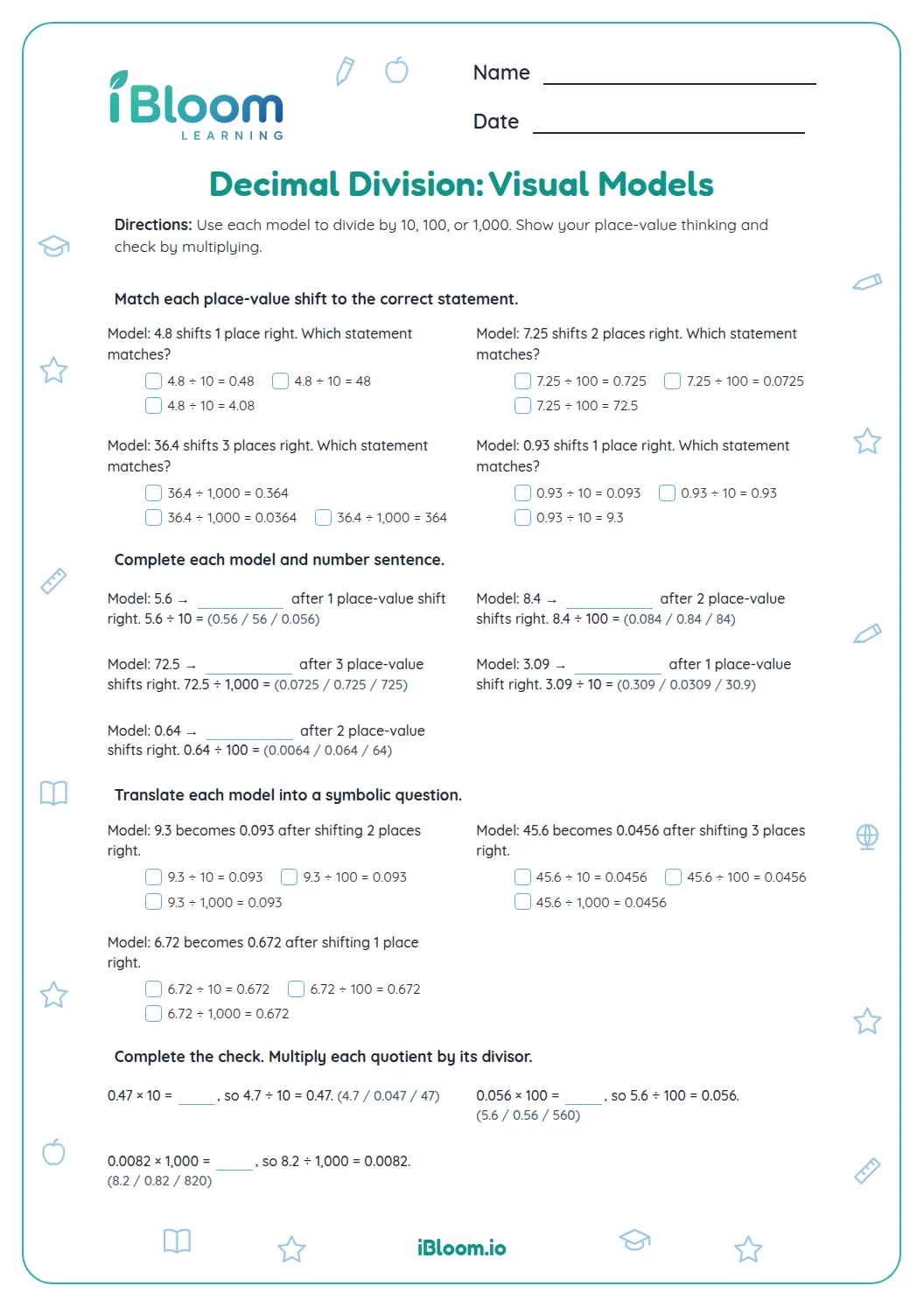
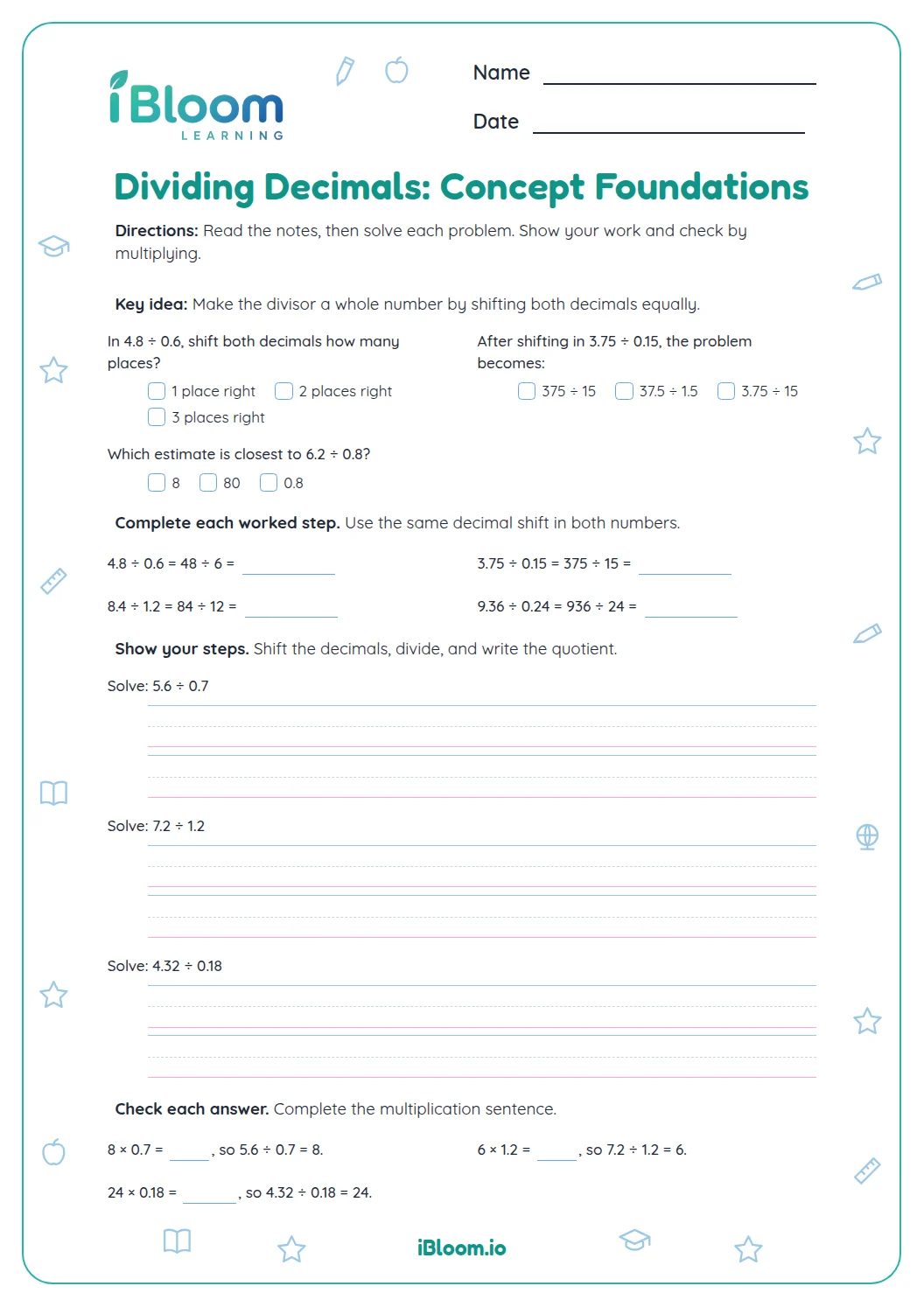
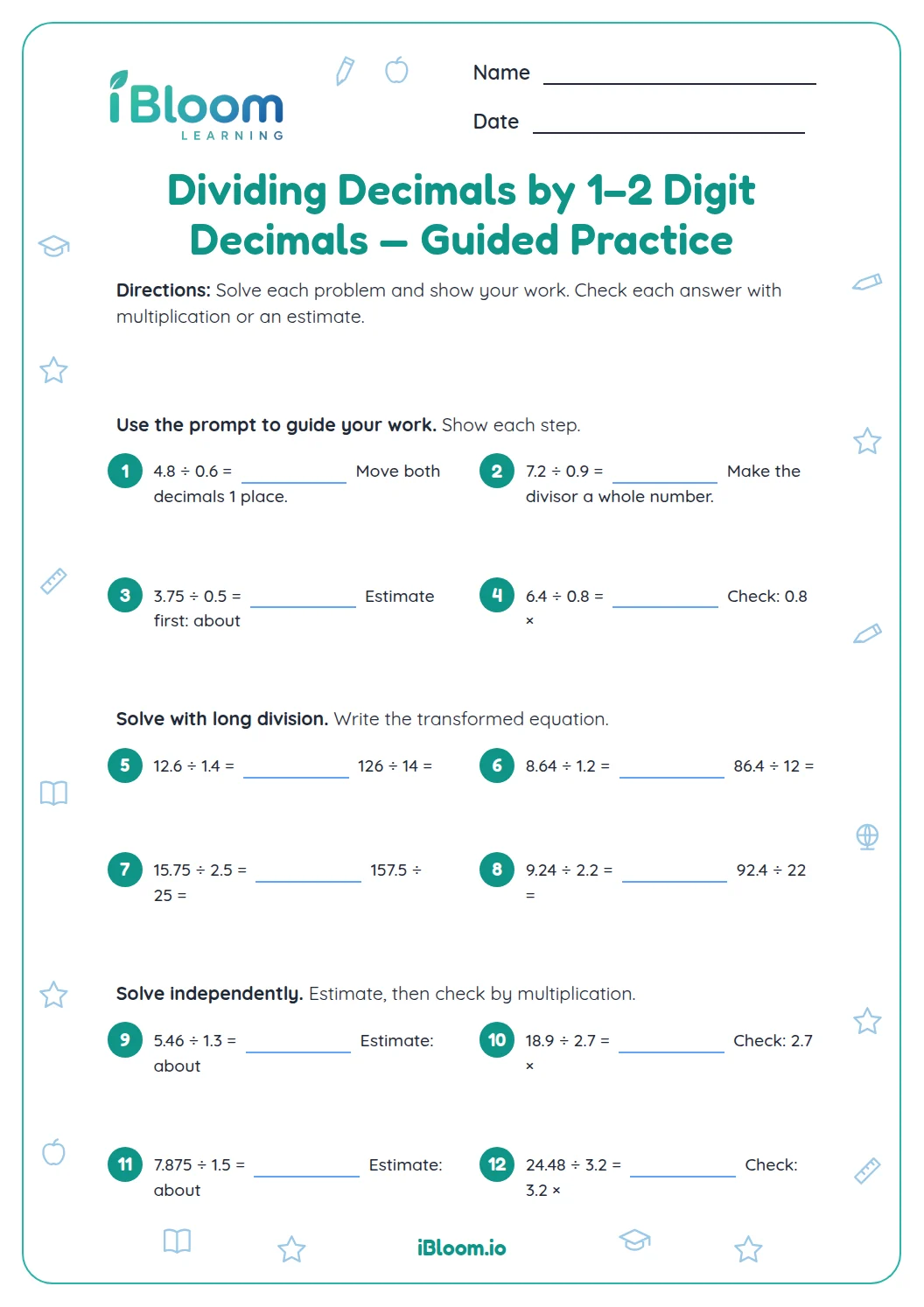
This Grade 6 printable gives students 16 questions dividing decimals and whole numbers by 10, 100, 1,000, 10,000, and 100,000. It practices CCSS 6.NS.B.3 through place-value reasoning and decimal division. Two hundredths grids model quotients; the other questions include decimal shifts, zeros in quotients, a sharing context, and an explanation. The answer key gives each result.
Aligned to 6.NS.B.3
What changes when you divide by a power of ten?
Each factor of ten makes the quotient ten times smaller. The decimal point moves left one place for each zero in the divisor. Dividing 3.6 by 10 gives 0.36: the 3 ones become 3 tenths and the 6 tenths become 6 hundredths.
Zeros may be needed to show the value clearly. For example, 5 ÷ 1,000 = 0.005.
- 13.6 ÷ 10 = 0.36
- 2The decimal point moves left one place.
- 3The hundredths grid models 36 hundredths.
How do the visual models help?
The hundredths grids show the quotient as shaded hundredths. For question 1, 36 shaded squares represent 0.36, the quotient of 3.6 divided by 10. The model connects the shaded amount to the change in place value.
- Questions 1–2: read a hundredths model
- Questions 3–14: divide by powers of ten
- Questions 15–16: apply and explain
When should you write a zero in the quotient?
A zero keeps each digit in the correct place. In 7.2 ÷ 100, the decimal point moves two places left, giving 0.072. Check by multiplying 0.072 by 100 to recover 7.2.
How to use this worksheet
- 1Count how many factors of 10 are in the divisor.
- 2Move each dividend digit that many places to the right in place value.
- 3Use zeros as placeholders when a digit moves past the ones place.
- 4Read the quotient aloud to check its place value.
- 5Multiply the quotient by the divisor to check the original dividend.
Common mistakes and quick fixes
The mistake
Moving the decimal one place for every zero in 10,000
The fix
Count four place shifts because 10,000 is ten to the fourth power.
The mistake
Dropping a zero needed as a placeholder
The fix
Write 0.005 for five thousandths, not 0.5.
The mistake
Moving digits left when dividing
The fix
Division by a number greater than 1 makes the quotient smaller.
Common Core alignment
This practice connects the named skill to a grade-level Common Core expectation.
Divide multi-digit decimals using place value and the standard algorithm.
On this sheet: Students divide decimals by powers of ten and track the value of each digit.
Show the official wordingHide the official wording
Fluently add, subtract, multiply, and divide multi-digit decimals using the standard algorithm for each operation.
What to practice next
Make more practice
Further reading
Questions parents and teachers ask
Why does the decimal point move left when dividing?
Each factor of ten makes the quotient ten times smaller, so the decimal point moves left one place for each zero in the divisor. For example, 3.6 ÷ 10 = 0.36. The hundredths grid on question 1 shows the quotient as 36 shaded hundredths.
How can I check a decimal quotient?
Multiply the quotient by the divisor and see whether you recover the dividend. For question 5, 12.5 ÷ 10 = 1.25, and 1.25 × 10 = 12.5. The answer key lists the quotient for each item so students can check their place-value work.
What does the hundredths grid represent?
Each grid has 100 equal squares, so every shaded square is one hundredth. Question 1 shades 36 squares to show 0.36, and question 2 shades 48 squares to show 0.48. Each shaded amount matches the quotient named in its division statement.
Why are zeros needed in some quotients?
Zeros hold empty places when the dividend has no digit to move into them. For example, 5 ÷ 1,000 is 0.005, or five thousandths. Writing 0.5 would make the quotient much larger. The answer key helps check the decimal places.
Which divisors appear on the worksheet?
Students divide by 10, 100, 1,000, 10,000, and 100,000. The quotient questions mix those powers with whole-number and decimal dividends, then a word problem applies division by 10. An explanation question asks why division by 100 makes 2.7 smaller. The key lists each quotient.