
About this worksheet
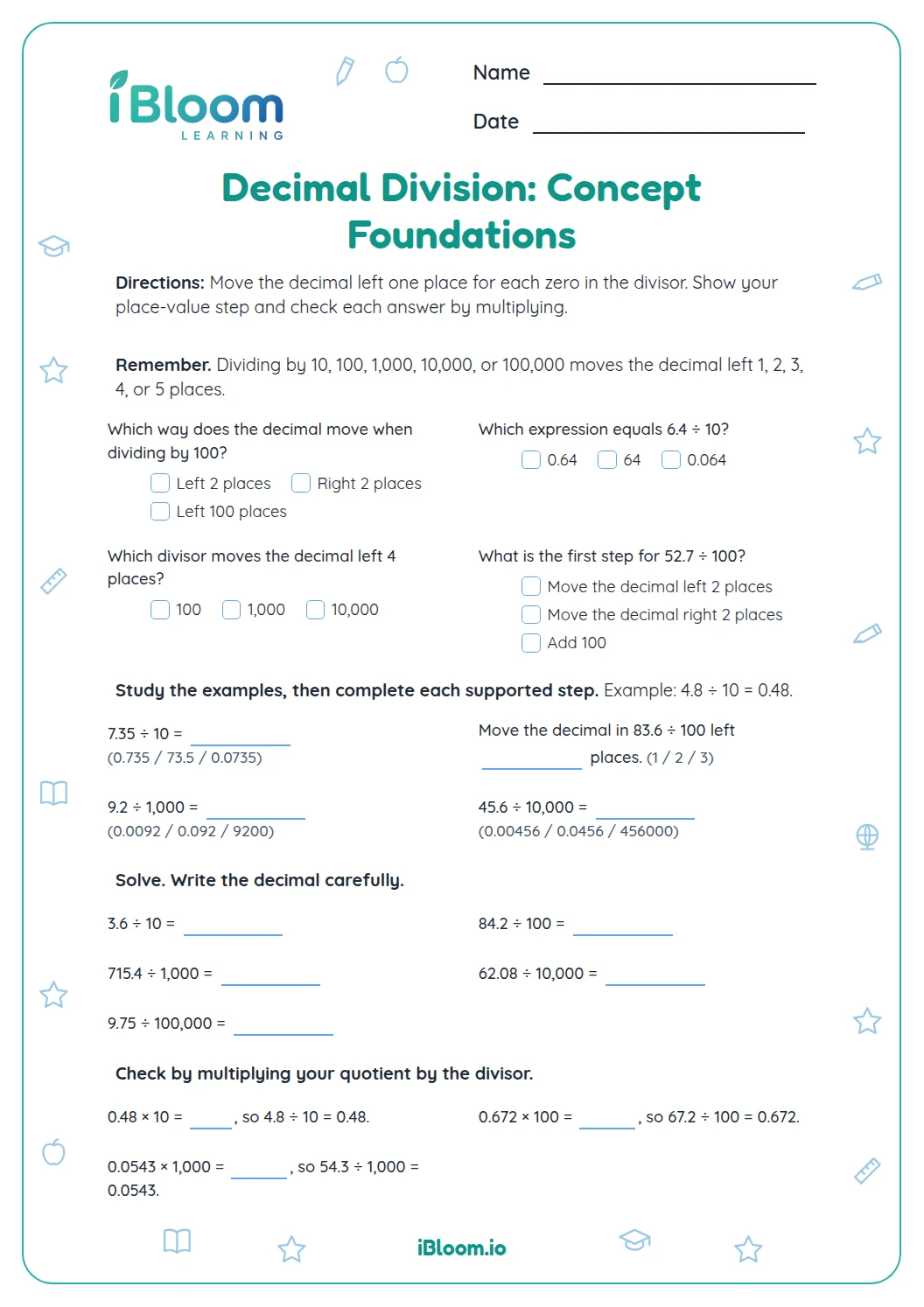
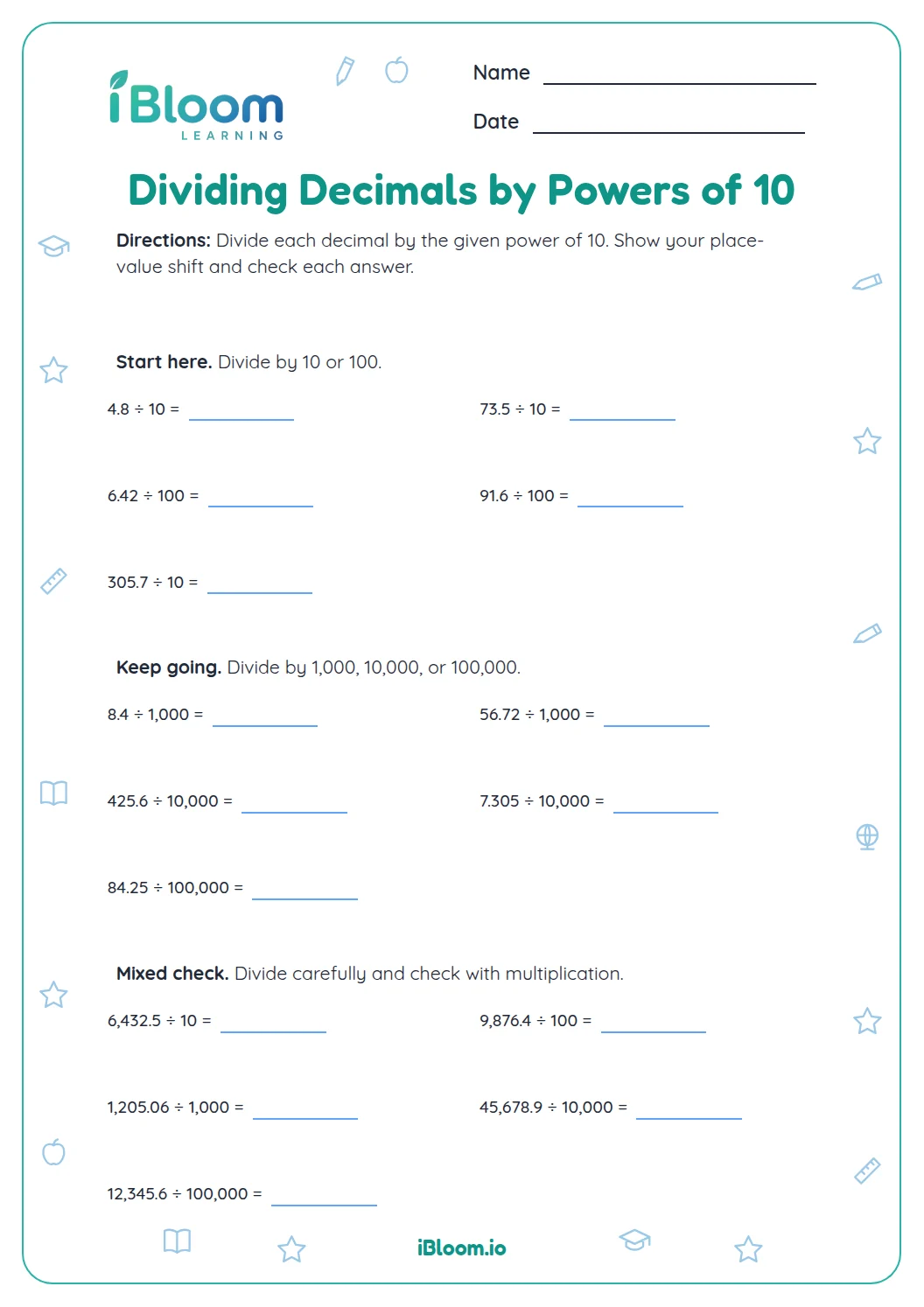
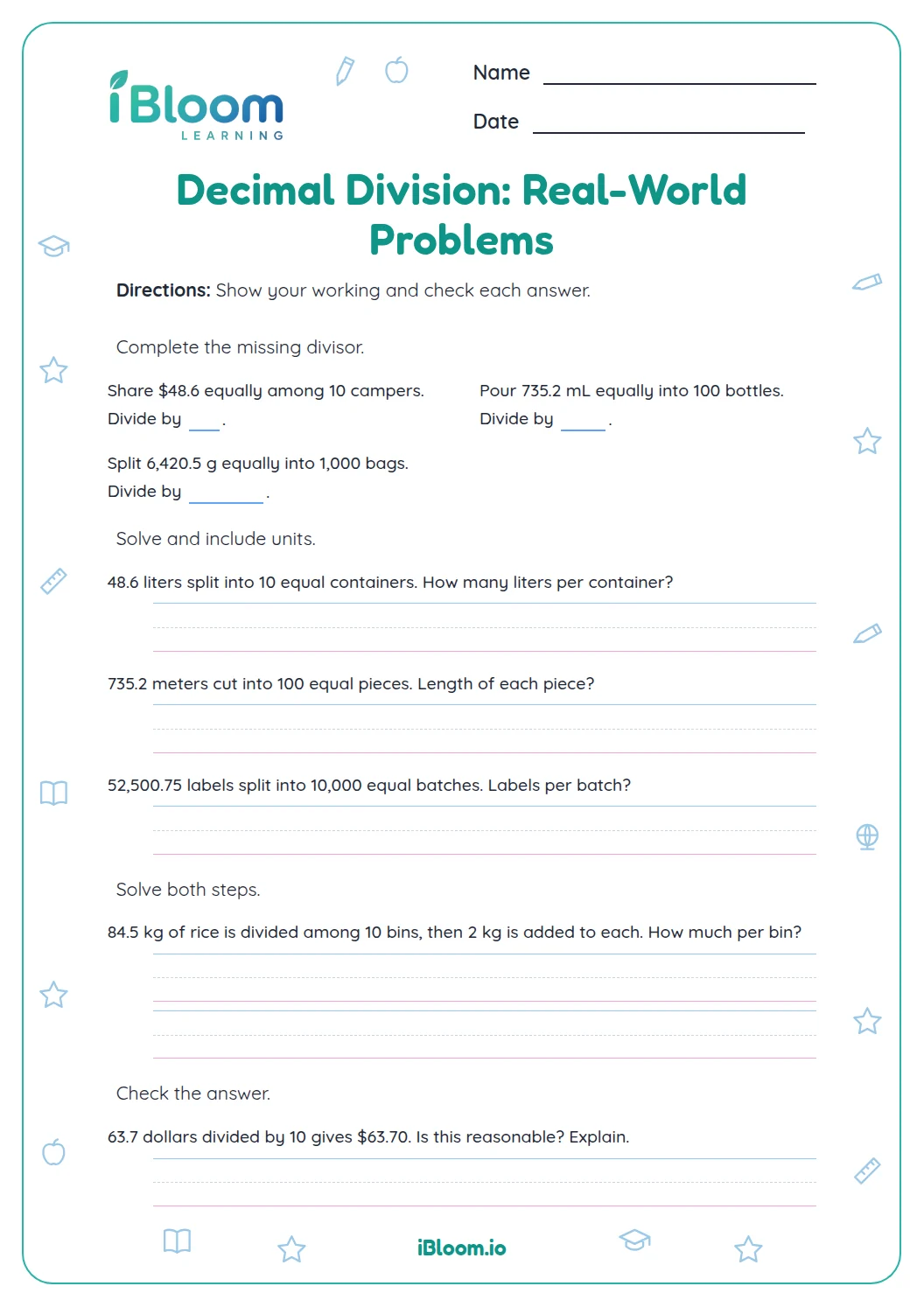
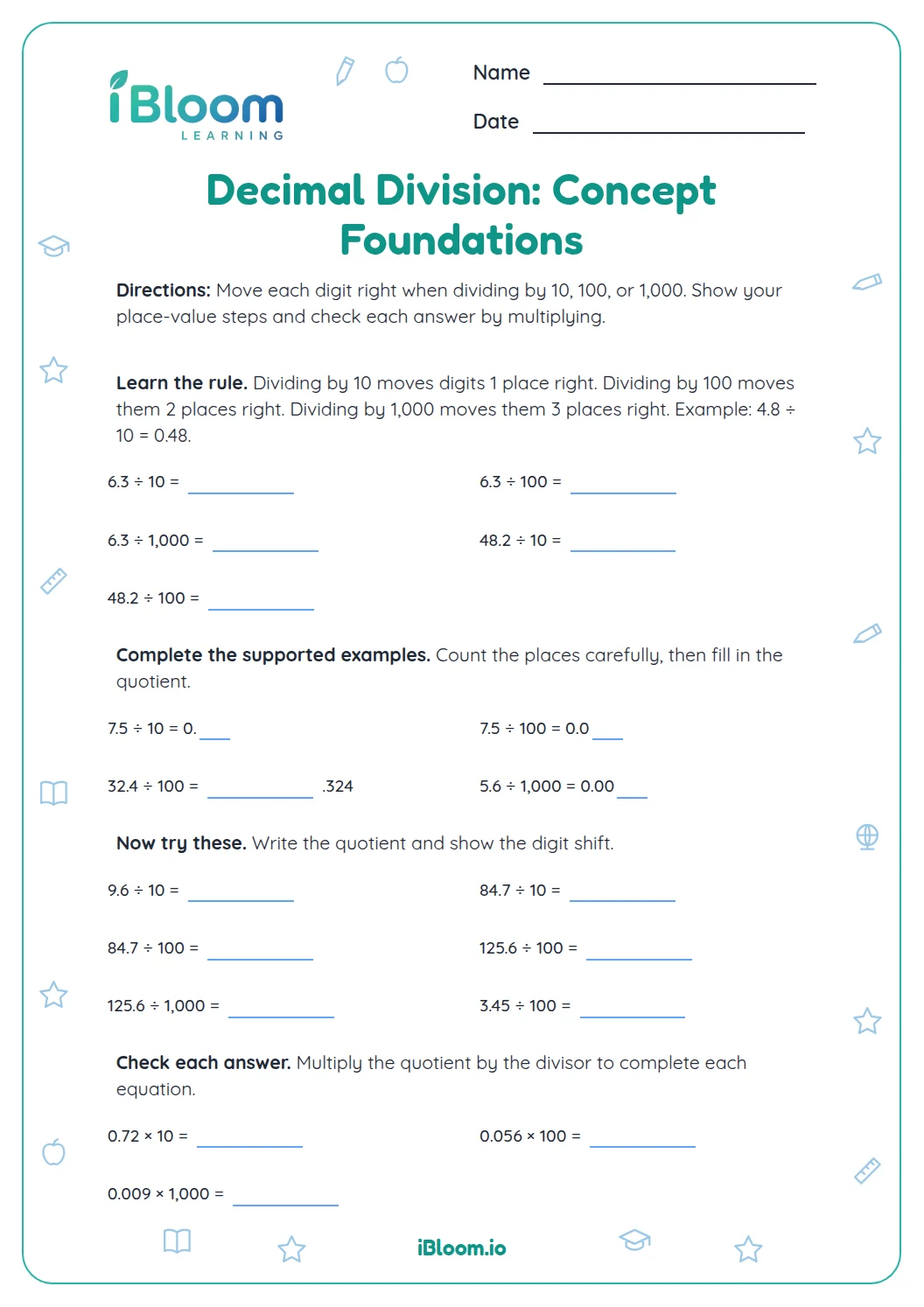
This Grade 6 printable practices dividing decimals by powers of ten from 10 through 100,000. Learners calculate quotients, find a missing dividend, compare results, correct a misplaced decimal, and explain place-value patterns. A ribbon problem and a reverse division prompt add context to the 16 questions. The separate key supports checking the work. The practice aligns with CCSS 5.NBT.A.2, which addresses decimal placement when dividing by powers of ten.
Aligned to 5.NBT.A.2
How does the sheet build decimal quotients?
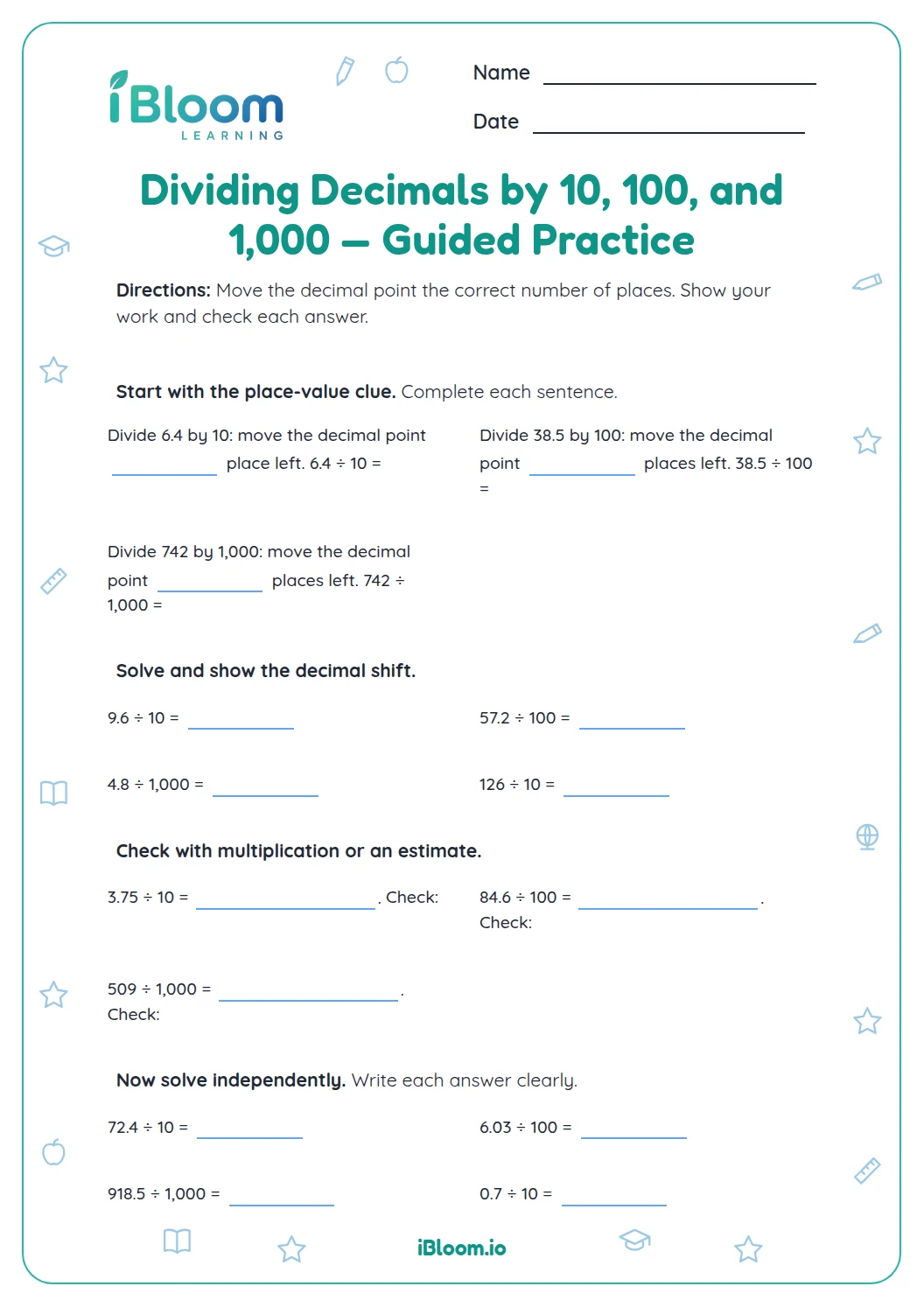
The first five questions divide by 10, 100, 1,000, 10,000, and 100,000 in order. Each quotient is one tenth as large per factor of ten in the divisor.
- 14.8 ÷ 10 = ___
- 2Dividing by 10 gives 0.48.
How do learners check a decimal quotient?
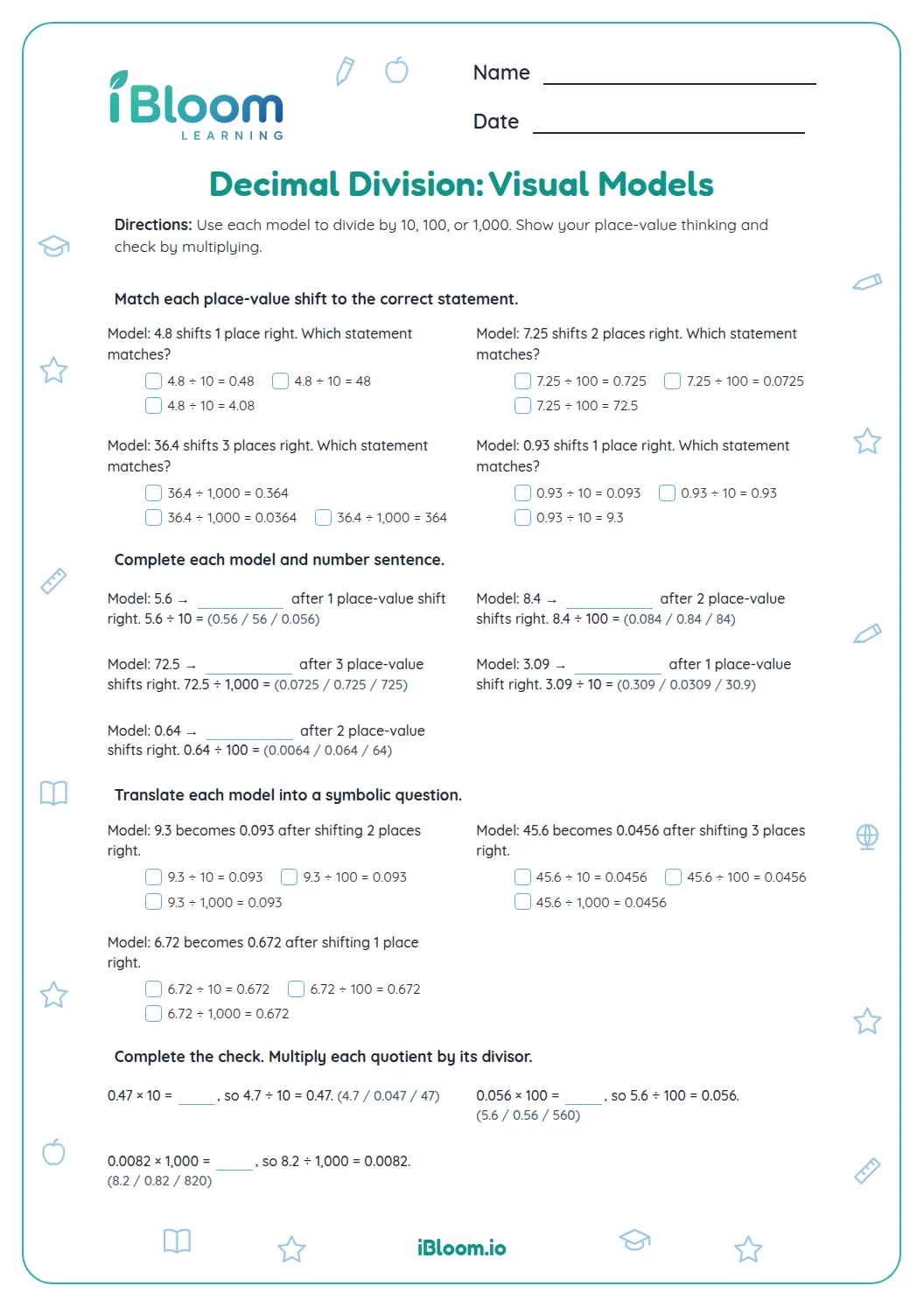
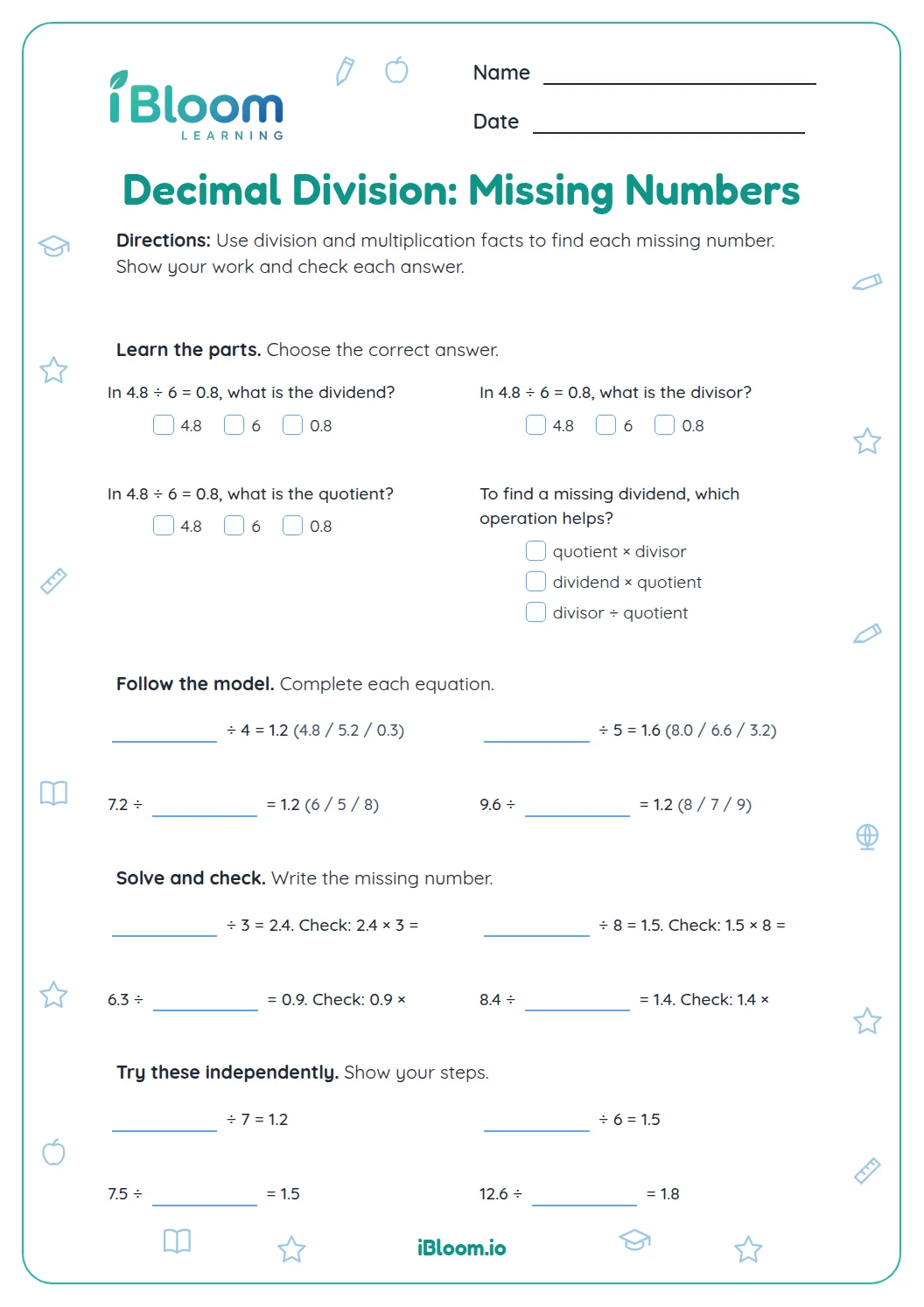
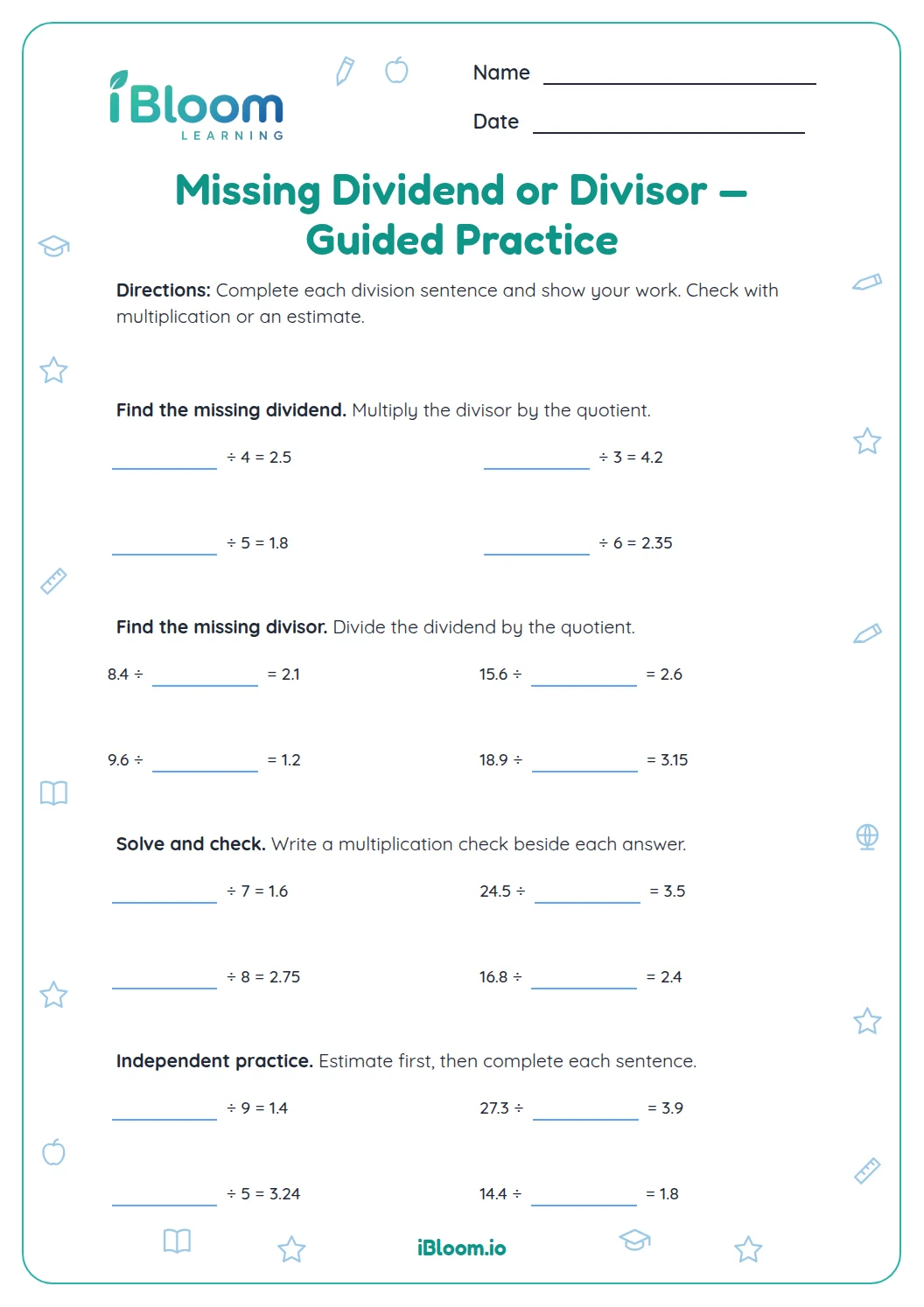
Later questions reverse division to find a missing dividend, compare two quotients, and correct a student’s decimal placement. Multiplying a quotient by its divisor checks the original number.
What reasoning and application are included?
Learners describe the place-value shift, divide a ribbon length into equal parts, identify a divisor from a quotient, and solve missing-number equations.
How many questions and pages are there?
The worksheet has 16 questions on two pages. The separate answer key includes numerical answers and a sample explanation for the written response.
How to use this worksheet
- 1Count the zeros in the power-of-ten divisor.
- 2Move each digit that many places right in the quotient.
- 3Use zero placeholders when the quotient needs them.
- 4Estimate whether the quotient should be smaller than the dividend.
- 5Multiply quotient by divisor to check a division answer.
- 6Write units for the ribbon-length answer.
Common mistakes and quick fixes
The mistake
Moving the decimal right when dividing by 10 or more.
The fix
Division by a power of ten makes the quotient smaller.
The mistake
Dropping zeros needed to hold a place.
The fix
Write placeholder zeros so each digit lands in the correct place.
The mistake
Using the wrong number of places for the divisor.
The fix
For 10,000, shift four places; for 100,000, shift five.
Common Core alignment
Explain decimal-place patterns when dividing decimals by powers of ten.
On this sheet: The questions practice decimal placement patterns when dividing by powers of ten.
Show the official wordingHide the official wording
Explain patterns in the number of zeros of the product when multiplying a number by powers of 10, and explain patterns in the placement of the decimal point when a decimal is multiplied or divided by a power of 10. Use whole-number exponents to denote powers of 10.
What to practice next
Make more practice
Further reading
Questions parents and teachers ask
Which powers of ten are included?
The worksheet includes division by 10, 100, 1,000, 10,000, and 100,000. The first five questions give one example for each divisor. Later items revisit these powers in comparisons, missing-number equations, error correction, and a measurement context, so learners practice both calculations and reasoning.
What does dividing by 10 do to a decimal?
Each digit moves one place right in the quotient’s place-value chart, making the quotient one tenth of the original number. For example, question 1 asks for 4.8 ÷ 10, which equals 0.48. The worksheet also asks learners to explain this relationship.
Does the page include word problems?
Yes. One question describes a 4.8-meter ribbon cut into 100 equal lengths. Learners divide the total length by 100 and include meters in the answer. Another prompt works backward from a quotient to identify which divisor was used.
What kinds of reasoning questions are included?
Learners compare quotients, correct a decimal-placement error, decide whether a statement is true, explain a place-value pattern, and solve for missing values. These items ask students to connect division facts and place value rather than only calculate a list of quotients.
How can the answer key be used?
Check each numerical response after the learner finishes. For the explanation prompt, compare the response with the sample idea that dividing by 100 shifts digits two places and gives a smaller quotient. A learner may use different words while expressing the same place-value reasoning.