

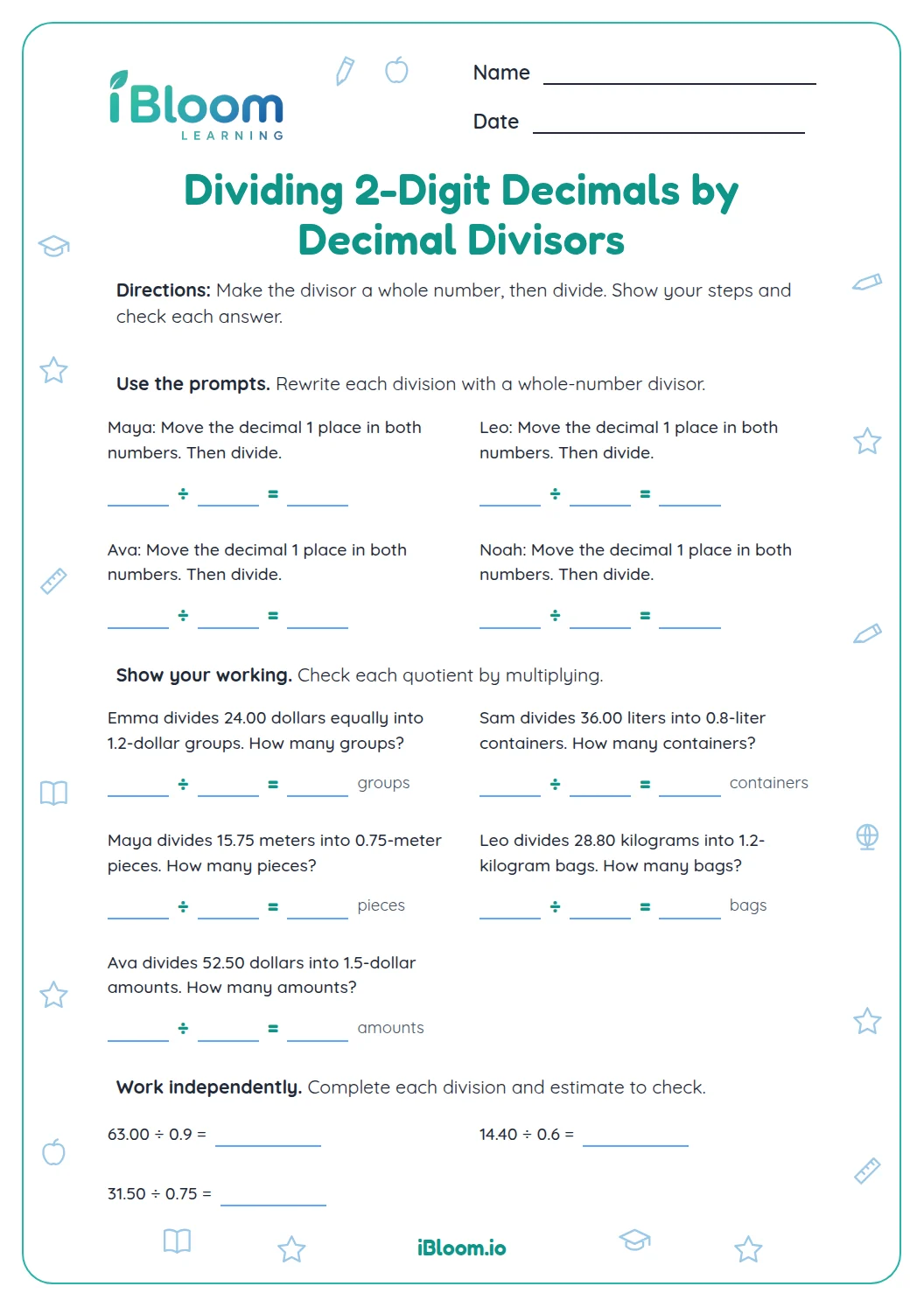

About this worksheet
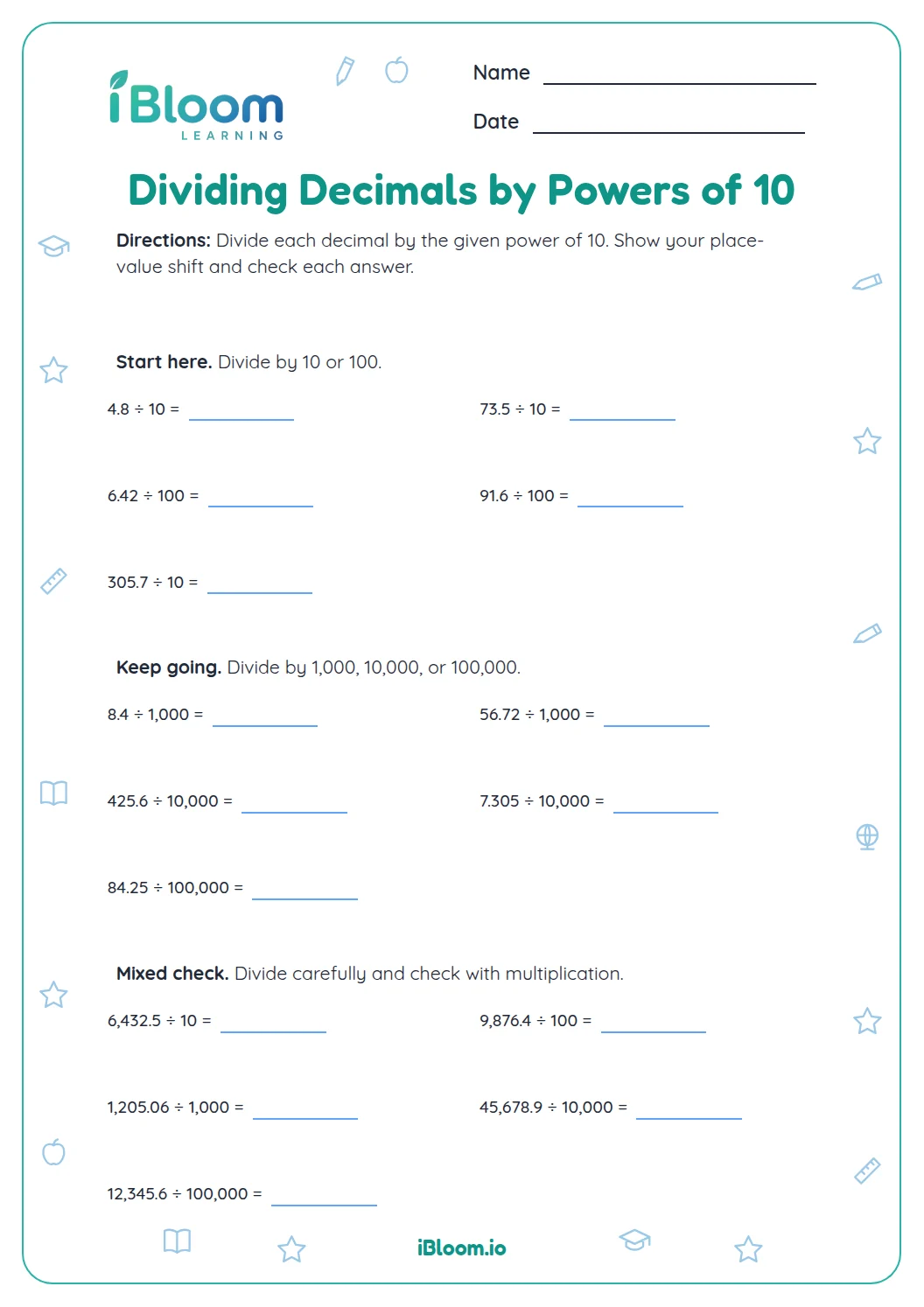
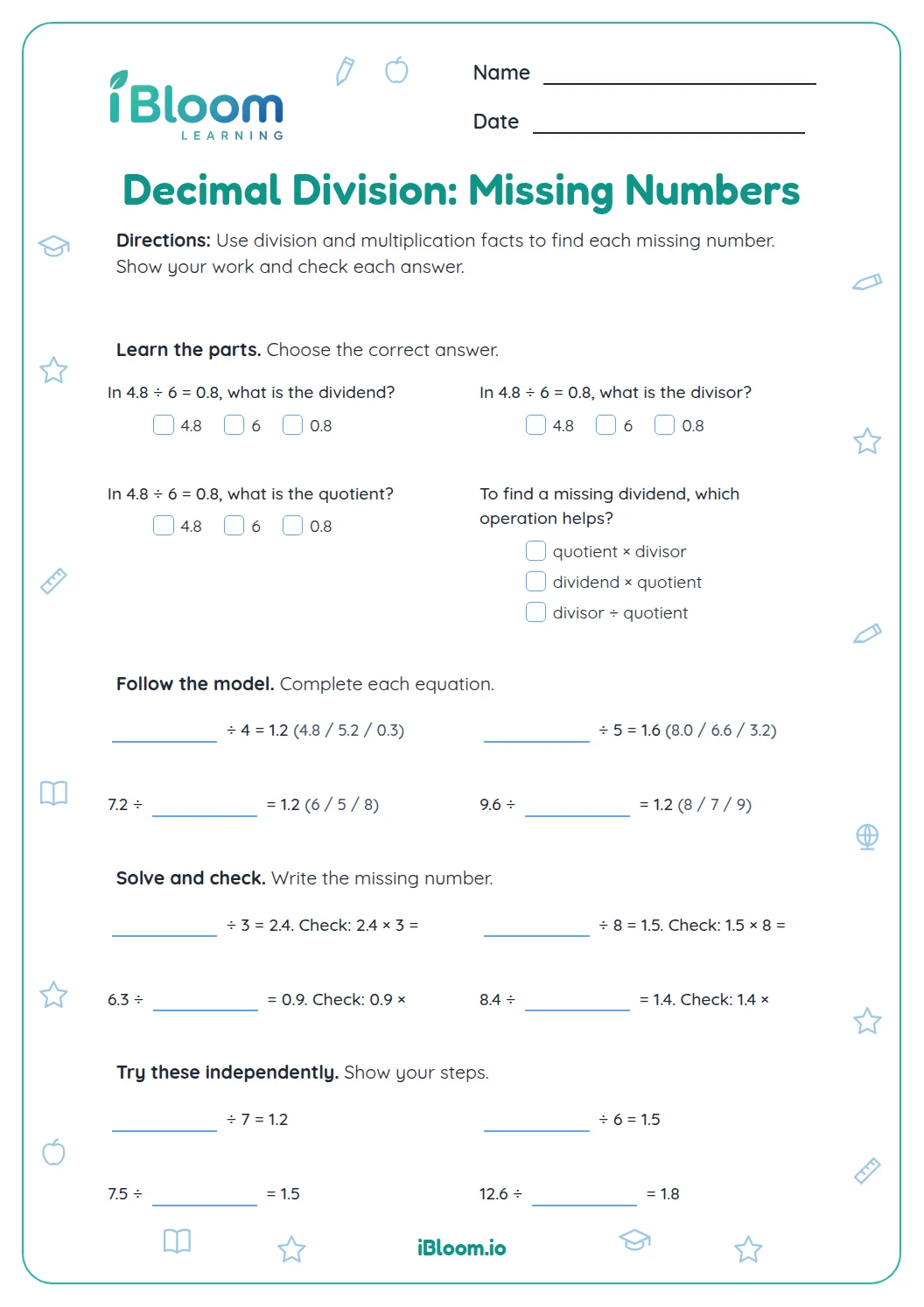
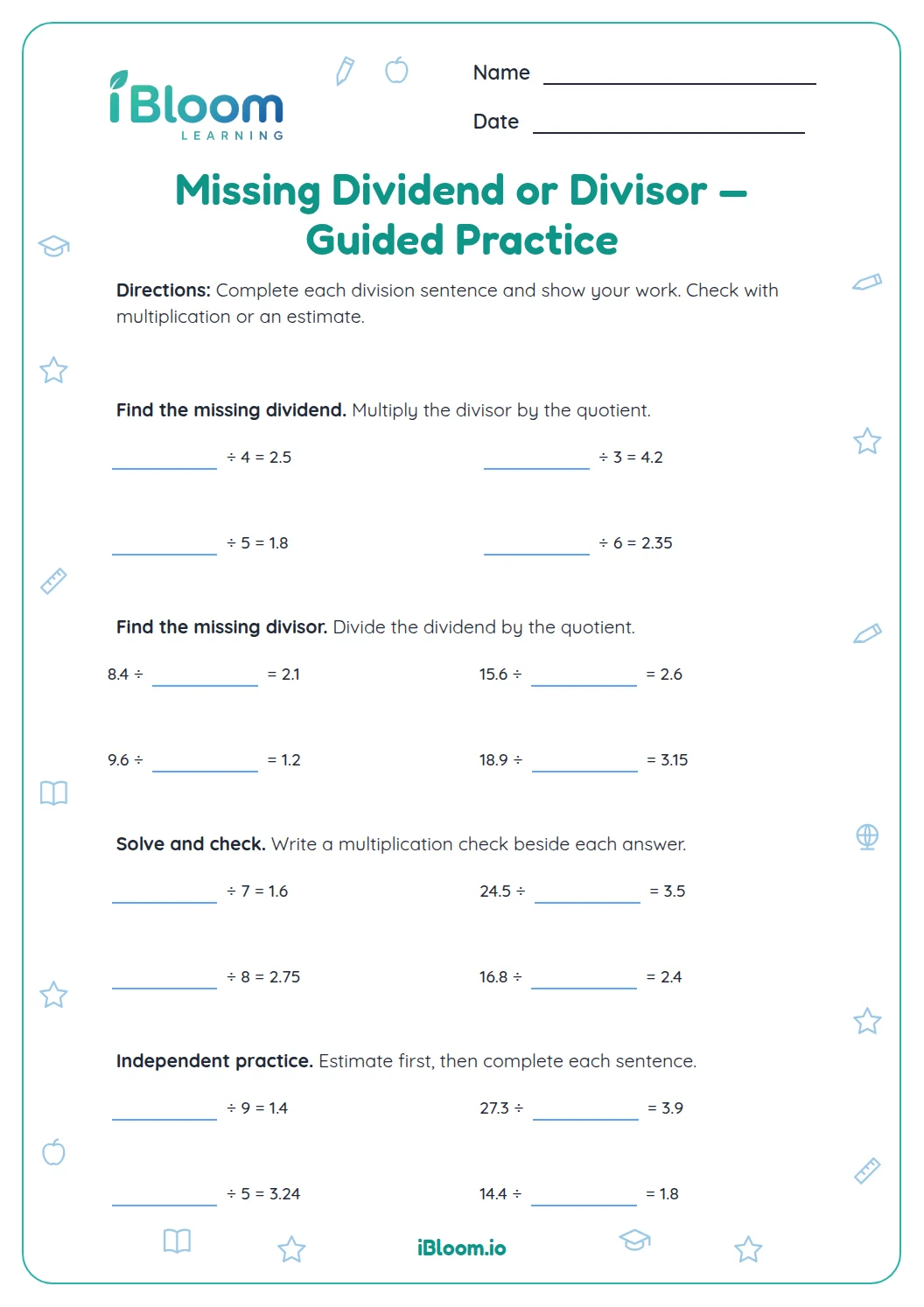
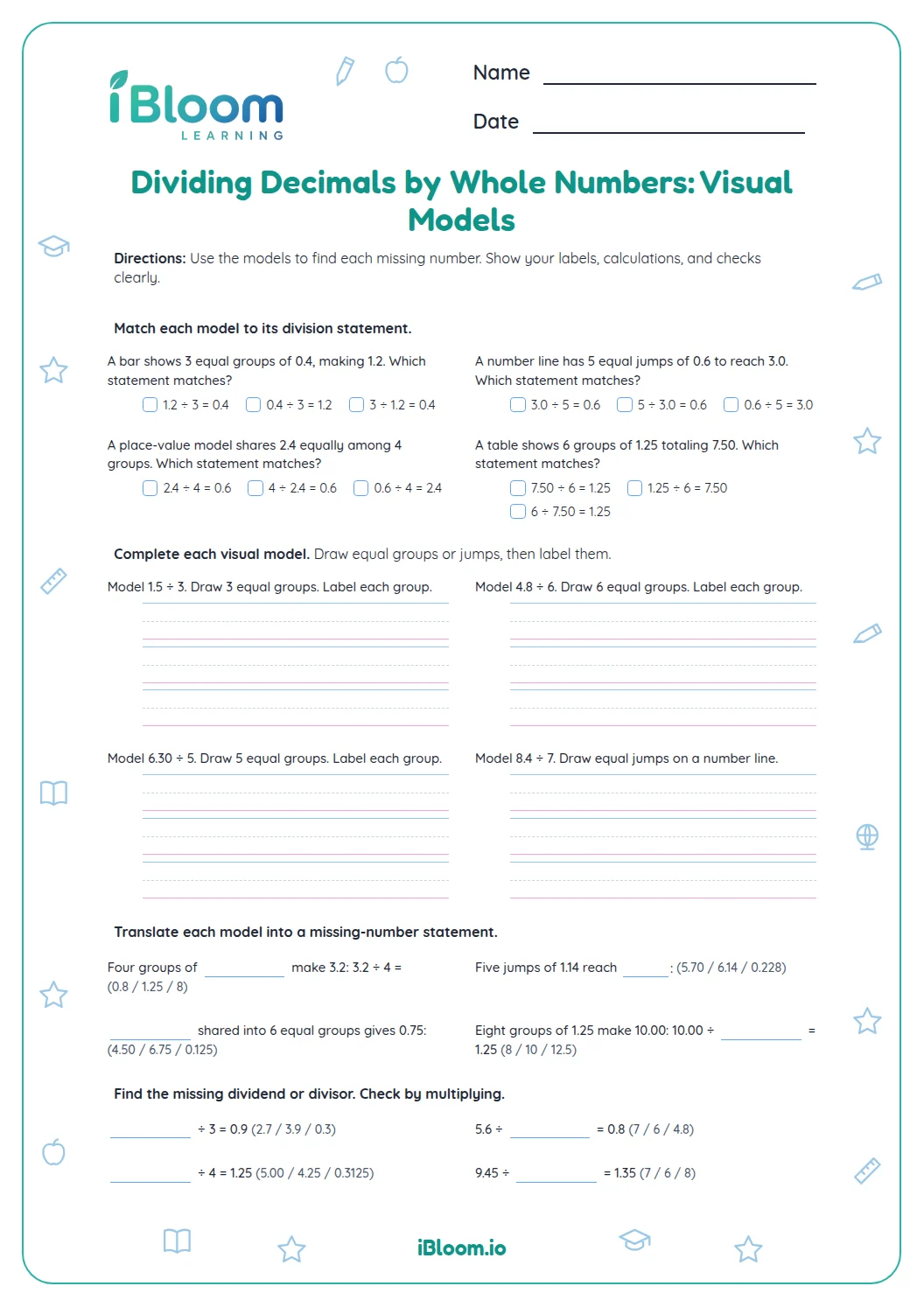
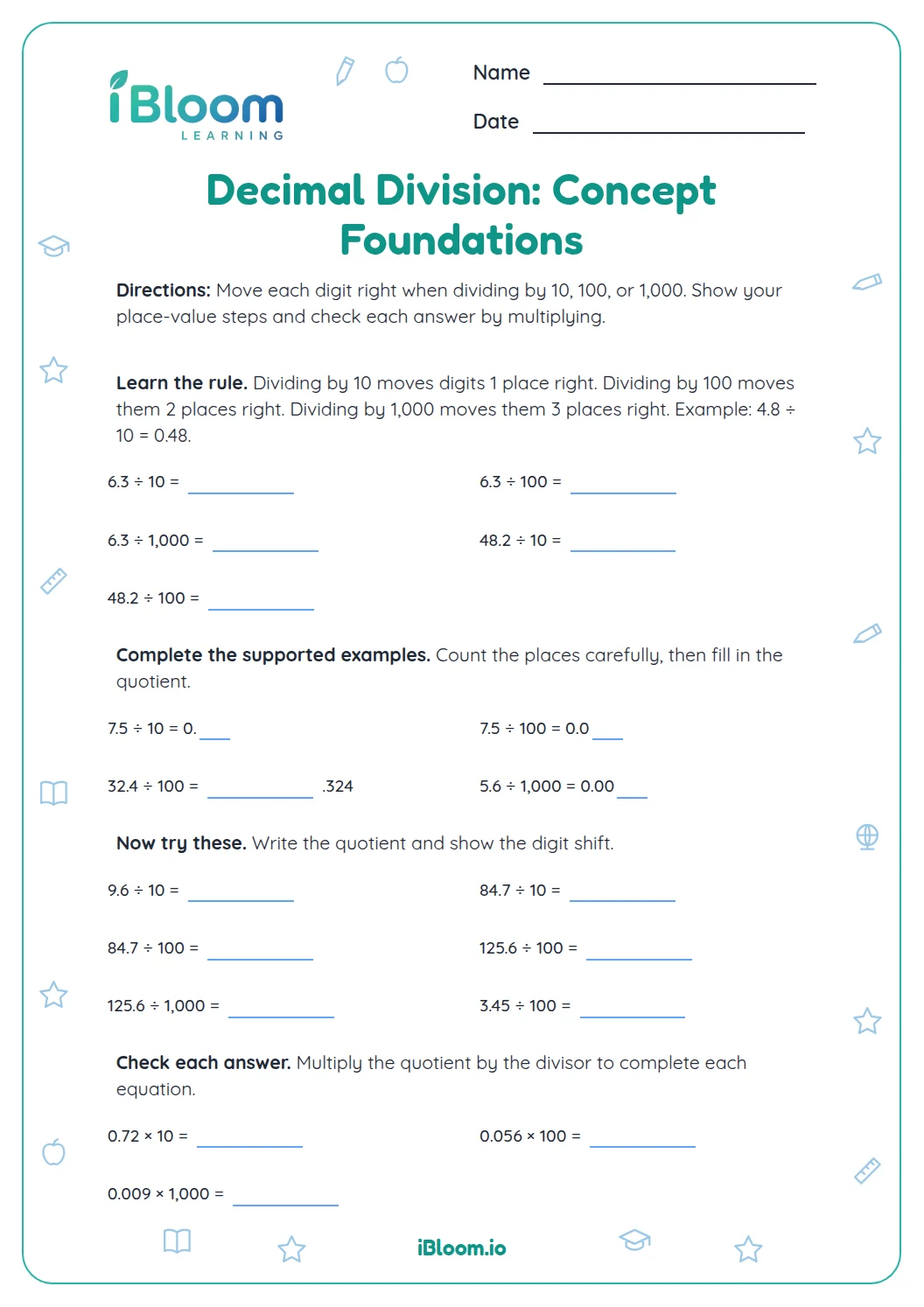
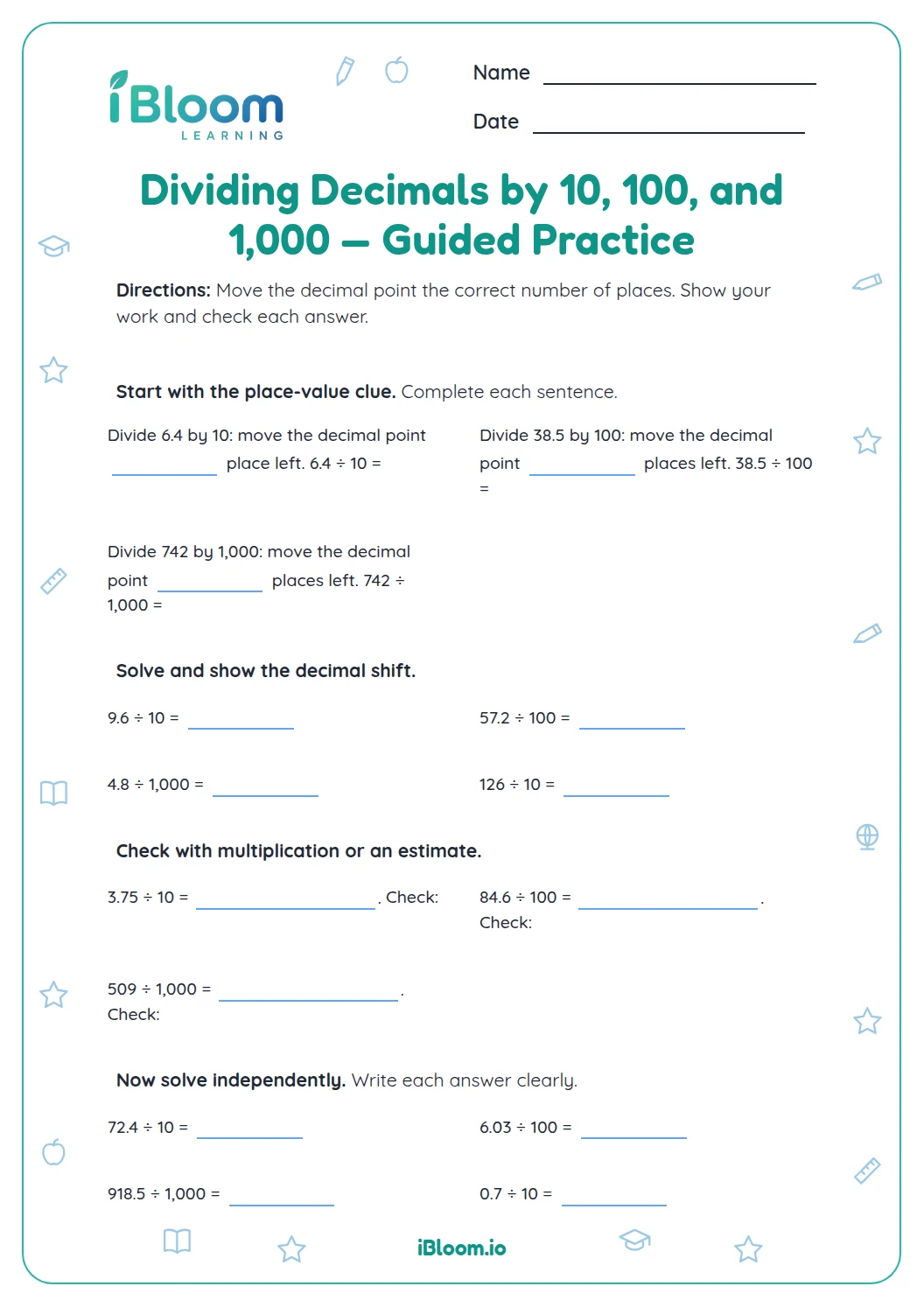
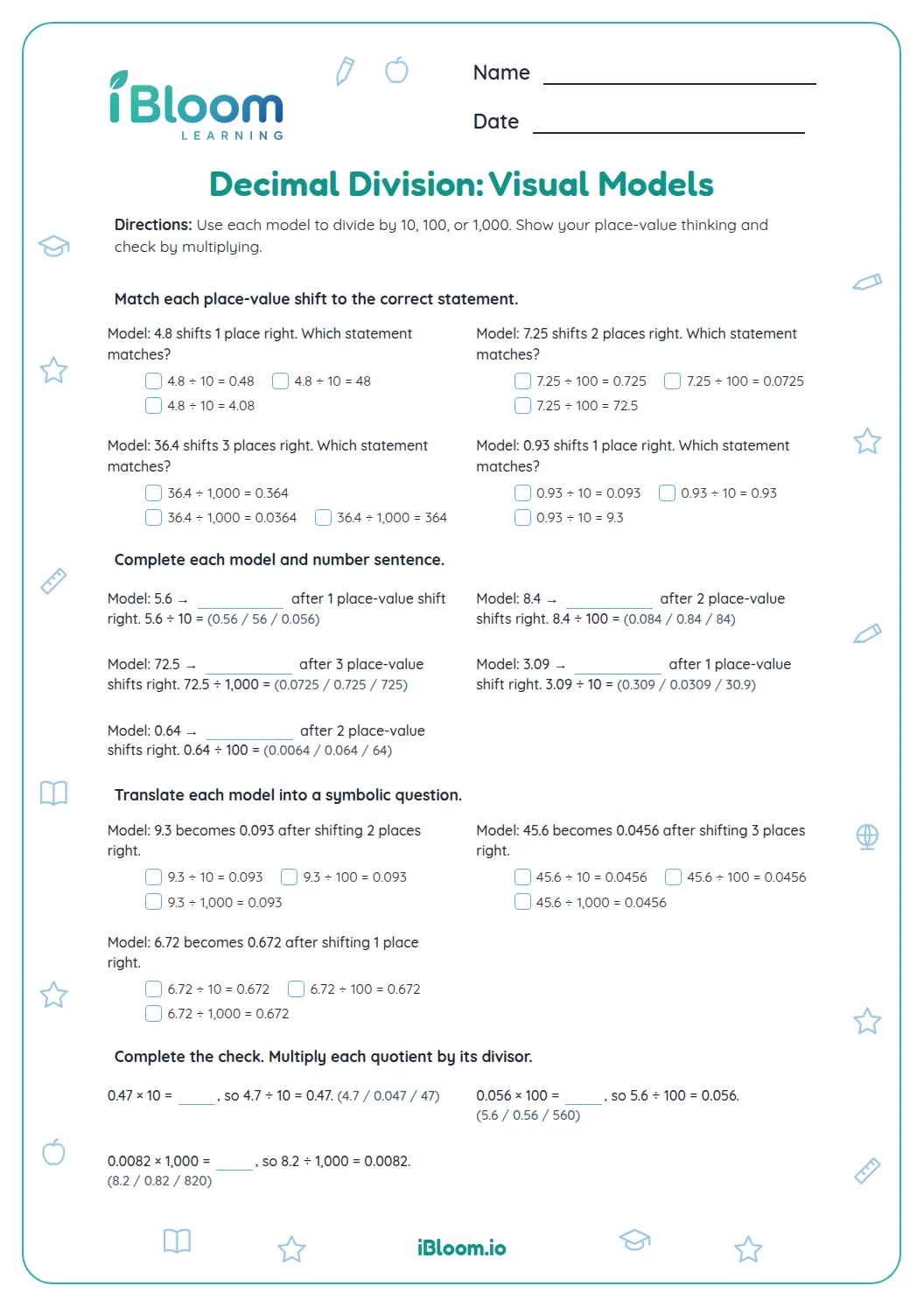
This Grade 6 worksheet gives 18 practice problems dividing decimals by 10, 100, 1,000, 10,000, and 100,000. Dividends have one to five decimal places, so students track how far each place value shifts. The sheet groups 10 one- and two-place dividends, five three-place dividends, and three four- or five-place dividends, with a separate answer key. It practices CCSS 6.NS.B.3.
Aligned to 6.NS.B.3
How does the divisor change the quotient?
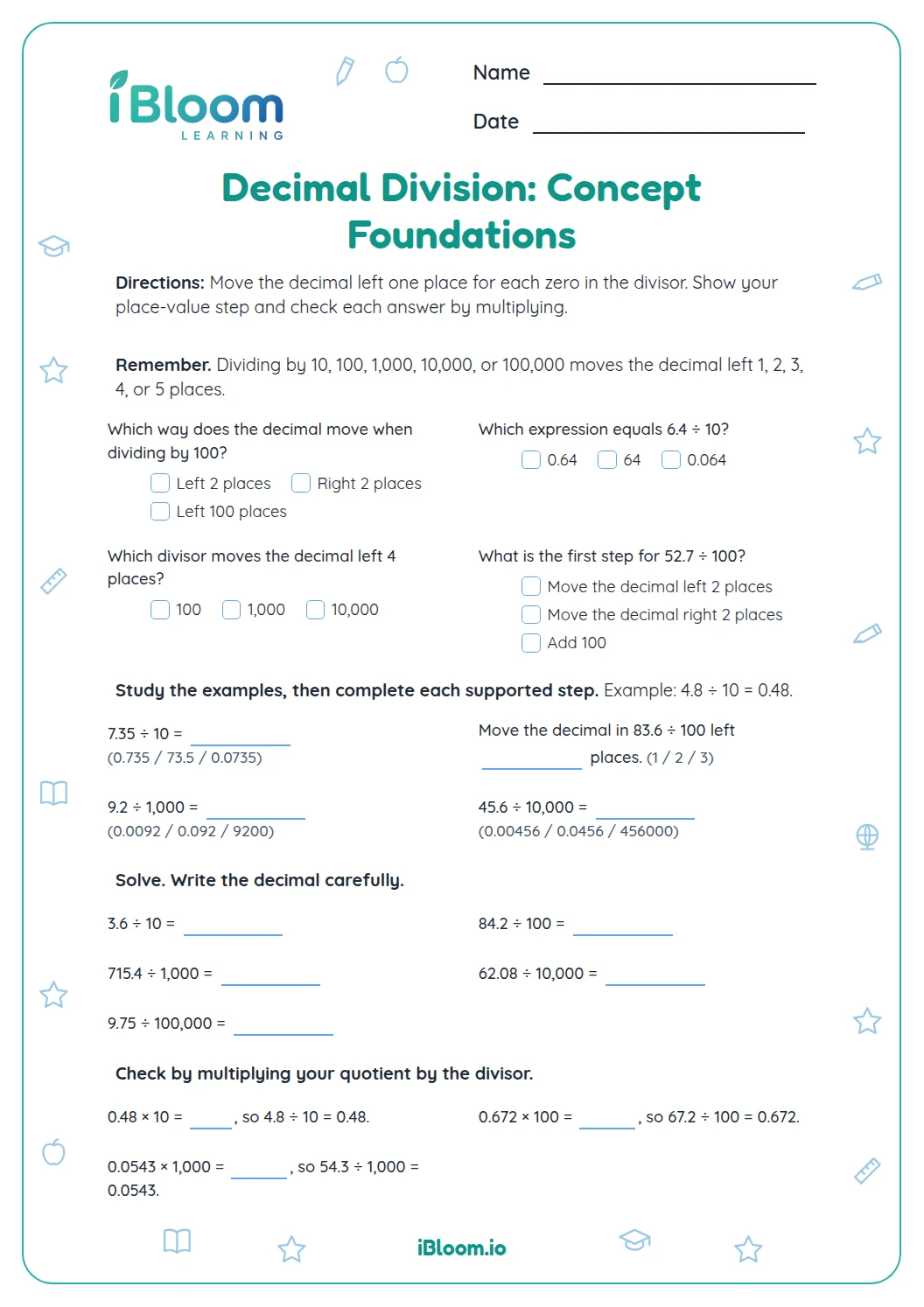
Dividing by a power of ten makes a number smaller. The number of zeros tells how many places the decimal point moves left: one place for 10, two for 100, and three for 1,000. Add zeros as placeholders when the decimal point passes the first digit.
Try question 7: 3.56 ÷ 100. Shift two places to get 0.0356. The digits stay in order; their place values change.
- 13.56 ÷ 100
- 2Move the decimal point two places left.
- 33.56 → 0.0356
- 4So, 3.56 ÷ 100 = 0.0356.
What does this practice page include?
The 18 problems move from dividends with one or two decimal places to dividends with three, four, and five places. Divisors include all five powers of ten named in the title. A separate answer key lists each quotient.
- Part A: ten dividends with one or two decimal places
- Part B: five dividends with three decimal places
- Part C: three dividends with four or five decimal places
How can a student check a quotient?
Multiply the quotient by the divisor. For question 7, 0.0356 × 100 returns 3.56. Also check whether the quotient is smaller than the starting decimal; dividing by 10 or a larger power of ten must reduce its value.
How to use this worksheet
- 1Count the zeros in the divisor before moving the decimal point.
- 2Keep the digits in order and use zeros to hold empty places.
- 3Estimate the quotient’s size before writing the final decimal.
- 4Multiply the quotient by the divisor to check.
Common mistakes and quick fixes
The mistake
Moving the decimal point right when dividing.
The fix
Division by a number greater than 1 makes the quotient smaller; move left.
The mistake
Dropping a needed zero in a small quotient.
The fix
Use a leading zero before the decimal and placeholder zeros, as in 0.0356.
The mistake
Moving the point only one place for every divisor.
The fix
Count divisor zeros: 10 has one, 10,000 has four.
Common Core alignment
This worksheet practices Grade 6 decimal computation.
Divide multi-digit decimals using the standard algorithm.
On this sheet: Students divide decimal dividends by powers of ten and check quotient place value.
Show the official wordingHide the official wording
Fluently add, subtract, multiply, and divide multi-digit decimals using the standard algorithm for each operation.
What to practice next
Make more practice
Further reading
Questions parents and teachers ask
Why does dividing by 100 move a decimal two places?
One hundred is 10 × 10, so dividing by 100 divides by ten twice. Each division shifts every digit one place to the right in place-value names, which moves the decimal point two places left. Question 7 shows this with 3.56 ÷ 100 = 0.0356.
What if there are not enough digits to move the decimal?
Write zeros as placeholders so the digits keep their correct place values. For example, 5.4 ÷ 1,000 is 0.0054: move three places left, passing the 5 and filling two empty places. This keeps the quotient’s value clear and uses a zero before the decimal point.
How can I check a decimal quotient?
Multiply the quotient by the divisor and see whether you get the starting number. For question 7, 0.0356 × 100 = 3.56. A quick estimate also helps: division by 100 should make the answer about one hundredth as large.
Which divisors appear on the worksheet?
Students divide by 10, 100, 1,000, 10,000, and 100,000. The dividends range from one to five decimal places, with six problems in each section. Students can compare each answer with the starting decimal to check that it became smaller.
Is there an answer key?
Yes. The printable has a separate answer key with all 18 quotients. Work through the two practice pages first, then use the key to check decimal placement and correct any missed problems. The key also makes it easy to check a quotient by multiplication.