



About this worksheet
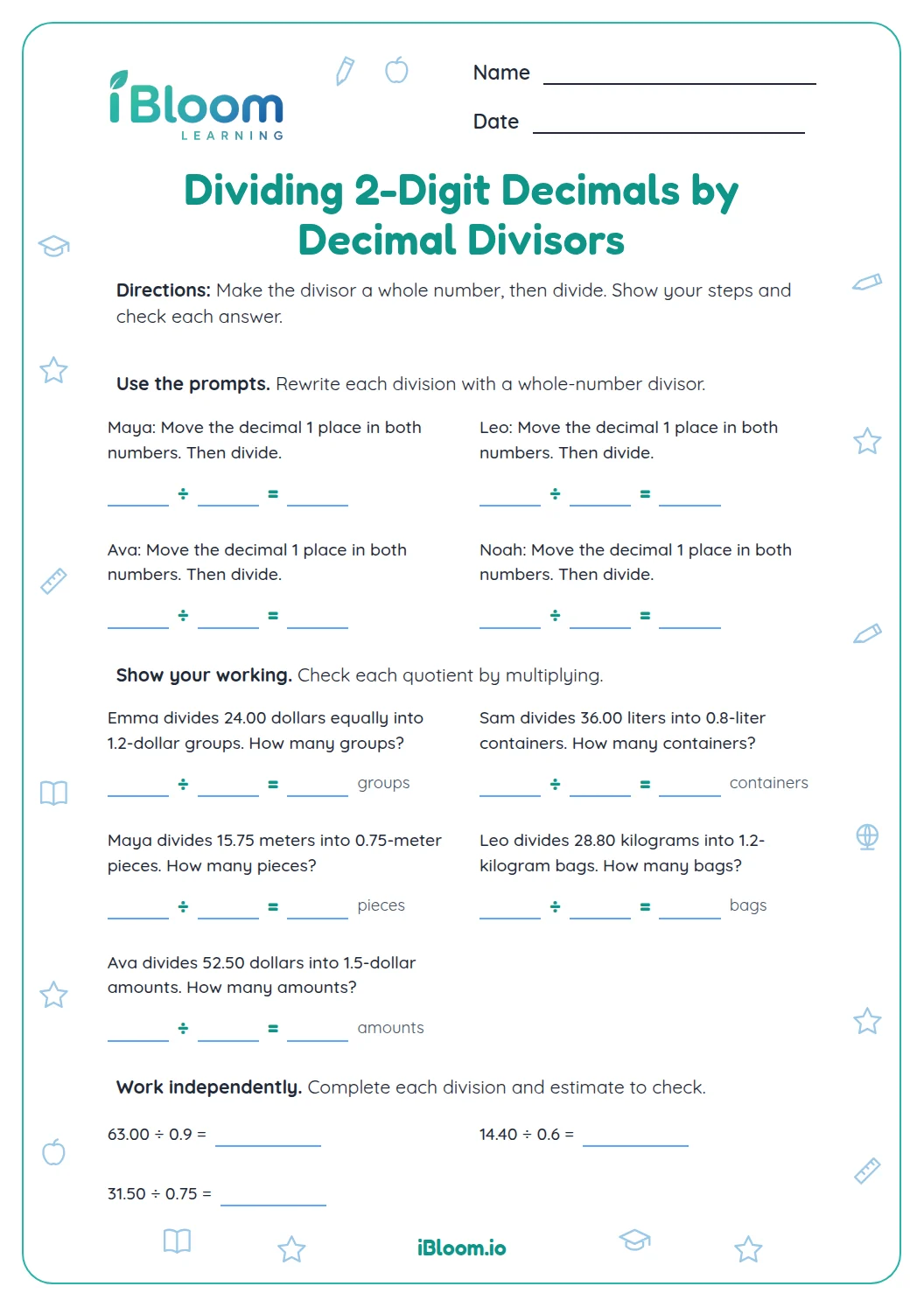
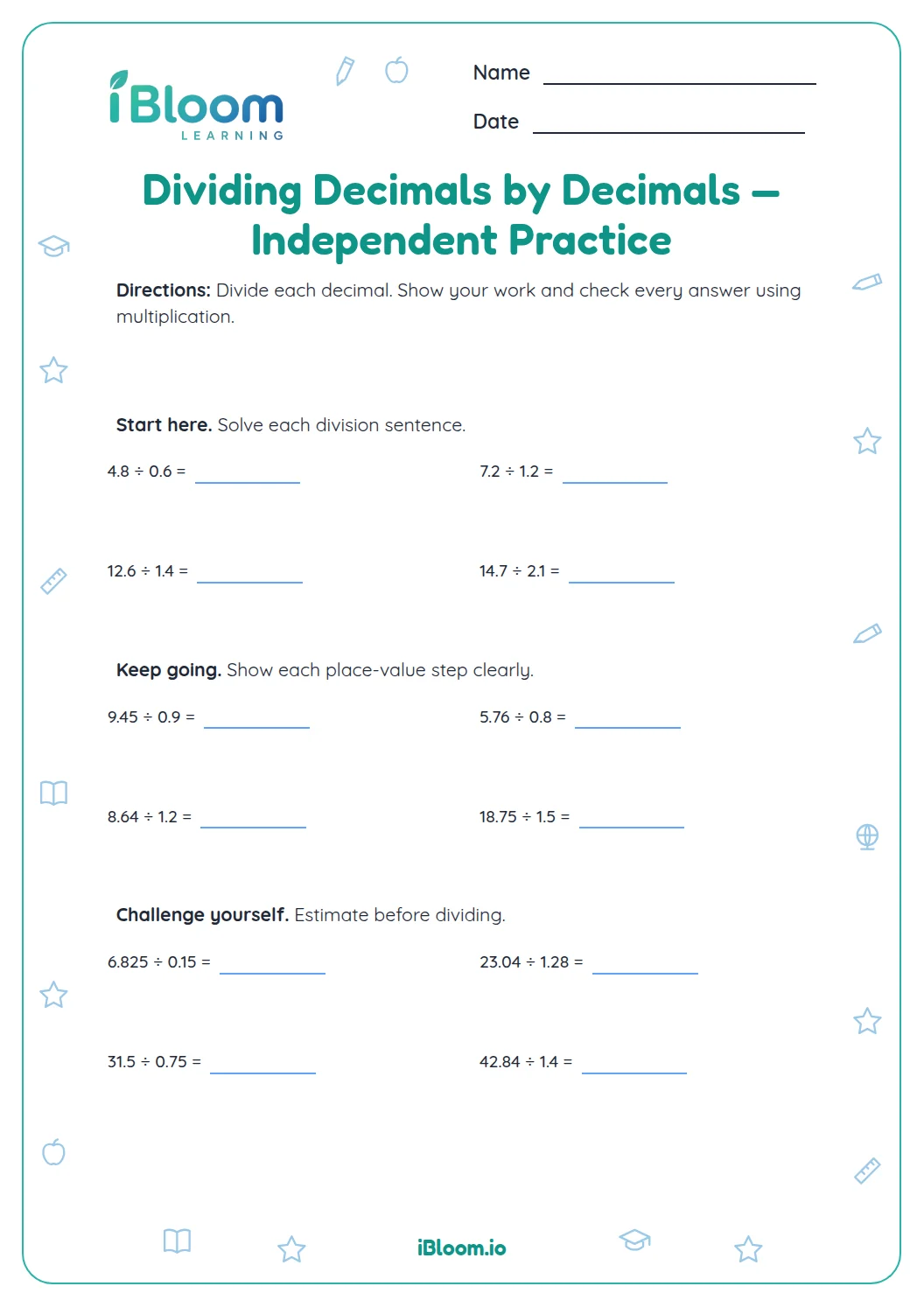
This free Grade 6 worksheet gives students sixteen decimal-division calculations to solve independently. Every dividend has two decimal places, every divisor is a decimal, and every quotient is a whole number. Part A uses divisors in tenths; Part B uses divisors in hundredths; Part C mixes divisors and includes several larger dividends. Students write equivalent whole-number-divisor calculations and use the division algorithm, then check by multiplication. The sheet practices Common Core 6.NS.B.3 and includes a separate answer key. Working space is provided for each calculation.
Aligned to 6.NS.B.3
Why must both numbers change together?
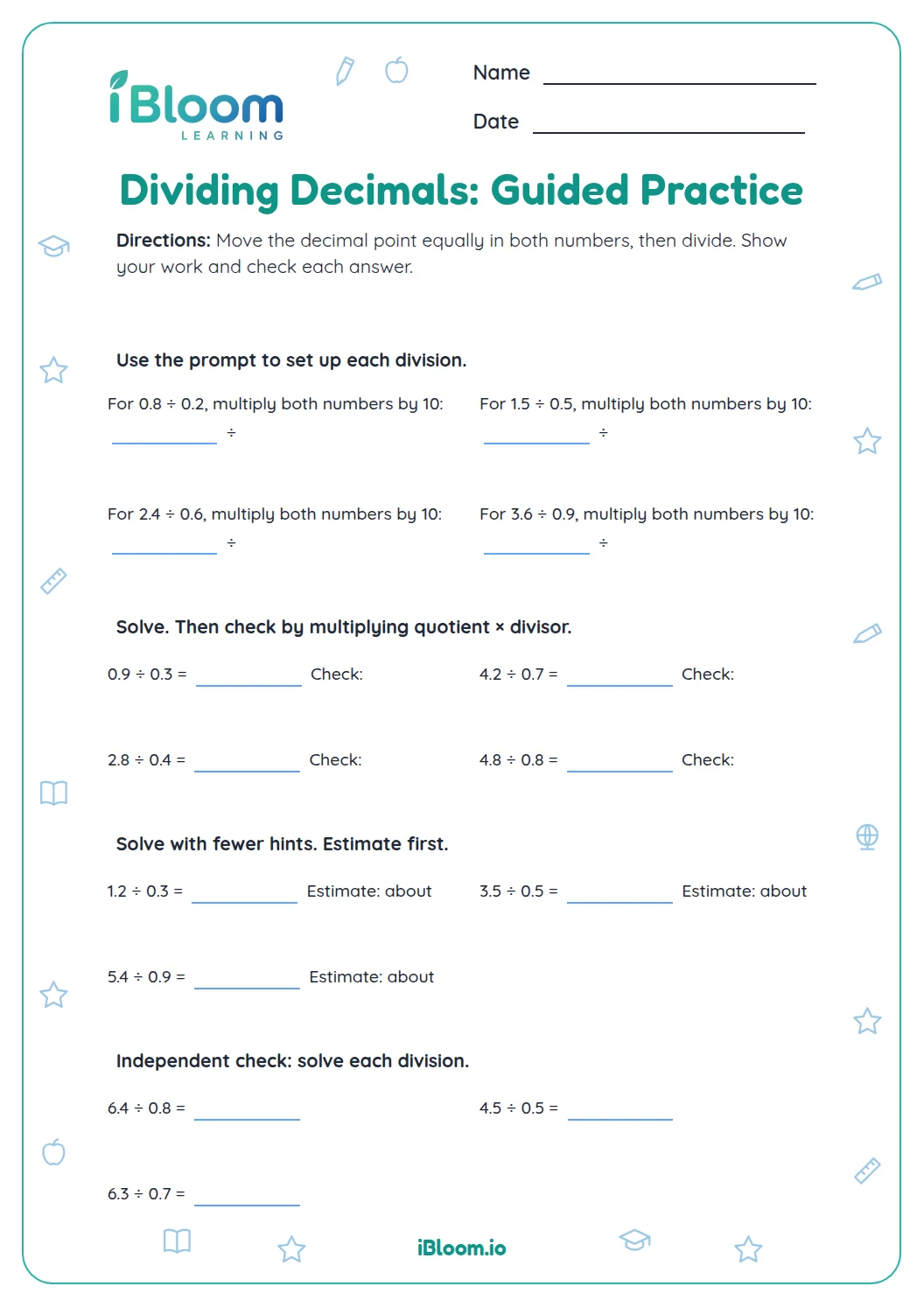
Multiplying the dividend and divisor by the same nonzero number keeps the quotient unchanged. If the divisor has one decimal place, multiply both numbers by 10. If it has two decimal places, multiply both by 100.
The divisor determines the scaling. In question 1, 4.80 ÷ 1.2 becomes 48.0 ÷ 12. In question 5, 0.84 ÷ 0.07 becomes 84 ÷ 7. Writing both transformed numbers helps students track the decimal points.
- 10.84 ÷ 0.07
- 2Multiply both numbers by 100.
- 384 ÷ 7 = 12
- 4Check: 12 × 0.07 = 0.84
What changes across the three parts?
Part A has four problems with tenths divisors, including dividends written with a final zero. Part B has six problems with hundredths divisors. Part C has six mixed problems, so students must decide how far to move both decimal points each time.
The final part includes 15.36 ÷ 1.28 and 19.44 ÷ 0.81. These give practice with larger whole-number calculations after scaling while keeping the requested quotients whole numbers.
How can students check a whole-number quotient?
Multiply the proposed quotient by the original divisor. The result should equal the original dividend, including its decimal value. For question 16, 24 × 0.81 = 19.44, so the quotient is 24.
Magnitude is another check. When a positive number is divided by a positive decimal less than 1, the quotient is larger than the dividend. A divisor greater than 1 produces a smaller quotient; question 14 uses 1.28 and gives 12.
How to use this worksheet
- 1Read the directions and note that every answer is a whole number.
- 2For each problem, decide whether the divisor needs one or two decimal places moved.
- 3Write the equivalent division calculation, multiplying both numbers by 10 or 100.
- 4Use the division algorithm in the working space and write the quotient.
- 5Multiply the quotient by the original divisor and compare with the dividend before checking the key.
Mistakes to check and ways to help
The mistake
Changing only the divisor: 0.84 ÷ 0.07 becomes 0.84 ÷ 7.
The fix
Multiply both numbers by 100 so the equivalent calculation is 84 ÷ 7.
The mistake
Multiplying by 10 for a hundredths divisor and stopping while it is still decimal.
The fix
For 0.16, use 100 so the divisor becomes 16; scale the dividend by 100 too.
The mistake
Assuming division always makes the answer smaller.
The fix
For question 12, 24 groups of 0.6 make 14.40. Dividing by a positive number less than 1 makes the quotient larger; check 24 × 0.6 = 14.40.
Common Core alignment
Divide decimals by decimals, then check whole-number quotients with multiplication.
On this sheet: Sixteen calculations give practice scaling both numbers before using the division algorithm.
Show the official wordingHide the official wording
Fluently add, subtract, multiply, and divide multi-digit decimals using the standard algorithm for each operation.
What to practice next
Make more practice
Further reading
Questions parents and teachers ask
What does two-digit decimals mean on this sheet?
The dividends are written to two decimal places, such as 4.80, 0.84, and 15.36. Divisors have one or two decimal places. Students must inspect the divisor to choose a scaling factor of 10 or 100, and all sixteen calculations have exact whole-number quotients.
Why does 0.84 divided by 0.07 equal 12?
There are twelve groups of seven hundredths in eighty-four hundredths. Multiplying both decimals by 100 gives the equivalent calculation 84 ÷ 7 = 12. Question 5 provides working space for that transformation, and multiplying 12 by the original divisor, 0.07, checks the result.
Can students remove a final zero from a dividend?
Yes, a final zero after the decimal does not change the value: 4.80 equals 4.8. Students should still scale both numbers equally to make the divisor whole. For question 1, either notation leads to 48 ÷ 12, so the whole-number quotient is 4.
Are there any answers that need rounding?
No, all sixteen quotients are exact whole numbers. If a calculation leaves a remainder or an unexpected decimal answer, students should check their scaling and division. The multiplication check is decisive: the answer times the original divisor must equal the original dividend exactly, without rounding.
How should this independent practice be checked?
Use the separate answer key to check each quotient, and review the written calculations for any missed item. Ask the student to show how both numbers were scaled and to multiply back with the original divisor. This distinguishes a scaling mistake from an error in the division itself.