





About this worksheet
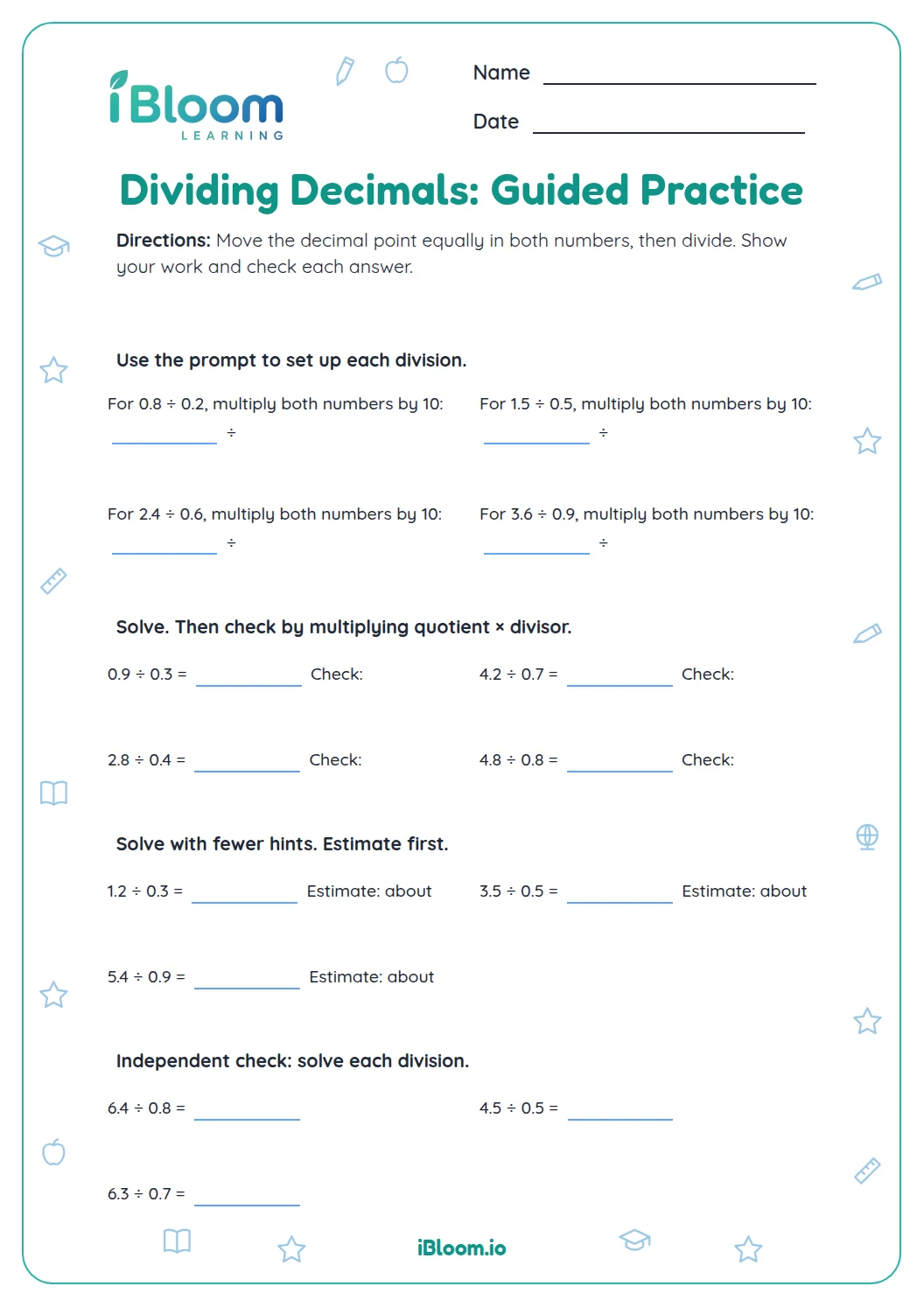
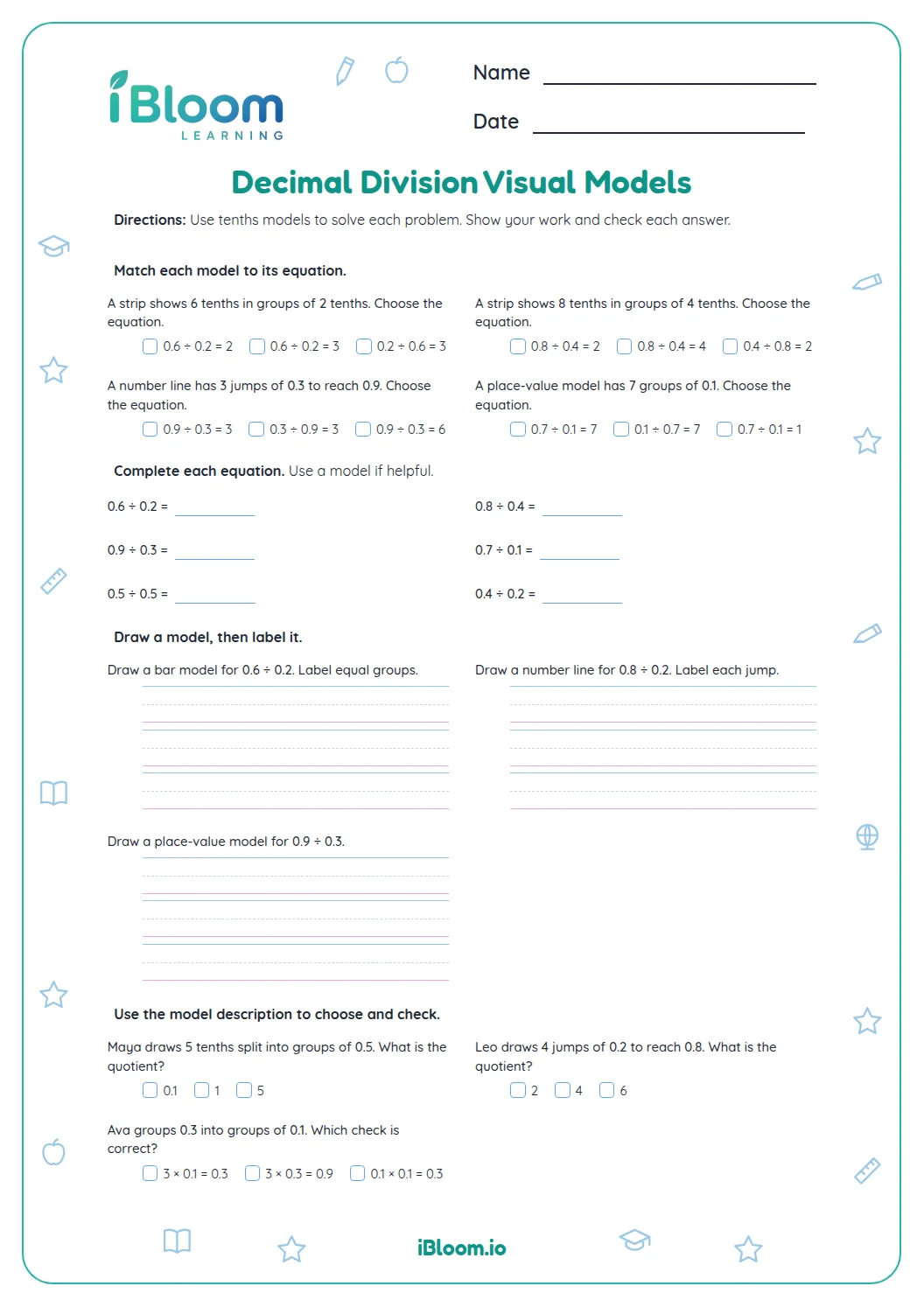
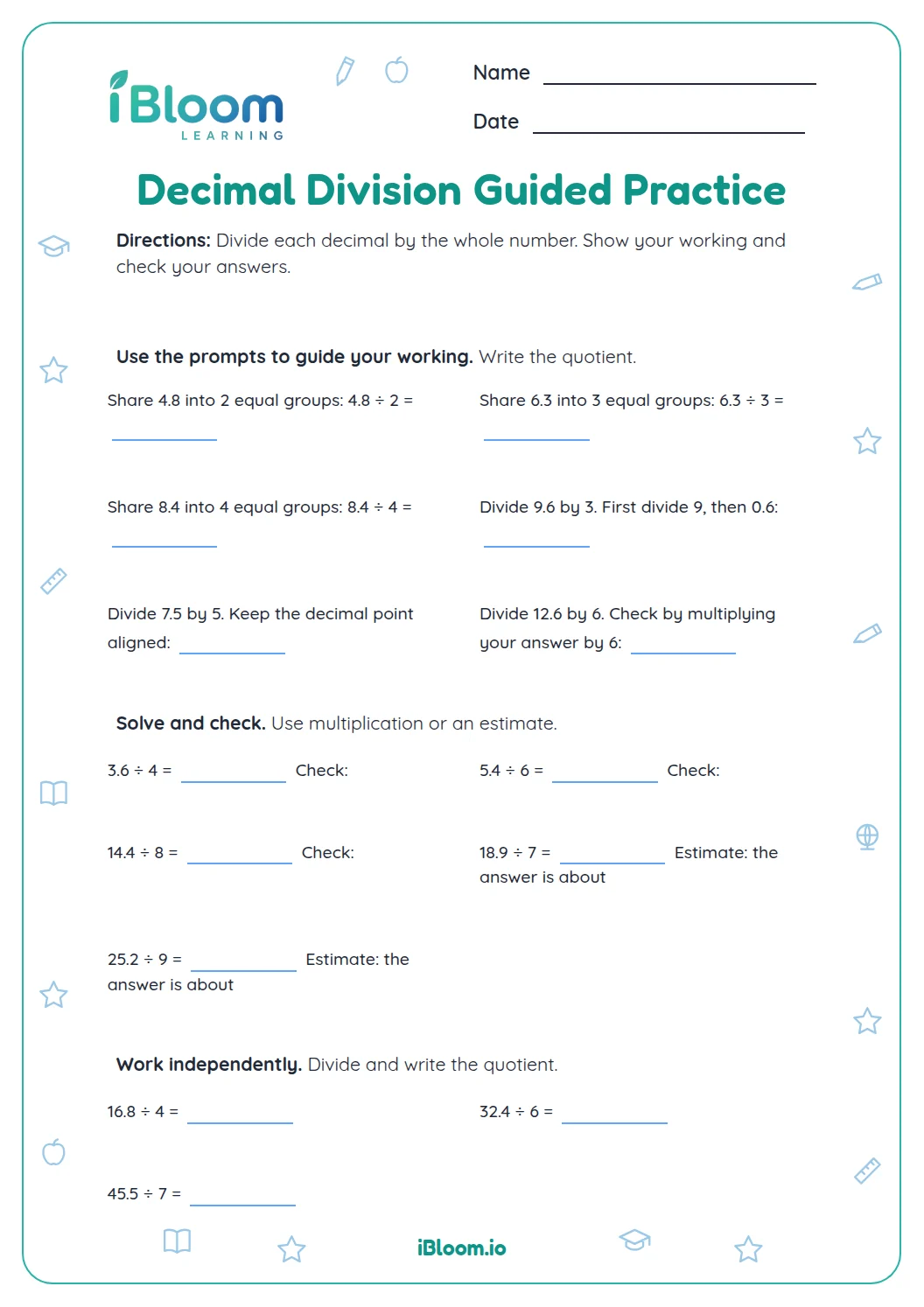
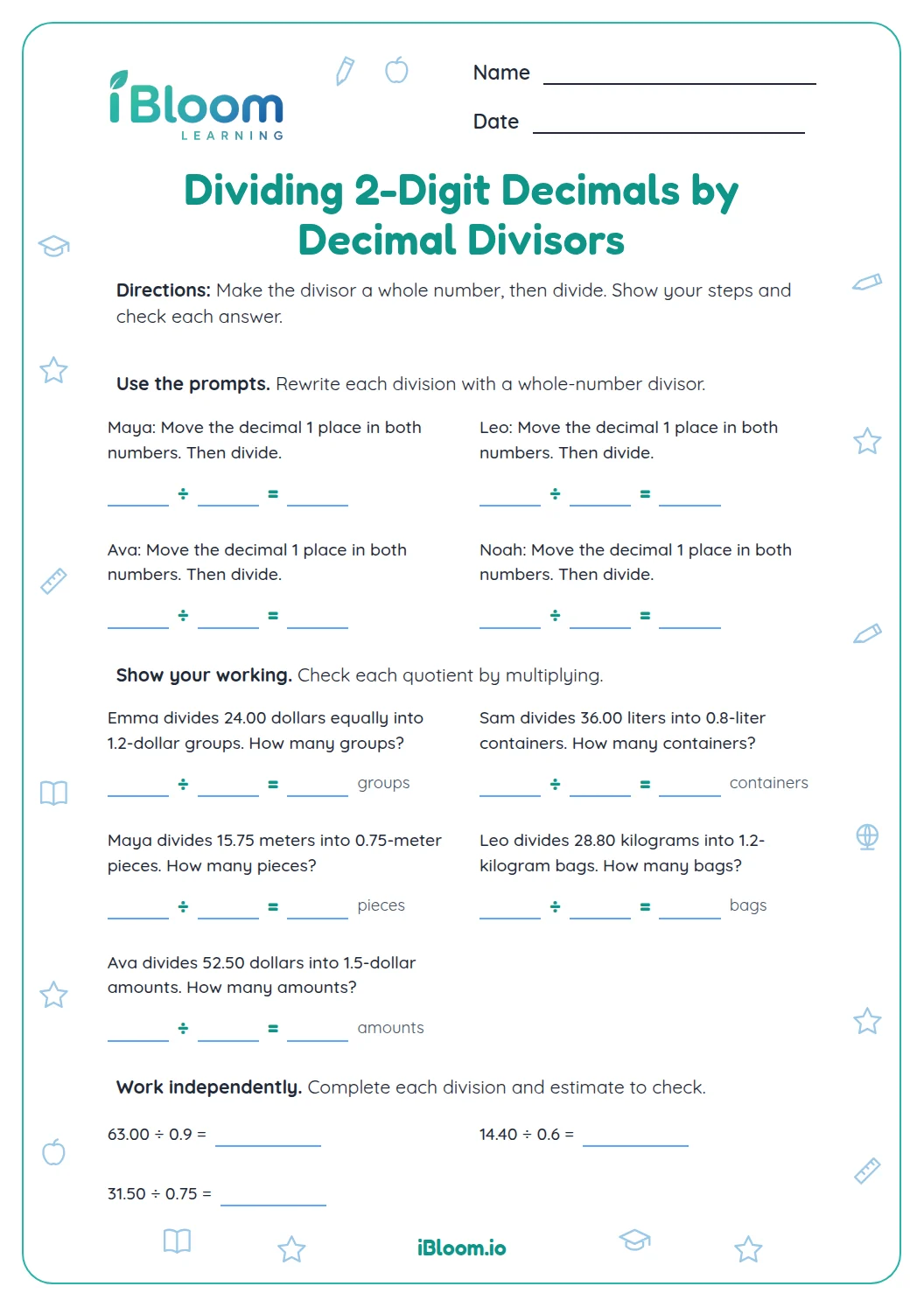
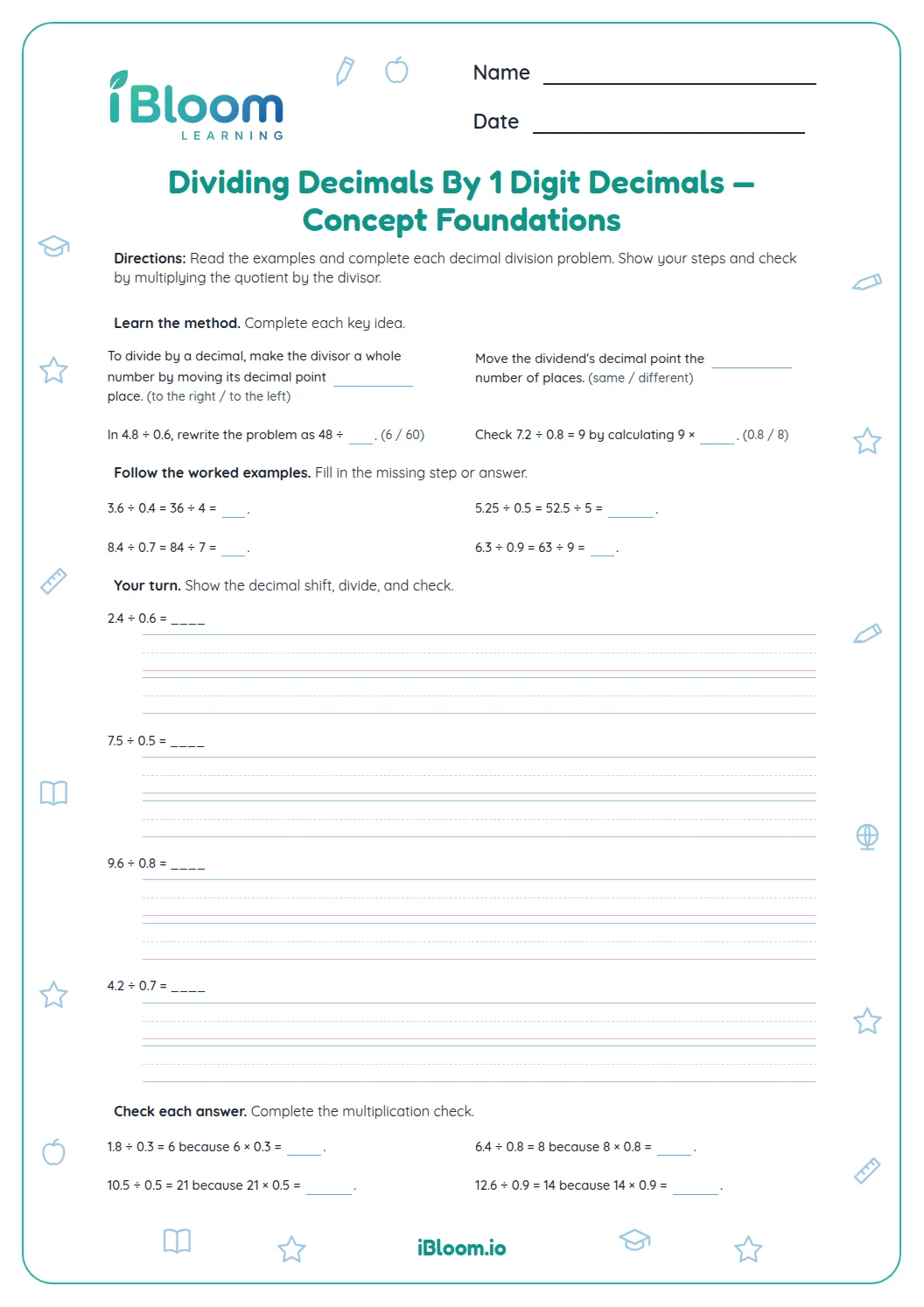
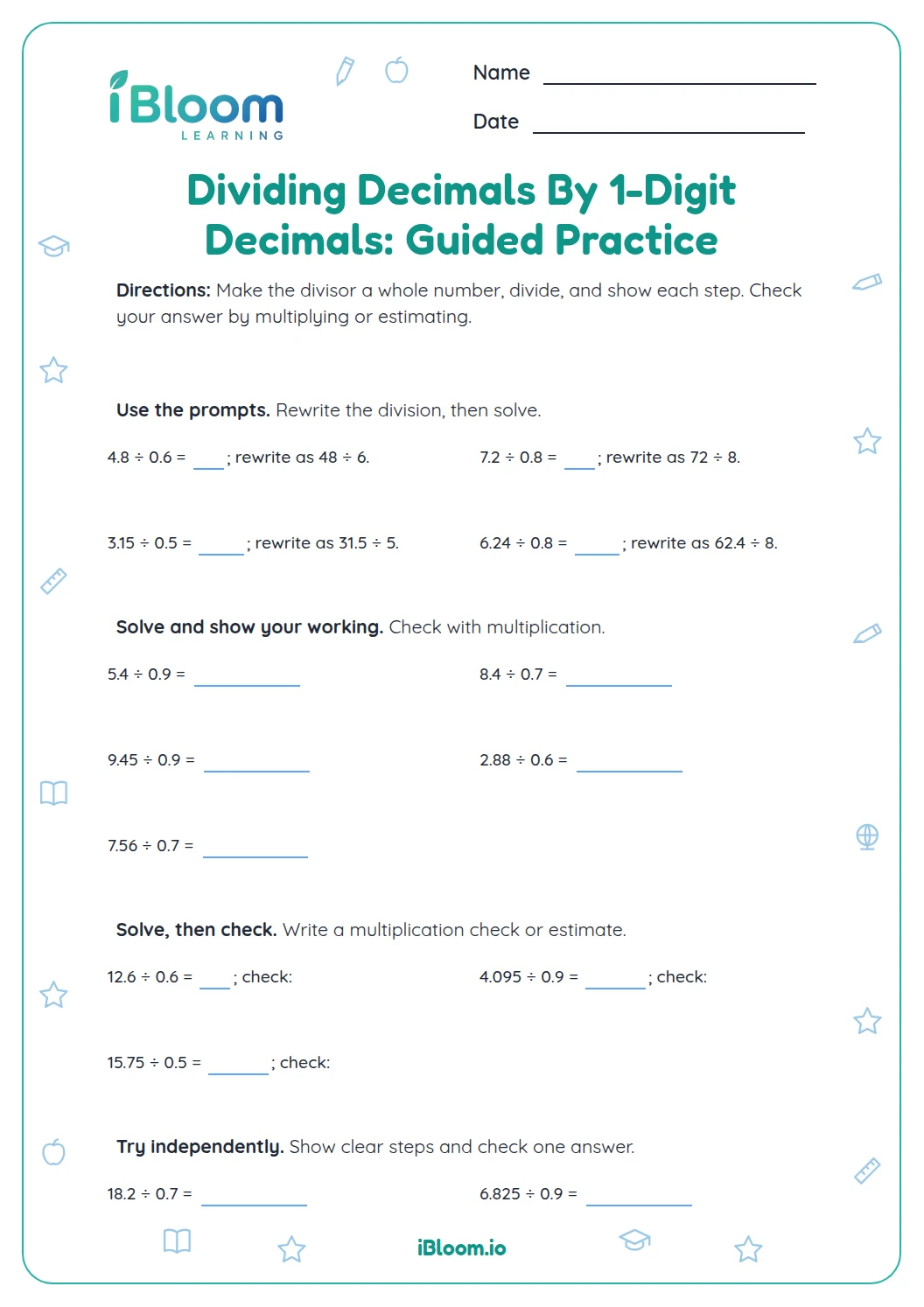
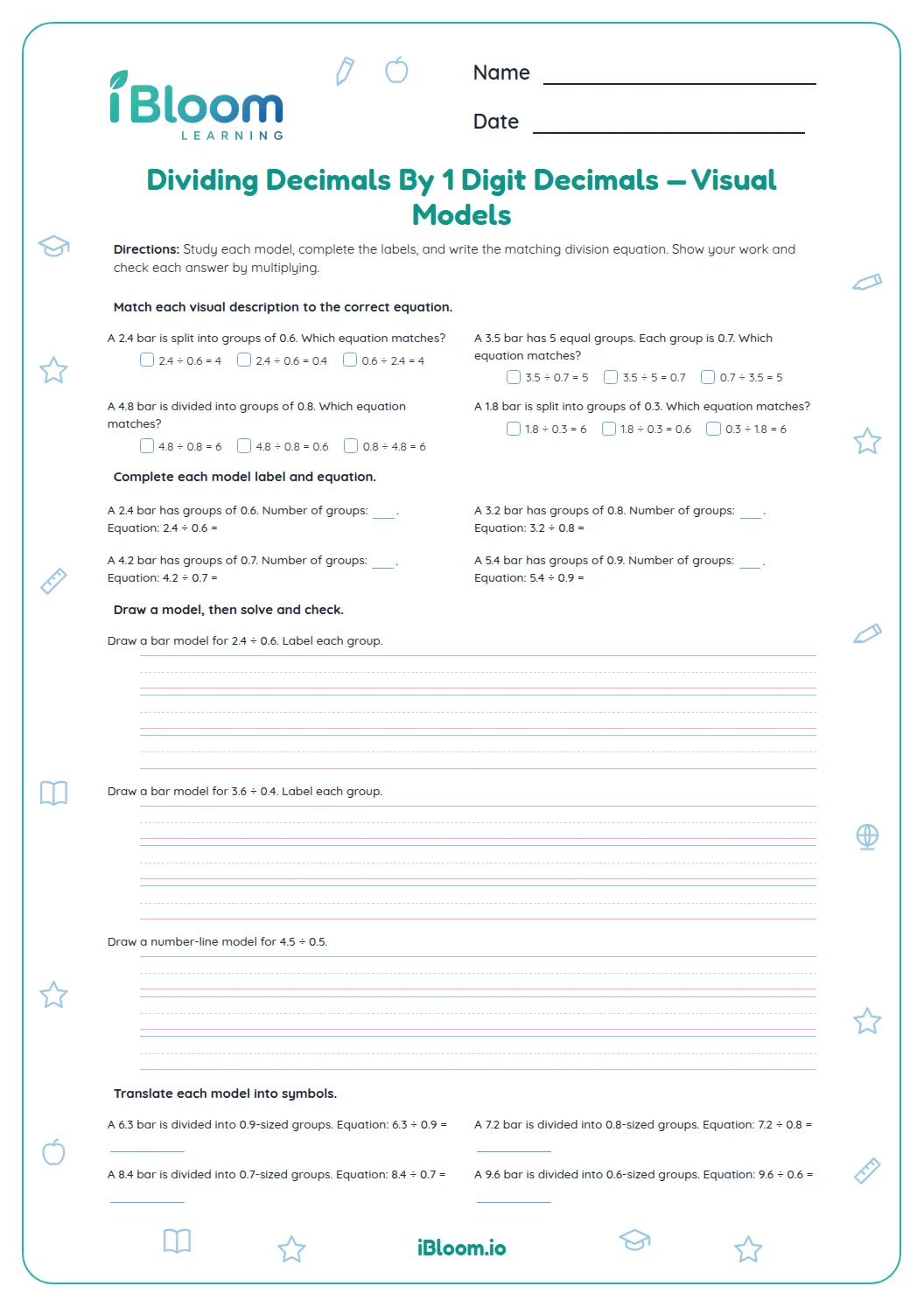
This free Grade 6 worksheet provides independent practice dividing one-decimal-place numbers by decimals, with a whole-number quotient every time. Part A has 16 calculations, including dividends greater than 10 and divisors both below and above 1. Part B applies the operation to ribbon, juice, trail sections, and rice. Students can rewrite each division using whole numbers, divide, and check by multiplying the quotient by the original divisor. The practice supports Common Core 6.NS.B.3. A separate answer key gives all 20 answers.
Aligned to 6.NS.B.3
Why do both numbers change?
Multiplying the dividend and divisor by 10 keeps the quotient unchanged. A question about how many groups of seven tenths fit into 126 tenths becomes a whole-number division question. Changing just one number changes the group count.
- 112.6 ÷ 0.7 = ___
- 2Multiply both numbers by 10: 126 ÷ 7 = 18.
- 3Check: 18 × 0.7 = 12.6.
- 4Answer: 18
What practice is on the sheet?
Part A moves from calculations such as 1.2 ÷ 0.3 to 14.4 ÷ 1.2 and 16.8 ÷ 2.4. All numbers have one decimal place, and all 16 quotients are whole numbers. Part B asks how many equal lengths, servings, sections, or bags can be made.
Ask students to keep the rewritten division beside their answer on scratch paper if they need more working room. The word problems have space for a number sentence.
How can students catch a misplaced decimal?
Multiply the proposed quotient by the original divisor. For 12.6 ÷ 0.7, an answer of 1.8 fails because 1.8 × 0.7 is 1.26. Also consider the divisor: dividing by a positive number smaller than 1 makes the quotient larger than the dividend.
How to use this worksheet
- 1Read the instructions and note that every answer is a whole number.
- 2Complete Part A independently, multiplying both numbers by 10 before dividing.
- 3For Part B, identify the total amount and the amount in one group.
- 4Check each answer with the original divisor, then compare with the key.
Mistakes to notice and fix
The mistake
Changing 12.6 ÷ 0.7 into 12.6 ÷ 7.
The fix
Multiply both numbers by 10: 126 ÷ 7.
The mistake
Writing 1.8 instead of 18 for question 6.
The fix
Check 18 × 0.7 = 12.6 and compare it with the original dividend.
The mistake
Dividing the piece length by the ribbon length.
The fix
Write total length ÷ length of one piece; the answer counts pieces.
Common Core alignment
Divide decimals to tenths and check whole-number quotients by multiplication.
On this sheet: Students divide decimals independently and apply the same operation to equal groups.
Show the official wordingHide the official wording
Fluently add, subtract, multiply, and divide multi-digit decimals using the standard algorithm for each operation.
What to practice next
Make more practice
Further reading
Questions parents and teachers ask
Are all the answers whole numbers?
Yes, every calculation and word problem has a whole-number answer. The quotients range from 3 to 42, so students cannot rely on a single multiplication table. Have them check the original decimal equation by multiplication, even when the answer seems obvious.
What does one decimal place mean here?
It means the numbers are written to tenths, such as 0.7, 12.6, and 2.4. The whole-number part can have more than one digit. Since each divisor has one decimal place, multiplying both numbers by 10 makes each division ready for whole-number calculation.
Why can division make a number larger?
A divisor smaller than 1 asks how many small groups fit into the total. In 8.4 ÷ 0.2, there are five groups of 0.2 in each whole. There are 42 such groups in 8.4, so the quotient is larger than the dividend.
How should students check the word problems?
Multiply the group count by the amount in each group. For the rice problem, 21 bags holding 0.9 kg each give 18.9 kg altogether. That matches the starting amount and confirms that the answer describes bags, while the multiplication result describes kilograms.
Can I use this for independent work?
Yes, the sheet is designed for students who have already learned to divide by a decimal. Let them complete the calculations and four word problems before showing the key. During review, ask them to explain one equal-scaling step and one multiplication check in their own words.