
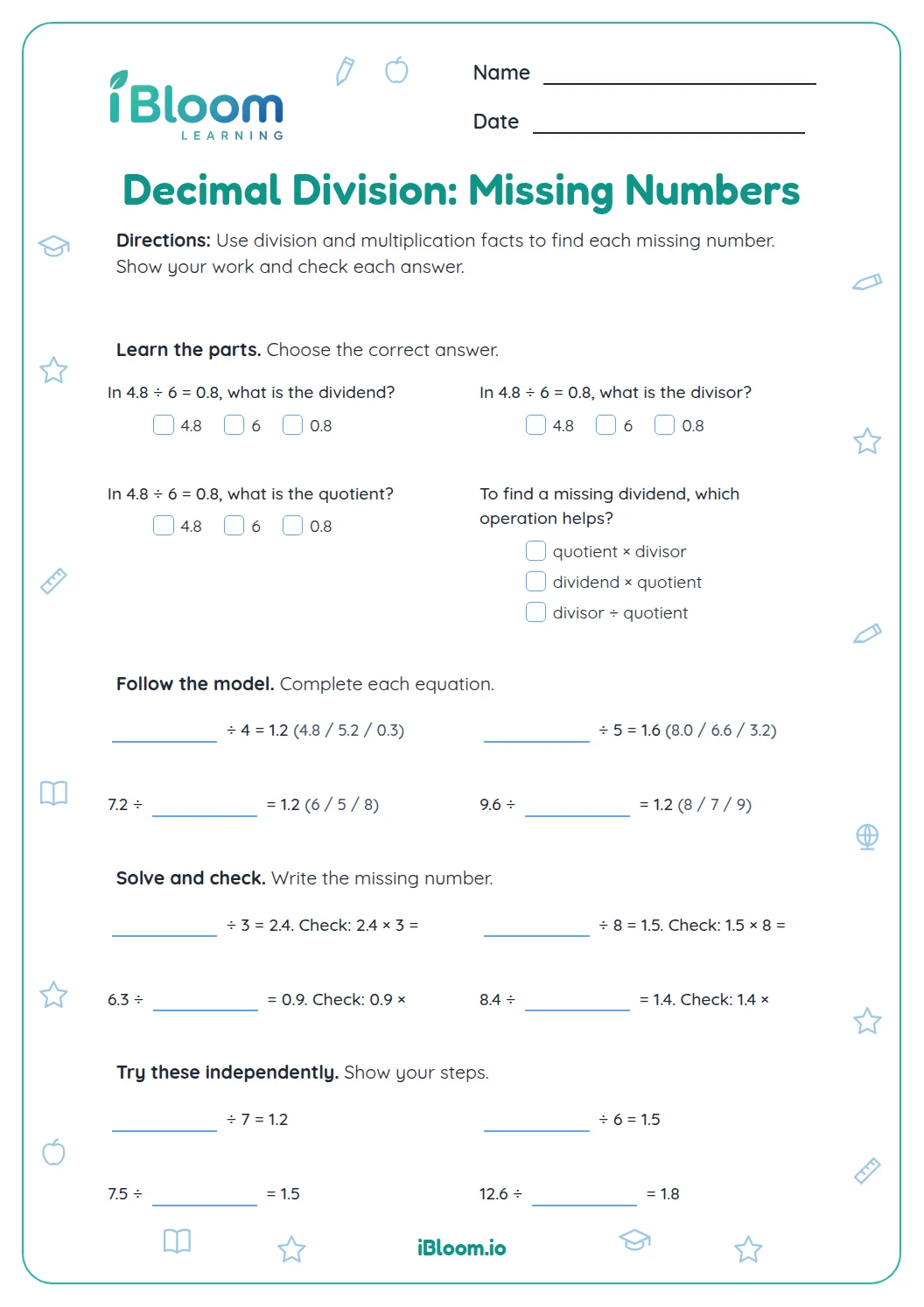
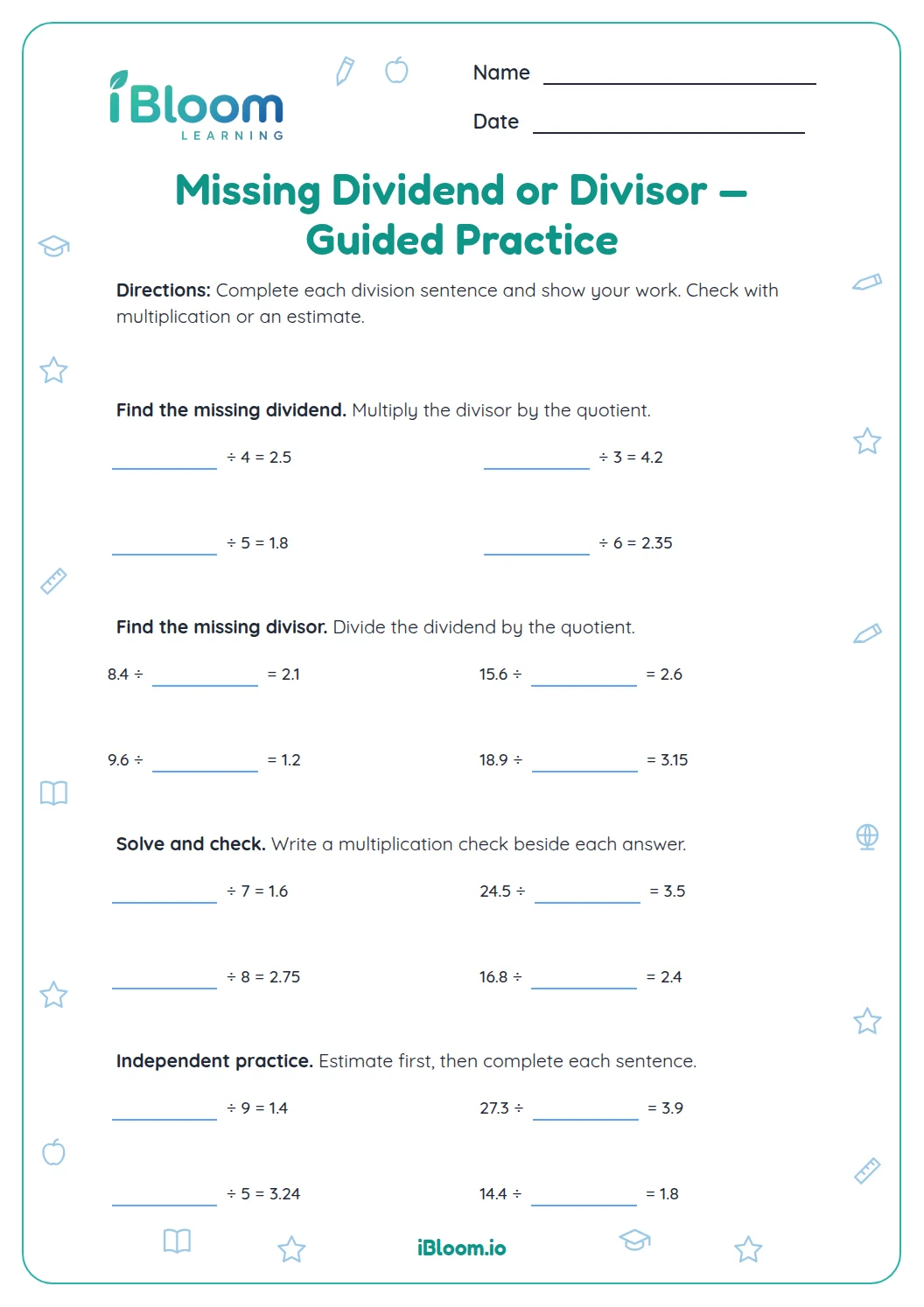
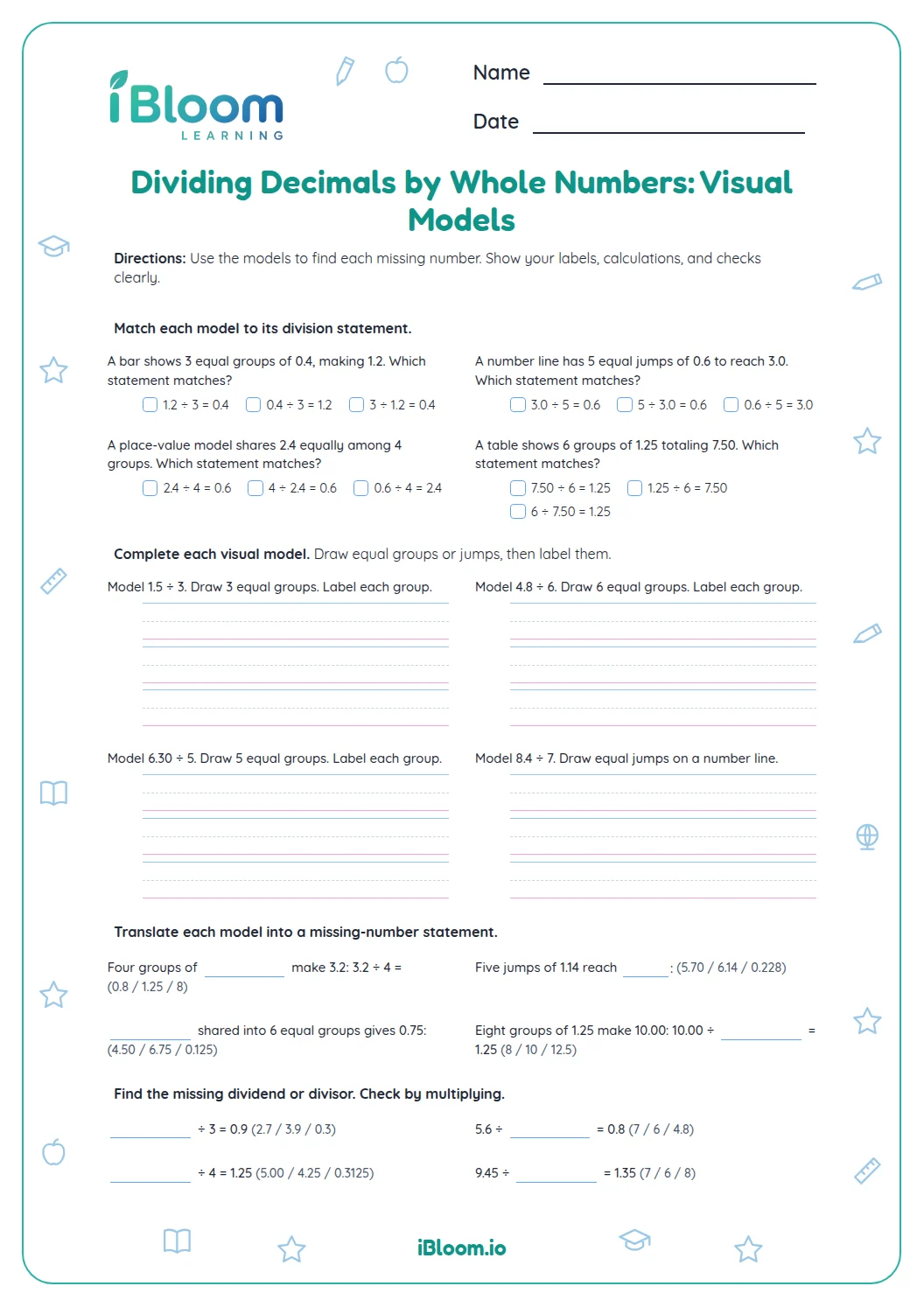

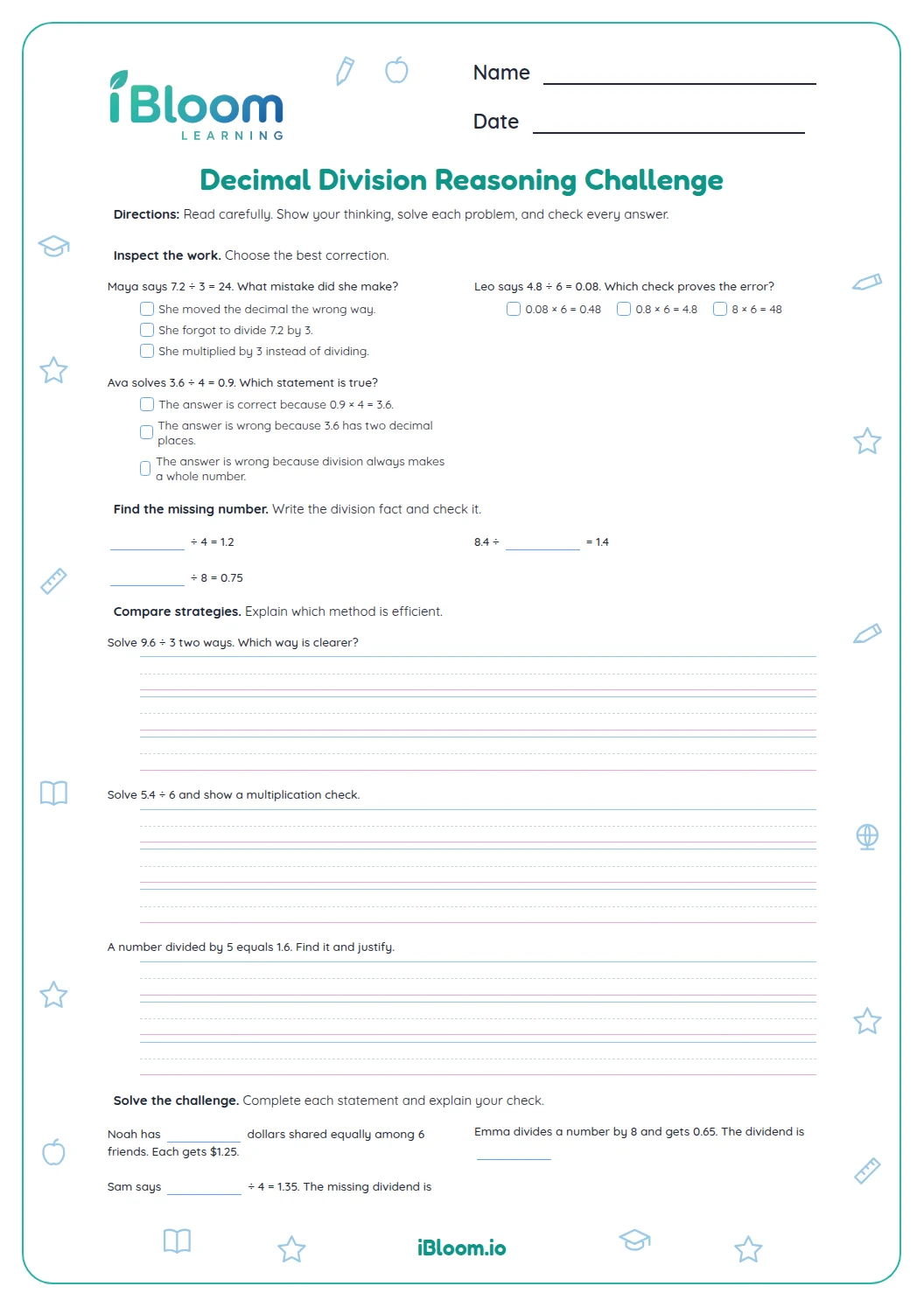
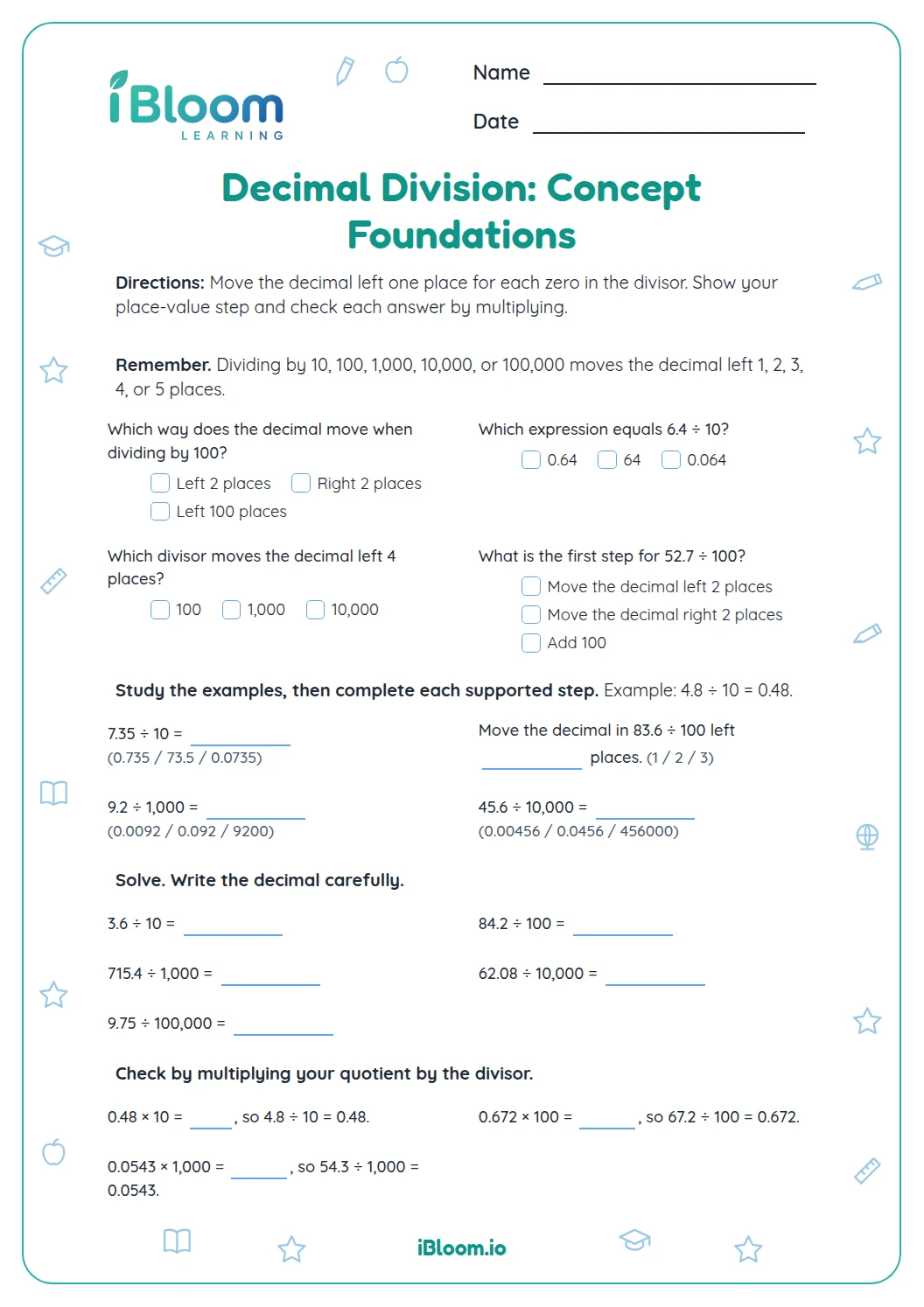
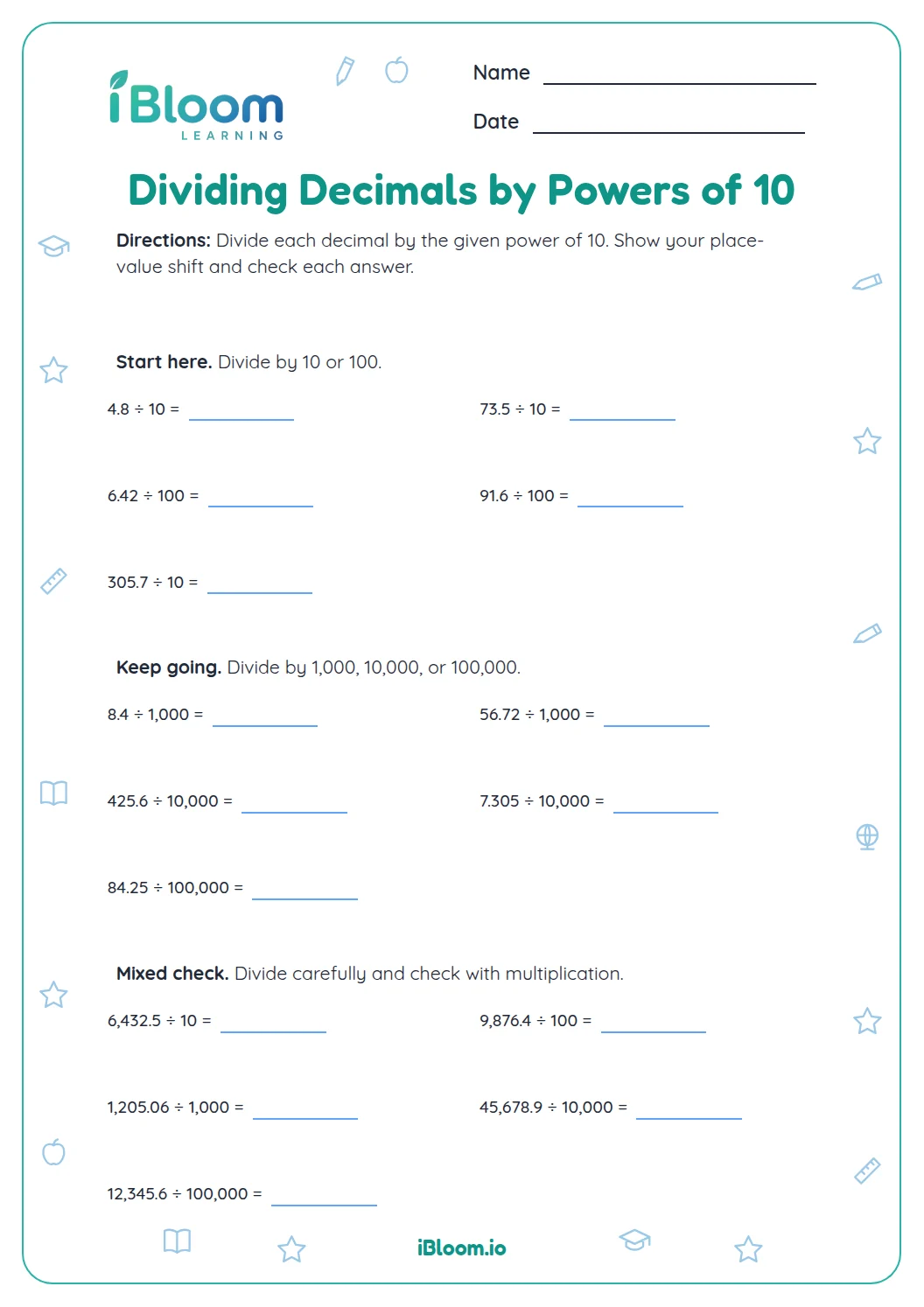
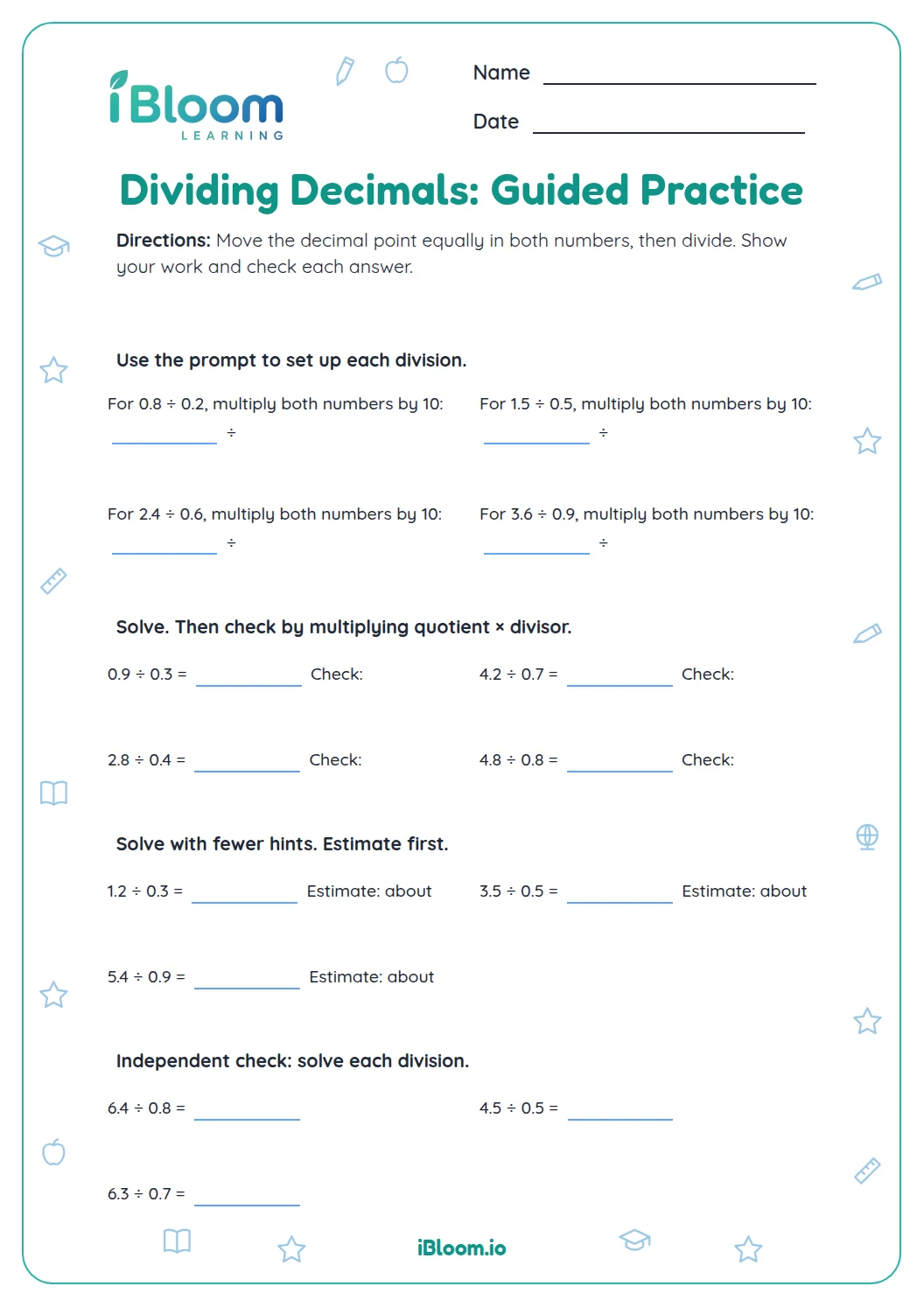
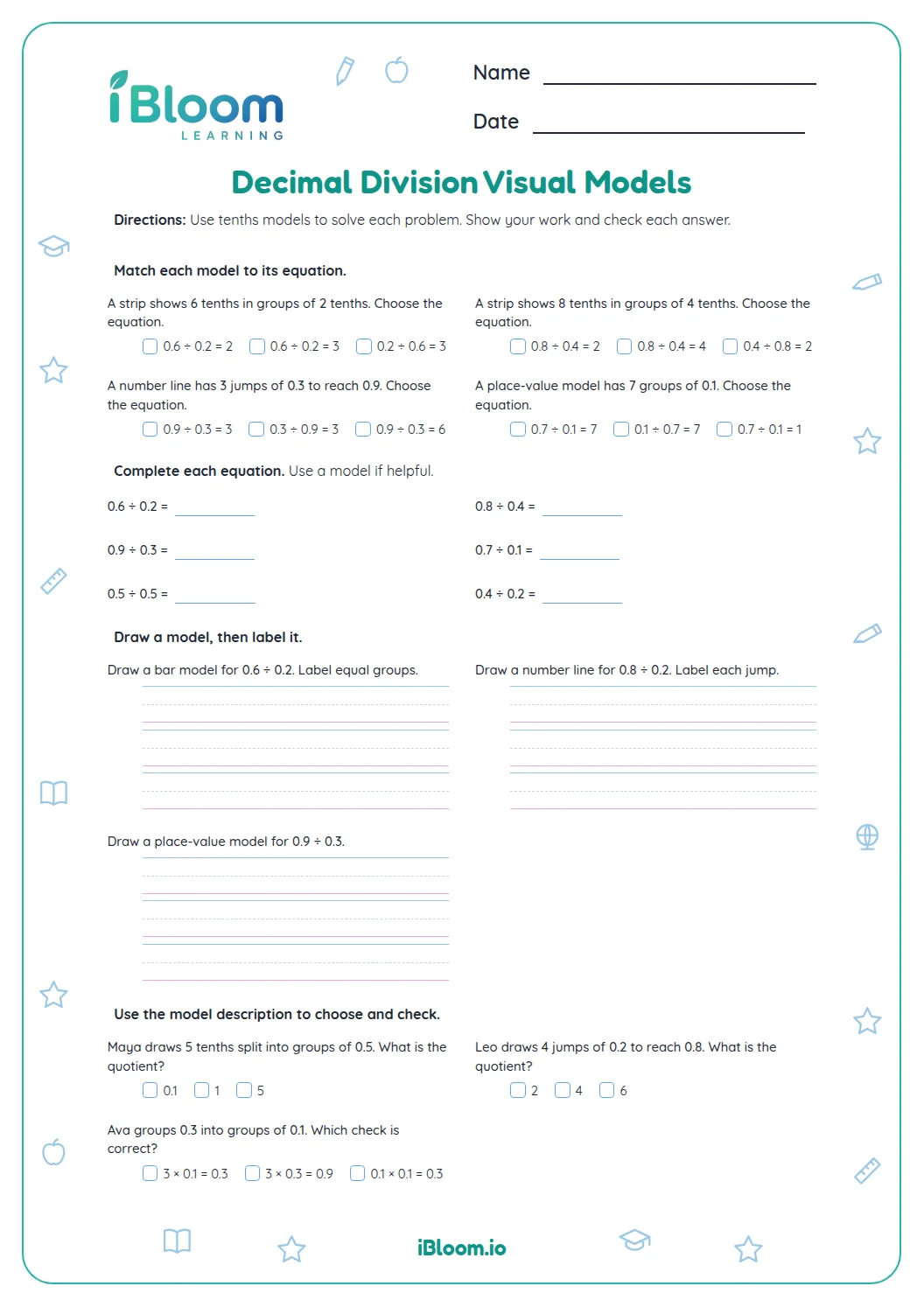
About this worksheet
This Grade 6 worksheet practices division with decimals through missing-number equations. Students solve quotients, then use the relationship between division and multiplication to recover a missing dividend or divisor. The 16 problems include whole-number and decimal dividends and short decimal quotients, with an answer key for checking each value. The practice aligns with Common Core 6.NS.B.3, which includes fluently dividing multi-digit numbers and decimals using the standard algorithm.
Aligned to 6.NS.B.3
How do you divide a decimal by a whole number?
Divide as you would with whole numbers, and place the decimal point in the quotient above the decimal point in the dividend.
- 16.3 ÷ 3 = 2.1
How can multiplication reveal a missing number?
A quotient multiplied by its divisor gives the dividend. If the divisor is missing, divide the dividend by the quotient.
- 1___ ÷ 5 = 2.06; 2.06 × 5 = 10.3
How can you check a division answer?
Multiply the quotient by the divisor. The product should equal the dividend, including its decimal place.
How to use this worksheet
- 1Identify which part of the division sentence is missing.
- 2When the quotient is missing, divide the dividend by the divisor.
- 3When the dividend is missing, multiply the quotient by the divisor.
- 4When the divisor is missing, divide the dividend by the quotient.
- 5Multiply your quotient and divisor to check.
Common mistakes and quick fixes
The mistake
Dropping the decimal point when dividing.
The fix
Place it in the quotient directly above the point in the dividend.
The mistake
Dividing the quotient by the known divisor to find a missing dividend.
The fix
Multiply quotient × divisor to recover the dividend.
The mistake
Moving the decimal in just one number without changing the equation equally.
The fix
Keep equivalent place value in both numbers if you scale the divisor.
Common Core alignment
These standards describe the reading, writing, or math students practice on this page.
Divide multi-digit numbers and decimals using the standard algorithm.
On this sheet:
Show the official wordingHide the official wording
Fluently add, subtract, multiply, and divide multi-digit decimals using the standard algorithm for each operation.
What to practice next
Make more practice
Further reading
Questions parents and teachers ask
How many problems are on this worksheet?
There are 16 number sentences in two parts. Part A includes quotient calculations and missing values; Part B continues with missing dividends, divisors, and quotients. Students write a value in each answer box, then can check the completed division sentence with multiplication.
How do you find a missing dividend?
Multiply the quotient by the divisor. In ___ ÷ 5 = 1.24, calculate 1.24 × 5 to get 6.2, so the missing dividend is 6.2. Multiplication reverses the division and gives a direct check: 6.2 ÷ 5 equals 1.24. This method works in every missing-dividend problem here.
How do you find a missing divisor?
Divide the dividend by the quotient. For 7.2 ÷ ___ = 1.8, calculate 7.2 ÷ 1.8 to get 4. Then check by multiplying 1.8 × 4; the product is 7.2, which matches the dividend in the original sentence. Keep the decimal values in the calculation.
Where should the decimal point go when dividing?
When dividing a decimal dividend by a whole number, place the decimal point in the quotient directly above the point in the dividend. For 6.3 ÷ 3, the quotient is 2.1. Keeping the decimal aligned helps preserve the value of the tenths.
How can students check a division answer?
Multiply the quotient by the divisor and compare the product with the dividend. For example, 2.1 × 3 = 6.3 checks 6.3 ÷ 3 = 2.1. For a missing dividend, divisor, or quotient, the same multiplication relationship confirms whether the completed sentence is true.