




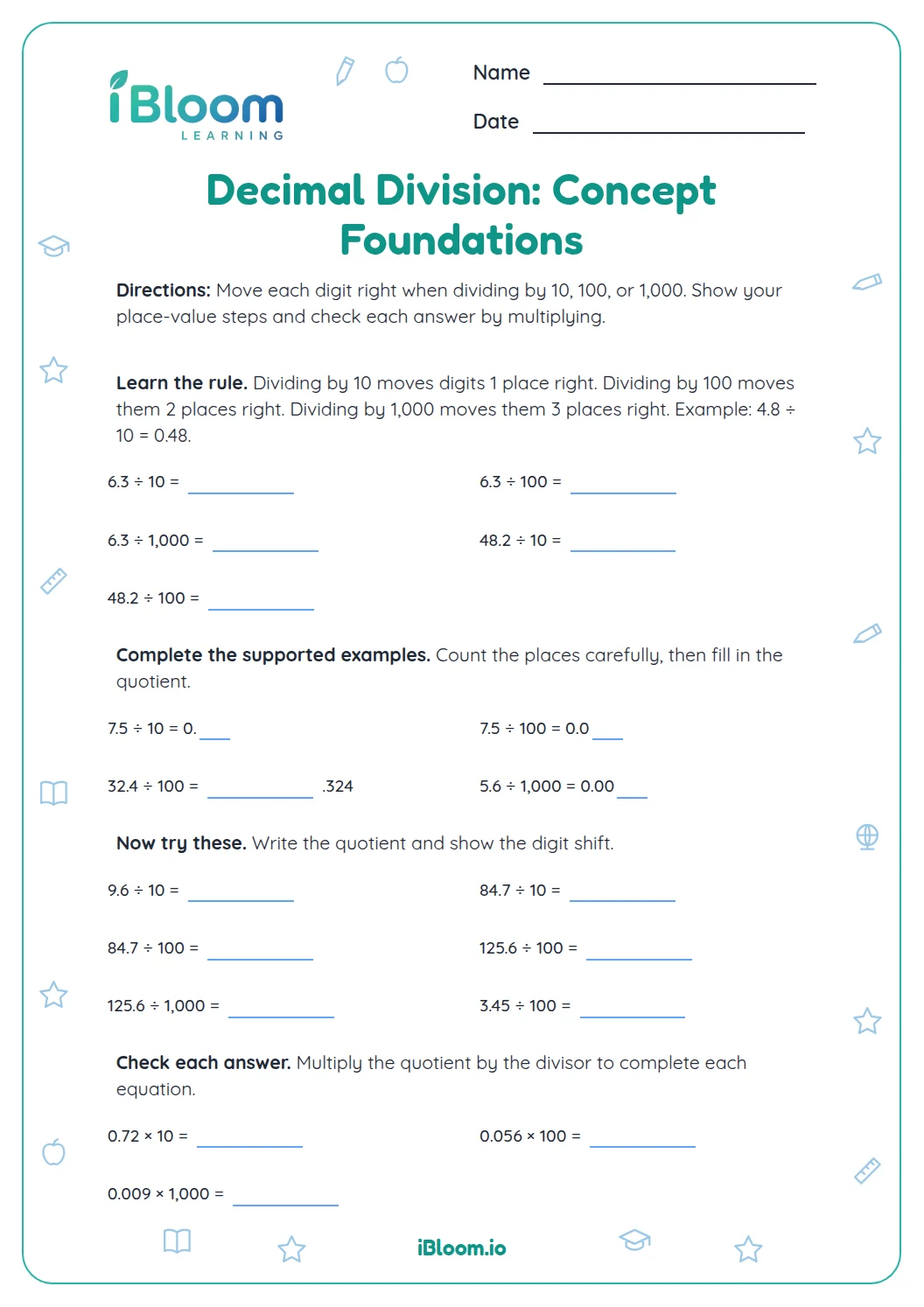
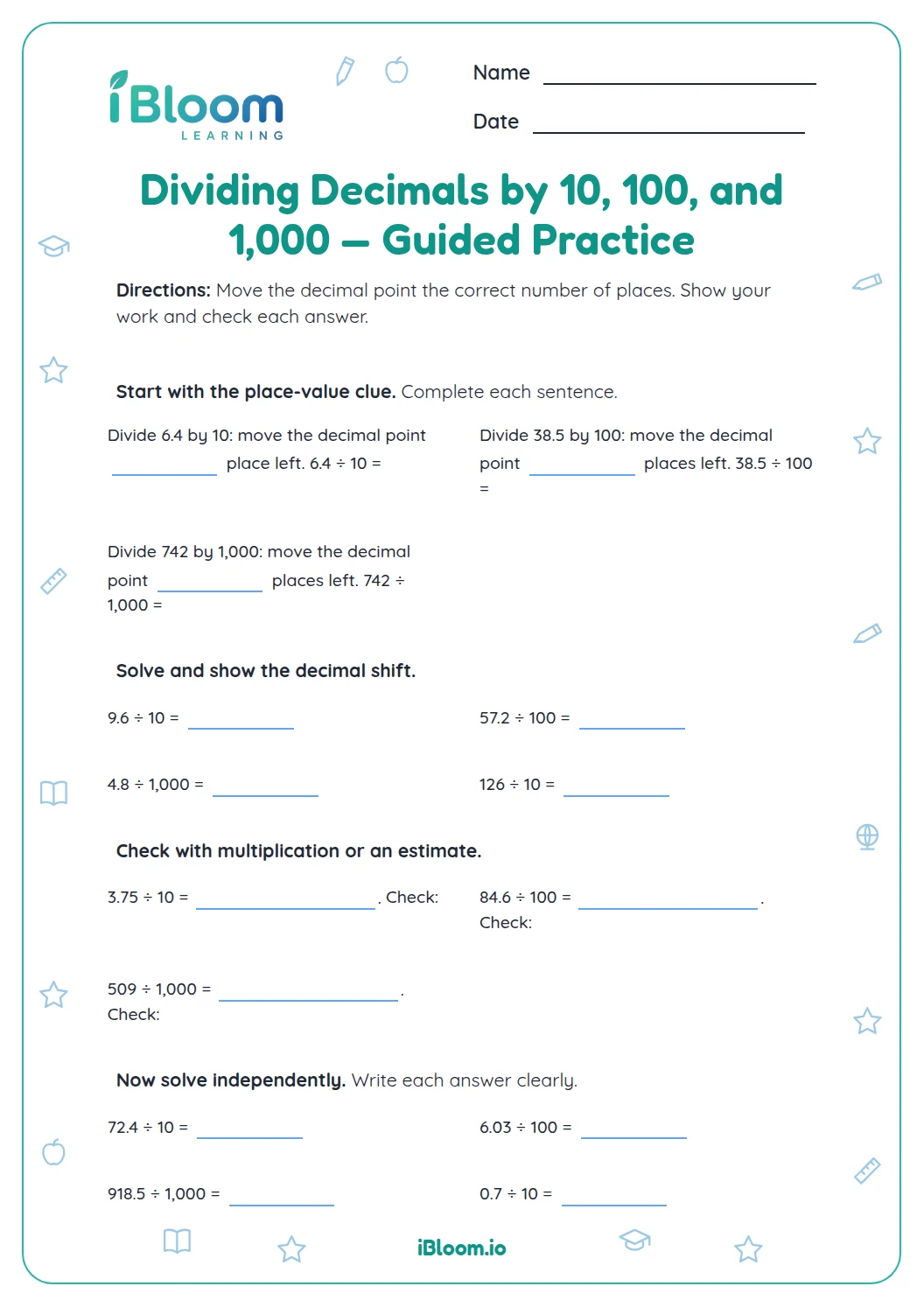
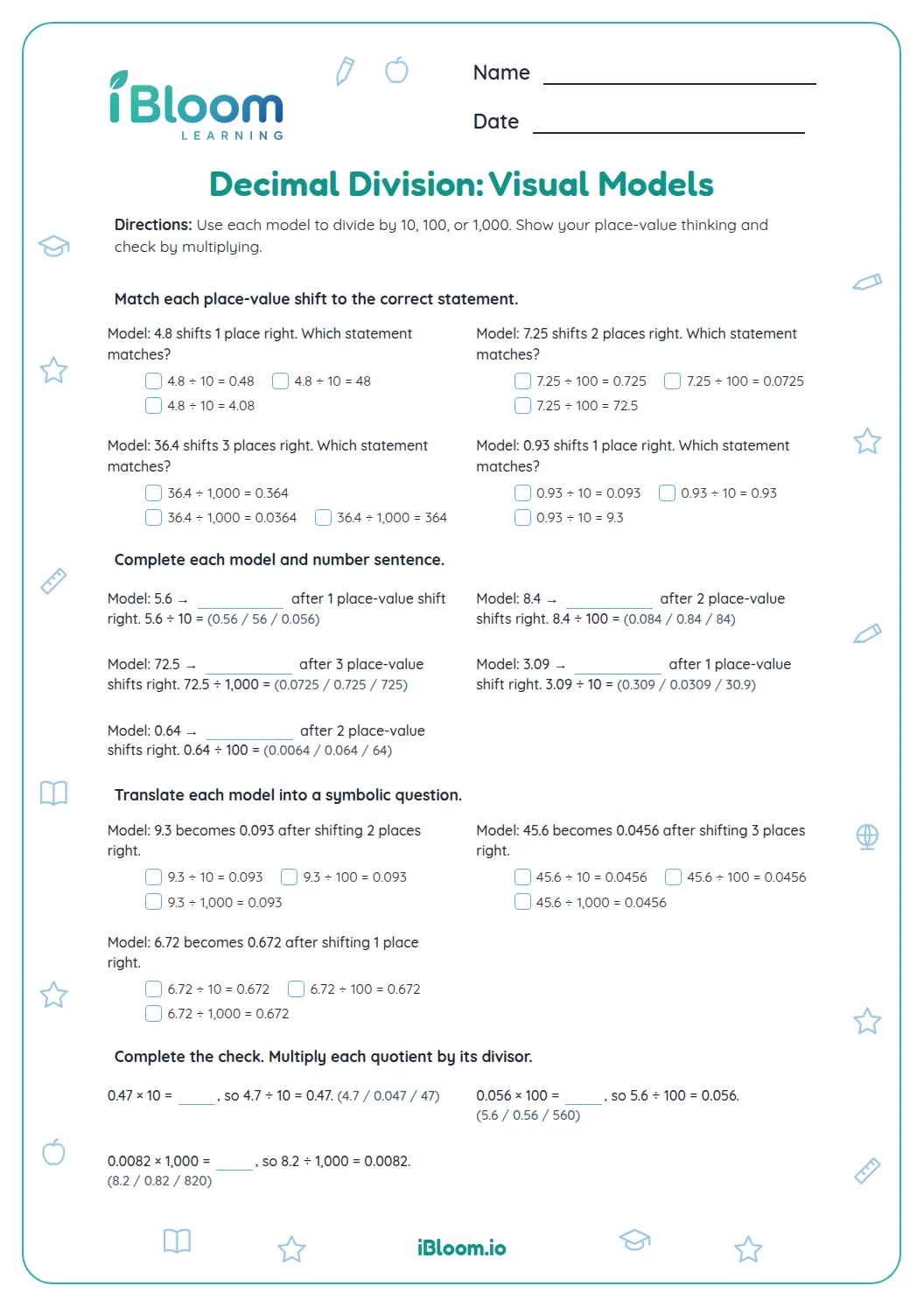
About this worksheet
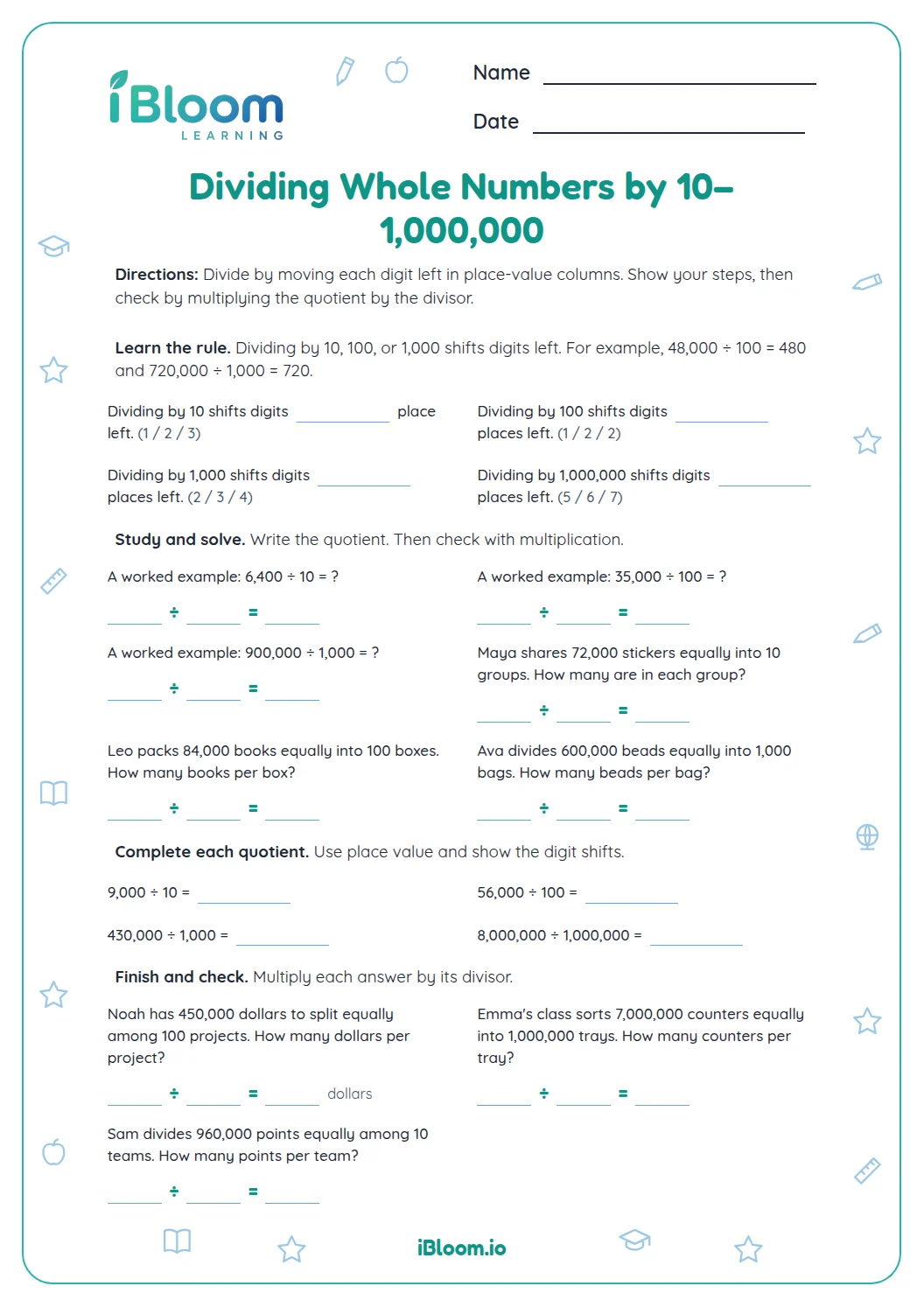
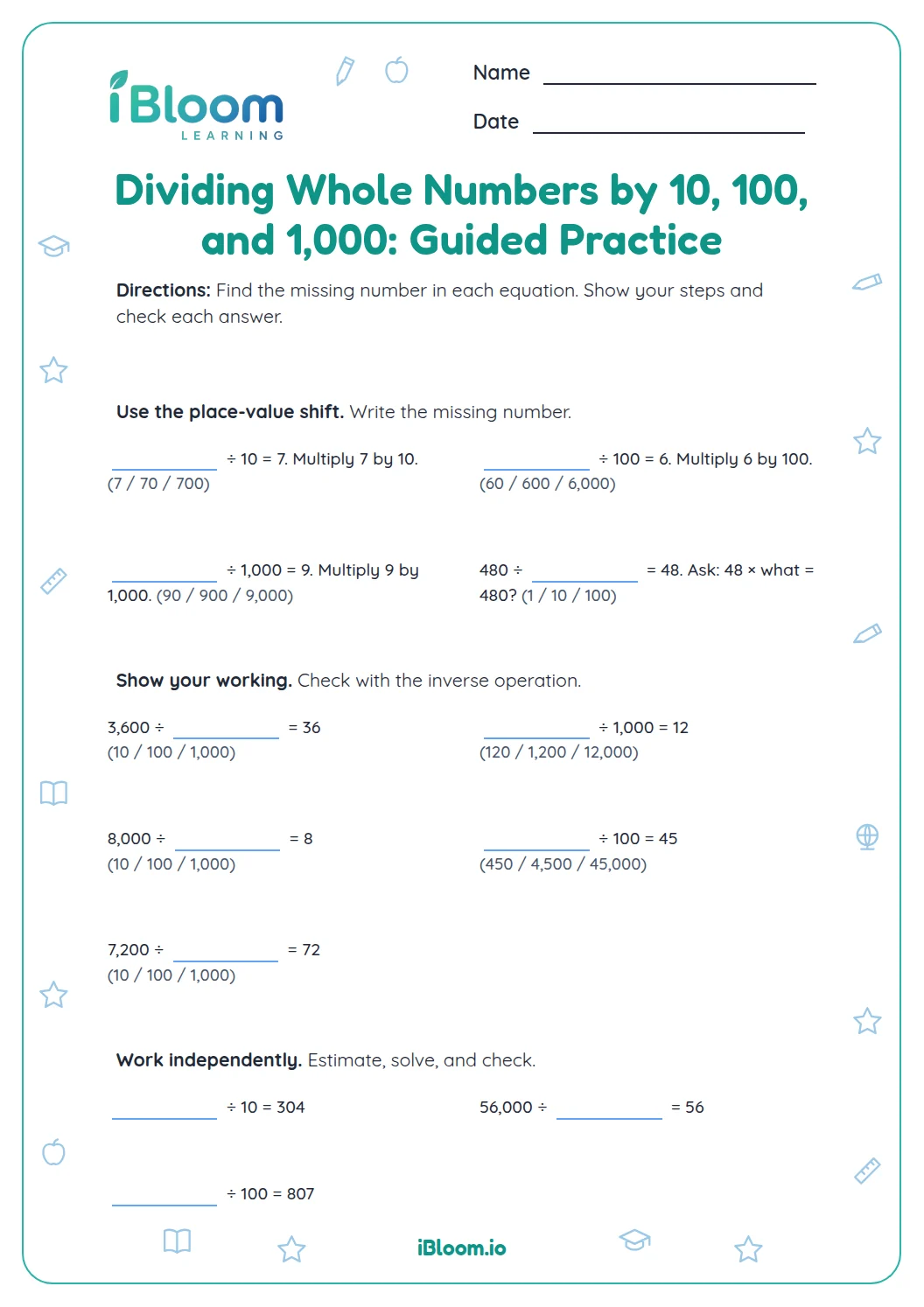
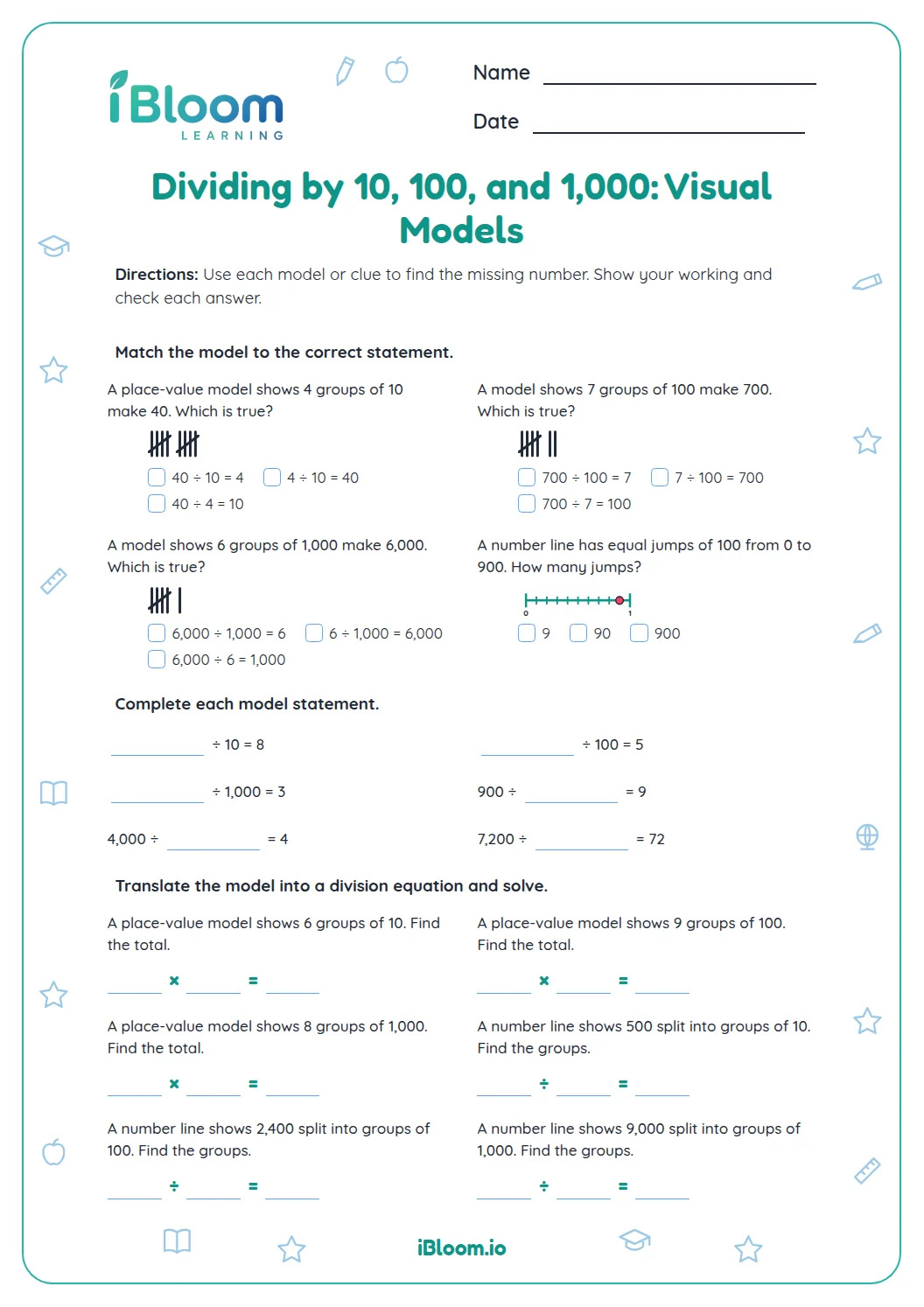
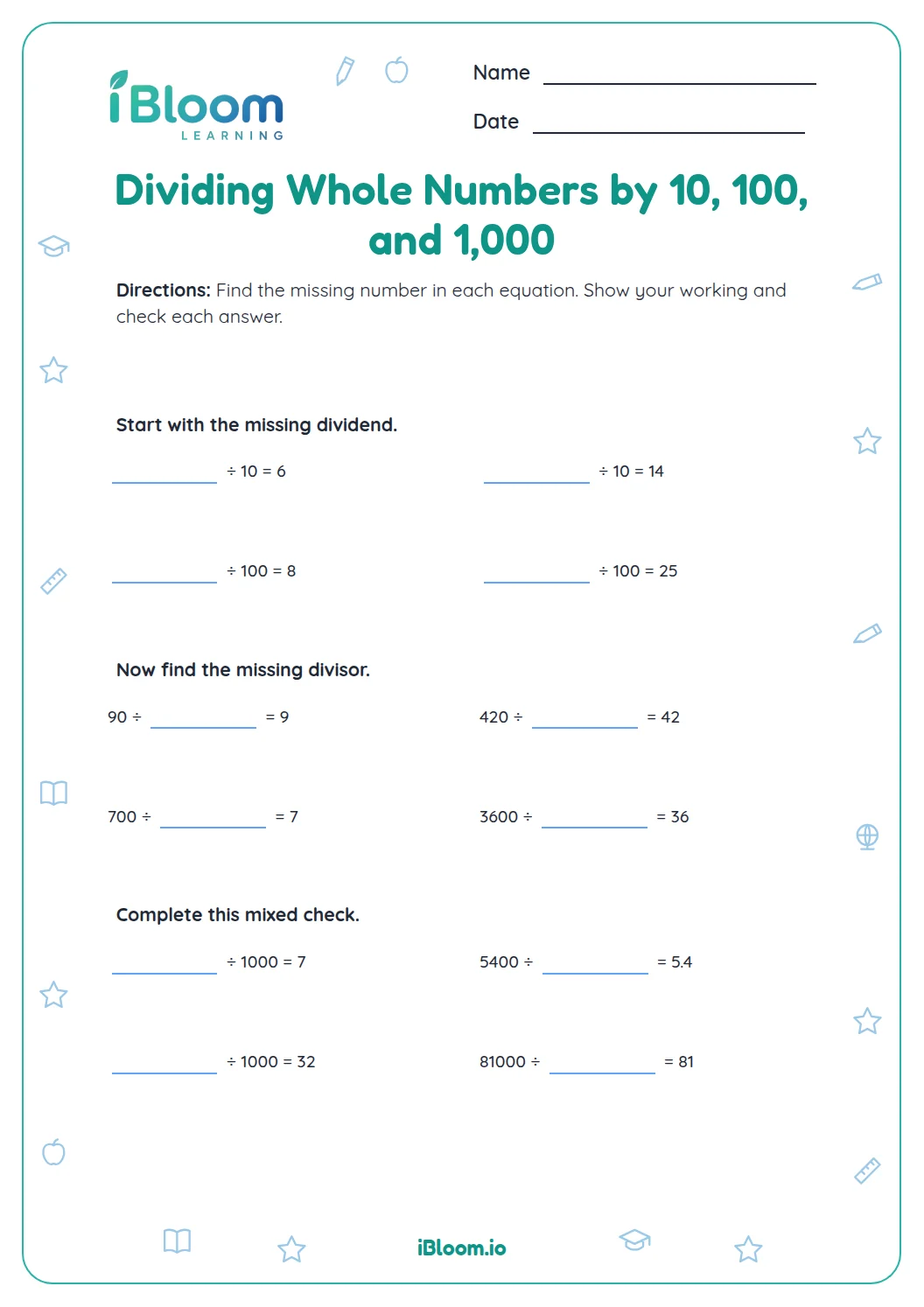
This Grade 6 worksheet has 16 equations dividing whole numbers by 10, 100, or 1,000. Learners track place value to write quotients with decimals, including values that need a leading or interior zero. The practice connects decimal quotients to place-value strategies described in Common Core 5.NBT.B.7. A separate answer key is included.
Aligned to 5.NBT.B.7
How does division by 100 change place value?
Each digit moves two places to a smaller value when dividing by 100. For example, 720 ÷ 100 = 7.2.
When does a quotient need a zero?
A zero holds a place when no digit moves into it. For example, 82 ÷ 1,000 = 0.082; the zero in the tenths place keeps the 8 in the hundredths place.
How to solve the division equations
- 1Read whether the divisor is 10, 100, or 1,000.
- 2Shift digits one, two, or three places to smaller values.
- 3Write zeros to hold empty place values.
- 4Check that each quotient is smaller than the dividend.
- 5Multiply the quotient by the divisor to check.
Common decimal placement mistakes
The mistake
Moving digits the wrong direction.
The fix
Division by 10, 100, or 1,000 makes the quotient smaller.
The mistake
Dropping a zero place in a quotient such as 0.082.
The fix
Use zero to hold an empty tenths place.
The mistake
Adding extra zeros after the decimal without checking value.
The fix
Read the quotient by place value and multiply it by the divisor to check.
Common Core alignment
This worksheet gives children focused practice with a named Common Core skill.
Use place-value strategies to write decimal quotients and check results.
On this sheet: The equations practice decimal quotients and place-value reasoning.
Show the official wordingHide the official wording
Add, subtract, multiply, and divide decimals to hundredths, using concrete models or drawings and strategies based on place value, properties of operations, and/or the relationship between addition and subtraction; relate the strategy to a written method and explain the reasoning used.
What to practice next
Make more practice
Further reading
Questions parents and teachers ask
What happens to place value when dividing by 10?
Each digit shifts one place to a smaller value, so the quotient is one tenth the dividend. For example, 48 ÷ 10 = 4.8. The worksheet also includes division by 100 and 1,000, which shift digits two or three places.
Why do some quotients begin with zero?
A leading zero keeps the quotient’s value clear when it is less than one. In 82 ÷ 1,000 = 0.082, the zero in the tenths place holds an empty place before the 8 in the hundredths place. Pause after each part and ask the learner to explain how the clue or operation supports the answer.
How can a child check a decimal quotient?
Multiply the quotient by the divisor and see whether the product returns to the original dividend. For example, 7.2 × 100 = 720, so 720 ÷ 100 = 7.2. A size estimate also helps because division by these numbers makes a value smaller.
Can children use the page for independent practice?
Yes. The 16 equations are grouped into an initial practice part and a checking part. Children can solve them, estimate whether each result is smaller than its dividend, and then use the separate answer key. Pause after each part and ask the learner to explain how the clue or operation supports the answer.
How long does this worksheet take?
About 20 minutes is a useful estimate for 16 division equations and a review of decimal placement. Children who write place-value steps may need more time. The worksheet and its answer key each fit on one page. Pause after each part and ask the learner to explain how the clue or operation supports the answer.