




About this worksheet
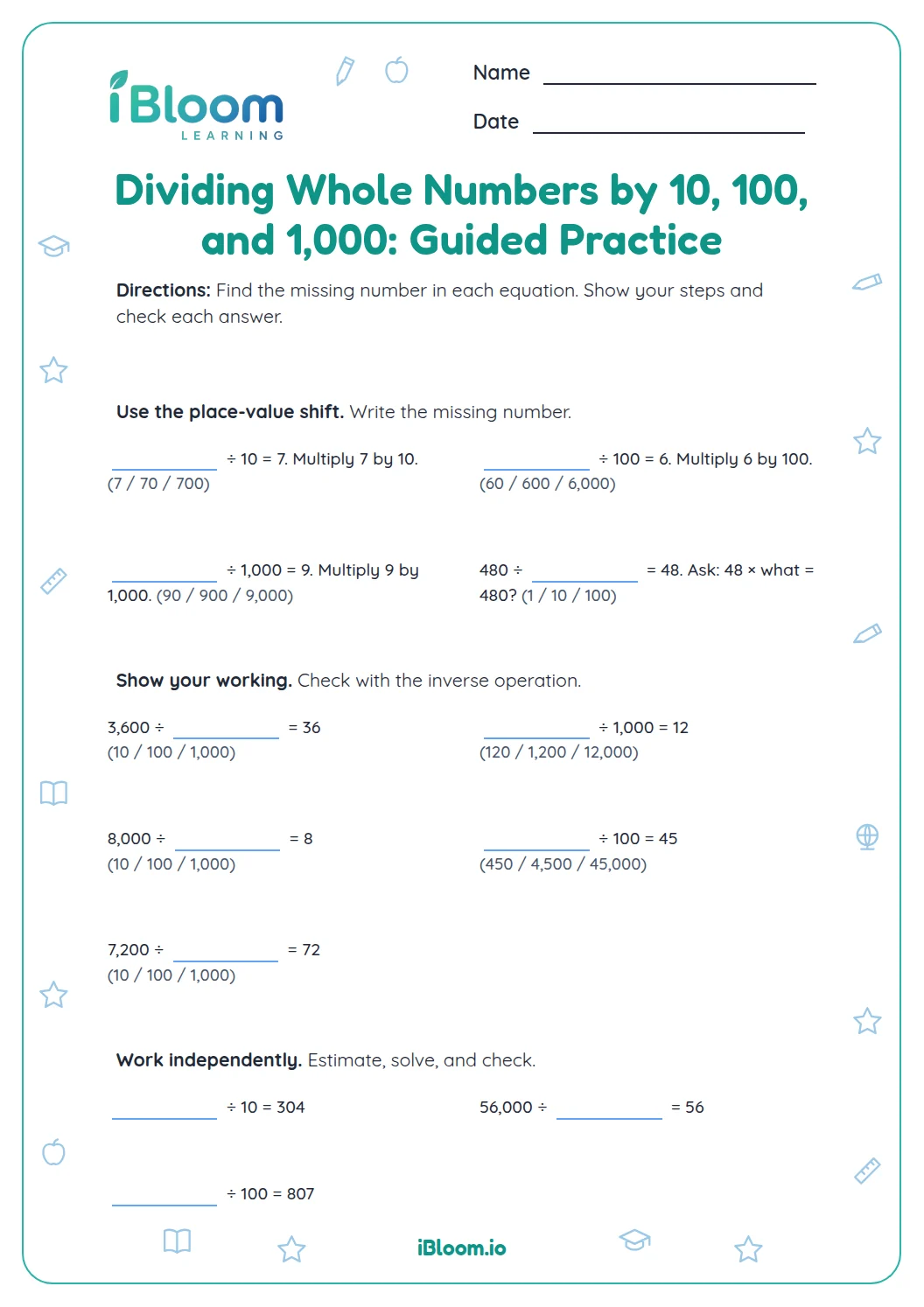
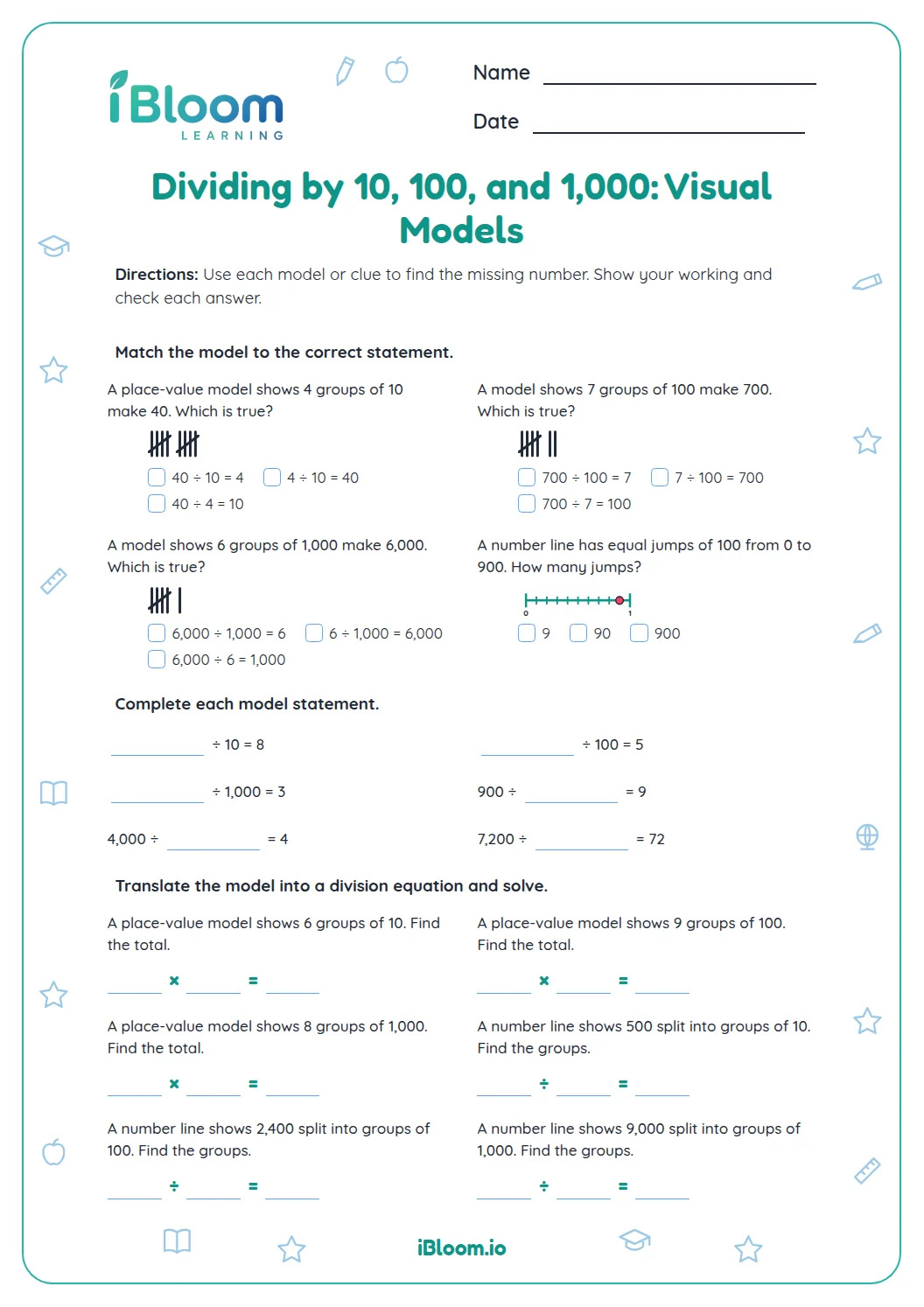
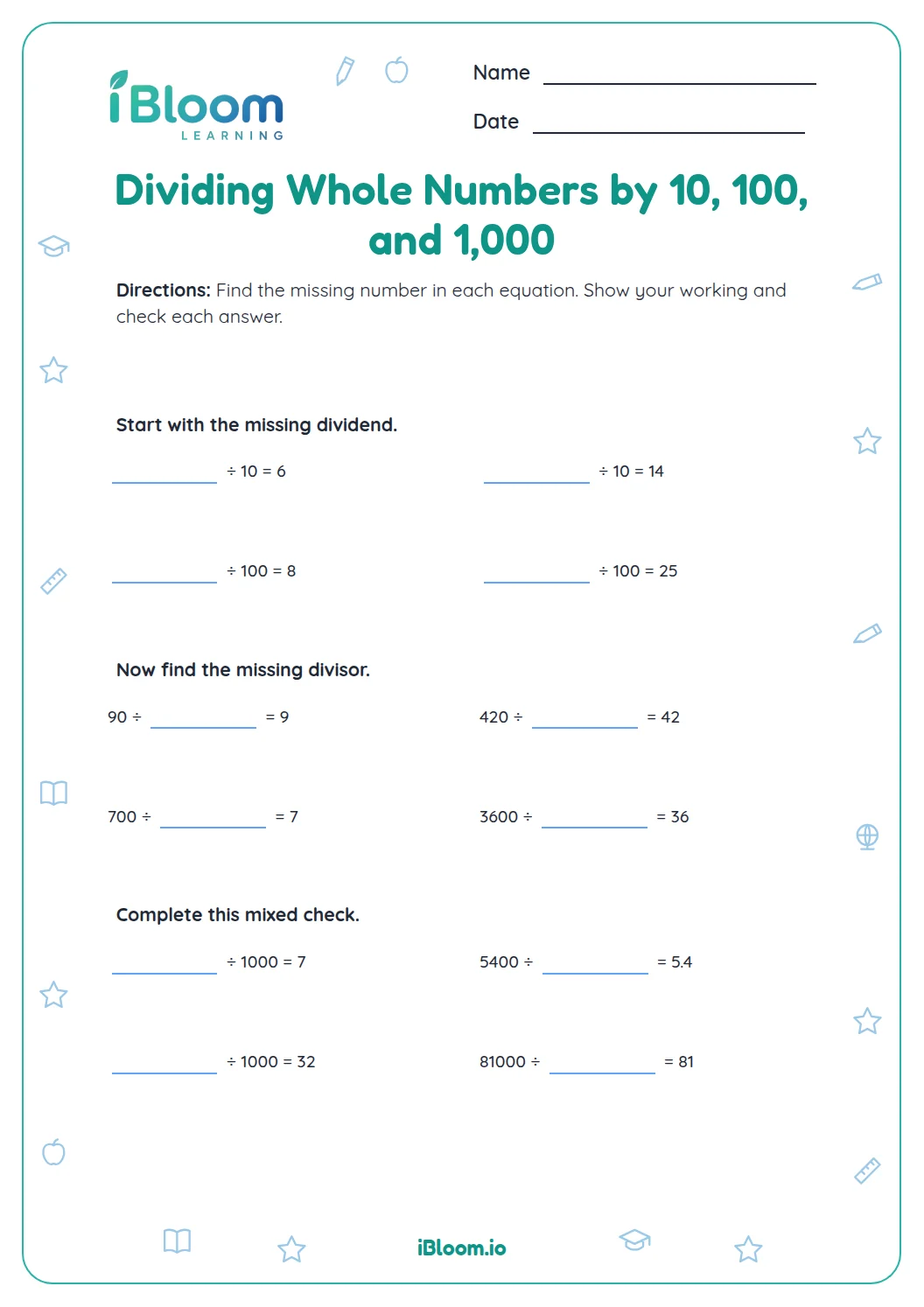
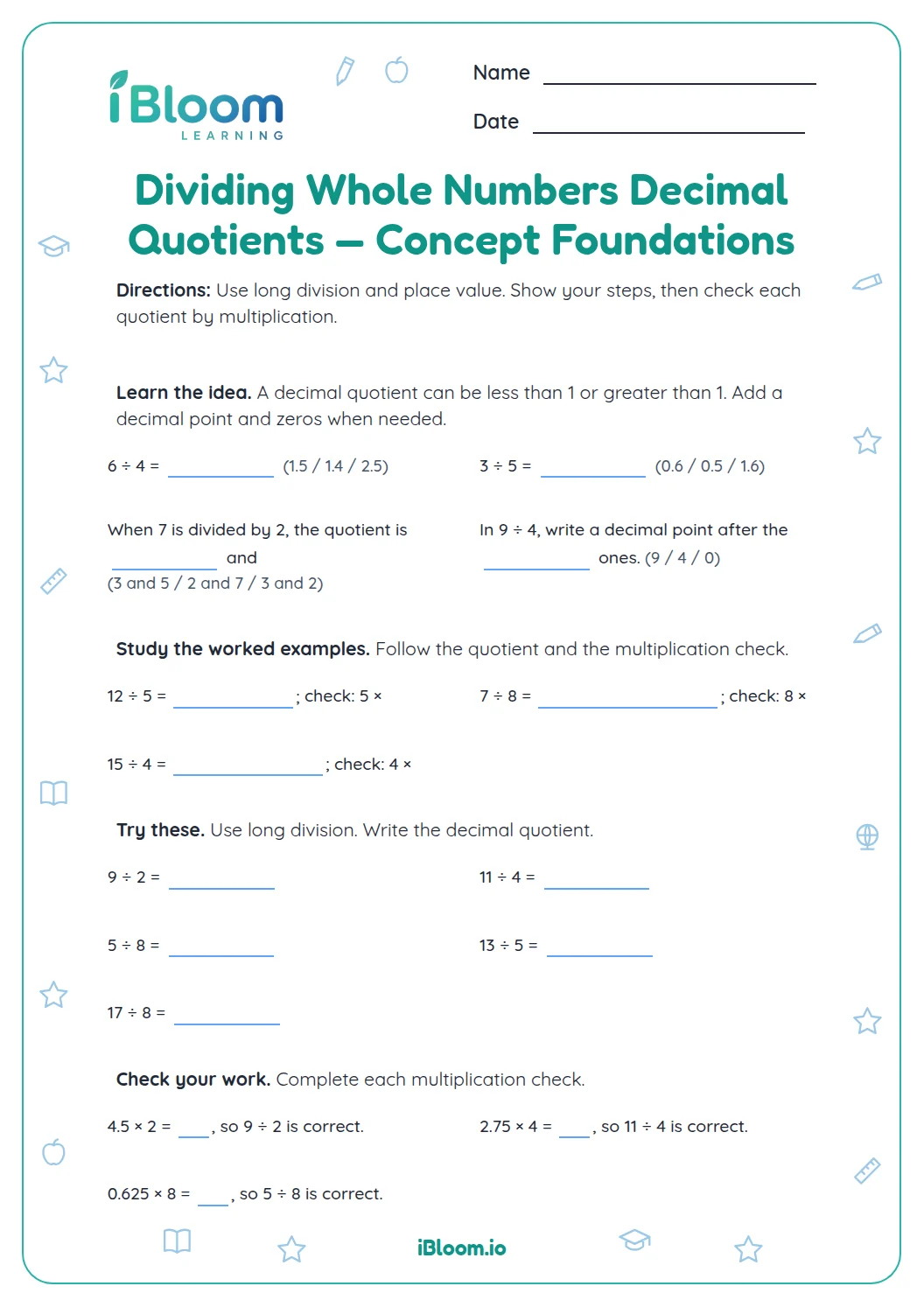
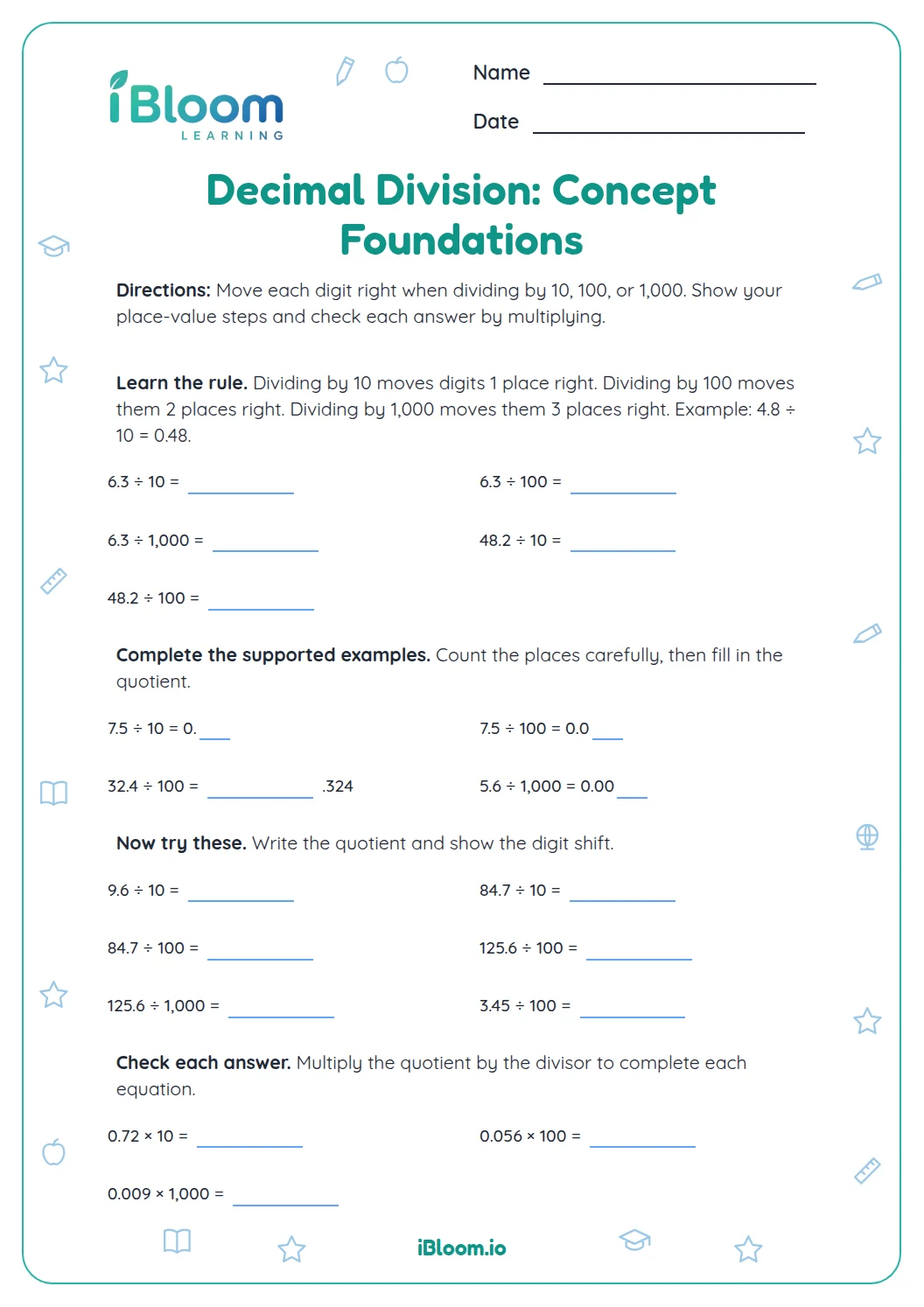
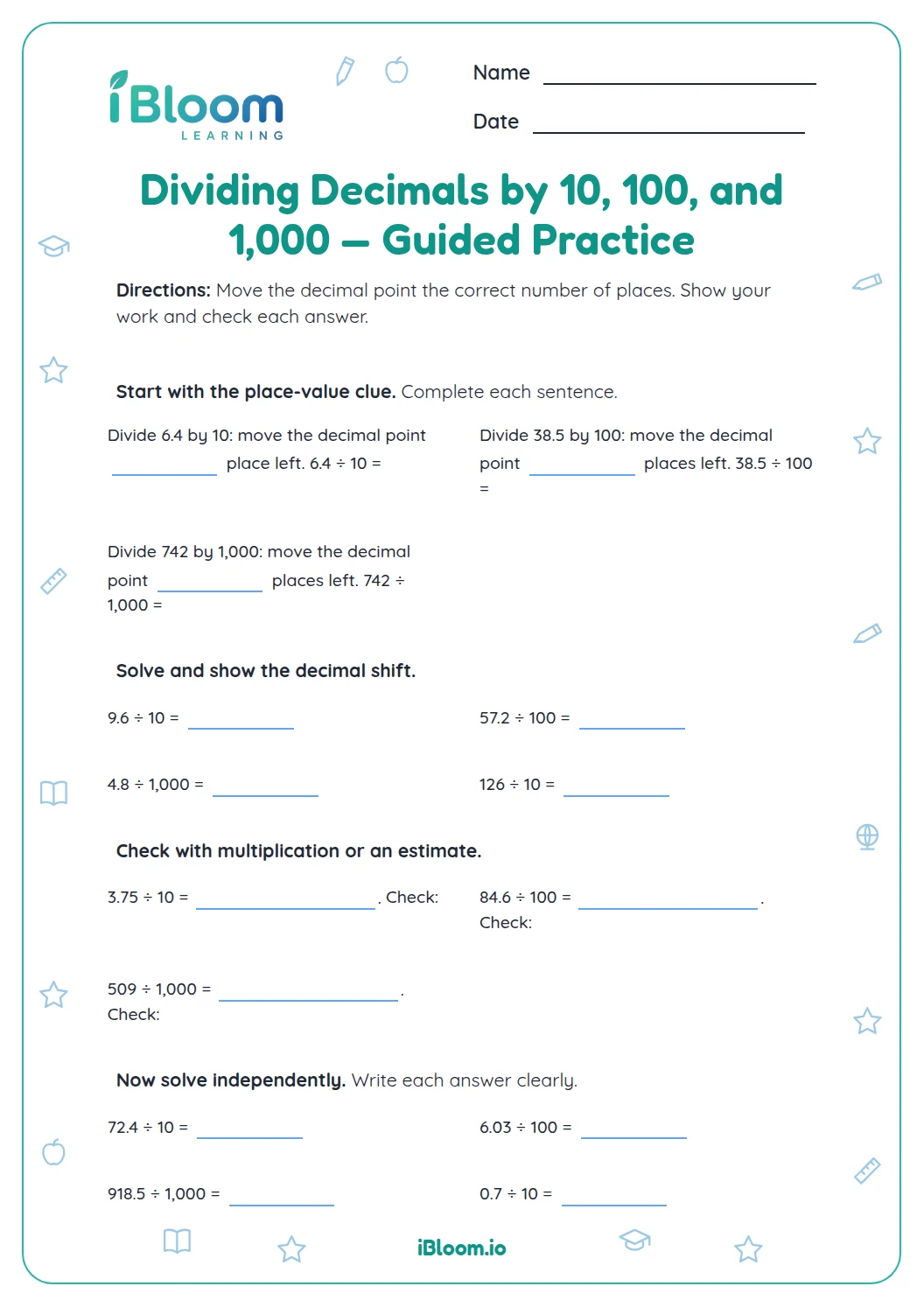
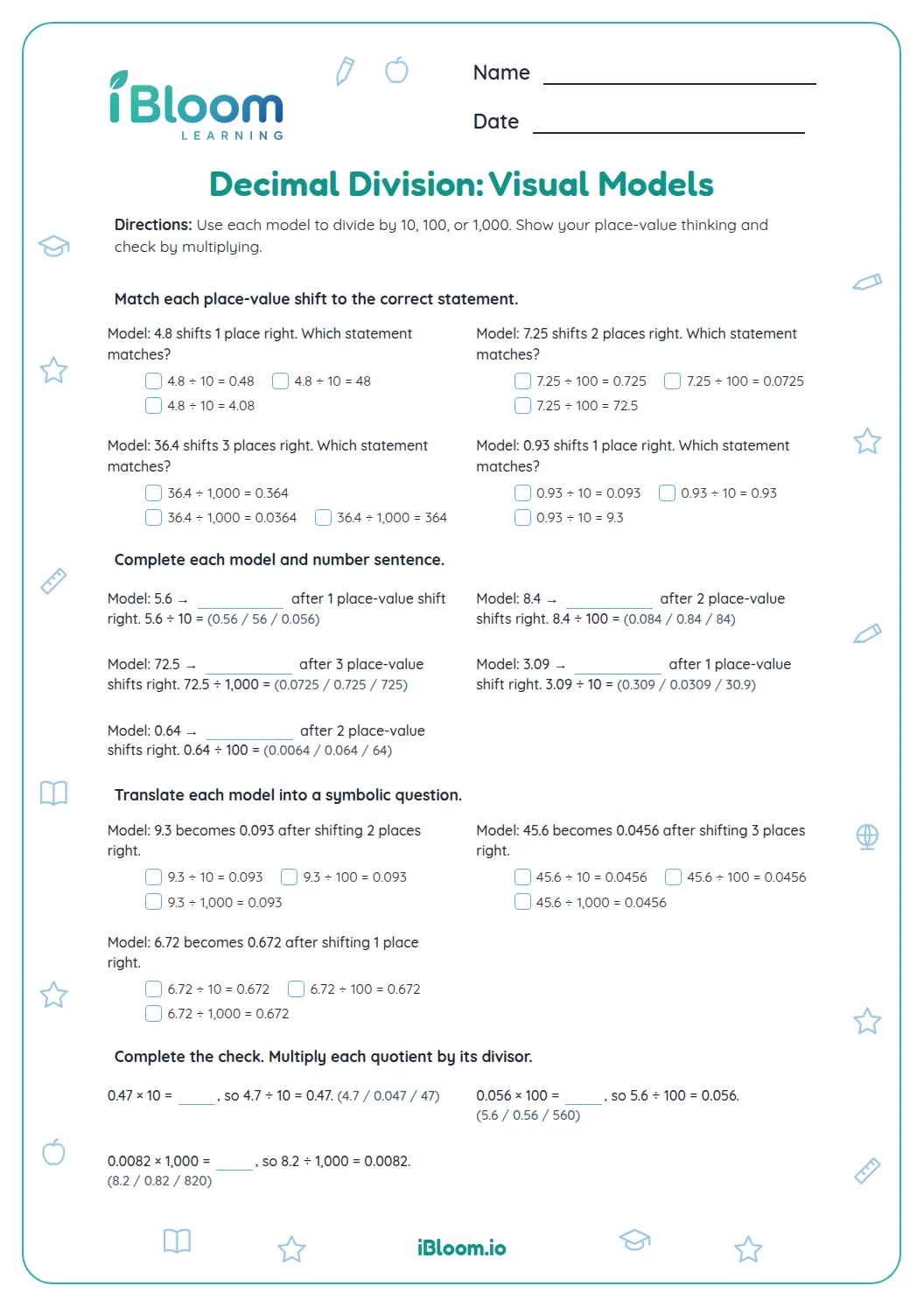
This Grade 6 worksheet practices dividing whole numbers by 10, 100, and 1,000. Students find direct quotients, use multiplication to solve missing-number equations, and apply the place-value pattern to equal groups. Some quotients are decimals, making the decimal-point shift visible. The practice aligns with CCSS 5.NBT.A.2.
Aligned to 5.NBT.A.2
How does division by 10 change a number?
Dividing by 10, 100, or 1,000 makes each place value one, two, or three places smaller. For 8,400 ÷ 100, the quotient is 84.
- 1620 ÷ 100
- 2Move each value two places smaller
- 3Quotient: 6.2
How do you find a missing number?
Use multiplication to undo division. If ___ ÷ 100 = 46, multiply 46 by 100 to find the dividend: 4,600. Then check 4,600 ÷ 100 = 46.
How does the pattern work in equal groups?
Divide a total by the number of equal groups. In question 13, 24,000 crayons shared among 10 classrooms gives 2,400 crayons per classroom.
How to use this worksheet
- 1Identify whether the divisor is 10, 100, or 1,000.
- 2Use place value to make each digit’s value one, two, or three places smaller.
- 3Write zeros where needed and place the decimal point in the quotient.
- 4For a missing dividend or divisor, use multiplication to work backward.
- 5Check by multiplying the quotient and divisor or by reading the story again.
Common mistakes and quick fixes
The mistake
Moving the decimal point without accounting for every place in the divisor.
The fix
Count one place for ÷10, two for ÷100, and three for ÷1,000.
The mistake
Dropping a zero that belongs in the quotient, such as changing 8,000 ÷ 10 to 80.
The fix
Use place-value positions to see that the correct quotient is 800.
The mistake
Using the divisor as the missing dividend.
The fix
Multiply the quotient by the known divisor to recover a missing dividend.
Common Core alignment
This worksheet practices place-value patterns when dividing by powers of 10.
Explain decimal-point patterns when dividing by a power of 10.
On this sheet: Students apply place-value patterns to quotients with divisors 10, 100, and 1,000.
Show the official wordingHide the official wording
Explain patterns in the number of zeros of the product when multiplying a number by powers of 10, and explain patterns in the placement of the decimal point when a decimal is multiplied or divided by a power of 10. Use whole-number exponents to denote powers of 10.
What to practice next
Make more practice
Further reading
Questions parents and teachers ask
Why is 48 ÷ 10 equal to 4.8?
Dividing by 10 makes each digit’s value one tenth as large. The 4 tens become 4 ones, and the 8 ones become 8 tenths, so the quotient is 4.8. Multiplying 4.8 by 10 returns 48. Multiplication gives a direct check for this place-value calculation.
How can multiplication check a quotient?
Multiply the quotient by the divisor and see whether the product matches the dividend. For example, 620 ÷ 100 = 6.2, and 6.2 × 100 = 620. This check works for the decimal quotients and whole-number quotients on the page.
How do I solve a missing dividend?
Multiply the quotient by the divisor. In question 11, the missing number divided by 100 equals 46, so calculate 46 × 100. The missing dividend is 4,600; dividing it by 100 confirms the equation. Multiplication gives a direct check for this place-value calculation.
What kinds of questions are included?
The 14 questions are grouped into eight direct quotients, four missing-number equations, and two equal-sharing situations. Divisors are 10, 100, or 1,000, and some results are decimals. The answer key gives a result for every item. Multiplication gives a direct check for this place-value calculation.
Which Common Core standard is listed?
The worksheet cites CCSS 5.NBT.A.2, which addresses patterns in multiplying and dividing by powers of 10 and decimal-point placement. The questions use that place-value reasoning for whole-number dividends and decimal quotients. Multiplication gives a direct check for this place-value calculation.