



About this worksheet
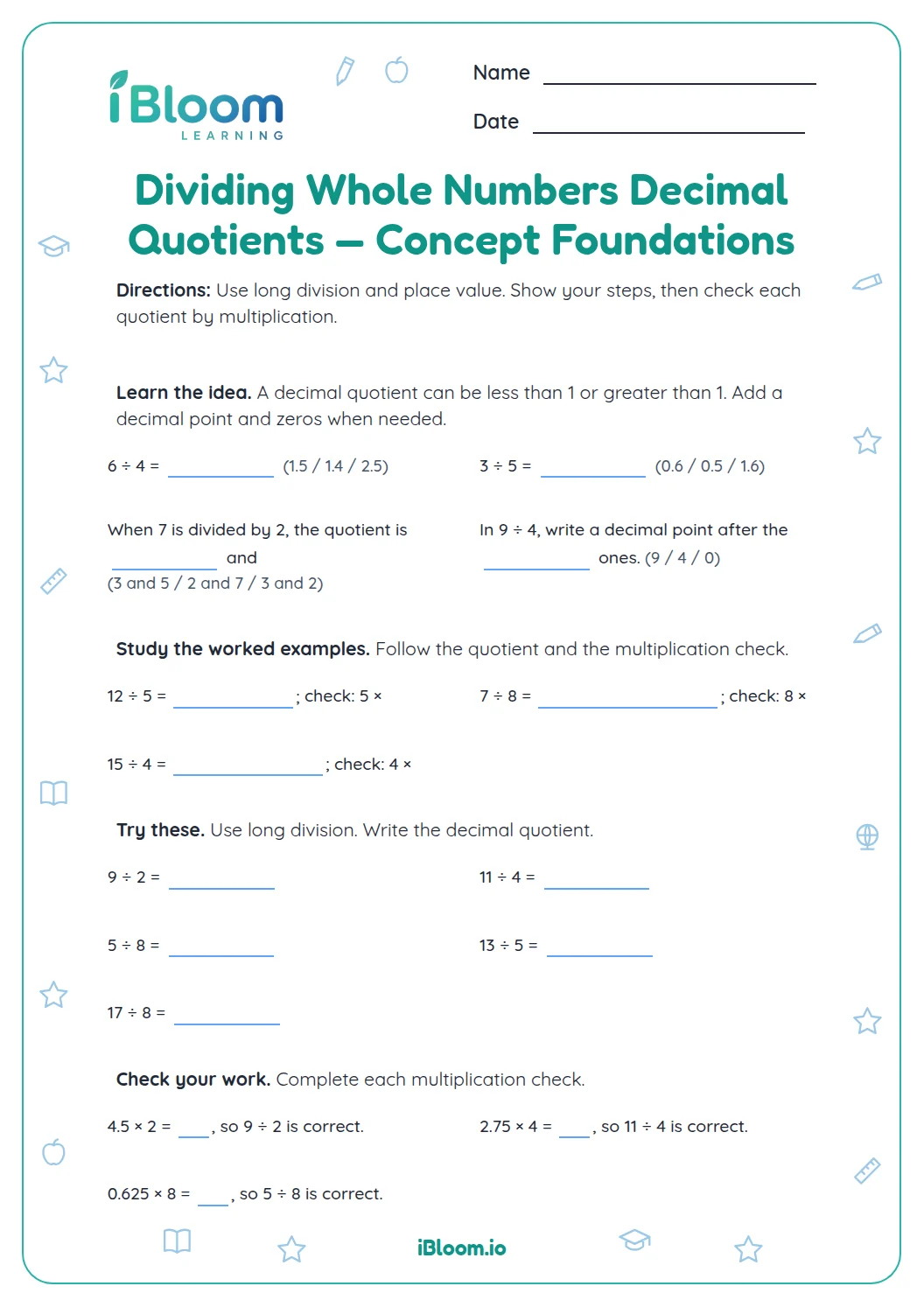
This free Grade 6 worksheet shows how whole-number division can continue beyond a remainder to produce an exact decimal quotient. Part A breaks 17 ÷ 4 into four fill-in steps, changing the remainder into tenths and then hundredths. Part B gives four divisions ending in tenths. Part C gives four more divisions, including answers less than one and answers needing three decimal places. The eight independent calculations include room for long division. This work practices the standard algorithm in Common Core 6.NS.B.2, and a separate key supplies all twelve answers.
Aligned to 6.NS.B.2
How does the guided example reach 4.25?
Four groups of 4 use 16 of the 17 wholes. The remaining whole is 10 tenths. Dividing those tenths among four groups gives 2 tenths each and leaves 2 tenths.
Rename the last 2 tenths as 20 hundredths. Each group receives 5 hundredths, completing a quotient with 4 wholes, 2 tenths and 5 hundredths.
- 117 ÷ 4: 4 wholes each, with 1 whole left
- 210 tenths ÷ 4: 2 tenths each, with 2 tenths left
- 320 hundredths ÷ 4: 5 hundredths each
- 417 ÷ 4 = 4.25; check 4.25 × 4 = 17
Where do the decimal point and zeros go?
Write the whole dividend as an equivalent decimal, such as 63.000. In long division, place the quotient’s decimal point directly above the dividend’s point. Each new zero lets you continue into a smaller place value.
In question 11, 7 is smaller than 20, so write 0 in the ones place of the quotient. Continuing with 7.00 gives 0.35. The zero before the decimal point makes the size of the answer clear.
When should children stop dividing?
Stop when the remainder is zero. The problems on this sheet end exactly: Part B reaches tenths, while Part C needs hundredths or thousandths. For 63 ÷ 8, stopping at 7.8 leaves a remainder; the exact quotient is 7.875.
Multiply the quotient by the divisor to check it. For question 12, 15.625 × 8 = 125, so the decimal placement and all three decimal digits are consistent with the original dividend.
Work through the division steps
- 1Complete the four linked blanks in Part A, saying the unit name at each trade.
- 2For Part B, set up long division and divide the whole-number part first.
- 3Write a decimal point in the dividend and directly above it in the quotient.
- 4Append zeros as needed and repeat divide, multiply, subtract and bring down.
- 5Stop at a zero remainder, then multiply each quotient by its divisor.
Mistakes to discuss and fix
The mistake
Writing 17 ÷ 4 = 4.1 because the remainder is 1.
The fix
The remainder is one whole shared among four groups. Rename it as 10 tenths and continue to reach 4.25.
The mistake
Writing 7 ÷ 20 = 3.5.
The fix
Since 7 is less than 20, the quotient must be less than 1. Write 0.35 and check that 0.35 × 20 = 7.
The mistake
Stopping 63 ÷ 8 at 7.8.
The fix
There is still a remainder. Bring down another zero, then one more, to reach the exact answer 7.875.
Common Core alignment
Use long division to find exact decimal quotients of whole numbers.
On this sheet: The guided example and ten calculations practice the standard division algorithm with multi-digit numbers.
Show the official wordingHide the official wording
Fluently divide multi-digit numbers using the standard algorithm.
What to practice next
Make more practice
Further reading
Questions parents and teachers ask
Why is the answer to 17 ÷ 4 not 4.1?
The remainder of 1 means one whole is still to be shared, not one tenth for each group. Divide that whole among four groups to give each group 0.25. Adding this to the 4 wholes already in each group gives 4.25, which is the answer completed in Part A.
Do any answers need rounding?
All ten independent divisions have exact terminating decimal answers. Continue until the remainder is zero, using additional zeros in the dividend when needed. Part B ends in tenths, while Part C includes hundredths and thousandths. For example, 63 ÷ 8 ends at 7.875, so all three decimal digits belong in the answer.
Why does 7 ÷ 20 start with zero?
The quotient starts with zero because 20 does not fit into 7 even once as a whole group. Write 0 in the ones place, then continue dividing 7.00 in smaller units. The answer is 0.35, and multiplying 0.35 by 20 returns the original dividend of 7.
How much help should I give during guided practice?
Work through the four Part A blanks together, naming wholes, tenths and hundredths as you go. Then let your child set up the Part B divisions. If they pause at a remainder, point to the corresponding trade in Part A and ask which smaller unit they can use next.
What is the best way to check the decimal answers?
Multiply each quotient by its divisor to recover the dividend. For instance, question 12 gives 125 ÷ 8 = 15.625, and 15.625 × 8 = 125. Also check the approximate size: since 8 × 15 = 120, the quotient should be a little more than 15, not near 1 or 150.