




About this worksheet
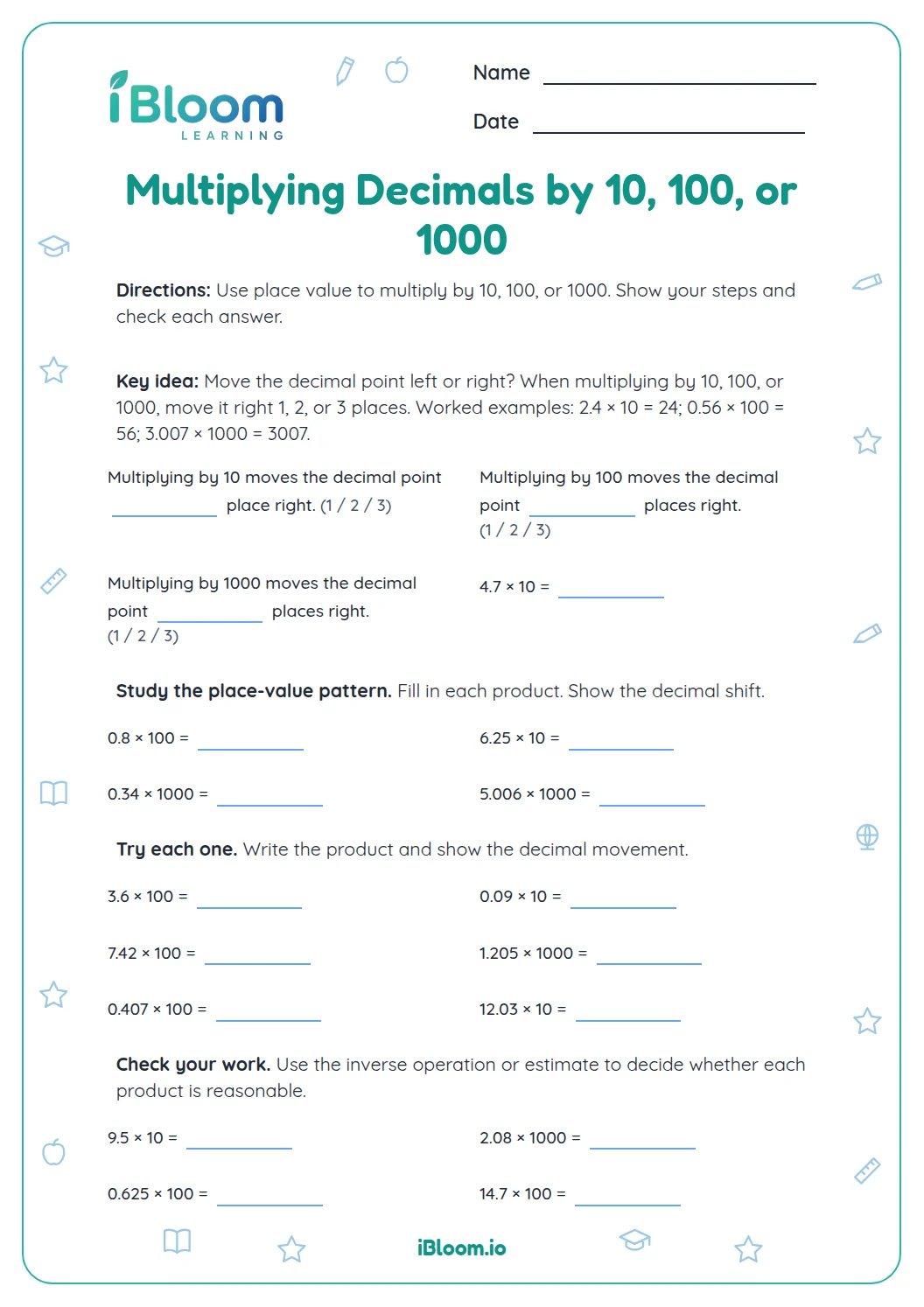
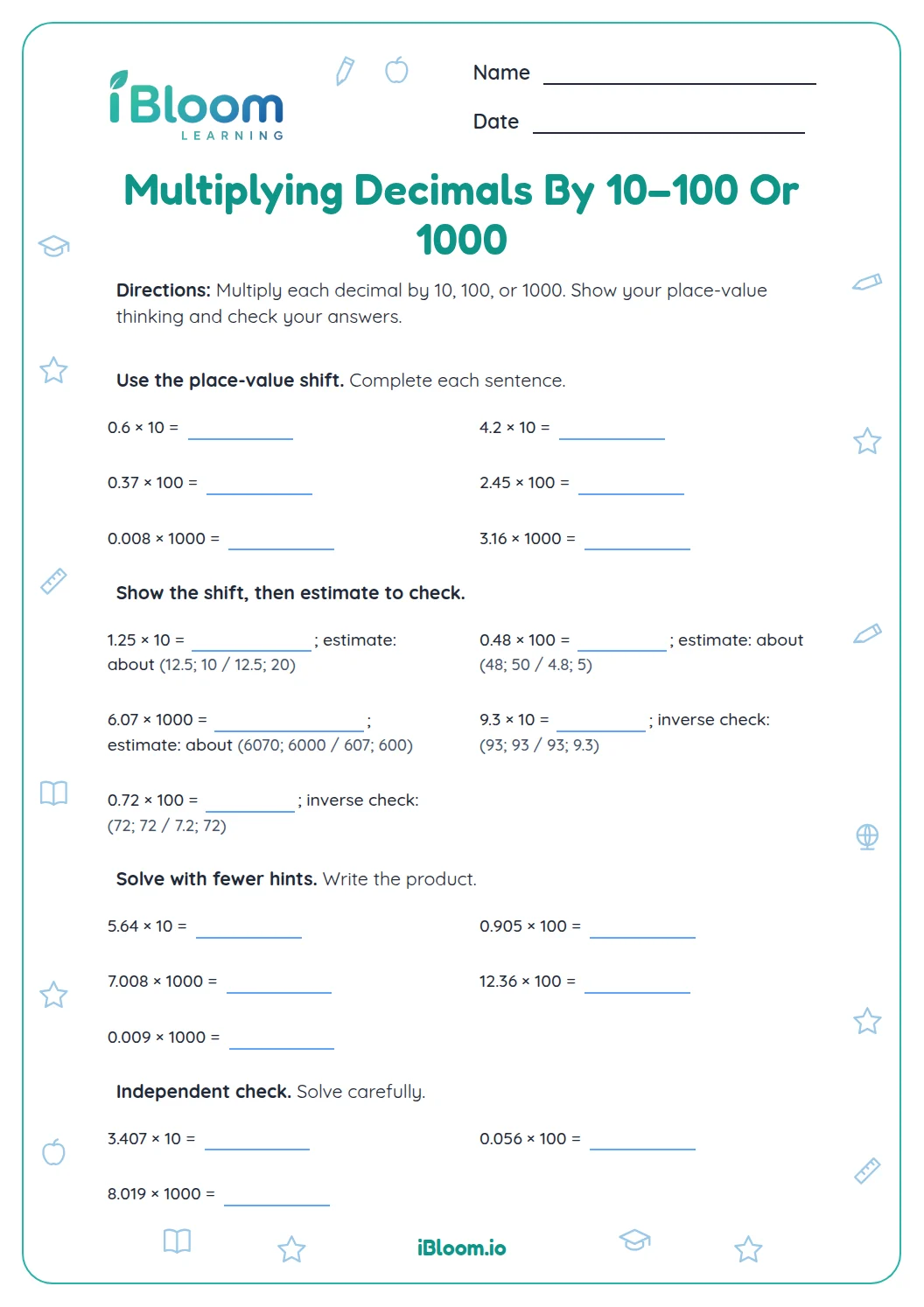
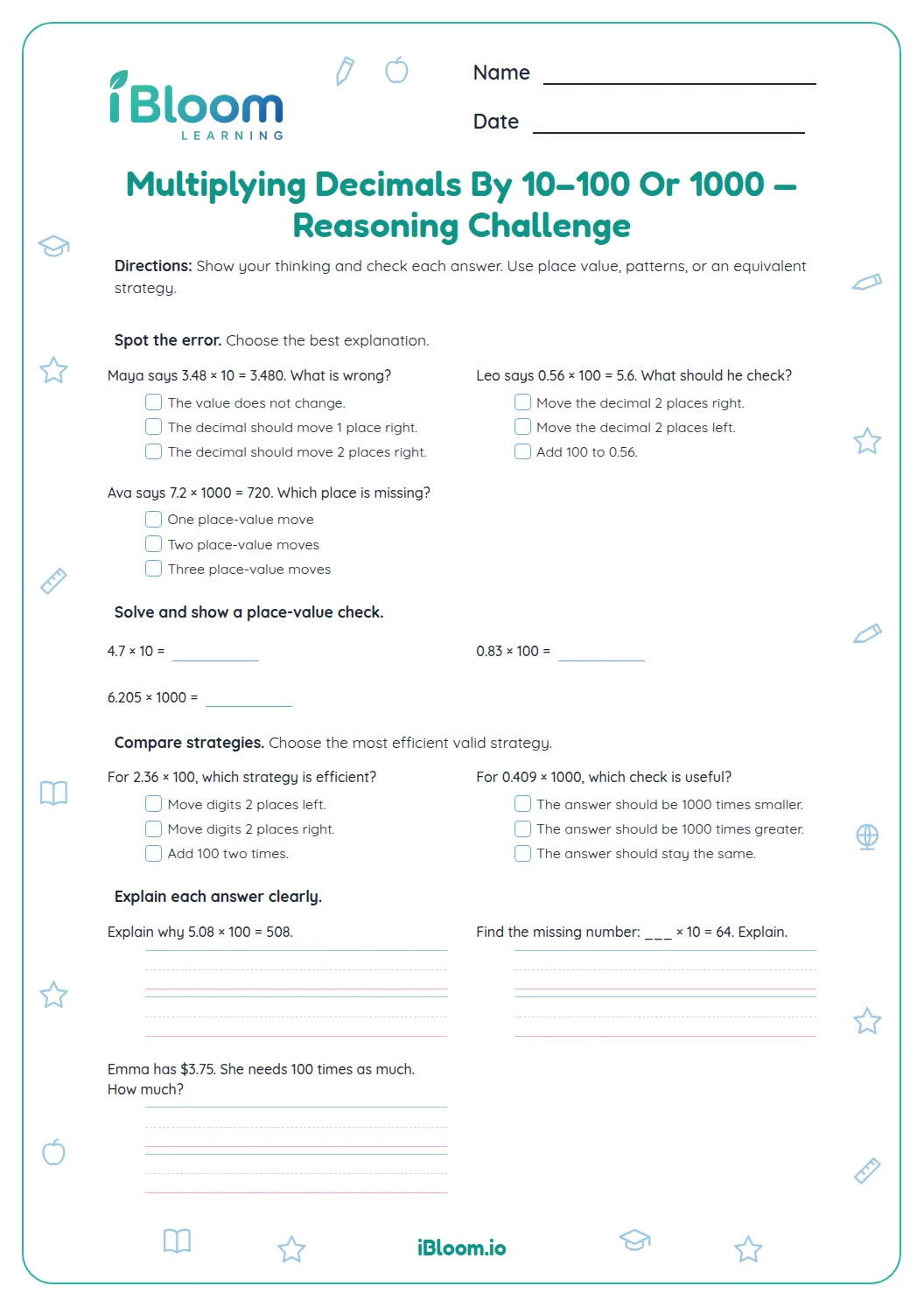
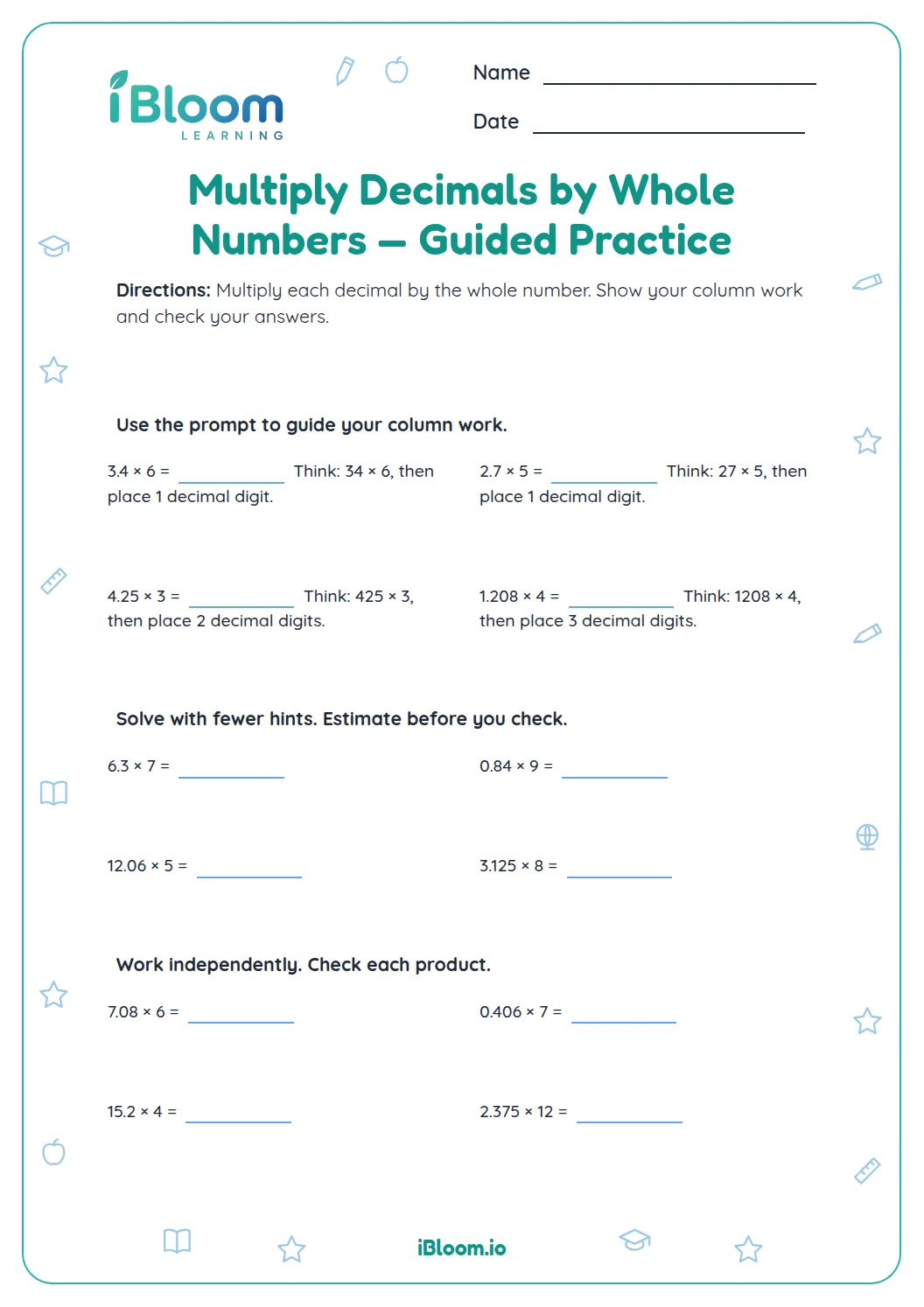
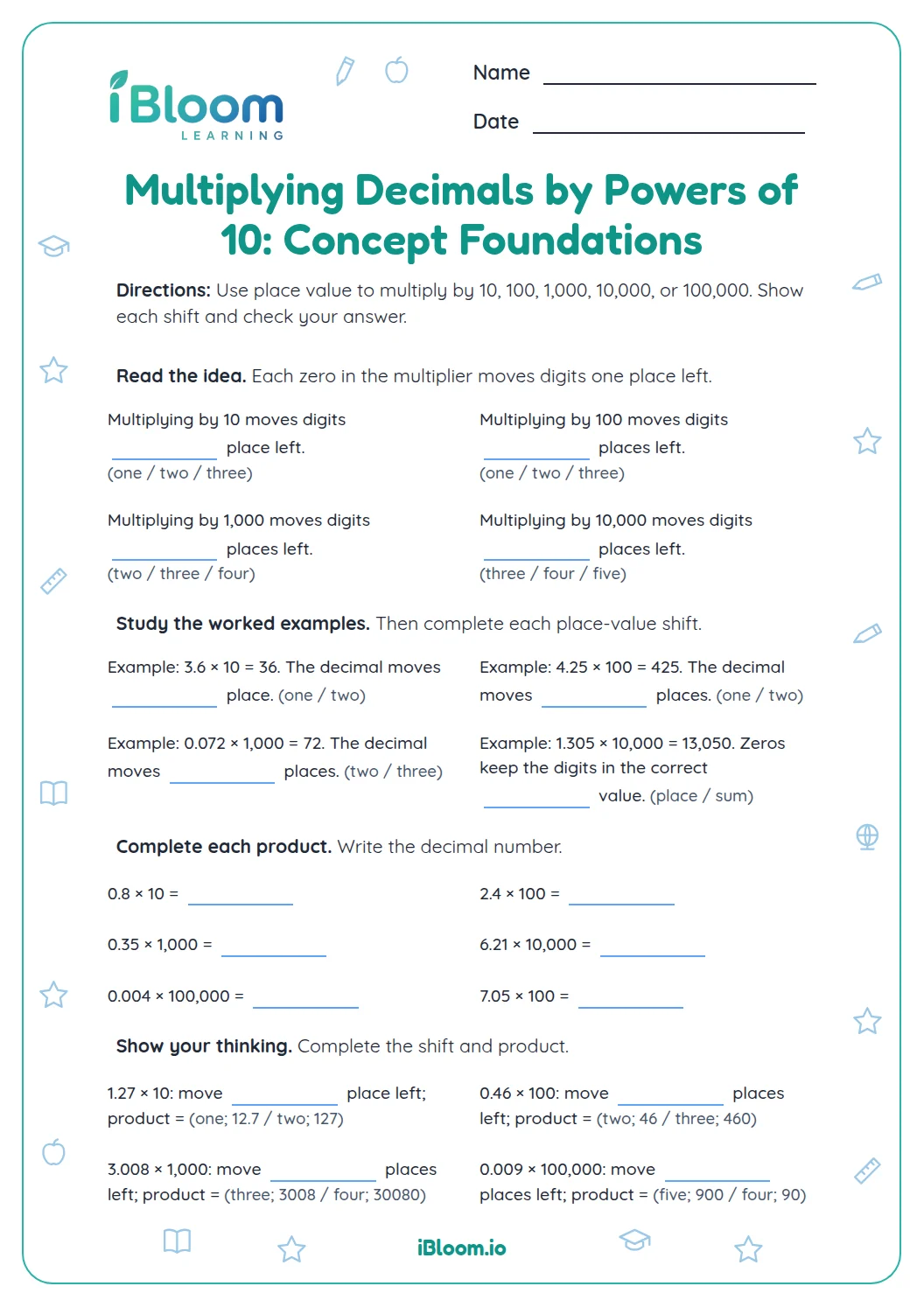
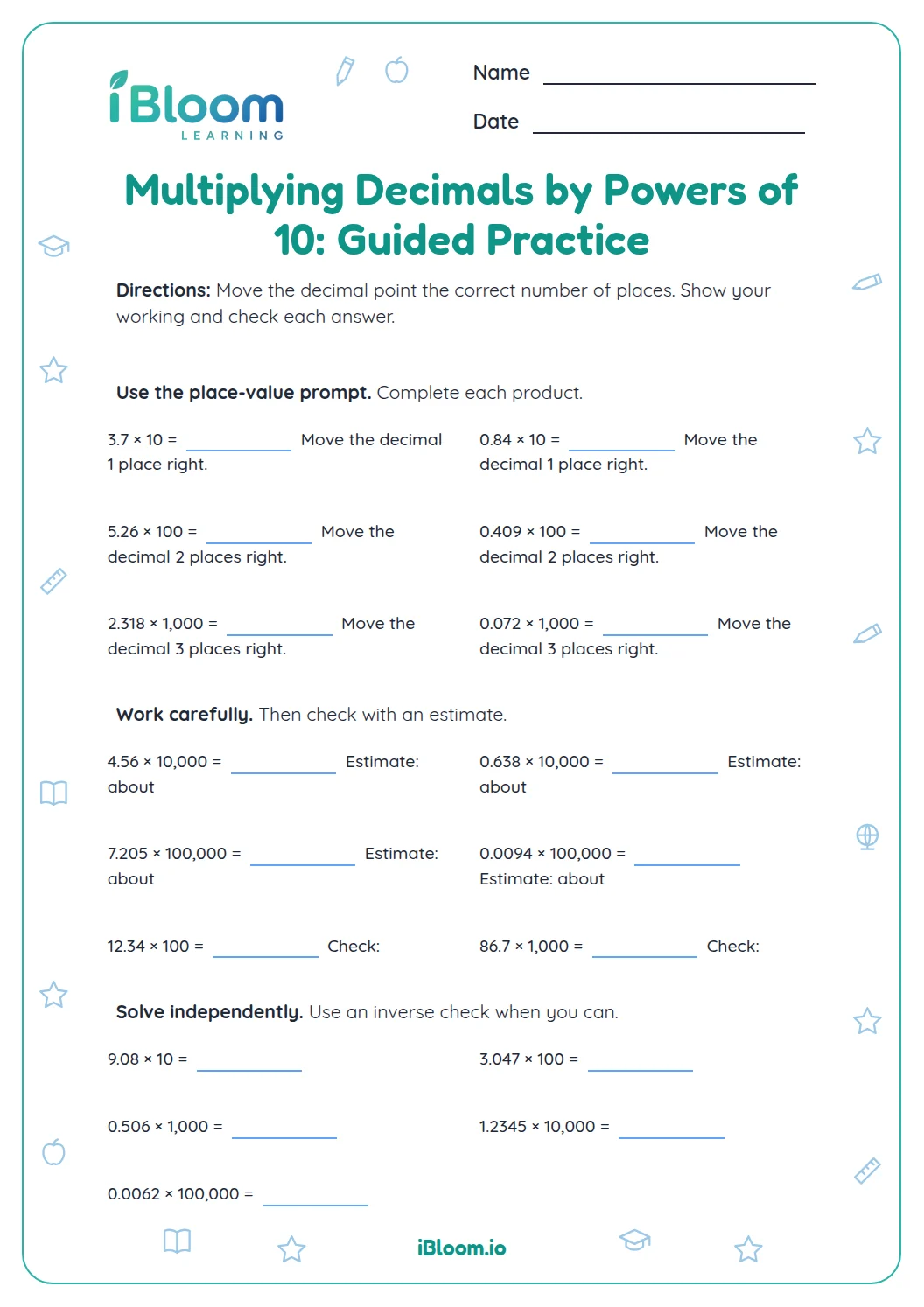
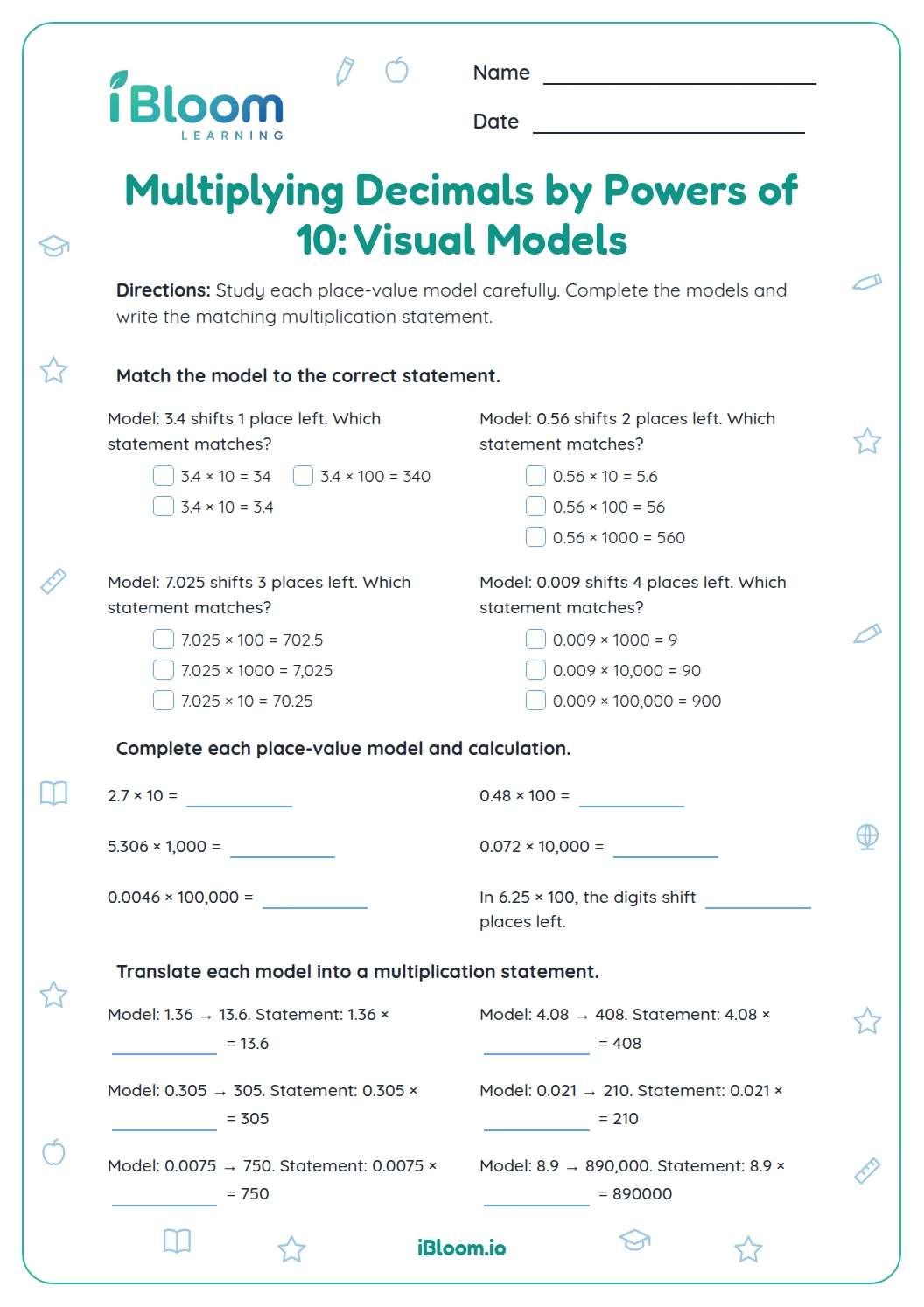
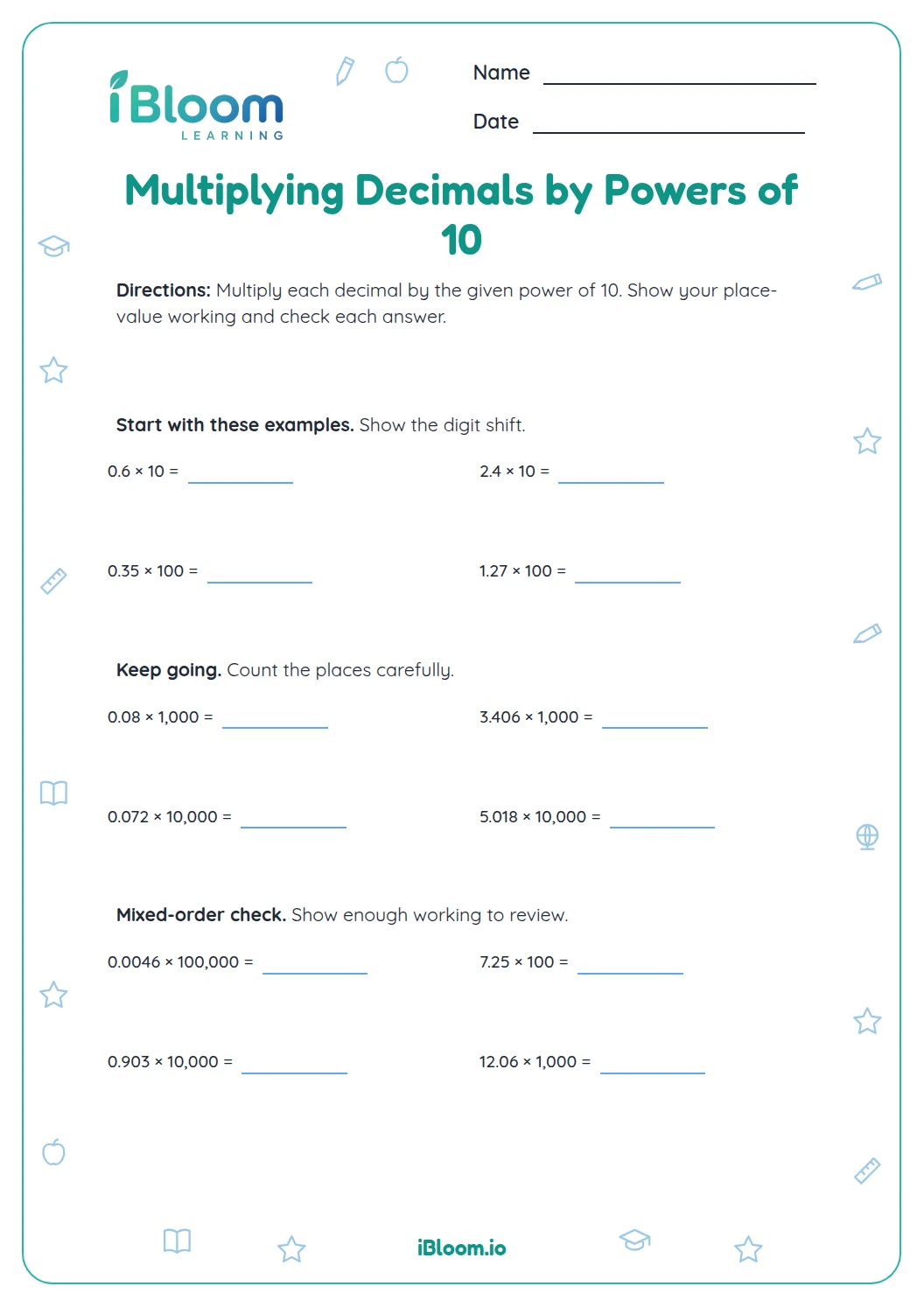
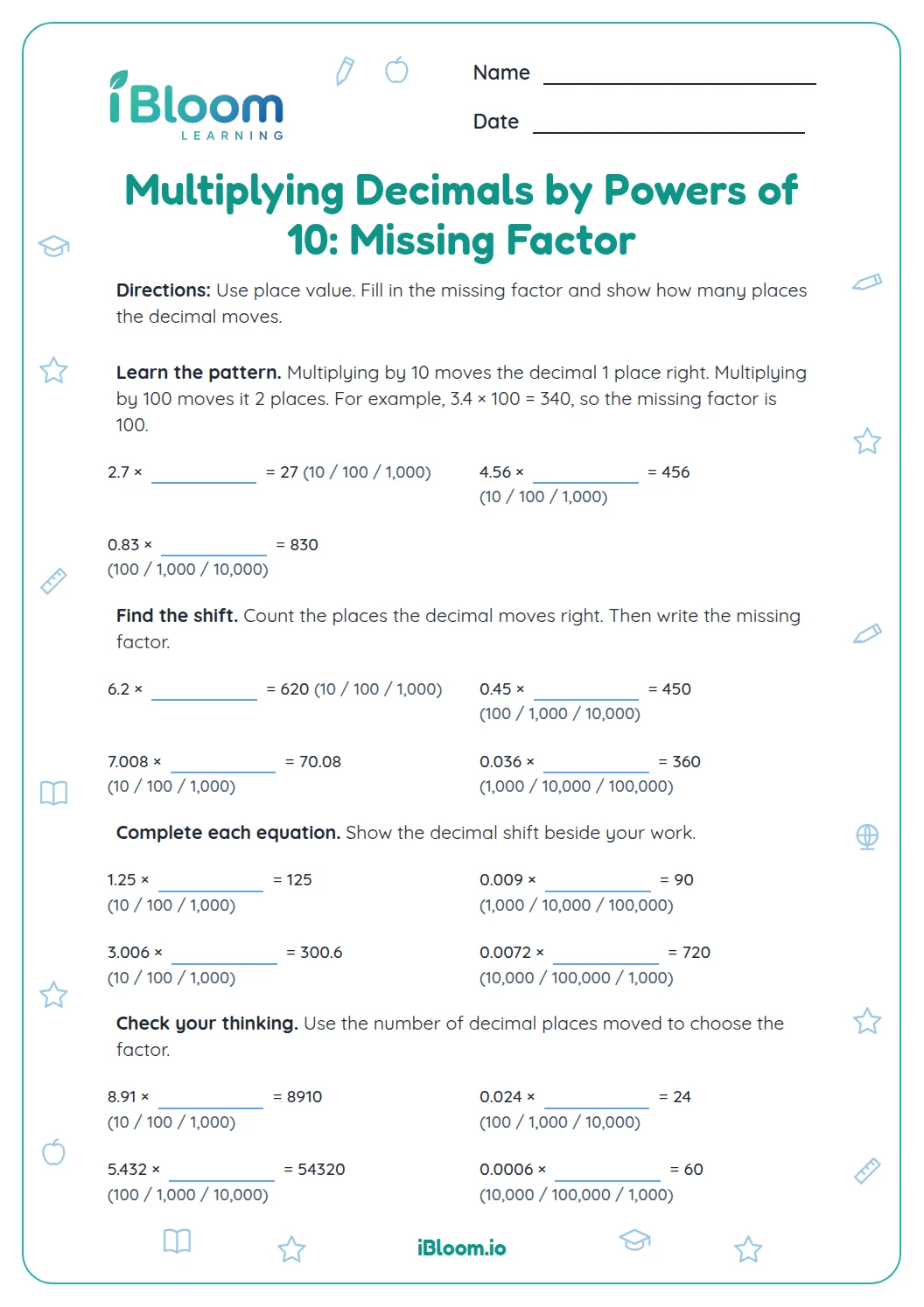
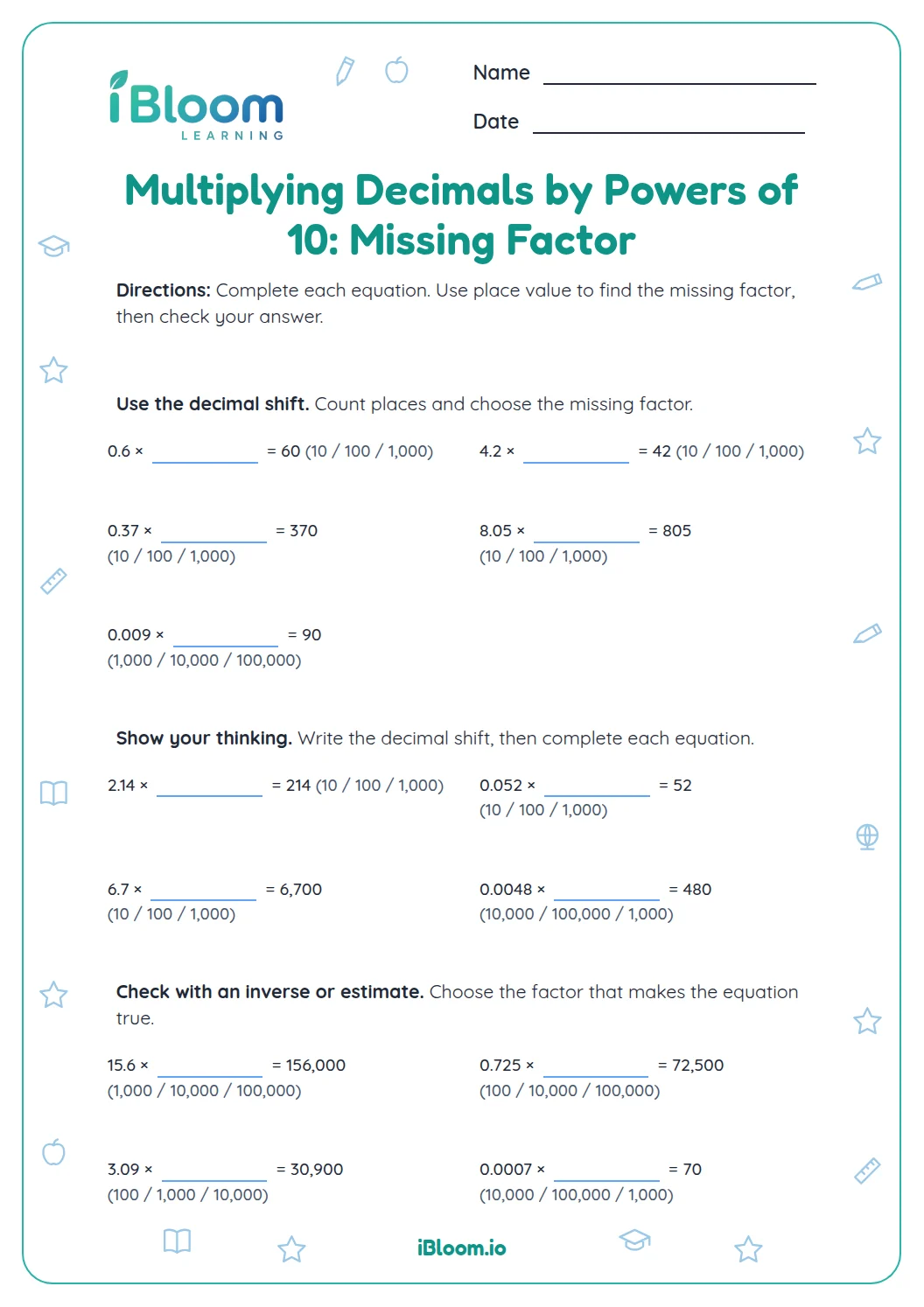
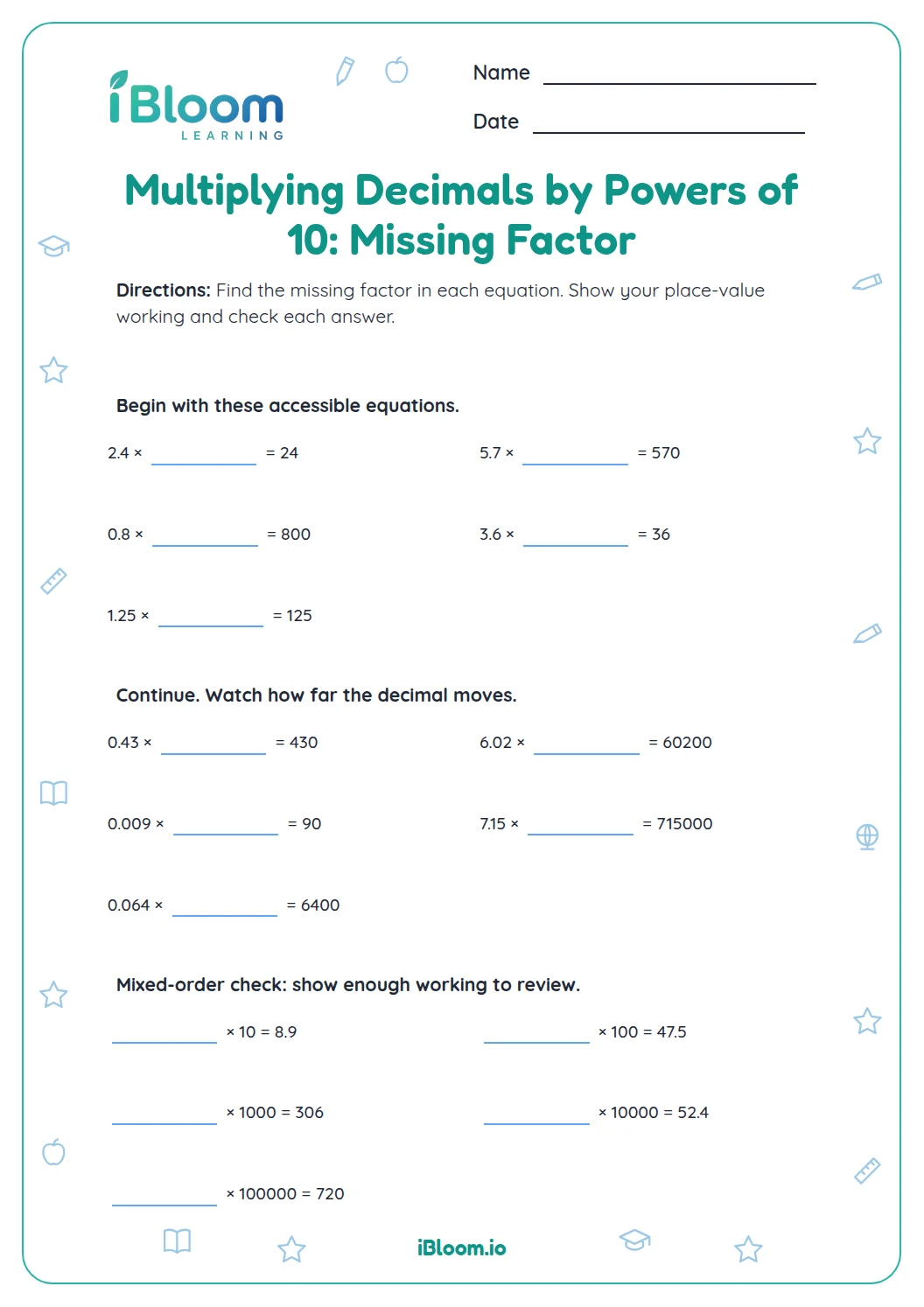
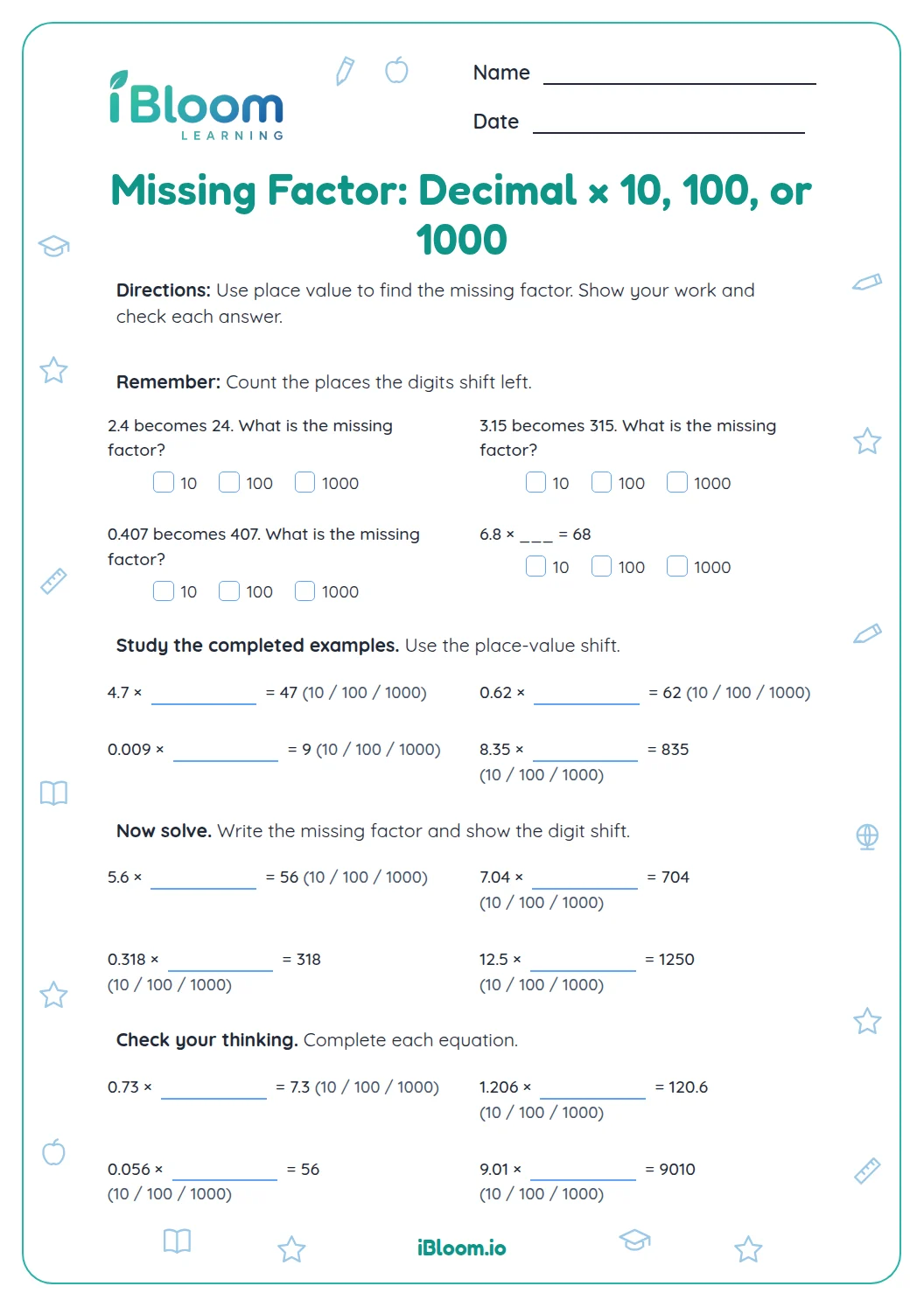
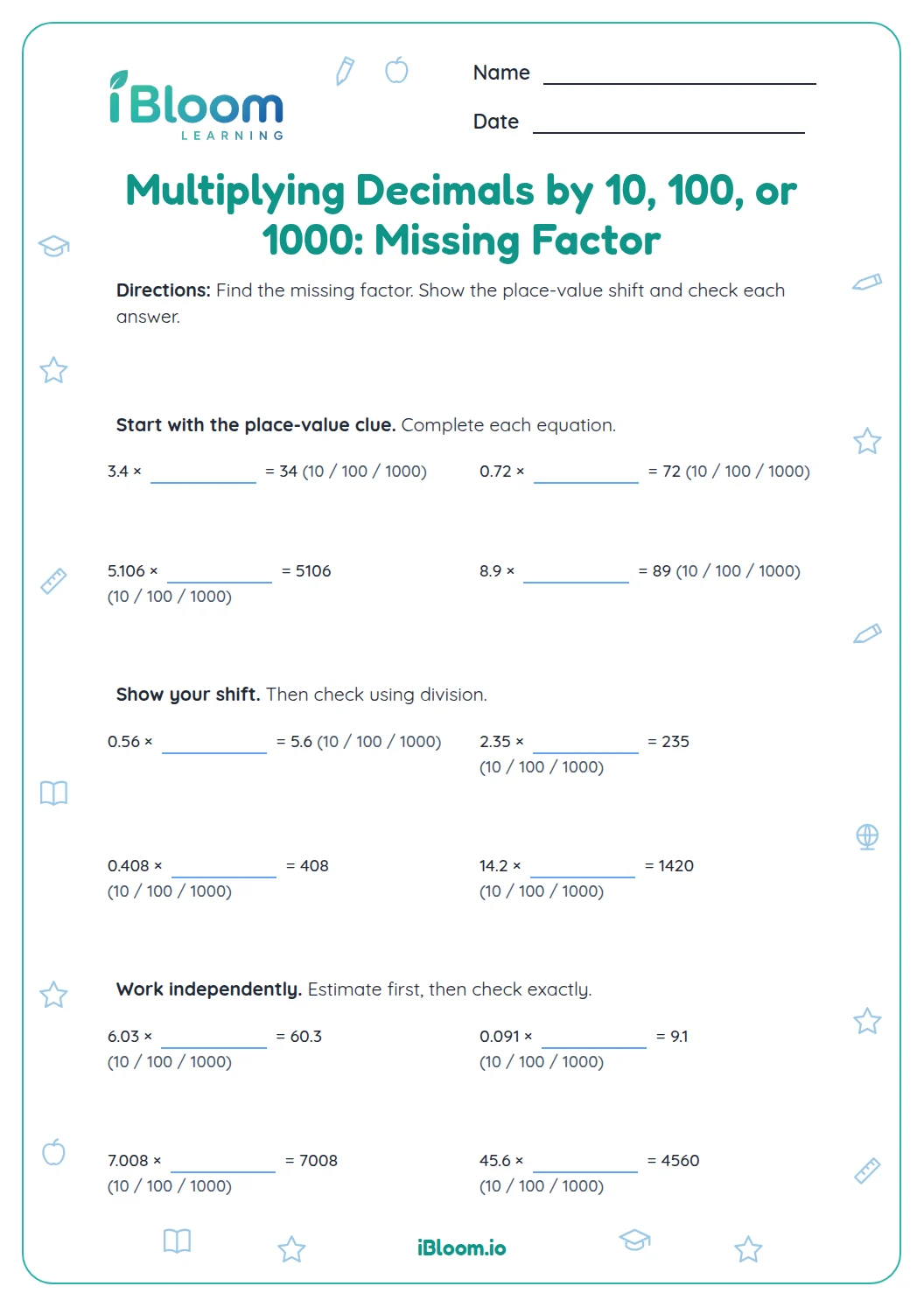
This Grade 6 worksheet practices multiplying decimals by 10, 100, and 1,000. Learners solve products, find missing factors, and apply the pattern to two short problems. The final response asks them to explain why 6.37 × 100 equals 637. The page supports place-value reasoning described in Common Core 5.NBT.A.2, and the separate answer key includes answers for all 15 questions.
Aligned to 5.NBT.A.2
What does the multiplier change?
Multiplying by 10, 100, or 1,000 makes each digit’s value 10, 100, or 1,000 times as large. The decimal point appears to move right, but the place-value relationship explains why.
How can place value guide an answer?
For 3.48 × 10, each digit takes the place one step to its left: 3 ones become 3 tens, 4 tenths become 4 ones, and 8 hundredths become 8 tenths. The product is 34.8.
How do you solve a missing-factor question?
Question 7 asks for ___ × 100 = 58.3. Divide 58.3 by 100 to undo the multiplication, giving 0.583.
- 1___ × 100 = 58.3
- 258.3 ÷ 100 = 0.583
- 3Answer: 0.583
How to use this worksheet
- 1Write the multiplier above each number sentence.
- 2Use place value to predict the size of the product.
- 3Check that the product is larger than the starting decimal.
- 4For a missing factor, undo the multiplication by dividing.
- 5Include units in the two application answers.
- 6Explain the place-value change in question 15.
Common mistakes and quick fixes
The mistake
Moving digits without tracking their values.
The fix
Name each digit’s starting and ending place.
The mistake
Making a product smaller after multiplying by 10 or more.
The fix
Estimate first; the product must be larger.
The mistake
Forgetting to reverse the operation for a missing factor.
The fix
Divide the known product by the multiplier.
Curriculum alignment
Explain place-value patterns when decimals are multiplied by powers of 10.
On this sheet: The problems multiply decimals by 10, 100, and 1,000 and ask learners to explain the change.
Show the official wordingHide the official wording
Explain patterns in the number of zeros of the product when multiplying a number by powers of 10, and explain patterns in the placement of the decimal point when a decimal is multiplied or divided by a power of 10. Use whole-number exponents to denote powers of 10.
What to practice next
Make more practice
Further reading
Questions parents and teachers ask
How many practice items are there?
There are 15 questions: 12 number sentences, two applications, and one explanation. The number sentences include direct products and missing factors for multiplication by 10, 100, or 1,000. Learners should show how the digits’ place values change for each multiplier.
Does the worksheet include an answer key?
Yes. A separate answer key gives answers for all 15 questions, including units for the ribbon and machine problems and a sample explanation of the place-value pattern. The key also makes it easy to discuss any place-value step that needs another look.
What does a missing-factor equation ask?
It asks learners to find the starting decimal. In ___ × 100 = 58.3, divide 58.3 by 100 to find 0.583, then multiply to check that the equation is true. A quick multiplication check confirms the starting decimal and product relationship.
Why does the decimal point appear to move?
The digits change place-value positions when multiplied by a power of 10. Thinking about each digit’s value helps explain the notation: 3.48 becomes 34.8 because every digit is worth ten times as much. The multiplier is visible in each equation, so learners can compare the three patterns.
What materials are needed?
Print the worksheet and its answer key. Learners need a pencil and space to show their calculations for the two application questions; the other items are number sentences and a written explanation. A calculator may be used after the written work to verify the products.