


About this worksheet
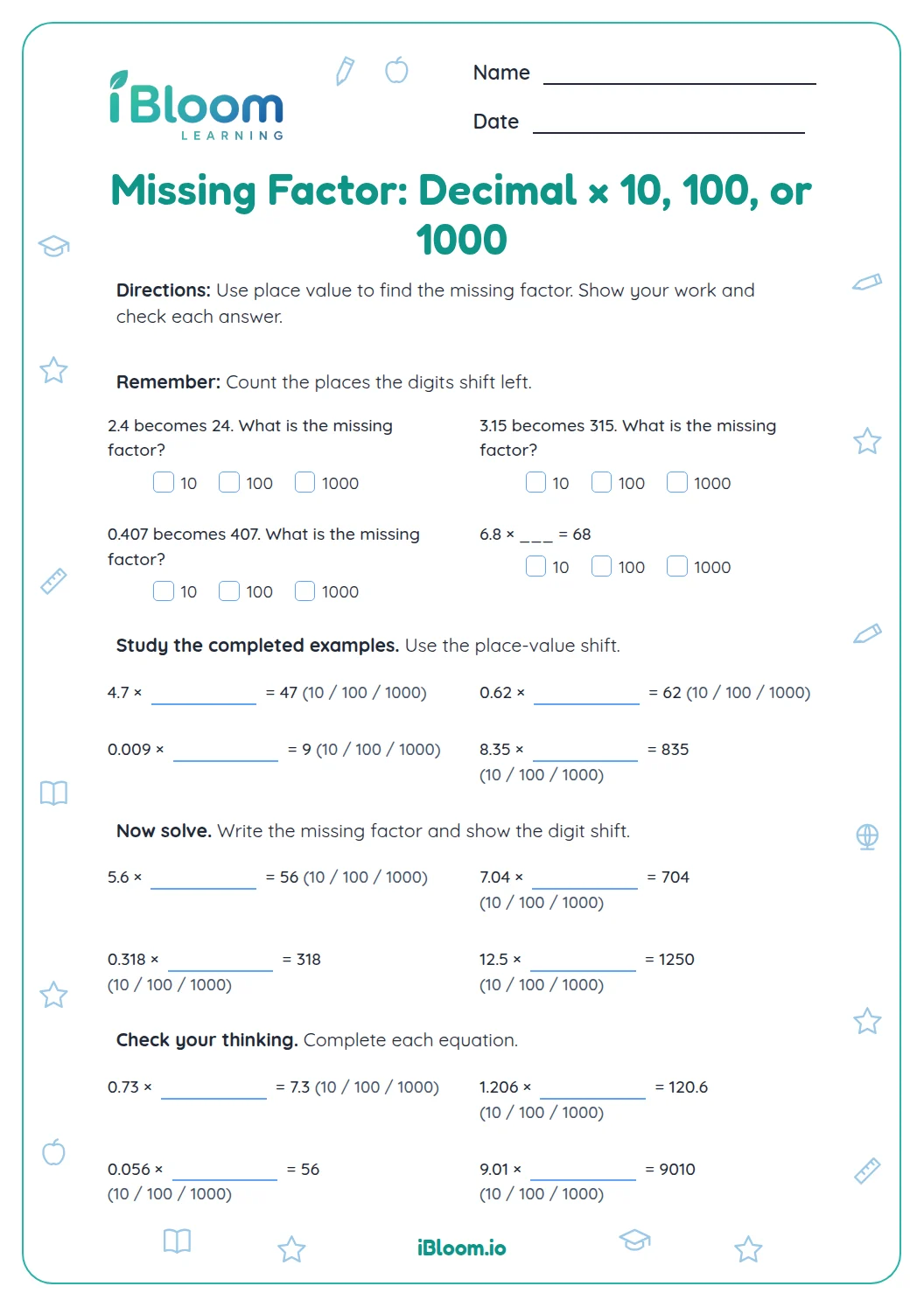
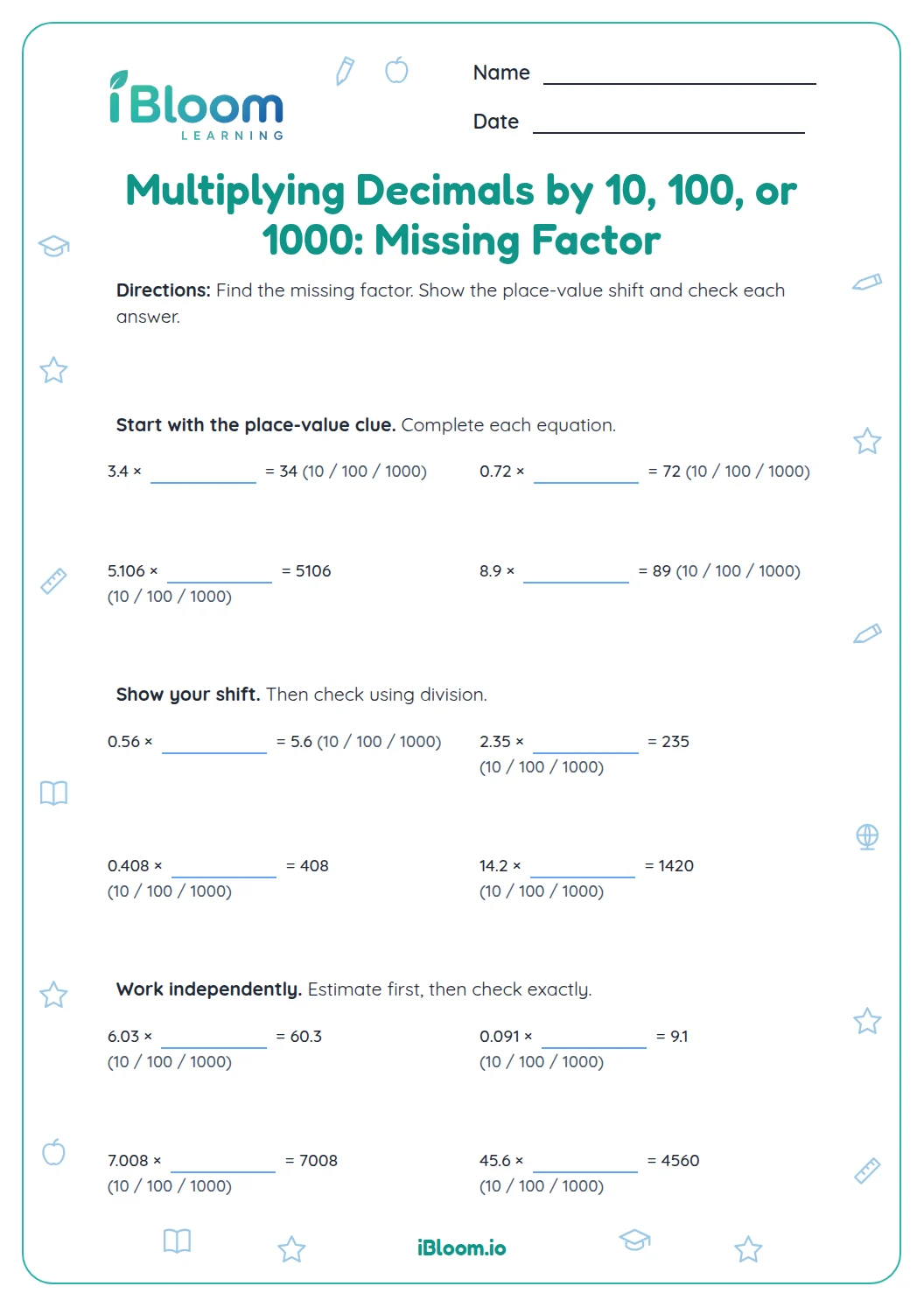
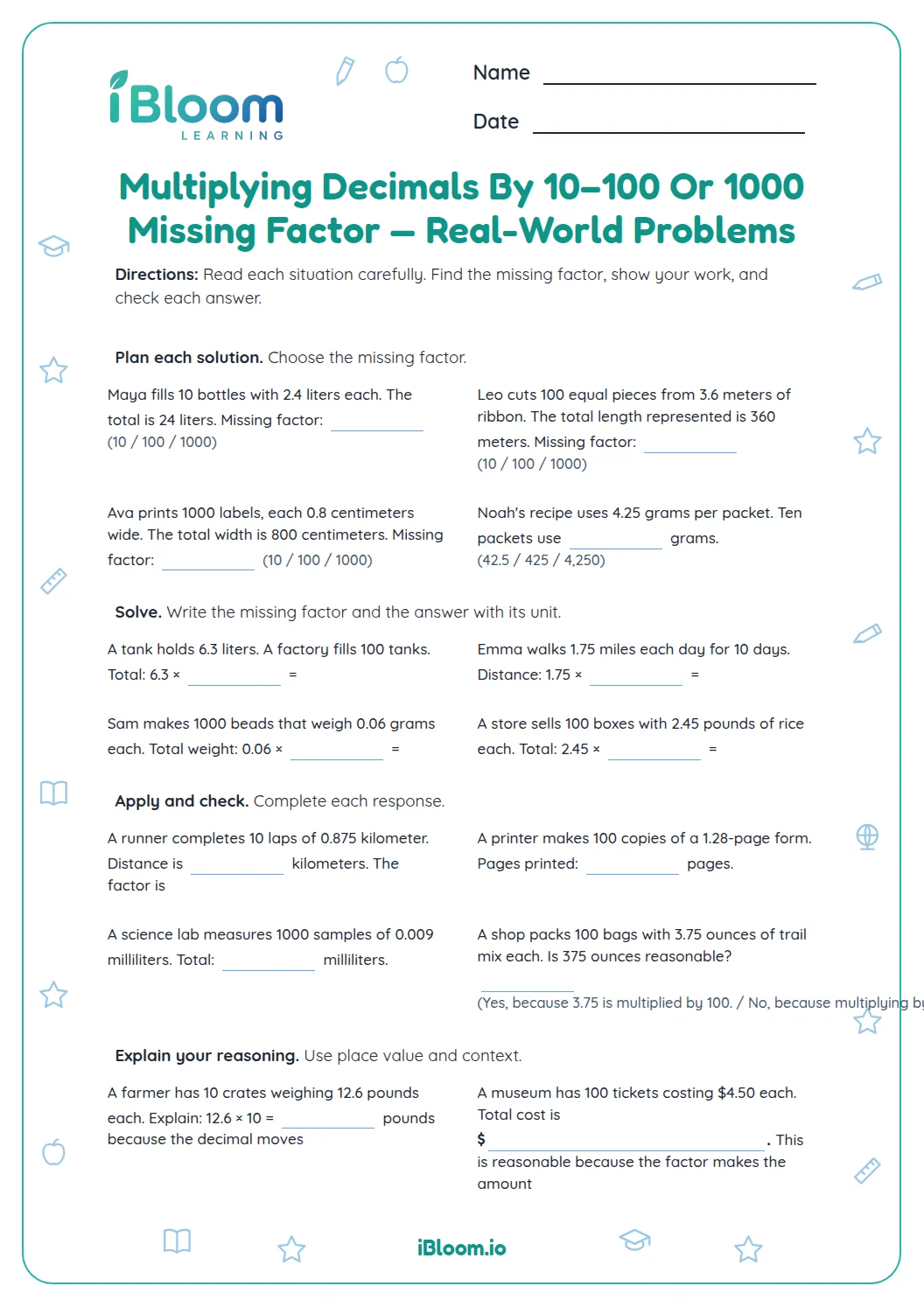
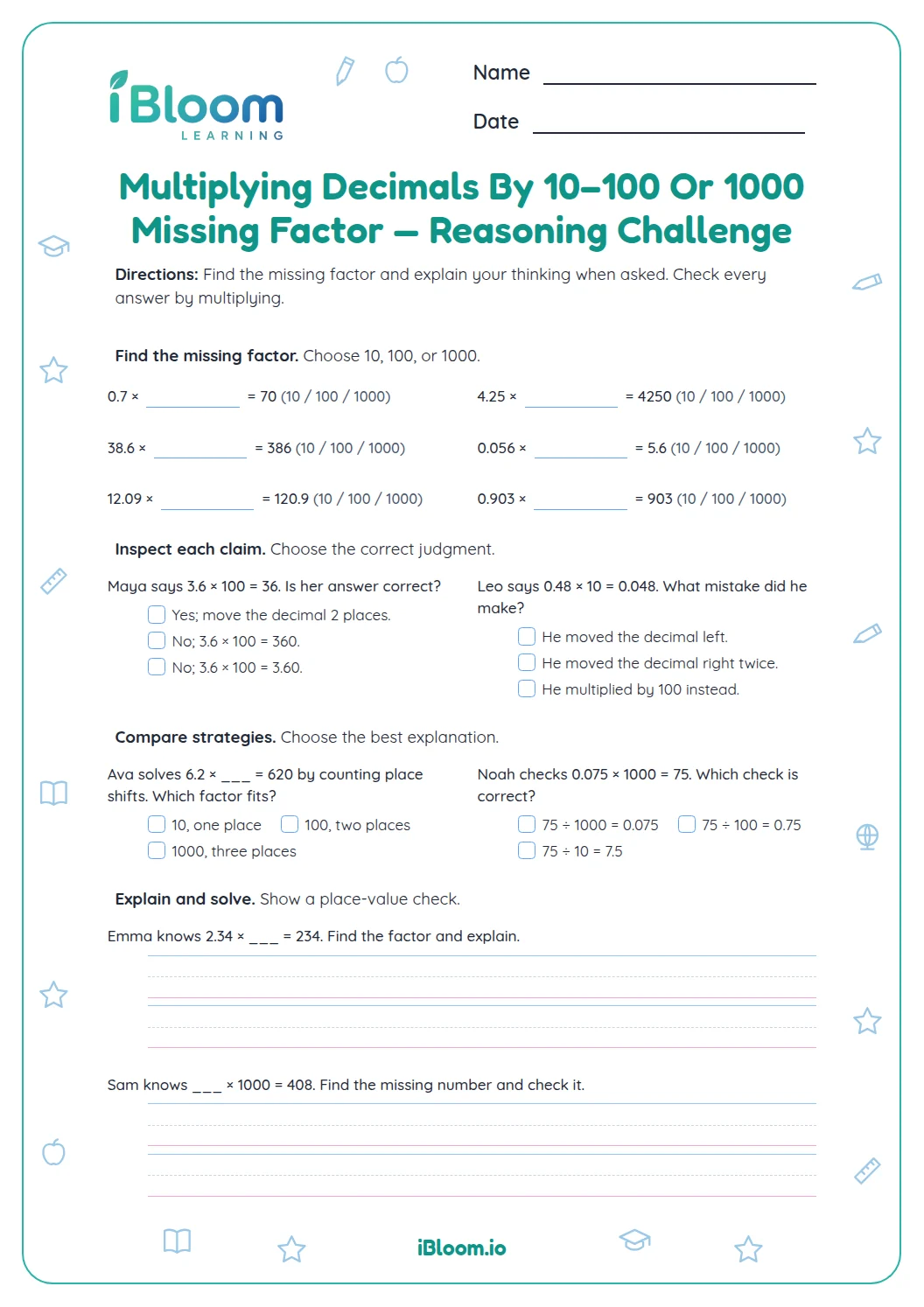
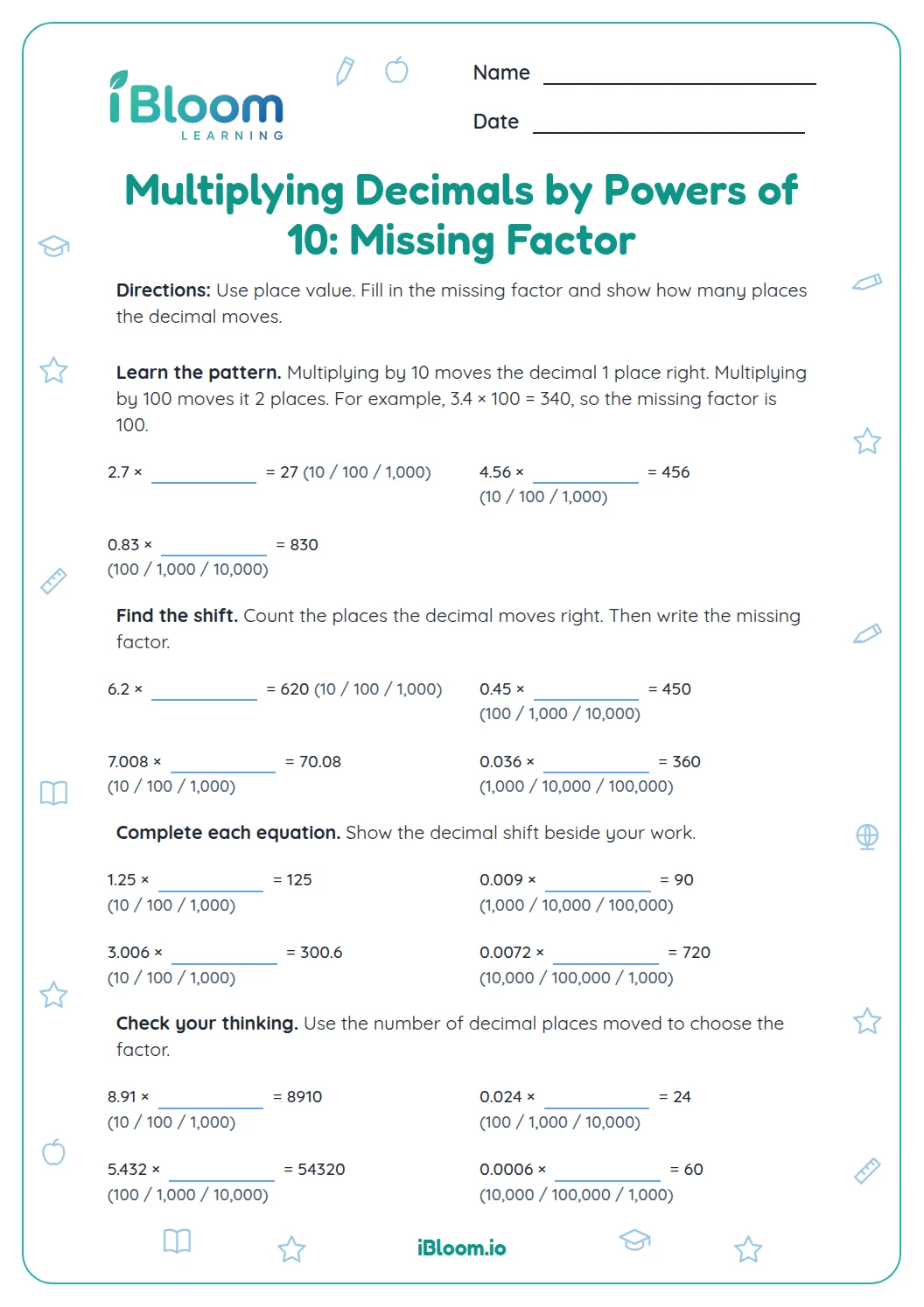
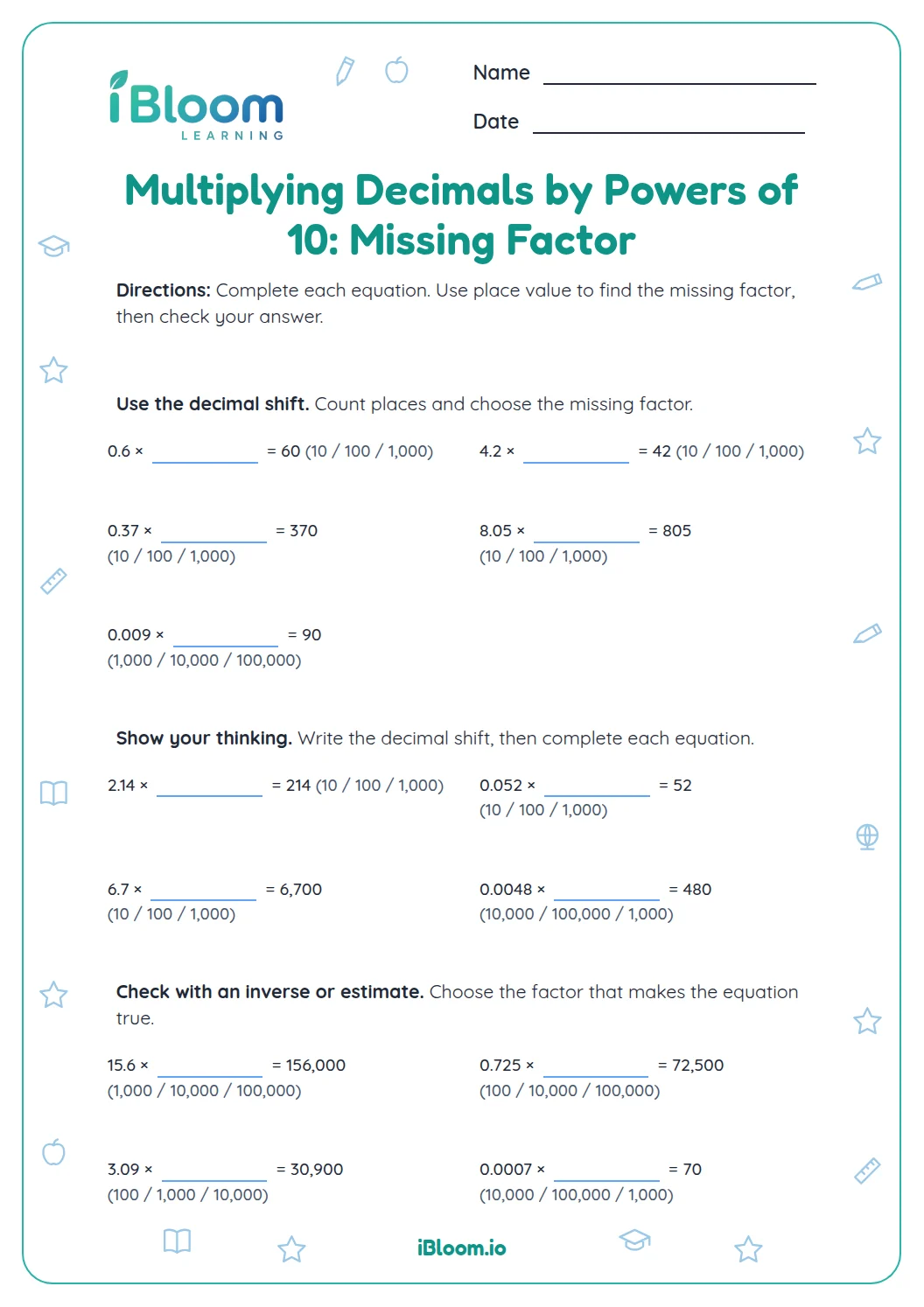
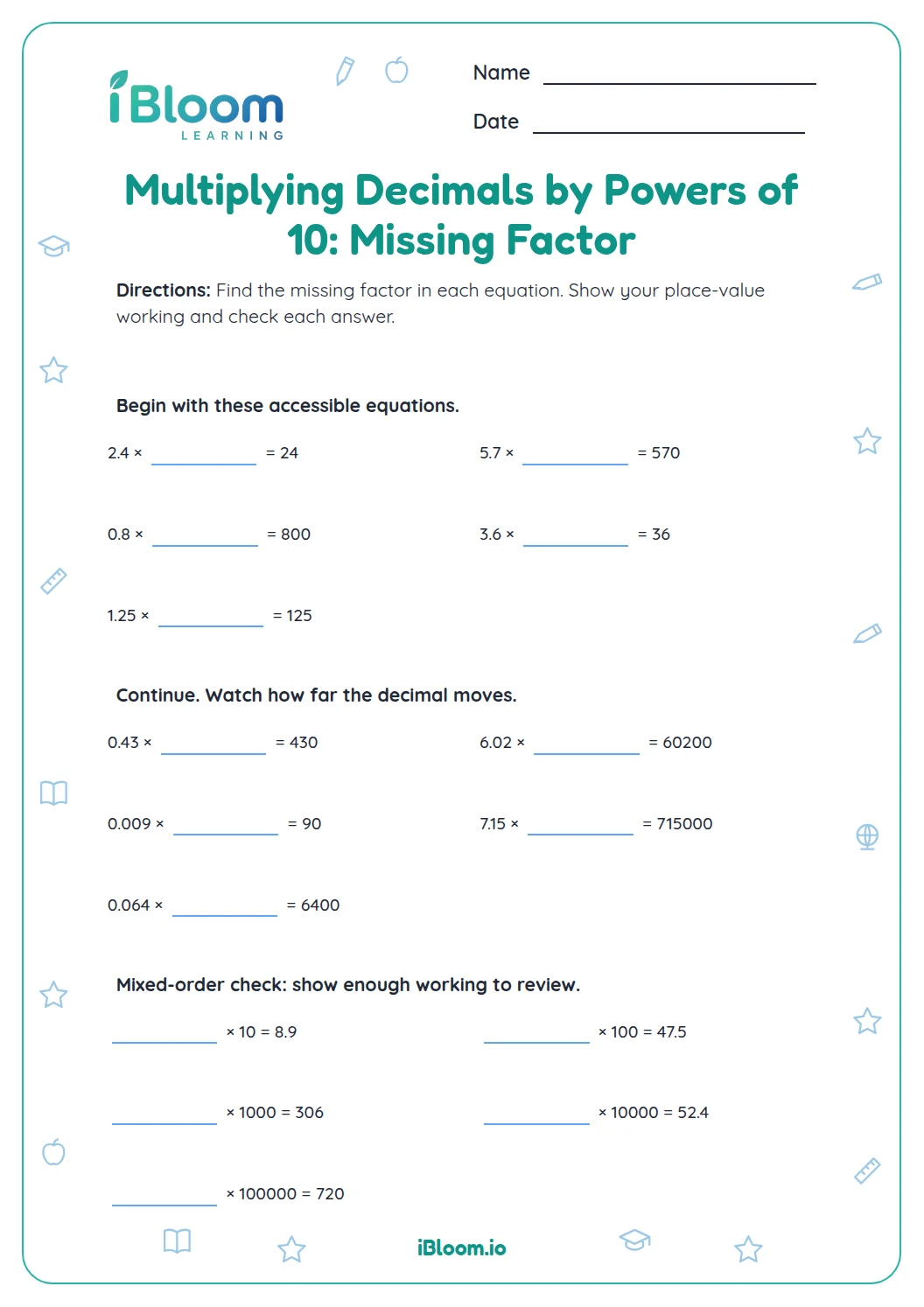
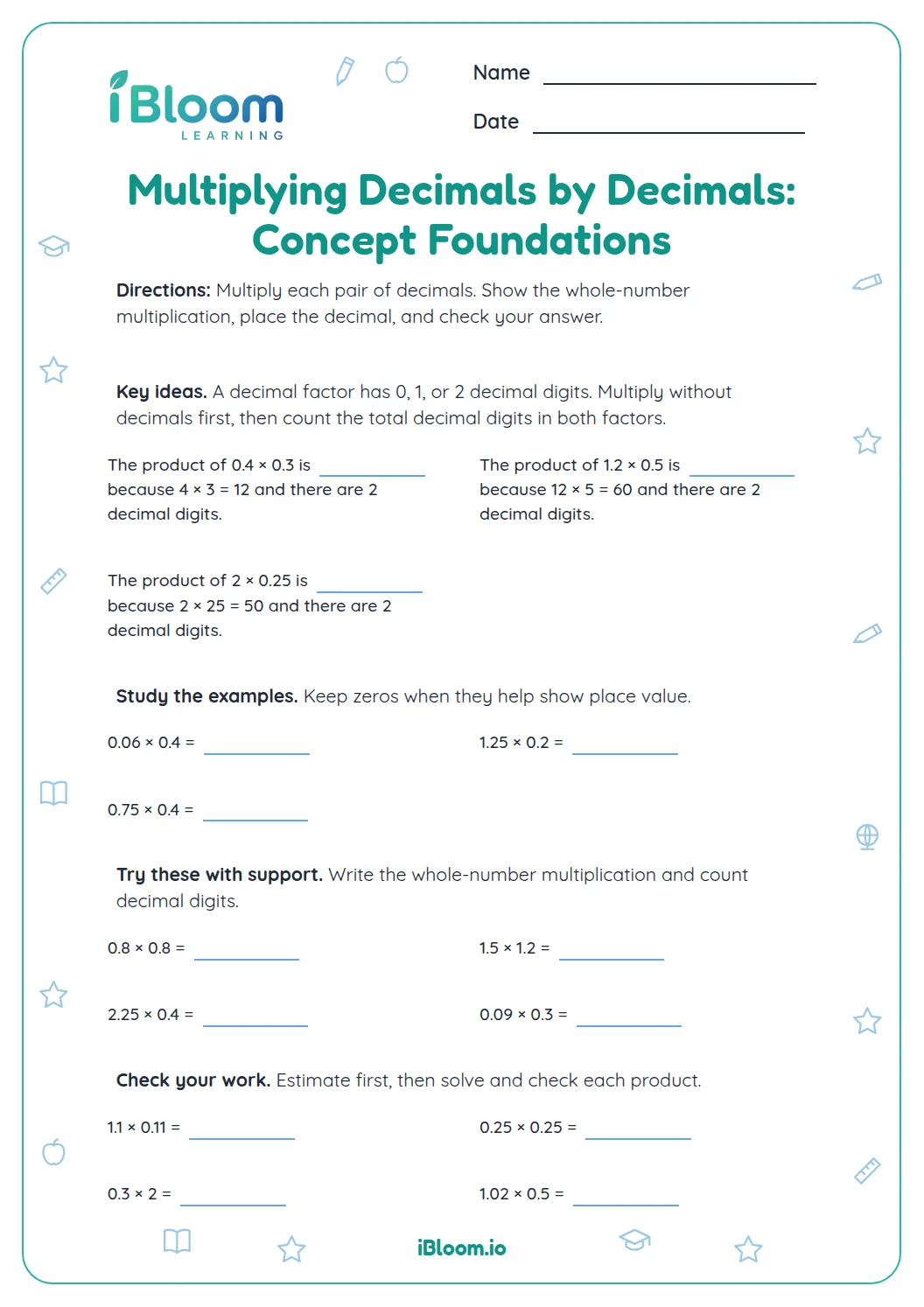
This Grade 6 worksheet practices multiplying decimals by 10, 100, and 1,000 and finding missing factors. Children solve direct products, work backward from a product, and use hundredths, tenths, and number-line models to connect decimal values with scaling. It aligns with Common Core 6.NS.B.3, which includes fluently multiplying multi-digit decimals. The answer key is a separate page.
Aligned to 6.NS.B.3
What happens to decimal digits when you multiply by 10, 100, or 1,000?
Each factor of 10 scales the value by one place. Multiplying by 100 scales it by two places, and multiplying by 1,000 scales it by three. The digits stay in the same order; their place values change.
For example, 0.058 × 100 = 5.8. The 5 moves from hundredths to ones, and the 8 moves from thousandths to tenths.
How can you find a missing factor?
Undo the scale factor by dividing the product by 10, 100, or 1,000. If ___ × 100 = 47, then 47 ÷ 100 = 0.47. Check by multiplying 0.47 by 100.
- 1___ × 100 = 47
- 2Undo × 100 by dividing 47 by 100.
- 347 ÷ 100 = 0.47
- 4Check: 0.47 × 100 = 47.
How do the models connect to decimal multiplication?
The hundredths grid, tenths strips, and number lines show the starting decimal. The question then asks you to scale that value by a power of ten. Read the marked or shaded amount first, then apply the factor.
How to use this worksheet at home or in class
- 1Name the power of ten in the question.
- 2Move each digit’s place value the matching number of places.
- 3For a missing factor, divide the product by the known factor.
- 4Use the visual to identify the starting decimal before scaling.
- 5Multiply back to check missing-factor answers.
Common mistakes and quick fixes
The mistake
Moving digits but changing their order.
The fix
Keep the digits in order and change only their place values.
The mistake
Moving the decimal the wrong direction for multiplication.
The fix
Multiplication by 10 or more makes a nonzero number larger.
The mistake
Leaving off zeros in a whole-number product.
The fix
Check the scale factor and write the resulting place value clearly.
Common Core alignment
This worksheet gives focused practice with a grade-level skill named in the Common Core standards.
Compute with multi-digit decimals using standard algorithms.
On this sheet: The product and missing-factor questions practice multiplying decimals and checking place value.
Show the official wordingHide the official wording
Fluently add, subtract, multiply, and divide multi-digit decimals using the standard algorithm for each operation.
What to practice next
Make more practice
Further reading
Questions parents and teachers ask
How do you multiply a decimal by 100?
Multiplying by 100 makes the value one hundred times as large, so each digit shifts two place values. For example, 0.058 × 100 = 5.8. Read the digits and their new places to check the product. This same place-value shift applies to each product on Part A.
How do I find a missing factor?
Divide the product by the known factor. For ___ × 100 = 47, calculate 47 ÷ 100 = 0.47. Multiply 0.47 by 100 to check that the product returns to 47. This reverse step works for each power of ten.
What do the models show?
The hundredths grid, tenths strip, and number lines show the starting decimal value. Read the shaded or marked amount, then use the equation practice to multiply by 10, 100, or 1,000. The visual values are also listed in the key.
Is an answer key included?
Yes. The key is a separate two-page section that lists the decimal products, missing factors, and values read from each model. Compare each answer after finishing, then redo any item that needs a place-value correction. The sheet and key each have two pages.
Which models appear on the sheet?
Students read two shaded decimal models and two number lines. The hundredths grid represents 0.23, the tenths strip represents 0.6, and the marked points show 0.4 and 0.07. The key gives each value so students can check how the models name decimals.