

About this worksheet
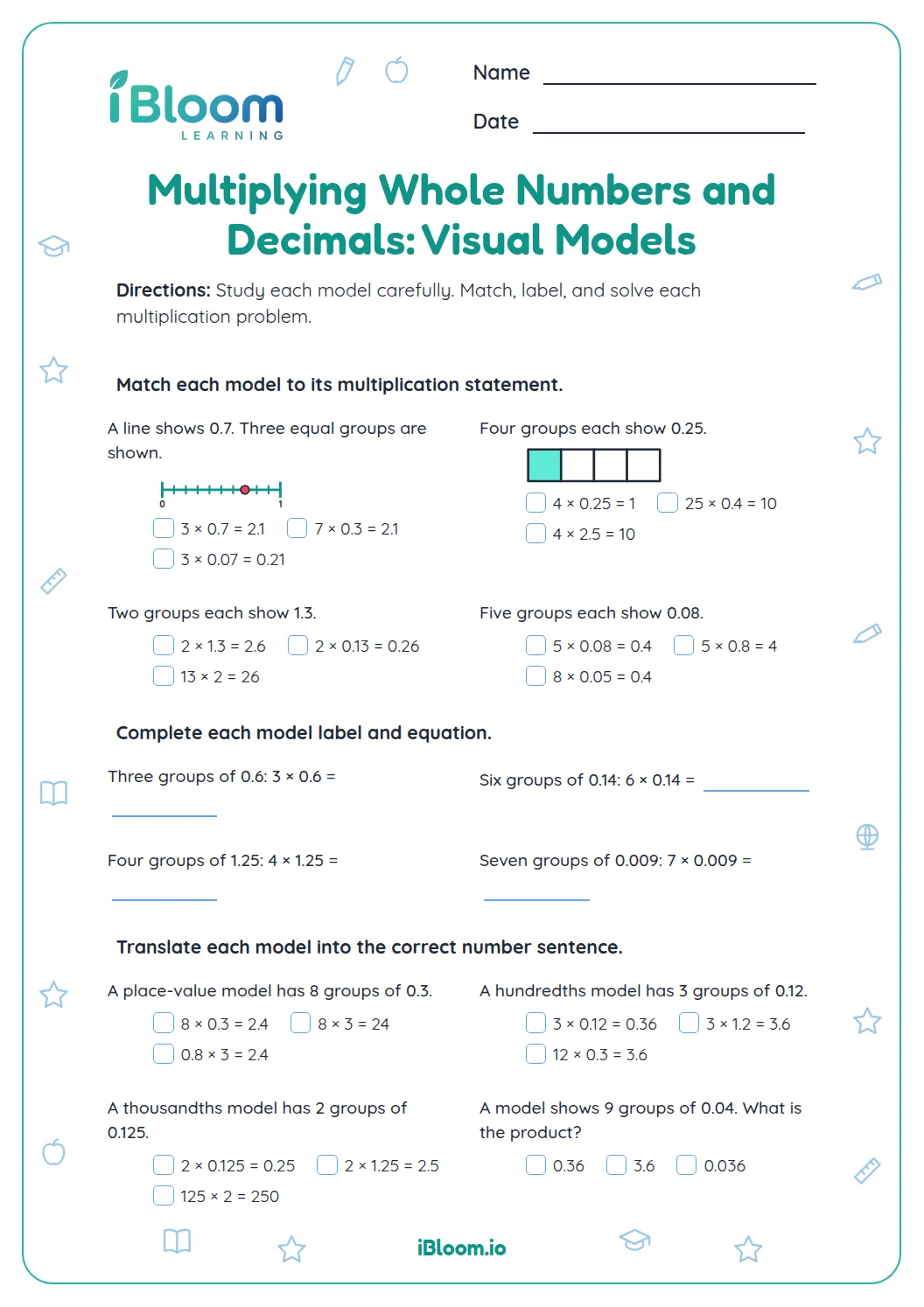
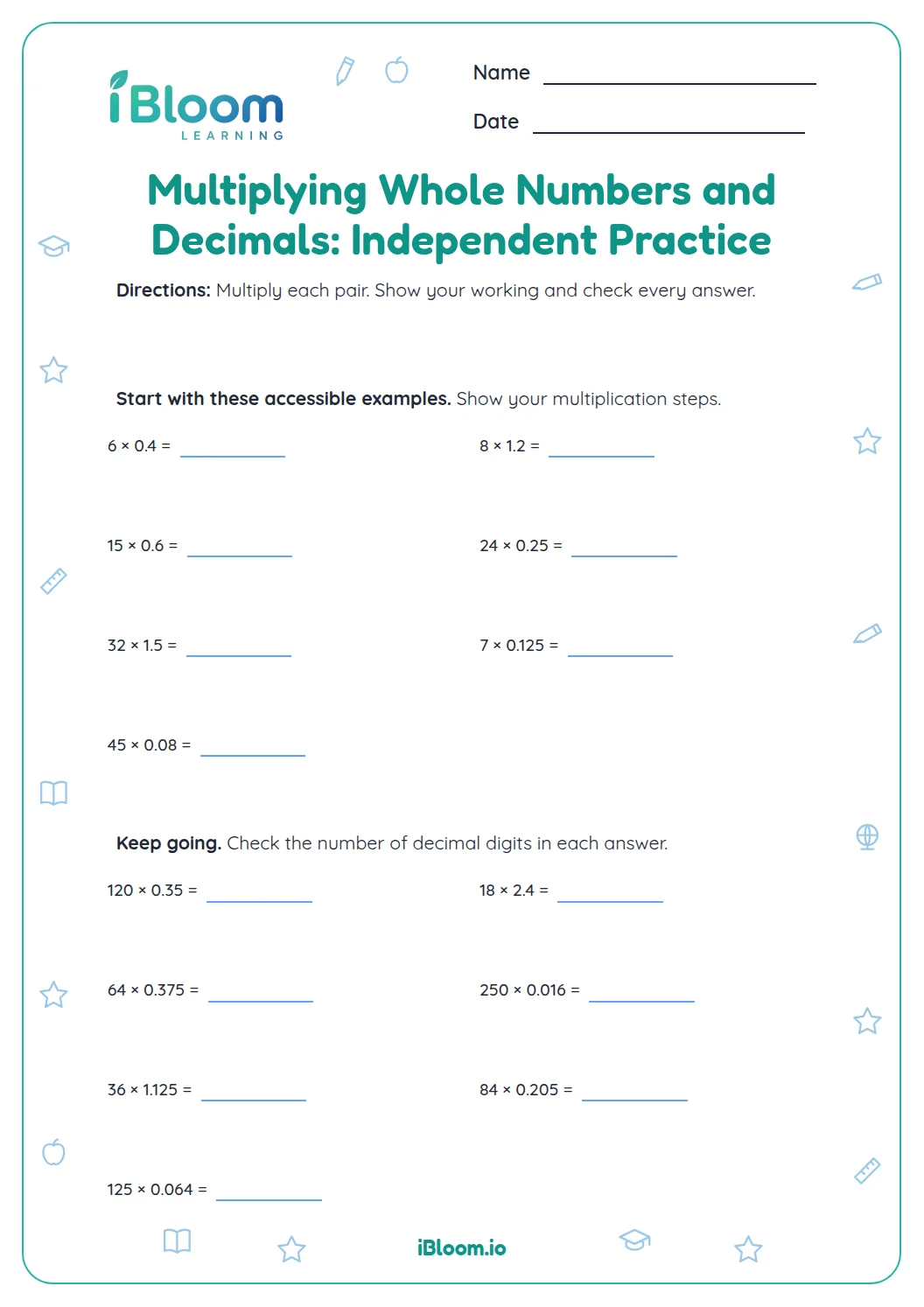
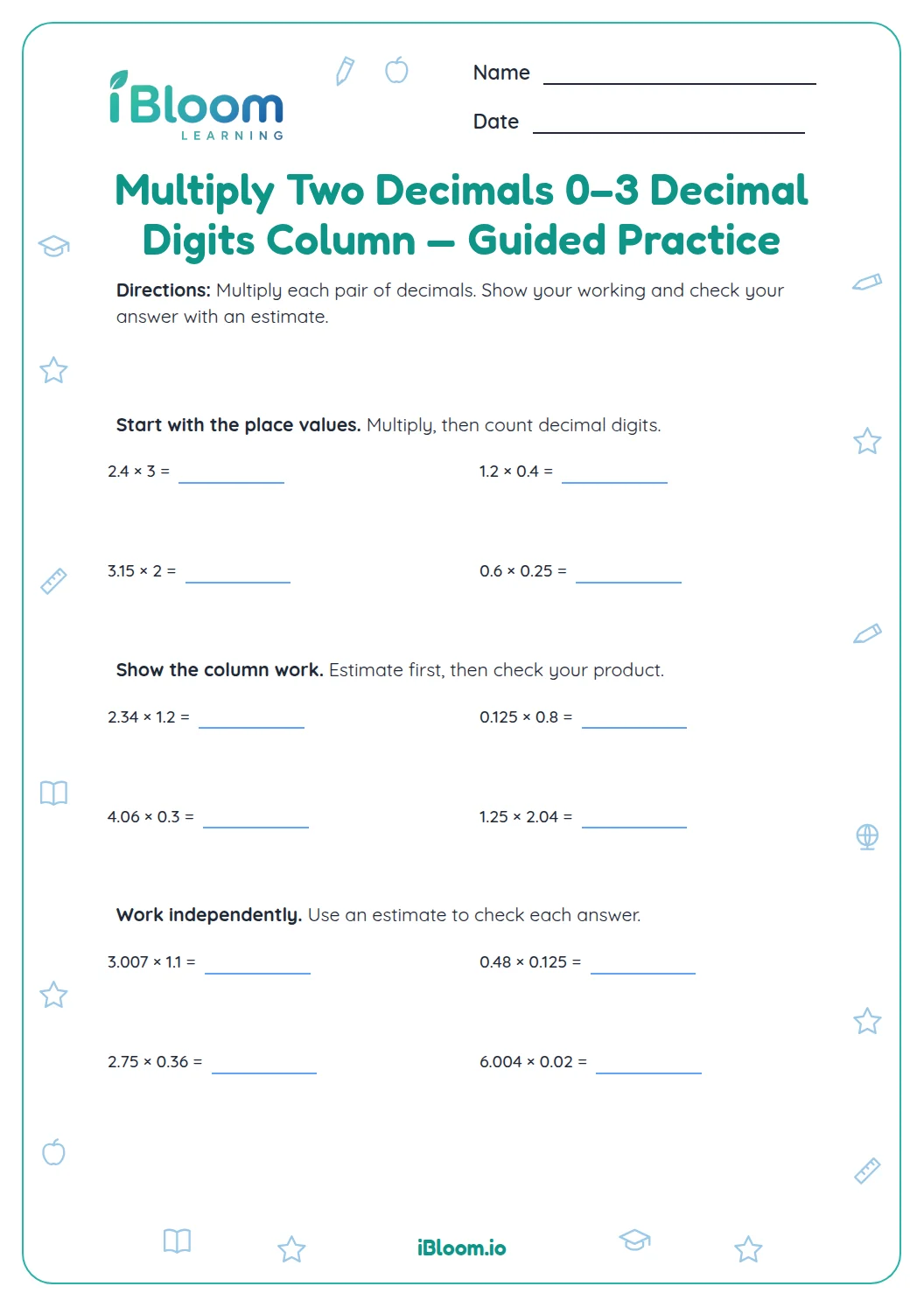
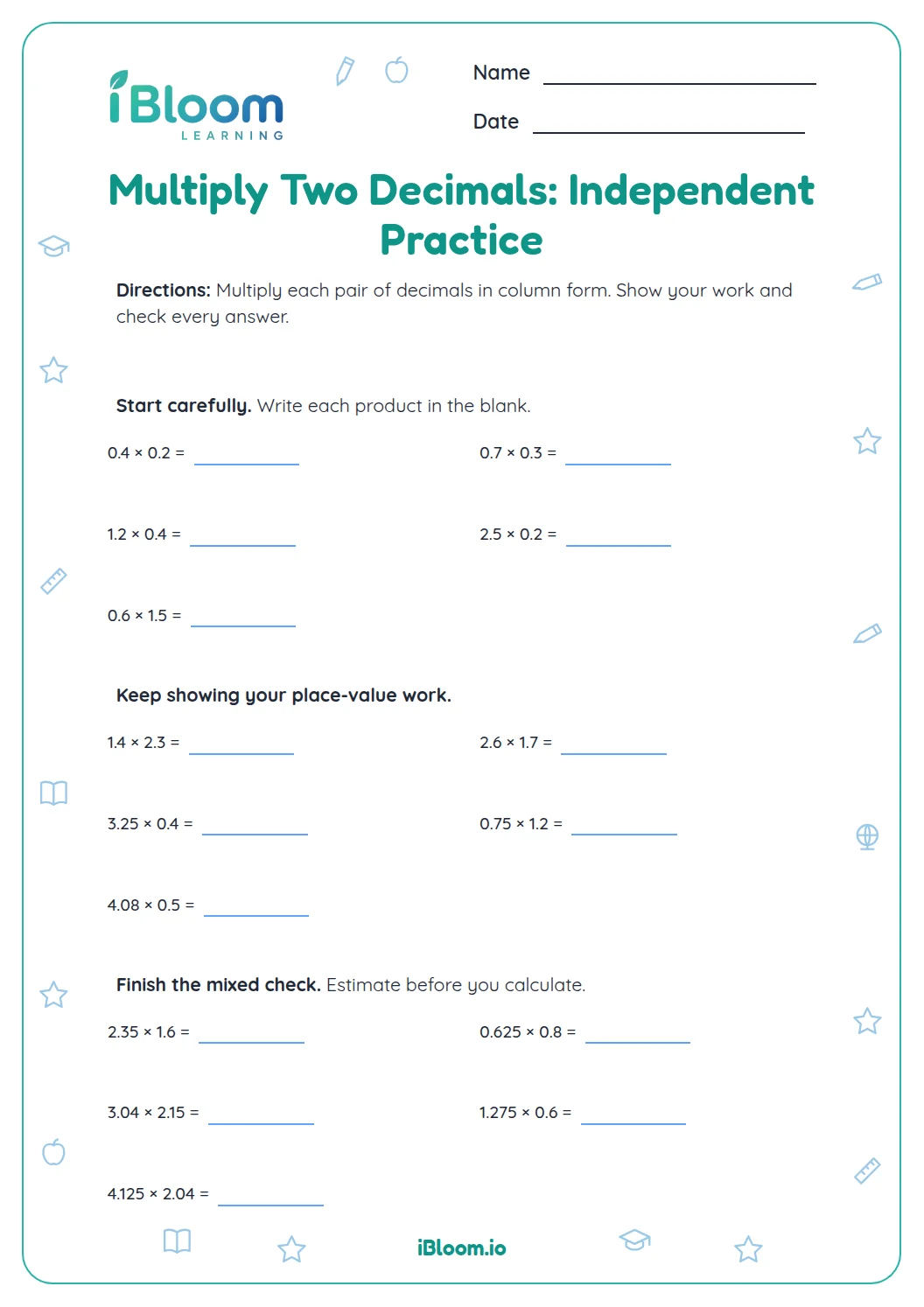
This 14-question worksheet connects decimal products to hundredths grids and a short number-line model, then provides compact multiplication practice. A separate answer key includes each result.
Aligned to 5.NBT.B.7 and 6.NS.B.3
How do the models show decimal products?
A hundredths grid has 100 small squares. Twelve shaded squares represent 0.12, so 0.3 × 0.4 = 0.12. The number line shows three jumps of 0.12 ending at 0.36.
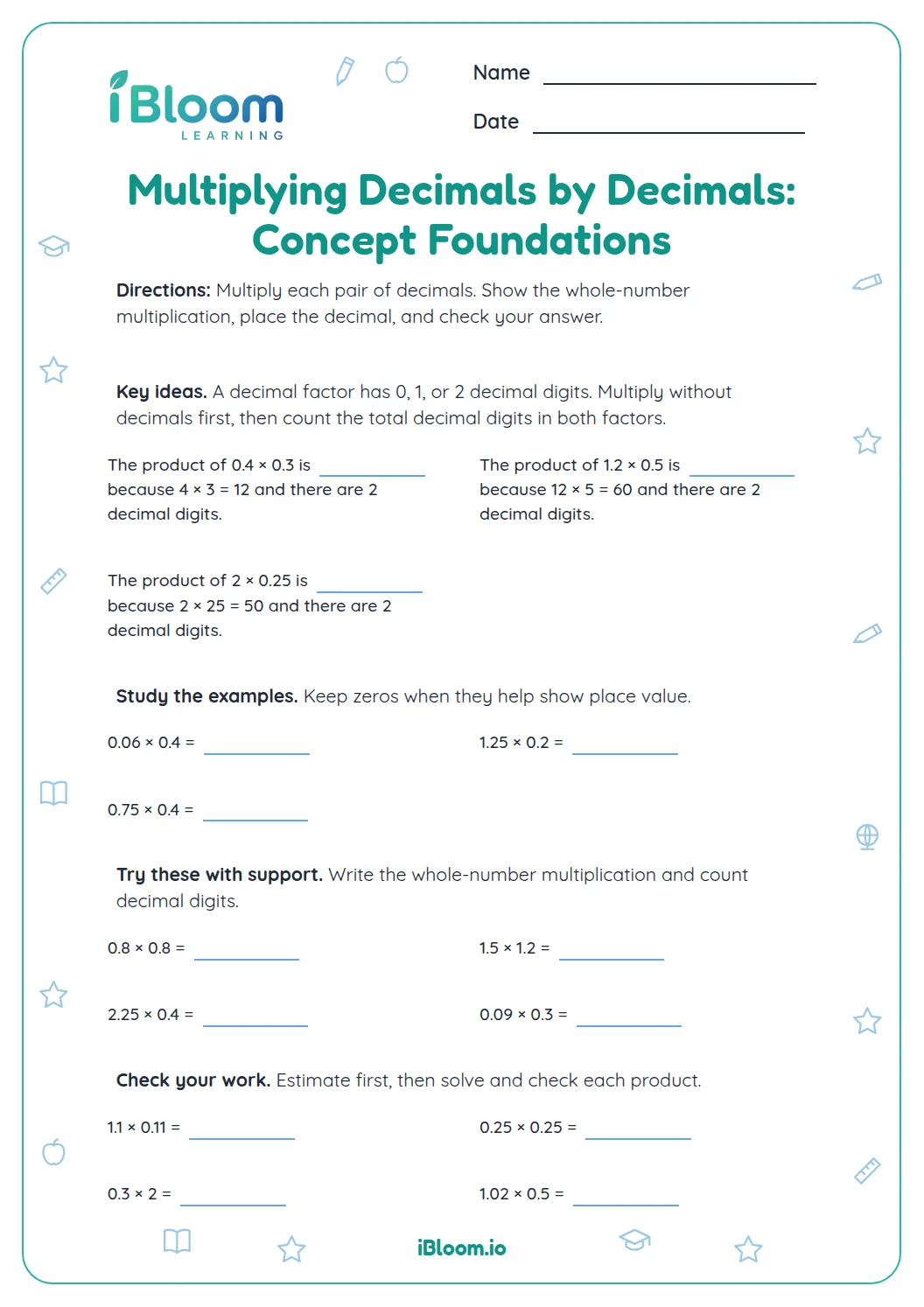
How do you multiply decimal factors?
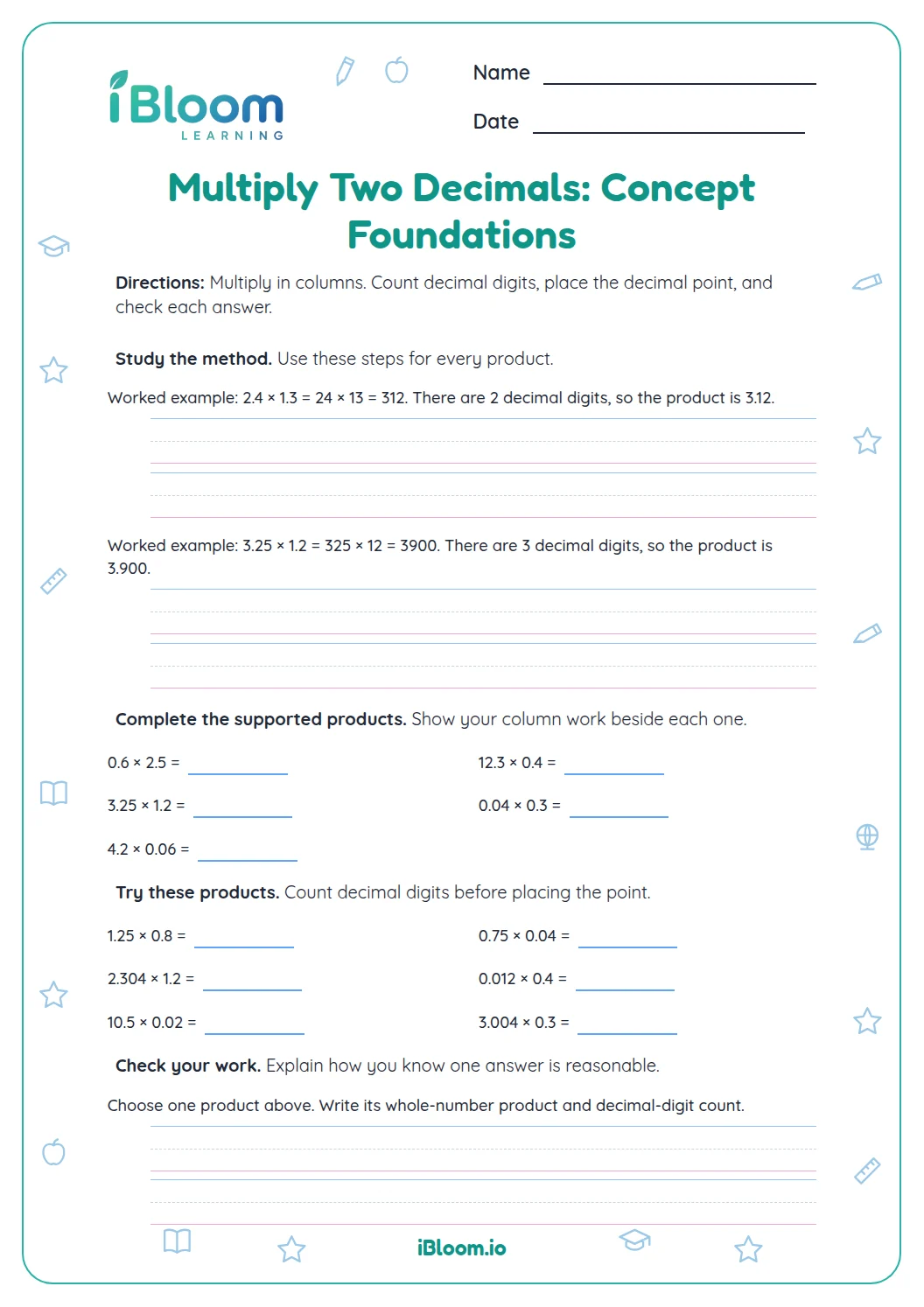
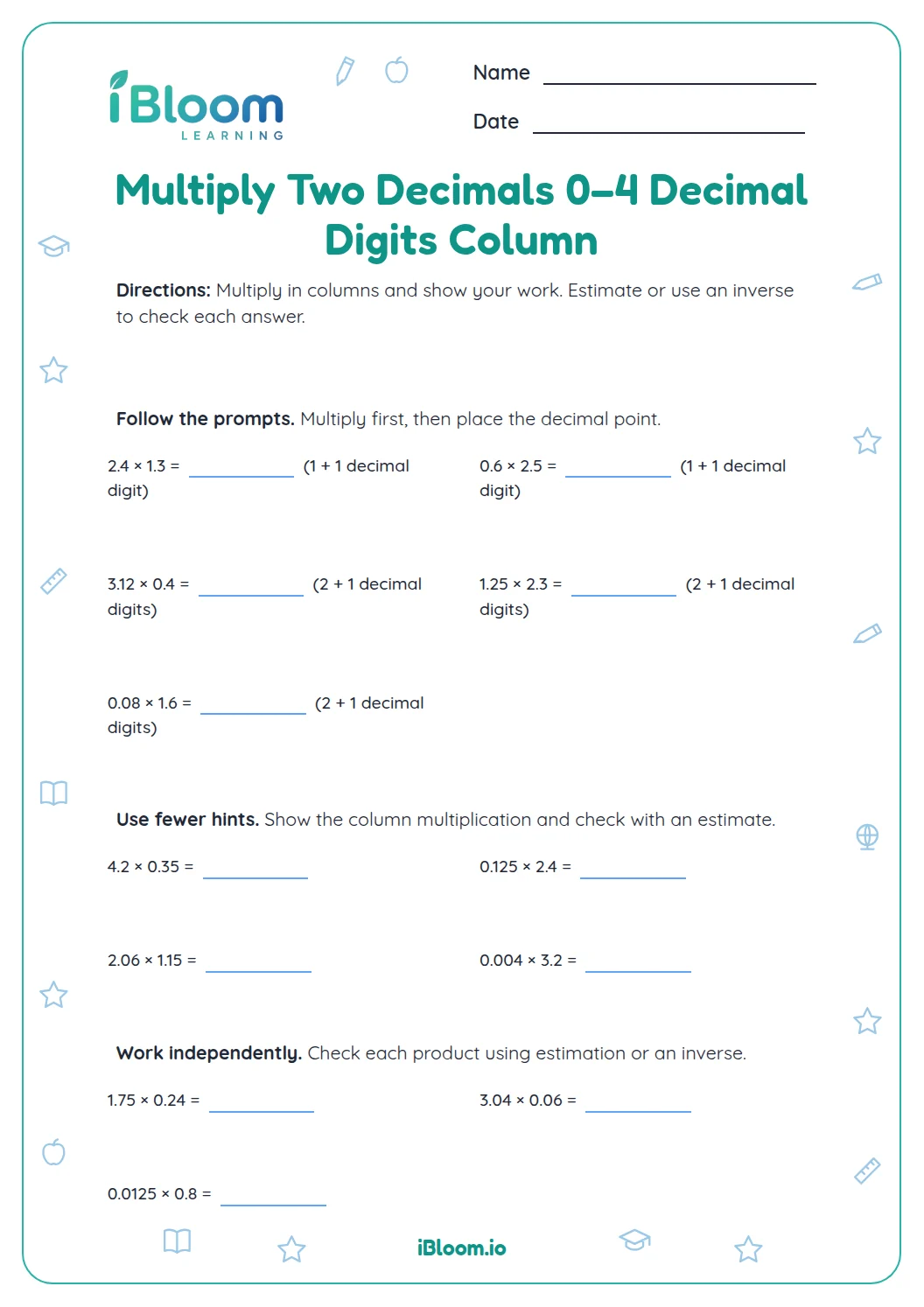
Multiply the digits as whole numbers, then use the total decimal places in both factors to place the decimal point. For 0.4 × 0.5, 4 × 5 = 20 hundredths, or 0.20.
What is on this worksheet?
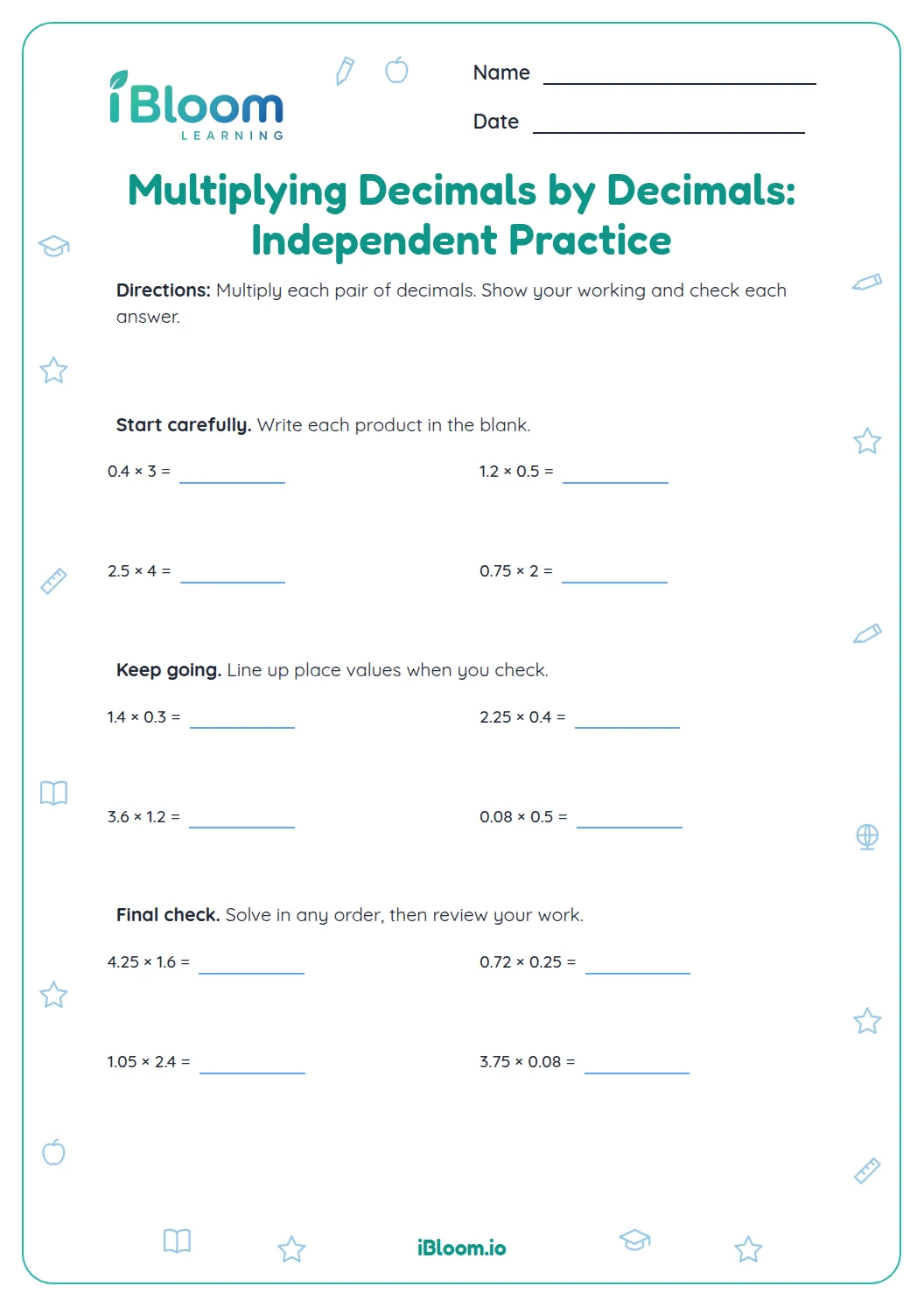
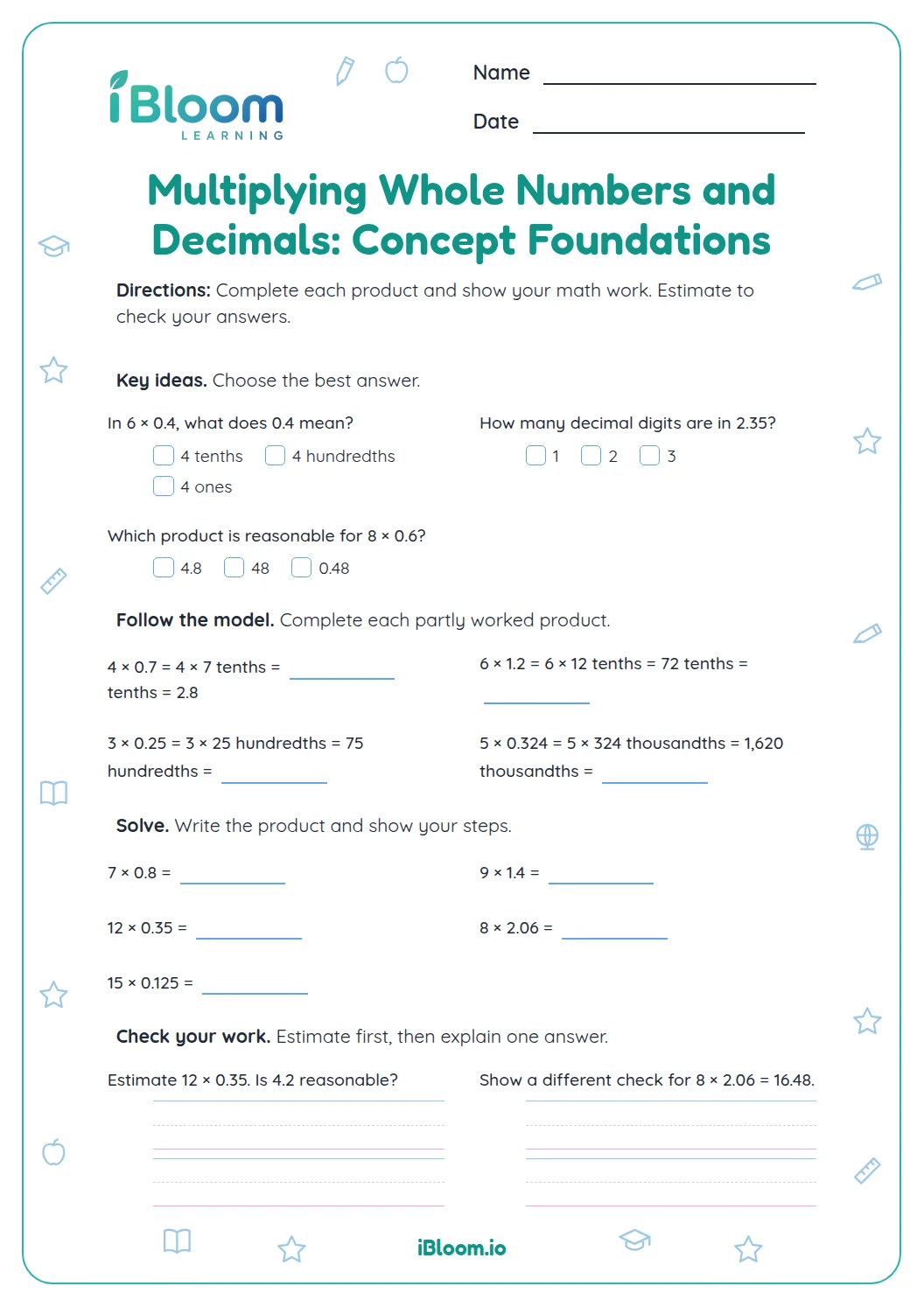
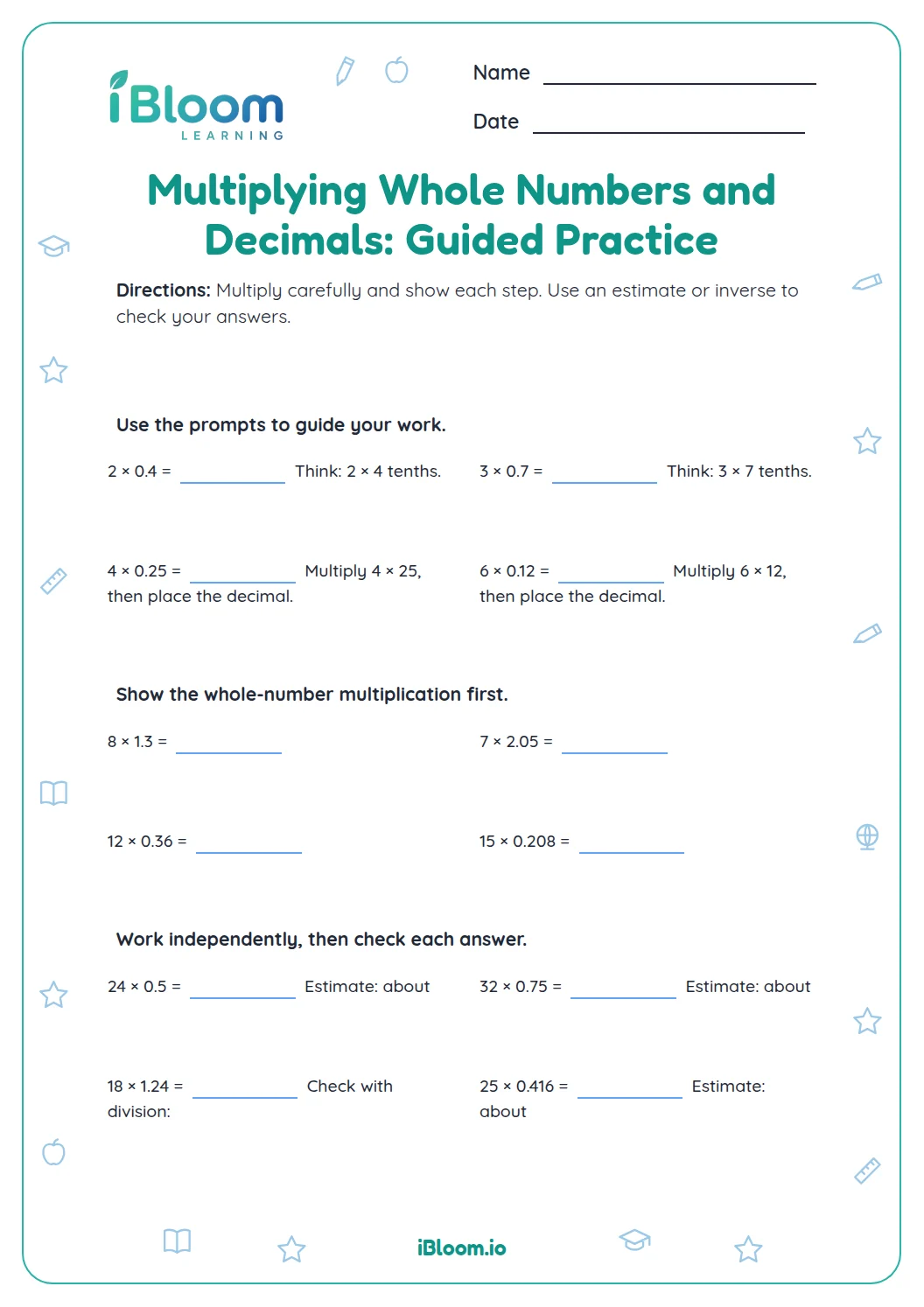
The sheet has 14 questions: three multiple-choice model reads and 11 compact decimal products. It fits two worksheet pages with a separate answer key.
Solve the products
- 1Read the factors and inspect the grid when one is provided.
- 2Multiply the digits as whole numbers.
- 3Count the decimal places in both factors.
- 4Place the decimal in the product and write any needed zero.
- 5Estimate to check that the product is reasonable.
Common Core alignment
The visual models reinforce the place-value reasoning behind multi-digit decimal multiplication.
Add, subtract, multiply and divide decimals to hundredths.
On this sheet: The hundredths grids model products of decimal factors.
Show the official wordingHide the official wording
Add, subtract, multiply, and divide decimals to hundredths, using concrete models or drawings and strategies based on place value, properties of operations, and/or the relationship between addition and subtraction; relate the strategy to a written method and explain the reasoning used.
Fluently compute with multi-digit decimals.
On this sheet: The final problems build fluency with decimal multiplication.
Show the official wordingHide the official wording
Fluently add, subtract, multiply, and divide multi-digit decimals using the standard algorithm for each operation.
What to practice next
Make more practice
Further reading
Questions parents and teachers ask
How does the grid show 0.3 times 0.4?
The product model has 12 of 100 squares shaded. That area represents 0.12, so 0.3 × 0.4 = 0.12. Each small square is one hundredth of the whole grid. For example, revisit question 4 and explain how its hundredths model supports the product.
Why is 0.4 times 0.5 equal to 0.20?
Four tenths times five tenths is twenty hundredths. The hundredths grid shows 20 shaded squares; 0.20 has the same value as 0.2. Both decimal forms represent the same amount. For example, revisit question 4 and explain how its hundredths model supports the product.
How do I place the decimal in a product?
Multiply the digits first, then count the decimal places in both factors together. For 0.6 × 0.7, 6 × 7 is 42 and two decimal places give 0.42. An estimate can check the placement. For example, revisit question 4 and explain how its hundredths model supports the product.
Can a decimal product be greater than 1?
Yes, when factors are large enough. For example, 3.4 × 1.2 is 4.08; estimating about 3 × 1 supports a product a little above 3. For example, revisit question 4 and explain how its hundredths model supports the product. as a quick reasonableness check.
How can I check a product without a model?
Estimate each factor and compare the result with the exact product. A product of two factors between 0 and 1 should be less than either factor, which helps catch decimal-place errors. For example, revisit question 4 and explain how its hundredths model supports the product.