

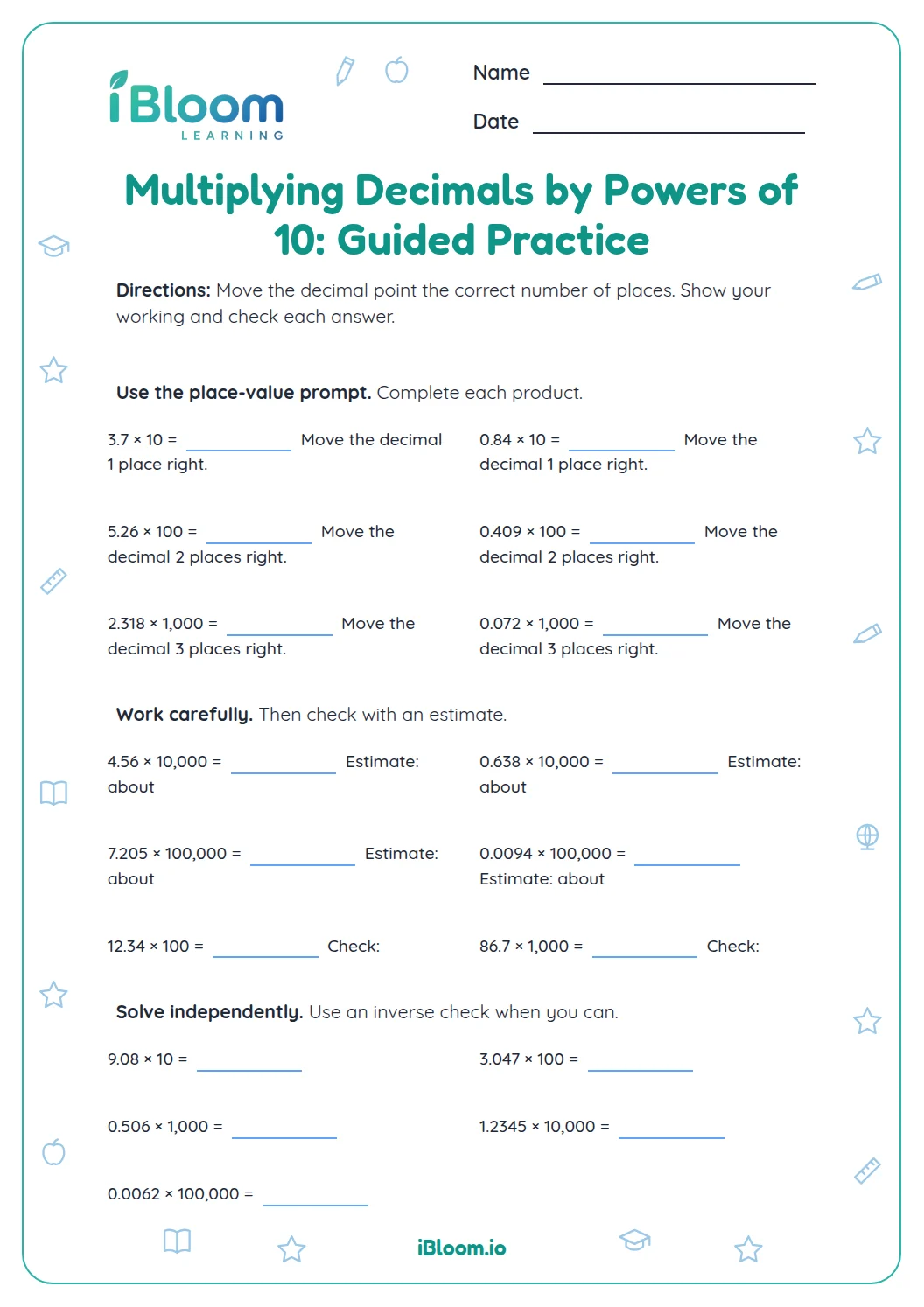
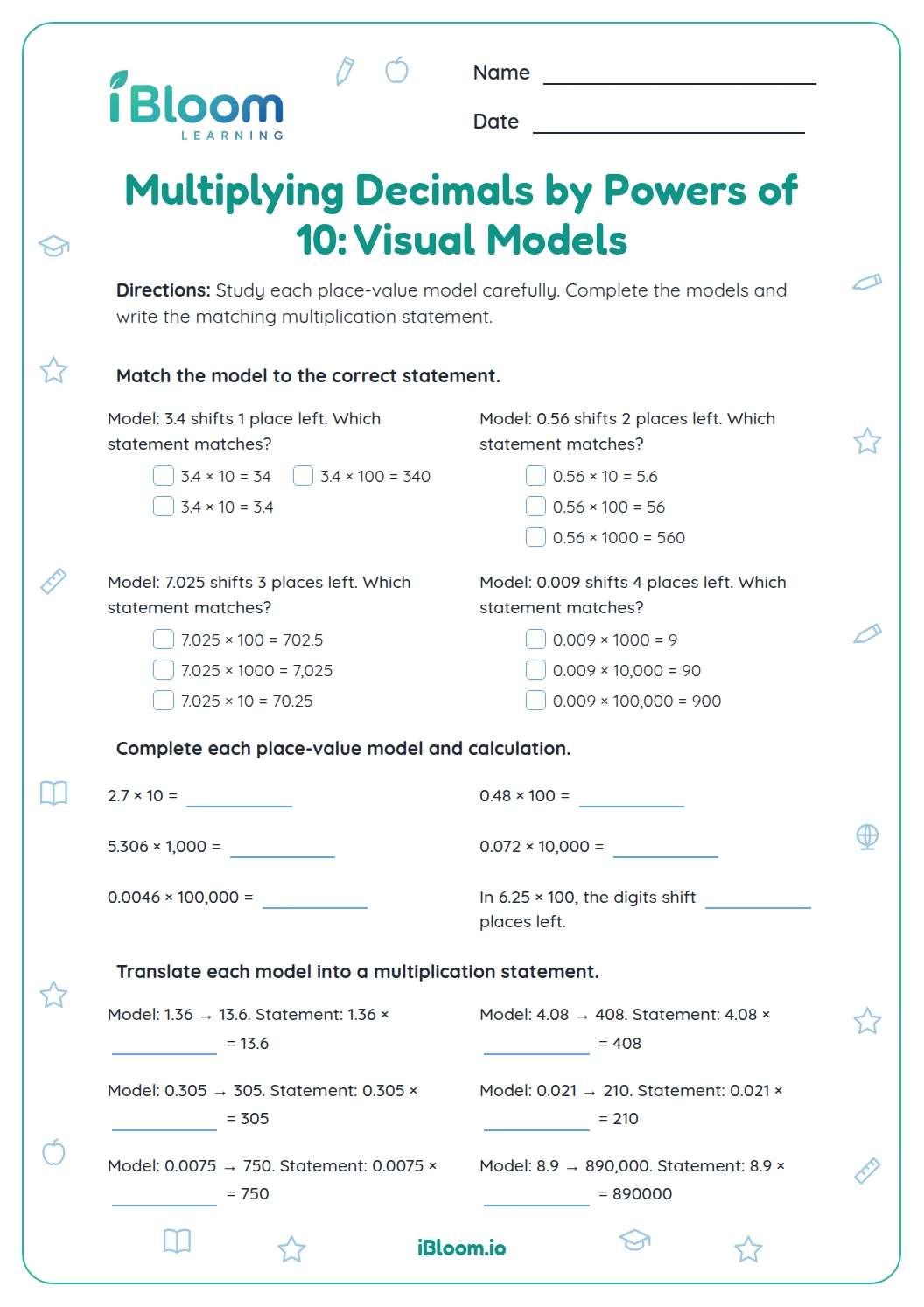
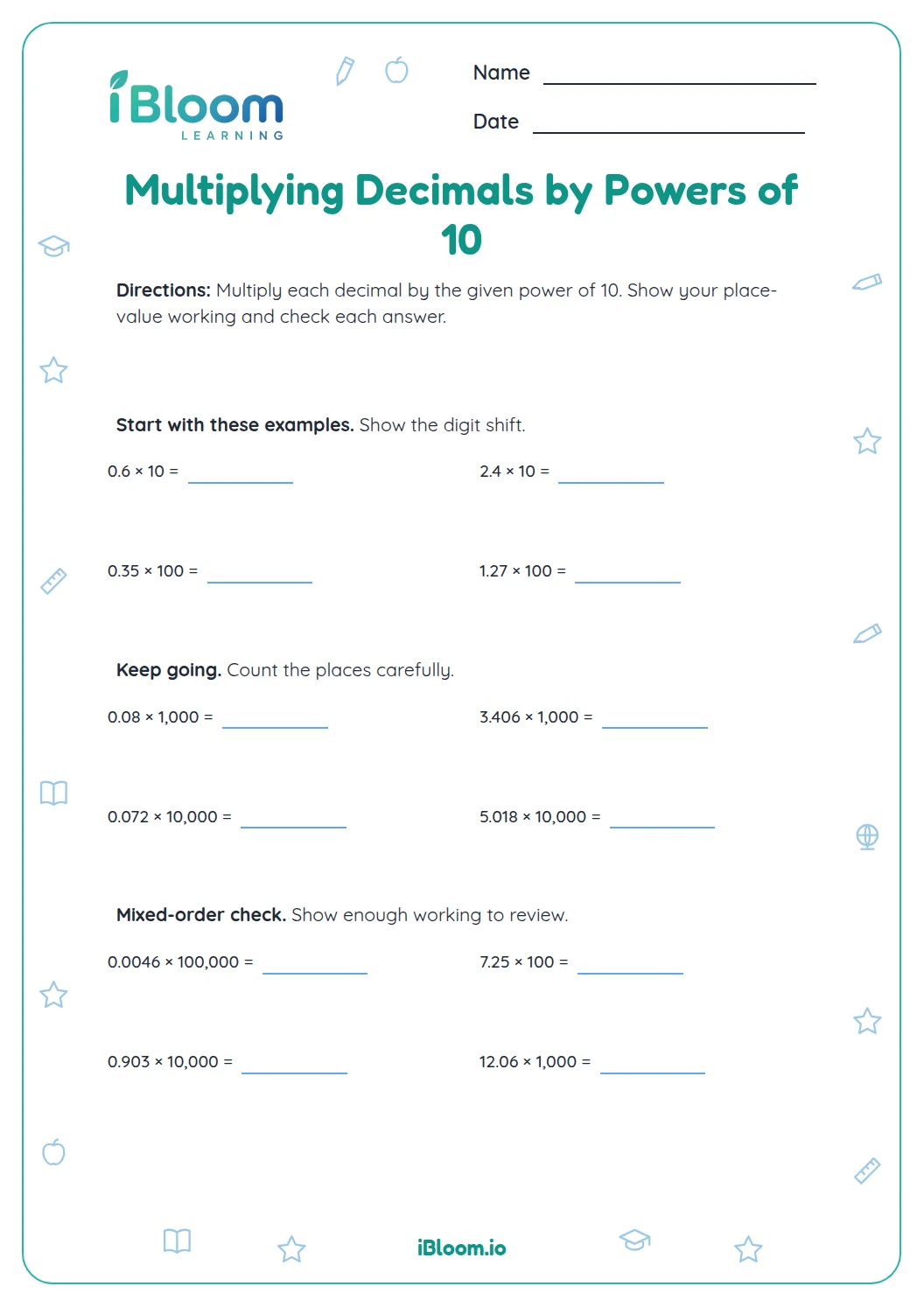
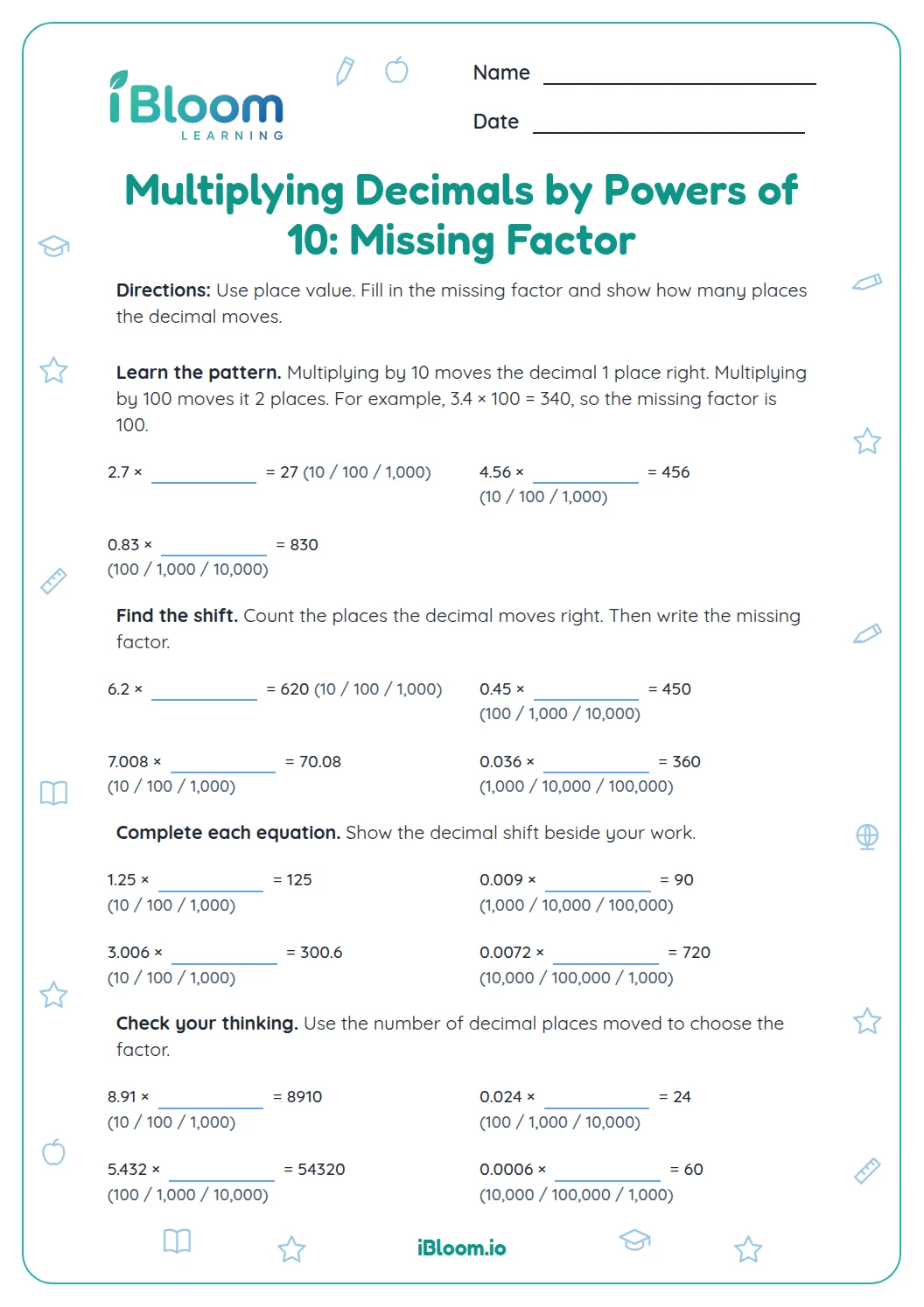


About this worksheet
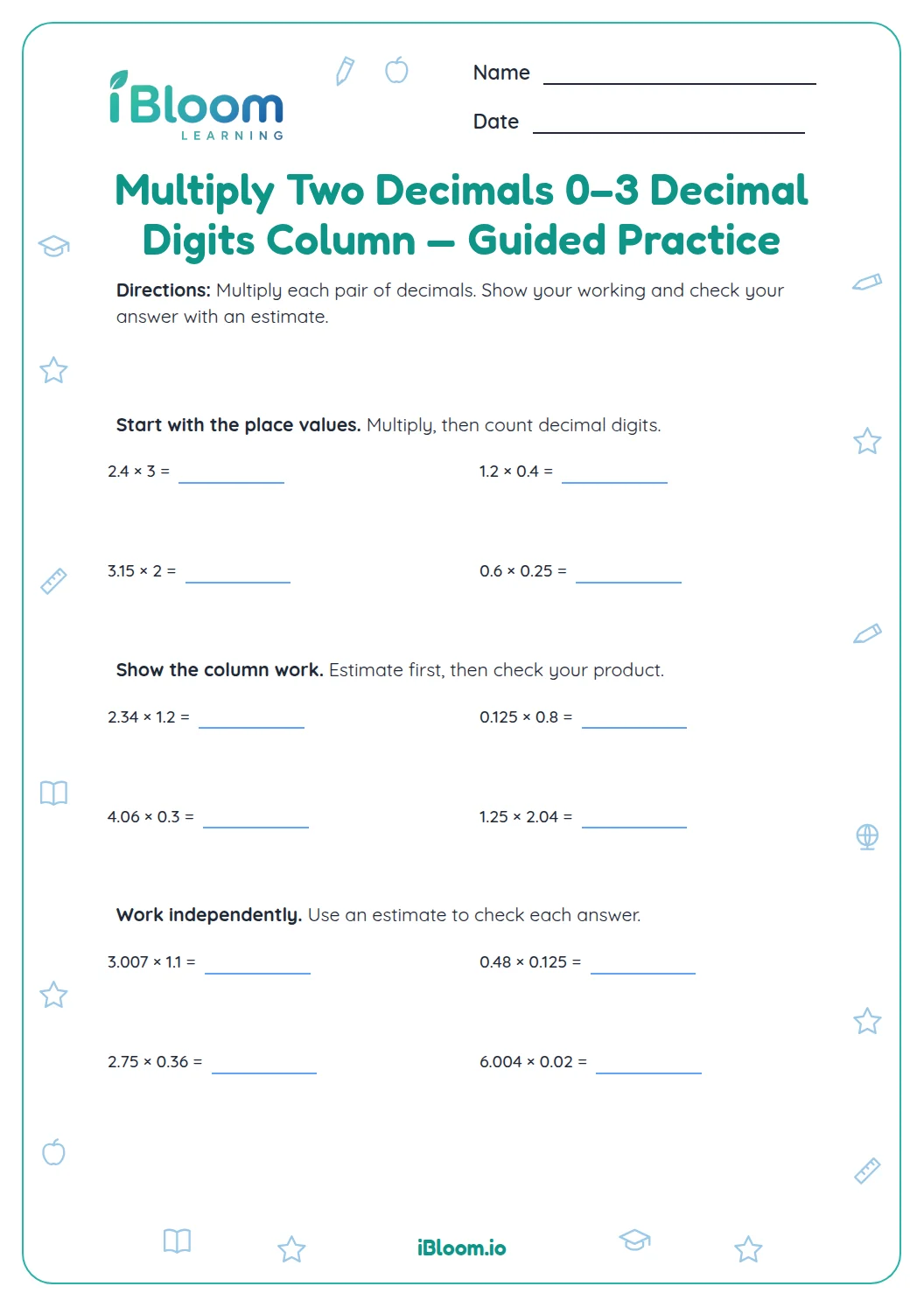
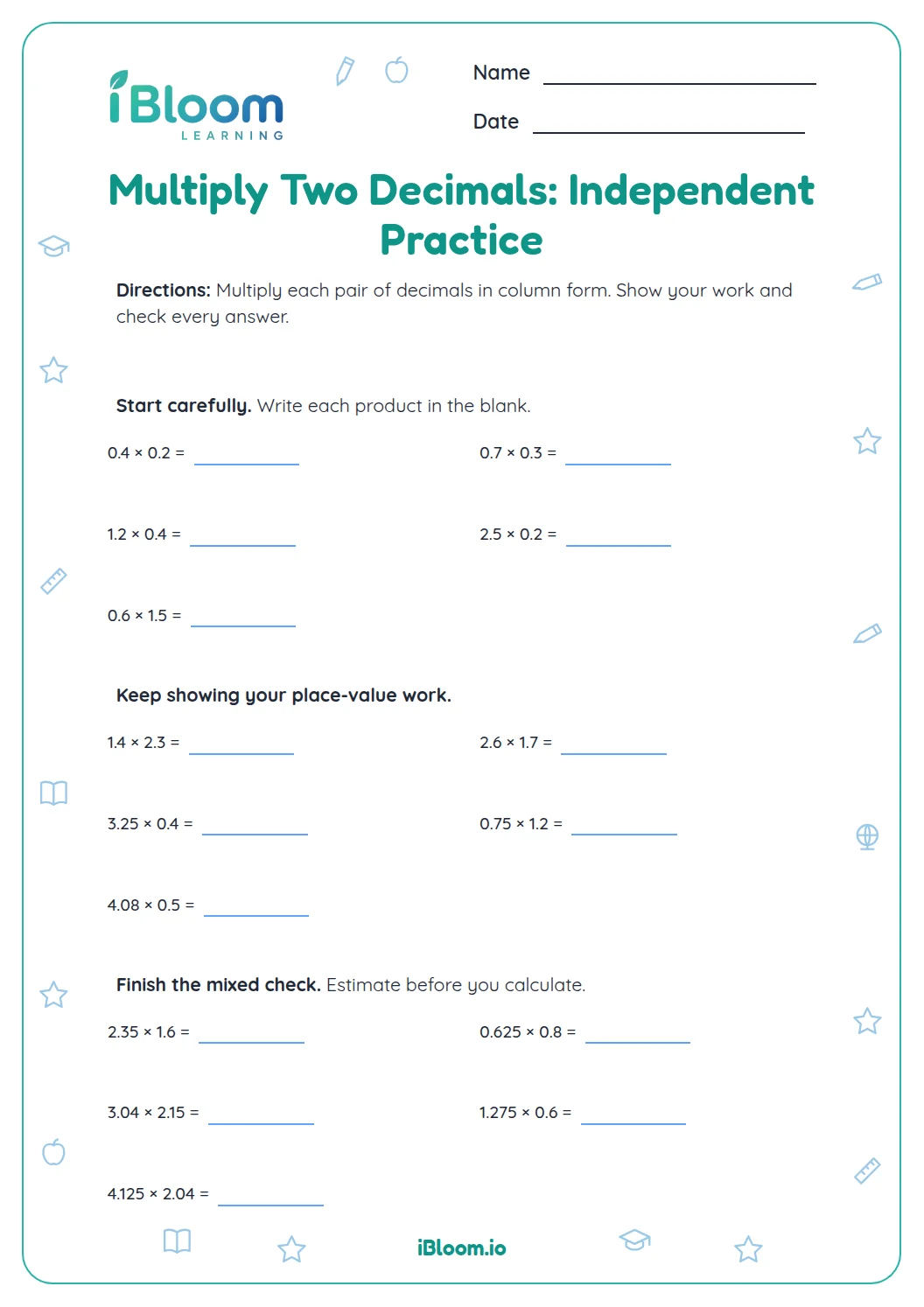
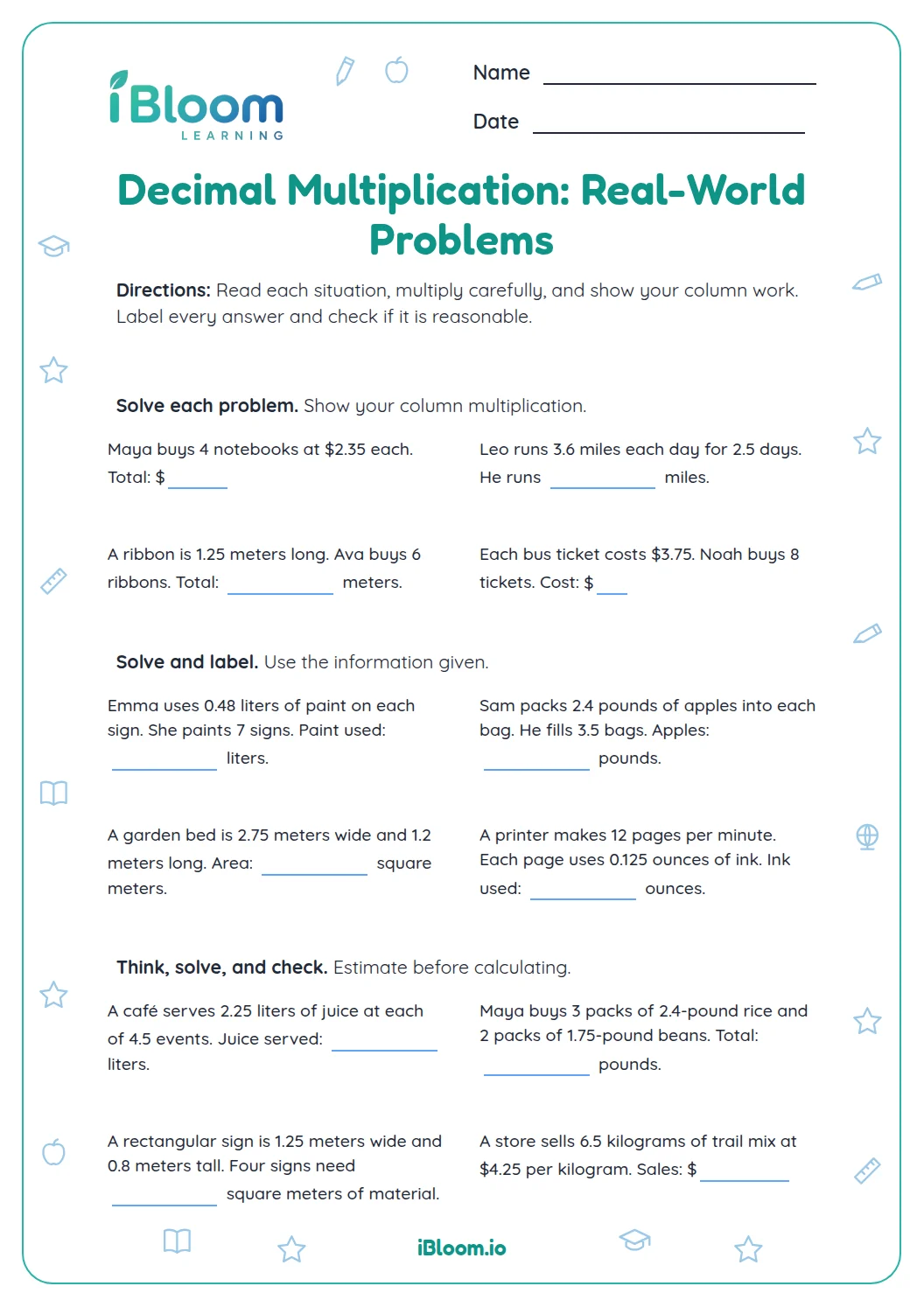
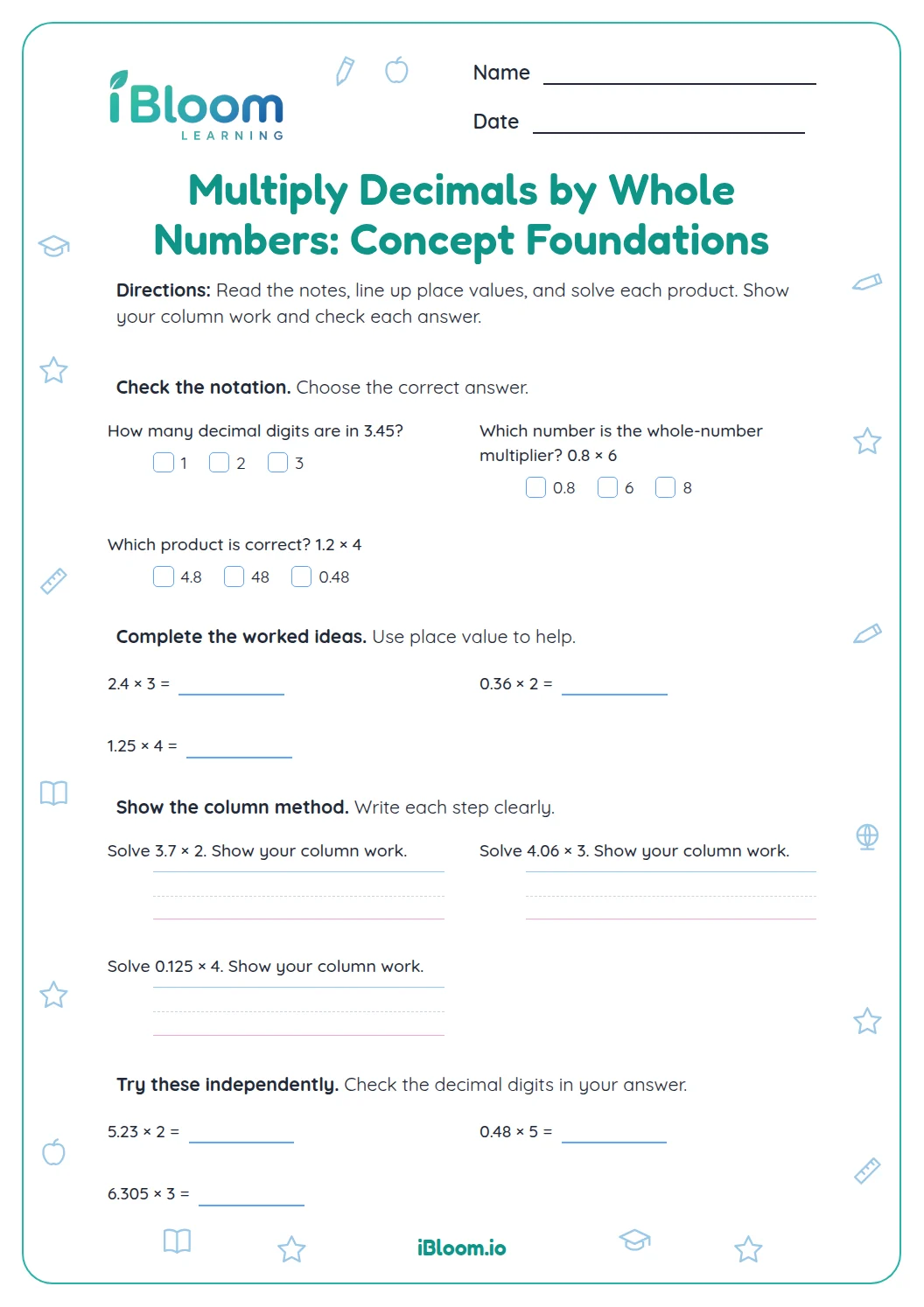
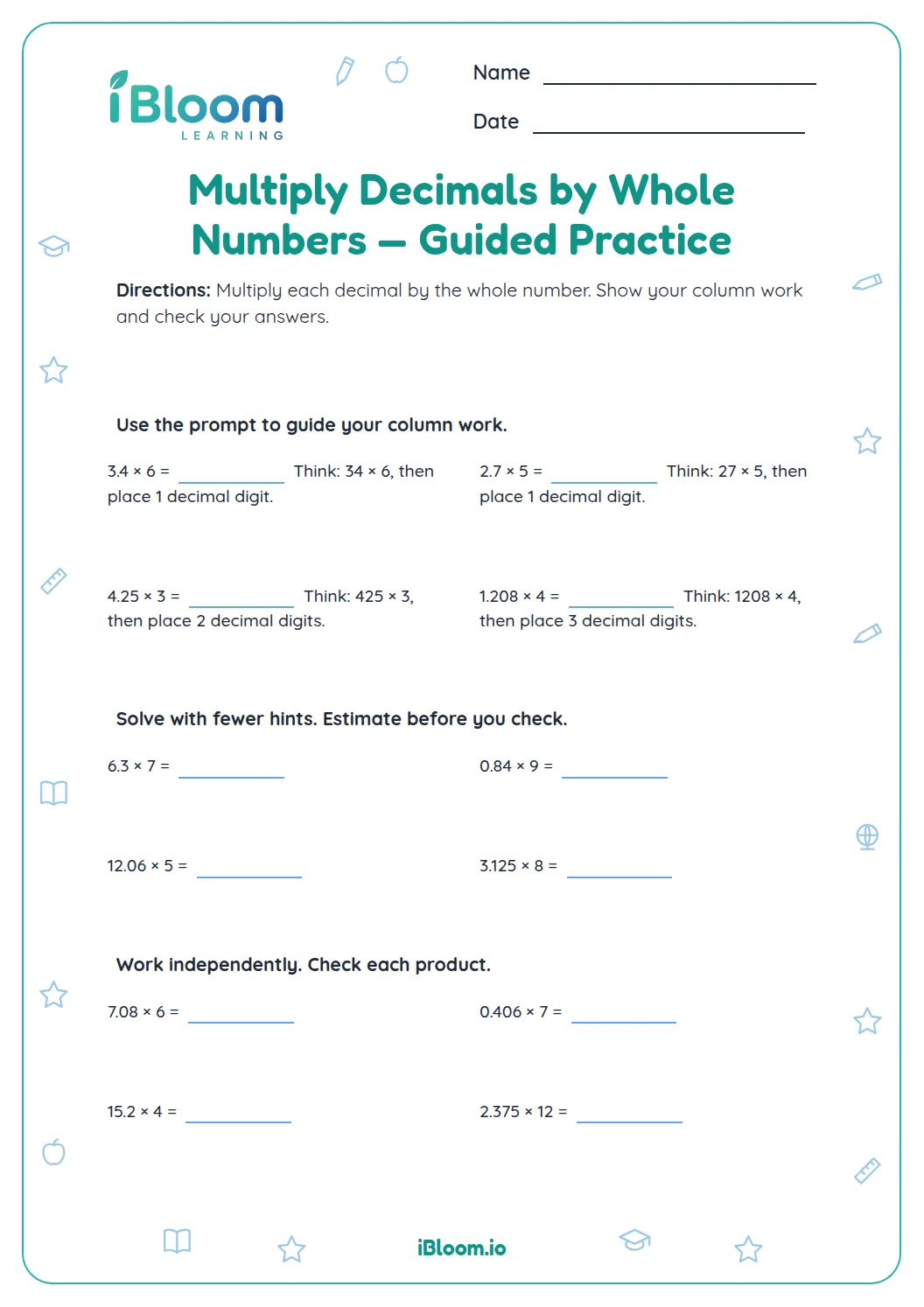
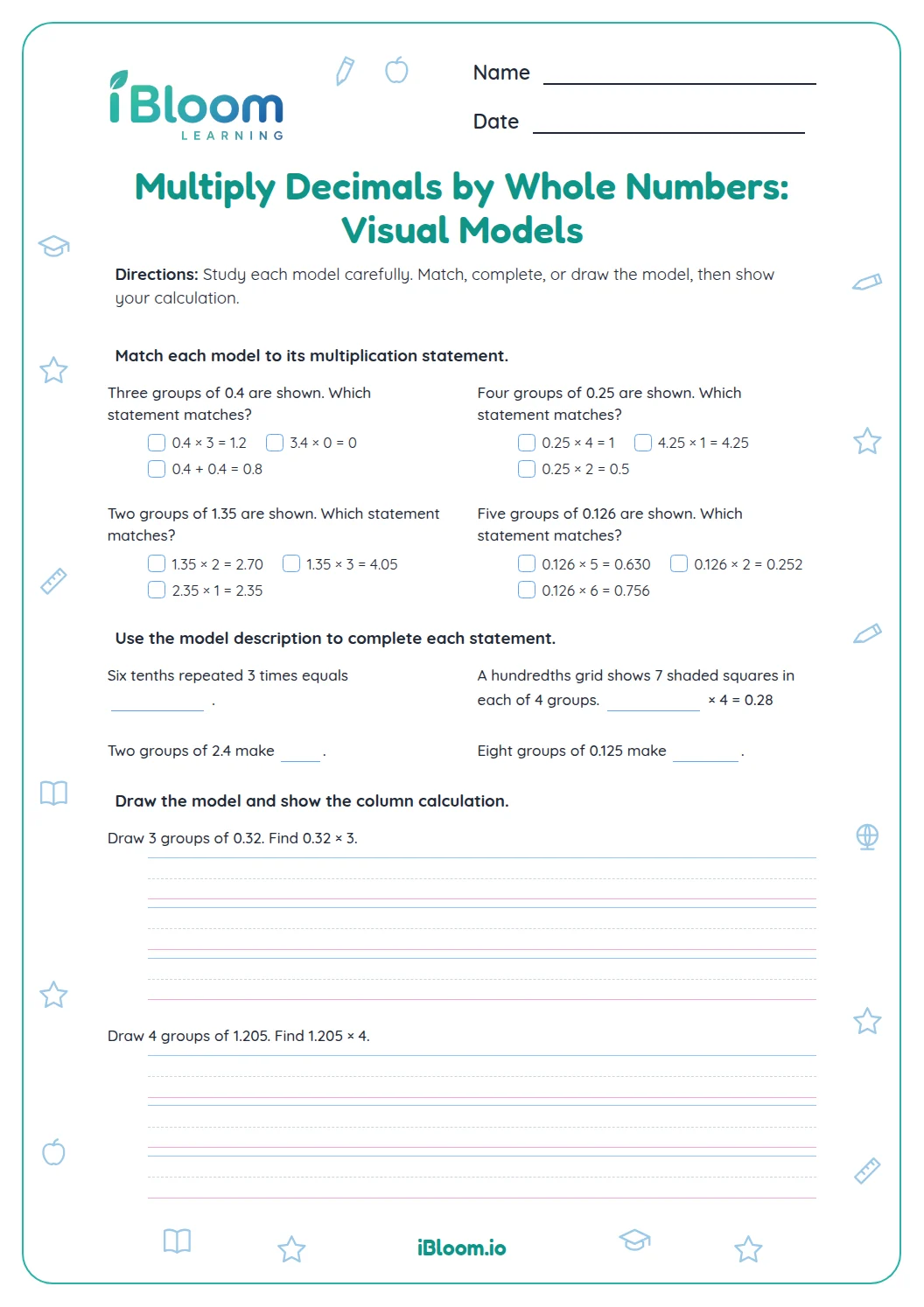
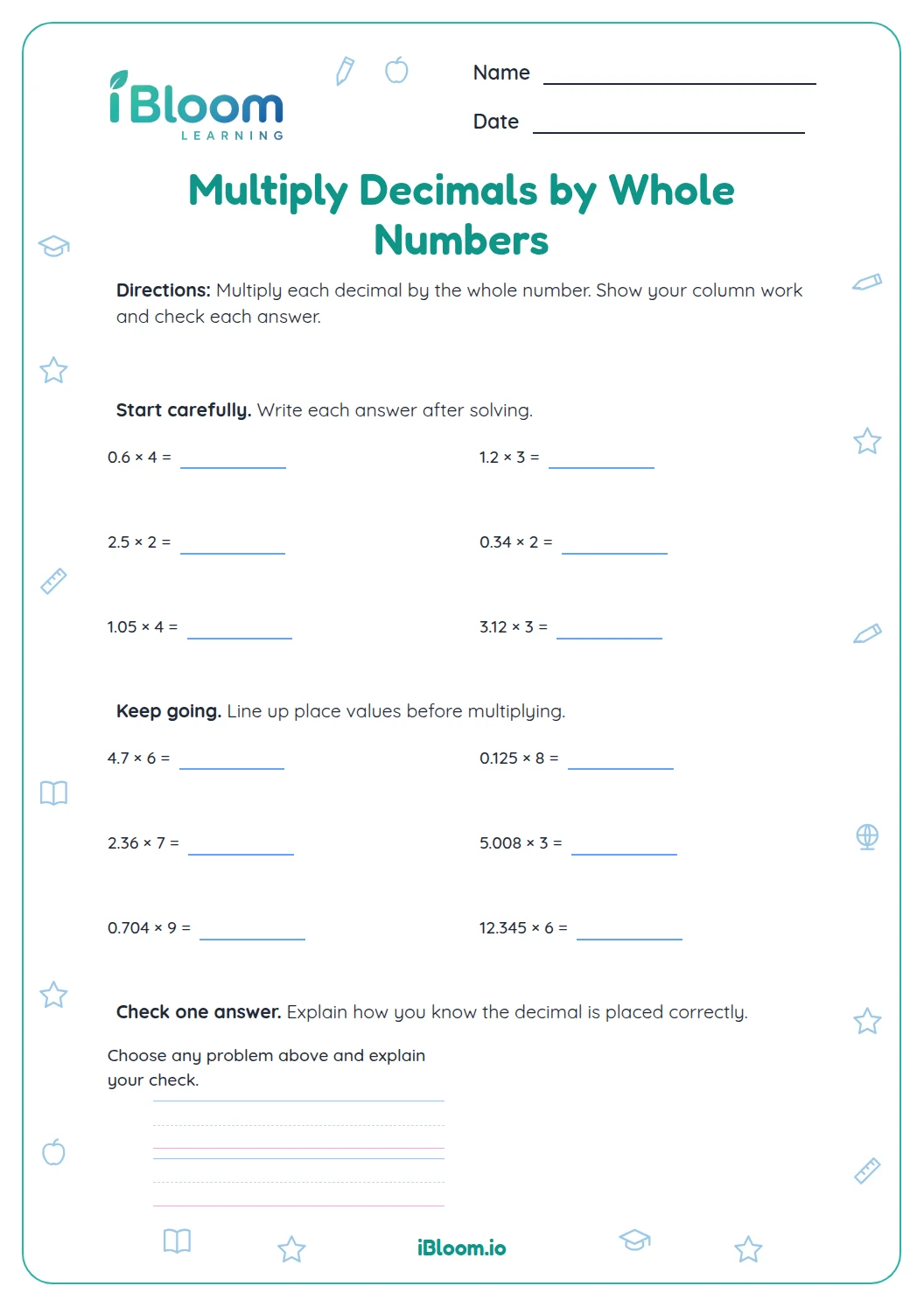
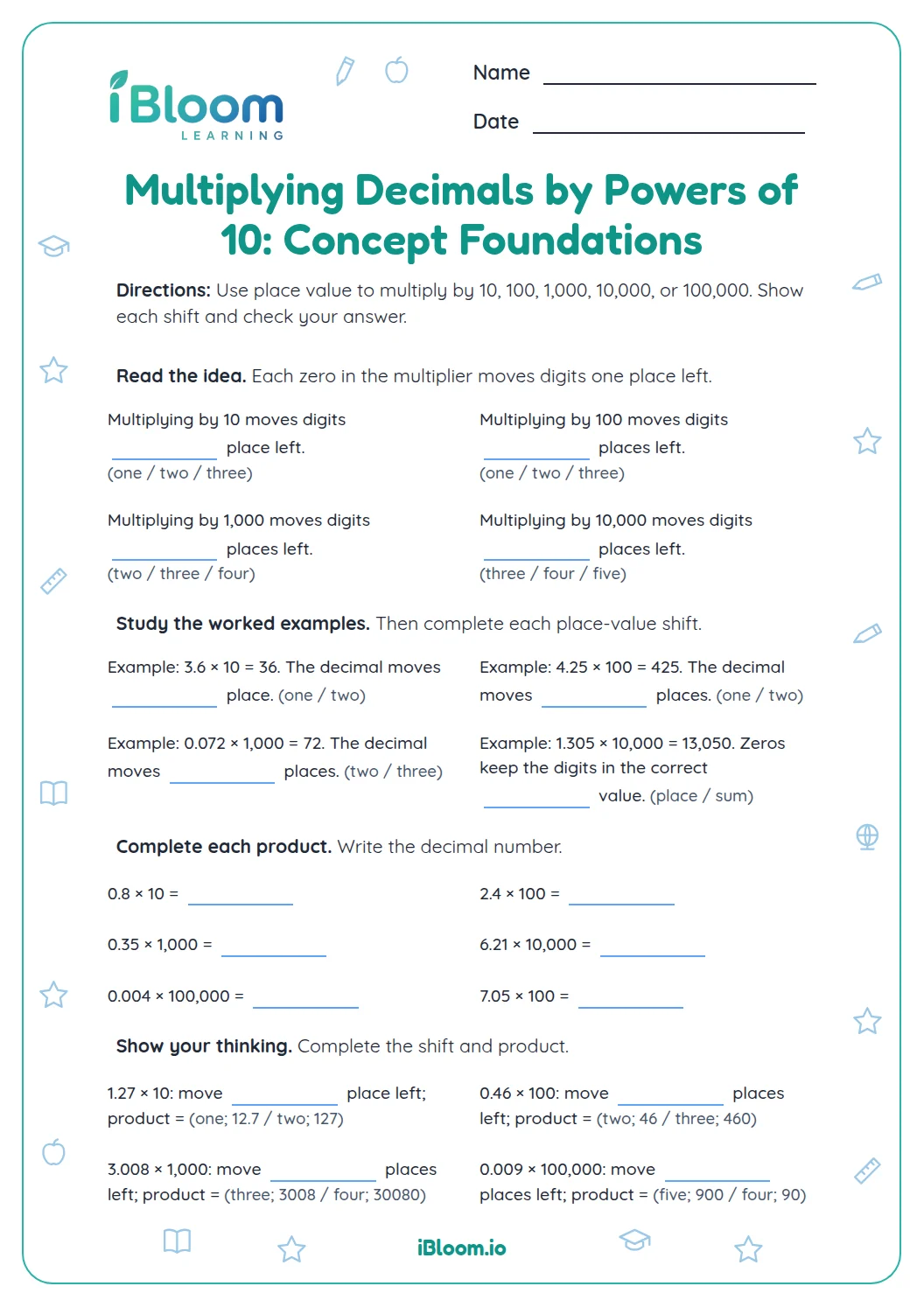
This Grade 6 worksheet gives students 20 products to solve using decimal multiplication. The factors range from tenths to thousandths, so children multiply as whole numbers and use the number of decimal places to locate each product. Later questions apply the skill to area and ask students to explain product size with place-value language. A separate answer key lists every product and sample explanations. The work practices CCSS 6.NS.B.3.
Aligned to 6.NS.B.3
How do students multiply two decimal factors?
First multiply without the decimal points, then count the decimal places in both factors. Question 1 is 2.4 × 1.3: 24 × 13 = 312, and the factors have two decimal places total, so the product is 3.12.
How can place value keep a product in the right size?
Estimate before placing the decimal point. In question 10, 0.09 × 0.07 is less than one tenth times one tenth, so the result must be less than 0.01. The exact product is 0.0063, with four decimal places.
Where does decimal multiplication appear in the word problems?
Question 13 asks for the area of a 1.2 m by 0.5 m rectangle: 1.2 × 0.5 = 0.6 m². Question 18 uses 0.4 m by 0.2 m, giving an area of 0.08 m². Both keep multiplication at the center of the problem.
A place-value routine for decimal products
- 1Estimate the product so you know its likely size.
- 2Multiply the factors as whole numbers, ignoring decimal points.
- 3Count the decimal places in both factors together.
- 4Place that many decimal places in the product.
- 5Check the answer against your estimate and include units in area problems.
Common decimal multiplication mistakes
The mistake
Counting decimal places in only one factor.
The fix
Count the places in both factors and add them before placing the decimal.
The mistake
Writing 0.0063 as 0.063 for 0.09 × 0.07.
The fix
Use the estimate: a product of two numbers below 0.1 is below 0.01.
The mistake
Dropping a needed zero in a small product.
The fix
Write a leading zero before the decimal and include placeholders, as in 0.08 × 0.5 = 0.040 = 0.04.
Common Core alignment
Fluently multiply multi-digit decimals using the standard algorithm.
On this sheet: Each product practices multiplying multi-digit decimals with the standard algorithm.
Show the official wordingHide the official wording
Fluently add, subtract, multiply, and divide multi-digit decimals using the standard algorithm for each operation.
What to practice next
Make more practice
Further reading
Questions parents and teachers ask
What is the decimal multiplication rule?
Multiply the factors as whole numbers, then count all decimal places in the two factors and place that many in the product. Question 1 has one decimal place in each factor, so 24 × 13 = 312 becomes 3.12. Have the student explain the reasoning aloud before moving to the next item.
Why is 0.6 × 0.4 equal to 0.24?
Six tenths times four tenths is 24 hundredths. The whole-number product is 6 × 4 = 24, and the factors have two decimal places combined, giving 0.24. This is one of the first products on the worksheet. Have the student explain the reasoning aloud before moving to the next item.
How can a student check a small decimal product?
Estimate the size before calculating. For 0.09 × 0.07, each factor is less than 0.1, so the product is less than 0.01. The answer 0.0063 fits that estimate and has four decimal places. Have the student explain the reasoning aloud before moving to the next item.
What kind of word problems are included?
The set includes rectangle-area questions with decimal side lengths. For a 1.2 m by 0.5 m rectangle, multiply the sides to get 0.6 square meters. A second rectangle uses 0.4 m by 0.2 m and has an area of 0.08 square meters.
Does the answer key show every product?
Yes. The separate key lists all 20 answers, including the two area results and sample responses to the place-value explanation questions. Students can use it after attempting a part, then revisit the decimal placement if their estimate and answer do not agree.
How many decimal places can the factors have?
The worksheet includes factors with up to three decimal places, such as 0.125, and combines them with tenths, hundredths, and other decimals. Students count the places across both factors, so the total may be greater than three. Have the student explain the reasoning aloud before moving to the next item.