



About this worksheet
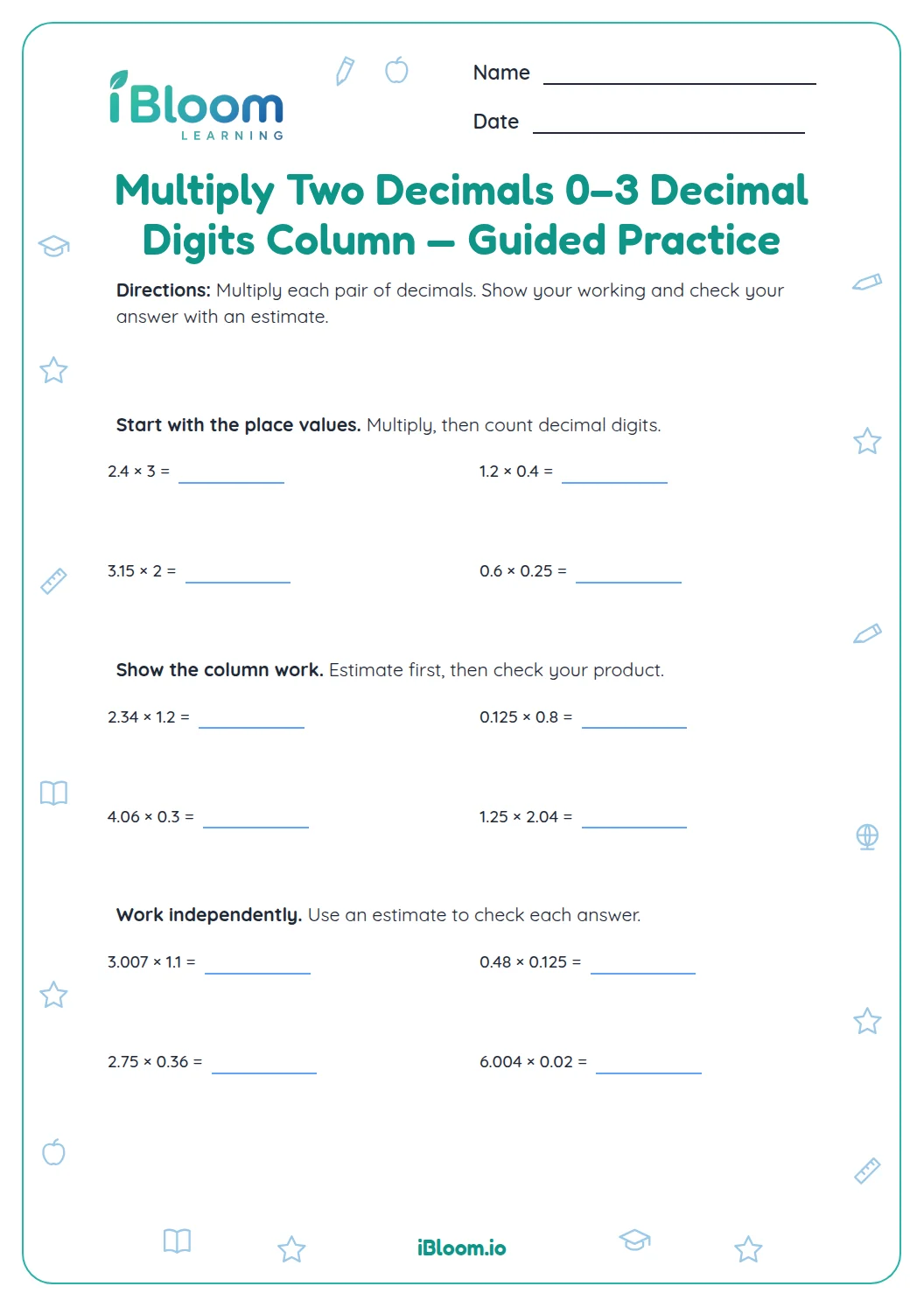
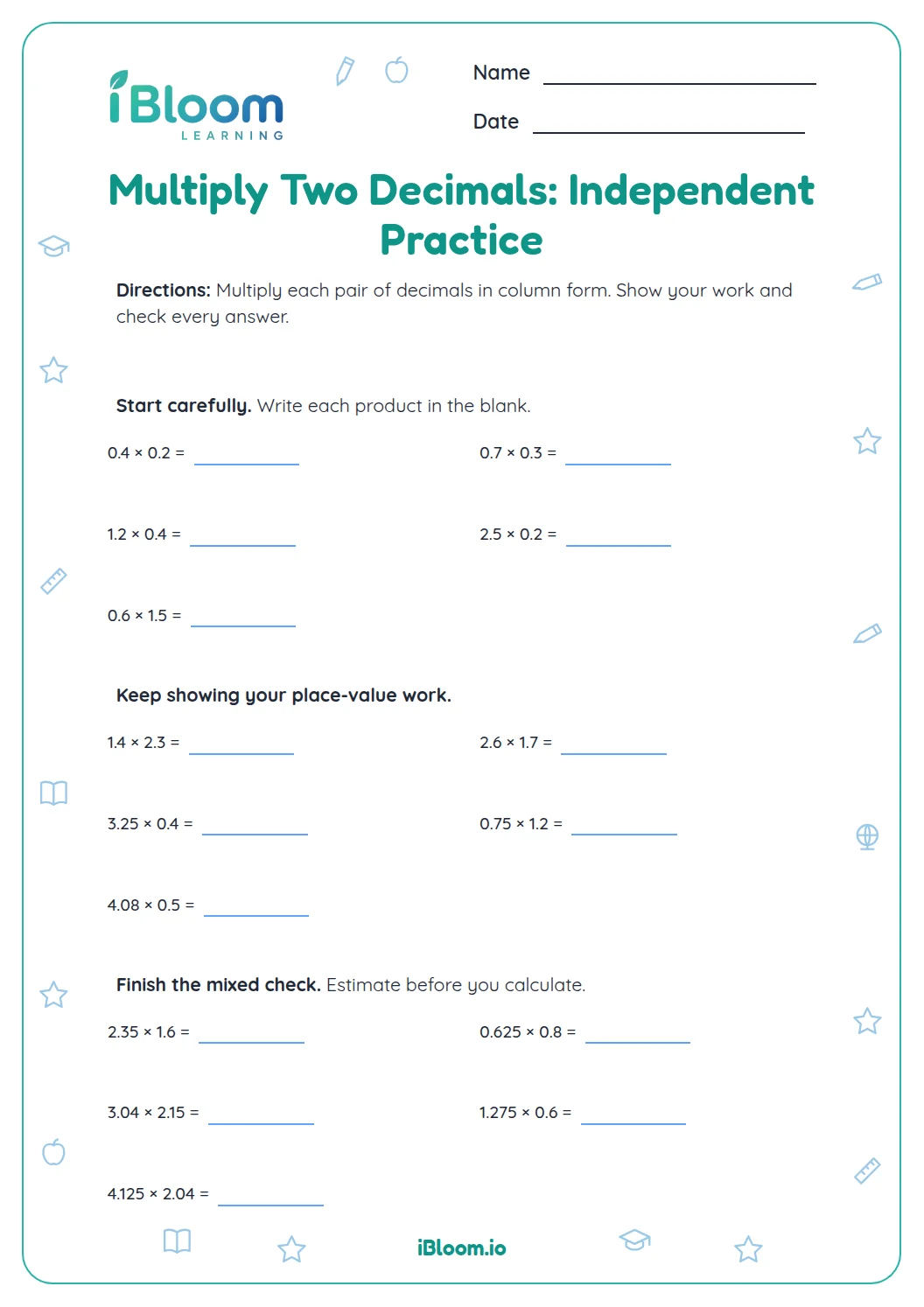
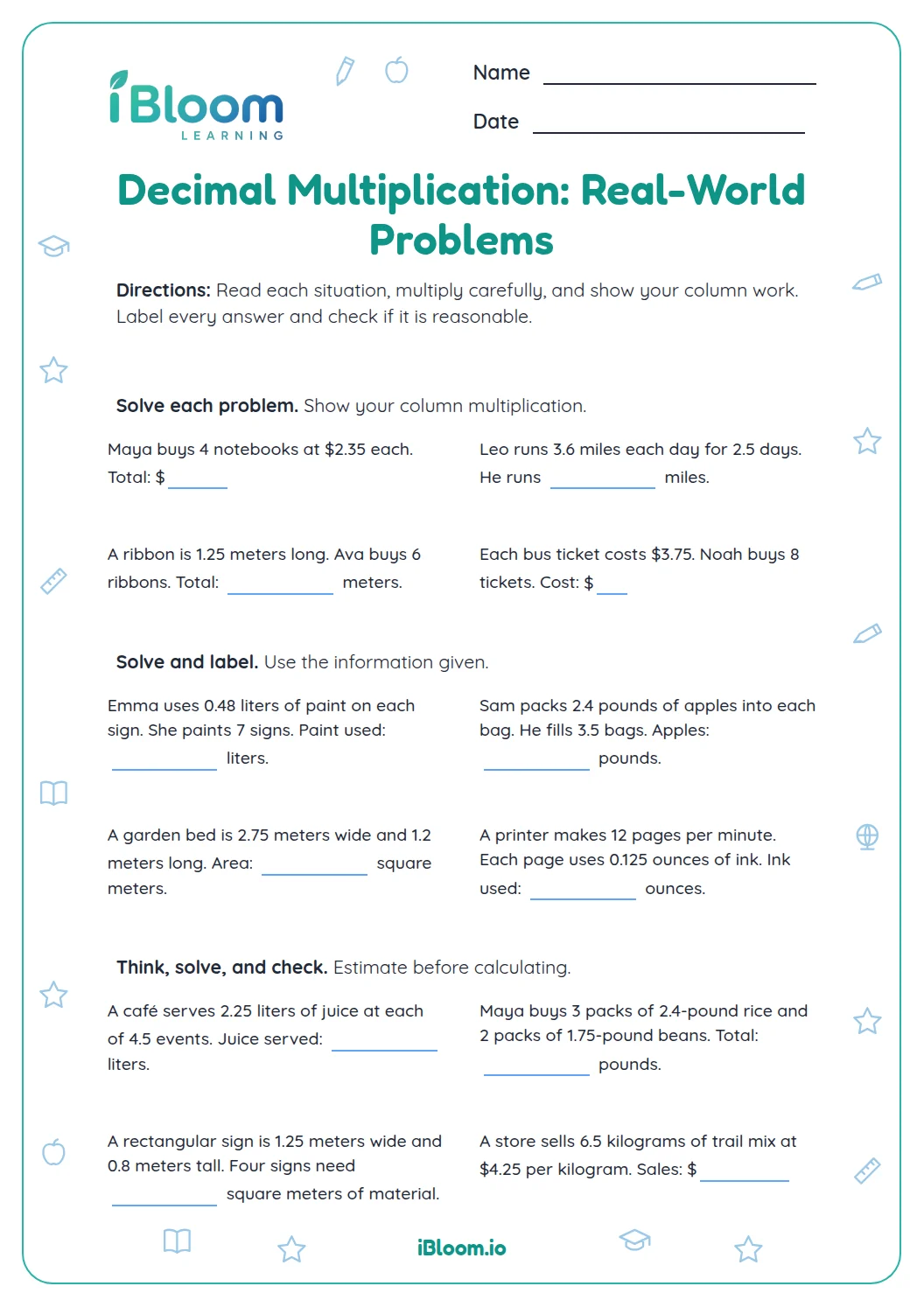
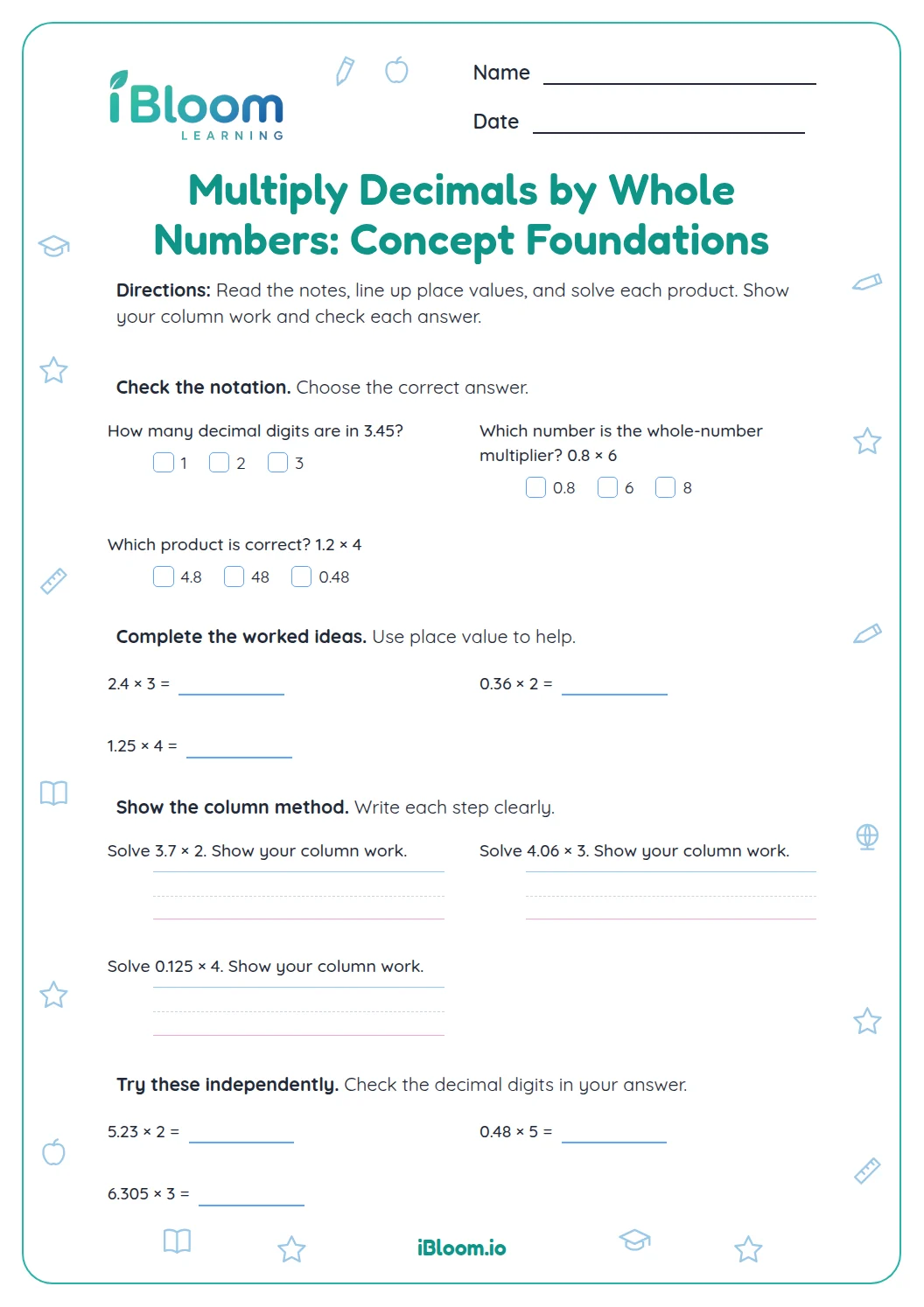
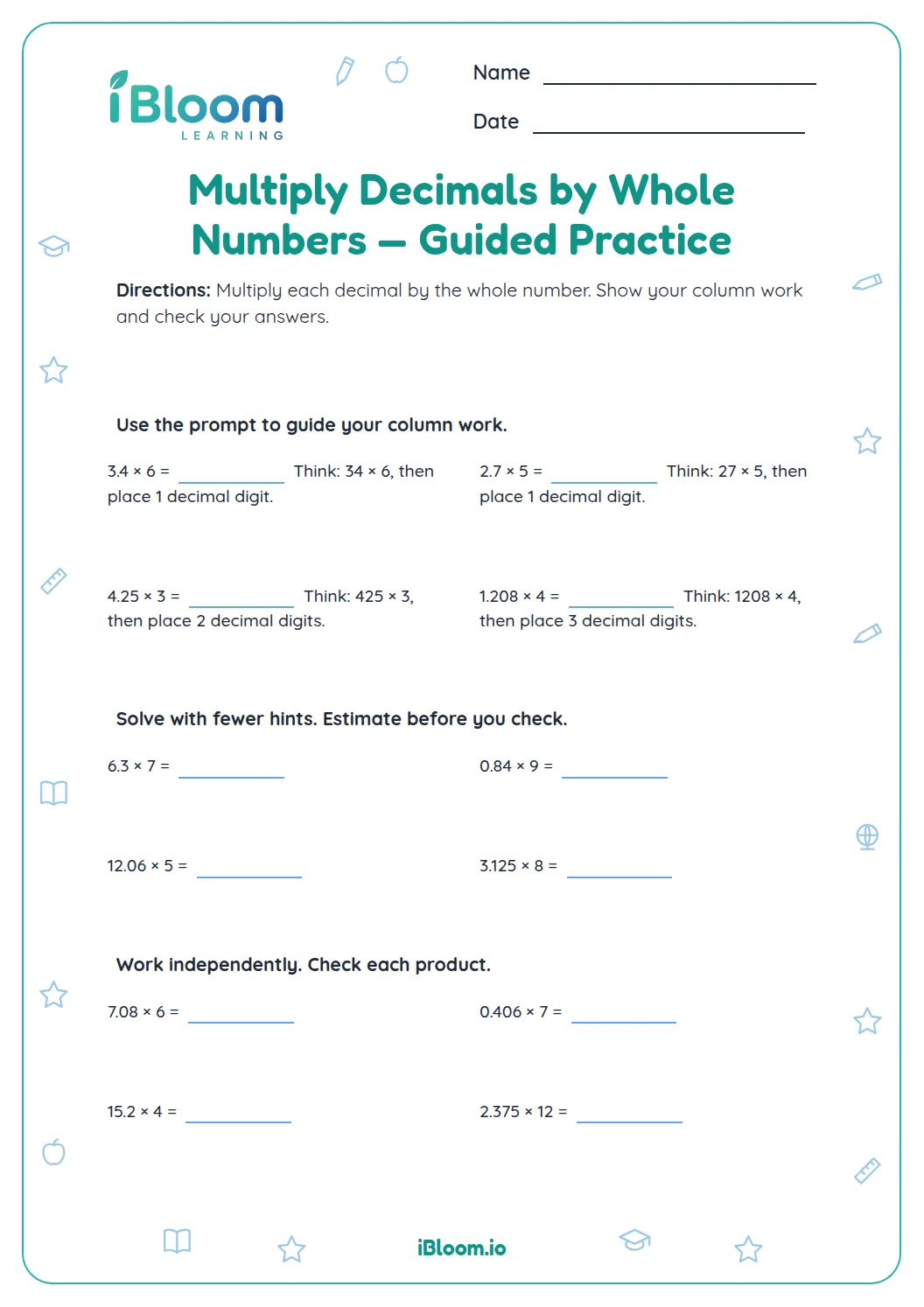
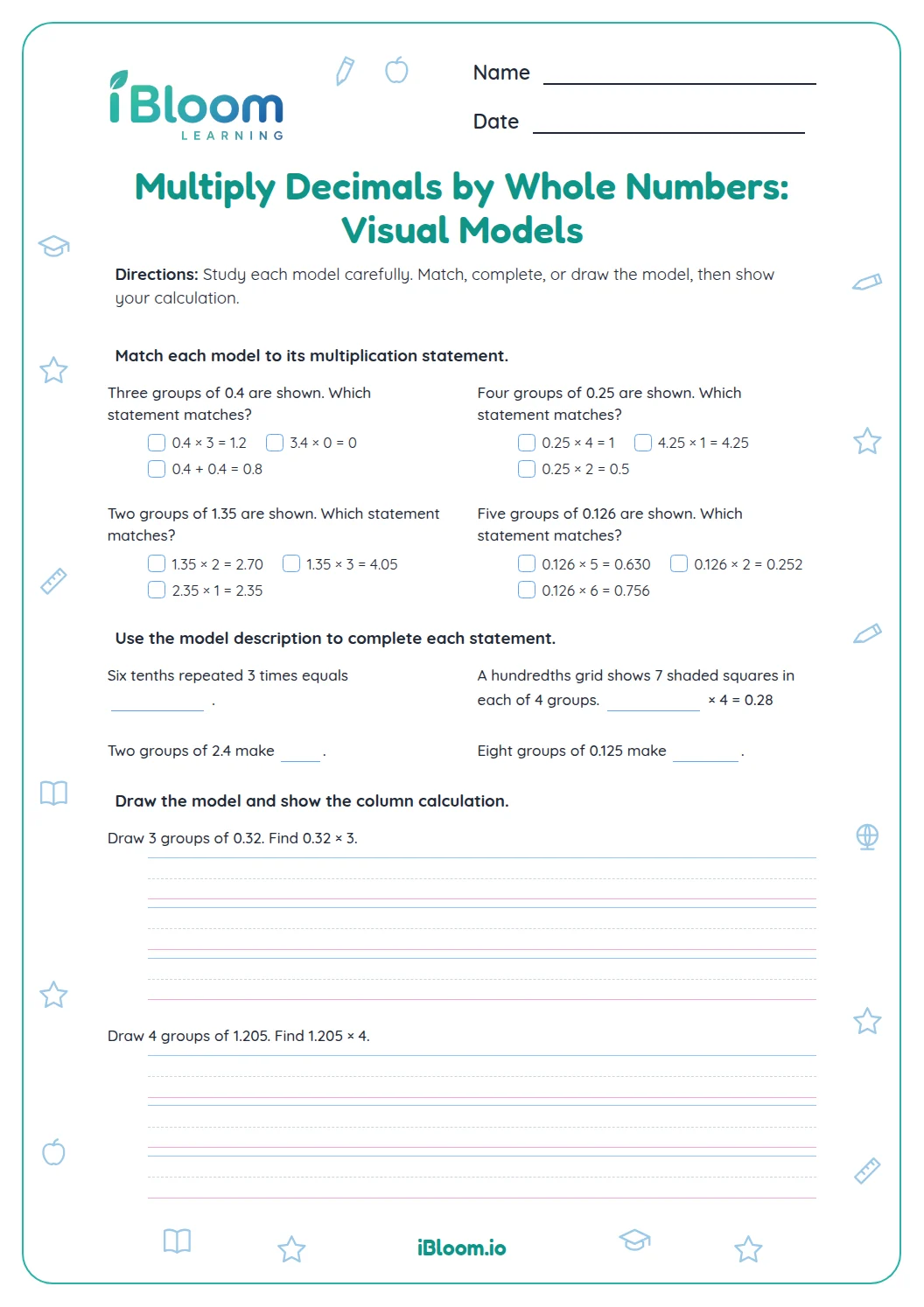
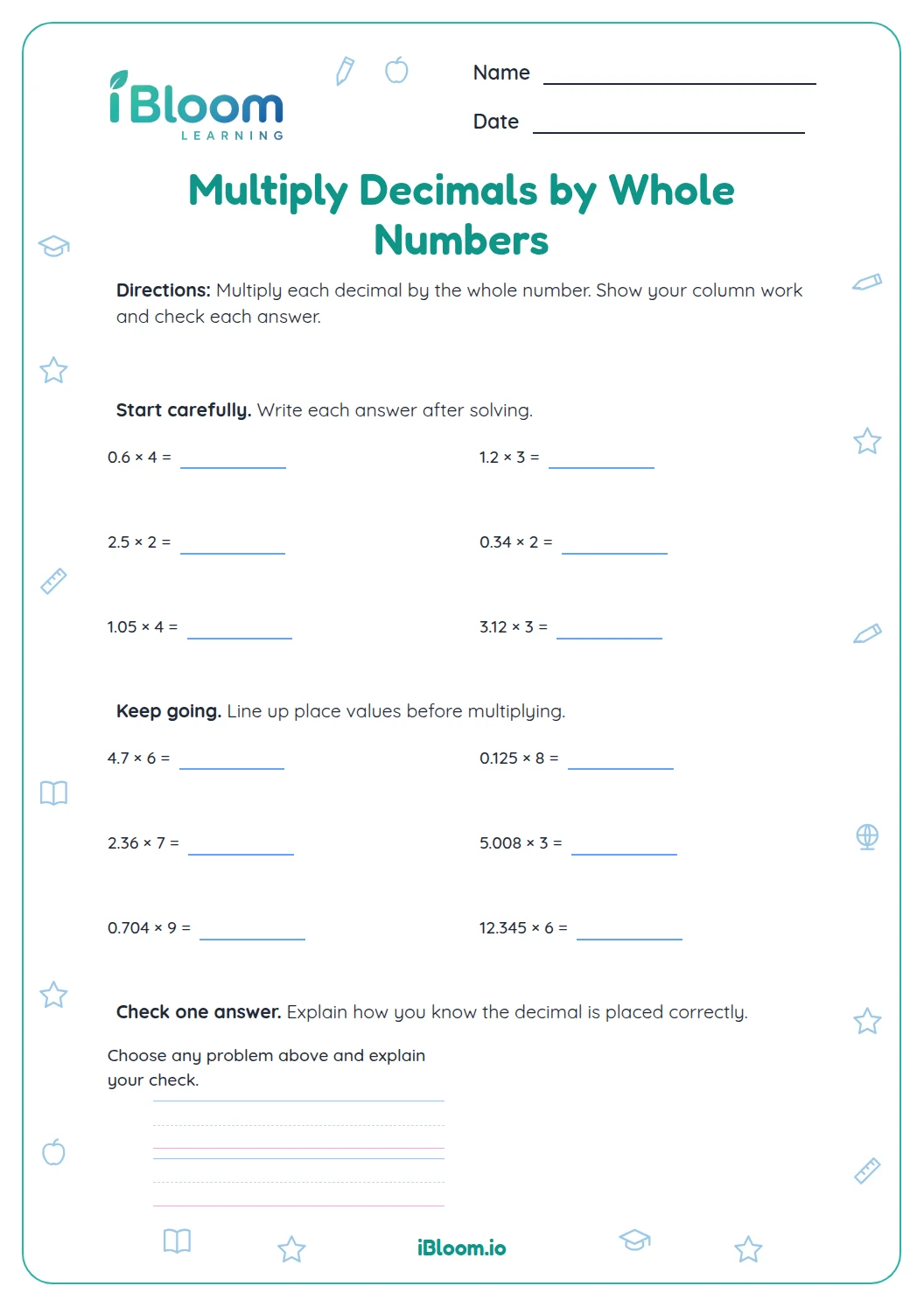
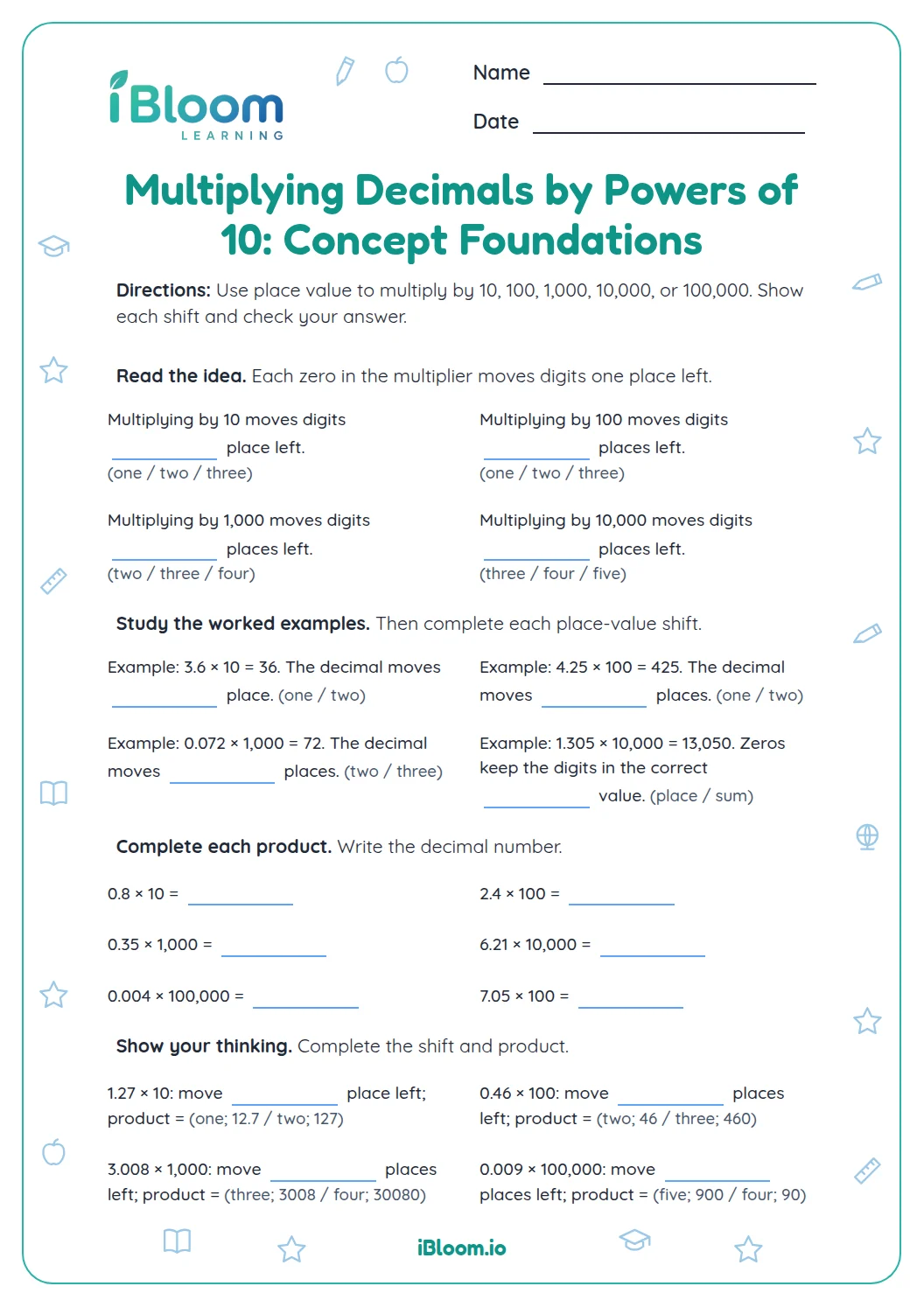
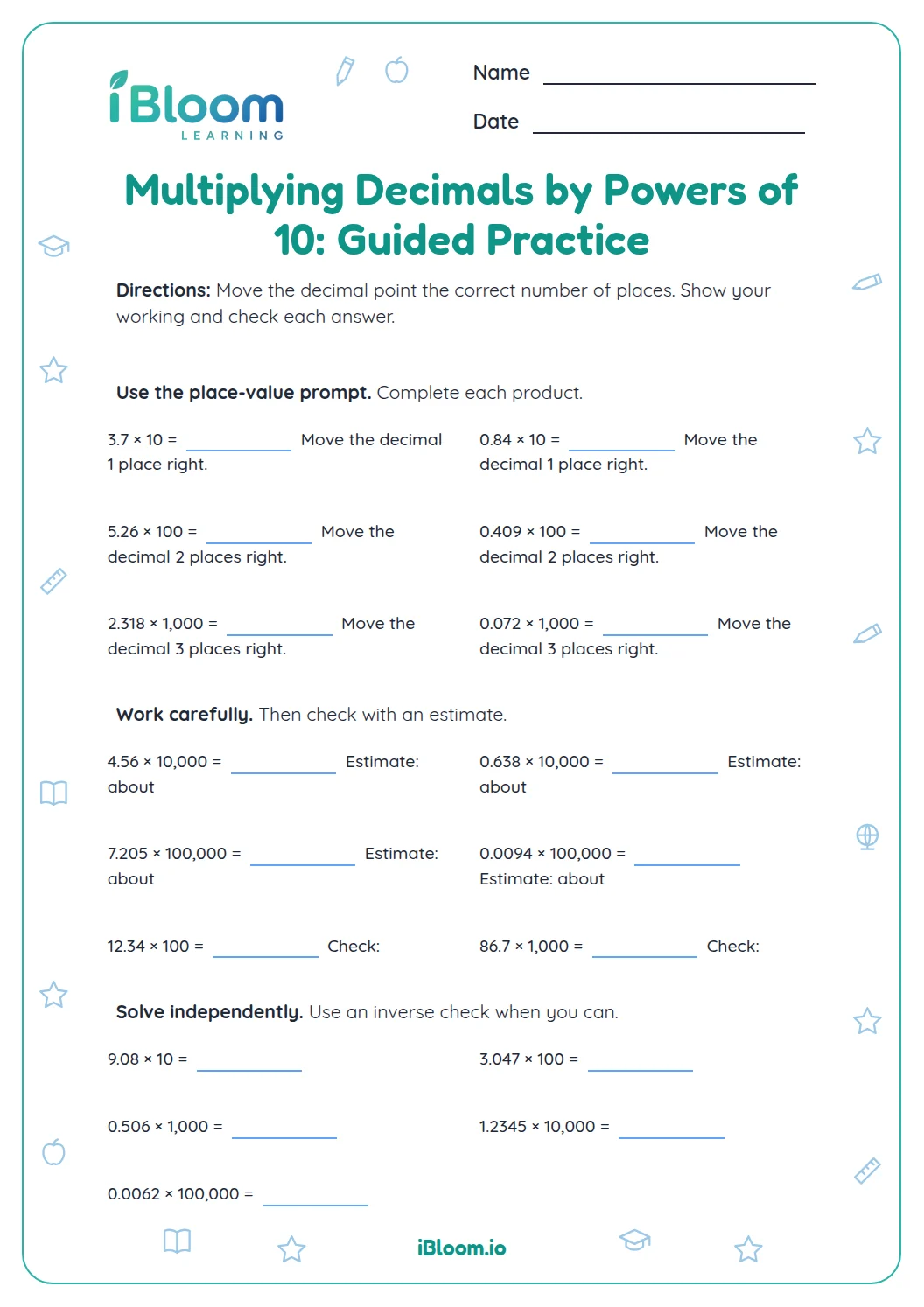
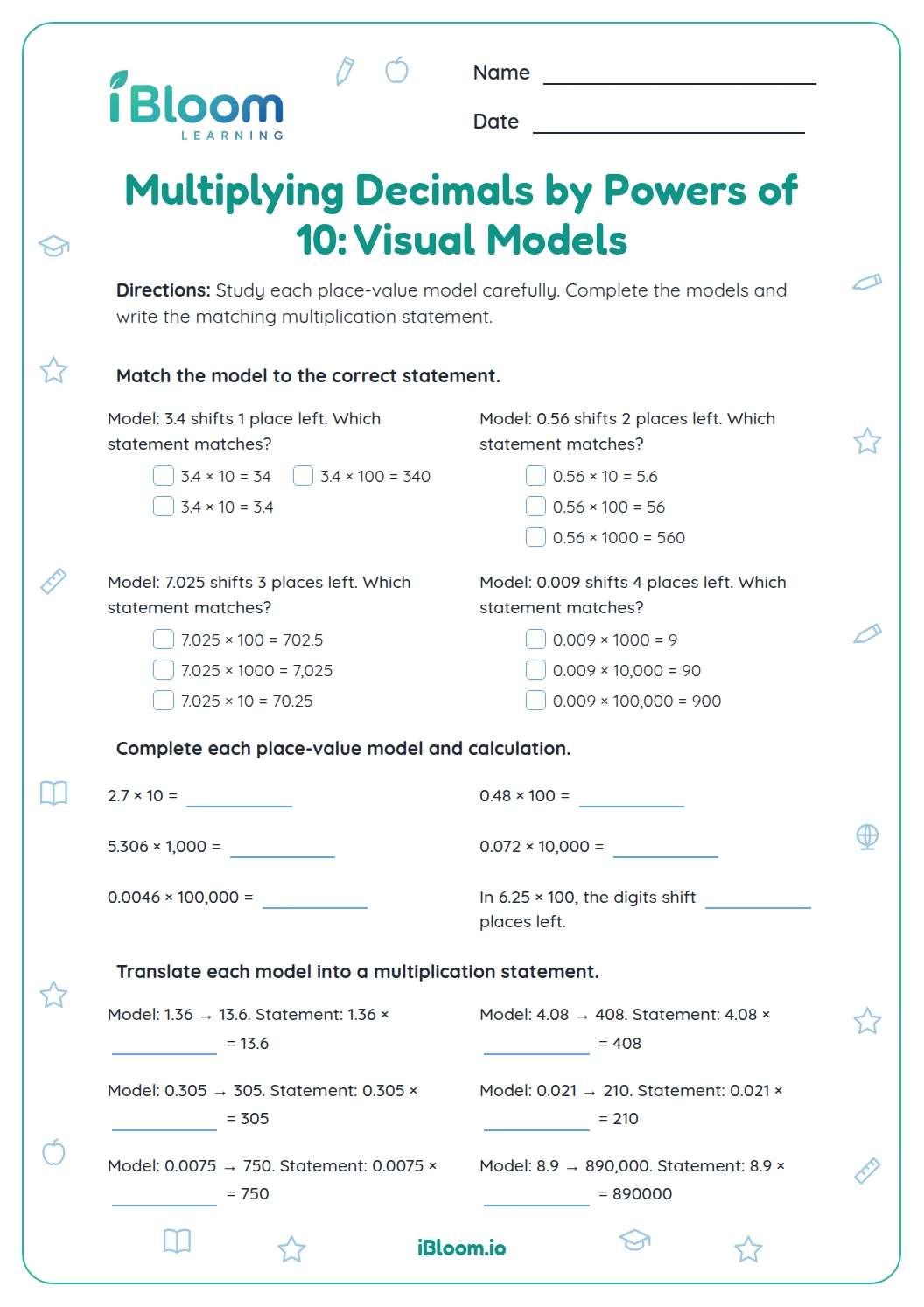
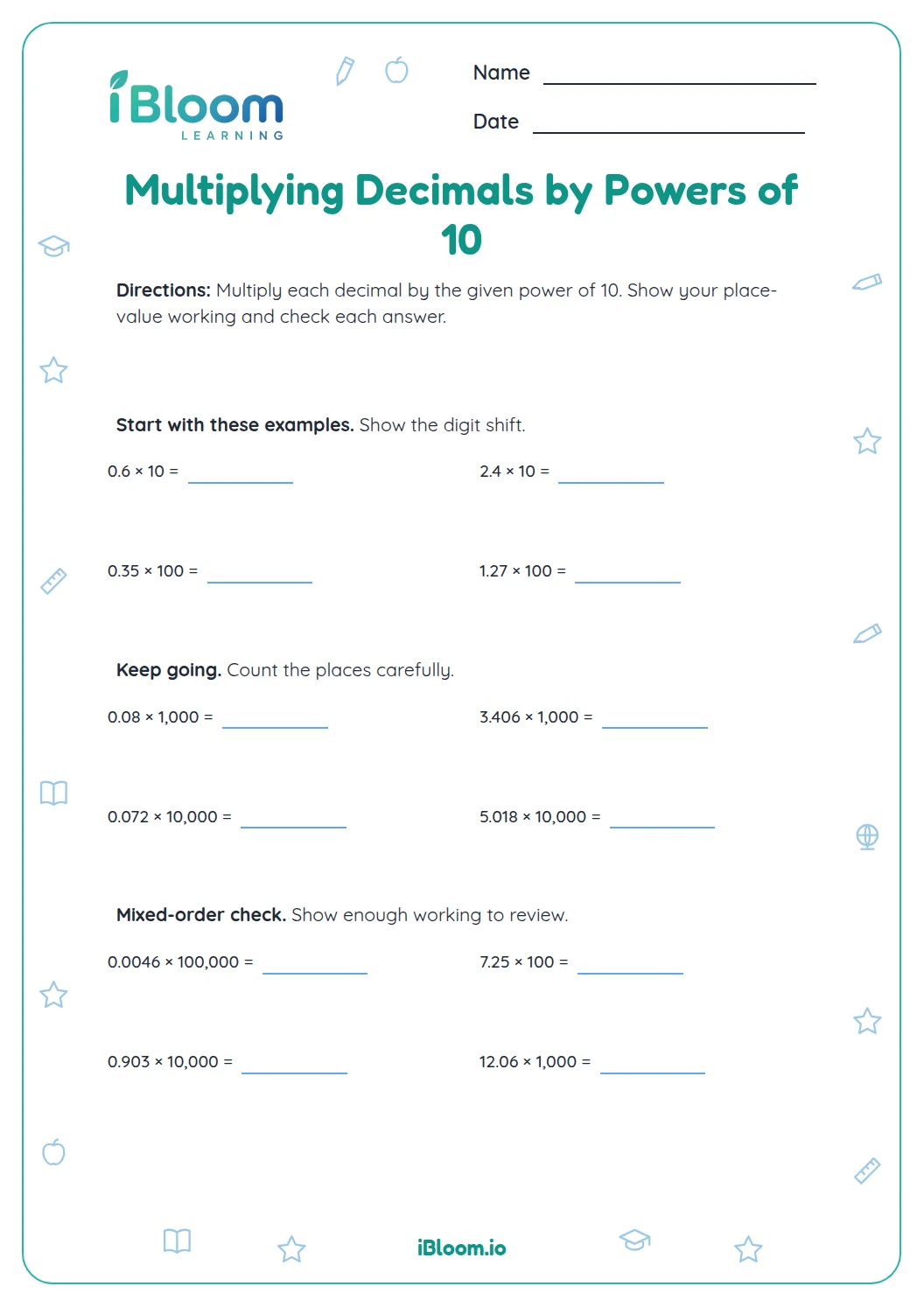
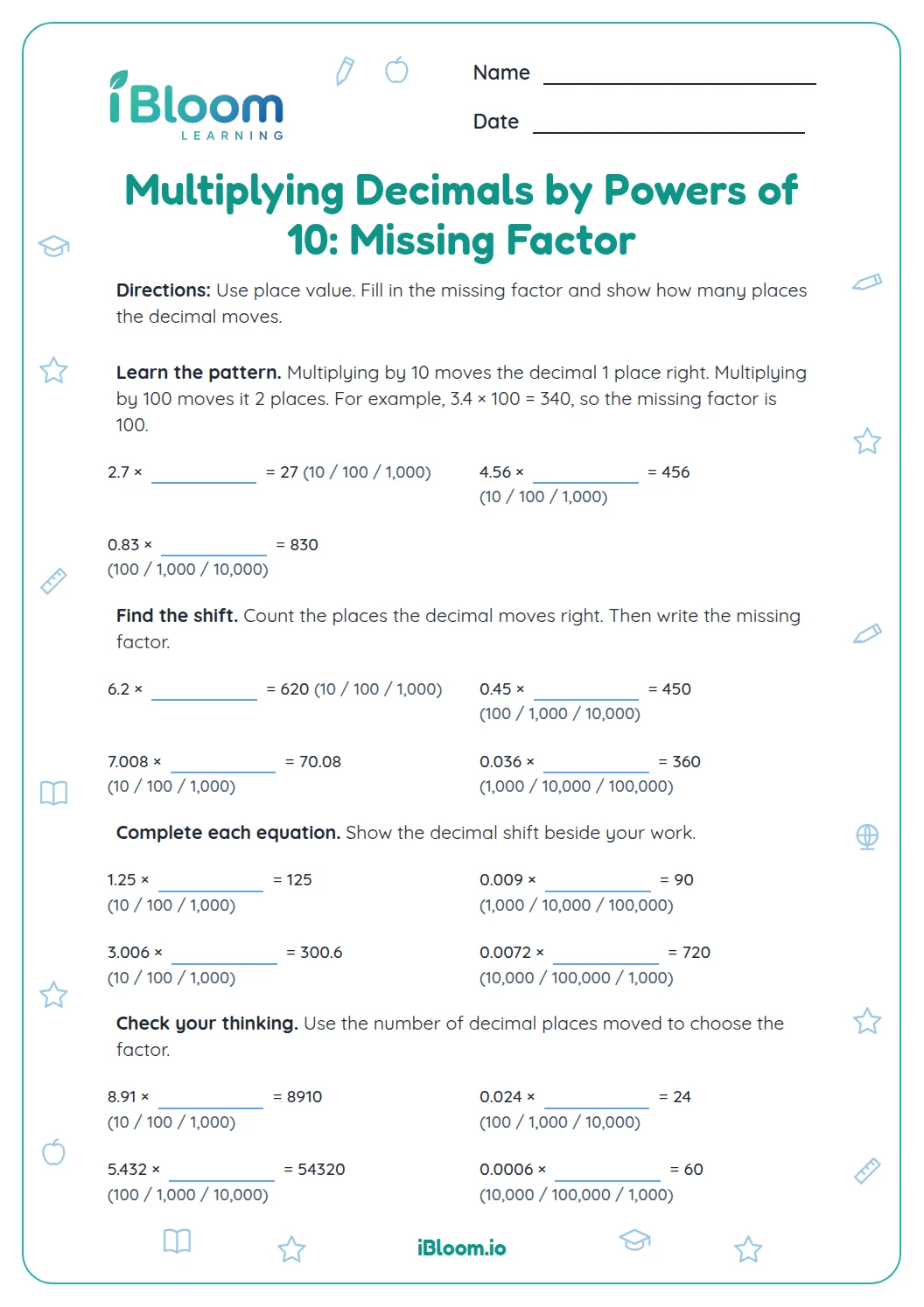
This Grade 6 printable connects decimal multiplication to hundredths area models, column computation, and real-world situations. Learners interpret tenths-by-tenths models, multiply factors with up to three decimal places, and explain how decimal placement affects product size. Fourteen questions include a separate answer key with products and sample reasoning. It practices CCSS 6.NS.B.3.
Aligned to 6.NS.B.3
What is the main idea?
Multiply the digits first, then use the number of decimal places in both factors to place the decimal in the product. Area models help estimate and interpret size.
For 0.4 × 0.3, compute 4 × 3 = 12. The factors have two decimal places altogether, so the product is 0.12. The hundredths model has 12 shaded squares.
How does the practice build?
The first part gives a clear starting point. Later items ask learners to apply the same idea in a new form and check that the result makes sense. Use the answer key after independent work so the learner can explain any correction.
How can an adult support the practice?
Read the directions together, then ask the learner to name the first step before writing. Encourage a check with a second method when one is available. The short written responses leave room to put the reasoning into words.
How to use this worksheet
- 1Read the factors and estimate the product size.
- 2Use the first four hundredths models to connect tenths to hundredths.
- 3Work the multiplication expressions using column methods.
- 4Write equations for the four context problems.
- 5Explain the decimal-place error and check answers with estimates.
Common mistakes and quick fixes
The mistake
Place the decimal using only one factor’s decimal places.
The fix
count the places in both factors before placing it.
The mistake
Assume multiplication always makes a number larger.
The fix
estimate; multiplying positive numbers by factors below 1 makes a smaller product.
The mistake
Read 0.08 as eight tenths.
The fix
say “eight hundredths” and check the hundredths grid.
Common Core alignment
This worksheet gives focused practice with the standard below.
Multiply multi-digit decimals accurately using the standard algorithm.
On this sheet: Multiply multi-digit decimals accurately using the standard algorithm.
Show the official wordingHide the official wording
Fluently add, subtract, multiply, and divide multi-digit decimals using the standard algorithm for each operation.
What to practice next
Make more practice
Further reading
Questions parents and teachers ask
How do you multiply two decimals?
Multiply as with whole numbers, then count the total decimal places in both factors and place the decimal in the product. For 0.4 × 0.3, 4 × 3 = 12 and there are two decimal places, so the product is 0.12.
How do the hundredths models help?
A 10-by-10 hundredths grid makes the size of a tenths-by-tenths product visible. For 0.2 × 0.4, the overlap covers 8 of 100 small squares, or 0.08. Invite the learner to point to the numbers or words in the prompt that support this answer, then check the completed item against the key.
Why can a product be smaller than both factors?
When both factors are positive and less than 1, their product can be smaller than either factor. For example, 0.6 × 0.3 is 0.18, which is less than 0.3 and 0.6. Invite the learner to point to the numbers or words in the prompt that support this answer, then check the completed item against the key.
What does “0–3 decimal digits” mean here?
The factors include whole numbers and decimals with up to three places. This page includes hundredths and thousandths as well as tenths, plus visual models for tenths-by-tenths products. Invite the learner to point to the numbers or words in the prompt that support this answer, then check the completed item against the key.
Does this page include column multiplication?
Yes. Several items give a multiplication expression to solve with column work, alongside model-reading questions, word problems, and a place-value explanation. Invite the learner to point to the numbers or words in the prompt that support this answer, then check the completed item against the key.
What is included in the key?
A separate key lists each product, story answer with units, and a sample explanation for the place-value error item. The sample wording can vary while keeping the decimal reasoning correct. Invite the learner to point to the numbers or words in the prompt that support this answer, then check the completed item against the key.