

About this worksheet
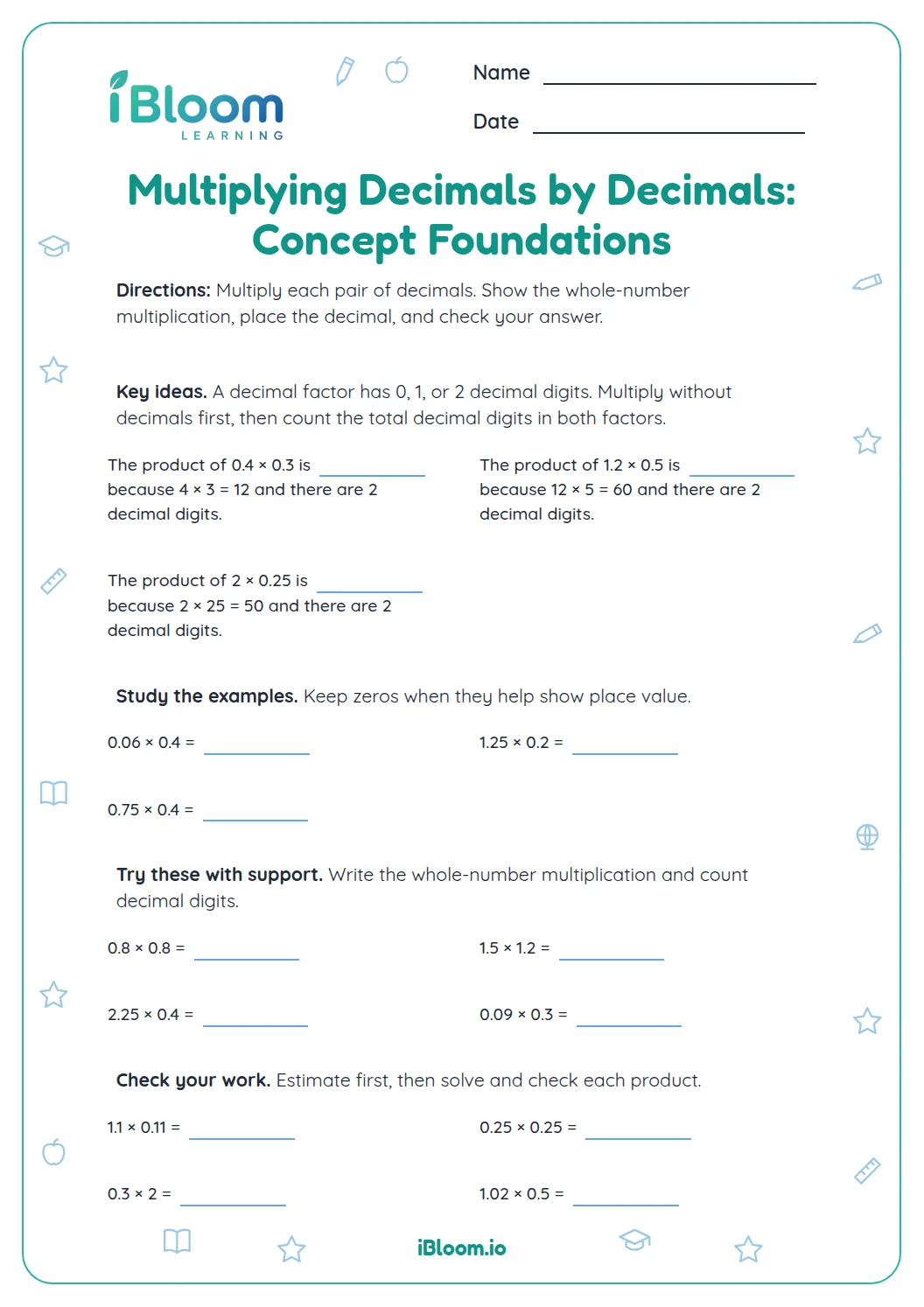
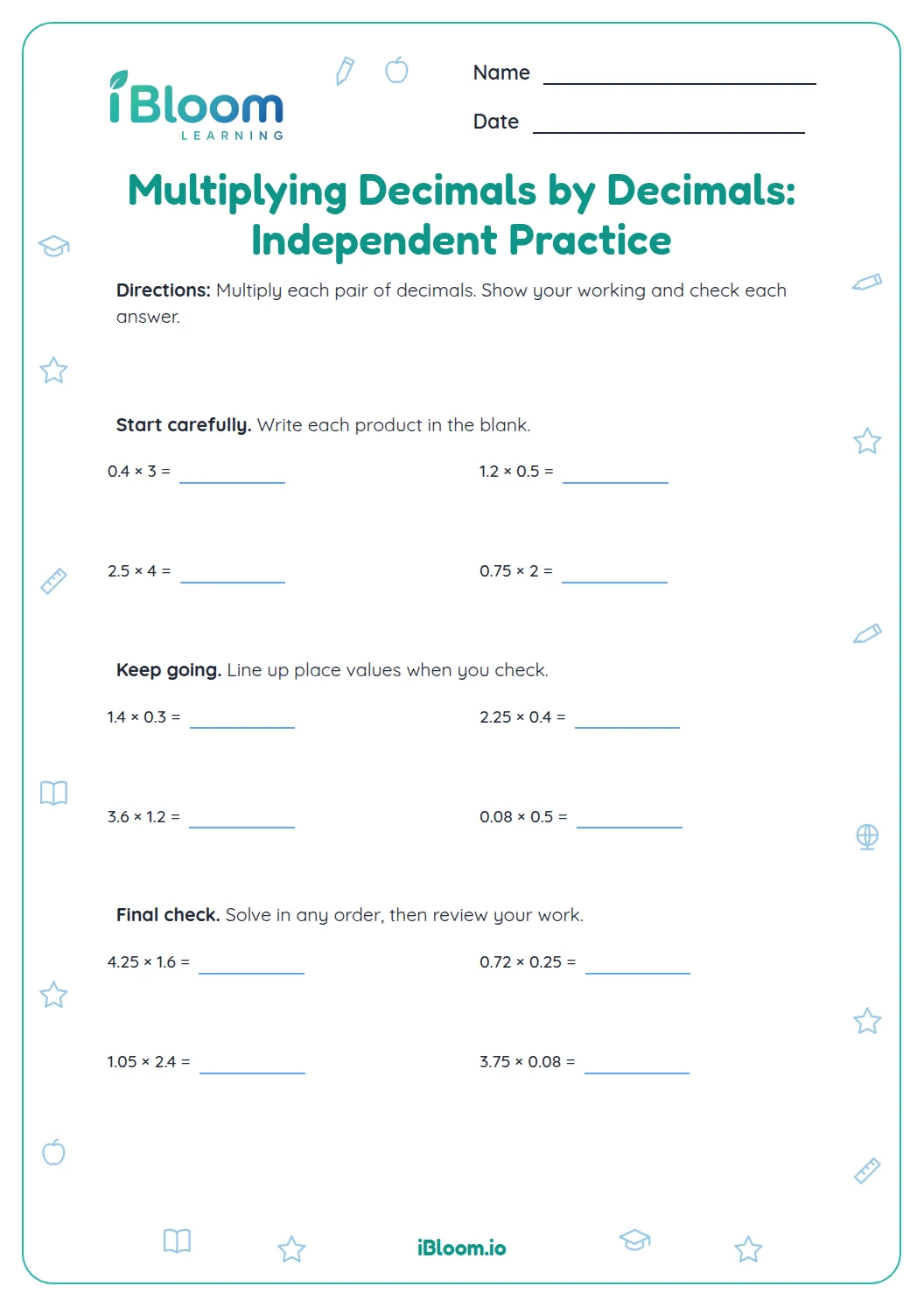
This Grade 6 worksheet has 16 real-world multiplication problems with decimal factors through hundredths. Students write equations and calculate amounts involving cost, distance, mass, recipes, and area. It practices CCSS 6.NS.B.3, which includes multiplying multi-digit decimals. A separate answer key includes products and brief reasonableness checks.
Aligned to 6.NS.B.3
How do you turn a situation into a product?
Identify the two quantities being multiplied and write them as factors. Keep the units in mind: multiplying a price per item by a number of items gives a total cost.
How can you check decimal placement?
Estimate the size before multiplying. For example, 2.4 × 1.5 is close to 2 × 2, so a result near 3.6 is sensible, while 36 is too large.
- 1A garden bed is 2.4 m by 1.5 m.
- 2Area = 2.4 × 1.5
- 32.4 × 15 = 36; two decimal places give 3.60.
- 4Answer: 3.6 m²
How to use this worksheet
- 1Underline the two quantities that are being multiplied.
- 2Estimate the product before computing.
- 3Write the unit with the final answer when the question names one.
Common decimal multiplication mistakes
The mistake
Counting decimal places in only one factor.
The fix
Count the decimal places in both factors together before placing the product point.
The mistake
Leaving off the unit in a measurement answer.
The fix
Carry the unit from the question and use square units for area.
The mistake
Accepting a product that is far from the estimate.
The fix
Round the factors first and compare the estimate with the exact product.
Curriculum alignment
This practice supports the named skill at the listed grade level.
Use decimal multiplication to solve practical problems and calculate products.
On this sheet: Multiply multi-digit decimals fluently and use the products to solve real-world problems.
Show the official wordingHide the official wording
Fluently add, subtract, multiply, and divide multi-digit decimals using the standard algorithm for each operation.
What to practice next
Make more practice
Questions parents and teachers ask
How do I multiply decimals in a word problem?
Write the two quantities as factors, estimate, multiply the digits, then place the decimal point using the total decimal places in both factors. Include the unit requested in the question. For instance, the notebook question multiplies a unit price by one and a half dozen notebooks.
Why estimate before multiplying?
An estimate helps catch a misplaced decimal point. For example, 2.4 × 1.5 is near 3.6, so 36 would be much too large. Comparing an estimate with the exact answer helps catch a product that is ten times too large or too small.
What kinds of situations appear?
The 16 questions include costs, lengths, mass, liquid amounts, travel, recipes, and areas. Each situation uses multiplication with decimal factors. Each item gives the quantities needed to write a multiplication equation before calculating. The situations include everyday quantities such as prices, distances, and weights.
How are area answers written?
Multiply the length by the width and use square units. For example, meters multiplied by meters gives square meters. Keep the length units together: a meter times a meter gives square meters for the area. Keep the length units together: meters multiplied by meters gives square meters for the area.
Is an answer key included?
Yes. The separate three-page key lists all 16 products, keeps the appropriate units, and includes reasonableness checks for the final problems. Use the key after solving so the products remain available for checking rather than copying. Use the key after solving so the products remain available for checking rather than copying.