



About this worksheet
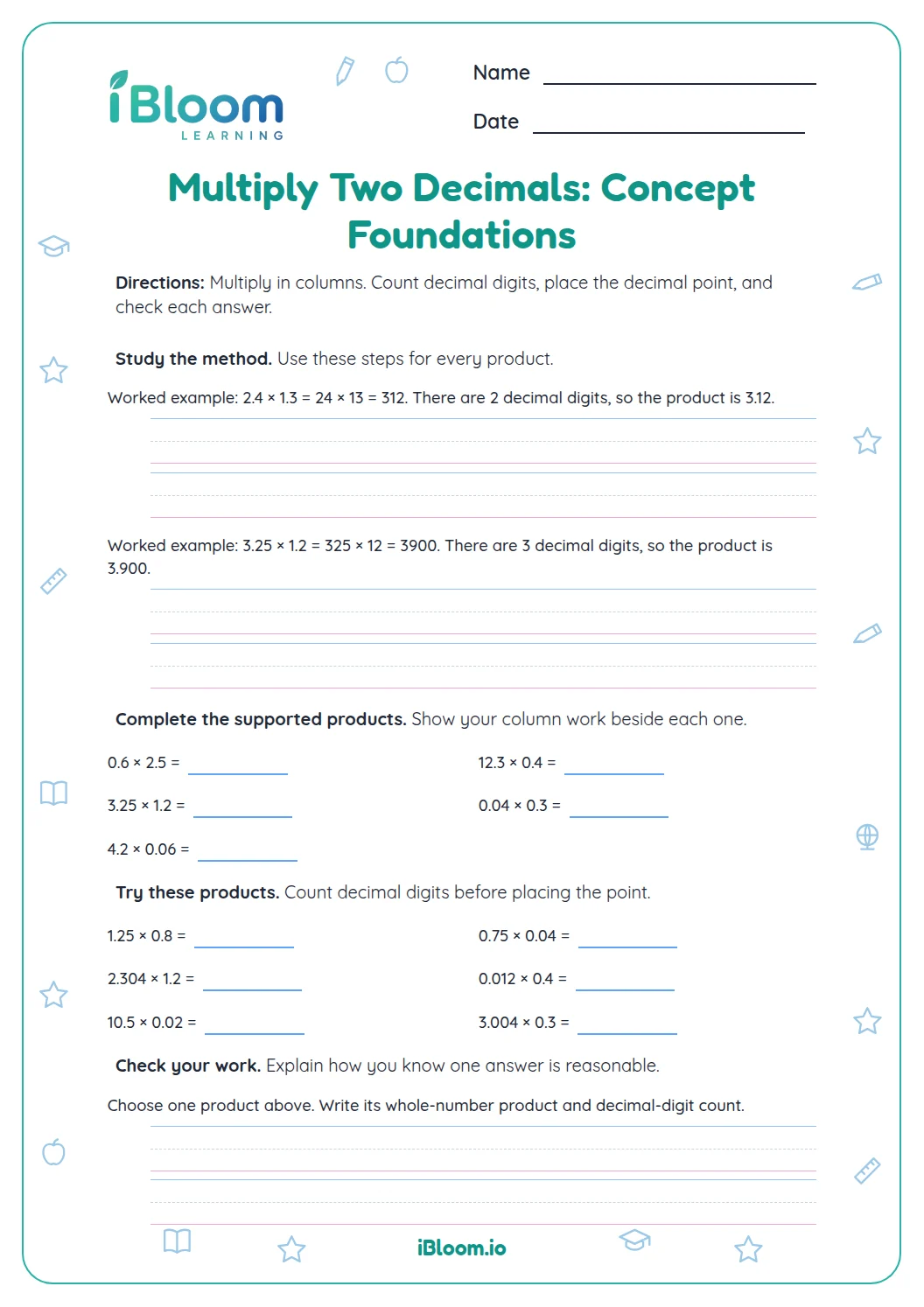
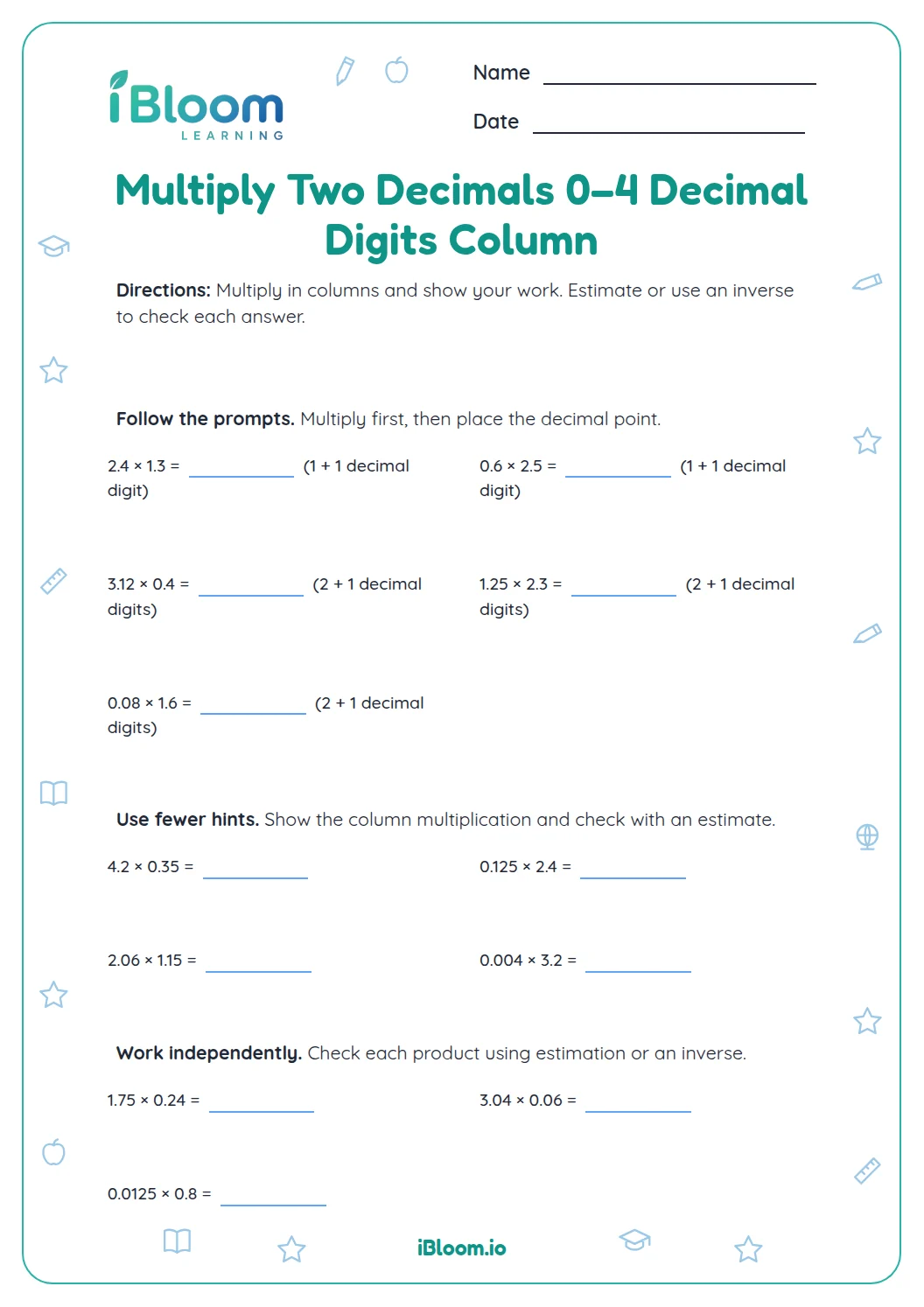
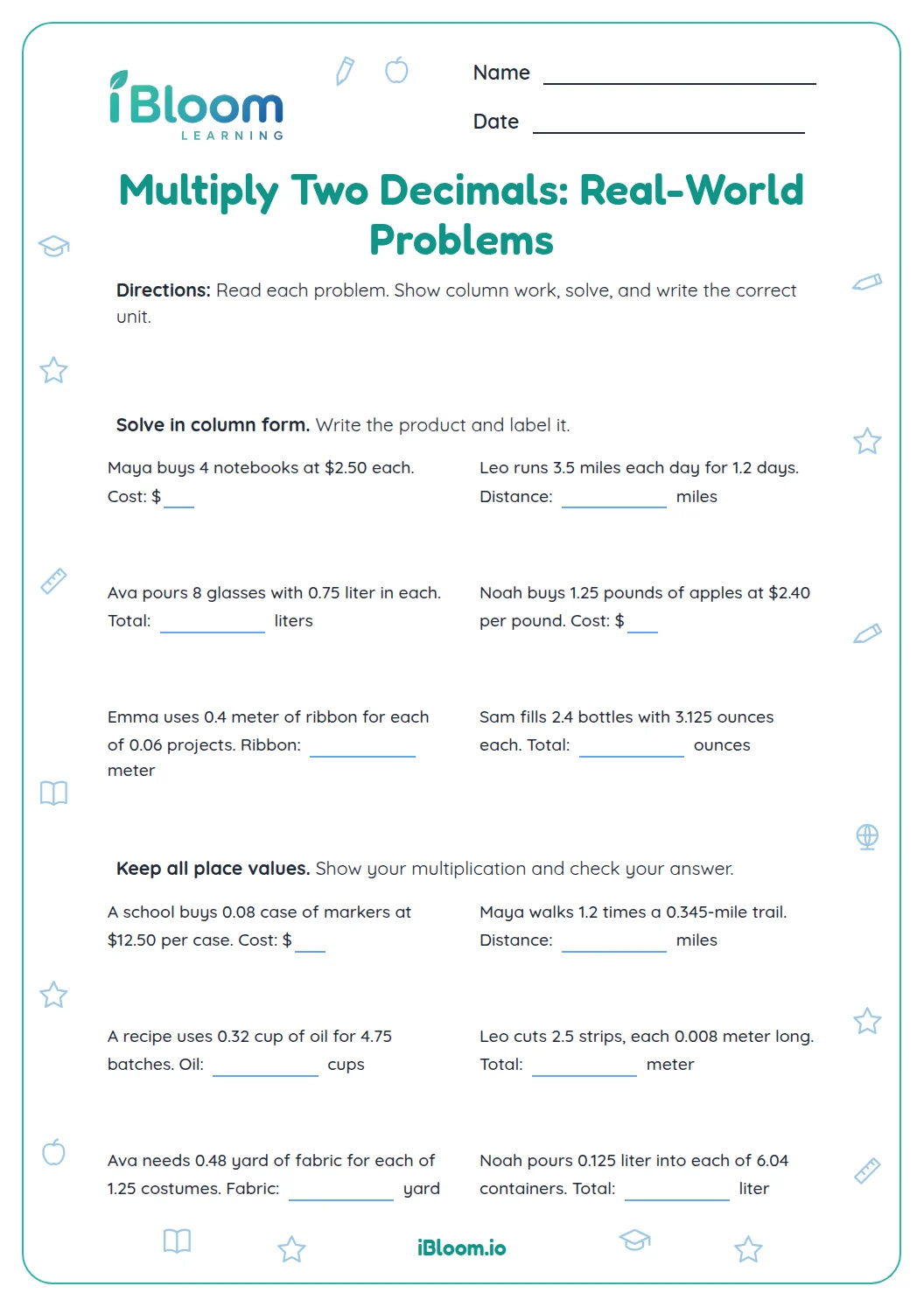
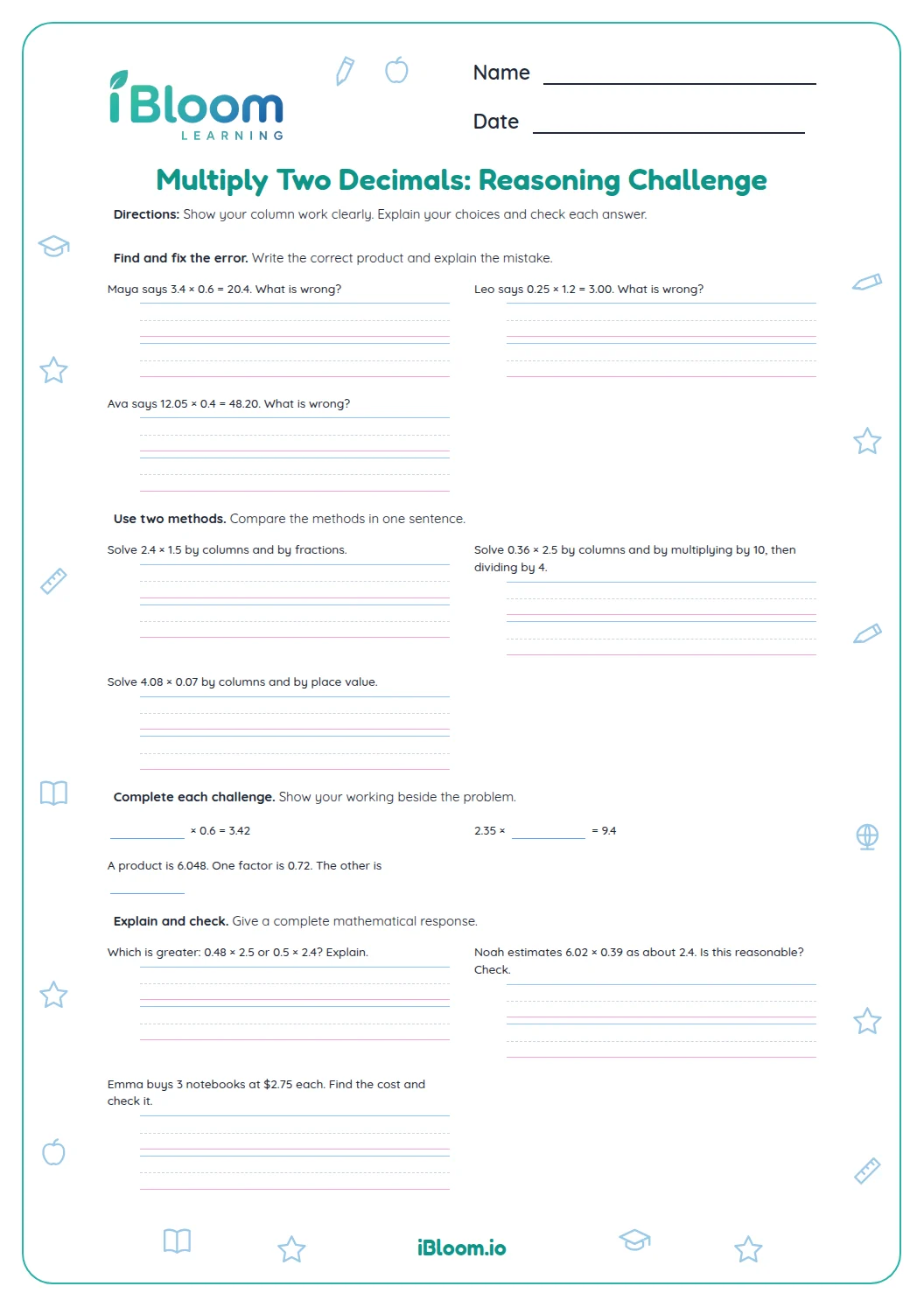
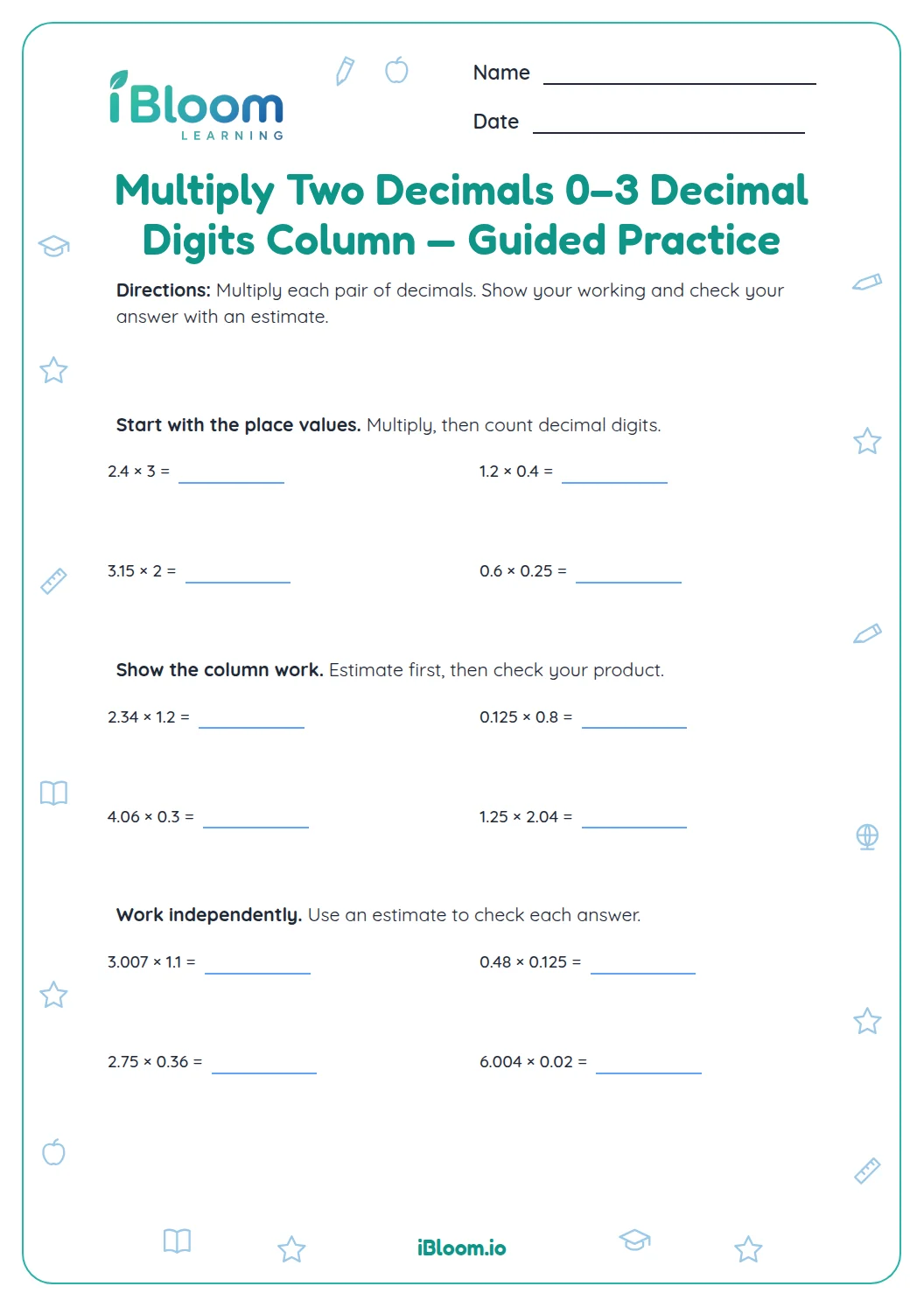
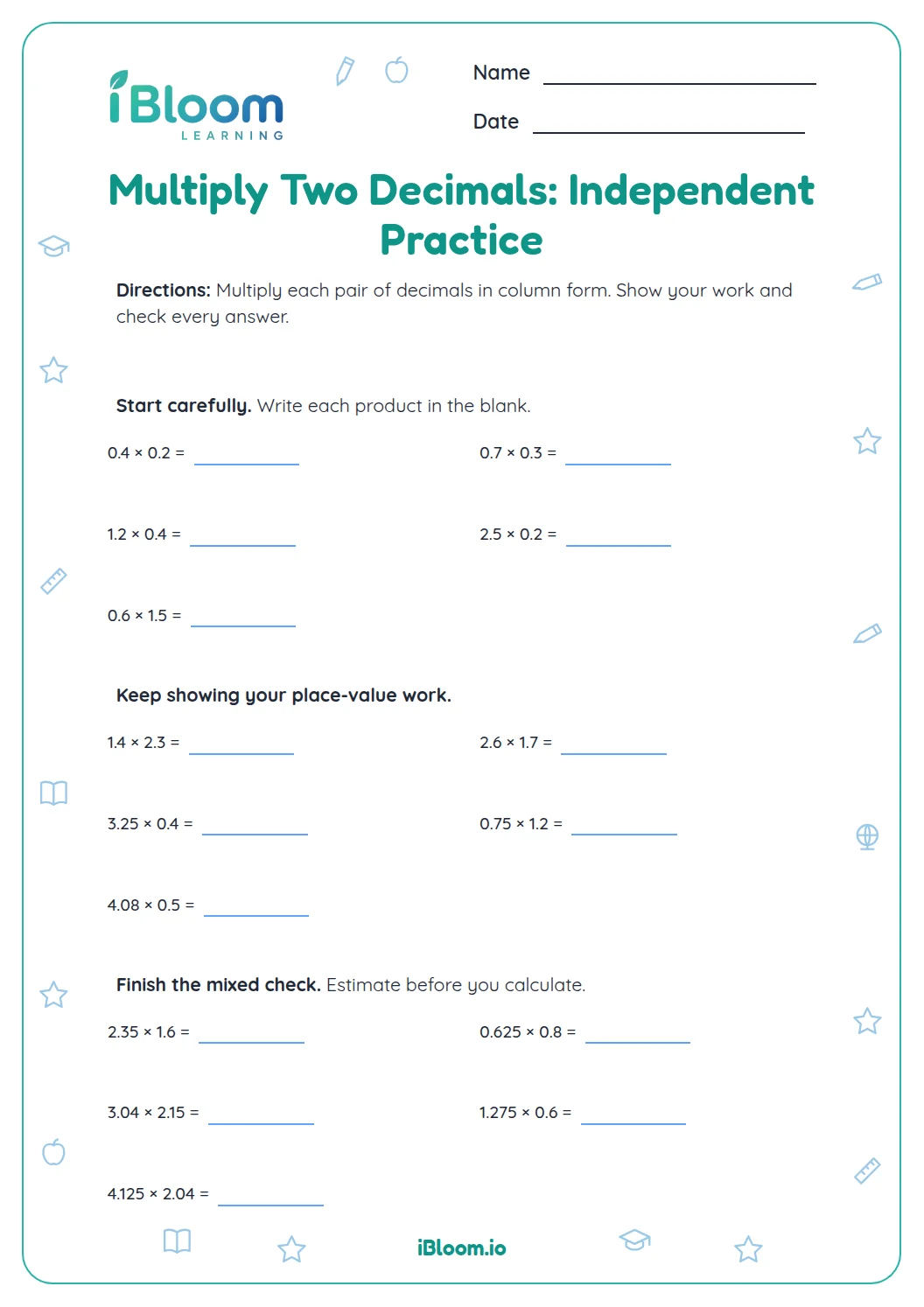
This Grade 6 worksheet gives students 20 decimal multiplication problems, from tenths and hundredths through factors with four decimal places. Children can use the standard multiplication algorithm, then place the decimal by counting the total decimal places in both factors. A separate answer key lists the products.
Aligned to 6.NS.B.3
How do you multiply the first decimal pairs?
Part A begins with products such as 2.4 × 1.3 and 0.6 × 0.08. Multiply the digits first, then count decimal places in both factors.
What changes when factors have more decimal places?
Part B includes factors with three or four decimal places. Keep track of each factor’s precision before placing the decimal in the product.
- 11.125 has 3 decimal places; 0.8 has 1.
- 21125 × 8 = 9000.
- 3Four decimal places in all: 0.9000, or 0.9.
How can you check a small product?
Part C includes very small factors and products. Estimate the size before calculating, then check that the decimal placement makes sense. The answer key accepts equivalent decimal forms.
How to use this worksheet
- 1Write the factors so the digits are easy to multiply.
- 2Multiply as with whole numbers.
- 3Count the decimal places in each factor.
- 4Add those counts and place the decimal in the product.
- 5Estimate the product to catch a misplaced decimal.
Common mistakes and quick fixes
The mistake
Counting decimal places in only one factor.
The fix
Count the places in both factors and add the counts.
The mistake
Dropping a needed zero in a small product.
The fix
Place the decimal by the total count, then add a leading zero if needed.
The mistake
Writing a product much larger than either factor when both are small.
The fix
Estimate first; multiplying two factors below 1 gives a product below either factor.
Common Core alignment
Students fluently multiply multi-digit numbers using the standard algorithm and apply place value to decimal products.
Multiply the decimal factors accurately and use place value to locate each product’s decimal point.
On this sheet: The worksheet questions practice this skill directly.
Show the official wordingHide the official wording
Fluently add, subtract, multiply, and divide multi-digit decimals using the standard algorithm for each operation.
What to practice next
Make more practice
Further reading
Questions parents and teachers ask
How many problems are on this worksheet?
There are 20 decimal multiplication problems in three parts. The factors range from tenths and hundredths to numbers with four decimal places. The key shows each product so students can check both the multiplication and decimal placement. Students can work the problems independently before checking their calculations.
Does the worksheet include column multiplication?
The directions ask students to line up place values and show their work. The problems are written as multiplication equations, so students can set each one up vertically in the available work area. The key shows each product so students can check both the multiplication and decimal placement.
How should students place a product’s decimal point?
First multiply the digits as whole numbers. Then count the decimal places in both factors and place that many decimal places in the product, adding a zero when the product needs one. The key shows each product so students can check both the multiplication and decimal placement.
Why do some answers begin with zero?
A product smaller than one needs a zero before the decimal point, as in 0.048. Leading zeros make the place value clear and do not change the product. The key shows each product so students can check both the multiplication and decimal placement.
Are equivalent decimal answers accepted?
Yes. The answer key accepts equivalent forms such as 0.9 and 0.9000 when both represent the correct product. Students should still use the decimal-place count to show the precision of their calculation. The key shows each product so students can check both the multiplication and decimal placement.