



About this worksheet
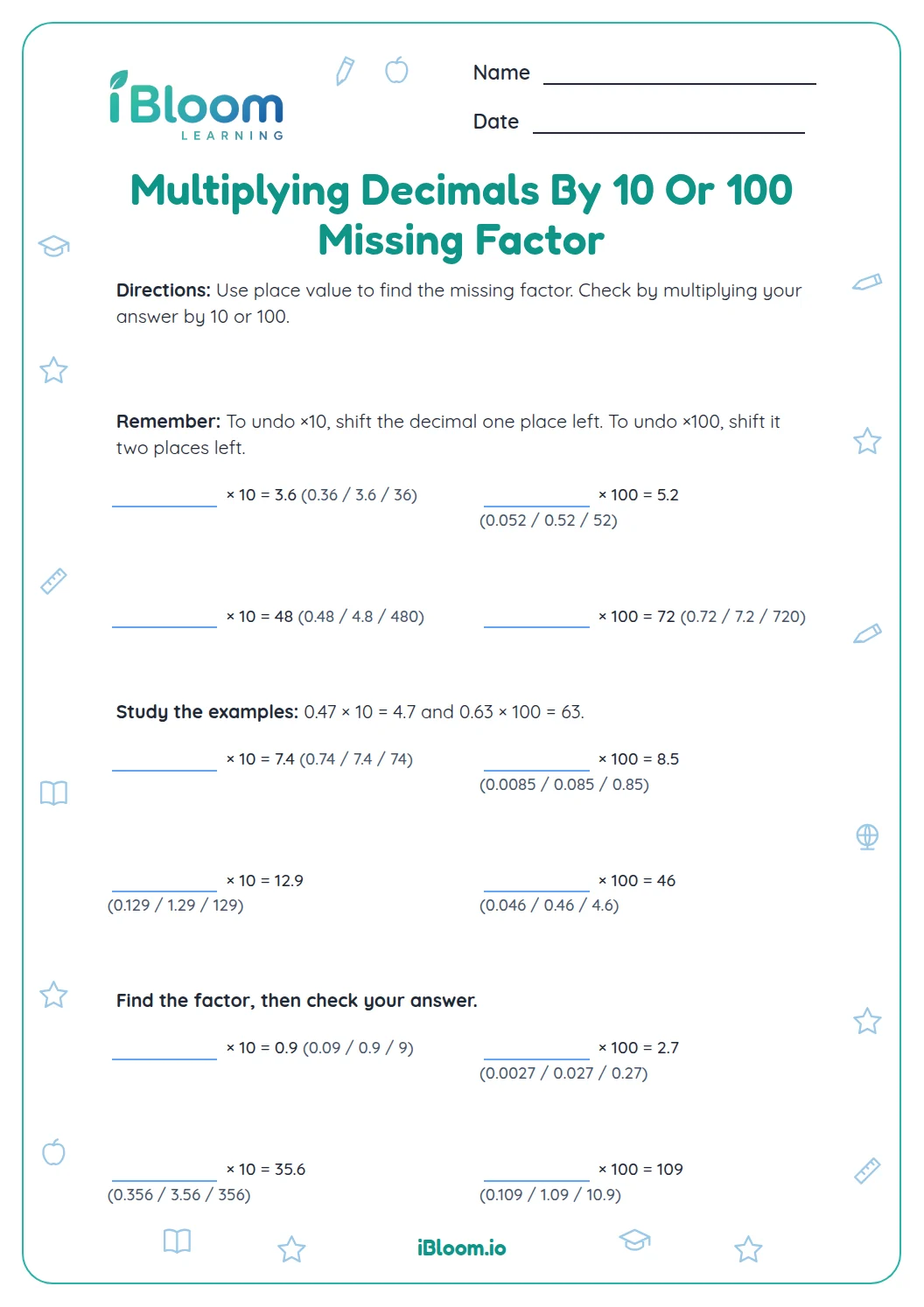
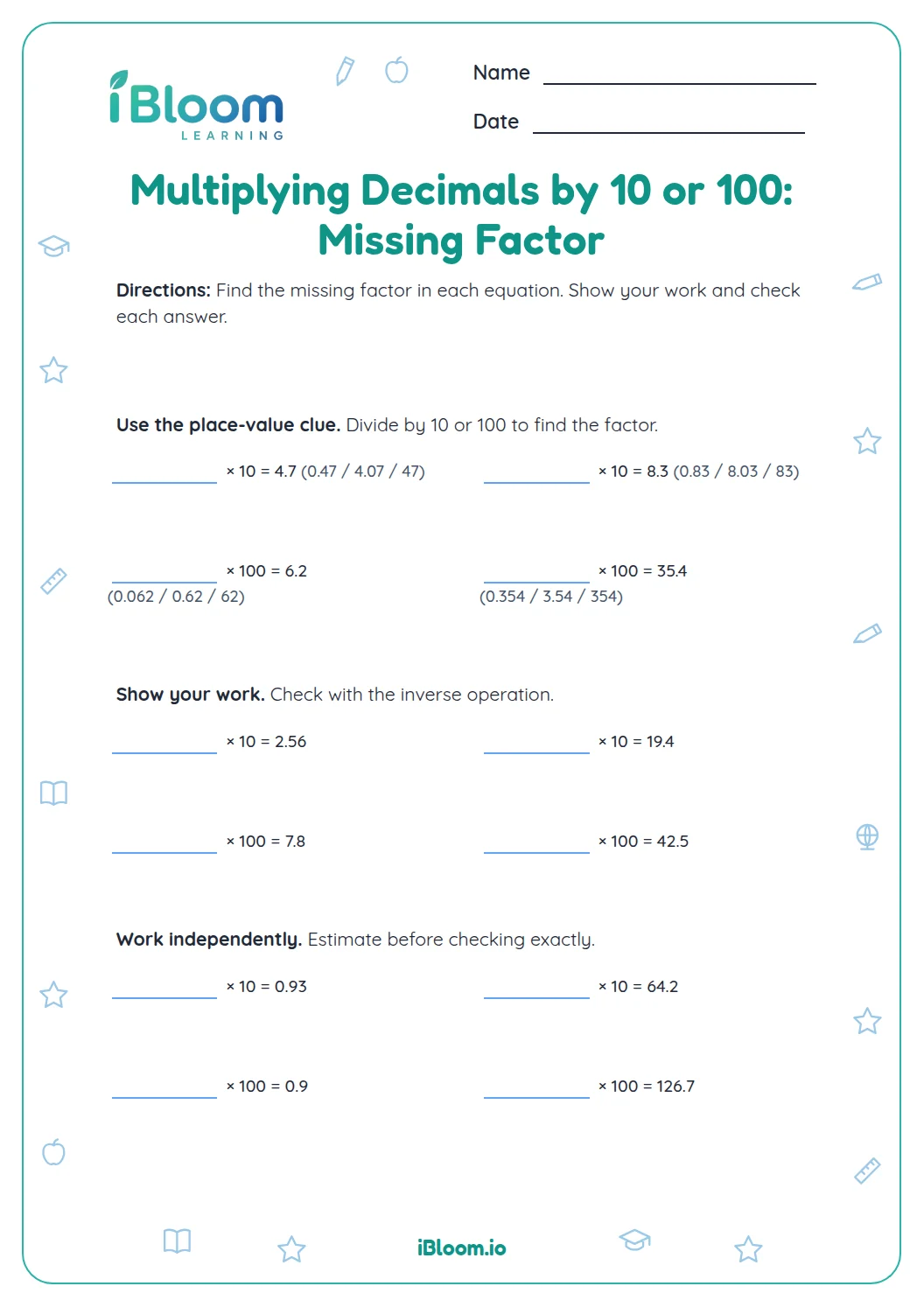
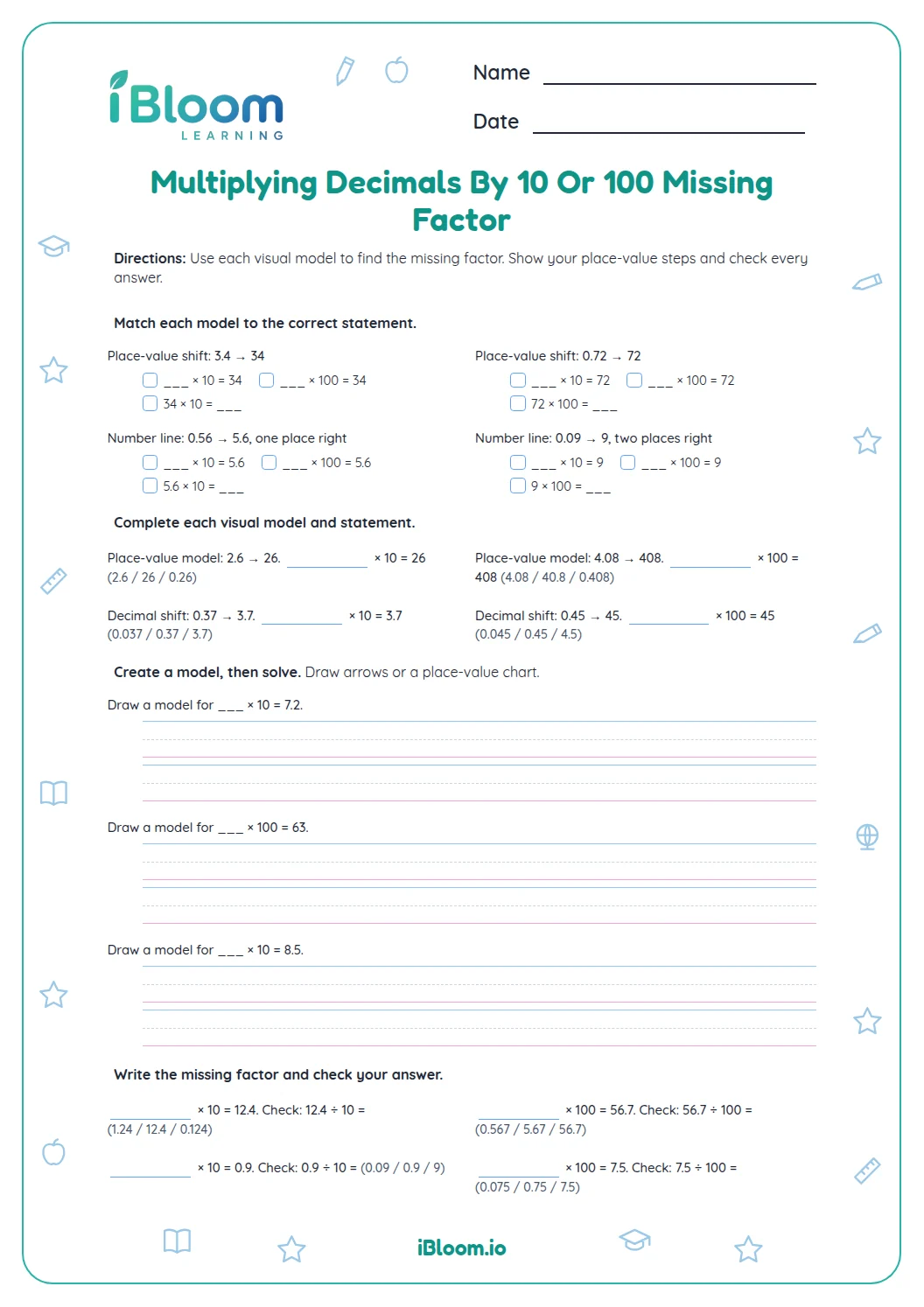
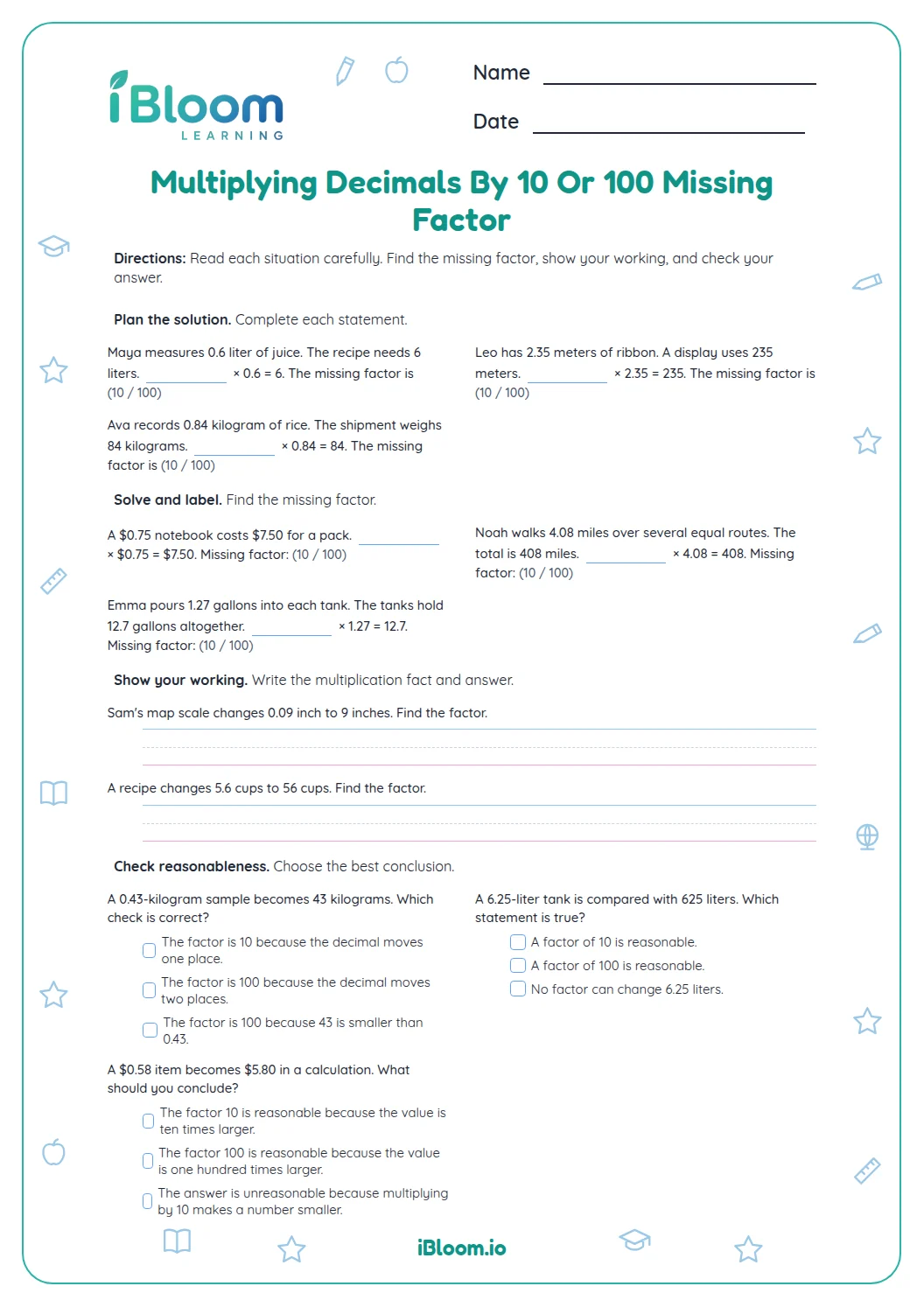
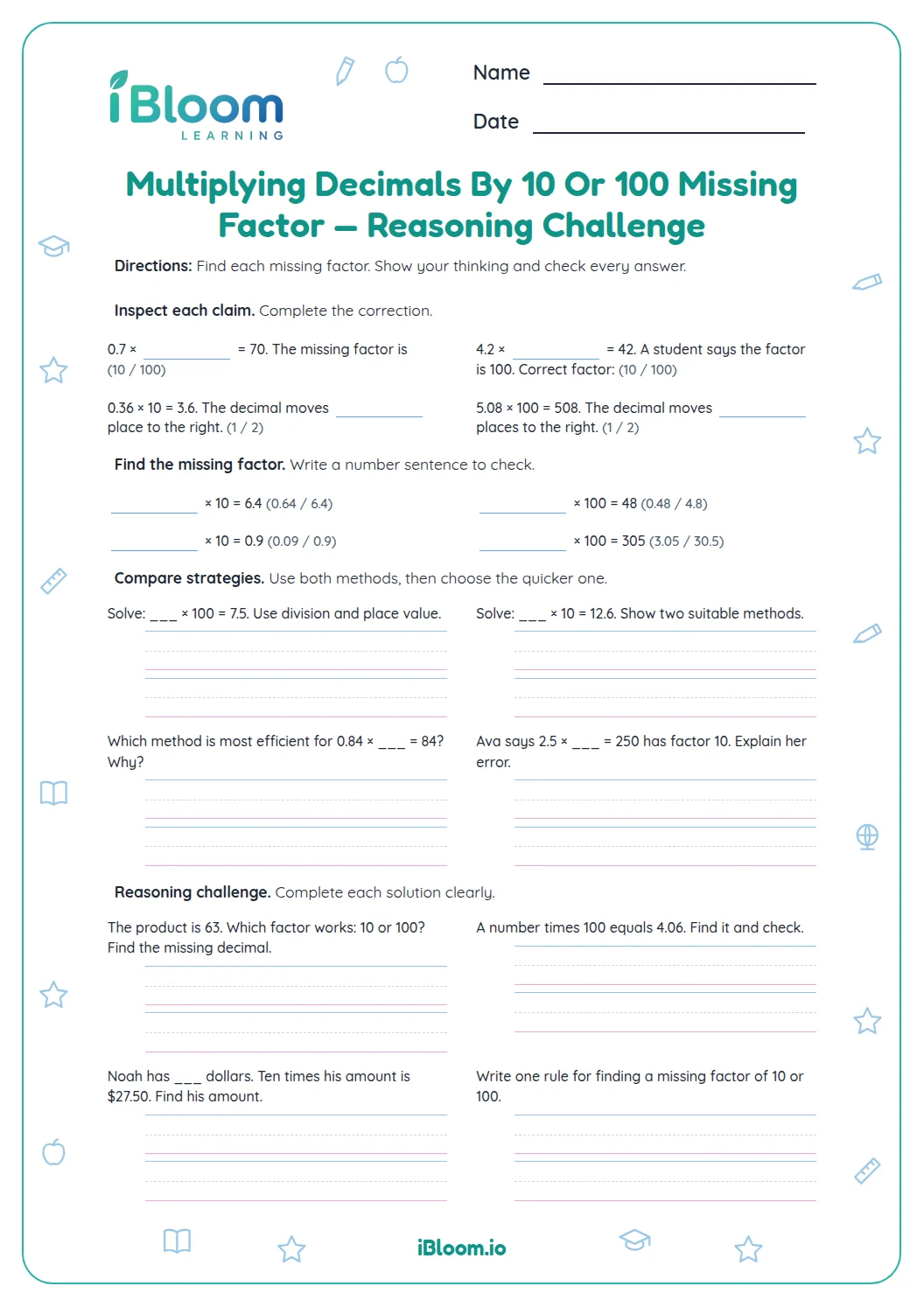
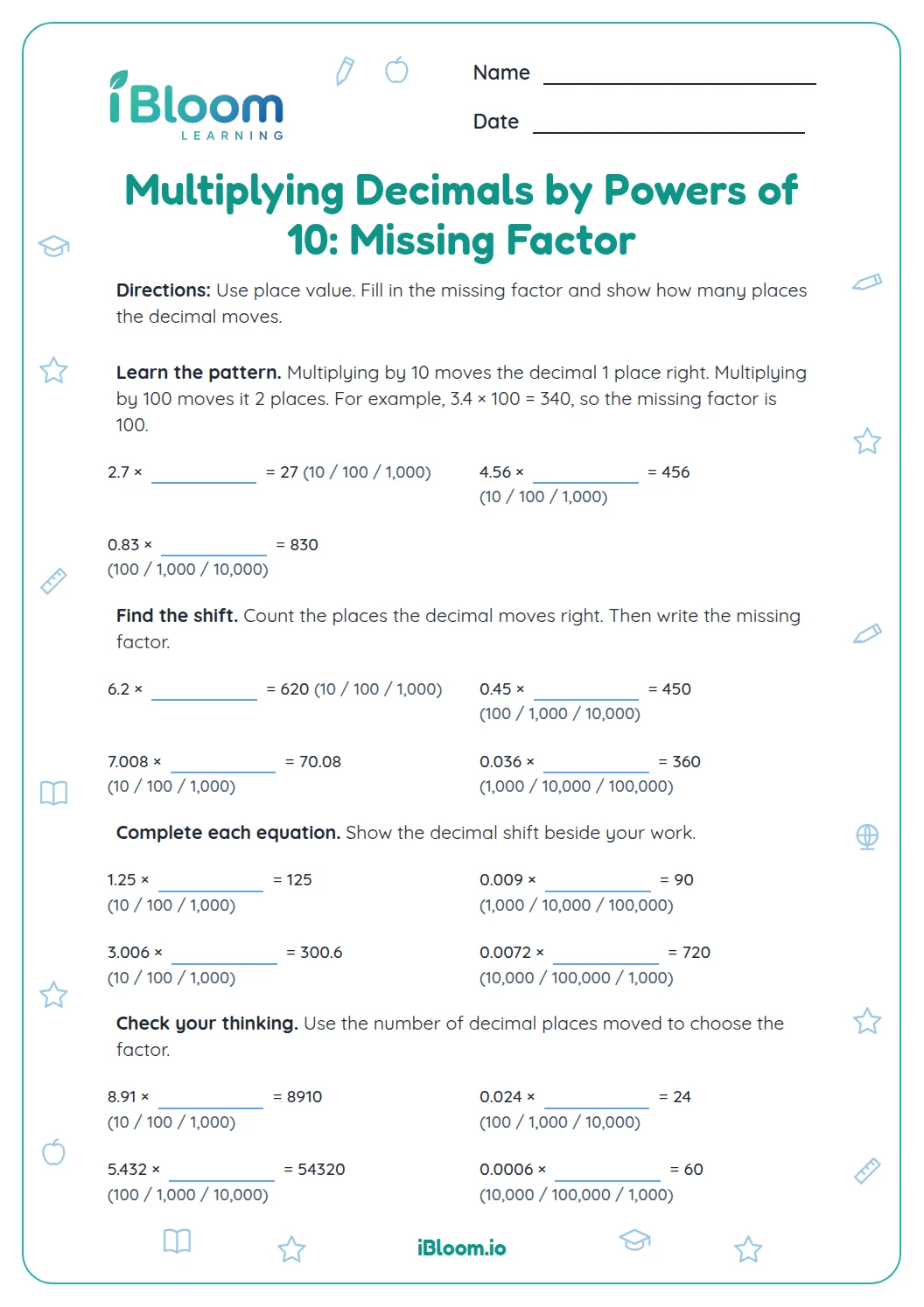
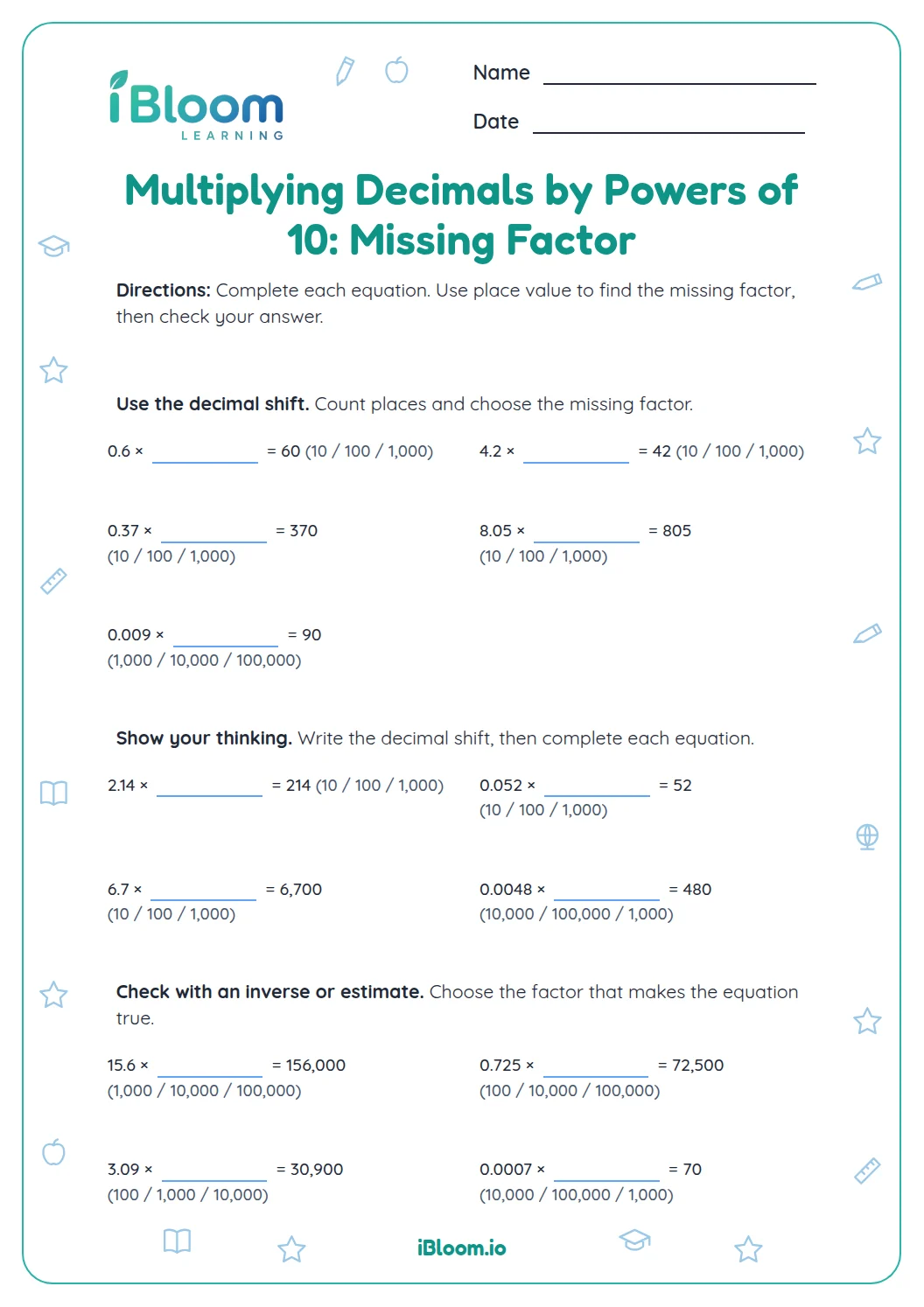
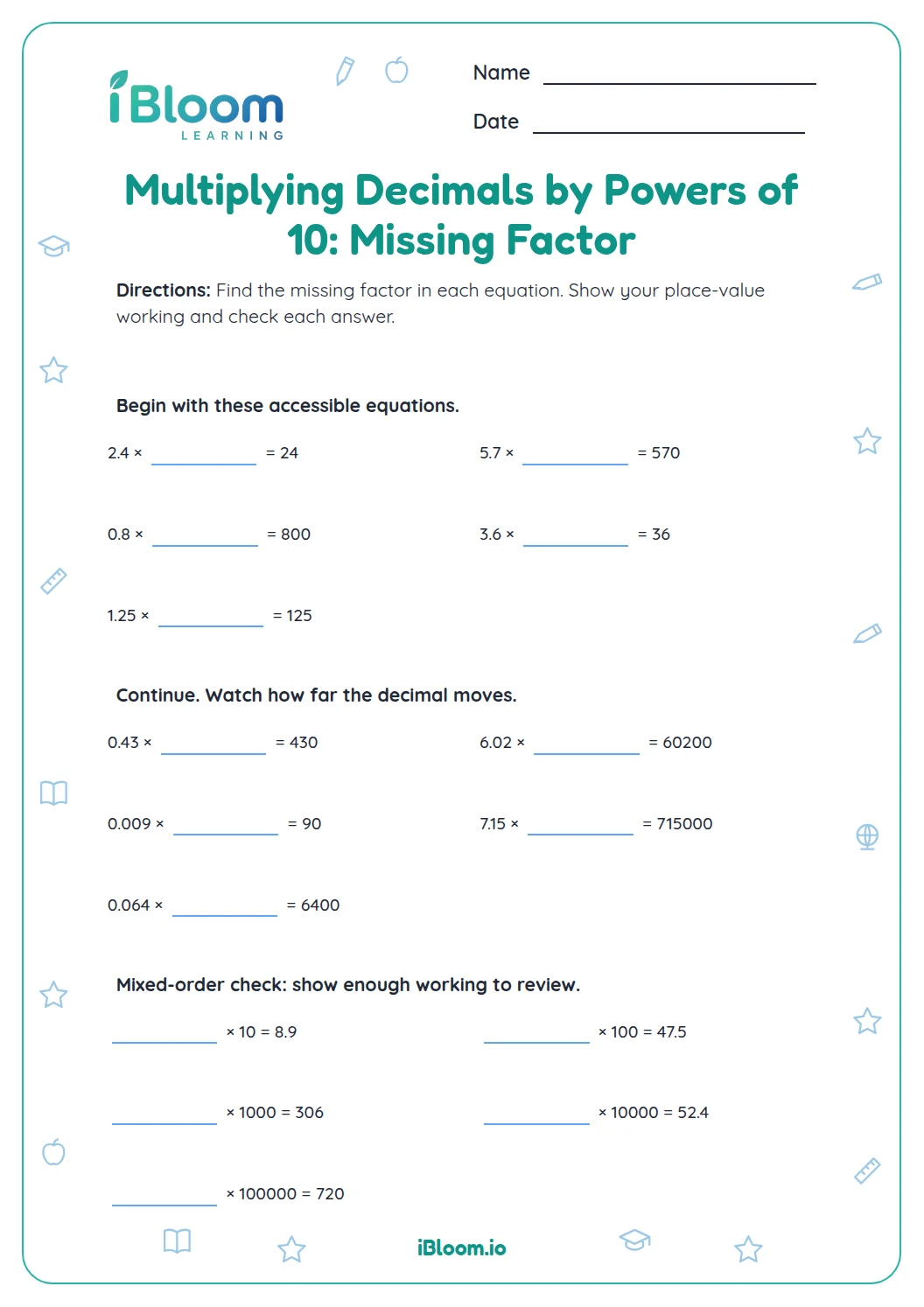
This Grade 6 worksheet practices finding a missing factor or starting decimal in multiplication equations involving 10 and 100. Students use place value to reason about each change, then apply the same idea to four short situations involving meters, centimeters, and liters. The 16 questions move from direct equations to word problems, and a separate answer key supports checking. The work aligns with CCSS 6.NS.B.3, which includes fluent multiplication of multi-digit decimals.
Aligned to 6.NS.B.3
How can place value reveal the missing number?
When a decimal is multiplied by 10, each digit has ten times its value; multiplying by 100 makes each digit one hundred times its value. To find a missing starting number, reverse that change.
For 0.46 × ___ = 46, 0.46 becomes 46 after a hundredfold increase, so the missing factor is 100.
- 10.46 × ___ = 46
- 20.46 × 100 = 46
- 3The missing factor is 100.
What situations use the same place-value idea?
The first twelve problems ask students to complete multiplication equations. Some leave the factor blank; others leave the starting decimal blank. The final four use the same reasoning in short metric and quantity situations.
A useful check is to substitute the answer and multiply. For example, 0.073 × 10 = 0.73.
How can students check a missing value?
Put the answer back in the original equation and multiply. Check both the product and any unit asked for in a situation. For 0.38 meter, multiplying by 100 gives 38 centimeters.
How to use this worksheet
- 1Read which value is missing before choosing an operation.
- 2For a missing factor, compare the starting and ending values.
- 3For a missing starting decimal, divide the product by 10 or 100.
- 4Write units in the situation problems.
- 5Substitute each answer to check the equation.
Mistakes to watch for
The mistake
Shifting a decimal the wrong way
The fix
Check whether multiplying should make the value ten or one hundred times larger.
The mistake
Writing 10 when the blank is the starting decimal
The fix
Use the product divided by the known factor.
The mistake
Dropping units in a word problem
The fix
Include centimeters or liters when the question asks for a measurement.
Common Core alignment
Multiply decimals by 10 or 100 and use place value to find missing values.
On this sheet: The equations and contexts require decimal multiplication and related reasoning.
Show the official wordingHide the official wording
Fluently add, subtract, multiply, and divide multi-digit decimals using the standard algorithm for each operation.
What to practice next
Make more practice
Further reading
Questions parents and teachers ask
What can the blank represent on this worksheet?
The blank can stand for either the multiplier or the starting decimal. Read the whole equation first. In 3.7 × ___ = 37, the factor must make 3.7 ten times as large, so the missing factor is 10. Put that value back in the equation to check it.
How do I find a missing starting decimal?
Undo the multiplication by dividing by the known factor. If ___ × 100 = 6.7, divide 6.7 by 100 to get 0.067. Check by multiplying 0.067 by 100; the product returns to 6.7. Estimating first can catch a decimal point in the wrong place.
Why does multiplying by 100 change place value by two places?
Multiplying by 100 makes each digit one hundred times its former value. For example, 0.46 × 100 = 46. Thinking about the value of each digit helps explain why the product is larger and helps catch a decimal point placed in the wrong direction.
What grade is this decimal worksheet for?
It is designed for Grade 6 practice with decimal multiplication by 10 or 100. Students find missing factors and starting values, then use the same operations in four short situations with metric units or whole-number groups. The answer key is separate from the two worksheet pages.
How should students check their answers?
The blank can stand for either the multiplier or the starting decimal. Read the whole equation first. In 3.7 × ___ = 37, the factor must make 3.7 ten times as large, so the missing factor is 10. Put that value back in the equation to check it. Then substitute it to check.