



About this worksheet
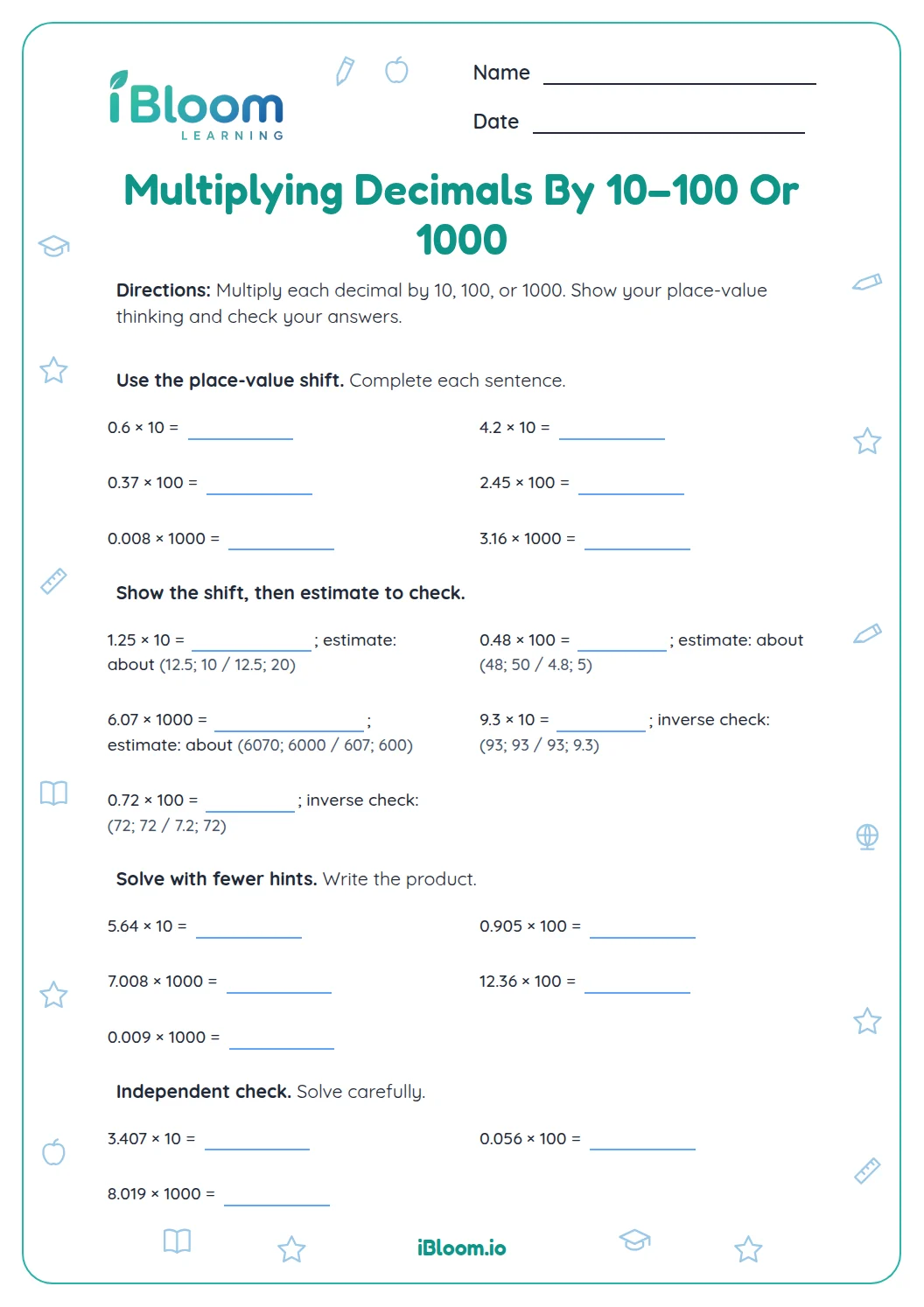
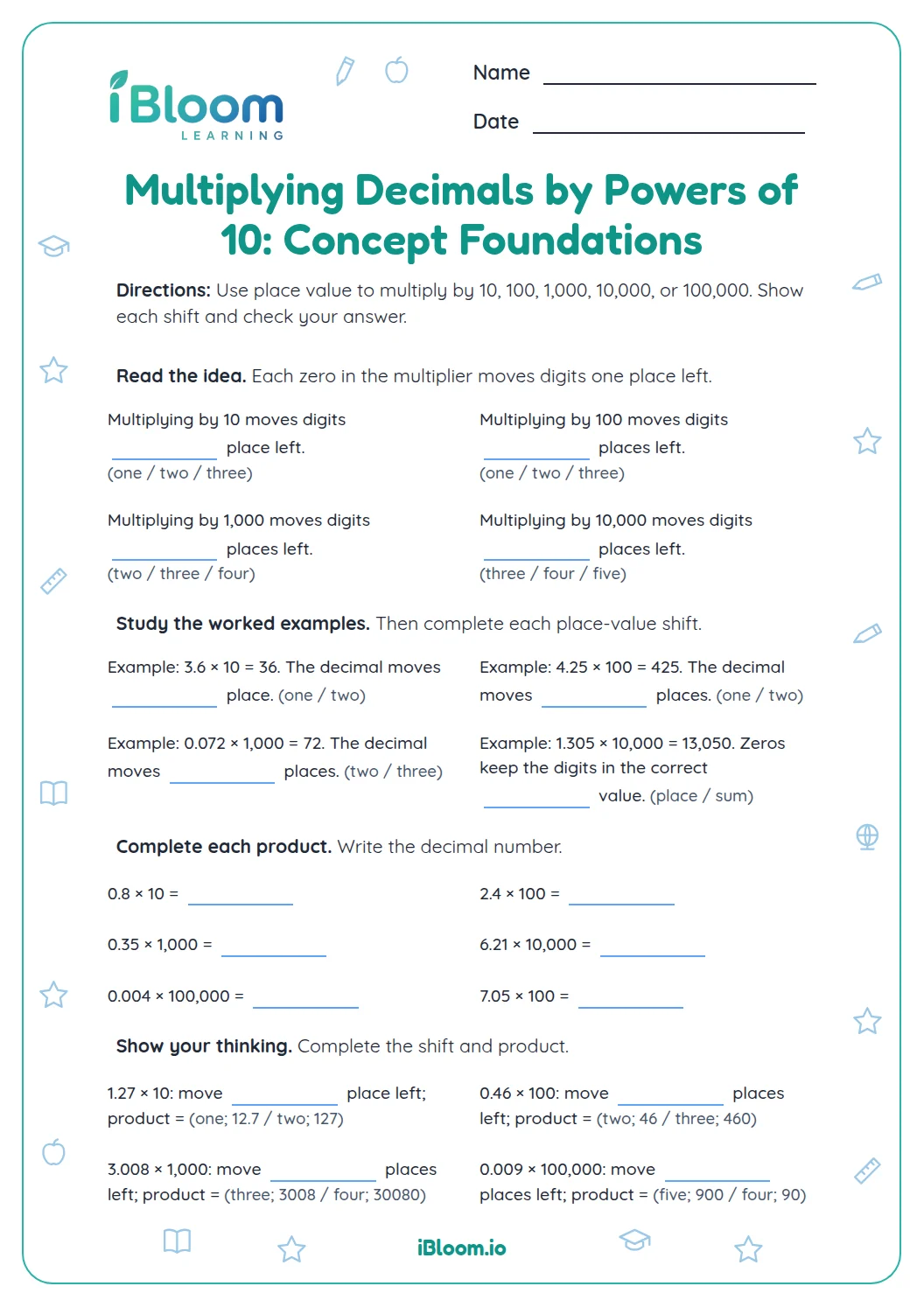
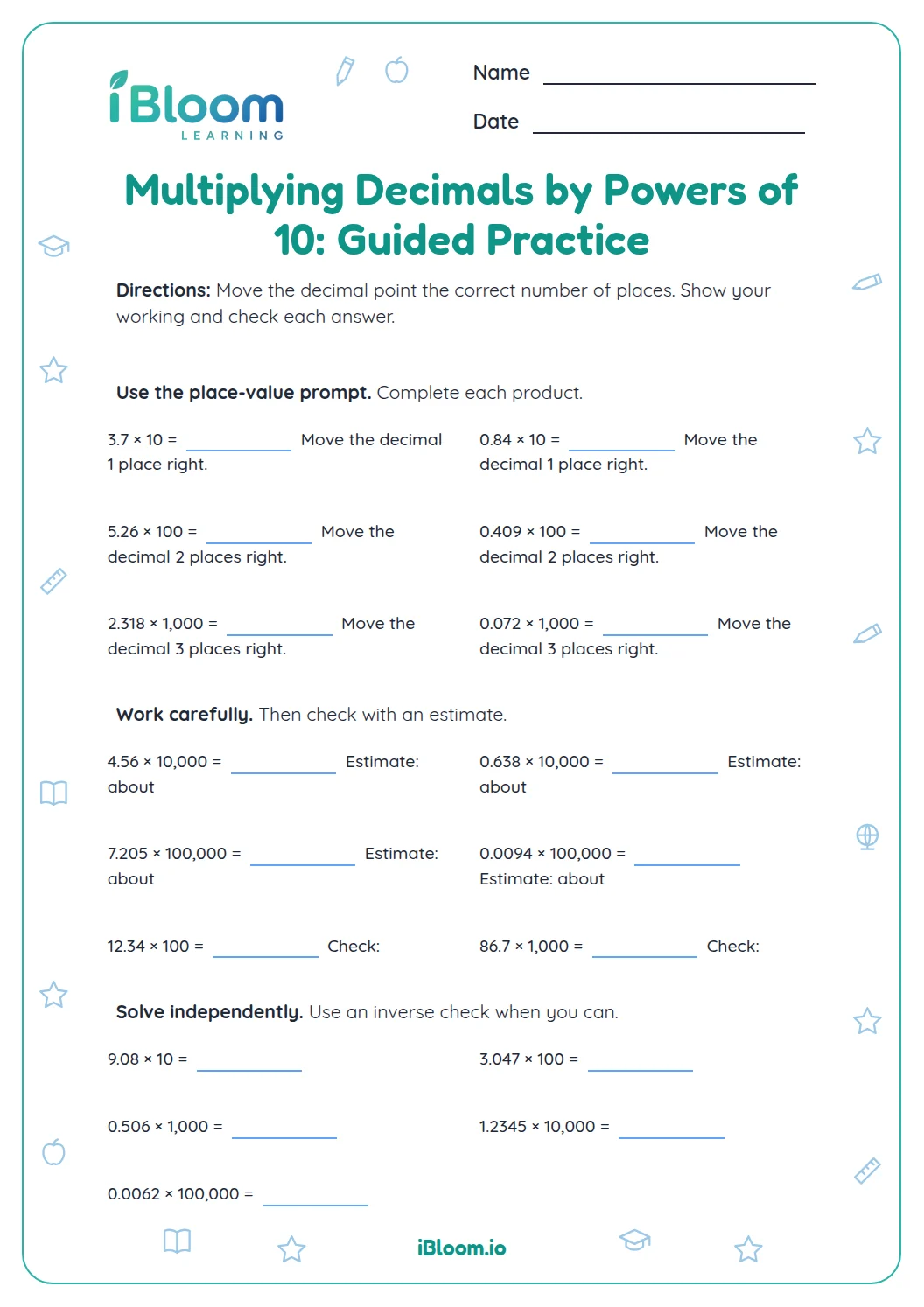
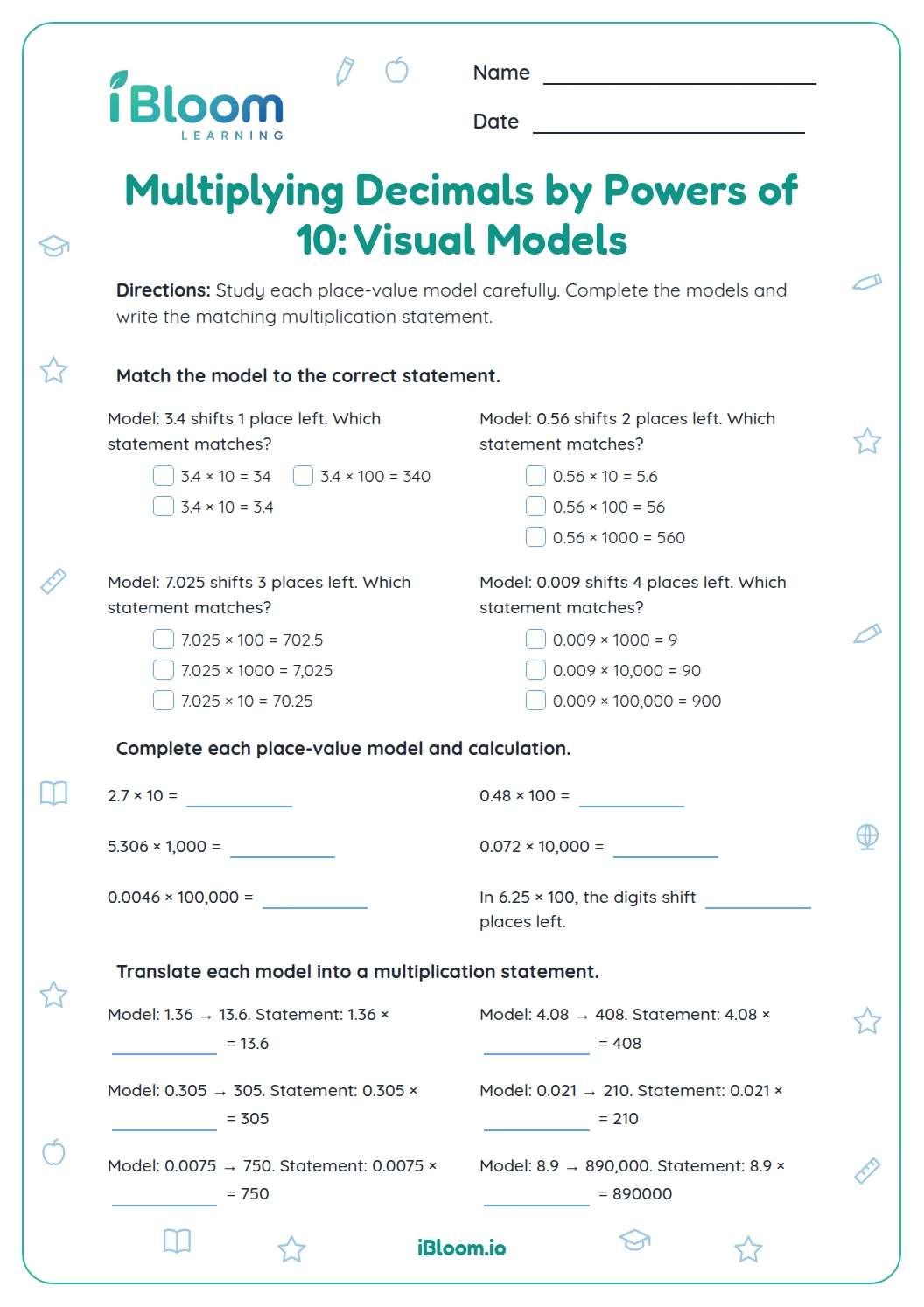
This free printable Grade 6 worksheet uses drawings to show why multiplying a decimal by 10 or 100 moves its digits to the left. In Part A students read tenths strips, a hundredths grid and a number line, and use each model to find a product, such as how many wholes 10 groups of 0.3 make. In Part B they multiply four decimals without a drawing, and in Part C they solve two stories about a paper stack and bottles of juice. It practices Common Core 5.NBT.A.2, and a two-page answer key is included.
Aligned to 5.NBT.A.2
Why does multiplying by 10 move the digits?
In our number system, each place is worth 10 times the place to its right. Multiplying by 10 makes every digit worth 10 times as much, so each digit shifts one place to the left. Multiplying by 100 does it twice. Another way to say the same thing is that the decimal point moves to the right.
That is why 0.3 × 10 = 3: 3 tenths become 3 ones. It is also why 0.3 × 100 = 30: 3 tenths become 3 tens.
How do the models show multiplying by 10 or 100?
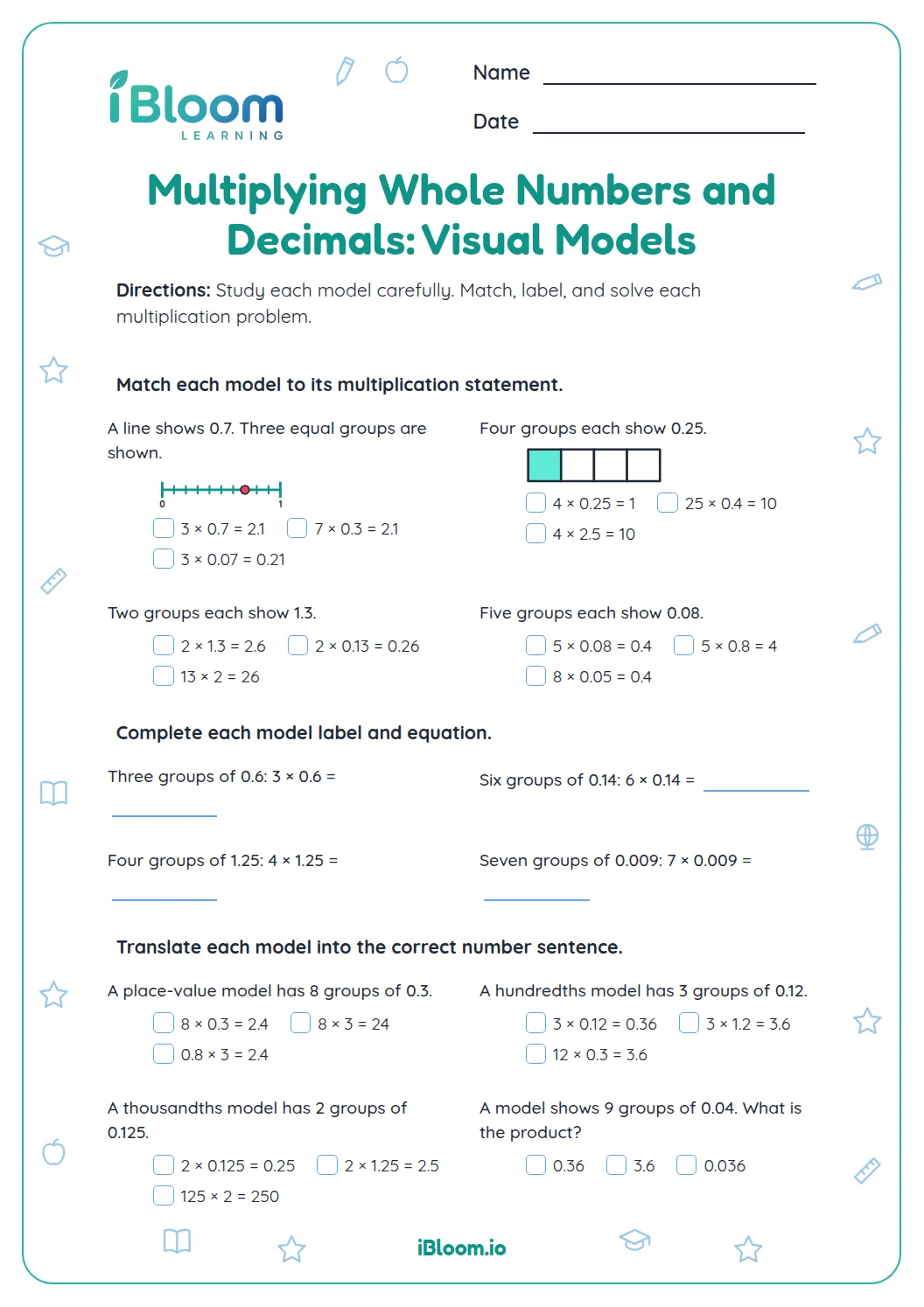
Each strip in questions 1 and 3 is one whole cut into ten tenths. Ten groups of 3 tenths make 30 tenths, and 30 tenths fill exactly 3 whole strips, so 0.3 × 10 = 3. The 10 by 10 grid in question 2 is one whole cut into hundredths, so 100 groups of 7 hundredths fill 7 whole grids.
The number line in question 4 runs from 0 to 1 in jumps of one tenth. Students count six jumps to find 0.6, then multiply it by 100 to get 60.
- 1The grid shows 0.07: 7 small squares out of 100.
- 2100 groups of 0.07 make 700 hundredths.
- 3100 hundredths fill one grid, so 700 hundredths fill 7 grids.
- 40.07 × 100 = 7
- 5Answer: 7 wholes
How do students multiply without a drawing?
Once the models make sense, students apply the shift to numbers alone. Move each digit one place left for every factor of 10, and fill an empty ones or tens place with zero. So 0.5 × 100 moves the 5 two places left, from tenths to tens: 50.
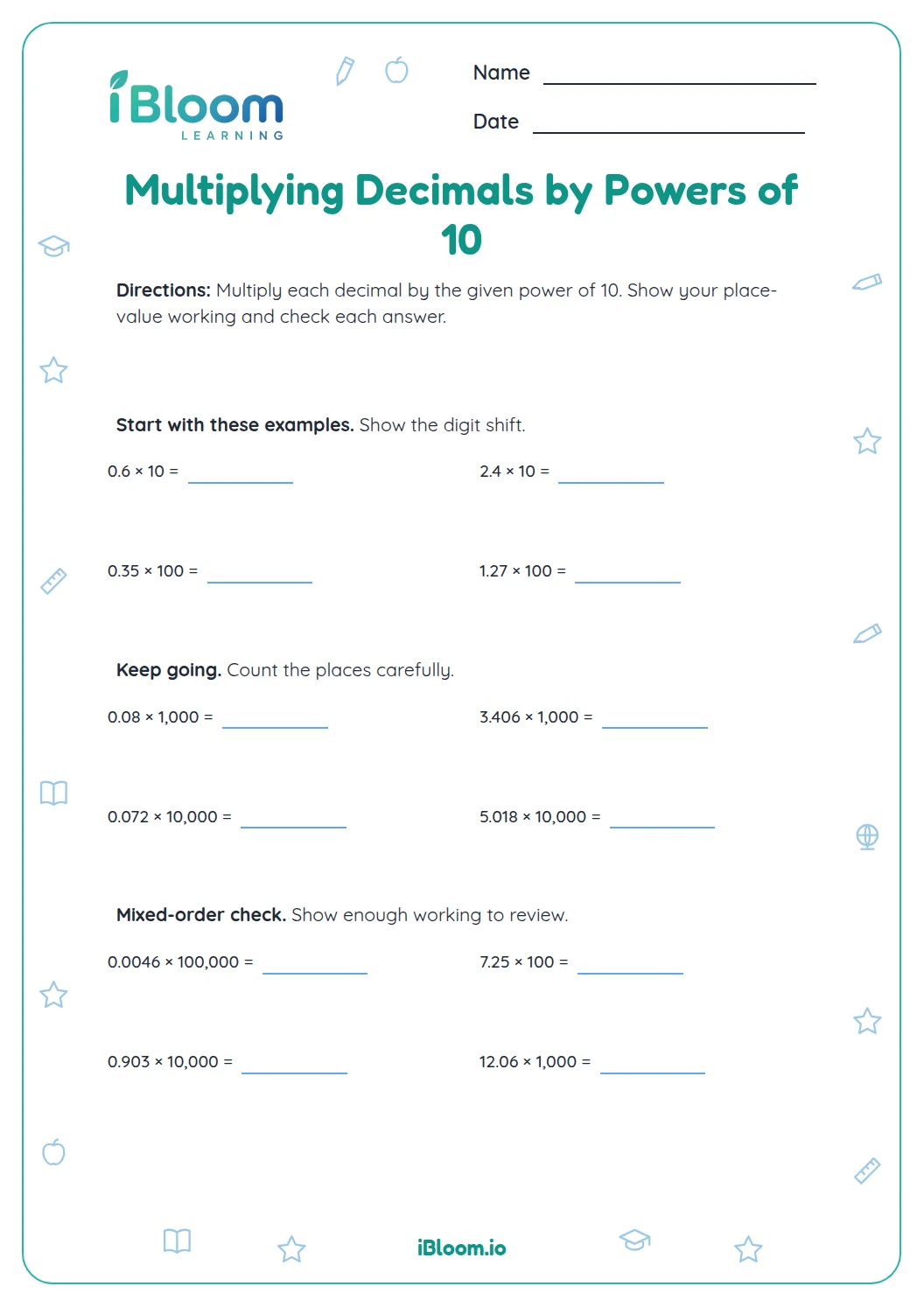
Part B practices four cases: hundredths times 10 (0.38 × 10 = 3.8), tenths times 100 (0.5 × 100 = 50), a number with a whole part (3.08 × 10 = 30.8) and thousandths times 100 (0.064 × 100 = 6.4).
What is on this worksheet?
Ten questions in three parts over two pages, moving from drawings to numbers to stories.
- Part A, Read the model: tenths strips for 0.3 and 1.4, a hundredths grid for 0.07 and a number line from 0 to 1 (questions 1 to 4)
- Part B, Move the decimal point: four decimals to multiply by 10 or 100 (questions 5 to 8)
- Part C, Solve the story: a stack of 100 sheets of paper and 10 bottles of juice, with working space (questions 9 and 10)
- A two-page answer key
How to use this worksheet at home or in class
- 1Start with money: 3 dimes is $0.30, and 10 times as many is $3.00. Ask where the 3 sits in each amount.
- 2Look at the strips in question 1 together. Ask how many tenths are shaded, how many tenths 10 groups make, and how many whole strips that fills.
- 3Let your child finish Part A, saying aloud which place each digit moves from and to.
- 4For question 4, have your child count the jumps from 0 to the dot before multiplying.
- 5In Part B, ask your child to predict whether each answer will be bigger or smaller than the starting number before writing it.
- 6In Part C, ask for an equation first, then the answer with its unit. Check with the answer key and revisit any miss with the strips.
Common mistakes and quick fixes
The mistake
Moving the digits the wrong way, as in 0.3 × 10 = 0.03.
The fix
Multiplying by 10 makes a number bigger, so the answer must be more than 0.3. The 3 moves from tenths to ones: 3.
The mistake
Moving the digits only one place for 100, as in 0.5 × 100 = 5.
The fix
100 is 10 × 10, so move two places, or multiply by 10 twice: 0.5 × 10 = 5, then 5 × 10 = 50.
The mistake
Adding a zero at the end of the decimal, as in 0.38 × 10 = 0.380.
The fix
A zero after the last decimal digit does not change the value: 0.380 is still 0.38. Move the digits instead: 0.38 becomes 3.8.
Common Core alignment
Most US states use the Common Core Math standards or a close state version. The standard below names exactly what this worksheet practices: where the digits and the decimal point land when a decimal is multiplied by 10 or 100.
Explain where the decimal point lands when a decimal is multiplied by 10 or 100.
On this sheet: All three parts: students multiply decimals by 10 and 100 and use models to see where the digits land.
Show the official wordingHide the official wording
Explain patterns in the number of zeros of the product when multiplying a number by powers of 10, and explain patterns in the placement of the decimal point when a decimal is multiplied or divided by a power of 10. Use whole-number exponents to denote powers of 10.
What to practice next
Make more practice
Further reading
Questions parents and teachers ask
What happens to a decimal when you multiply it by 10?
Every digit moves one place to the left, so the number becomes 10 times as large. For example, 0.38 × 10 = 3.8, because 3 tenths become 3 ones and 8 hundredths become 8 tenths. The digits shift; the decimal point just marks where the ones place begins.
What is the difference between multiplying by 10 and by 100?
Multiplying by 100 is multiplying by 10 twice, so the digits move two places left instead of one. For 0.5, times 10 gives 5, and times 10 again gives 50. Count the zeros in the factor: 10 has one zero, 100 has two.
Why is adding a zero not a good rule for decimals?
Adding a zero at the end of a decimal does not change its value: 0.38 and 0.380 are the same number. The "add a zero" shortcut works for whole numbers but fails for decimals. Moving the digits to higher places is the idea that always works.
What are the answers to Parts C and D?
The Part B answers are 3.8, 50, 30.8 and 6.4. In Part C, 100 sheets of paper 0.1 mm thick make a stack 10 mm thick, and 10 bottles of 1.25 L hold 12.5 L of juice. The answer key lists all ten answers, including the four model questions in Part A.
Why does this worksheet use strips, a grid and a number line?
Each shows the same idea in a different way. The strips show tenths, the 10 by 10 grid shows hundredths, and the number line shows tenths as jumps. Seeing 30 tenths fill exactly 3 whole strips makes 0.3 × 10 = 3 something students can check, not just a rule to memorize.
How long does it take, and is there an answer key?
Most Grade 6 students need about 15 minutes. Yes, a two-page answer key follows the worksheet, so you can print the two worksheet pages alone and keep the key for checking afterward. The two stories in Part C have working space for an equation.