




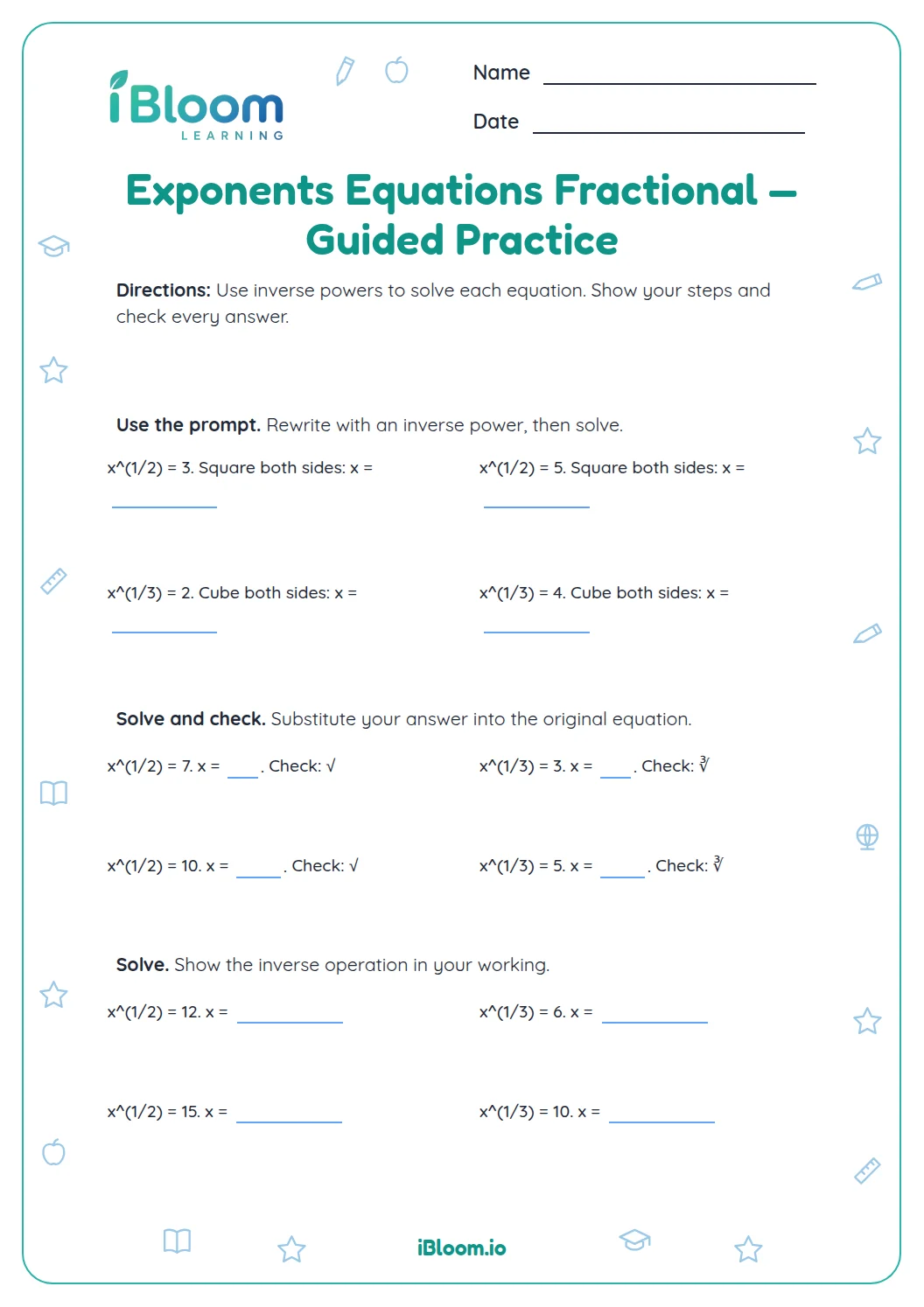
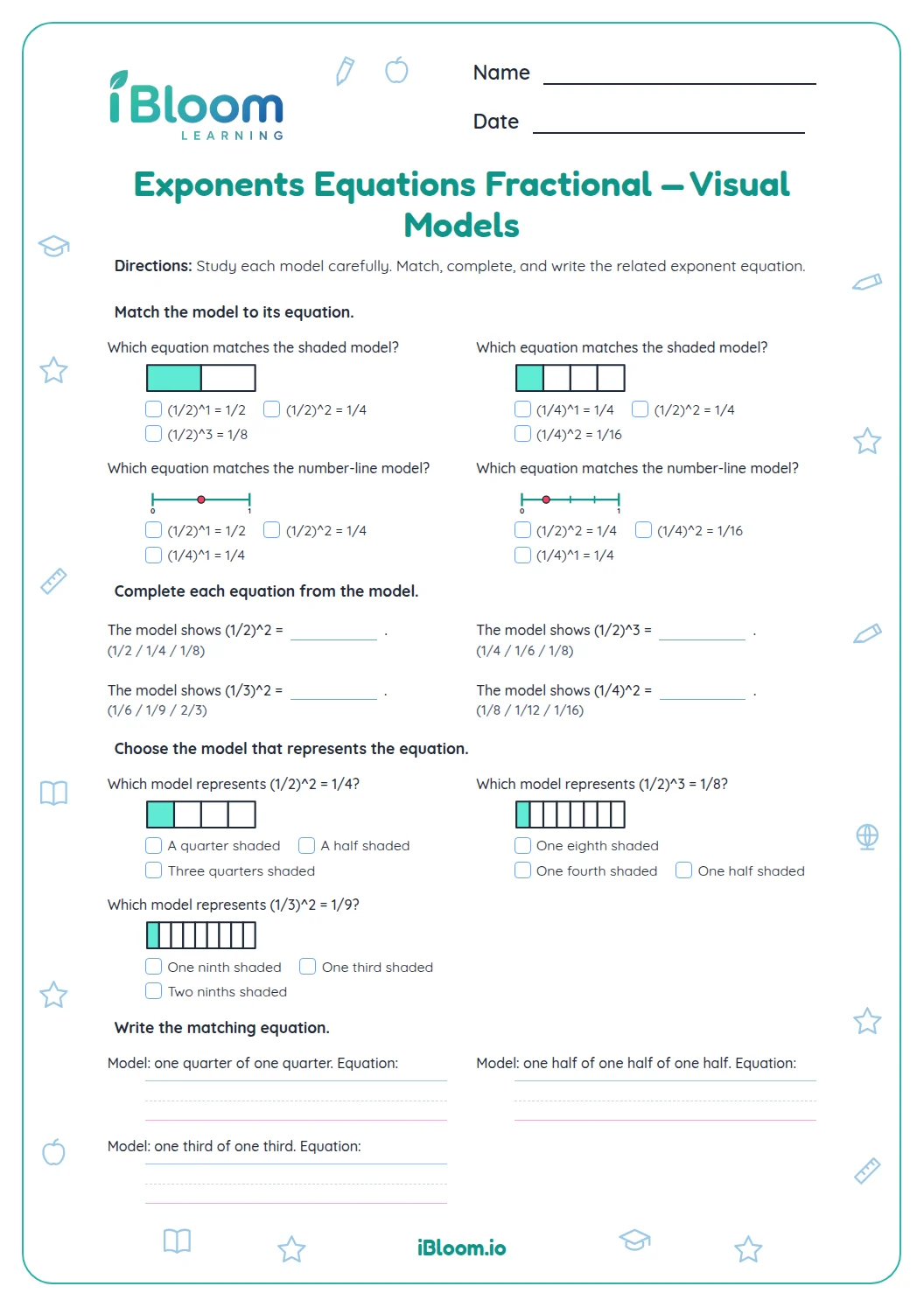
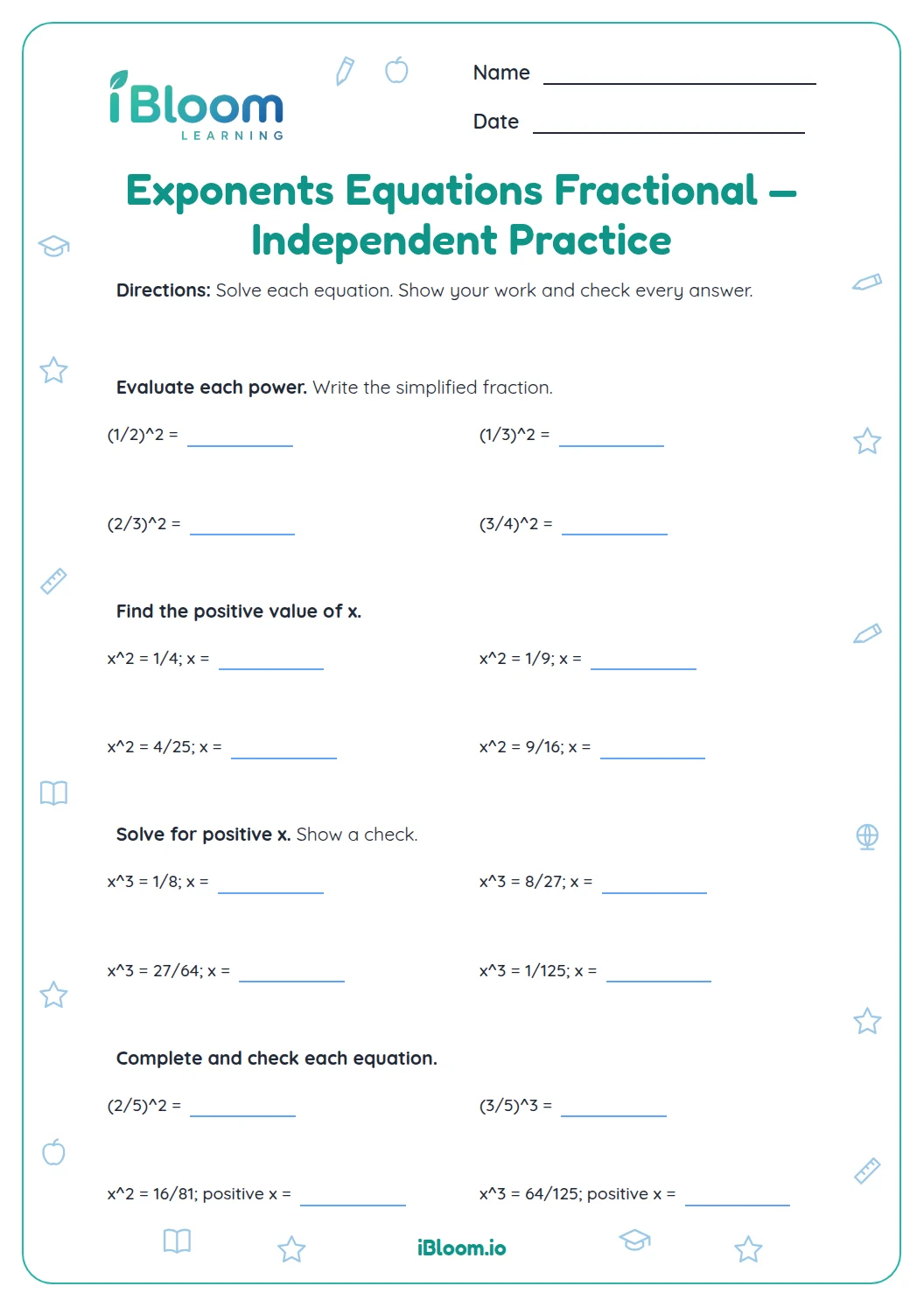
About this worksheet
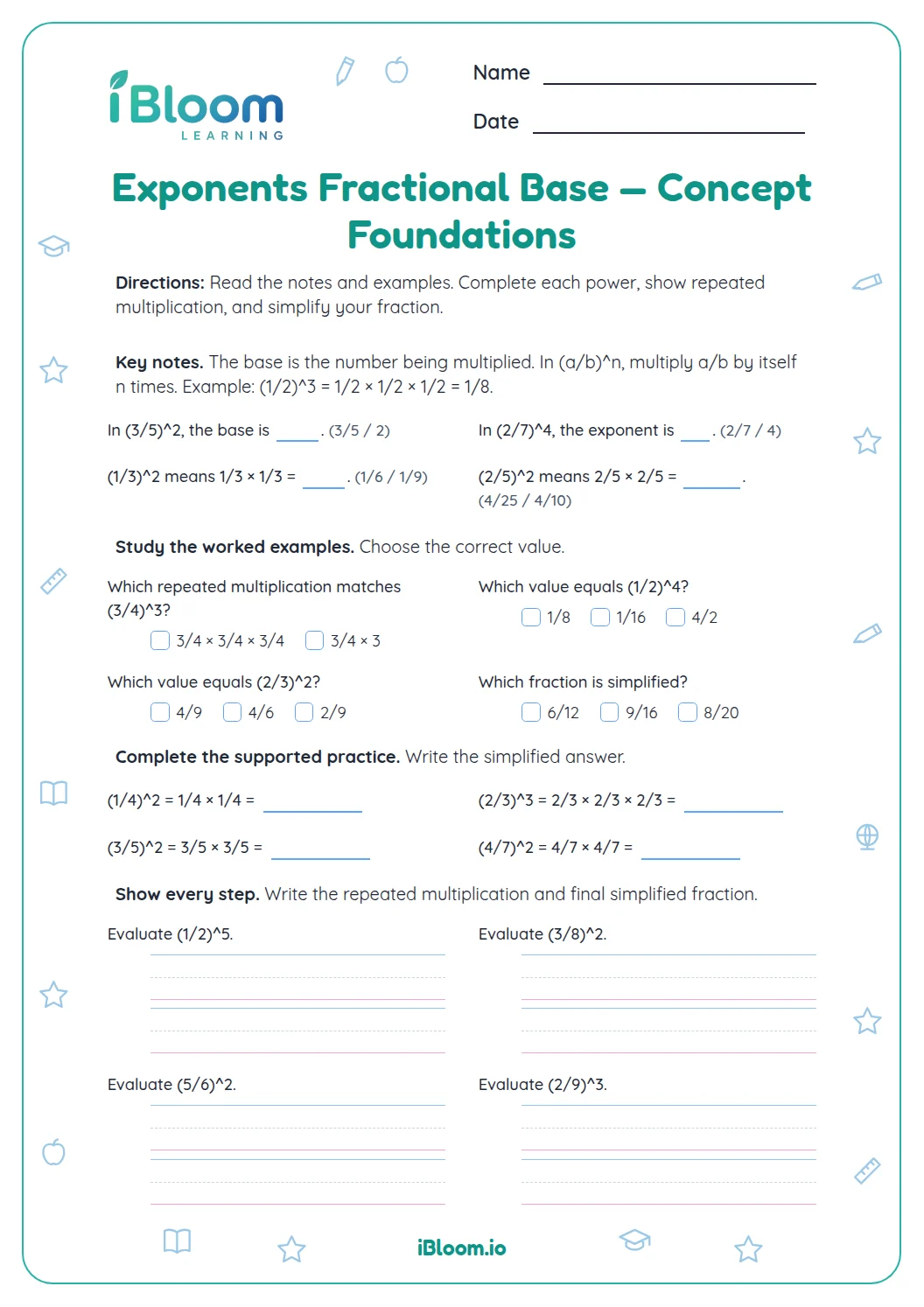
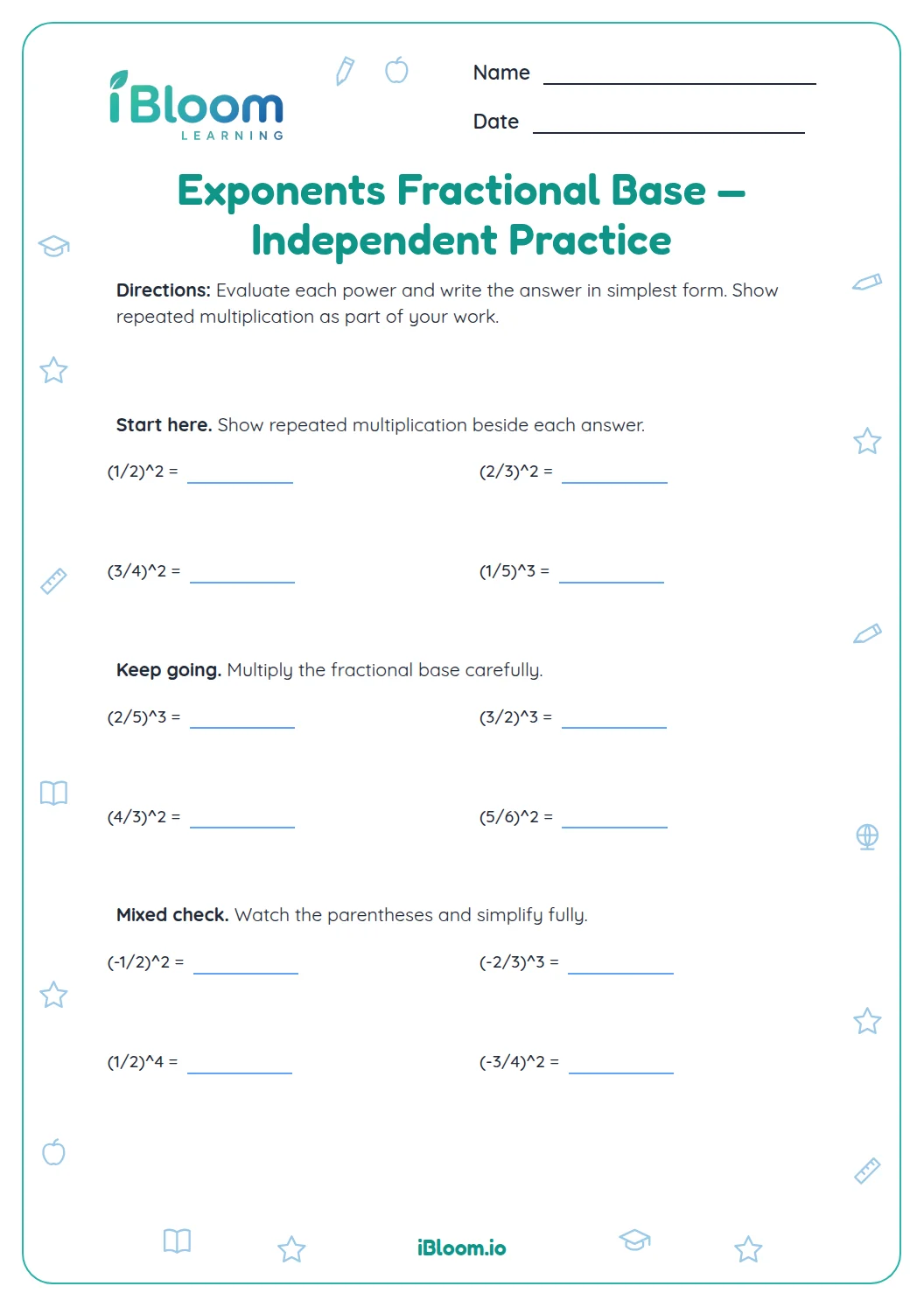
This free Grade 6 math worksheet focuses on whole-number exponents with fractional bases. Students match powers to values, compare powers of unit fractions, evaluate squares and higher powers, write repeated factors, and explain an error in squaring a fraction. Its 14 questions revisit the error-correction and evaluation approach of the original sheet across two parts, with a separate key. The work practices CCSS.Math.Content.6.EE.A.1.
Aligned to CCSS.Math.Content.6.EE.A.1
Which power matches the value?
Expand the power into equal factors, then multiply the numerators and denominators.
- 1(2/3)³ = (2/3) × (2/3) × (2/3).
- 2The numerator product is 8 and the denominator product is 27, so the value is 8/27.
How do you evaluate a fractional-base power?
Apply the exponent to the whole fraction: repeat the numerator and denominator the same number of times. For example, (3/5)² = 9/25.
How can you check an exponent error?
Check both factors in the denominator. In question 14, 7 × 7 makes 49; 14 would come from multiplying 7 by 2.
How to use this worksheet
- 1Read the base as one fraction and the exponent as its number of repeated factors.
- 2Write a power as repeated multiplication before calculating when needed.
- 3Multiply numerators together and denominators together.
- 4For unit fractions, compare the values after adding another factor.
- 5Check the key and explain why the denominator in the final item must be squared.
Common mistakes and quick fixes
The mistake
Squaring only the numerator, as in (2/5)² = 4/10.
The fix
Square the numerator and denominator: 2 × 2 over 5 × 5 gives 4/25.
The mistake
Treating the exponent as a number to multiply by the base.
The fix
Expand the power into the stated number of equal factors.
The mistake
Assuming a larger exponent makes a fraction between 0 and 1 larger.
The fix
Evaluate the products; extra factors below 1 make the product smaller.
Students write and evaluate expressions with whole-number exponents and fractional bases.
Write and evaluate powers with whole-number exponents and fractional bases.
On this sheet:
Show the official wordingHide the official wording
Write and evaluate numerical expressions involving whole-number exponents.
What to practice next
Make more practice
Further reading
Questions parents and teachers ask
What does an exponent mean with a fractional base?
The exponent tells how many equal copies of the fraction to multiply. For example, (2/3)³ means 2/3 × 2/3 × 2/3, which equals 8/27. Students use this idea to evaluate powers and connect a product to its exponent form.
Why is (2/5)² equal to 4/25?
Squaring the fraction means multiplying the whole fraction by itself: (2/5) × (2/5). Multiply numerators together and denominators together, giving 4/25. The answer 4/10 comes from multiplying across the fraction rather than using two equal factors. The denominator must also be multiplied by itself to match the squared numerator.
How do powers of one-half compare?
A unit fraction such as 1/2 gets smaller when it is multiplied by itself again: (1/2)² is 1/4, while (1/2)³ is 1/8. The comparison item asks students to reason about the repeated factors, not just compare the exponents.
What answer formats appear on this worksheet?
Items ask for a matching power, an error explanation, a simplified fraction, or a missing numerator or denominator. The key shows each expected response. For repeated multiplication, equivalent formatting is fine as long as all factors are present and the base is repeated the correct number of times.
How can an adult support this practice?
Ask the student to read a power aloud as repeated multiplication before calculating. Then have them square the numerator and denominator separately and check the result. The 14 questions are arranged across two worksheet pages, with a matching two-page key.