


About this worksheet
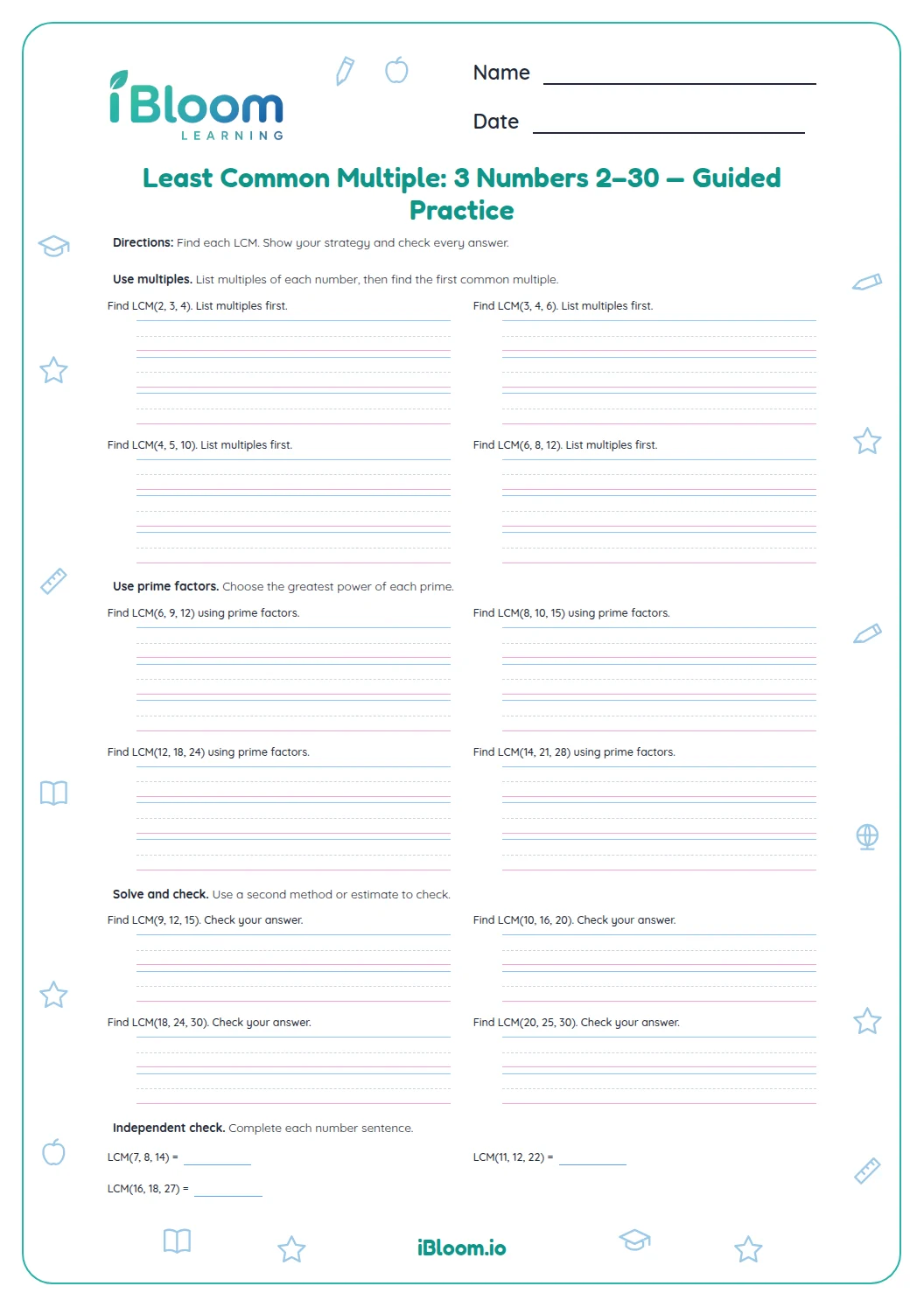
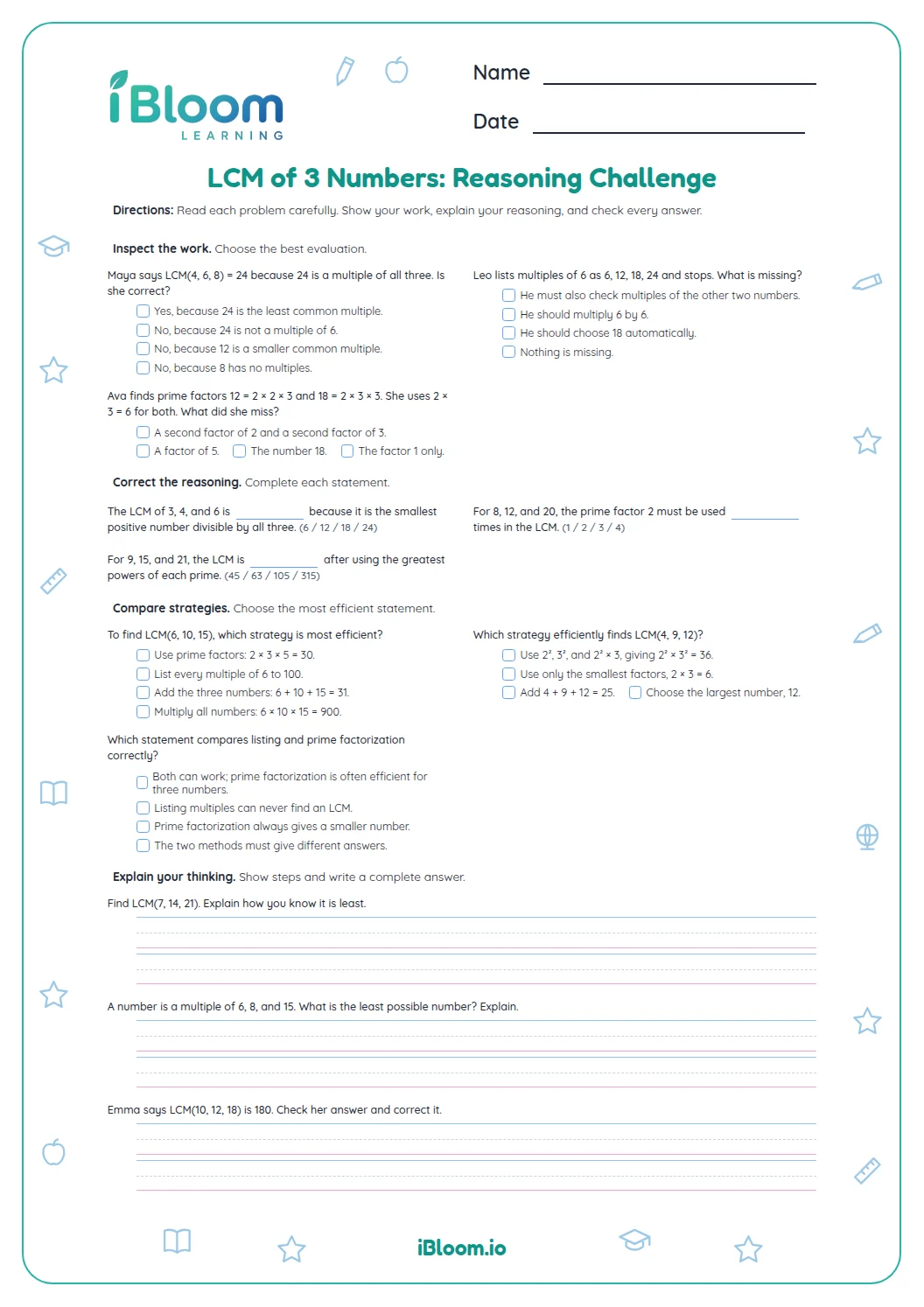
Compare multiples to find the least common multiple of each triple. Two number-line models introduce the idea, followed by 13 concise multiple-choice questions using triples from 2 to 30. A separate answer key is included.
How do you find a three-number LCM?
List positive multiples of each number and find the first value that appears in all three lists. For 4, 6, and 8, that first shared value is 24.
How do the number lines help?
Marking multiples on one line makes shared values easy to compare. Choose the earliest positive point common to all three patterns, not a later match.
What is on this worksheet?
The sheet has 15 multiple-choice questions on triples from 2 to 30. Two number-line models introduce the search; the remaining questions use compact choices. The answer key lists each LCM.
How to use this worksheet
- 1Read the three numbers named in the question.
- 2Compare the matching multiples in all three table columns.
- 3Find a value that appears in every column.
- 4Choose the first shared positive value, not a later common multiple.
- 5Check your choice with the answer key.
Common mistakes and quick fixes
The mistake
Choosing a multiple shared by only two of the three numbers.
The fix
Check the candidate in every column before recording it.
The mistake
Stopping at a shared value even though a smaller positive one appears above it.
The fix
Scan the lists from the top and select their first shared positive value.
The mistake
Using zero as the least common multiple.
The fix
LCM means least positive common multiple, so begin with positive multiples.
What to practice next
Make more practice
Questions parents and teachers ask
How does a multiples table help?
A least common multiple is the smallest positive whole number that is a multiple of every number in the set. In the table for 4, 6, and 8, the first value shared by all three columns is 24. The smallest positive value matters because later matches are common multiples, but not the least one.
Can zero be the least common multiple?
No. LCM means the least positive common multiple. Begin with the first positive multiple in each column and compare those values. Zero is shared by every list but does not count as the LCM. Start comparing the positive values in the table.
What does LCM(4, 6, 8) mean?
It asks for the smallest positive whole number divisible by 4, 6, and 8. Their multiples first meet at 24, so the answer is 24. For 4, 6, and 8, the columns first share 24. Checking 12 fails because 12 is not in the multiples-of-8 column.
Why are there three columns?
Each question has three input numbers. One column tracks the multiples of each input, so the common value must occur in all three patterns. Use all three columns when checking a candidate. A value appearing in only two columns is not common to the full set.
Does the answer key show the result?
Yes. The key lists the LCM for each of the 15 triples, so students can check the first shared positive multiple they found. The answer key gives one LCM per triple. Compare your chosen value with all three lists before checking the key.