








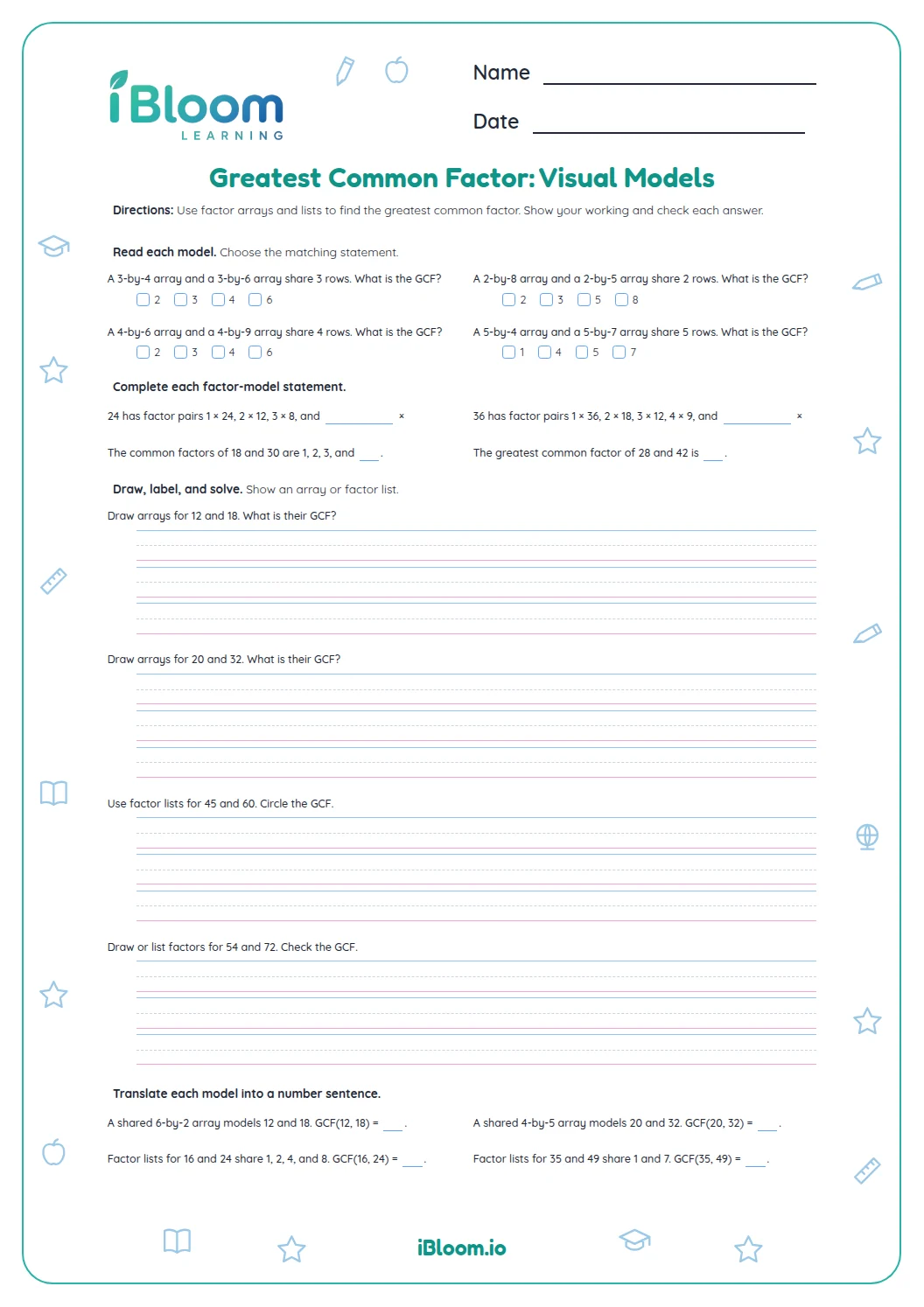

About this worksheet
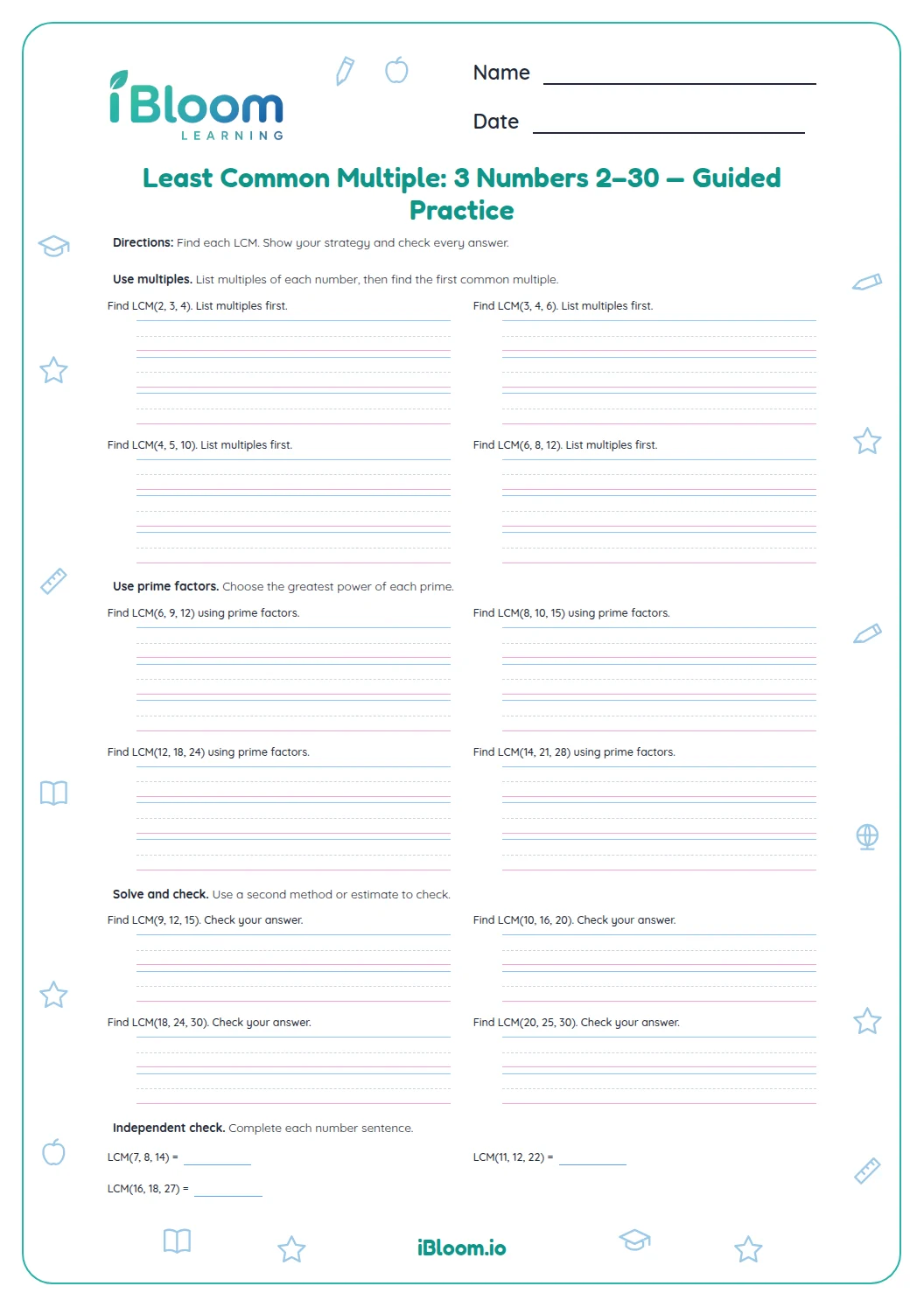
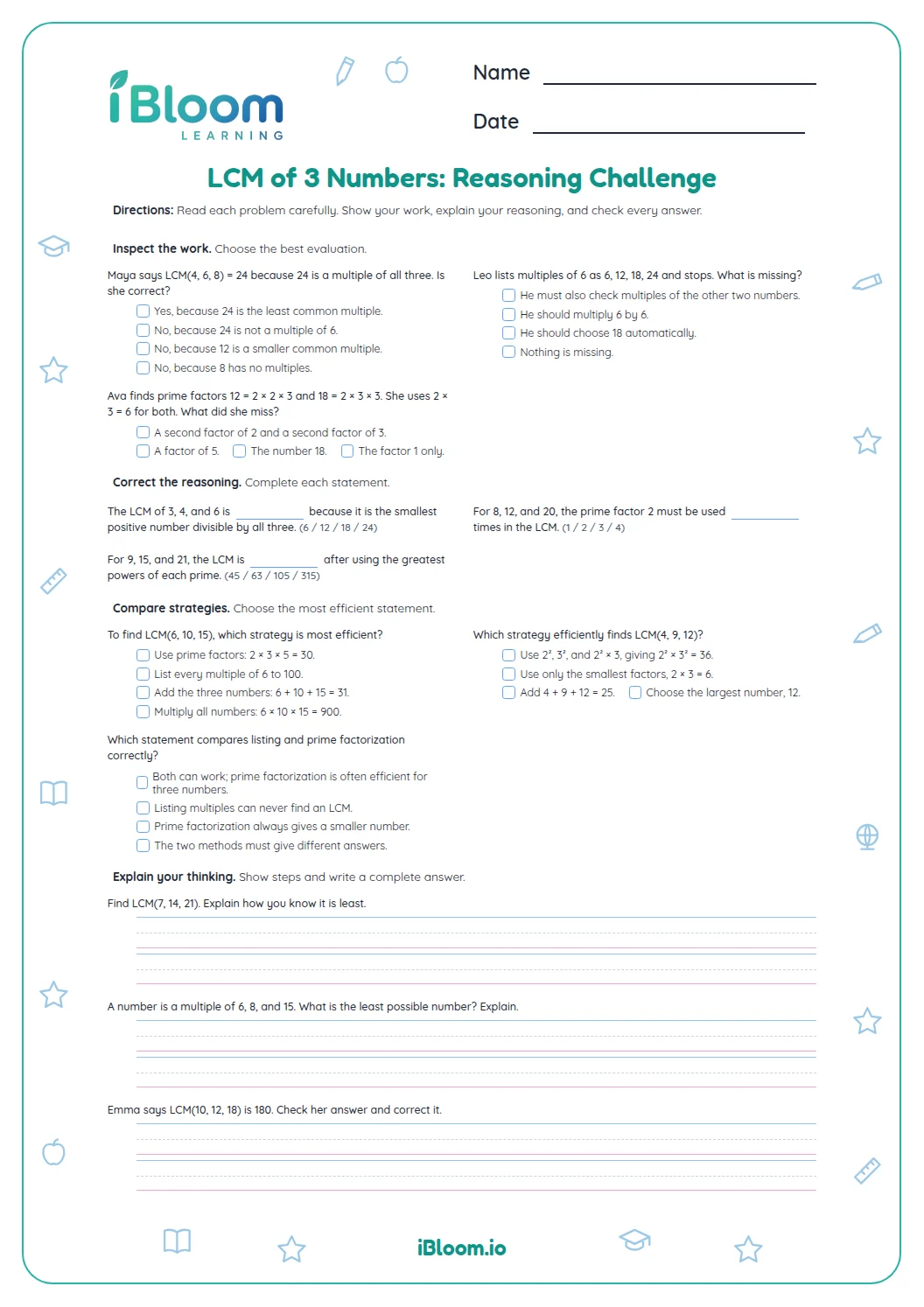
This Grade 6 worksheet gives students 14 questions about finding the least common multiple of three numbers. It moves from identifying multiples and LCMs to repeating-event stories about bells, shuttles, plant care, lights, routes, and schedules. Students find the first time all three cycles meet and include the unit named in each story. A separate answer key lists a checked answer for every question.
What does this worksheet ask students to solve?
Fourteen questions build from recognizing multiples and least common multiples to solving repeating-event stories. Each story asks when three cycles first meet again.
- Questions 1–4: identify a multiple or least common multiple
- Questions 5–11: find shared cycle times in short stories
- Questions 12–14: find least common multiples without a story
How can a student check an LCM?
Check that the answer divides evenly by all three starting numbers. Then make sure no smaller positive number is shared. For a story, add the unit named in the prompt.
- 1Question 5: bells ring every 2, 3, and 5 minutes.
- 230 is divisible by 2, 3, and 5, and no smaller positive number is shared.
- 3The bells ring together after 30 minutes.
How to use this worksheet
- 1Read the three repeating intervals.
- 2Write multiples or factor each interval.
- 3Find the smallest positive number shared by all three.
- 4Check divisibility by each interval.
- 5Write the answer with the story’s unit.
Common mistakes and quick fixes
The mistake
Stopping at a number divisible by only two intervals.
The fix
Check the candidate against all three numbers.
The mistake
Choosing a shared multiple that is not the least.
The fix
Check earlier multiples before settling on the answer.
The mistake
Leaving off minutes or days.
The fix
Carry the unit from the story into the answer.
What to practice next
Make more practice
Questions parents and teachers ask
How do I find when three repeating events happen together?
List or build multiples for each interval until you find the first number that appears in all three lists. That first shared number is the least common multiple. For example, the bells that ring every 2, 3, and 5 minutes next ring together after 30 minutes.
What does “least” mean in least common multiple?
A common multiple is divisible by each given number. The least common multiple is the smallest positive one, so it describes the first time cycles meet. A later shared time is also a common multiple, but it does not answer when the events first happen together.
Does the answer need a unit?
Yes. The number tells how many units pass, so keep the unit from the story: minutes, seconds, days, or school days. The answer key includes the unit for every story problem, which makes it easier to see whether the result fits the situation.
Why do some story answers get large?
Three cycles may take a while to line up. For example, the first number divisible by 9, 12, and 15 is 180. Checking that 180 divides evenly by each interval confirms the shared time, while checking smaller shared candidates helps confirm it is the least one.
What is included in the answer key?
The key gives the shared time or LCM for all 14 questions. For story problems, it includes the unit so a student can compare the answer with the wording of the situation. Students can also show their own multiple lists or prime-factor work in the worksheet space.