Free printable practice
Factoring 0 100 Into Prime Factors Practice Activities
Grade 6 students factor numbers up to 100 into prime factors using factor pairs, divisibility, and factor trees.
Free printable worksheet PDFs
Preview every available page, then download the free worksheet PDF for home, homeschool, tutoring, or classroom practice.
Preview the exact activity before downloading it.
 Factoring 0–100 Into Prime Factors — Concept FoundationsGrade 6 students factor numbers up to 100 into prime factors using factor pairs, divisibility, and factor trees. This Grade 6 foundations worksheet adds concise teaching notes, worked examples, and supported first attempts.Grade 6Free PDF preview
 Factoring 0–100 Into Prime Factors — Guided PracticeGrade 6 students factor numbers up to 100 into prime factors using factor pairs, divisibility, and factor trees. This Grade 6 guided-practice worksheet progresses from prompts and checkpoints to independent questions.Grade 6Free PDF preview4 pages
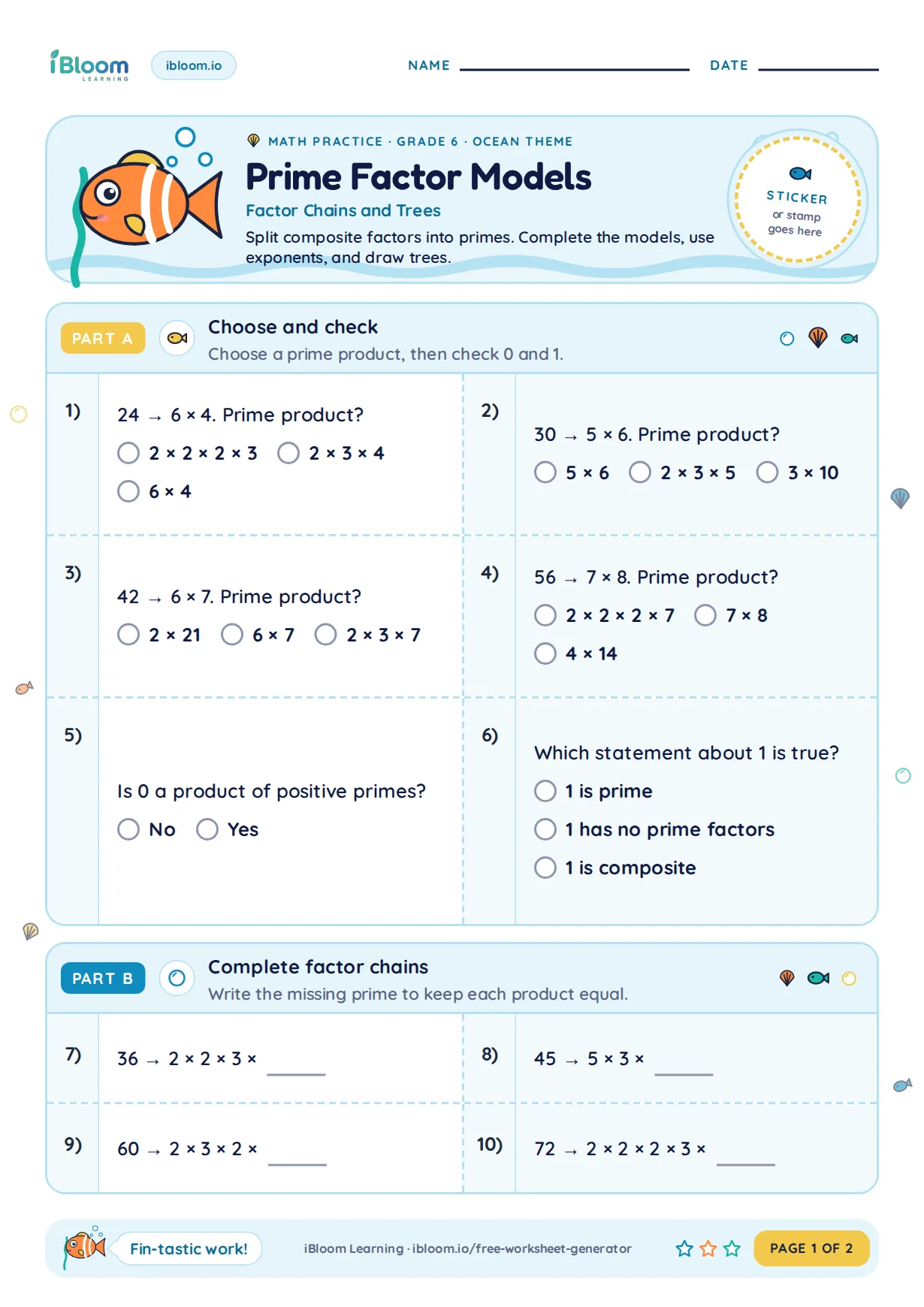 Factoring 0–100 Into Prime Factors — Visual ModelsGrade 6 students factor numbers up to 100 into prime factors using factor pairs, divisibility, and factor trees. This Grade 6 visual-model worksheet connects suitable diagrams, tables, number lines, or place-value models to mathematical notation.Grade 6Free PDF preview
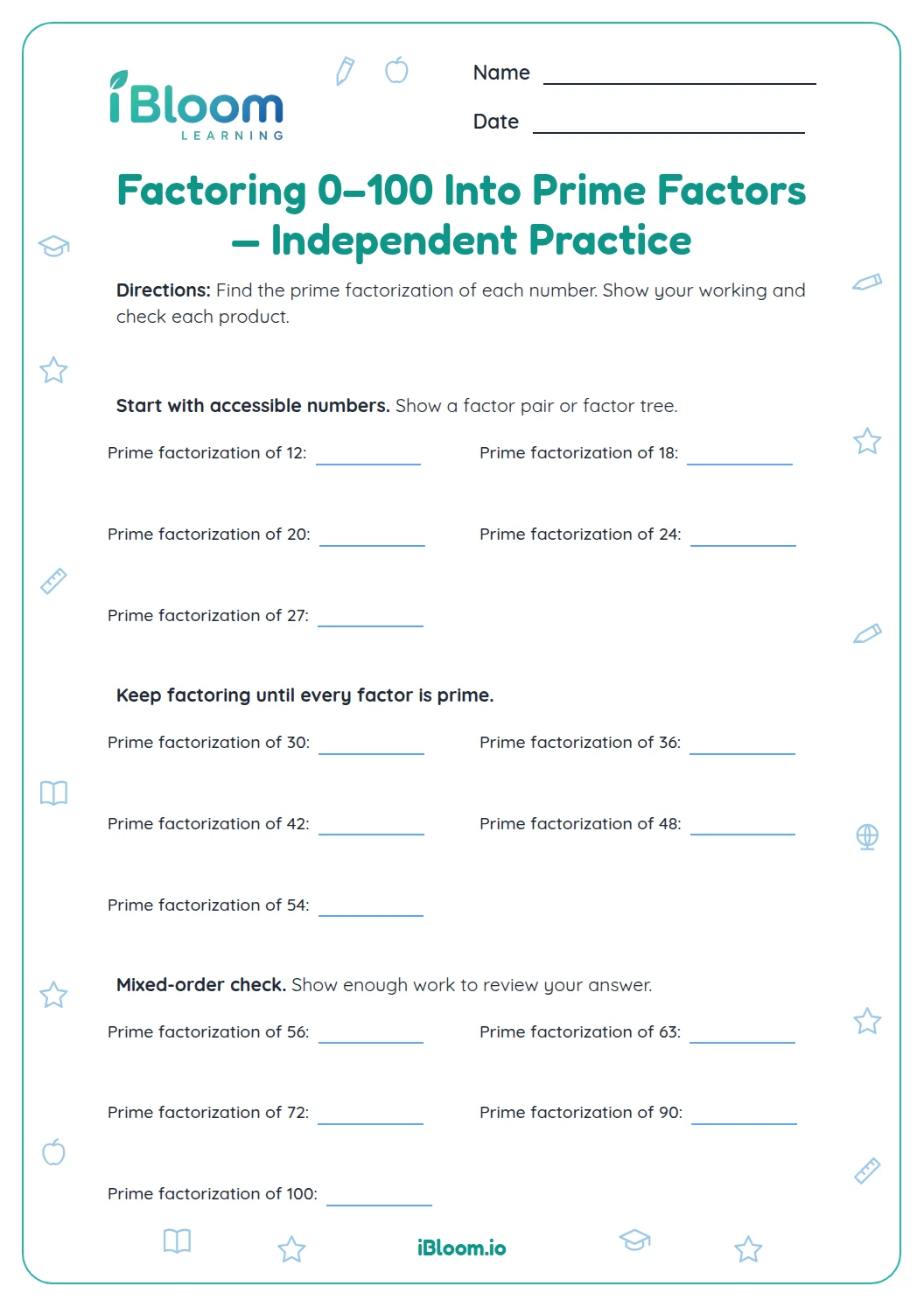 Factoring 0–100 Into Prime Factors — Independent PracticeGrade 6 students factor numbers up to 100 into prime factors using factor pairs, divisibility, and factor trees. This Grade 6 independent-practice worksheet provides a balanced sequence of accurate, grade-level exercises.Grade 6Free PDF preview
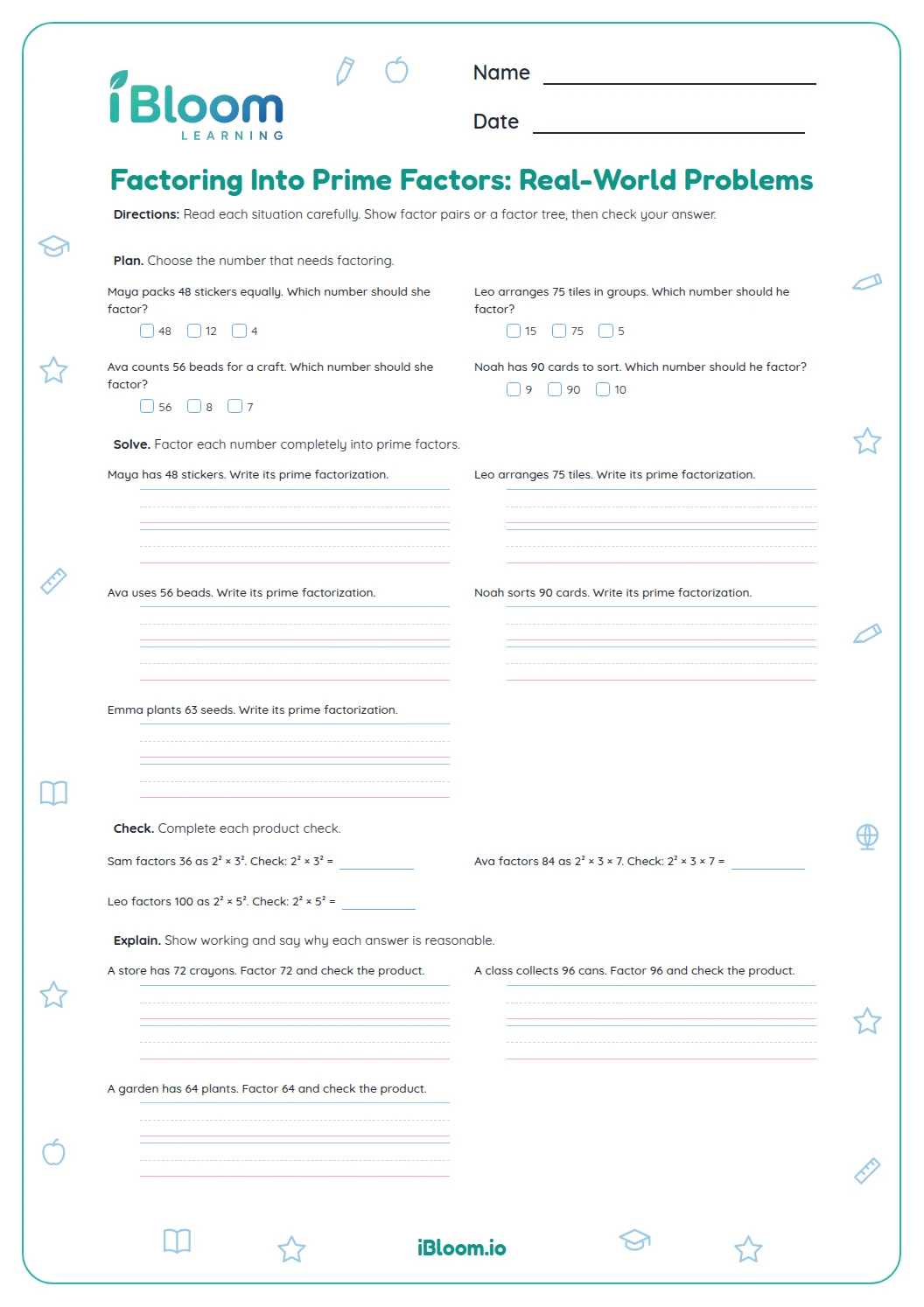 Factoring 0–100 Into Prime Factors — Real-World ProblemsGrade 6 students factor numbers up to 100 into prime factors using factor pairs, divisibility, and factor trees. This Grade 6 application worksheet uses realistic one-step and multi-step situations with room to model and solve.Grade 6Free PDF preview4 pages
 Factoring 0–100 Into Prime Factors — Reasoning ChallengeGrade 6 students factor numbers up to 100 into prime factors using factor pairs, divisibility, and factor trees. This Grade 6 reasoning worksheet combines error analysis, strategy comparison, missing information, and a gentle extension.Grade 6Free PDF preview
Practice that builds confidence
What prime factorization shows
These Grade 6 factoring worksheets help students break numbers from 0 to 100 into prime factors. Learners use factor pairs, divisibility tests, and factor trees to show how composite numbers are built from primes.
The activities also reinforce that prime factorization applies to whole numbers greater than 1, while 0 and 1 need special attention because they do not have prime factorizations.
Prime factorization expresses a composite number as a product of prime numbers. For example, 60 can be written as 2 × 2 × 3 × 5. This helps students see the structure of numbers rather than treating factors as a memorized list.

Working within 0 to 100
Numbers in this range are large enough to include many useful patterns but small enough for careful reasoning. Students may meet primes, composites, square numbers, and numbers with repeated prime factors. They should also learn that 0 has infinitely many factor pairs and 1 is neither prime nor composite, so neither has a prime factorization.
Methods students practise
A factor tree begins with any factor pair, such as 84 = 7 × 12 or 84 = 6 × 14. Different trees should end with the same prime factors: 2 × 2 × 3 × 7. Students can also divide by the smallest prime possible, using divisibility rules for 2, 3, 5, and other primes when helpful.
A parent routine at home
Pick one number under 100 each day. Ask your child to name a factor pair, split any composite factors again, and stop only when every factor is prime. Then have them multiply the prime factors back together to prove the answer. This check builds accuracy and confidence.

Classroom uses for teachers
Teachers can use these worksheets for guided practice, partner comparison of different factor trees, or preparation for work with greatest common factor, least common multiple, fractions, and exponents. Students can also sort numbers into prime, composite, and special cases.

Free printable PDF download
Use this Grade 6 prime factorization worksheets 0 to 100 page to preview the activity, print it, or download it as a PDF for quick practice. It works well for homework, homeschool lessons, tutoring, morning work, revision, and classroom centers.
Answers and answer key support
After the child completes the worksheet independently, parents and teachers can use the answer support or answer key information to check the work, review mistakes, and choose the next practice step.
Why iBloom worksheets help
The practice balances procedure and understanding. Common errors include stopping at a composite factor, listing factors instead of prime factors, or treating 1 as prime. A child-friendly strategy is: Split, test, circle primes, and multiply back to check.
Helpful answers
Frequently asked questions
Do 0 and 1 have prime factorizations?
No. Prime factorization is used for whole numbers greater than 1. Zero and one are special cases and should not be written as products of prime factors.
Does it matter which factor pair starts a factor tree?
No. Different starting factor pairs can be used, but a correct factor tree for the same number will end with the same prime factors.
How can students check a prime factorization?
They should multiply all the prime factors together. If the product equals the original number, and every factor is prime, the factorization is correct.
What is a common mistake in prime factorization?
A common mistake is stopping too early, such as writing 36 as 4 × 9 instead of continuing to 2 × 2 × 3 × 3.
How does this skill help later math?
Prime factorization supports greatest common factor, least common multiple, fraction simplification, and understanding powers and exponents.
Is this Grade 6 prime factorization worksheets 0 to 100 free?
Yes. You can preview it for free and use the printable worksheet for home or classroom practice.
Can I download this Grade 6 prime factorization worksheets 0 to 100 as a PDF?
Yes. Use the worksheet download option to save a printable PDF, or print the worksheet directly from the page.
Does this Grade 6 prime factorization worksheets 0 to 100 include answers or an answer key?
When the activity has fixed answers, iBloom includes answer support so parents and teachers can check the completed worksheet.