







About this worksheet
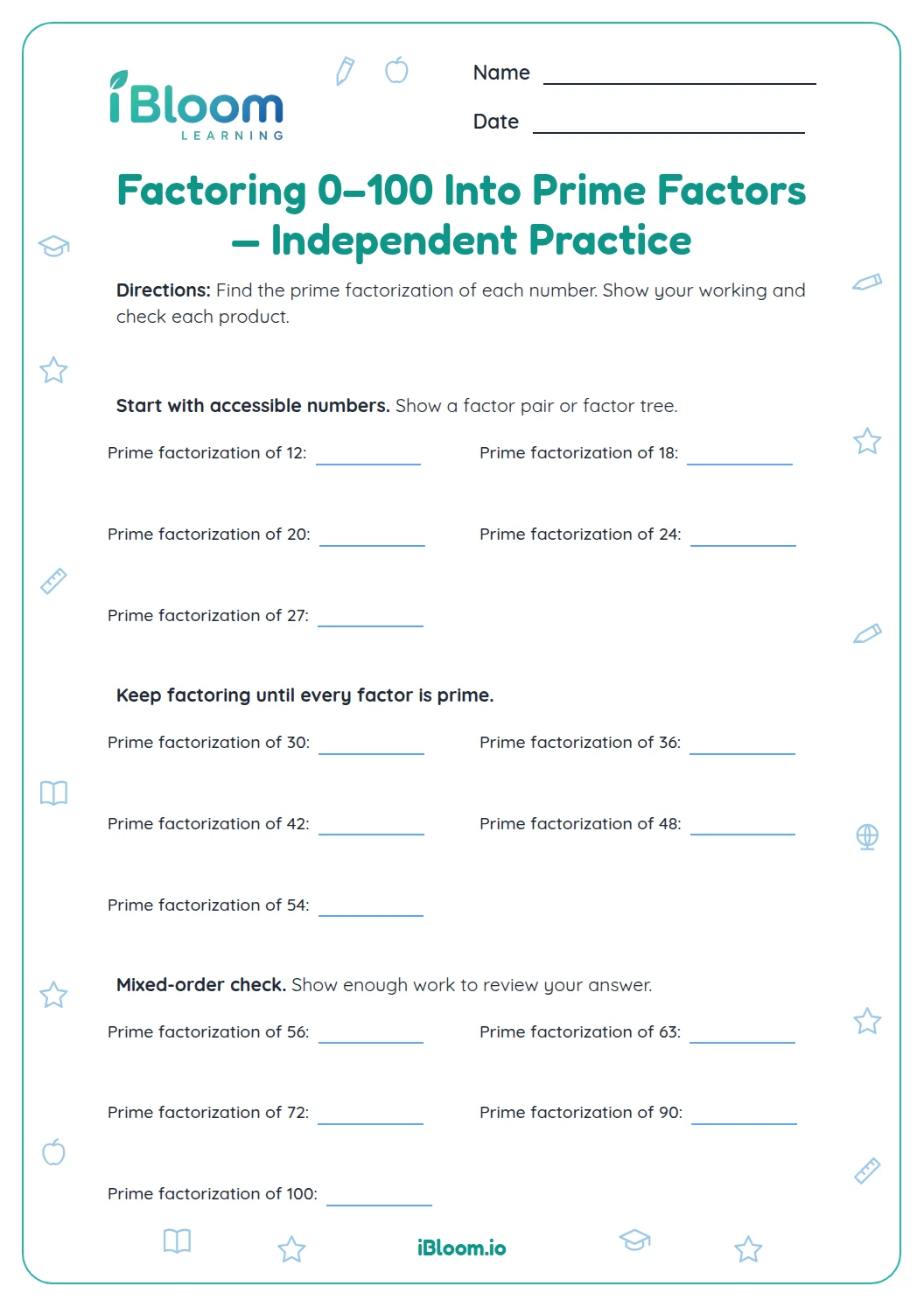
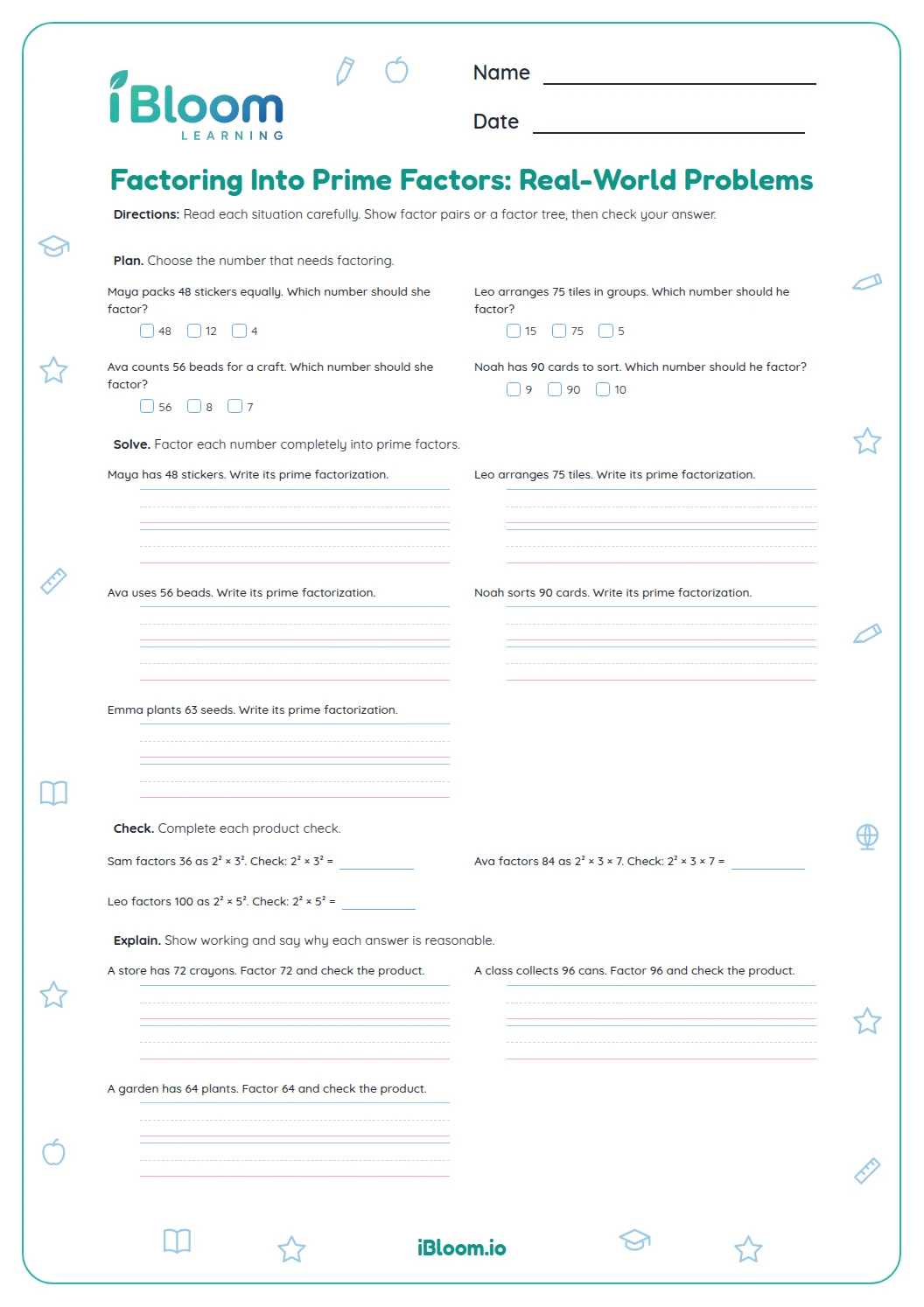
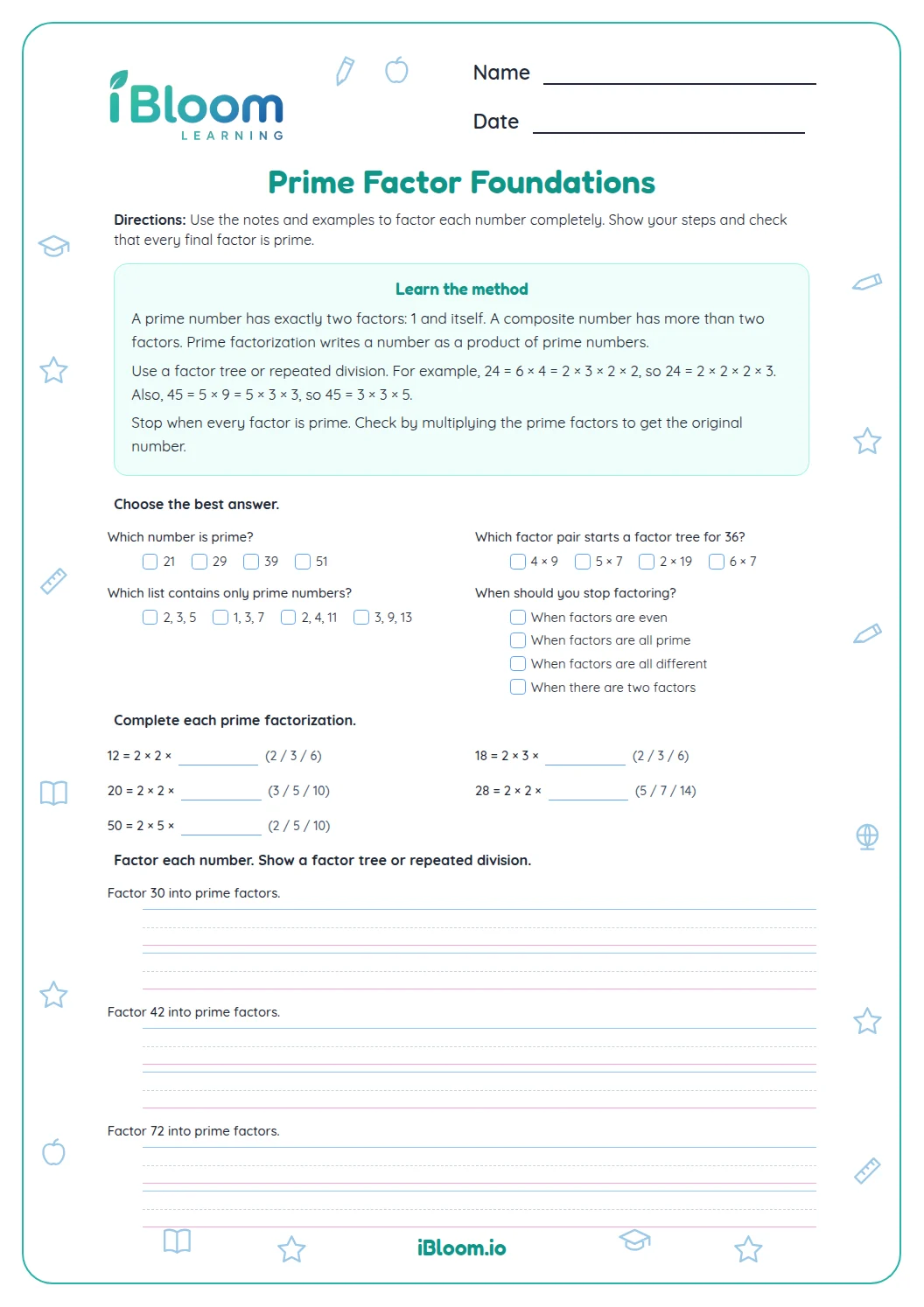
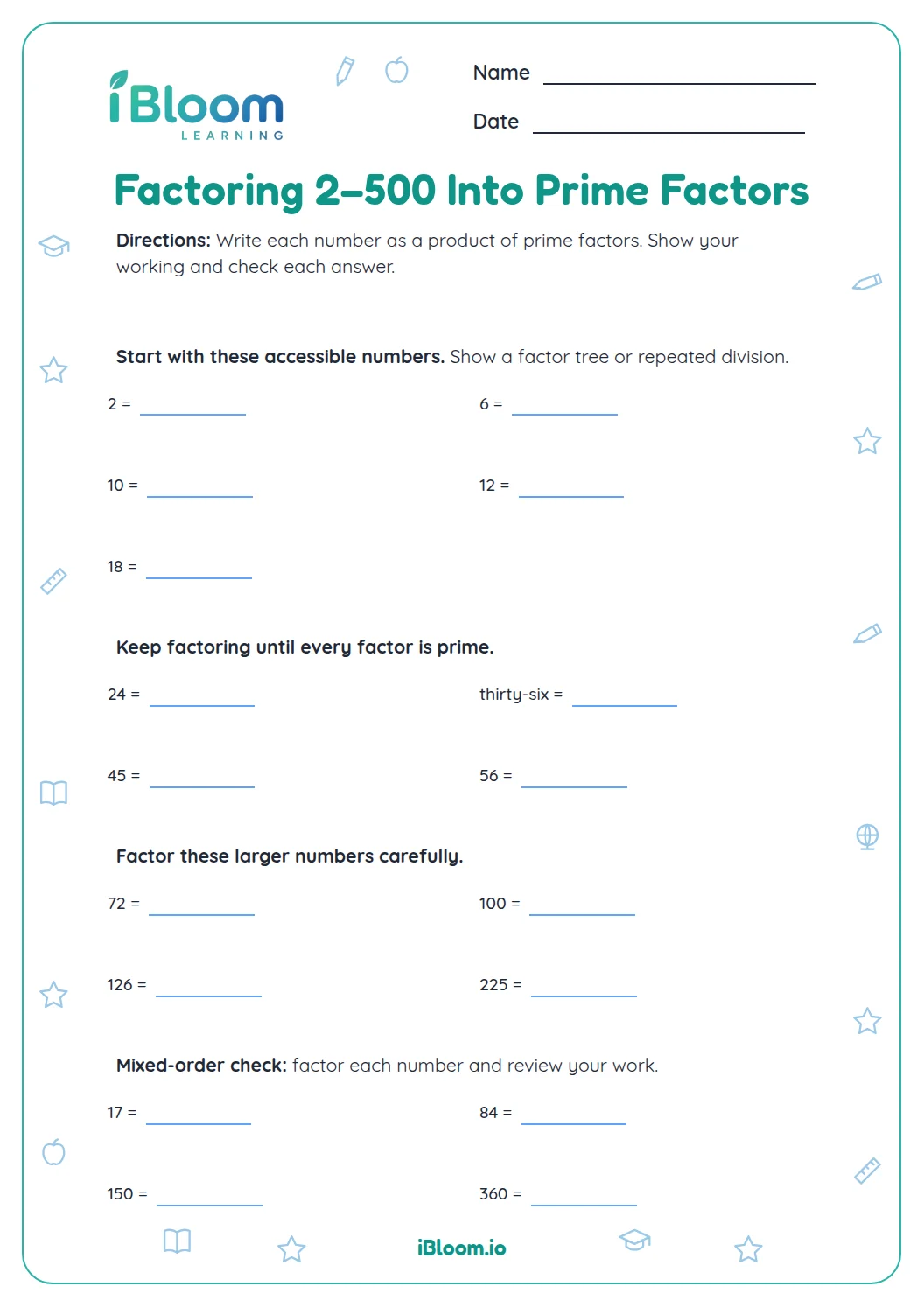
This free printable Grade 6 worksheet offers 14 questions on factoring whole numbers from 1 to 100 into primes. Learners write complete prime factorizations, recognize when a factor is still composite, identify prime and composite numbers, and rebuild numbers from their prime factors. The work supports reasoning with common factors in CCSS 6.NS.B.4. A separate answer key is included.
Aligned to 6.NS.B.4
How do you build a prime factorization?
Keep splitting a composite number into factors until every factor is prime. For 24, one path is 24 = 4 × 6, then 2 × 2 × 2 × 3.
Question 1 asks for 24. Check that multiplying the primes gives 24 and that none of them can be split further.
- 124 = 4 × 6
- 24 = 2 × 2 and 6 = 2 × 3
- 324 = 2 × 2 × 2 × 3
How can you tell when the factorization is complete?
A factorization is complete when every factor is prime. The choice 2 × 3 × 10 is unfinished because 10 is composite; split it into 2 × 5. The number 1 is a special case: it has no prime factors. A prime number, such as 97, is its own prime factorization.
What reasoning does this challenge include?
Learners test prime and composite numbers, reverse a product to find its number, and explain why a composite factor must be split again. All question values stay within 1 to 100.
How to use this worksheet at home or in class
- 1Choose a factor pair for the number.
- 2Keep splitting any composite factor.
- 3Write all prime factors as a product.
- 4Multiply to verify the original number.
- 5For a prime number, write the number itself.
- 6For 1, remember that it has no prime factors.
Common mistakes and quick fixes
The mistake
Stopping when one factor is still composite.
The fix
Test each factor for divisors other than 1 and itself.
The mistake
Listing a factor pair but calling it prime factorization.
The fix
Continue until every factor is prime.
The mistake
Treating 1 as prime.
The fix
Remember that prime numbers have exactly two positive factors; 1 has only one.
Common Core alignment
This worksheet practices the Common Core skill named below.
Use prime factors to reason about whole numbers up to 100.
On this sheet: One item uses shared prime factors to find a GCF, alongside complete factorizations and prime/composite reasoning.
Show the official wordingHide the official wording
Find the greatest common factor of two whole numbers less than or equal to 100 and the least common multiple of two whole numbers less than or equal to 12. Use the distributive property to express a sum of two whole numbers 1-100 with a common factor as a multiple of a sum of two whole numbers with no common factor. For example, express 36 + 8 as 4 (9 + 2).
What to practice next
Make more practice
Questions parents and teachers ask
How do you know a prime factorization is complete?
Check each factor: a prime has exactly two positive factors, 1 and itself. If a factor is composite, split it again. For example, 2 × 3 × 10 is unfinished because 10 can become 2 × 5. Checking every final factor is the last step before the product is ready.
What is the prime factorization of 84?
One complete factorization is 2 × 2 × 3 × 7. Multiply the factors to check: 2 × 2 = 4, 4 × 3 = 12, and 12 × 7 = 84. Each factor is prime, so the factorization is complete.
Is 1 prime or composite?
One is neither prime nor composite. A prime number has exactly two positive factors, while 1 has only one. The worksheet includes this special case so learners do not treat 1 as a prime factor. The key repeats this reminder.
What does the worksheet ask learners to explain?
Along with finding prime factors, learners check whether a factorization is complete, classify 91, rebuild a number from its prime factors, and explain why a composite factor must be split again. The answer key includes sample explanations for open responses.
Why is a factorization finished only when every factor is prime?
A prime number has exactly two positive factors, 1 and itself, so it cannot be split into smaller whole-number factors. If a factor is composite, split it again. The product stays the same while the factors become prime.
Does 1 have a prime factorization?
No. The number 1 is neither prime nor composite, and it is not a product of prime factors. Question 5 checks that distinction; the other factorization questions use composite whole numbers that can be split into primes. This helps keep the definition of prime factorization precise.