Free printable practice
Factoring Practice Activities
Grade 6 factoring worksheets for prime factorization, greatest common factor, and least common multiple with numbers in the listed practice ranges.
Explore Factoring
Free printable worksheet PDFs
Preview every available page, then download the free worksheet PDF for home, homeschool, tutoring, or classroom practice.
Preview the exact activity before downloading it.
 Factoring 0–100 Into Prime Factors — Concept FoundationsGrade 6 students factor numbers up to 100 into prime factors using factor pairs, divisibility, and factor trees. This Grade 6 foundations worksheet adds concise teaching notes, worked examples, and supported first attempts.Grade 6Free PDF preview
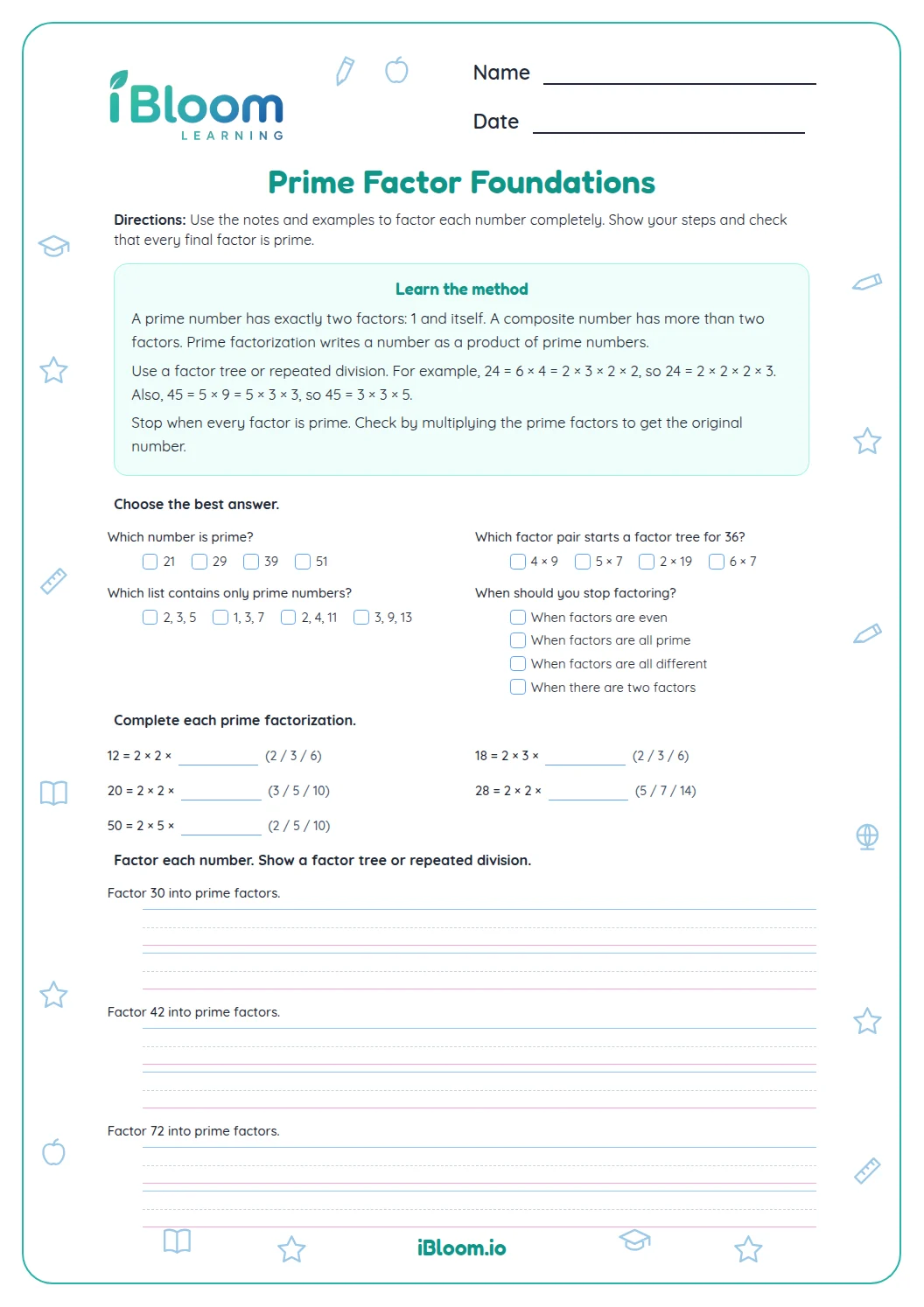 Factoring 2–500 Into Prime Factors — Concept FoundationsGrade 6 students factor numbers from 2 to 500 into prime factors using divisibility, factor trees and repeated division. This Grade 6 foundations worksheet adds concise teaching notes, worked examples, and supported first attempts.Grade 6Free PDF preview
 Greatest Common Factor Gcf 2 Numbers 2–100 — Concept FoundationsGrade 6 worksheets for finding the greatest common factor of two whole numbers between 2 and 100 using factor lists and reasoning. This Grade 6 foundations worksheet adds concise teaching notes, worked examples, and supported first attempts.Grade 6Free PDF preview6 pages
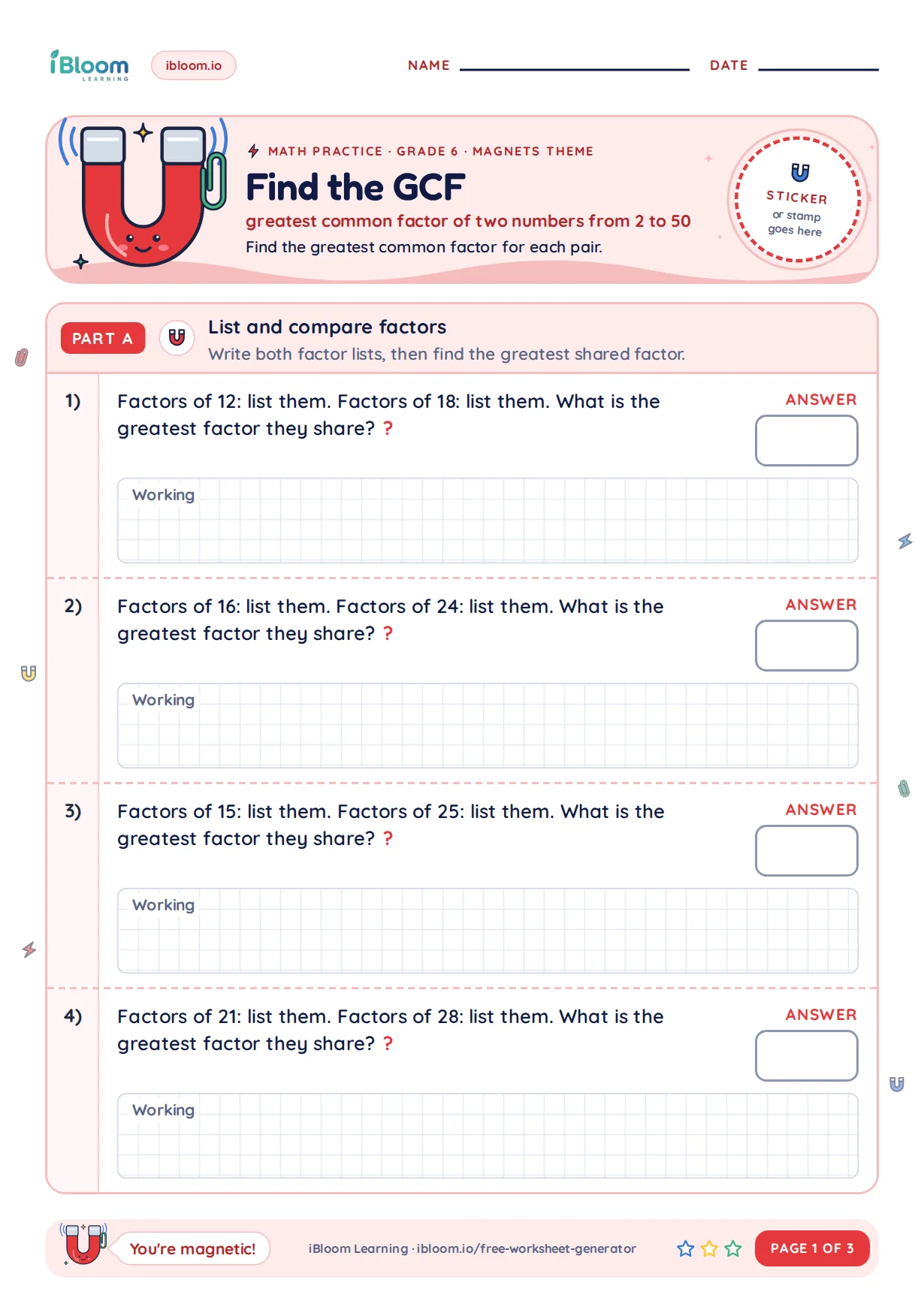 Greatest Common Factor Gcf 2 Numbers 2–50 — Concept FoundationsGrade 6 worksheets for finding the greatest common factor of two numbers from 2 to 50 using factor lists, divisibility, and comparison. This Grade 6 foundations worksheet adds concise teaching notes, worked examples, and supported first attempts.Grade 6Free PDF preview4 pages
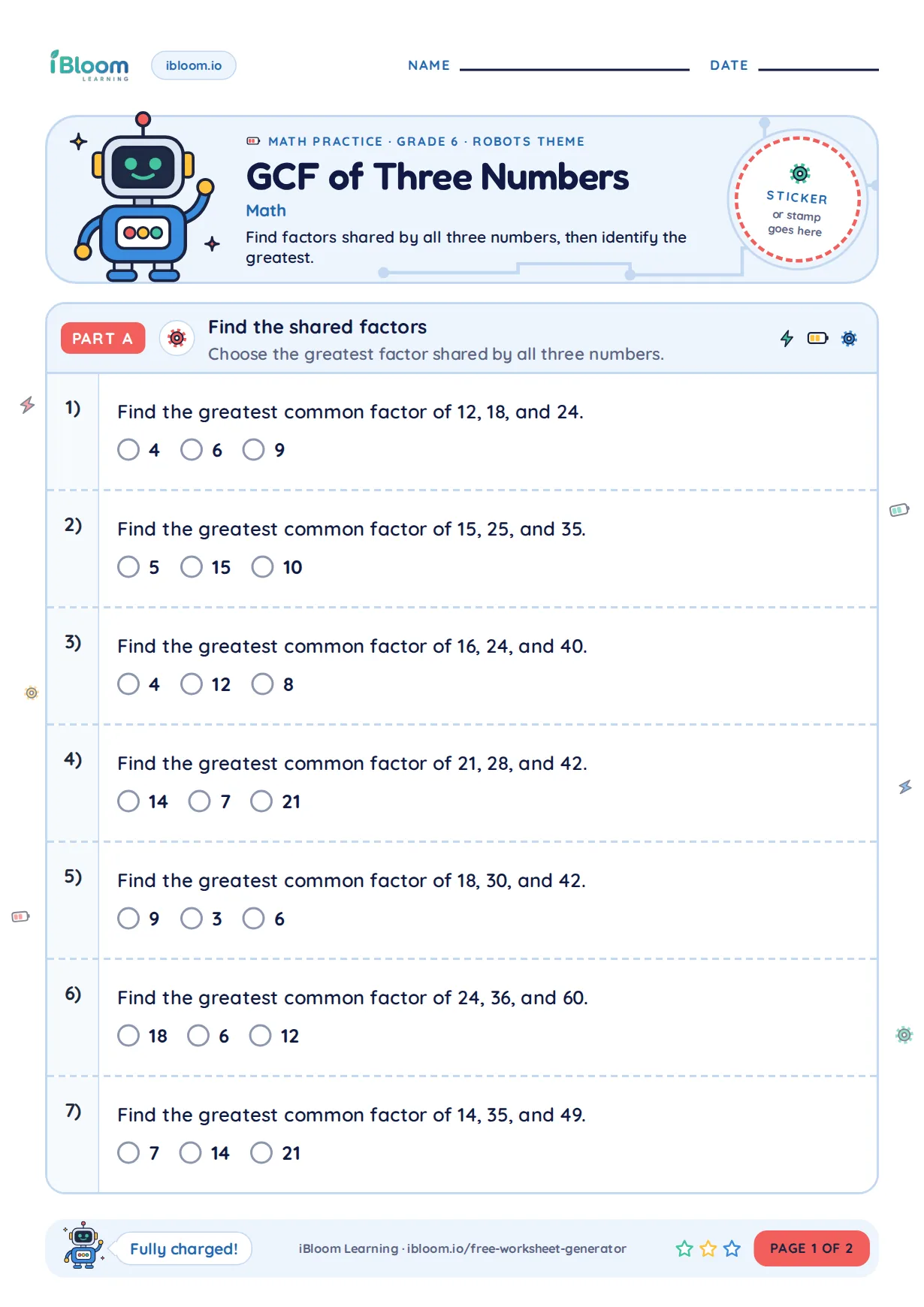 Greatest Common Factor Gcf 3 Numbers 2–100 — Concept FoundationsGrade 6 worksheets for finding the greatest common factor of three numbers from 2 to 100 using factor lists, divisibility, and prime factor thinking. This Grade 6 foundations worksheet adds concise teaching notes, worked examples, and supported first attempts.Grade 6Free PDF preview
 Least Common Multiple Lcm 2 Numbers 2–30 — Concept FoundationsExplore least common multiple lcm 2 numbers 2 30 practice activities within Factoring Practice Activities, organised so children, families, and elementary teachers can move from broad learning areas to focused printable practice. This Grade 6 foundations worksheet adds concise teaching notes, worked examples, and supported first attempts.Grade 6Free PDF preview
 Least Common Multiple Lcm 2 Numbers 2–50 — Concept FoundationsGrade 6 printable practice for finding the least common multiple of two numbers between 2 and 50 using multiples, factor pairs, and prime factorization. This Grade 6 foundations worksheet adds concise teaching notes, worked examples, and supported first attempts.Grade 6Free PDF preview
 Least Common Multiple Lcm 3 Numbers 2–30 — Concept FoundationsFree Grade 6 worksheets that teach students to find the LCM of three numbers between 2 and 30 using multiple strategies. This Grade 6 foundations worksheet adds concise teaching notes, worked examples, and supported first attempts.Grade 6Free PDF preview
 Factoring 0–100 Into Prime Factors — Guided PracticeGrade 6 students factor numbers up to 100 into prime factors using factor pairs, divisibility, and factor trees. This Grade 6 guided-practice worksheet progresses from prompts and checkpoints to independent questions.Grade 6Free PDF preview
 Factoring 2–500 Into Prime Factors — Guided PracticeGrade 6 students factor numbers from 2 to 500 into prime factors using divisibility, factor trees and repeated division. This Grade 6 guided-practice worksheet progresses from prompts and checkpoints to independent questions.Grade 6Free PDF preview4 pages
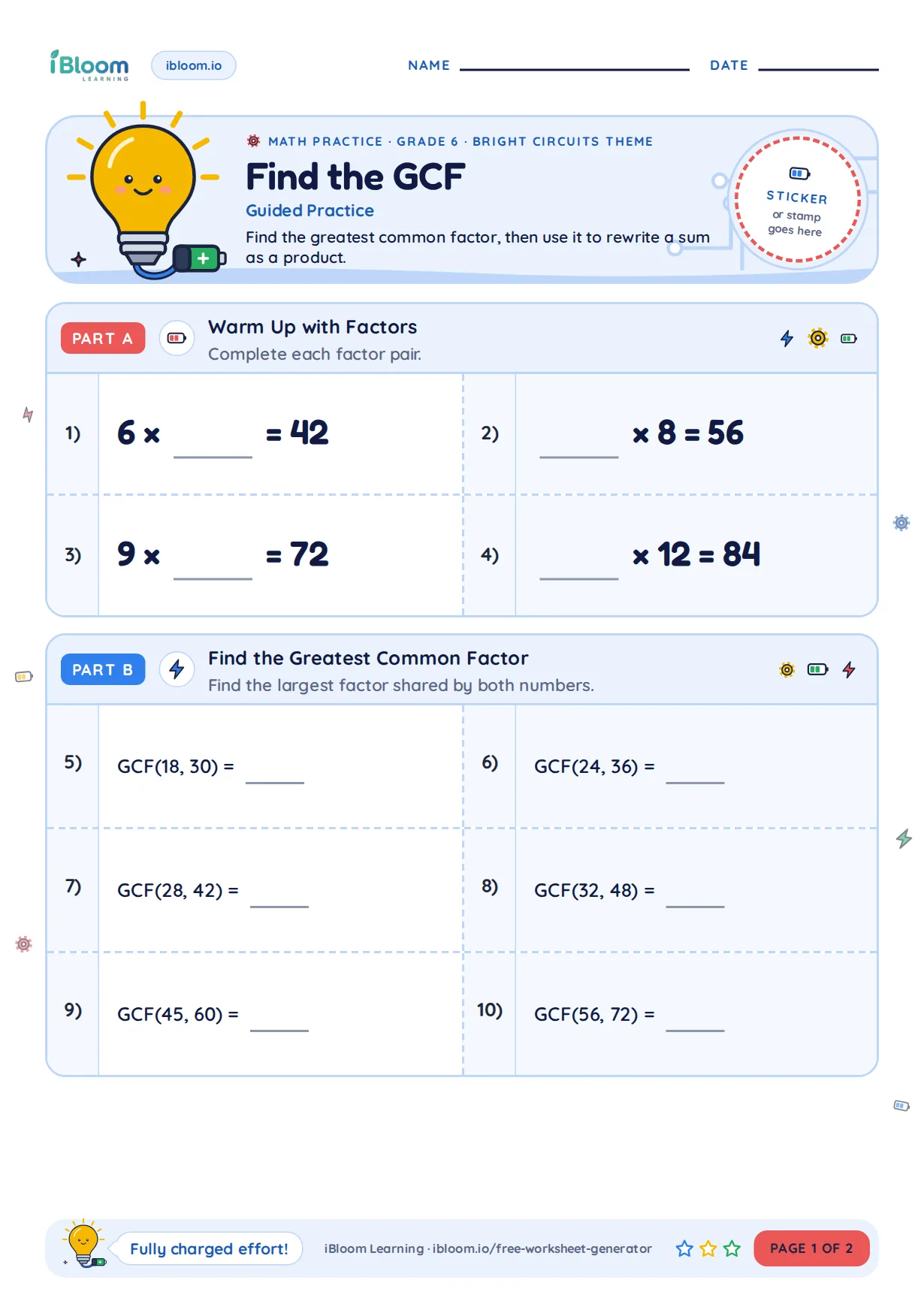 Greatest Common Factor Gcf 2 Numbers 2–100 — Guided PracticeGrade 6 worksheets for finding the greatest common factor of two whole numbers between 2 and 100 using factor lists and reasoning. This Grade 6 guided-practice worksheet progresses from prompts and checkpoints to independent questions.Grade 6Free PDF preview
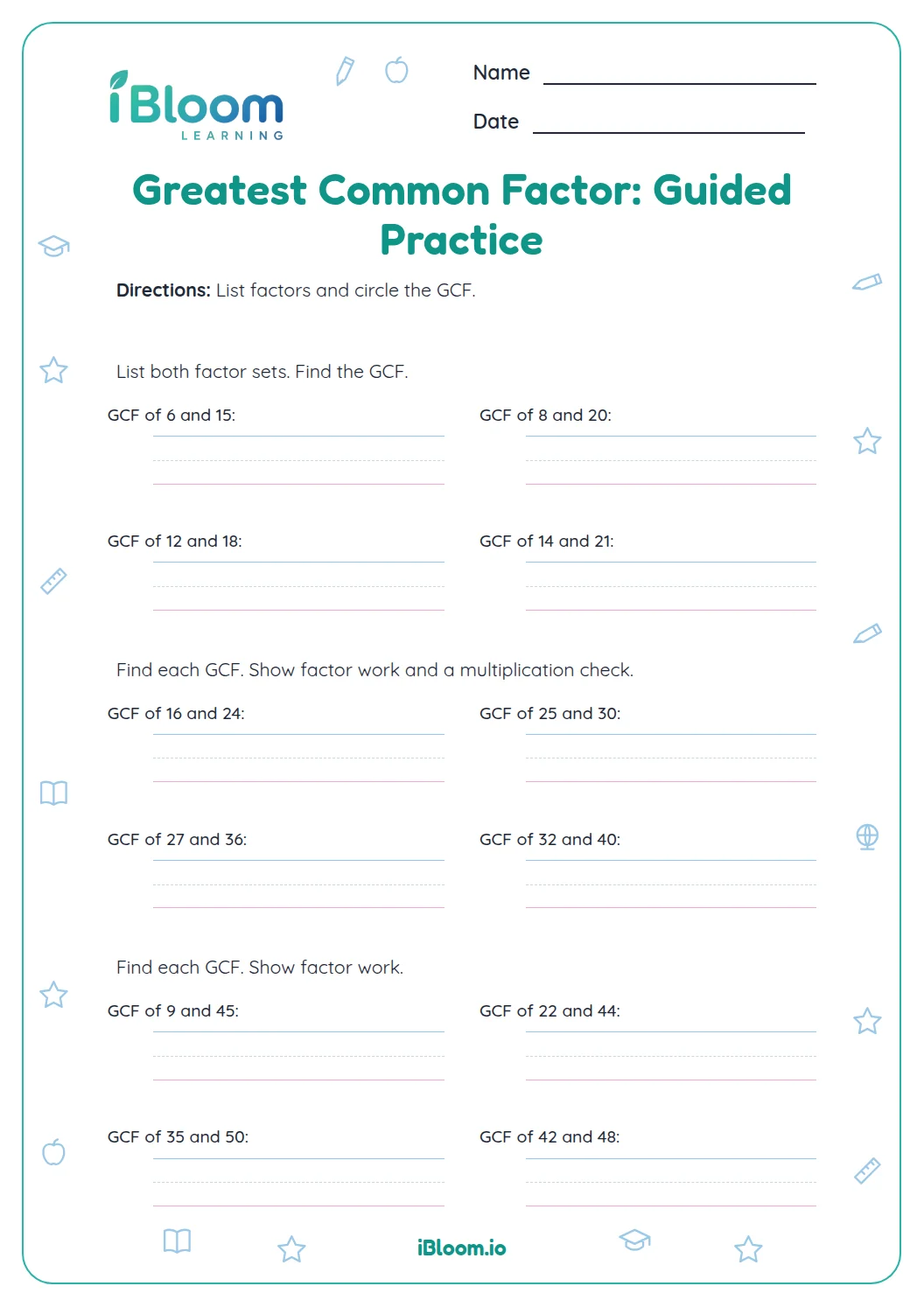 Greatest Common Factor Gcf 2 Numbers 2–50 — Guided PracticeGrade 6 worksheets for finding the greatest common factor of two numbers from 2 to 50 using factor lists, divisibility, and comparison. This Grade 6 guided-practice worksheet progresses from prompts and checkpoints to independent questions.Grade 6Free PDF preview
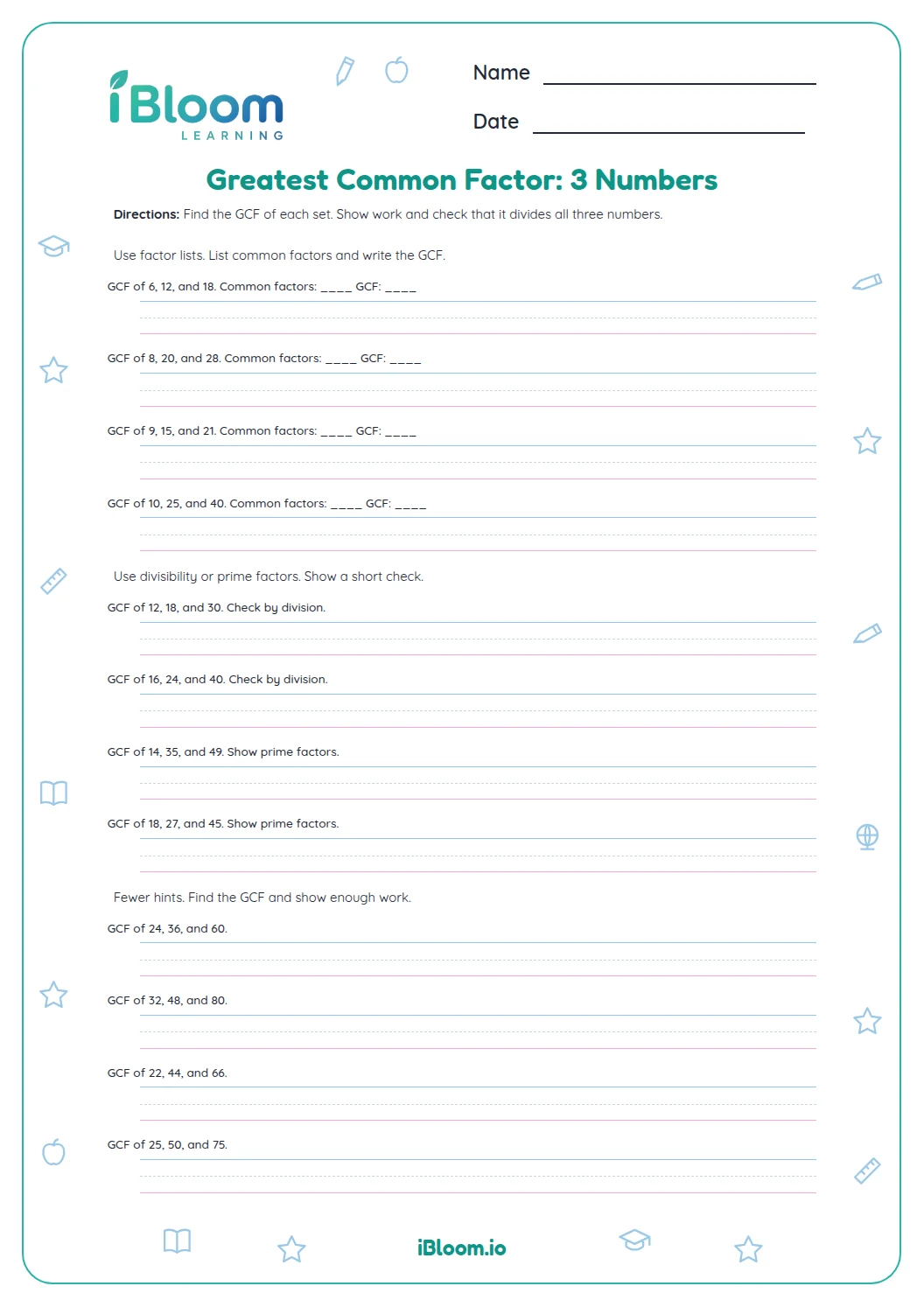 Greatest Common Factor Gcf 3 Numbers 2–100 — Guided PracticeGrade 6 worksheets for finding the greatest common factor of three numbers from 2 to 100 using factor lists, divisibility, and prime factor thinking. This Grade 6 guided-practice worksheet progresses from prompts and checkpoints to independent questions.Grade 6Free PDF preview
 Least Common Multiple Lcm 2 Numbers 2–30 — Guided PracticeExplore least common multiple lcm 2 numbers 2 30 practice activities within Factoring Practice Activities, organised so children, families, and elementary teachers can move from broad learning areas to focused printable practice. This Grade 6 guided-practice worksheet progresses from prompts and checkpoints to independent questions.Grade 6Free PDF preview6 pages
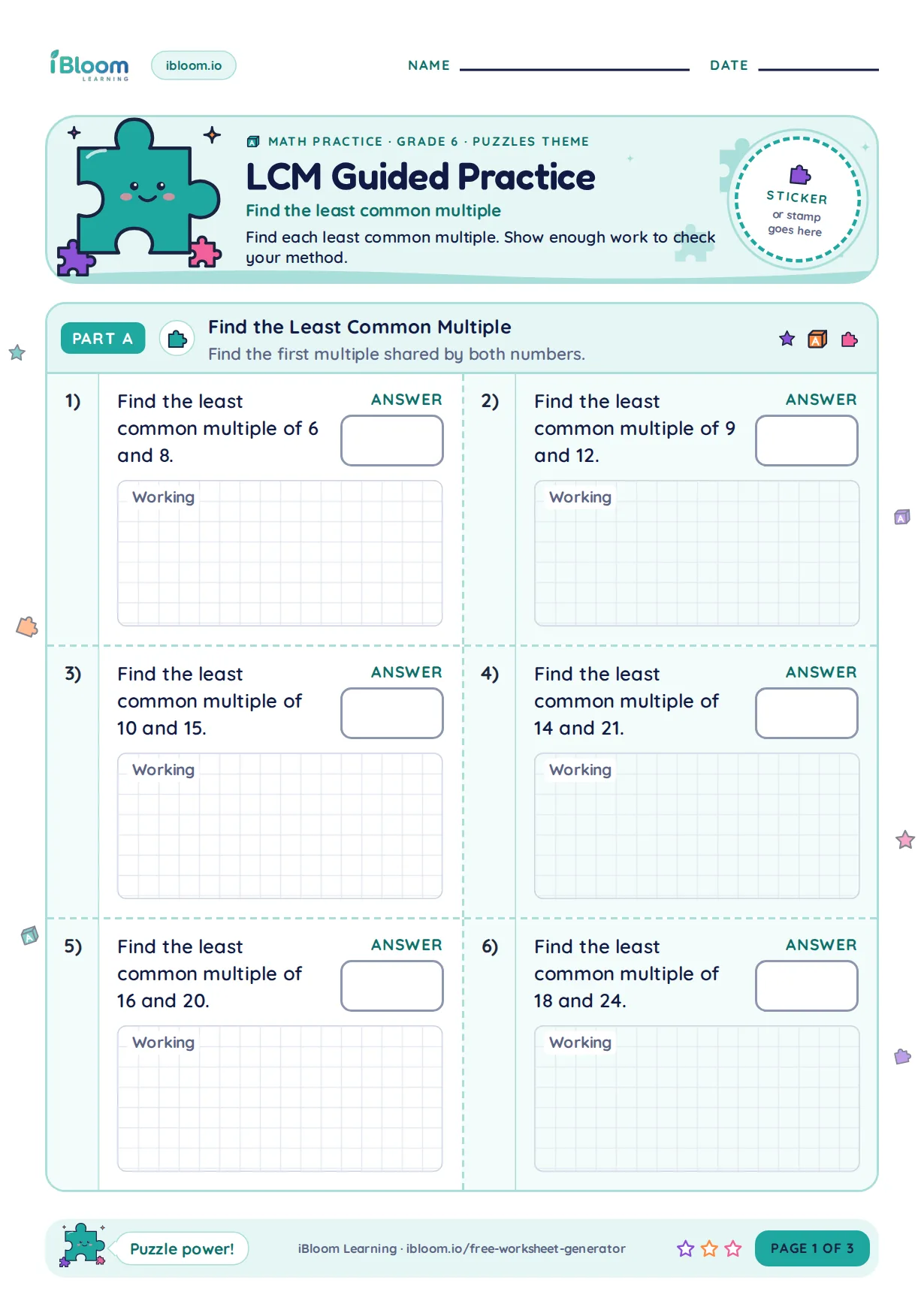 Least Common Multiple Lcm 2 Numbers 2–50 — Guided PracticeGrade 6 printable practice for finding the least common multiple of two numbers between 2 and 50 using multiples, factor pairs, and prime factorization. This Grade 6 guided-practice worksheet progresses from prompts and checkpoints to independent questions.Grade 6Free PDF preview
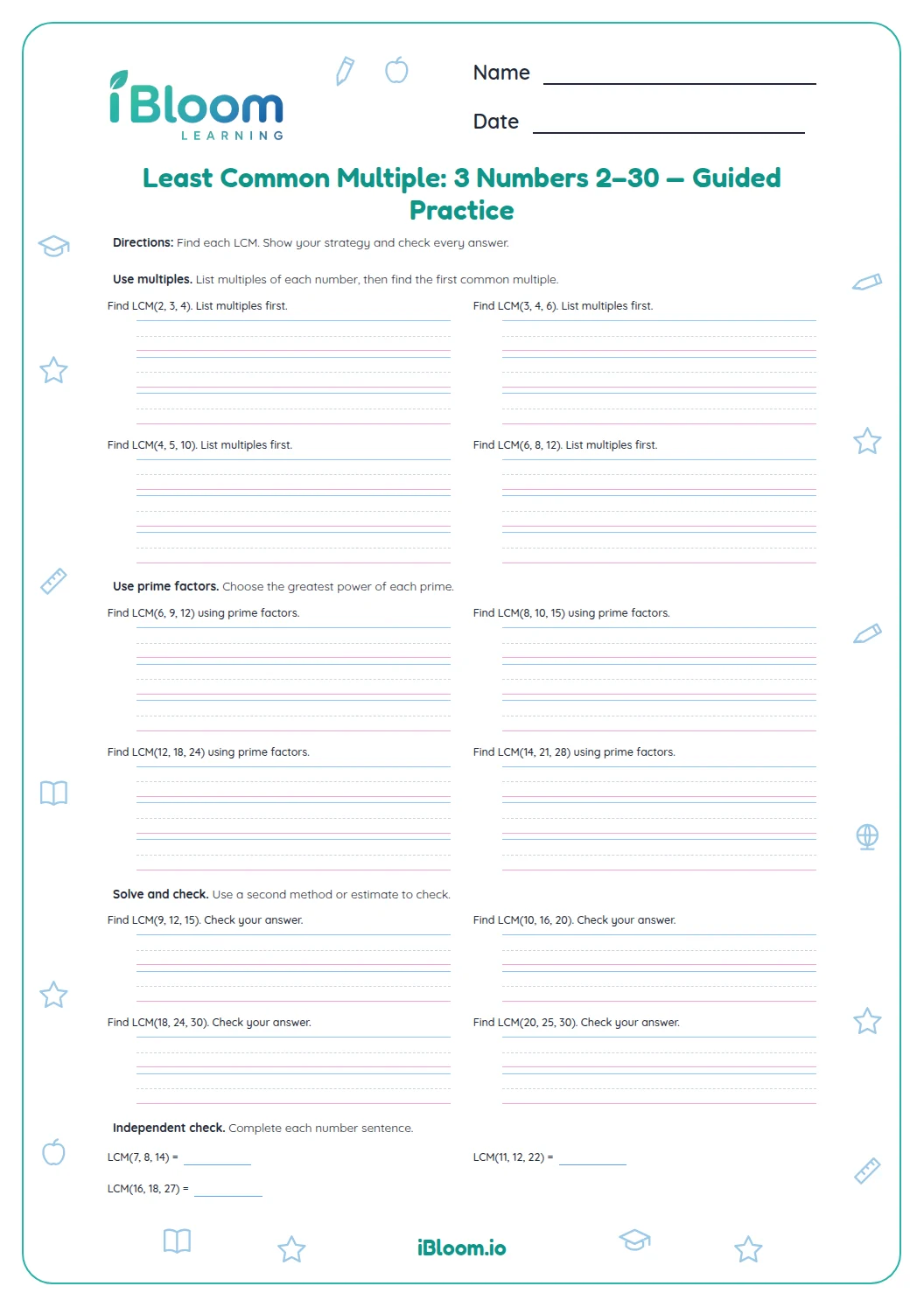 Least Common Multiple Lcm 3 Numbers 2–30 — Guided PracticeFree Grade 6 worksheets that teach students to find the LCM of three numbers between 2 and 30 using multiple strategies. This Grade 6 guided-practice worksheet progresses from prompts and checkpoints to independent questions.Grade 6Free PDF preview4 pages
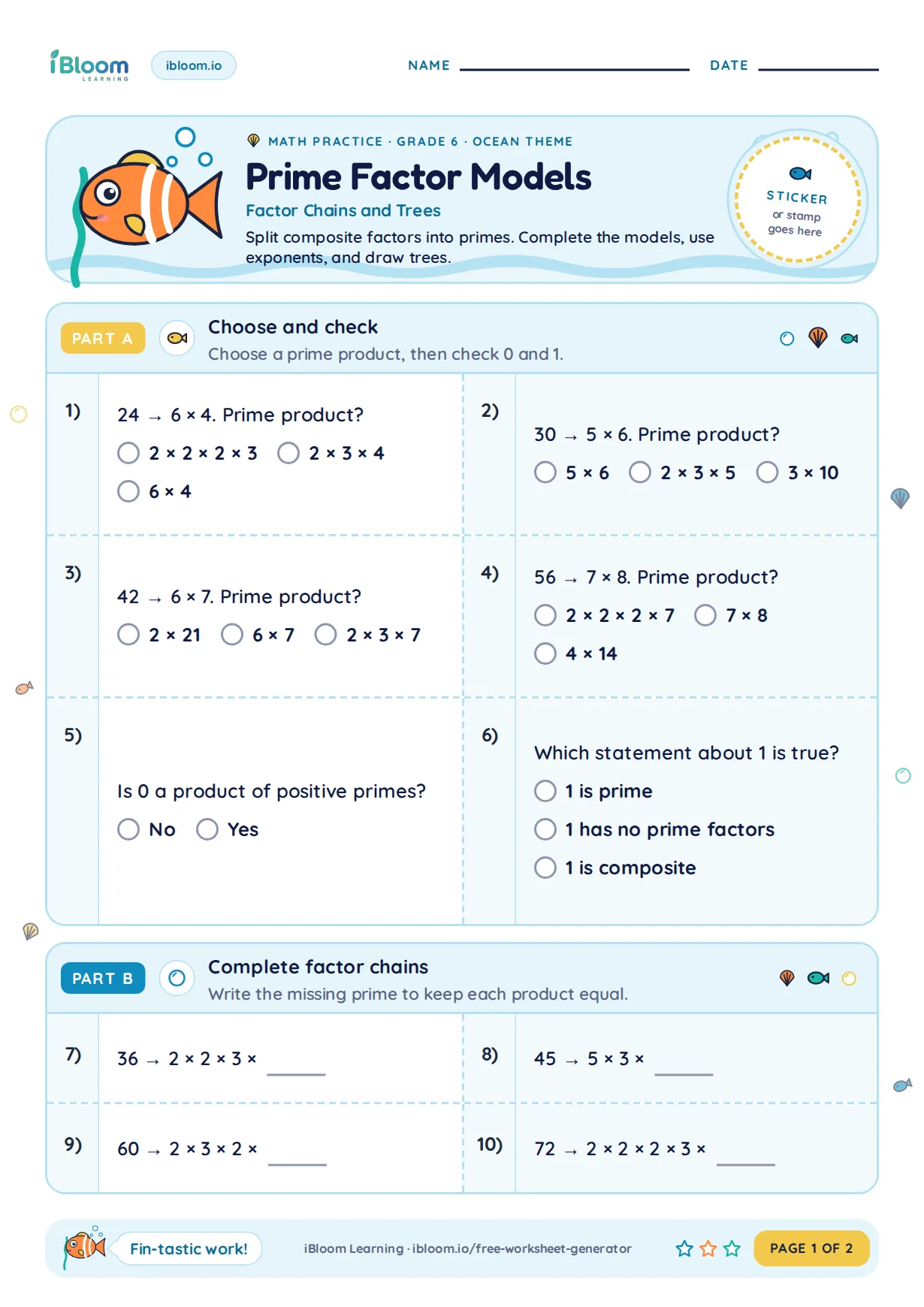 Factoring 0–100 Into Prime Factors — Visual ModelsGrade 6 students factor numbers up to 100 into prime factors using factor pairs, divisibility, and factor trees. This Grade 6 visual-model worksheet connects suitable diagrams, tables, number lines, or place-value models to mathematical notation.Grade 6Free PDF preview
 Factoring 2–500 Into Prime Factors — Visual ModelsGrade 6 students factor numbers from 2 to 500 into prime factors using divisibility, factor trees and repeated division. This Grade 6 visual-model worksheet connects suitable diagrams, tables, number lines, or place-value models to mathematical notation.Grade 6Free PDF preview
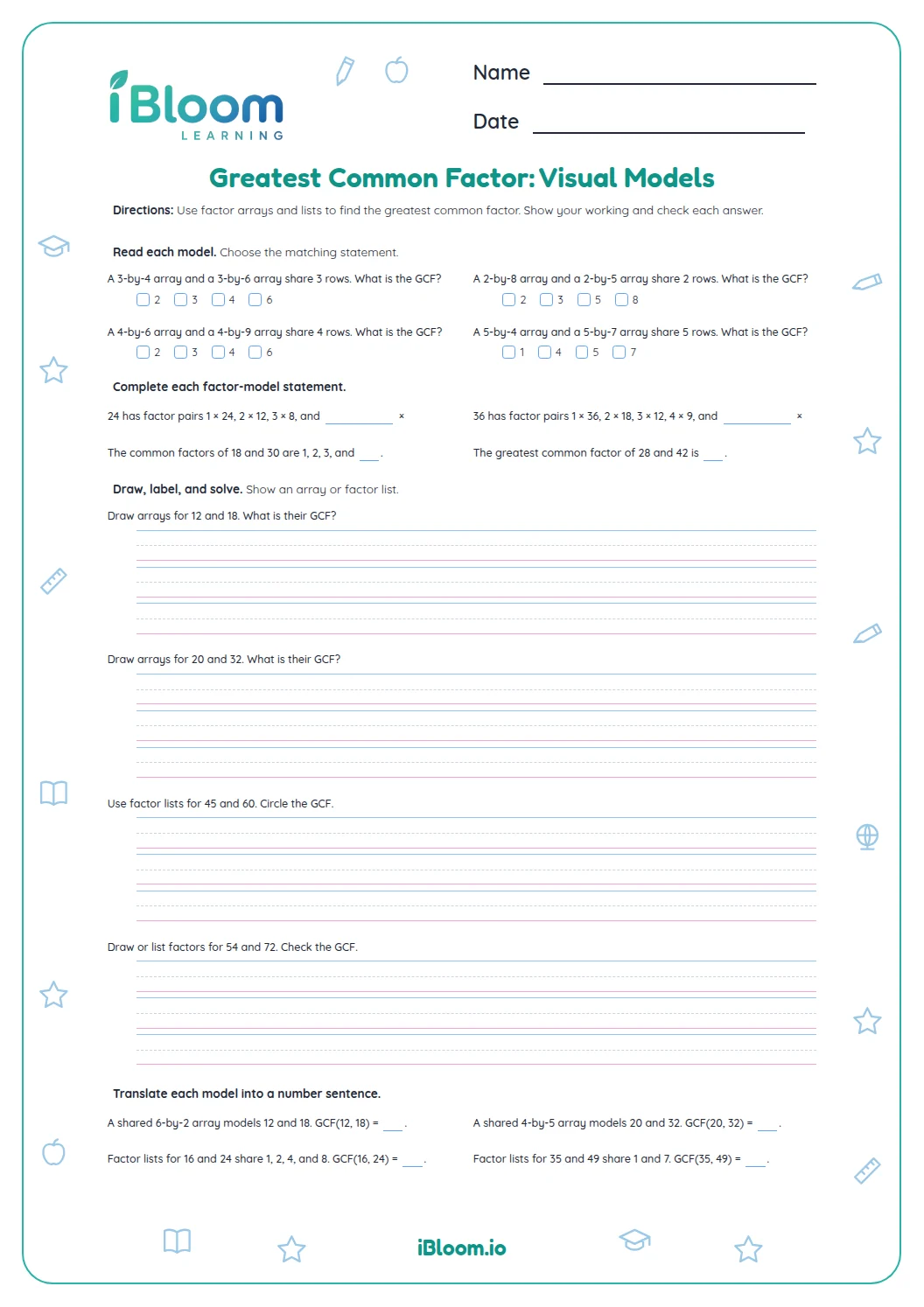 Greatest Common Factor Gcf 2 Numbers 2–100 — Visual ModelsGrade 6 worksheets for finding the greatest common factor of two whole numbers between 2 and 100 using factor lists and reasoning. This Grade 6 visual-model worksheet connects suitable diagrams, tables, number lines, or place-value models to mathematical notation.Grade 6Free PDF preview
 Greatest Common Factor Gcf 2 Numbers 2–50 — Visual ModelsGrade 6 worksheets for finding the greatest common factor of two numbers from 2 to 50 using factor lists, divisibility, and comparison. This Grade 6 visual-model worksheet connects suitable diagrams, tables, number lines, or place-value models to mathematical notation.Grade 6Free PDF preview
Practice that builds confidence
What students practise
These Grade 6 factoring worksheets help students break numbers into prime factors, compare factor lists, and use those lists to find greatest common factors and least common multiples. Practice includes numbers from small ranges such as 2–30 and 2–50, as well as prime factorization up to 500.
The printable activities build from finding prime factors to solving GCF problems with 2 or 3 numbers and LCM problems with 2 or 3 numbers. Children practise factor trees, organized lists, and repeated division so they can choose an efficient method instead of guessing.
Factoring in Grade 6 is more than naming factors. Students learn that composite numbers can be written as products of primes, such as 84 = 2 × 2 × 3 × 7. They then use prime factorization to compare numbers and reason about common factors, common multiples, GCF, and LCM. The collection includes prime factor practice through 100 and 500, GCF for 2 numbers up to 50 or 100, GCF for 3 numbers up to 100, and LCM for 2 or 3 numbers in the listed ranges.

Skill progression
Children usually begin with factor pairs and divisibility rules, then move to factor trees or division ladders. Once prime factors are clear, they identify the shared prime factors for GCF and the complete set of needed prime factors for LCM. This progression helps students see why the GCF of 24 and 36 is 12, while the LCM is 72, instead of treating both as memorized procedures.
A simple parent routine
Choose two numbers from a worksheet and ask your child to list factor pairs first. Next, have them make a prime factor tree and circle matching prime factors in the two lists. Finish by asking one sentence of reasoning: The greatest common factor is __ because __, or the least common multiple is __ because __. For three-number problems, use different colors for each number so shared factors are easier to track.

Classroom uses for teachers
These pages work well for warm-ups, small-group reteaching, math centers, homework, or quick checks after a lesson on factors and multiples. Teachers can assign narrower sets, such as LCM of 2 numbers from 2–30, before moving to mixed GCF and LCM practice. Pair work is especially useful when students must explain which primes are shared and which are only needed for the multiple.

Common errors to watch for
Students may include 1 as a prime, stop a factor tree before all factors are prime, confuse greatest with largest listed number, or find a common multiple when asked for a common factor. Zero and 1 require careful language: they are not prime numbers, and prime factorization applies to whole numbers greater than 1. Encourage students to check whether the answer makes sense: a GCF must divide each given number, and an LCM must be a multiple of each given number.
Free printable PDF download
Use this grade 6 factoring worksheet page to preview the activity, print it, or download it as a PDF for quick practice. It works well for homework, homeschool lessons, tutoring, morning work, revision, and classroom centers.
Answers and answer key support
After the child completes the worksheet independently, parents and teachers can use the answer support or answer key information to check the work, review mistakes, and choose the next practice step.
Why iBloom worksheets help
The worksheets separate skills into focused child topics, so students are not asked to master every factoring idea at once. Repeated practice across controlled number ranges helps them gain fluency while still using reasoning. Child-friendly strategy: factor, compare, choose. Factor each number into primes, compare the prime lists, then choose shared primes for GCF or the full needed set for LCM.
Helpful answers
Frequently asked questions
What factoring skills are included in this Grade 6 collection?
The collection covers prime factorization, greatest common factor for 2 and 3 numbers, and least common multiple for 2 and 3 numbers using the number ranges listed for each child topic.
Should students use factor trees or division ladders?
Either method is appropriate if the final factorization contains only prime numbers. Factor trees are visual and good for beginners, while division ladders can be faster for repeated practice.
How can my child tell when to find GCF instead of LCM?
GCF asks for the largest factor shared by all the numbers, so the answer divides each number. LCM asks for the smallest common multiple, so each number divides into the answer.
Are 0 and 1 treated as prime factors?
No. Zero and 1 are not prime numbers. Prime factorization is used for whole numbers greater than 1, so students should learn to recognize these special cases.
How do the three-number GCF and LCM worksheets differ from two-number practice?
Three-number problems require students to compare all three prime factor lists. For GCF, a factor must appear in every list; for LCM, the answer must include enough prime factors to cover all three numbers.
Is this grade 6 factoring worksheet free?
Yes. You can preview it for free and use the printable worksheet for home or classroom practice.
Can I download this grade 6 factoring worksheet as a PDF?
Yes. Use the worksheet download option to save a printable PDF, or print the worksheet directly from the page.
Does this grade 6 factoring worksheet include answers or an answer key?
When the activity has fixed answers, iBloom includes answer support so parents and teachers can check the completed worksheet.