










About this worksheet
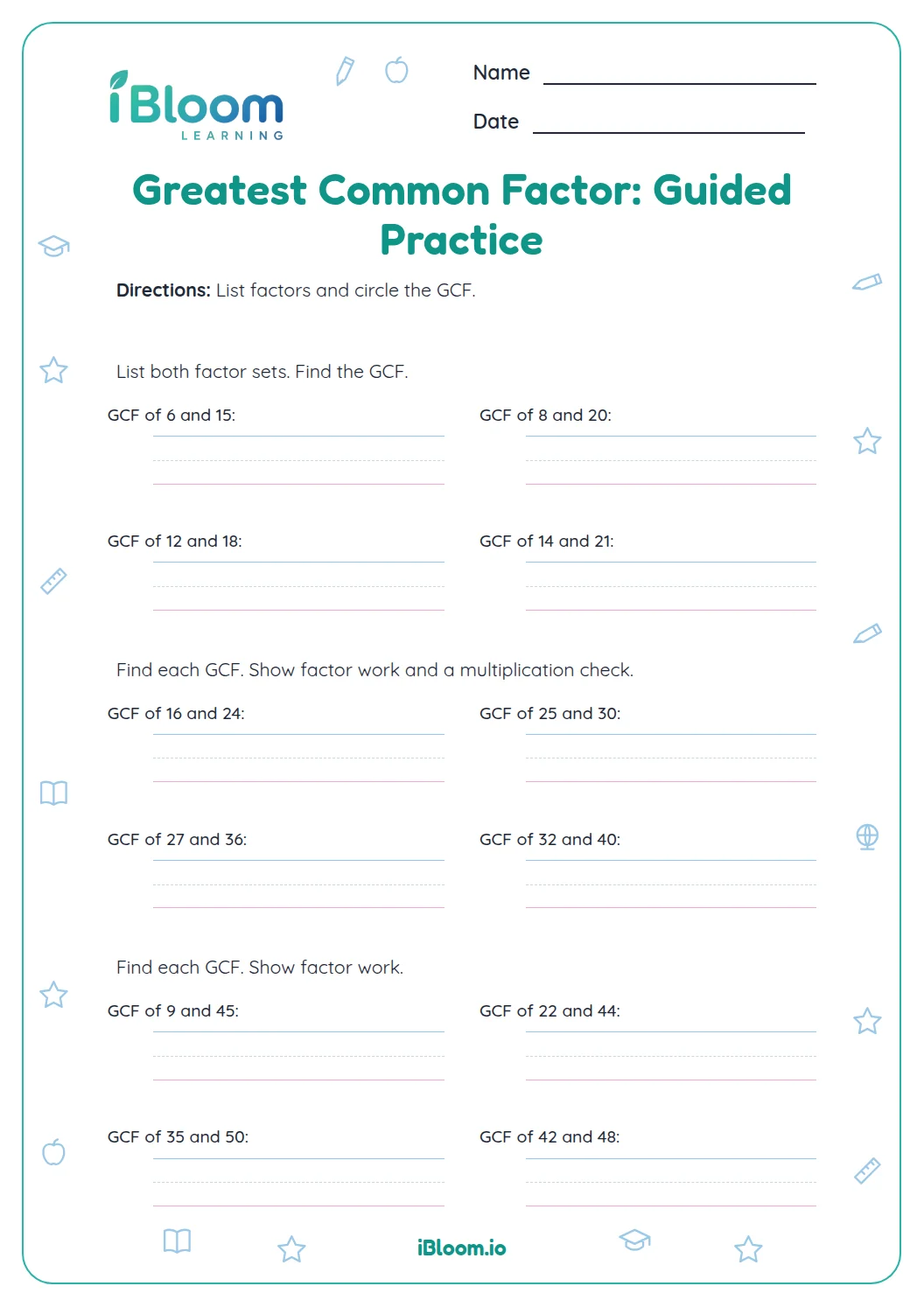
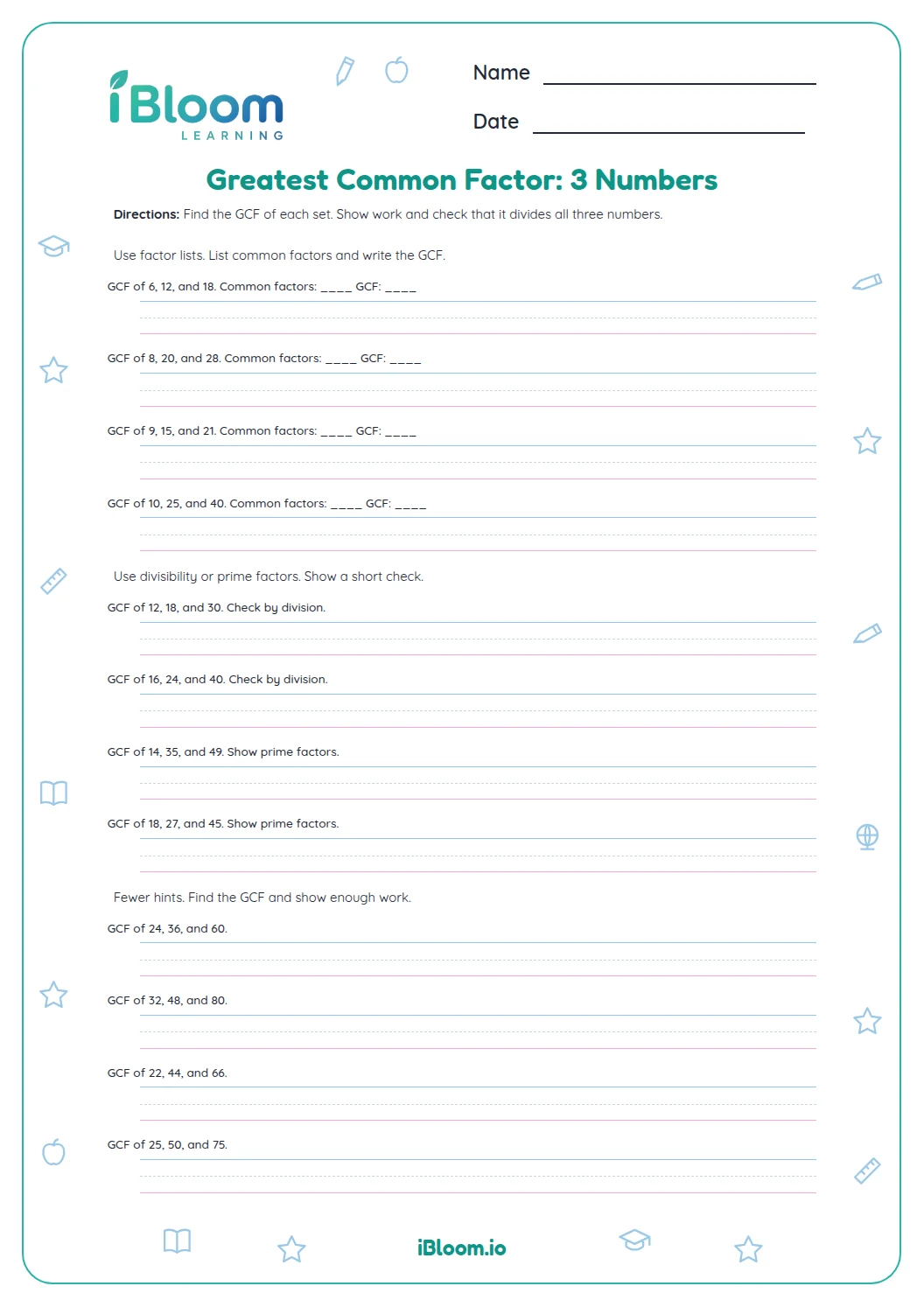
This Grade 6 worksheet builds greatest-common-factor practice with 16 number pairs from 2 to 50. Students begin by listing factors and comparing the lists, then find the GCF without preprinted lists. The answer key gives each result for checking.
Aligned to 6.NS.B.4
How do you find shared factors?
List the positive factors of each number, then compare the lists. The greatest value that appears in both is the GCF. For question 1, 12 and 18 share 1, 2, 3 and 6, so their GCF is 6.
- 1Factors of 12: 1, 2, 3, 4, 6, 12
- 2Factors of 18: 1, 2, 3, 6, 9, 18
- 3Greatest shared factor: 6
How can you check a GCF?
Divide both numbers by your proposed GCF. Both quotients should be whole numbers. Then make sure no larger listed factor is shared.
How do factor pairs help?
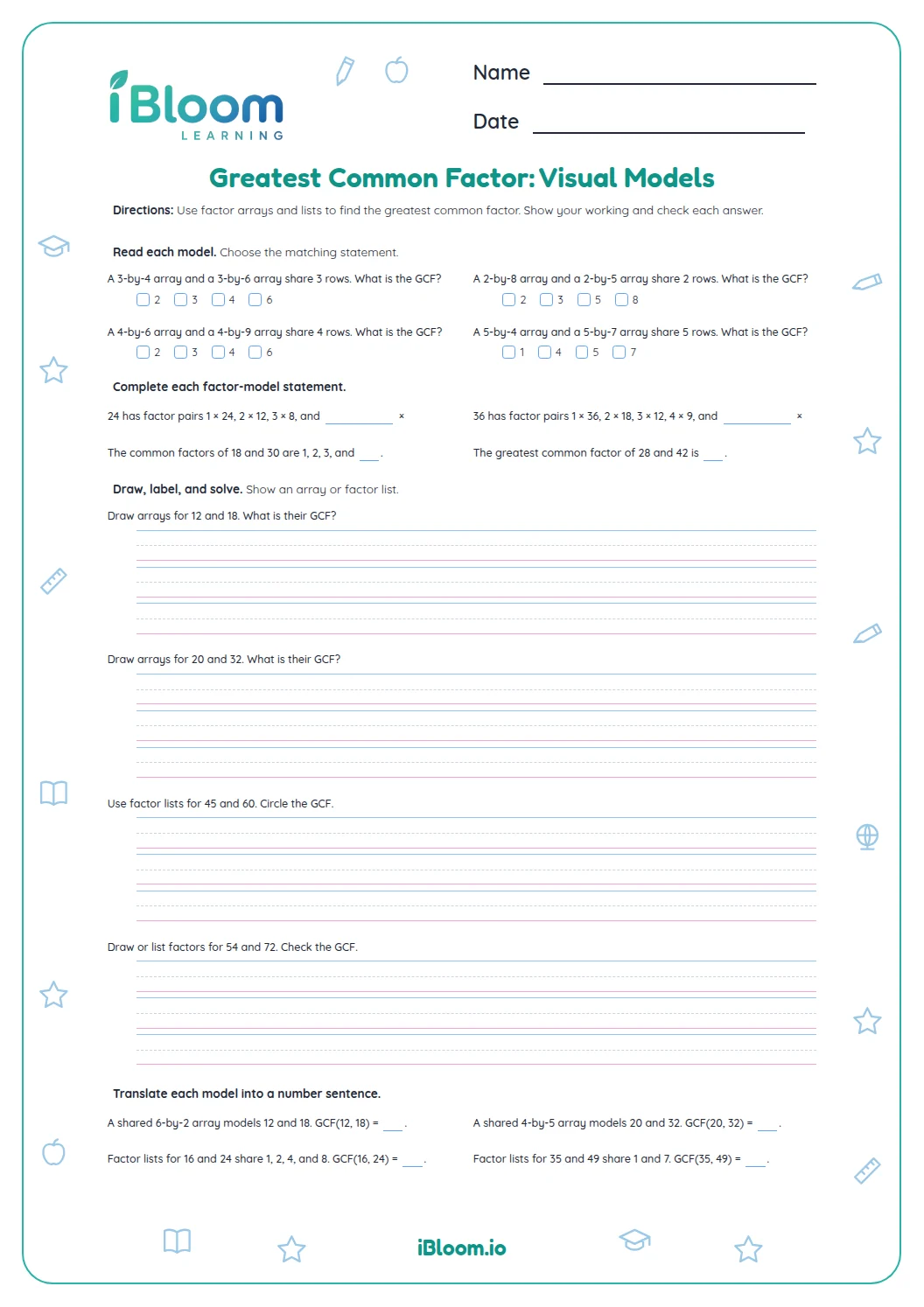
Factor pairs show the numbers that multiply to make a target. For 24, the pairs are 1 and 24, 2 and 12, 3 and 8, and 4 and 6. Compare these factors with the other number’s factors to find the greatest match.
How to use this worksheet at home or in class
- 1Read the direction for each part before beginning.
- 2Work through the first example together and name the strategy.
- 3Complete the remaining questions, showing steps where space is provided.
- 4Use the answer key to check each response.
- 5For any missed item, solve it again and explain what changed.
Common mistakes and quick fixes
The mistake
Leaving 1 out of a factor list.
The fix
Include 1 and the number itself before comparing the lists.
The mistake
Choosing a common factor that is not the greatest.
The fix
Compare every shared factor and select the largest value.
The mistake
Listing a number that does not divide evenly.
The fix
Check each factor by division; the quotient must be a whole number.
Common Core alignment
This practice connects to the following Common Core skill.
Find the greatest common factor of two whole numbers.
On this sheet: Every pair asks students to find the greatest shared factor of two whole numbers under 50.
Show the official wordingHide the official wording
Find the greatest common factor of two whole numbers less than or equal to 100 and the least common multiple of two whole numbers less than or equal to 12. Use the distributive property to express a sum of two whole numbers 1–100 with a common factor as a multiple of a sum of two whole numbers with no common factor.
What to practice next
Make more practice
Further reading
Questions parents and teachers ask
What will students practice on this Grade 6 worksheet?
Students find the greatest common factor of 16 pairs from 2 to 50. The first eight prompts cue students to list and compare factors; the second eight ask for each GCF directly. The answer key lists the result for every pair.
How should students use the answer key?
Try each pair before checking the key. When an answer differs, list the factors of both numbers, circle the shared values, and select the greatest one. Then verify that it divides each number evenly. Be sure to include 1 in both factor lists.
Can this worksheet be used for independent practice?
Yes. The first part provides a consistent factor-list routine, and the second part lets students apply it with less prompting. Students can complete the problems independently, then use the key to check which factors they shared. They can retry missed pairs by writing both factor lists.
What materials are needed?
A pencil and the printed page are enough. Students may use the work area or scrap paper to list factor pairs for each number. Writing both lists makes it easier to compare the shared values before choosing the greatest.
How long does the worksheet take?
Plan for about 25 minutes to list factors for the first group and solve the direct GCF questions. Some pairs have more factors to compare than others. Students may use the printed work space or scrap paper for their lists.