




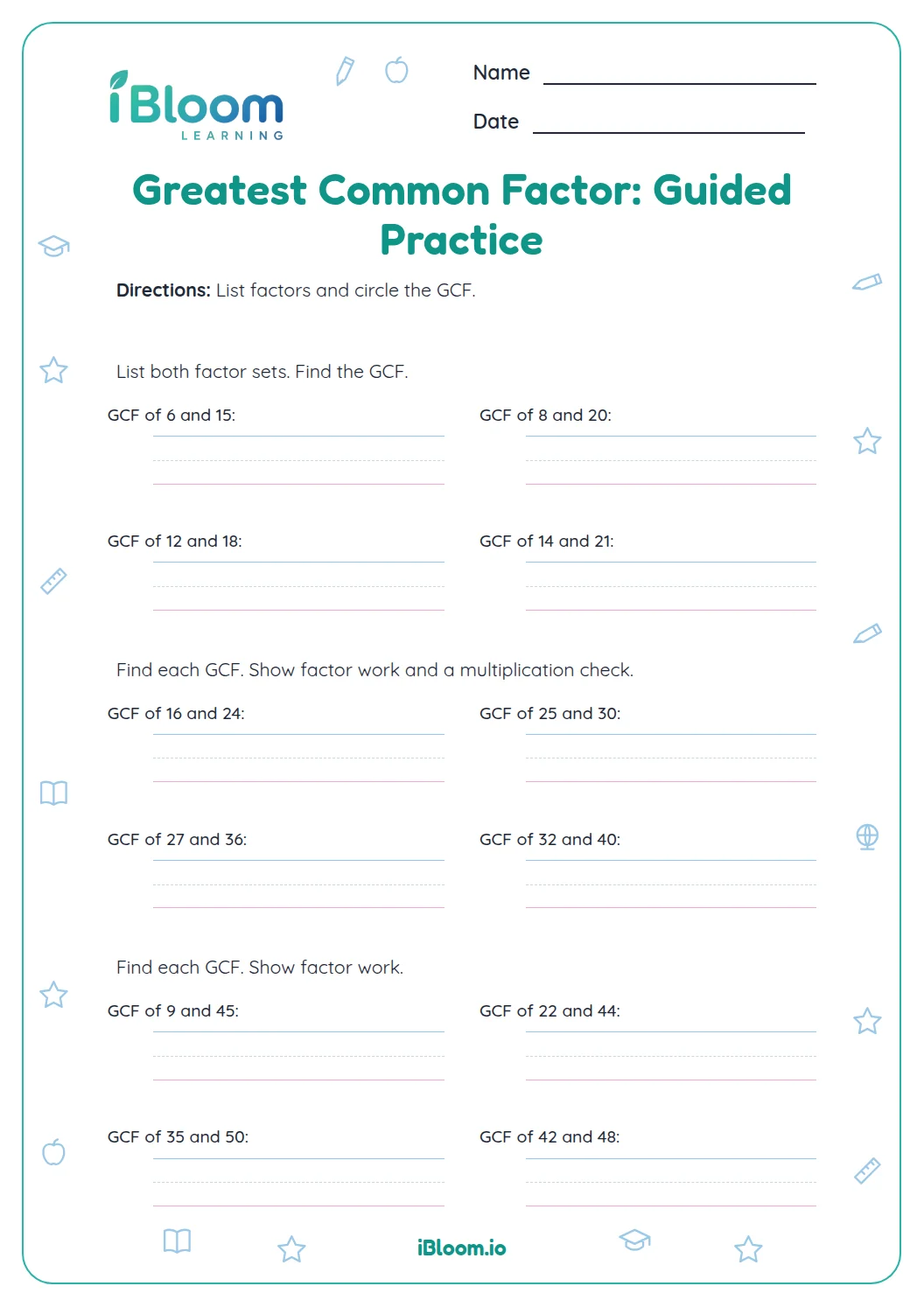


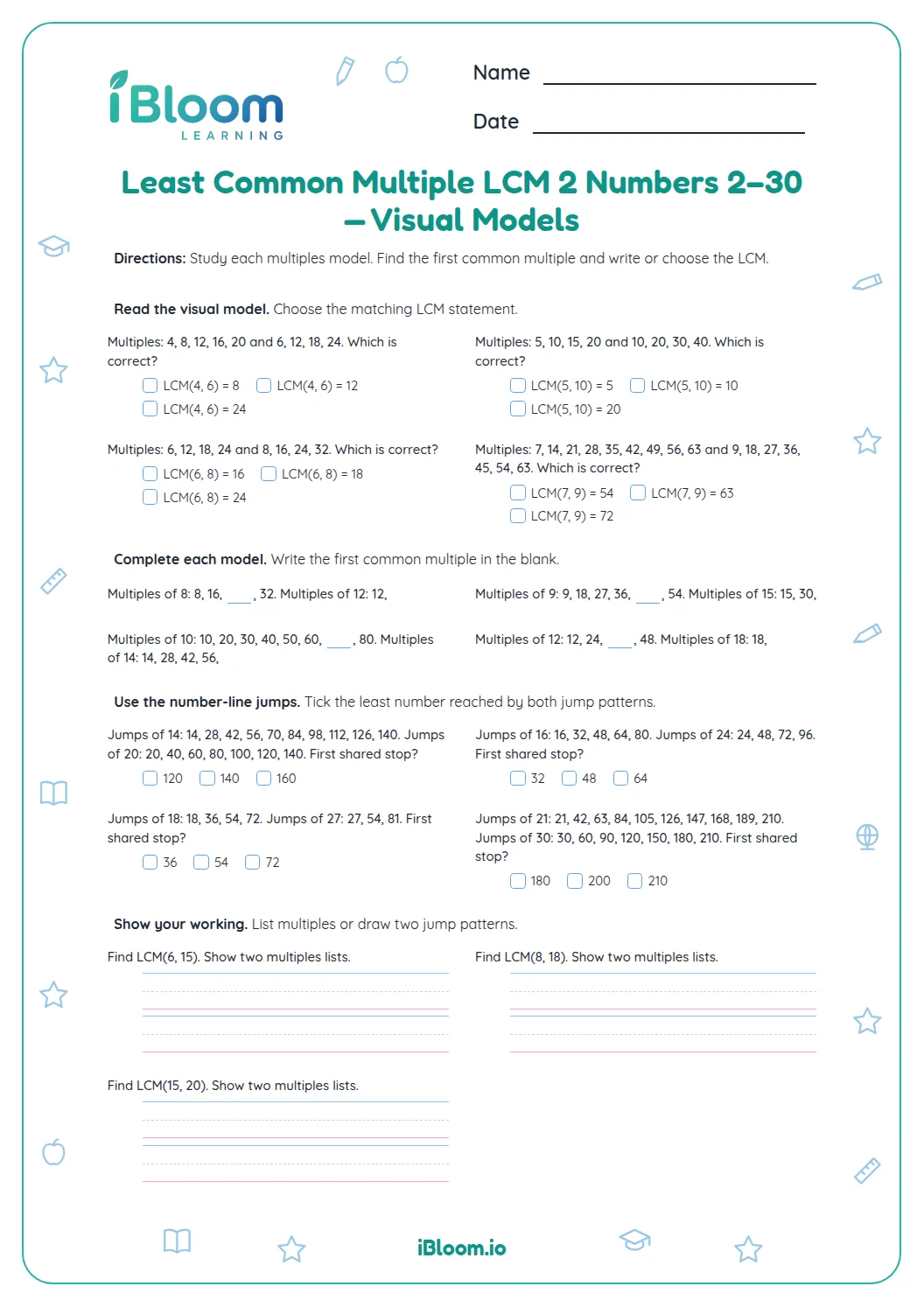

About this worksheet
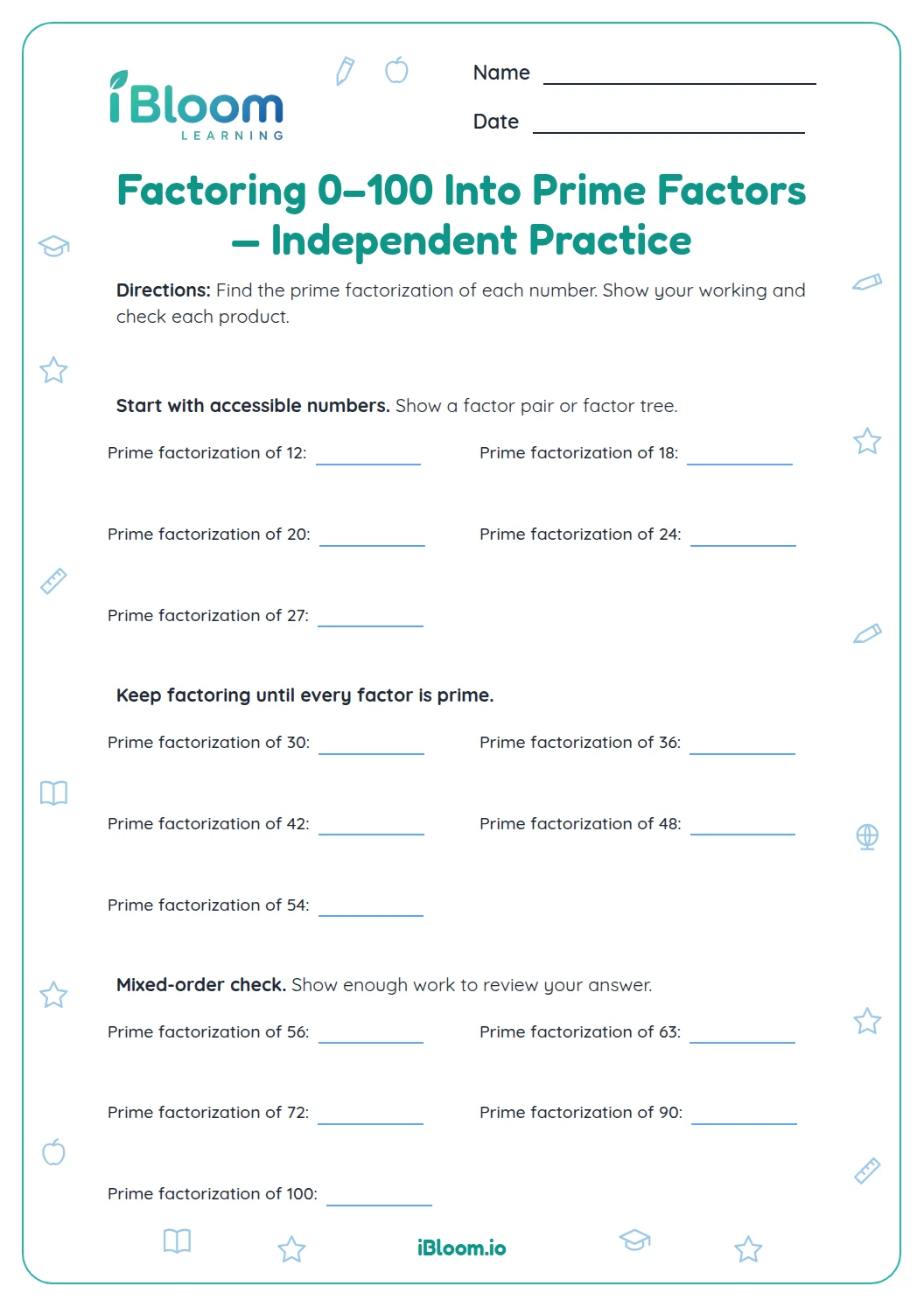
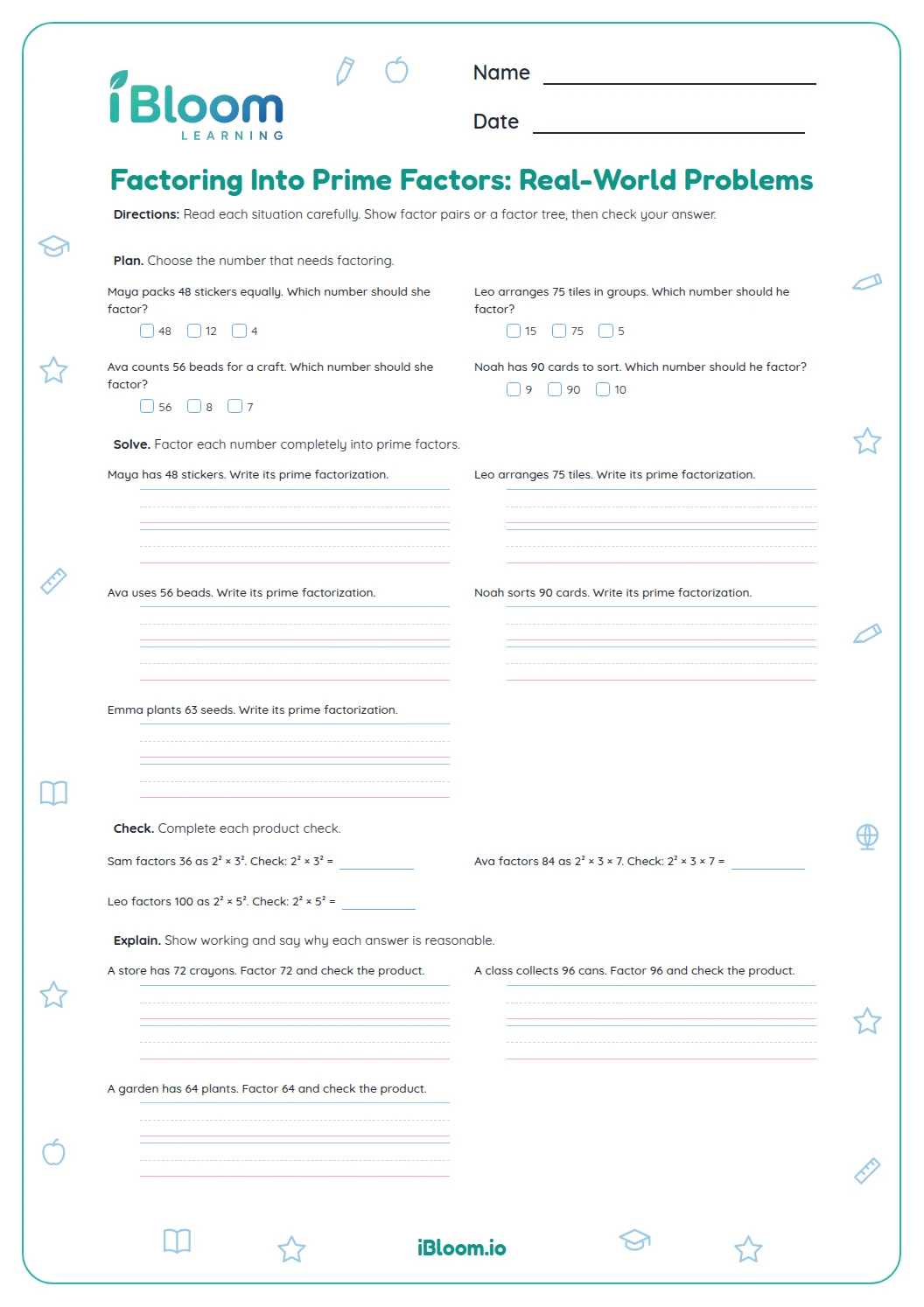
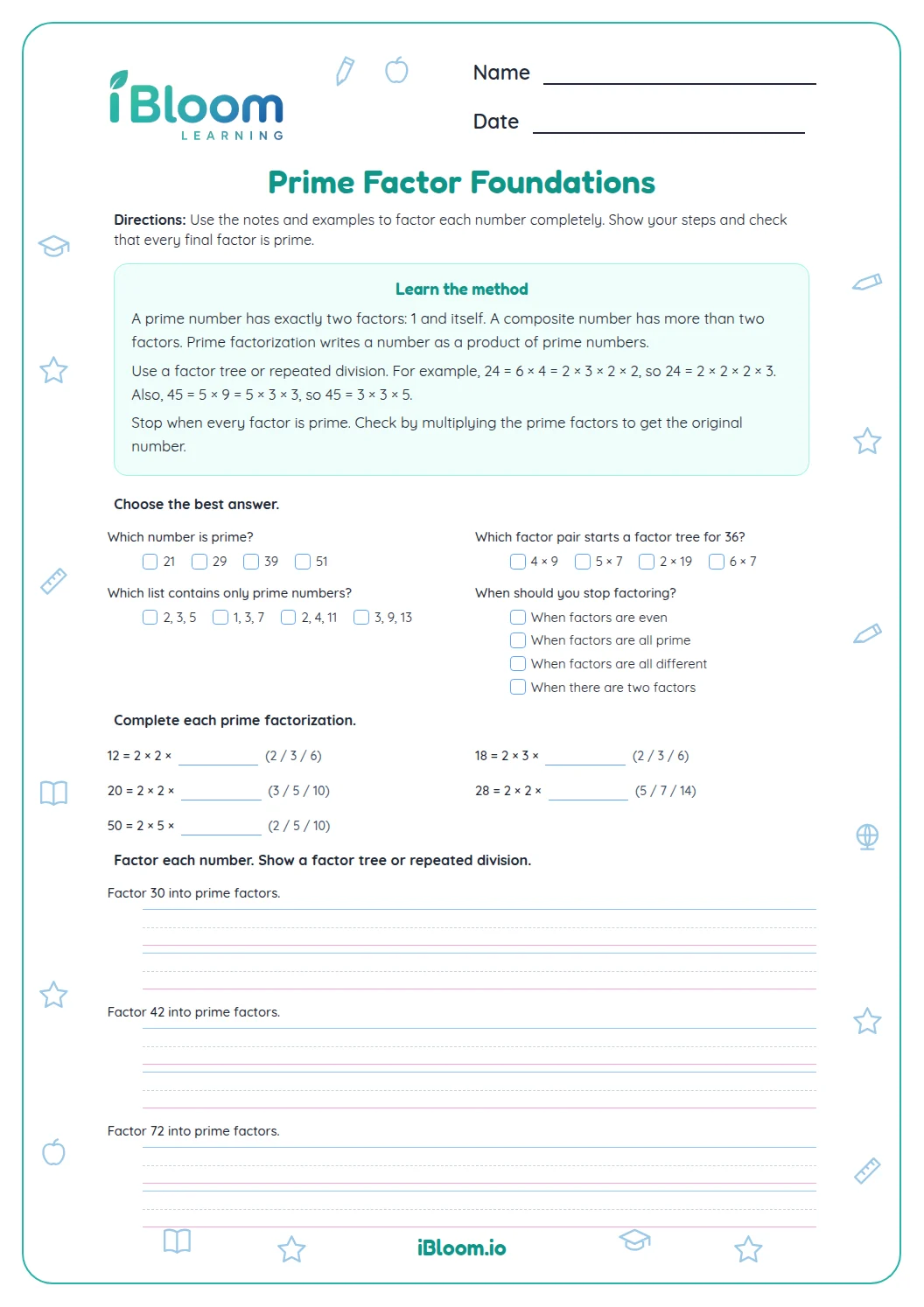
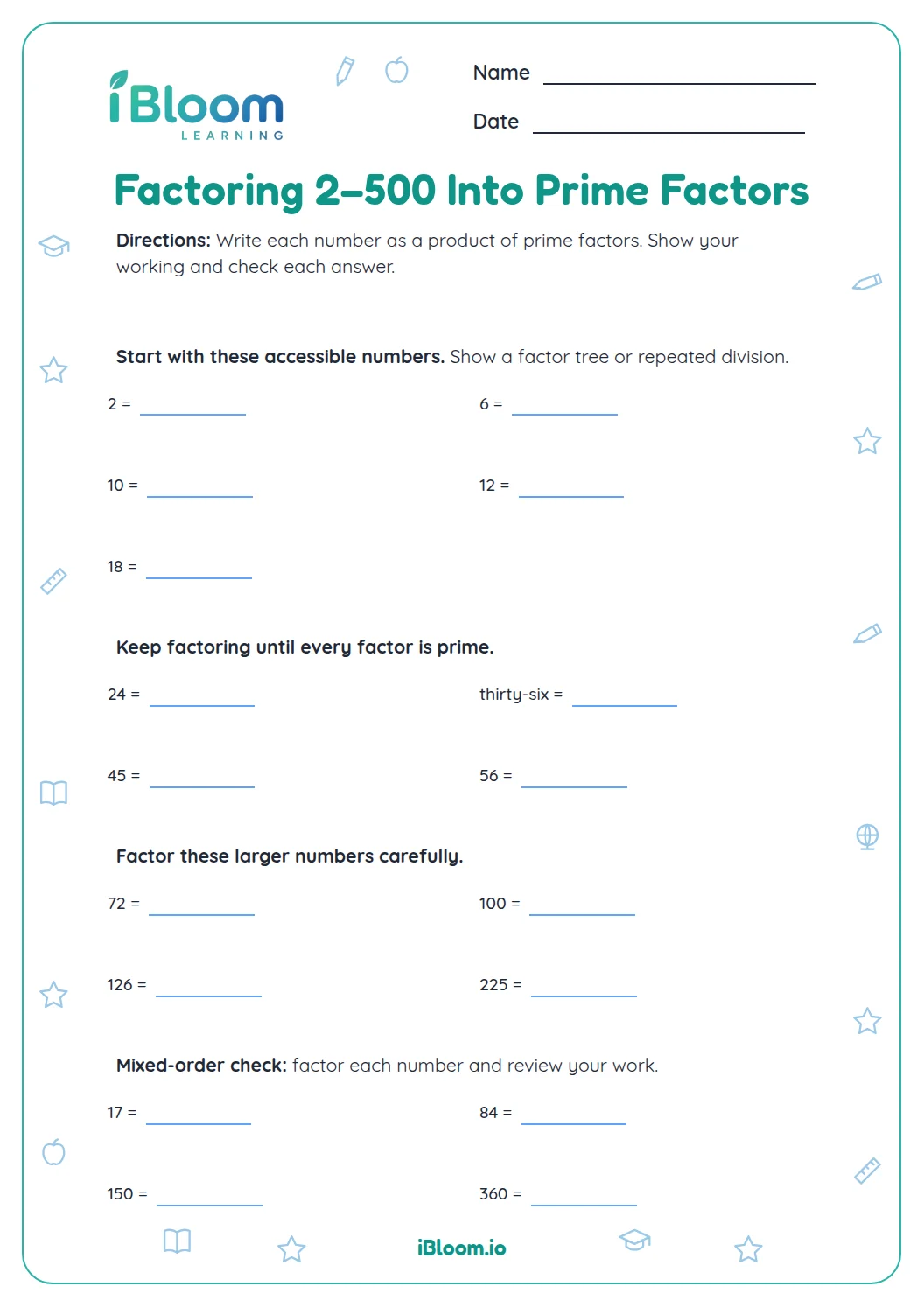
This free Grade 6 worksheet uses factor chains and factor trees to break selected numbers through 100 into primes. Students choose complete prime products, fill missing primes, check 0 and 1, and write repeated factors with exponents before drawing three trees of their own. The 17 questions build from supplied factor pairs to independent models. Part C practices Common Core 6.EE.A.1 by writing numerical expressions with whole-number exponents and multiplying to check them. A separate answer key gives each result and sample branches for the trees. Keep splitting every composite factor until all the end numbers are prime.
Aligned to 6.EE.A.1
How do students finish a factor chain?
Each arrow shows a number being replaced by factors with the same product. In Part A, the supplied pair is a starting point. Students must keep splitting composite factors, including both factors when both are composite.
Part B leaves one prime missing from each chain. Multiplying the factors already shown helps students find the missing one and check that the chain still equals its starting number.
- 124 → 6 × 4
- 26 → 2 × 3 and 4 → 2 × 2
- 324 = 2 × 2 × 2 × 3
- 4Check: 2 × 2 × 2 × 3 = 24; every factor is prime.
How do exponents record repeated primes?
An exponent counts how many copies of a prime appear as factors. In question 11, 48 → 6 × 8 becomes (2 × 3) × (2 × 2 × 2), giving four factors of 2 and one of 3. Write 2⁴ × 3.
Multiply to check: 2⁴ = 16, and 16 × 3 = 48. A factor used twice needs an exponent of 2, even if its copies came from different branches.
What should a finished factor tree show?
Part D asks for trees for 28, 63 and 84. Write the starting number above two branches, then put a factor pair at their ends. Split each composite end number into two more branches until every end number is prime.
Multiply only the prime end numbers to write the final product. Different first splits are valid: 28 can begin with 4 × 7 or 2 × 14. The key supplies one possible set of branches, and either tree ends with two 2s and one 7.
Why do 0 and 1 need separate checks?
Zero cannot be written as a product of positive primes because multiplying positive primes gives a positive number. One has no prime factors and is neither prime nor composite. Questions 5 and 6 ask students to state those facts before continuing with exponent notation.
How to use this worksheet
- 1Read a starting factor pair and decide which factors are composite.
- 2Split composite factors again, retaining every repeated prime.
- 3Answer the 0 and 1 choices in Part A, then complete the four chains in Part B.
- 4In Part C, group equal primes, write their exponents, and multiply to check.
- 5Draw the three trees in Part D and write a product from each tree’s prime ends.
- 6Compare with the key; accept different branch arrangements with the same prime factors.
Mistakes to watch for
The mistake
Stopping at 6 × 4 for 24.
The fix
Both factors are composite. Split 6 into 2 × 3 and 4 into 2 × 2.
The mistake
Writing 2³ × 3 for 48 after counting only the three 2s from 8.
The fix
The 6 contributes another 2. Keep all four: 48 = 2⁴ × 3.
The mistake
Including 1 as a prime end number in a tree.
The fix
A prime has exactly two positive factors. One has only one, so it is not a prime factor.
Curriculum alignment
Write prime products with whole-number exponents and check their values.
On this sheet: Part C asks students to write four prime products with whole-number exponents and multiply to check them.
Show the official wordingHide the official wording
Write and evaluate numerical expressions involving whole-number exponents.
What to practice next
Make more practice
Further reading
Questions parents and teachers ask
What does an arrow in a factor chain mean?
An arrow replaces a number with factors that multiply to that number. In 24 → 6 × 4, both 6 and 4 can split further. The next stage uses 2 × 3 × 2 × 2. Multiplying after each stage checks that the value has stayed 24.
Can my child start a factor tree with a different pair?
Yes, any pair of factors both greater than 1 can start the tree. For 28, both 4 × 7 and 2 × 14 work. Keep splitting composite factors until all end numbers are prime. The finished product should contain two factors of 2 and one factor of 7.
What should students write in the exponent section?
Write a product of prime bases, using exponents for repeated factors. For 48, write 2⁴ × 3, since four factors of 2 and one of 3 make 48. Then multiply to check. The four questions in Part C use 48, 75, 90 and 100.
How does the worksheet handle zero and one?
Part A asks whether zero can be a product of positive primes and which statement about one is true. Choose no for zero and “1 has no prime factors” for one. Every prime is at least 2, so multiplying one or more primes cannot give 0 or 1.
What does the key show for the factor trees?
The key describes one set of branches for each tree and gives its prime product. Use these notes to check your child’s drawing. A different branch arrangement is correct when each split multiplies back to its parent number and the final prime factors multiply to the starting number.