







About this worksheet
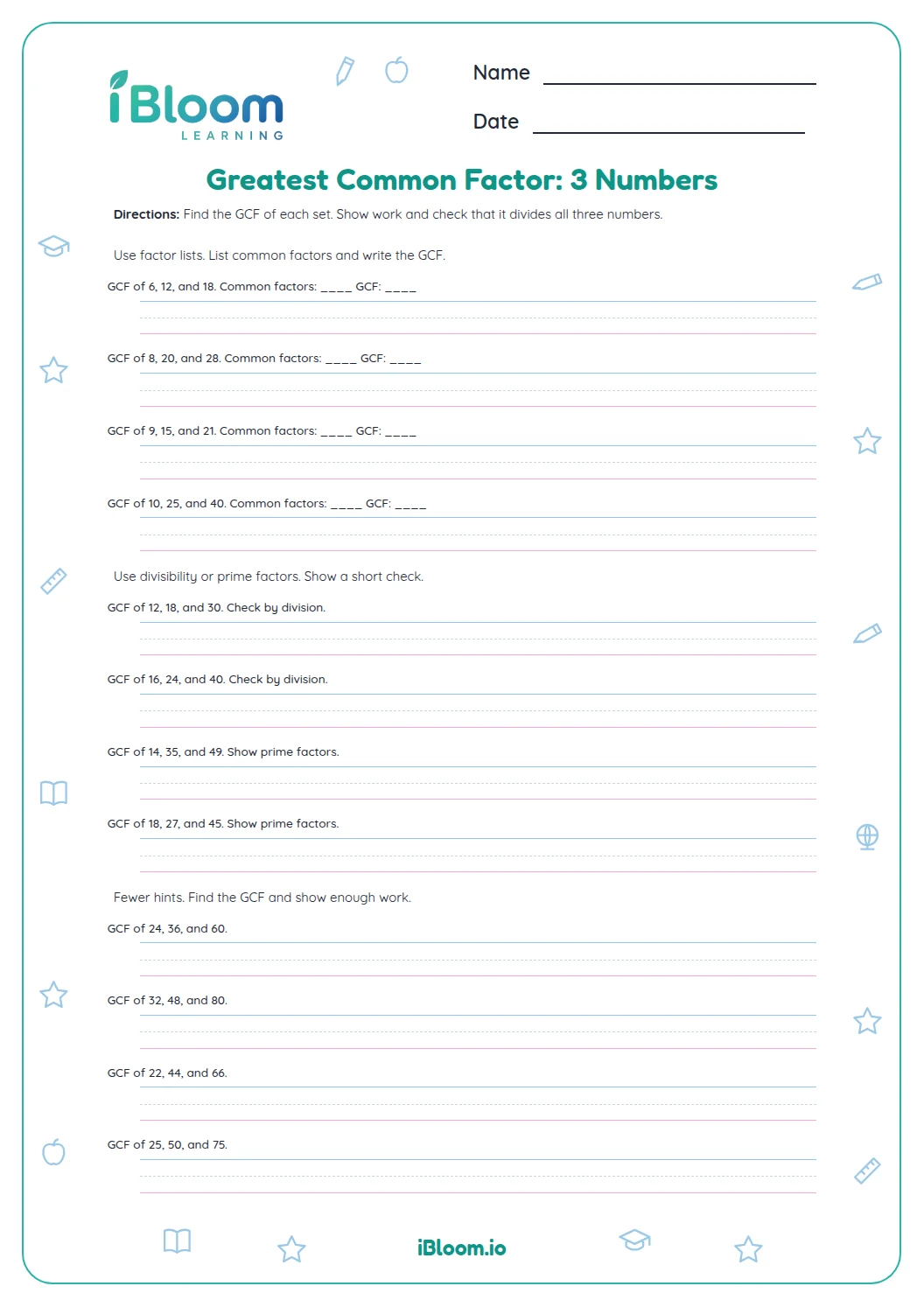
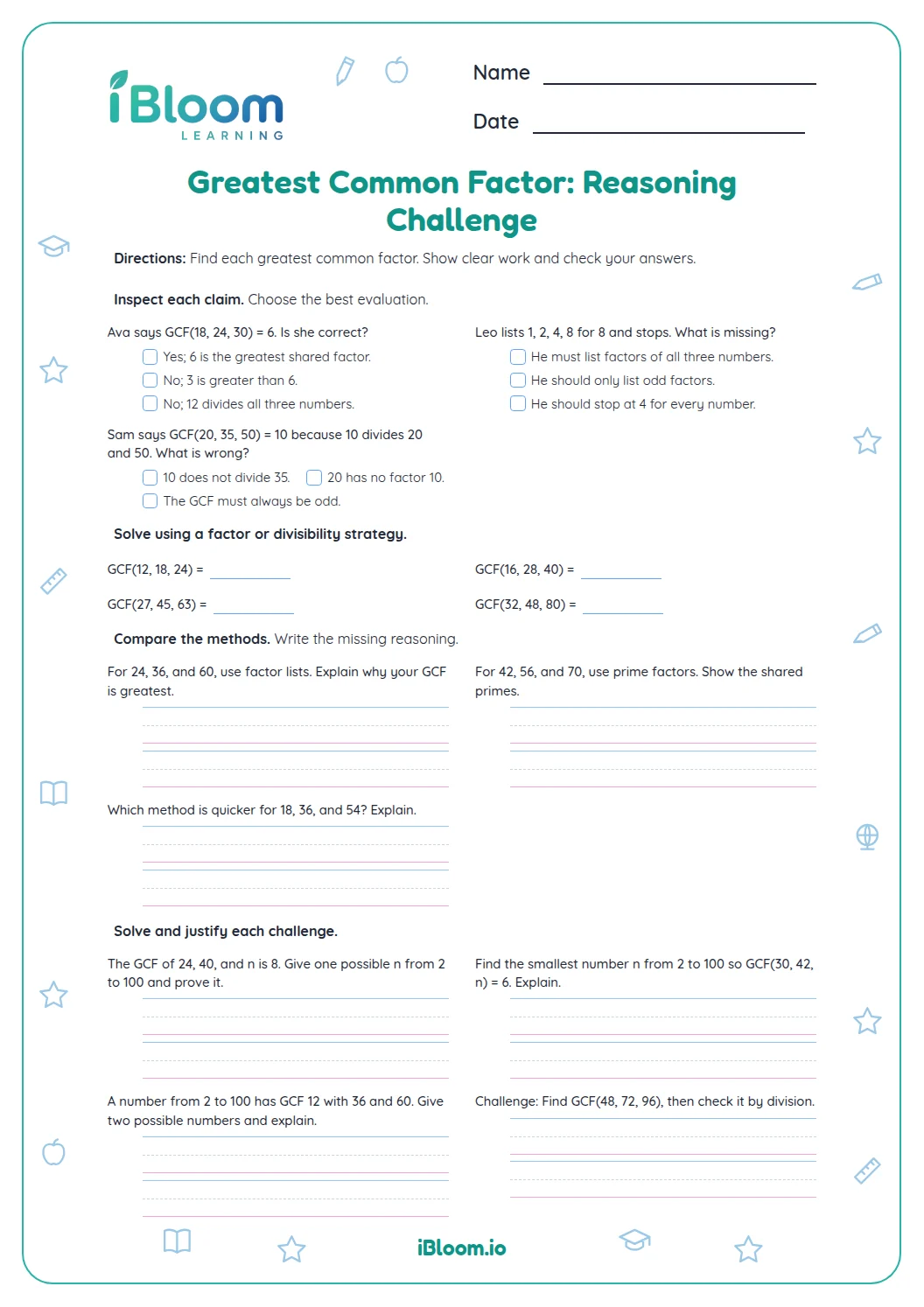
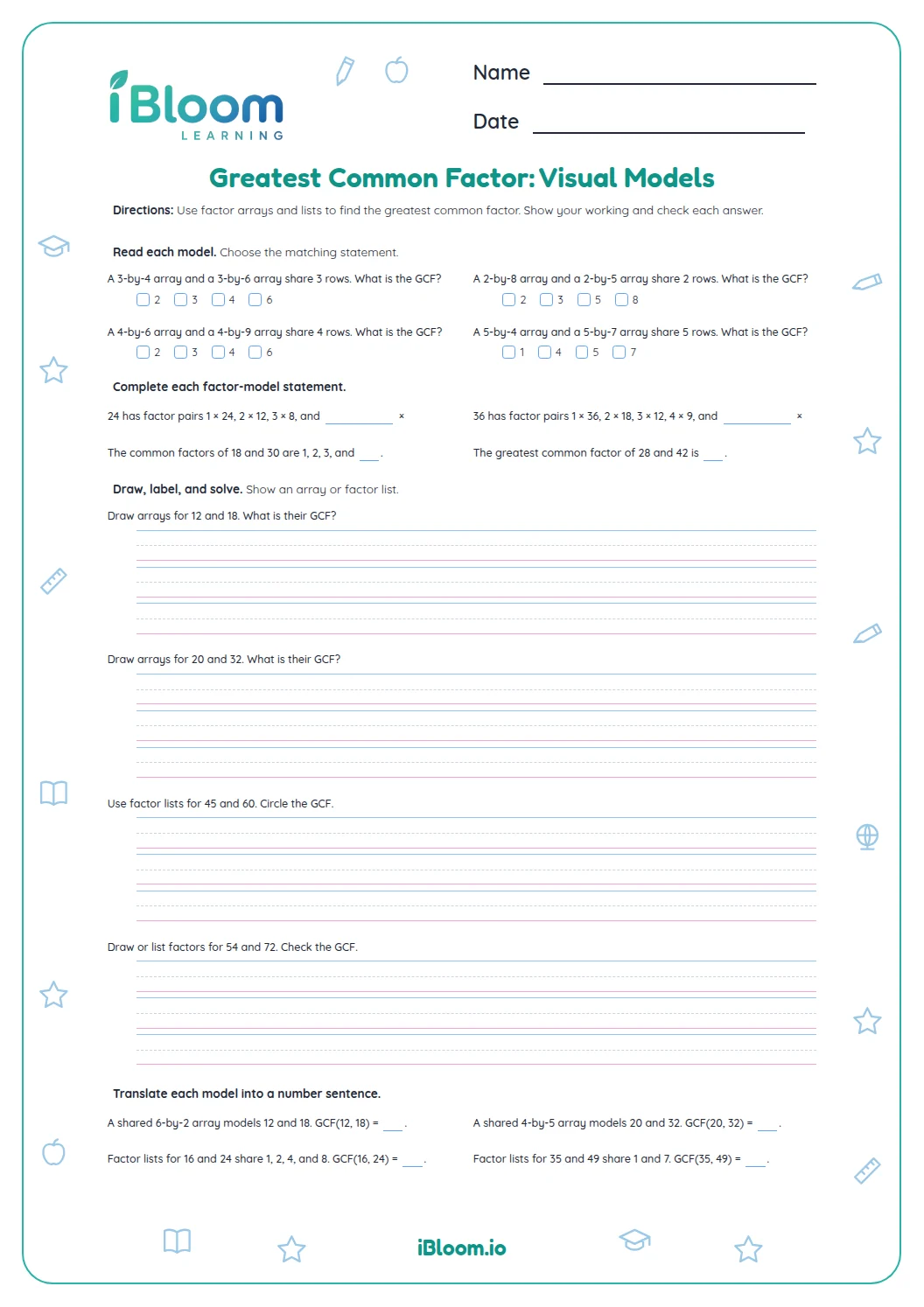
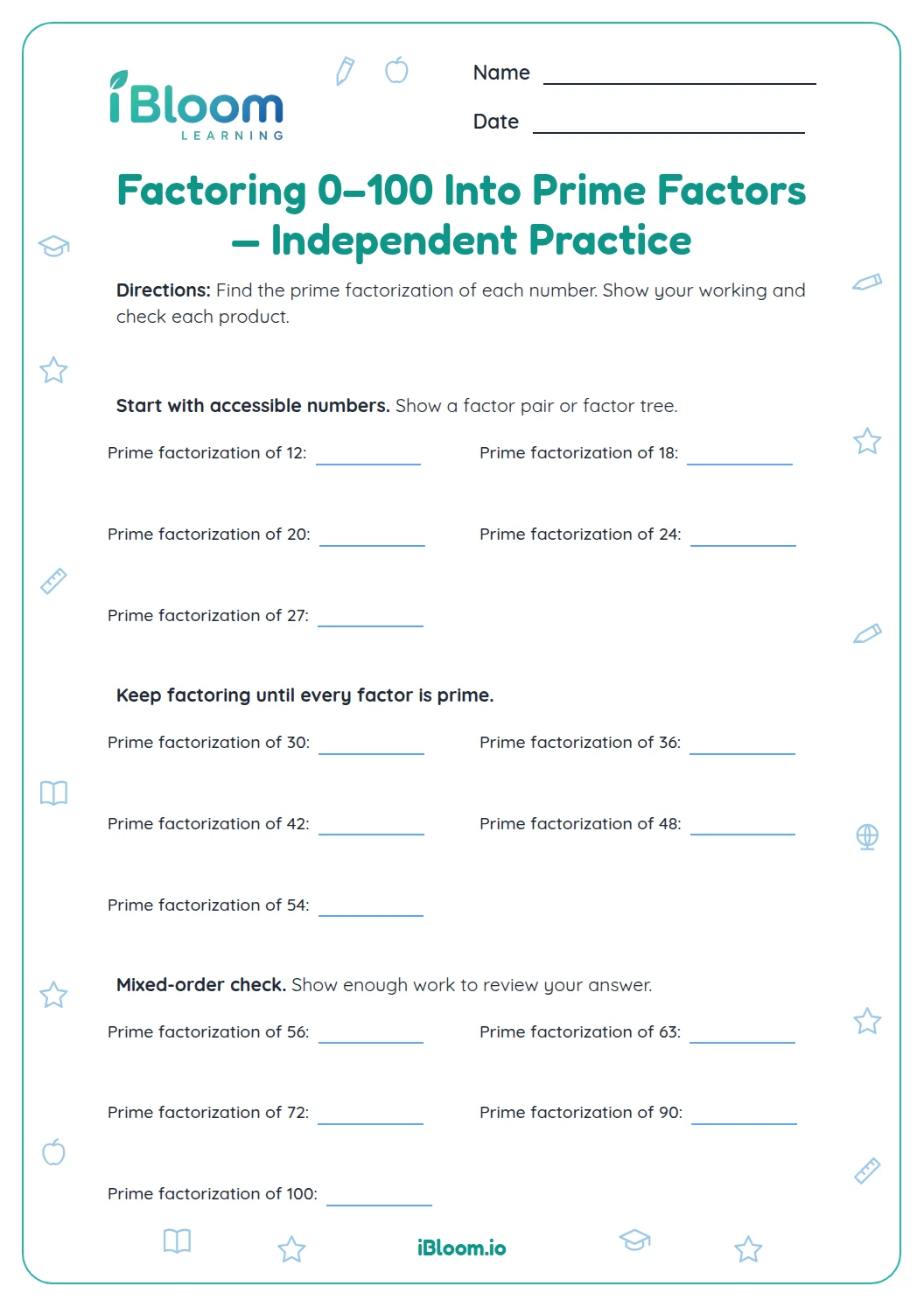
This Grade 6 printable develops the idea of a greatest common factor across three numbers. Learners identify shared factors, calculate GCFs, and use the result to make equal groups without leftovers. Fourteen questions move from direct practice to reasoning, with a separate answer key.
Aligned to CCSS 6.NS.B.4
What is the greatest common factor?
A factor divides a number with no remainder. A common factor divides every number in a set. The greatest common factor, or GCF, is the largest of those shared factors. For 12, 18, and 24, the GCF is 6.
How can you find a GCF?
List the factors for each number and compare the lists, or compare prime factorizations. Check the result by dividing every number in the set by it.
- Part A: find GCFs for three numbers.
- Part B: identify shared factors and apply GCF reasoning.
How can you check a proposed GCF?
A proposed common factor must divide each number with no remainder. Then check that no larger common factor exists.
- 1Find the GCF of 12, 18, and 24.
- 2A factor shared by all three is 6.
- 3No larger factor divides all three, so the GCF is 6.
How to use this worksheet
- 1Read the directions and complete Part A before moving on.
- 2Read each sentence or expression fully before choosing or calculating.
- 3Mark the clue, factor, or operation that supports your answer.
- 4For written work, reread the response and check that it answers the prompt.
- 5Use the separate answer key to check each response and revisit any missed step.
Common mistakes and quick fixes
The mistake
Answering from one familiar word or number without reading the full prompt.
The fix
Read the whole item and identify the clue or operation it asks you to use.
The mistake
Stopping after a first step when the item needs more reasoning.
The fix
Check whether the prompt asks for a meaning, a greatest value, or a final result.
The mistake
Copying an answer without checking that it fits the sentence or calculation.
The fix
Read the completed response again and compare it with the original question.
Curriculum alignment
This worksheet practices the following Common Core standard.
Find a greatest common factor by checking factors shared by the numbers.
On this sheet: Learners find common factors and greatest common factors; the worksheet extends the shared-factor reasoning to three numbers, as its title specifies.
Show the official wordingHide the official wording
Find the greatest common factor of two whole numbers less than or equal to 100 and the least common multiple of two whole numbers less than or equal to 12.
What to practice next
Make more practice
Further reading
Questions parents and teachers ask
What does common factor mean?
A common factor is a whole number that divides every number in a set with no remainder. For a three-number GCF question, a factor shared by only two numbers does not qualify. The first part asks learners to compare factors across triples and select the greatest one.
How can you check a proposed GCF?
Divide each number in the set by the proposed GCF. Each quotient should be a whole number. Then make sure no larger number also divides all the original numbers evenly. This two-part check confirms both that the factor is common and that it is the greatest.
Why must a factor divide all three numbers?
The phrase common factor means the factor is shared by every number in the group. A number that divides only two of the three is not common to the entire set. Check each number before choosing a candidate, even if it divides the first pair evenly.
What is the difference between a common factor and the GCF?
A set of numbers can have several common factors. The greatest common factor is the largest one. List or identify shared factors, then select the greatest value that divides every number. For example, 1, 2, 3, and 6 divide 12, 18, and 24.
How does GCF help make equal groups?
The GCF gives the greatest number of identical groups that can be made with no items left over when each color or type is split evenly. For 24, 36, and 60 beads, the GCF is 12, so the club can make 12 groups.