








About this worksheet
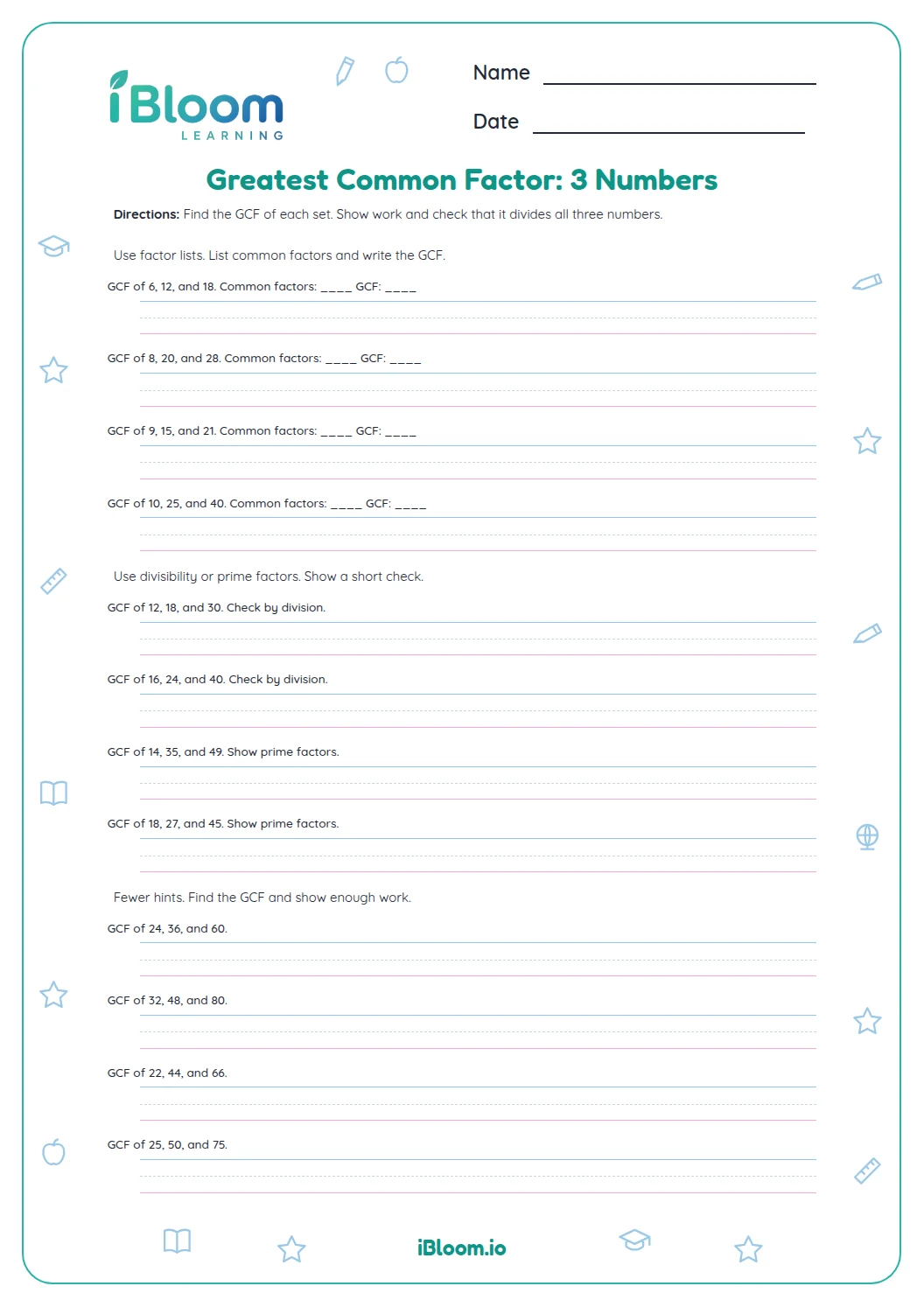
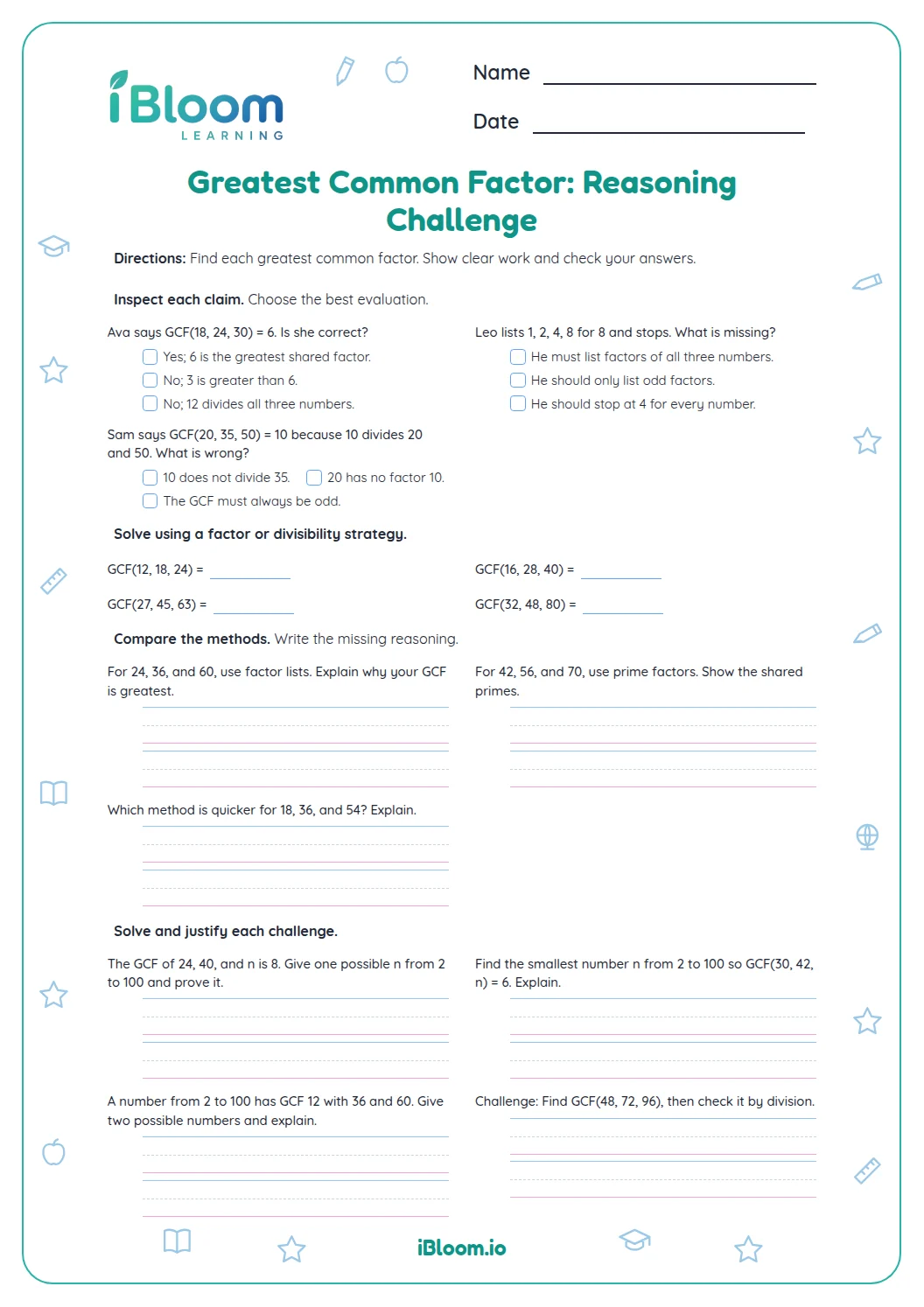
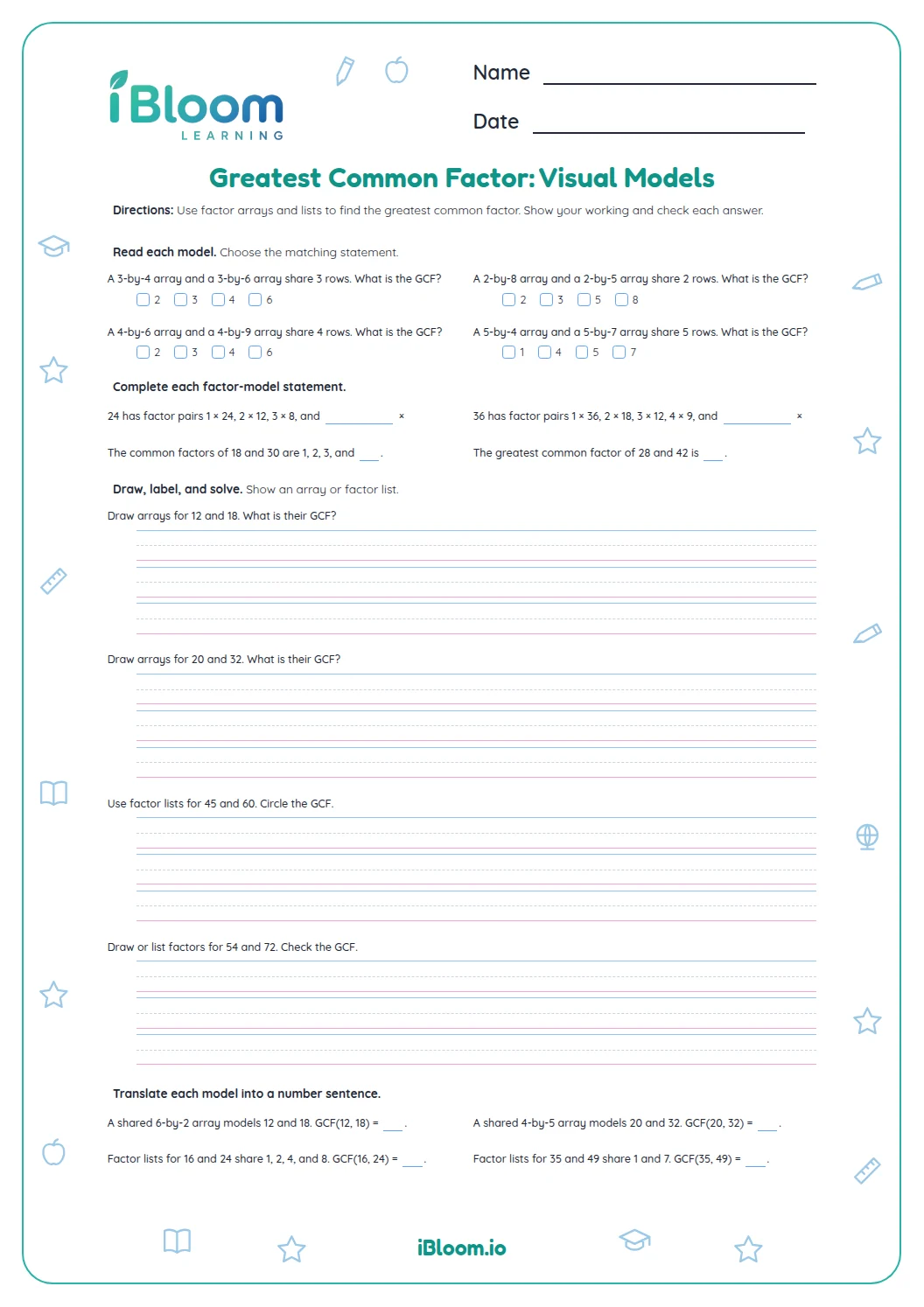
This free Grade 6 worksheet practices greatest common factor (GCF) with three-number sets from 2 to 100. Children use GCF to find the greatest number of identical kits, rows, bundles, or groups that use every item, then solve ten direct GCF questions. It aligns with CCSS 6.NS.B.4. The printable includes 14 problems over two worksheet pages and a separate answer key.
Aligned to 6.NS.B.4
What does the GCF tell you in a grouping problem?
When three amounts must be split into identical groups with nothing left over, the GCF gives the largest possible number of groups. The number of items in each group may differ by item type, but every group has the same mix.
How do you find a GCF for three numbers?
List factors or use prime factorization for each number. Keep only factors shared by all three, then choose the largest. Check by dividing each amount by your answer; each quotient should be a whole number.
- 136 red, 60 blue, 84 green beads
- 2The greatest factor shared by 36, 60, and 84 is 12.
- 3So the club can make 12 identical kits.
What kinds of problems are on the sheet?
Part A uses four equal-group word problems. Part B asks for the GCF directly, so students can focus on factor work without a story.
- 4 equal-group word problems with three amounts
- 10 direct GCF questions with three-number sets
- Every story asks for the greatest number of equal groups
How to use this worksheet
- 1Read all three quantities and underline what must be shared equally.
- 2Decide whether the question asks for the number of groups or items in each group.
- 3Find factors common to all three amounts.
- 4Choose the greatest shared factor.
- 5Divide each amount by it to check there are no leftovers.
- 6Write the unit named in the story, such as kits or rows.
Common mistakes and quick fixes
The mistake
Using a factor shared by only two amounts.
The fix
Check the third amount too; a valid GCF must divide all three numbers.
The mistake
Choosing a smaller common factor.
The fix
Compare shared factors and select the greatest one.
The mistake
Reporting items per group instead of number of groups.
The fix
Reread the question and label the answer with the requested unit.
Common Core alignment
This worksheet gives children focused practice with the stated grade-level skill.
Find the greatest common factor of three whole numbers, each at most 100.
On this sheet: The practice finds a greatest common factor for sets of three numbers within 100.
Show the official wordingHide the official wording
Find the greatest common factor of two whole numbers less than or equal to 100 and the least common multiple of two whole numbers less than or equal to 12. Use the distributive property to express a sum of two whole numbers 1-100 with a common factor as a multiple of a sum of two whole numbers with no common factor. For example, express 36 + 8 as 4 (9 + 2).
What to practice next
Make more practice
Further reading
Questions parents and teachers ask
What does GCF mean in these problems?
GCF means greatest common factor. It is the largest whole number that divides every amount in the problem with no remainder. In an equal-kit problem, that number tells how many identical kits can be made when all supplies are used.
How many numbers are in each GCF set?
Every direct set and story problem uses three amounts. Students look for a factor shared by all three, so a factor that works for only two quantities is not enough. Check that each amount divides evenly by the candidate. No remainder may be left.
Does the answer mean items in each group?
The questions ask for the greatest number of groups, so the answer is the number of kits, rows, bundles, or sets. To find how many of each item goes in one group, divide each amount by that group count. The answer is the group count, not the contents of one kit.
Can students use prime factorization?
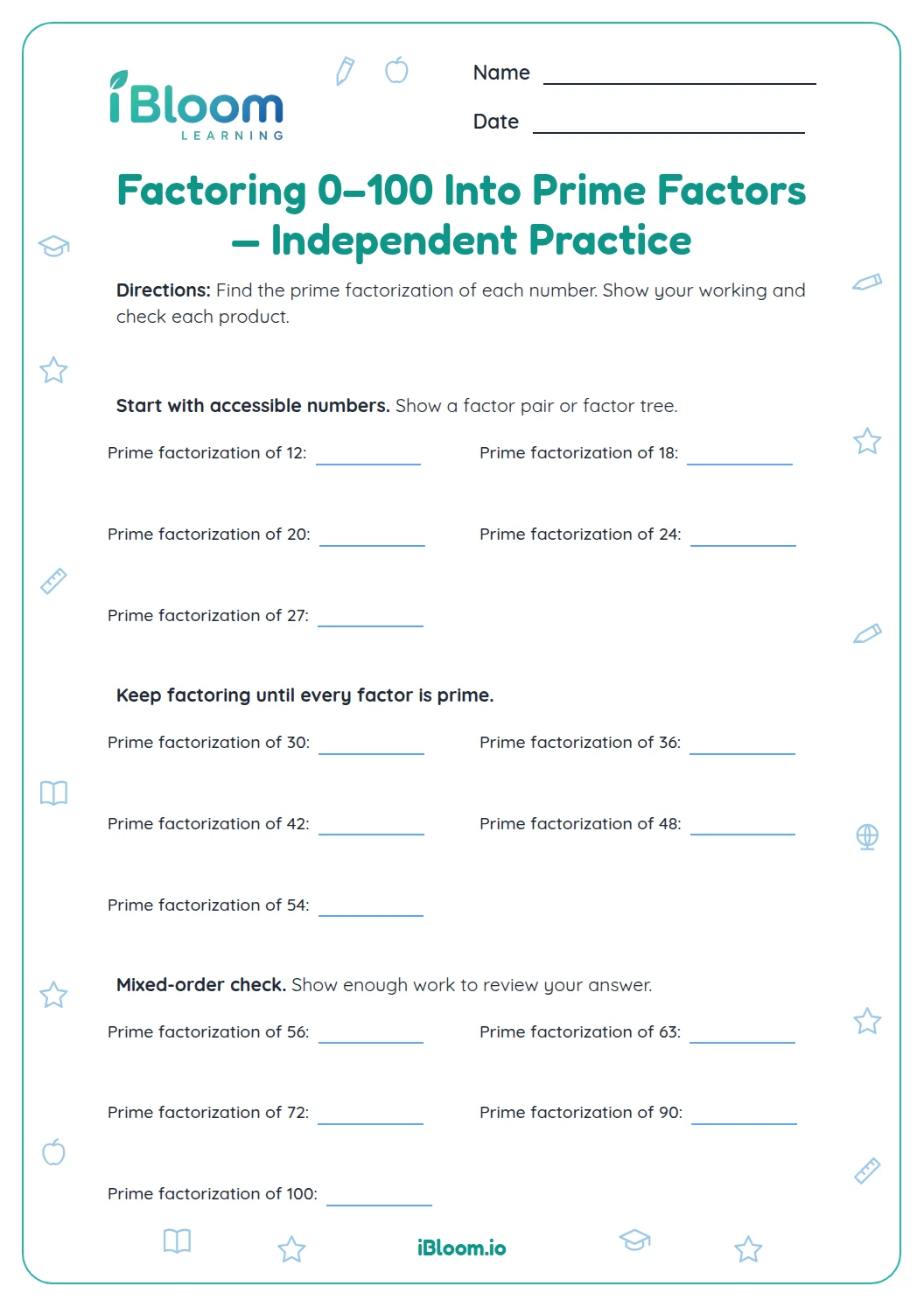
Yes. Prime factorization is one useful way to identify factors shared by all three numbers. Students may also list factors or check candidates by division, then confirm the chosen factor is greatest. Each method should account for all three amounts in the set. The numerical section also lists each three-number set.
Is an answer key included?
Yes. The answer key gives the GCF and the labeled number of groups for each word problem, along with the numerical answers. Students can use division to verify that each group count divides all three starting amounts evenly. Equivalent work is also acceptable.