









About this worksheet
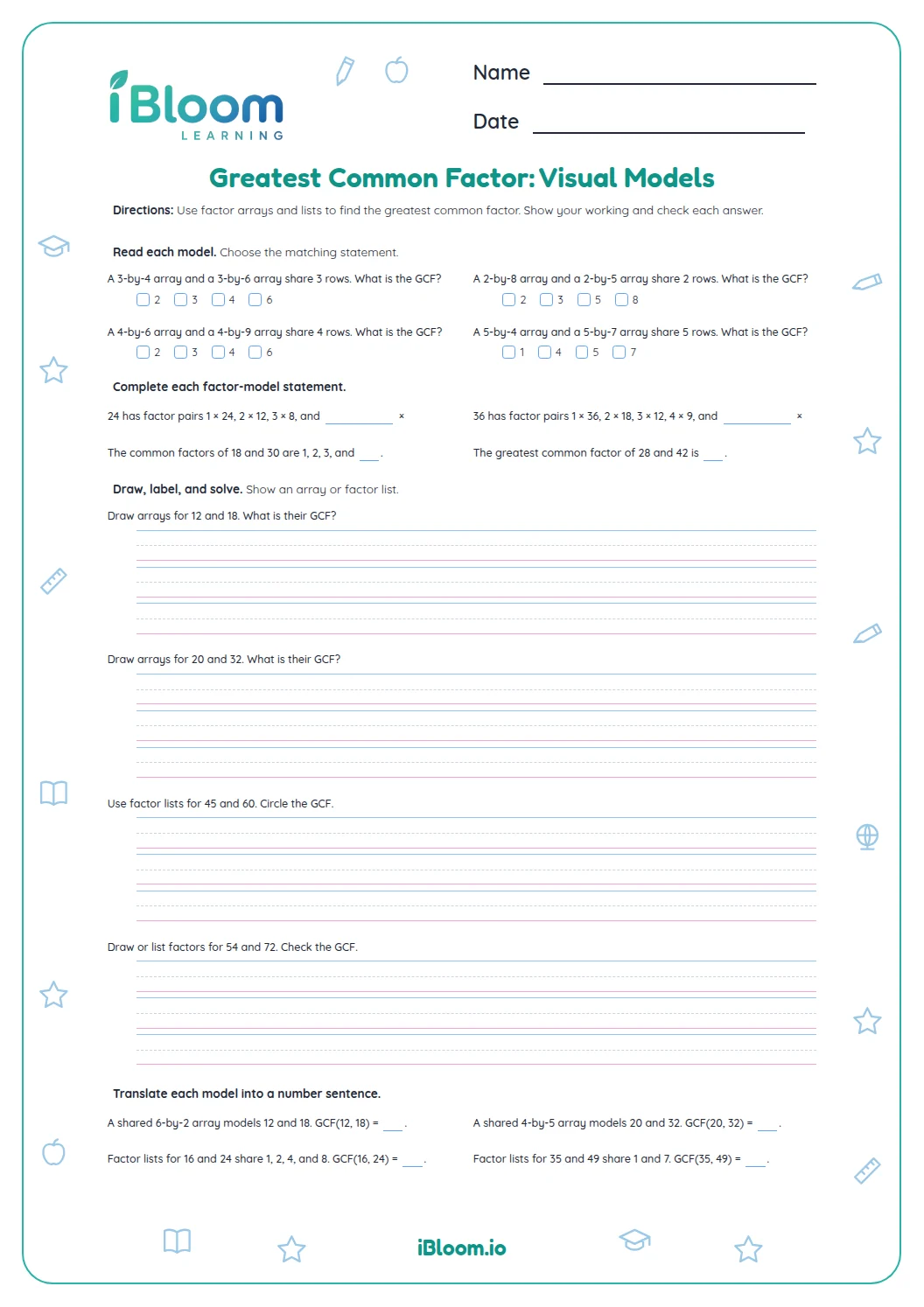
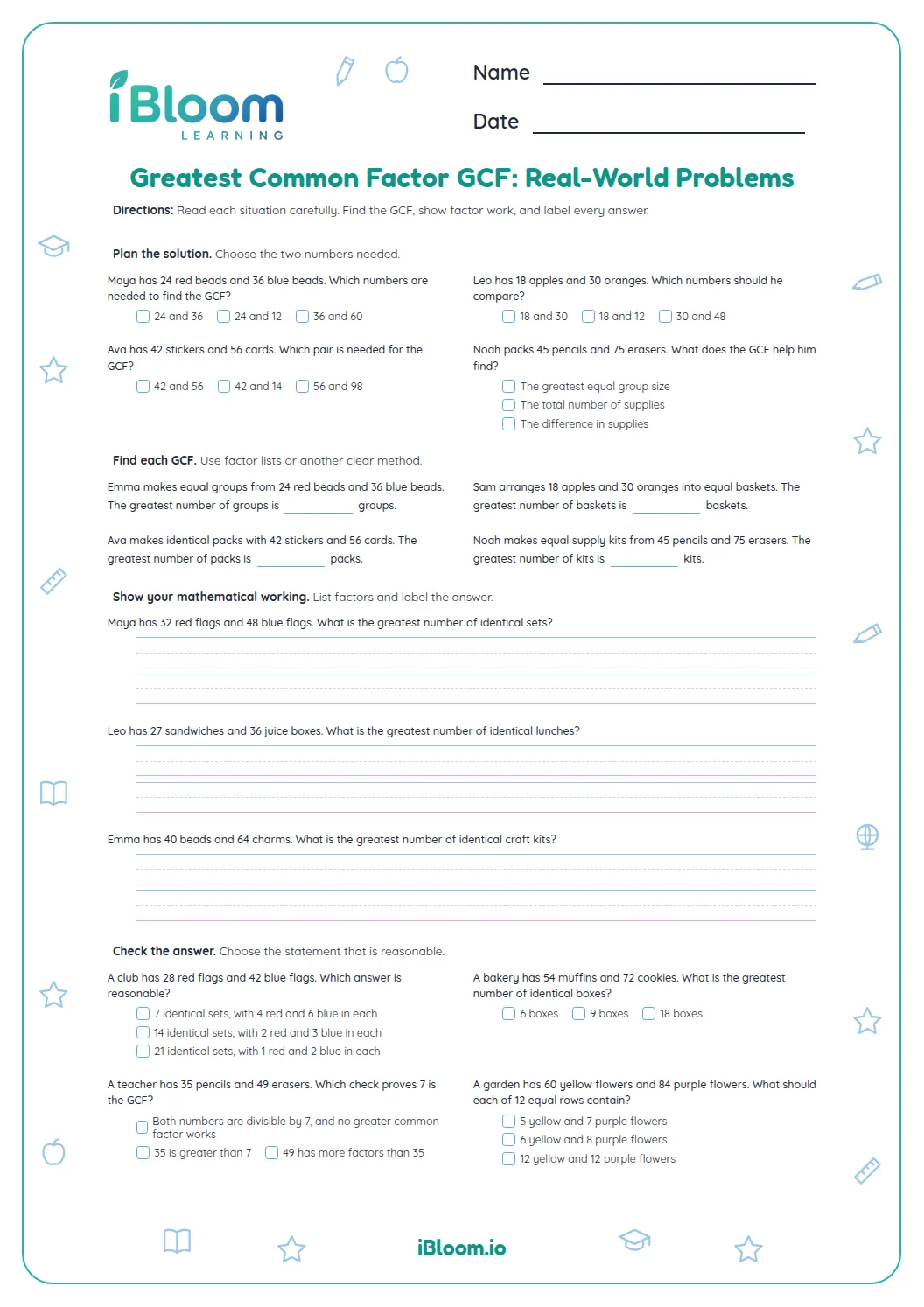
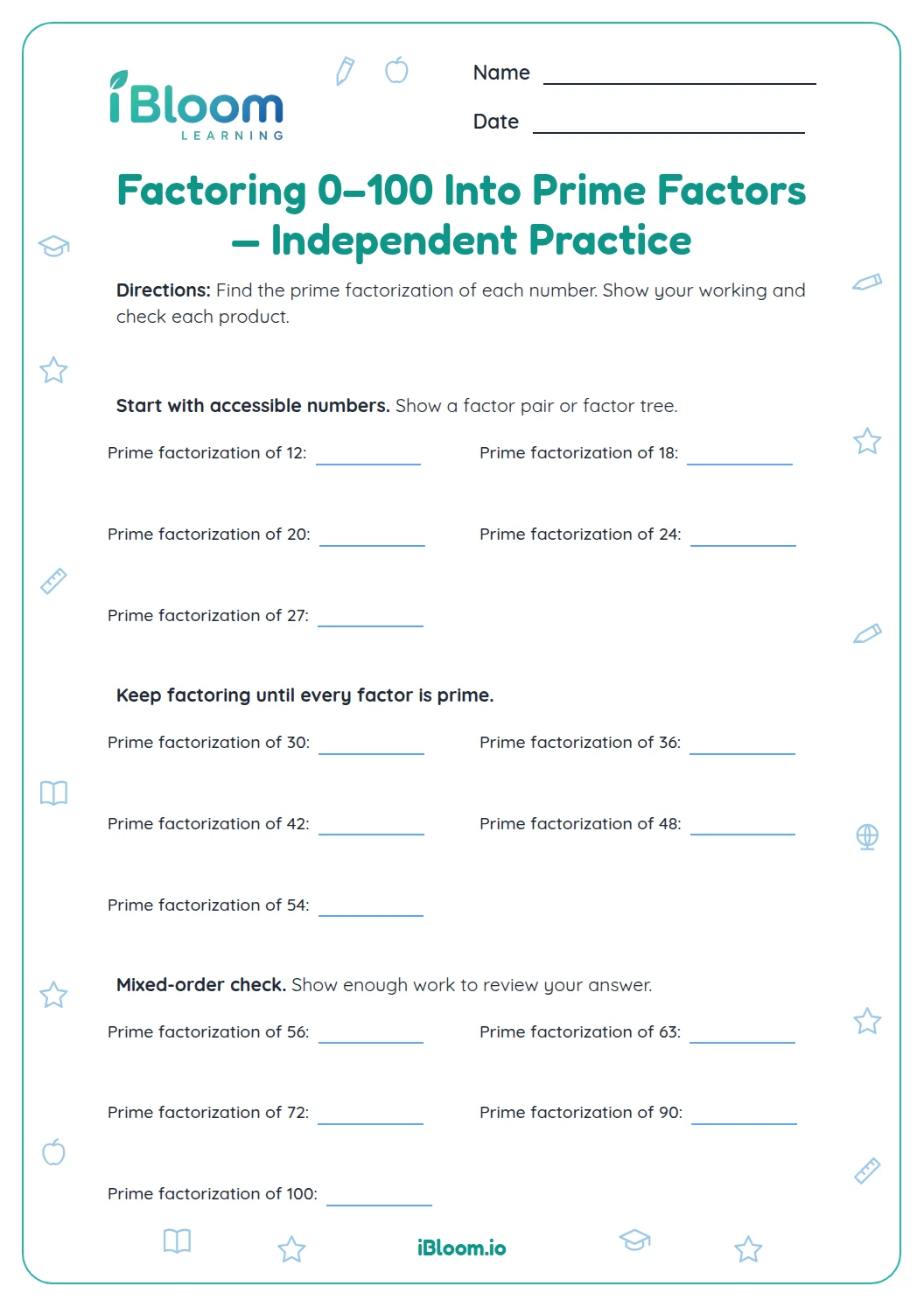
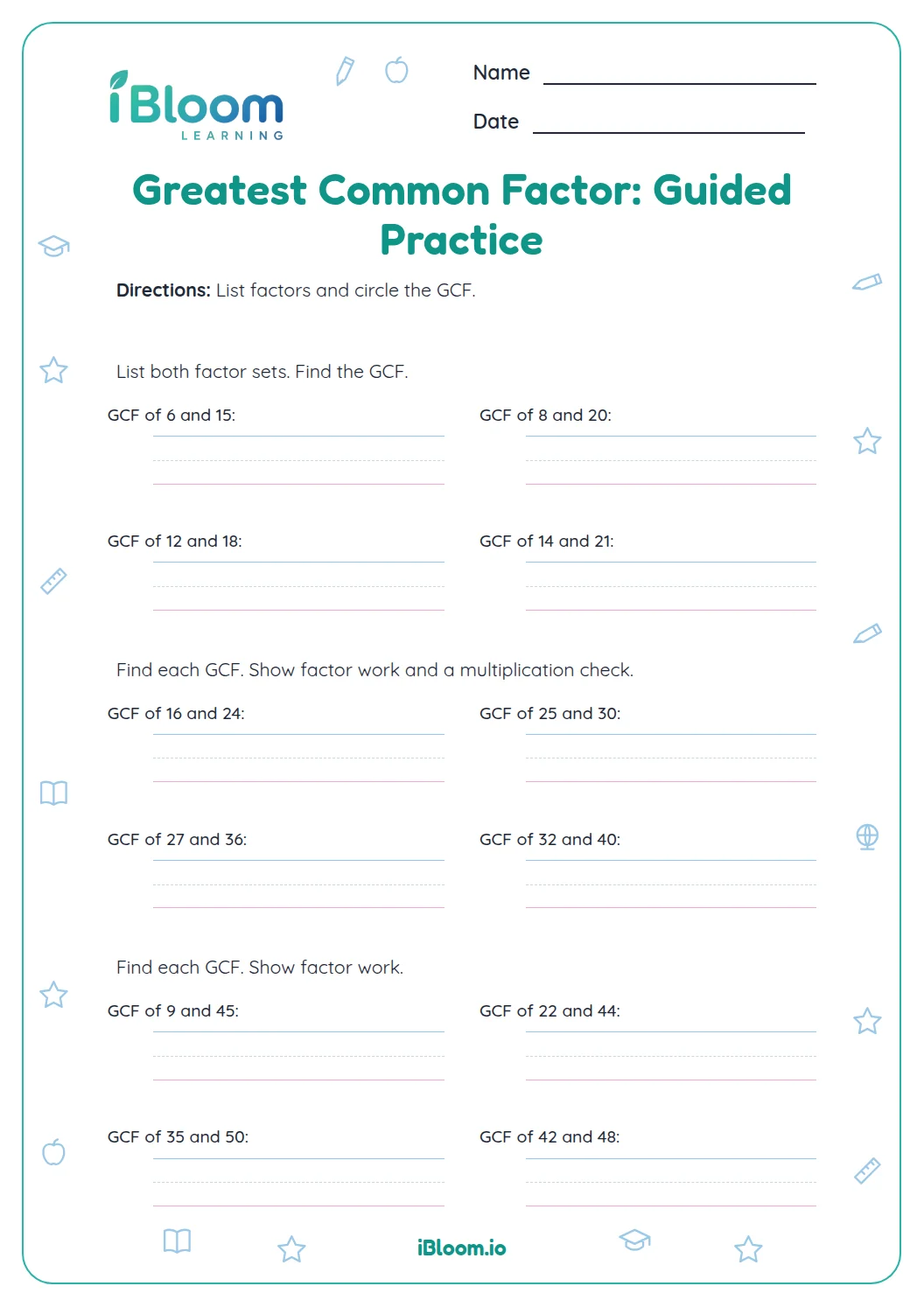
This Grade 6 worksheet guides students through finding the greatest common factor of two whole numbers from 2 to 100. The first questions warm up with missing factors, the next set asks for the GCF, and the final set uses that factor to rewrite sums with the distributive property. The page practices the GCF and factoring language in Common Core 6.NS.B.4. The answer key gives the common factor or an equivalent factored expression for every problem.
Aligned to 6.NS.B.4
How do factor pairs help find a GCF?
A factor divides a number with no remainder. Factor pairs multiply to make the number, so question 1, 6 × ___ = 42, uses 7 to complete the pair. Shared factors are the factors that divide both numbers.
- 16 × 7 = 42
- 2So 7 is a factor of 42.
How do I know a common factor is the greatest?
Check that the candidate divides both numbers. Then make sure there is no larger factor shared by them. In question 5, 6 divides 18 and 30, while the next larger shared factor does not divide both.
- 1Factors common to 18 and 30 include 1, 2, 3 and 6.
- 2The greatest shared factor is 6.
How does the GCF rewrite a sum?
Divide each addend by the GCF. Put the GCF outside parentheses and the two quotients inside. Multiplying back should return each original addend.
- 118 ÷ 6 = 3 and 30 ÷ 6 = 5.
- 218 + 30 = 6 × (3 + 5).
How to use this worksheet
- 1Finish each missing factor pair by multiplying to check it.
- 2For a GCF question, test factors that divide both numbers evenly.
- 3Compare the common factors and select the largest one.
- 4For a sum, divide each addend by the GCF and place both quotients in parentheses.
- 5Multiply the outside factor through the parentheses to check the original sum.
Common mistakes and quick fixes
The mistake
Choosing a factor that divides only one number.
The fix
Divide the candidate into both numbers and check for zero remainder.
The mistake
Stopping at a common factor that is not the greatest.
The fix
Check whether a larger factor also divides both numbers.
The mistake
Dividing only one addend when factoring a sum.
The fix
Divide each addend by the GCF and include both quotients inside parentheses.
Common Core alignment
The questions use GCFs of two whole numbers and apply the distributive property to sums.
Find GCFs of pairs up to 100 and write sums as a common factor times a sum.
On this sheet: Questions 5–12 find GCFs through 100; questions 13–18 factor sums using the GCF.
Show the official wordingHide the official wording
Find the greatest common factor of two whole numbers less than or equal to 100 and the least common multiple of two whole numbers less than or equal to 12. Use the distributive property to express a sum of two whole numbers 1-100 with a common factor as a multiple of a sum of two whole numbers with no common factor. For example, express 36 + 8 as 4 (9 + 2).
What to practice next
Make more practice
Questions parents and teachers ask
What is a greatest common factor?
The greatest common factor is the largest whole number that divides both numbers in a pair evenly. For 18 and 30, the shared factors include 1, 2, 3 and 6, so 6 is the GCF. Check it by dividing each original number by 6.
How can I check a GCF?
Divide both numbers by the proposed GCF and confirm both quotients are whole numbers. Then check whether a larger factor is shared. For example, 6 divides 18 and 30, and no larger whole-number factor divides both, so it is their greatest common factor.
What does factoring out the GCF mean?
Write the GCF outside parentheses and put the quotients of both addends inside. For example, divide 18 and 30 by 6 to get 3 and 5, then write 18 + 30 as 6 × (3 + 5). Multiplying back checks the expression.
Are equivalent factored expressions accepted?
Yes. An equivalent expression is correct when multiplying it out returns the original sum and the outside factor is the greatest common factor. Check each addend by multiplying the outside number by its matching quotient inside the parentheses.