







About this worksheet
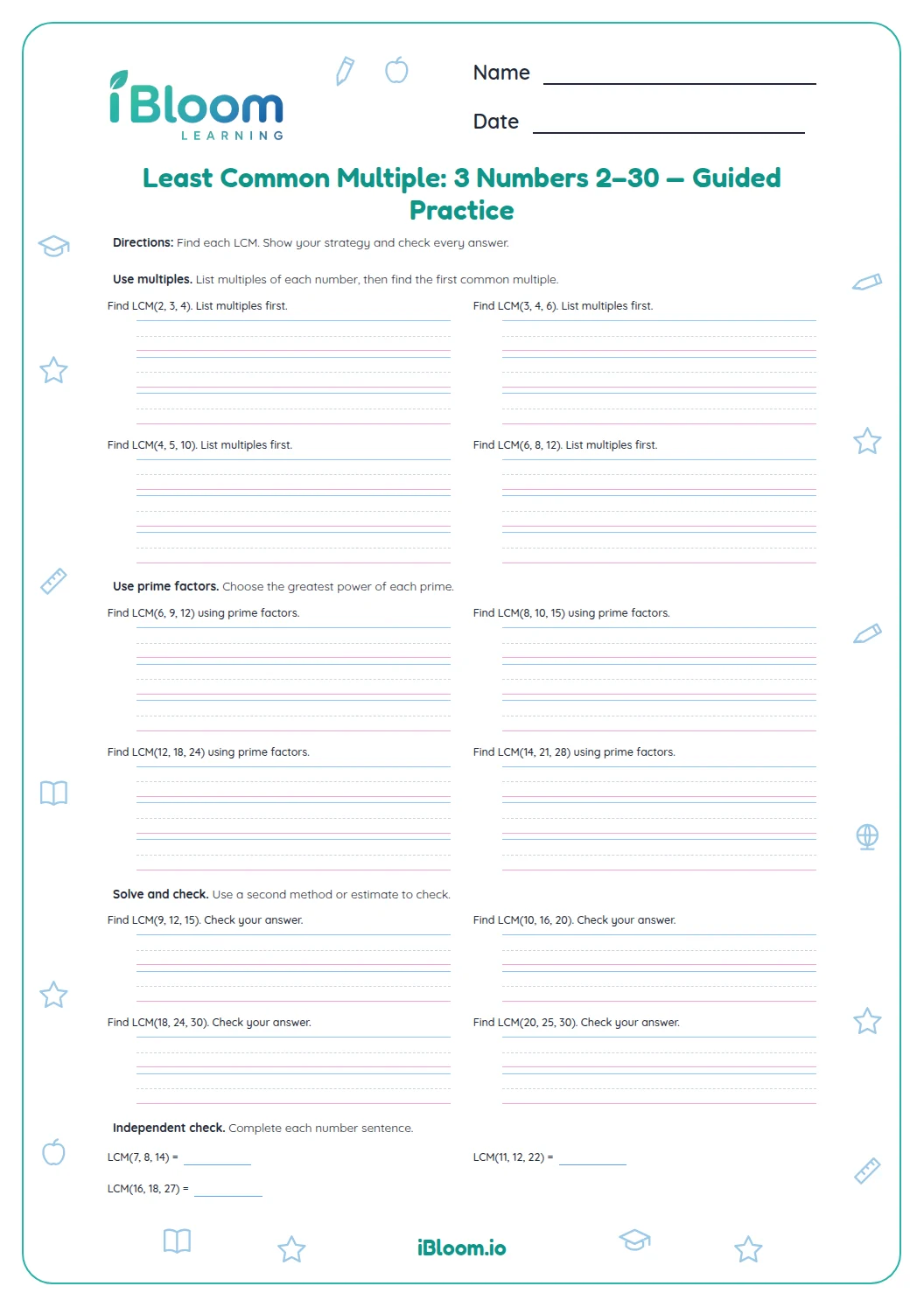
This Grade 6 math printable gives 16 pairs of whole numbers, all from 2 through 50. Learners find each least common multiple and have room to show a method such as listing multiples or using prime factors. The answer key gives the LCM for every pair.
Aligned to 6.NS.B.4
What will this worksheet help my child practice?
The 16 items focus on lcm guided practice. The answer key is included for checking the exact responses.
Read each direction before starting a part. The parts build practice with the named skill through the worksheet’s examples and response formats.
How should we work through the questions?
Work through Find the Least Common Multiple and Use a Helpful Strategy and Check the Shared Multiples in order. Read each sentence or number pair carefully before responding.
Use the key after completing the page. Ask the learner to point to the word, phrase, calculation, or grid location that supports the answer.
How can we check the answers?
Compare each response with the matching answer in the key. For written responses, check that the target phrase or ordered pair is complete and copied accurately.
If an answer differs, return to the exact sentence, number pair, or marked point and work through the relevant clue again.
How to use this worksheet
- 1Read the one-sentence direction together.
- 2Work through the first part in order.
- 3Ask the learner to explain one clue or step.
- 4Complete the remaining parts independently.
- 5Check every response with the answer key.
Common mistakes and quick fixes
The mistake
Stopping at a common multiple that is not least.
The fix
Check that no smaller positive multiple is shared.
The mistake
Multiplying the two numbers even when they share factors.
The fix
Use prime factors or list multiples, then remove duplicate factors.
The mistake
Giving a number not divisible by both inputs.
The fix
Divide the proposed LCM by each original number.
Curriculum alignment
This worksheet practices the skill described in this Common Core standard.
Find the least common multiple of two whole numbers.
On this sheet: Each item asks learners to find the least common multiple of a pair of whole numbers.
Show the official wordingHide the official wording
Find the greatest common factor of two whole numbers less than or equal to 100 and the least common multiple of two whole numbers less than or equal to 12. Use the distributive property to express a sum of two whole numbers 1–100 with a common factor as a multiple of a sum of two whole numbers with no common factor.
What to practice next
Further reading
Questions parents and teachers ask
What skill does this worksheet practice?
This worksheet practices finding the least common multiple of two whole numbers. Learners solve pairs using shared multiples or factor strategies, then check divisibility. The answer key gives the least shared multiple for every pair so work can be reviewed one item at a time.
How many questions are on the worksheet?
There are 16 number pairs in three parts, with room to work through each LCM. The first questions encourage listing multiples; later items invite more efficient strategies. Check that each answer is divisible by both numbers and that no smaller positive common multiple exists.
How should I use the answer key?
Check a choice against the exact word in the key. For a completed sentence, read it aloud with the noun inserted and confirm that the sentence makes sense as written. Review any difference by pointing back to the exact words or values in the original question.
What should I do if a question is difficult?
Read the sentence again and ask which word names a person, place, animal, or thing. Help the learner rule out action words and describing words, then try the item again. A brief explanation can help the learner remember the clue and apply the skill to a new example.
How long does the practice take?
Plan for about 15 minutes, with a short pause between the two parts if useful. Learners can complete the recognition questions first and return to the sentence completions later. Take breaks as needed and return to the remaining items with the same read, solve, check routine.
What can we practice next?
Continue with identifying nouns in full sentences, then practice sorting common and proper nouns. The related worksheets below keep the focus on naming words while changing the task. The linked activities provide another way to practice the skill with new examples and a different format.