





About this worksheet
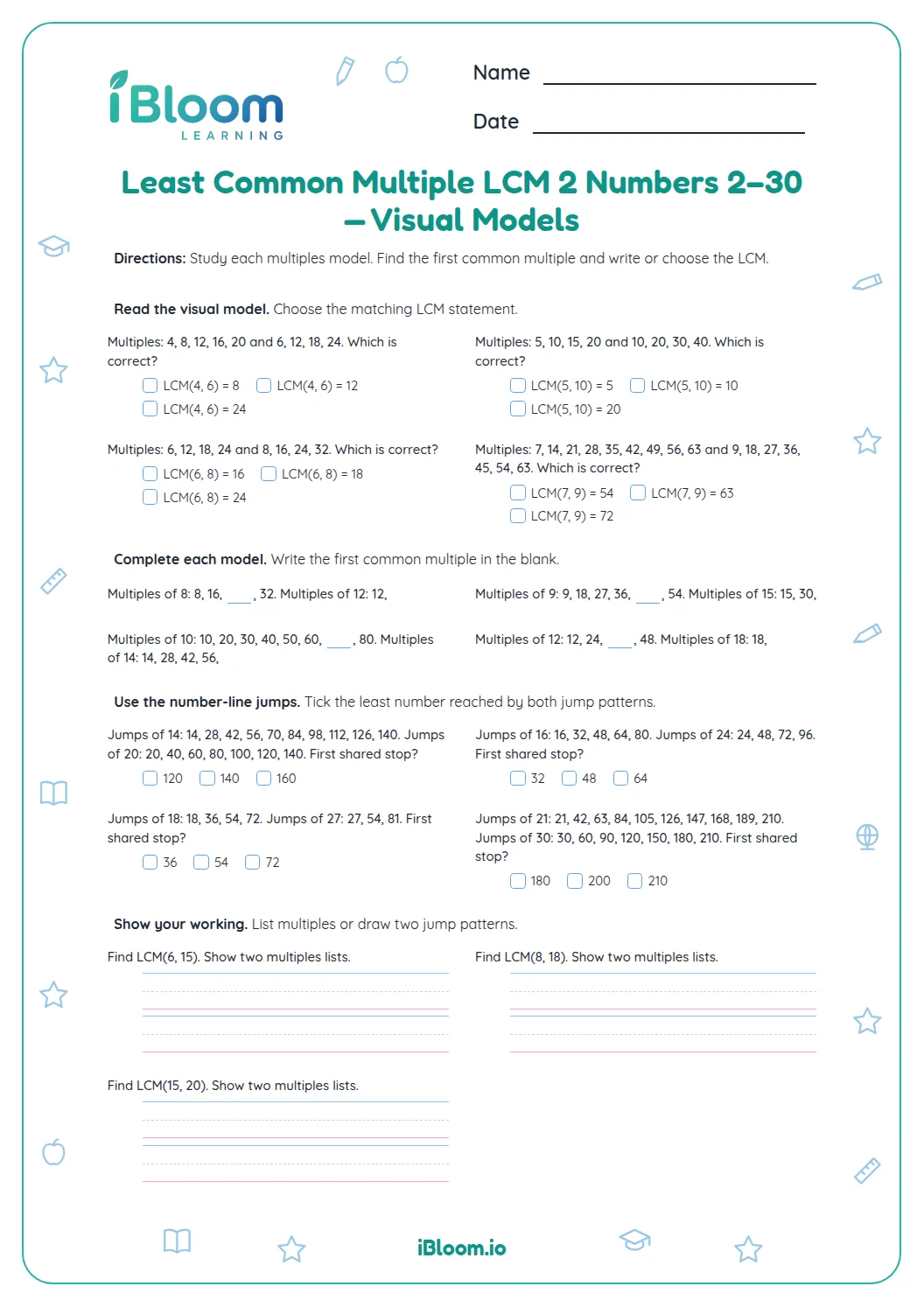
This Grade 6 challenge asks students to do more than list multiples. They explain why a number is a common multiple, identify a candidate that fails divisibility, compute five LCMs, and apply LCM to repeating events. The number pairs stay within the title’s 2–50 range. The page practices the LCM skill named in Common Core 6.NS.B.4.
Aligned to 6.NS.B.4
What is on this worksheet?
Fifteen questions build from recognizing common multiples to checking an explanation. Part A asks students to reason about common multiples and factors.
Part B checks reasoning and calculates least common multiples. Part C continues the calculations and applies LCM to two repeating events.
- Part A: reason about common multiples and factors (questions 1–5)
- Part B: test a claim and find LCMs (questions 6–10)
- Part C: find LCMs and solve repeating-event problems (questions 11–15)
How do you know a common multiple is the least one?
A common multiple is divisible by both numbers. The least common multiple is the smallest positive number with that property. A number that is common but larger than another common multiple is not the LCM.
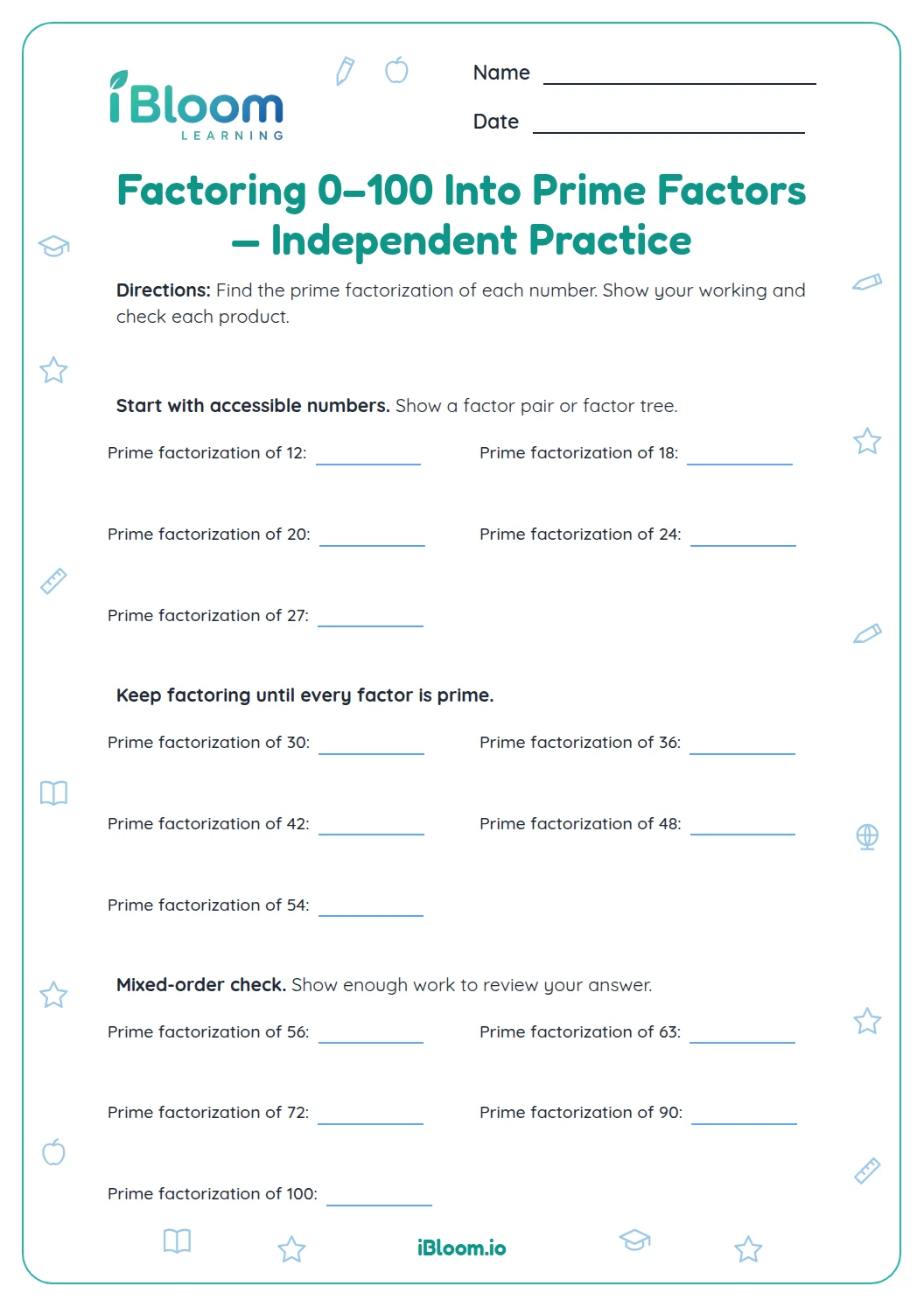
One useful strategy is to factor each number and use each prime factor the greatest number of times it appears in either factorization. Checking divisibility confirms the result.
- 1For 12 and 18, 36 ÷ 12 = 3 and 36 ÷ 18 = 2.
- 2Check the earlier multiples to see that no smaller positive shared multiple works.
How does LCM help with repeating events?
When two events repeat at different intervals, their first shared time is the least common multiple of those intervals. The answer stays in the unit used by the question.
For the bell problem, find LCM(30, 42) to determine how many minutes pass before both bells ring together again.
- 1Bell A: every 30 minutes
- 2Bell B: every 42 minutes
- 3Find the first shared multiple of 30 and 42.
How to use this worksheet
- 1Read the direction under each part before answering.
- 2Work through the questions in order and use the space to show thinking.
- 3Use the separate answer key to review answers; talk through any response that needs more than one idea.
- 4After calculating, divide the result by each number and check for an earlier common multiple.
Common mistakes and quick fixes
The mistake
Stopping at a common multiple that is not the smallest one.
The fix
Check earlier multiples or use prime factors, then verify no smaller positive common multiple works.
The mistake
Checking divisibility by just one number.
The fix
Divide the candidate by both numbers in the pair.
The mistake
Stopping at a number that is common but not least.
The fix
Check smaller multiples or use prime factors, then verify the candidate is divisible by both numbers.
Common Core alignment
This page gives Grade 6 practice with least common multiples. The cited Common Core standard describes the skill practiced here.
Find common factors and least common multiples; apply the distributive property.
On this sheet: Students find common multiples and use the relationship between the greatest common factor and least common multiple to solve problems.
Show the official wordingHide the official wording
Find the greatest common factor of two whole numbers less than or equal to 100 and the least common multiple of two whole numbers less than or equal to 12. Use the distributive property to express a sum of two whole numbers 1-100 with a common factor as a multiple of a sum of two whole numbers with no common factor. For example, express 36 + 8 as 4 (9 + 2).
What to practice next
Make more practice
Further reading
Questions parents and teachers ask
What does LCM mean?
LCM means least common multiple. It is the smallest positive whole number that is a multiple of each number in a pair. For 6 and 8, common multiples include 24 and 48, and the least one is 24. The result must also be smaller than every other common multiple.
How can prime factors help find an LCM?
Write each number as a product of prime factors. Use each prime factor the greatest number of times it appears in either factorization, then multiply. Checking that the result is divisible by both numbers confirms it is common. This method is especially useful when listing multiples takes time.
Why must the LCM be the least common multiple?
A number can be a common multiple without being the least one. For example, 48 is a multiple of both 6 and 8, but 24 is smaller and also works. The word least requires checking that no smaller positive common multiple exists.
How does LCM help with repeating events?
When two events repeat at different intervals, their least common multiple gives the first time their schedules meet again. The bell problem on this page uses that idea. Convert the LCM to the unit used in the question if a different unit is requested.
How can a student check an LCM?
Divide the proposed LCM by each number in the pair; both quotients should be whole numbers. Then check for a smaller positive number divisible by both. The worksheet asks students to use common-multiple reasoning as well as calculate, so the check helps distinguish “common” from “least.”