







About this worksheet
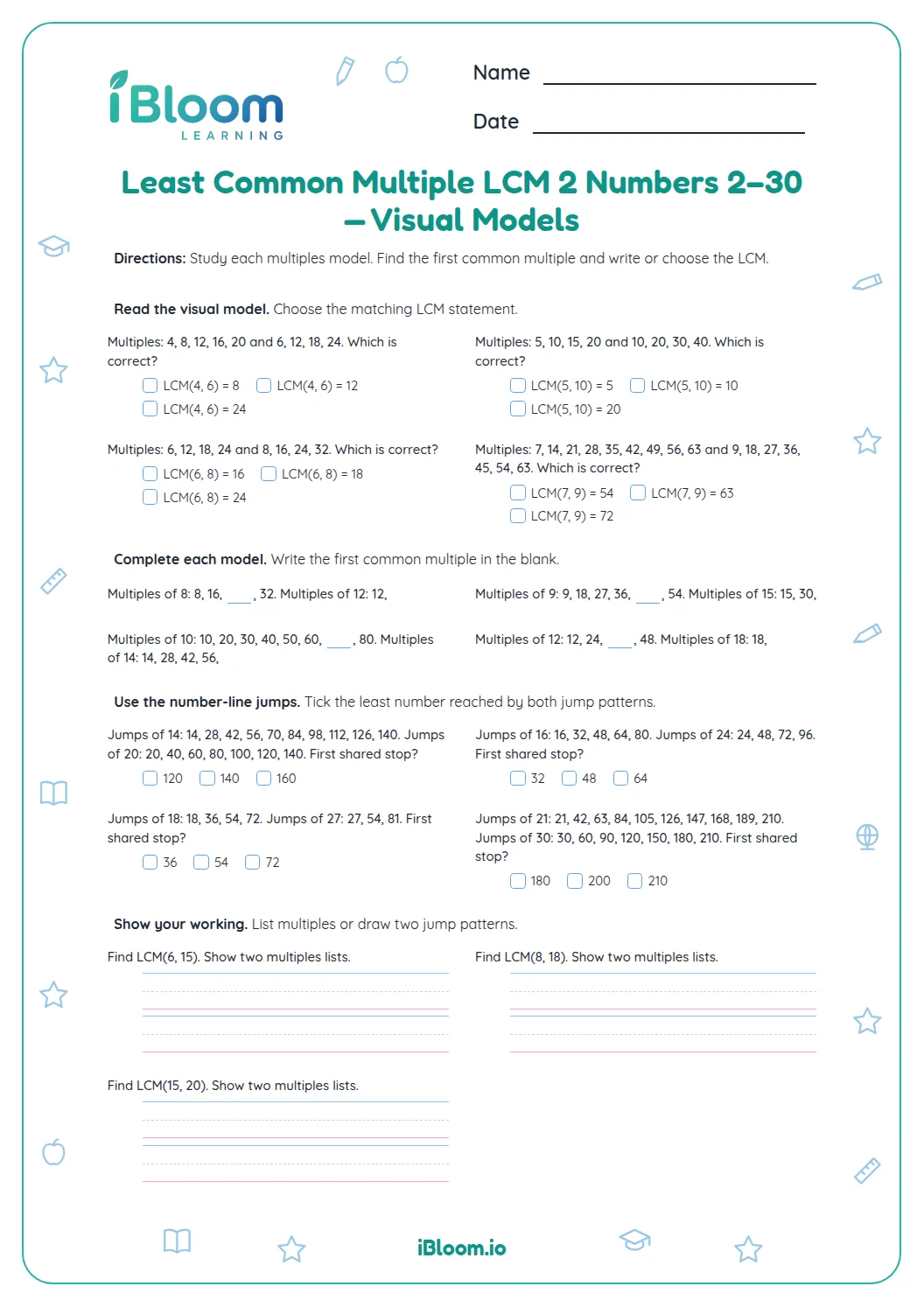
This Grade 6 worksheet uses tables as visual models for finding least common multiples. Each of the 14 items shows paired lists of multiples, and students locate the first shared value. The pairs range from small factors to values in the 20s and 40s, so students can see how repeated multiples meet. It practices the LCM reasoning in Common Core 6.NS.B.4, with a separate answer key.
Aligned to 6.NS.B.4
What does “least common multiple” mean?
A multiple is the result of multiplying a whole number by 1, 2, 3, and so on. A common multiple belongs to both numbers’ lists. The least common multiple is the first positive value they share.
In question 1, the two table columns list multiples of 4 and 6. Their first shared value is 12.
- 1Multiples of 4: 4, 8, 12
- 2Multiples of 6: 6, 12
- 3First shared value: 12
How does a table make the search easier?
A table places the two multiples sequences side by side. Continue each sequence in equal jumps, then compare entries until you reach a shared value. Stop at the first match; later matches are also common multiples, but they are not the least.
How to use this worksheet
- 1Read the two numbers at the top of the table.
- 2Follow each sequence of multiples from left to right.
- 3Compare values and locate the first shared multiple.
- 4Check that no smaller positive multiple is shared.
- 5Write the value as the least common multiple.
Common mistakes and quick fixes
The mistake
Choosing a common multiple that is not the least.
The fix
Check earlier entries in both sequences for a smaller match.
The mistake
Listing the number itself but skipping later multiples.
The fix
Continue by adding the same number each time.
The mistake
Confusing a factor with a multiple.
The fix
A multiple is found by multiplying the starting number by a whole number.
Common Core alignment
This worksheet practices the Common Core skill described below.
Find least common multiples by using factor and multiple relationships.
On this sheet: The visual models make common multiples visible as children identify least common multiples.
Show the official wordingHide the official wording
Find the greatest common factor of two whole numbers less than or equal to 100 and the least common multiple of two whole numbers less than or equal to 12. Use the distributive property to express a sum of two whole numbers 1-100 with a common factor as a multiple of a sum of two whole numbers with no common factor. For example, express 36 + 8 as 4 (9 + 2).
What to practice next
Make more practice
Questions parents and teachers ask
What does LCM stand for?
LCM means least common multiple. It is the smallest positive whole number that is a multiple of each number in the pair. Students can use the model to check each step and review the skill in a clear, complete response.
How does the table help find an LCM?
The table places multiples of both numbers side by side. Students compare the lists and stop at the first value that appears in both. Students can use the model to check each step and review the skill in a clear, complete response.
What is the least common multiple of 4 and 6?
The least common multiple is 12. The multiples of 4 include 4, 8 and 12, while the multiples of 6 include 6 and 12, making 12 their first match. Students can use the model to check each step and review the skill in a clear, complete response.
How many questions are included?
There are 14 problems, each with a paired multiples table. The answer key gives the least common multiple for every pair, and the worksheet pages leave space to compare each list and record the first shared value. Some larger pairs require longer lists.
Can the LCM be larger than both numbers?
Yes. A shared multiple is often larger than either starting number. For example, 4 and 6 first meet at 12, which is larger than both. Students can use the model to check each step and review the skill in a clear, complete response.