





About this worksheet
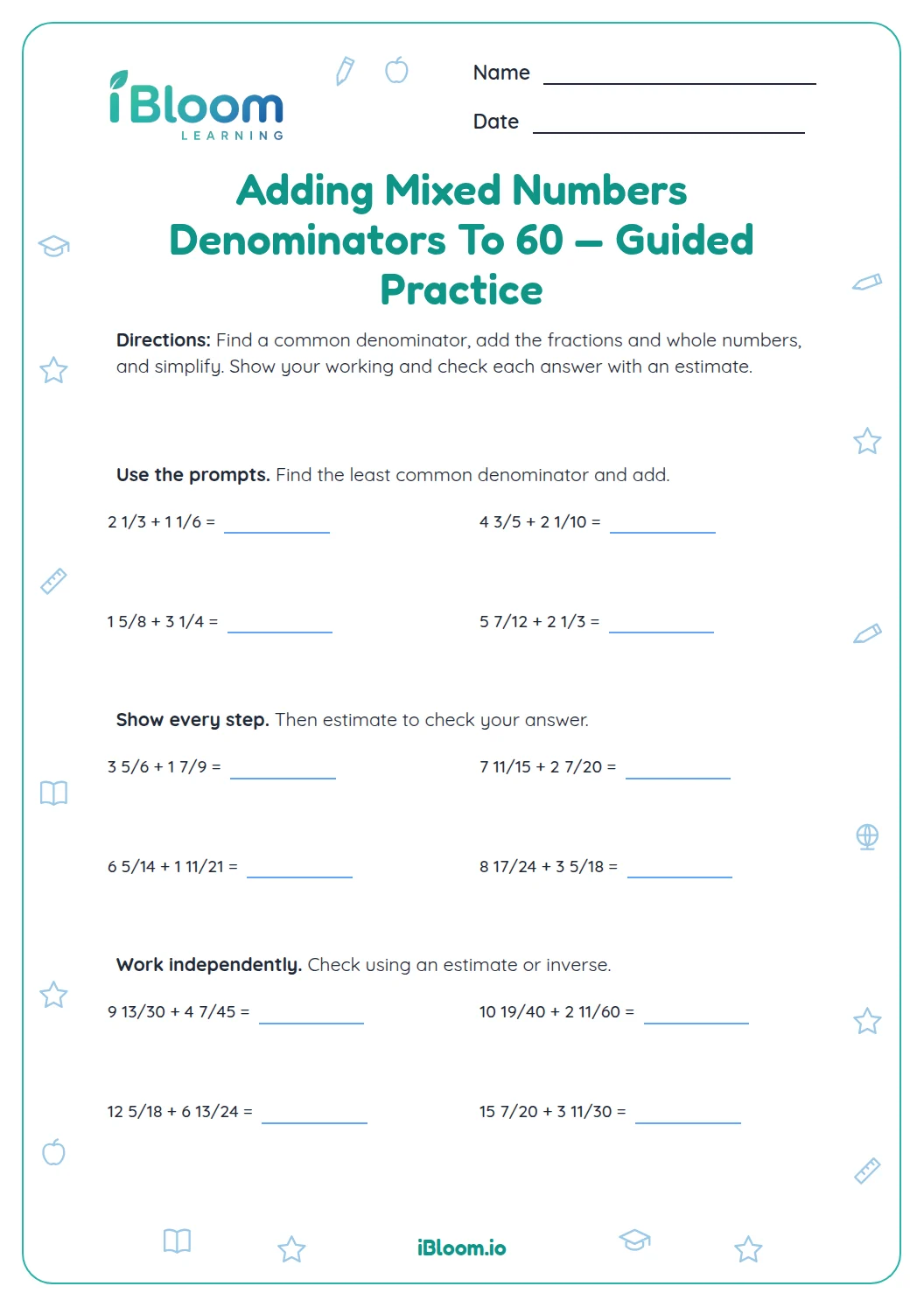
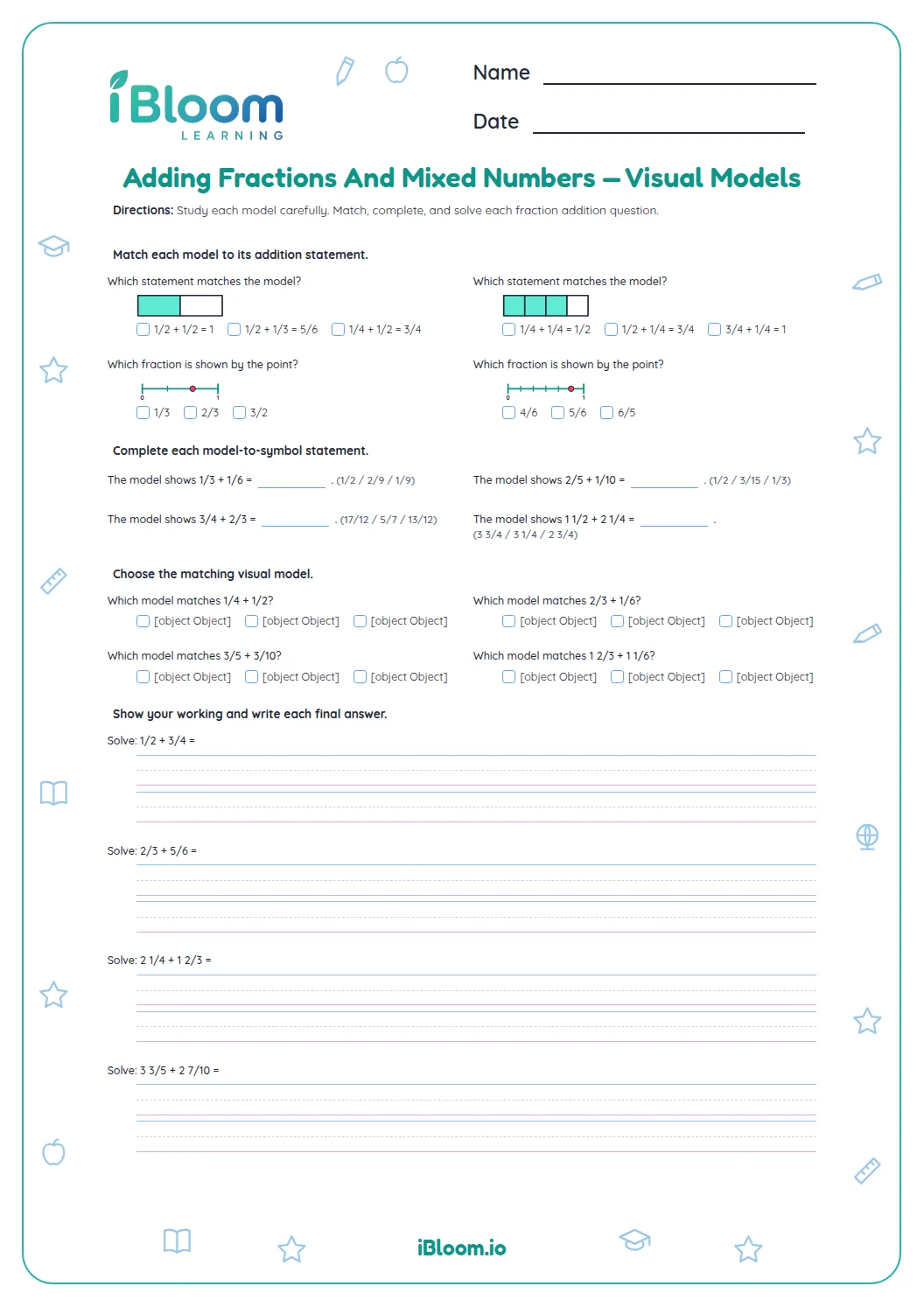
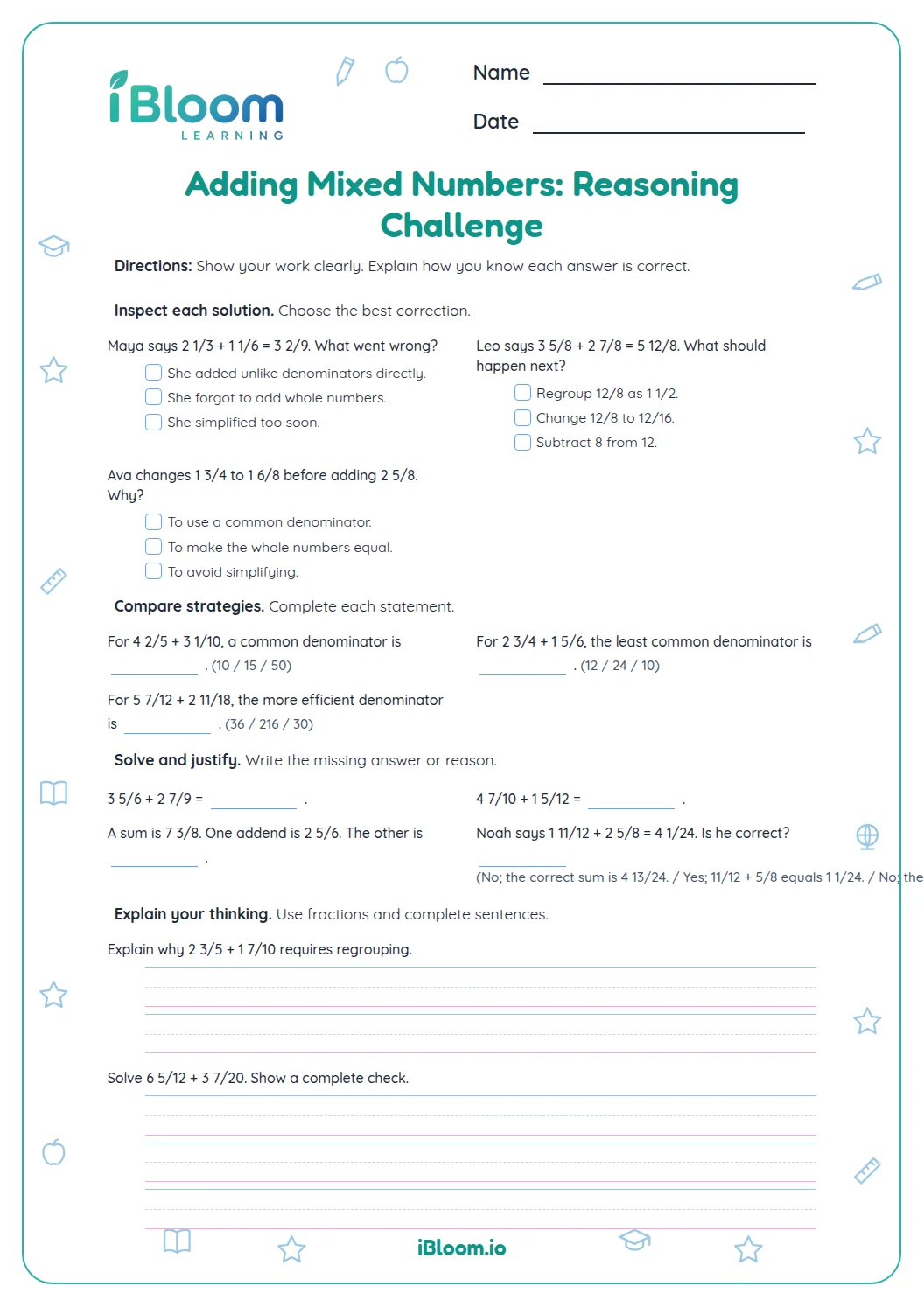
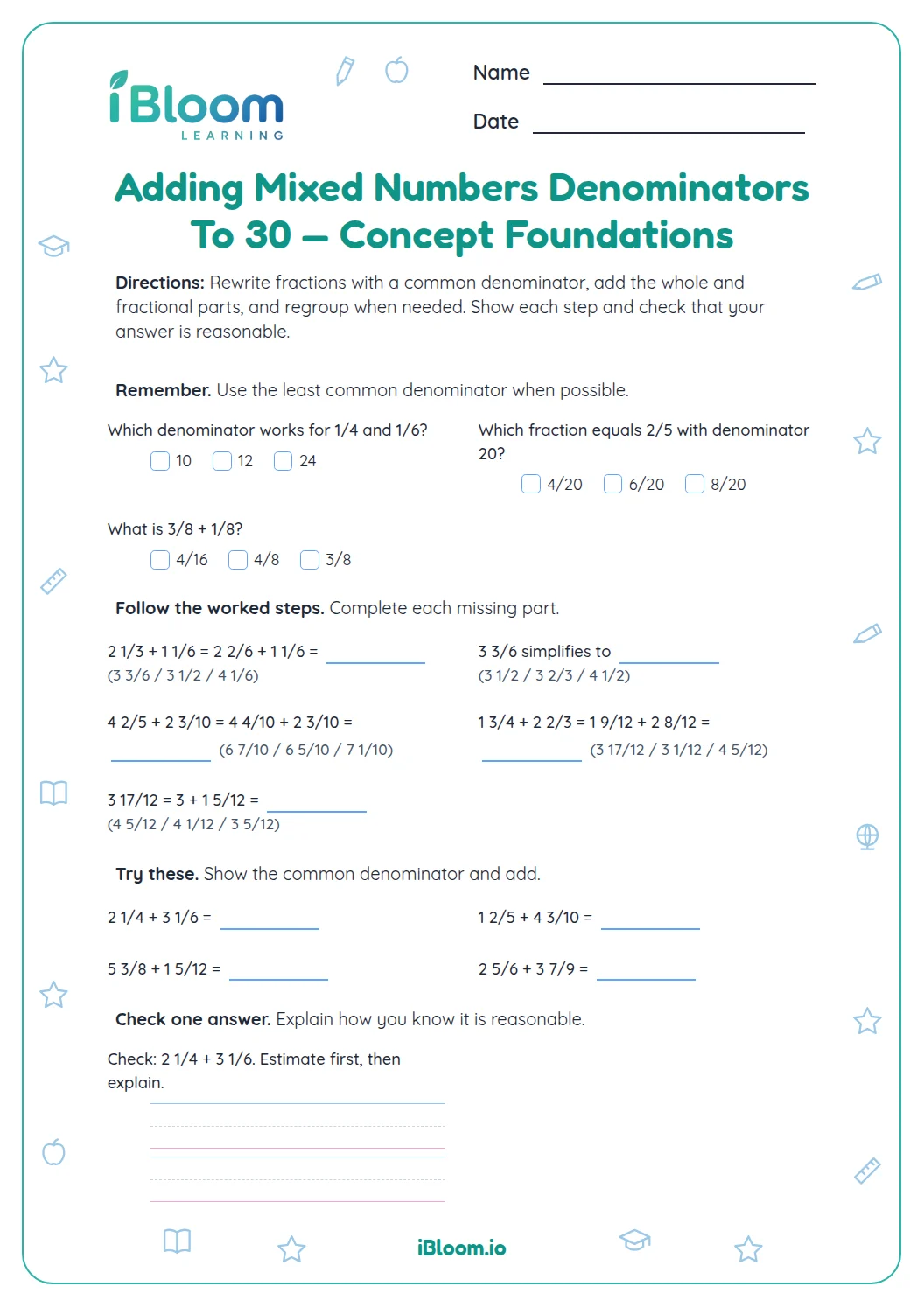
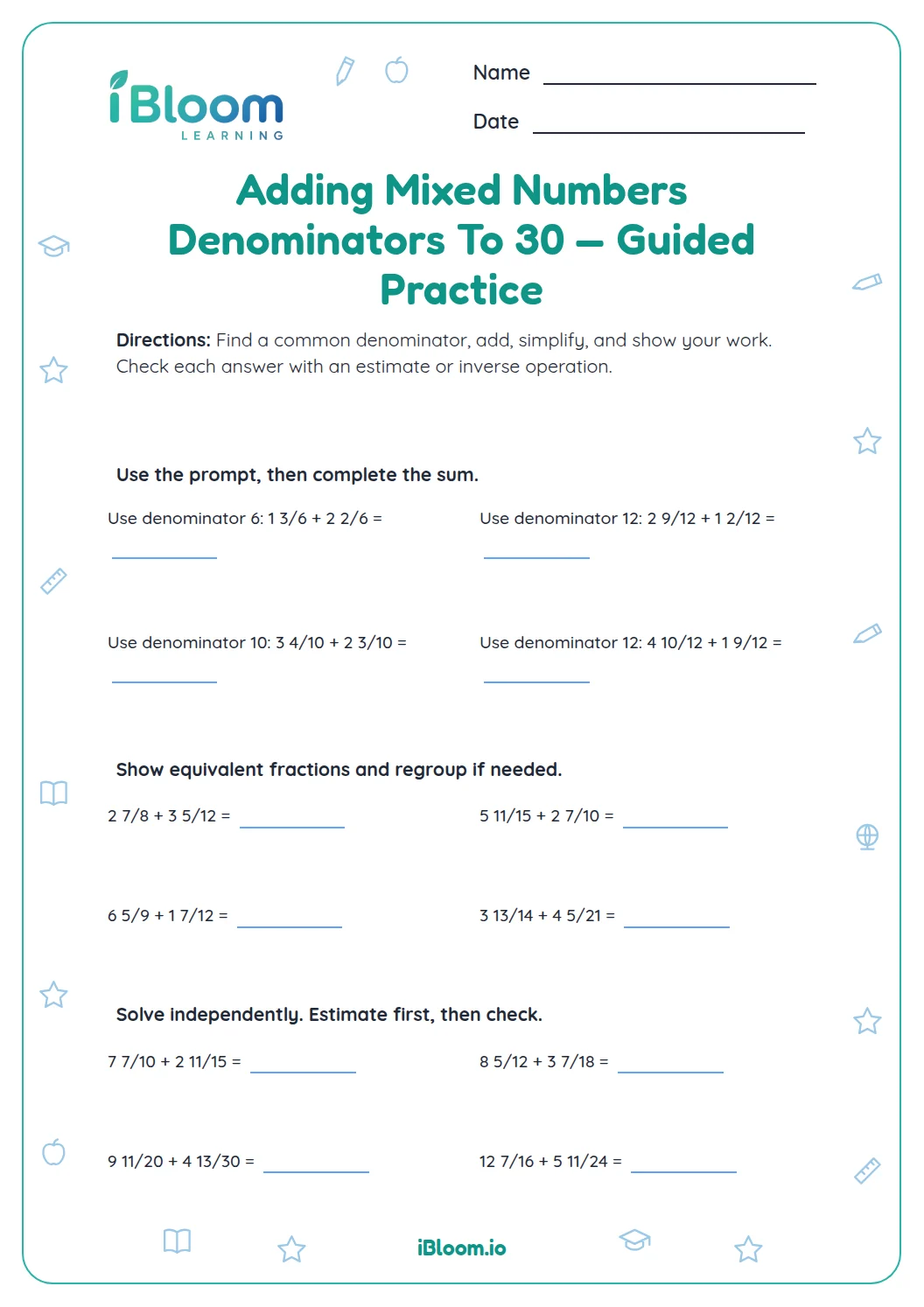
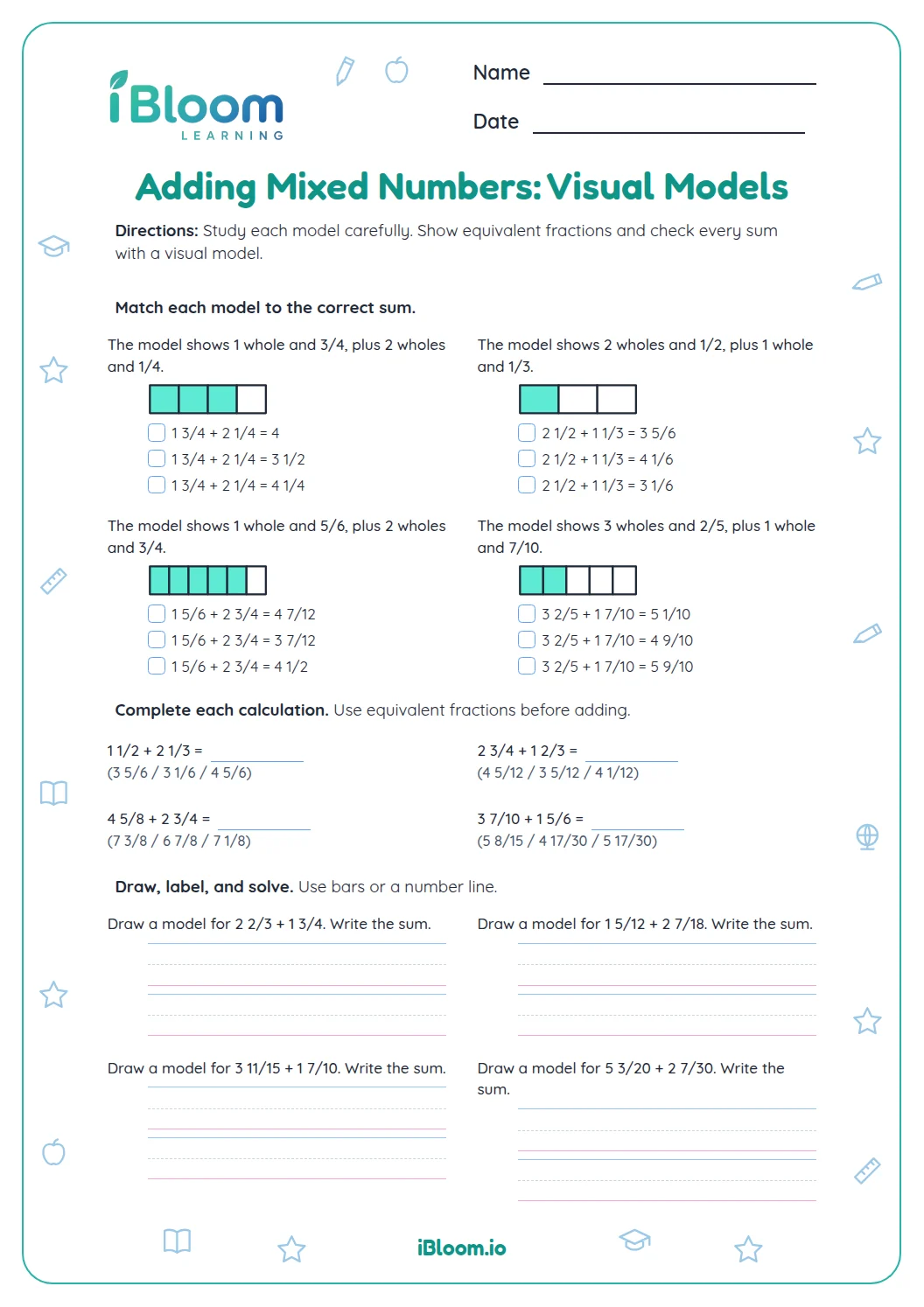
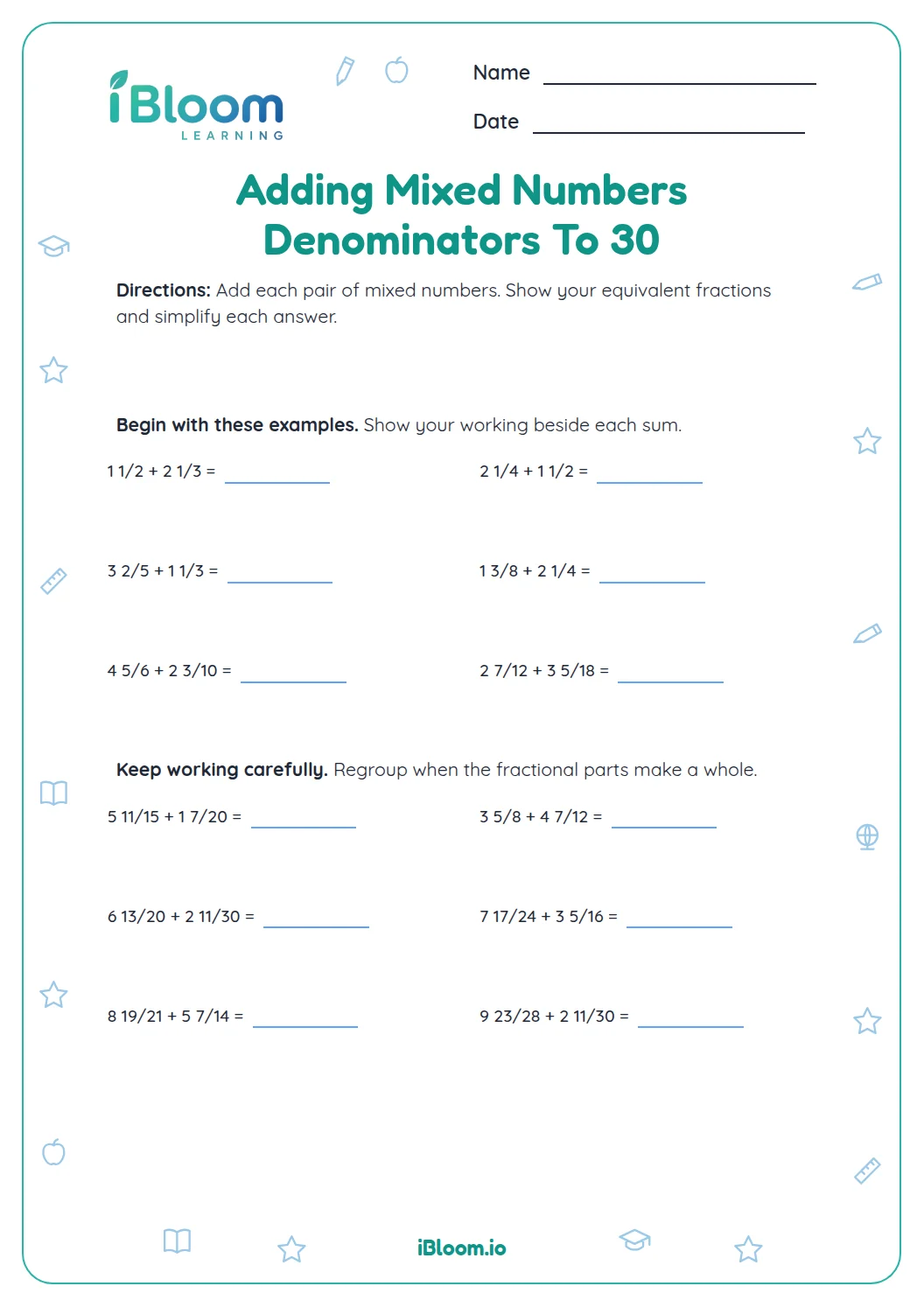
This independent practice sheet gives 14 problems adding mixed numbers with unlike denominators, including denominators up to 60. Students find common denominators, simplify, and apply the process to two short measurement situations. The final questions ask students to explain why denominators cannot be added and to write a valid example. The work aligns with CCSS 5.NF.A.1, which includes adding fractions and mixed numbers by making equivalent fractions with like denominators. A separate answer key shows simplified results and sample reasoning.
Aligned to 5.NF.A.1
Why do mixed numbers need a common denominator?
Fraction parts can be added directly only when they describe equal-sized parts. For example, halves and fourths can be renamed as fourths before combining. Add whole numbers and fraction parts, then regroup if the fraction reaches one whole.
- 11 1/2 + 2 1/4
- 2Rename 1/2 as 2/4; add 1 2/4 + 2 1/4 = 3 3/4.
When should the answer be simplified?
After adding, reduce the fractional part when numerator and denominator share a factor. In Part B, 2 1/3 + 1 2/5 becomes 3 + 5/15 + 6/15 = 3 11/15. Check that the final fraction is less than one unless it has been regrouped into the whole number.
What if the fractional parts make a whole?
When the fractional parts add to one whole or more, regroup that amount with the whole numbers. Question 10 uses fifteenths and twentieths, so both fractions can be renamed in sixtieths. Their numerators add to 61/60, which is 1 1/60; add the extra whole before writing the simplified mixed number.
- 12 7/15 + 1 11/20
- 22 28/60 + 1 33/60 = 3 + 61/60 = 4 1/60
How to use this worksheet
- 1Circle the denominators in both addends.
- 2Find a common multiple and rename each fraction.
- 3Add the whole numbers and the numerators separately.
- 4Regroup any fraction equal to or greater than one whole.
- 5Reduce the fraction and check that the mixed number is sensible.
Mistakes to watch for
The mistake
Adding denominators, such as writing 1/3 + 1/4 = 2/7.
The fix
Rename both fractions as twelfths, then add the numerators.
The mistake
Adding only the fractions and forgetting the whole numbers.
The fix
Keep a separate whole-number sum beside the fraction sum.
The mistake
Leaving an improper fractional part in a mixed-number answer.
The fix
Trade each group of one whole for one more whole number.
Rename unlike denominators as equivalent fractions with like denominators, then add.
On this sheet:
Show the official wordingHide the official wording
Add and subtract fractions with unlike denominators (including mixed numbers) by replacing given fractions with equivalent fractions in such a way as to produce an equivalent sum or difference of fractions with like denominators. For example, 2/3 + 5/4 = 8/12 + 15/12 = 23/12. (In general, a/b + c/d = (ad + bc)/bd.)
What to practice next
Make more practice
Further reading
Questions parents and teachers ask
What is the first step when adding mixed numbers?
Find a common denominator for the fractional parts and rename each fraction as an equivalent fraction. Then add whole numbers and numerators. For example, 1 1/2 + 2 1/4 becomes 1 2/4 + 2 1/4, or 3 3/4. The sheet also includes denominators whose common denominator is 60.
Can students use a common denominator larger than needed?
Yes, if both fractions are renamed correctly and the final answer is simplified. A least common denominator often keeps the numbers smaller, but any shared multiple works. Students should show equivalent fractions so the answer key can be used to check their method as well as the result.
How should a student handle a fractional sum over one?
Regroup each whole fraction into one additional whole number. For example, 5/4 equals 1 1/4. Add that whole to the whole-number total, then leave a proper fraction as the fractional part. Check that the fraction is less than one after regrouping.
What do the word problems ask students to add?
One asks for the total length of two ribbons, and the other asks for the total distance Kai walked in two parts of the day. In both, the quantities are mixed numbers with unlike denominators. Students should include feet or miles with the numerical sum.
Why can’t students add the denominators?
The denominators name the size of the parts. Thirds and fourths are not the same-sized pieces, so their numerators cannot be combined directly. Rename both fractions using twelfths: 1/3 is 4/12 and 1/4 is 3/12, so their sum is 7/12.
Which problem uses a common denominator of 60?
Question 10 adds 2 7/15 and 1 11/20. Fifteenths and twentieths can both be written as sixtieths: 7/15 is 28/60, and 11/20 is 33/60. Their sum is 61/60, so regrouping gives the simplified answer 4 1/60. Question 9 also uses sixtieths.