






About this worksheet
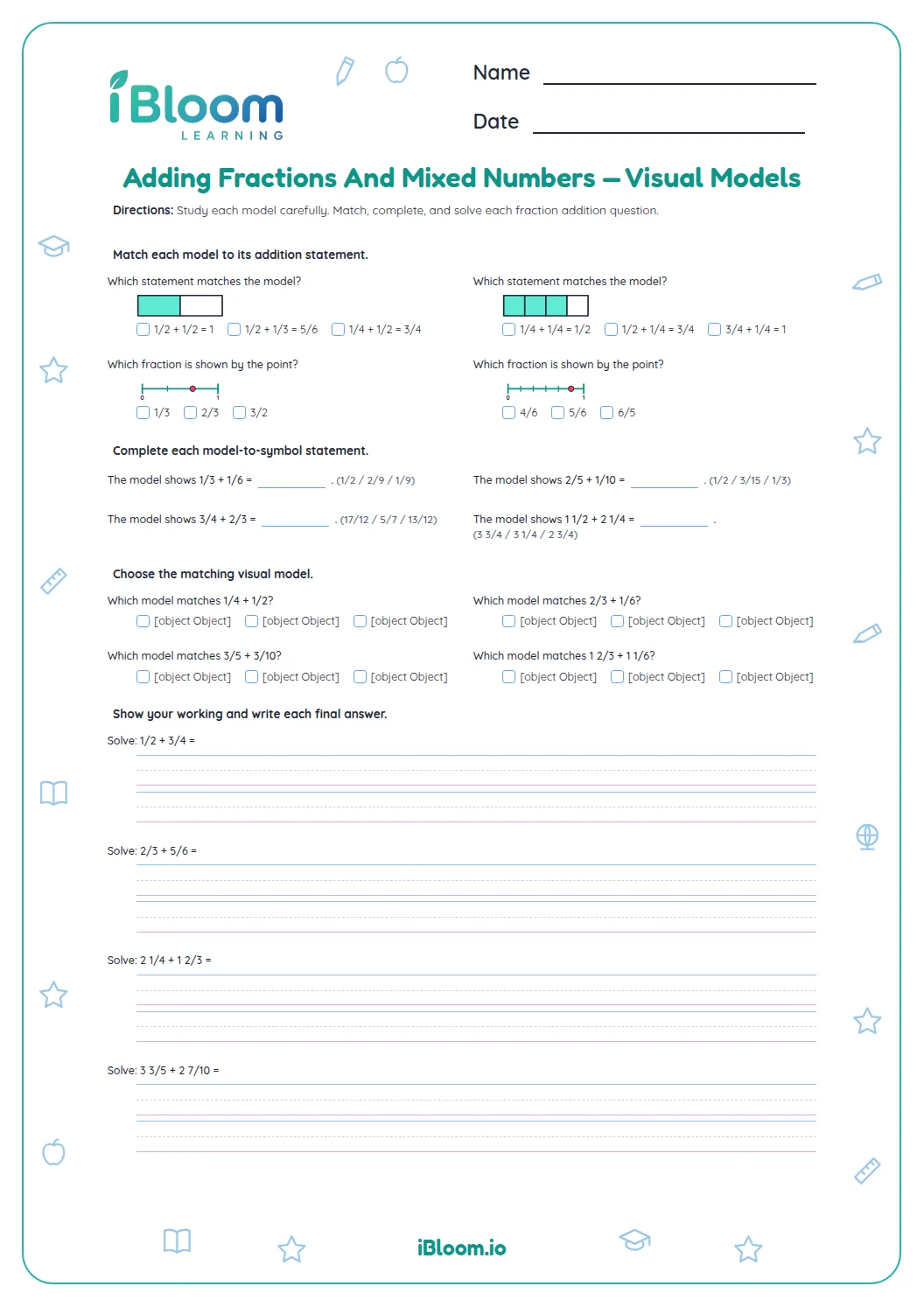
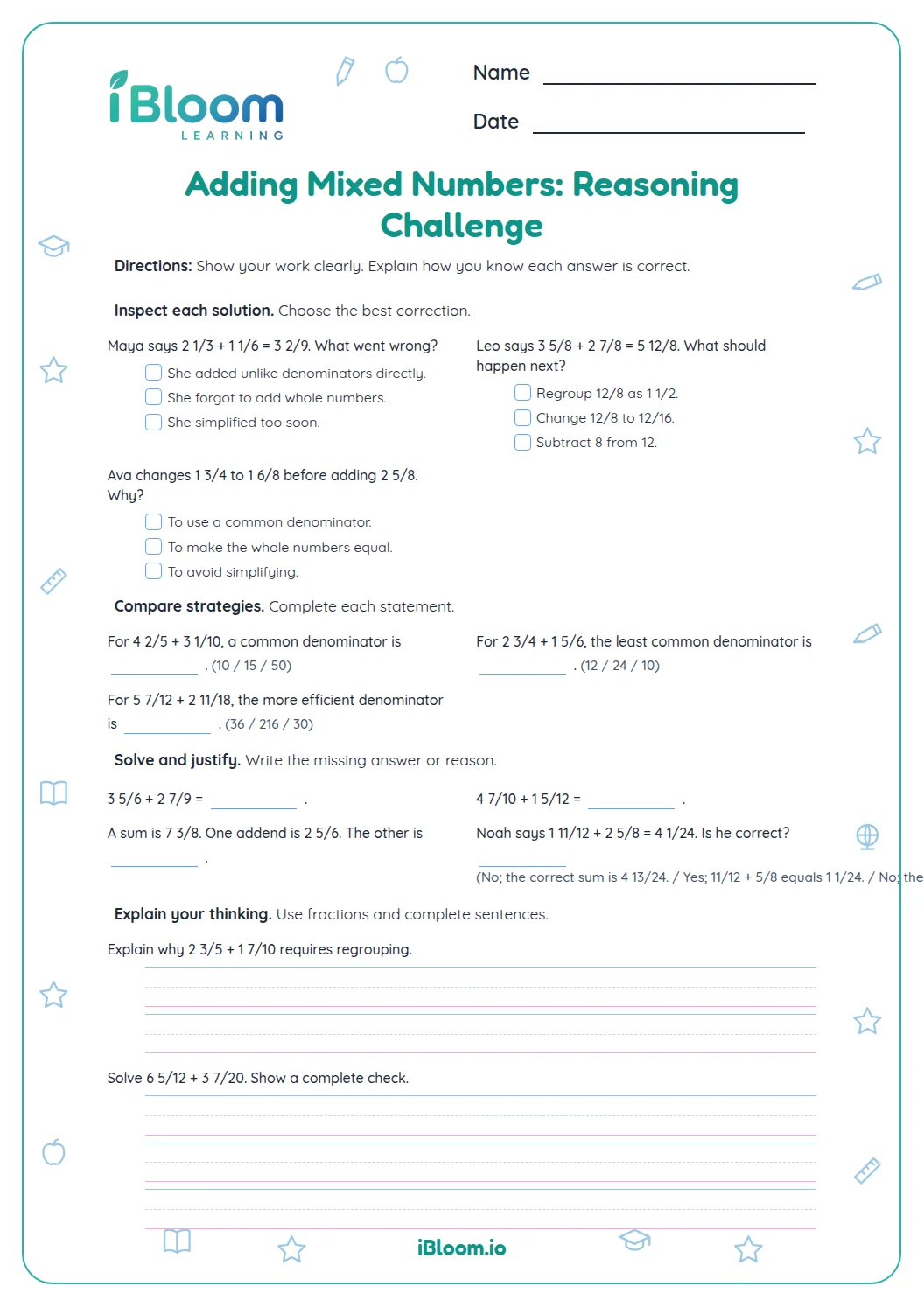
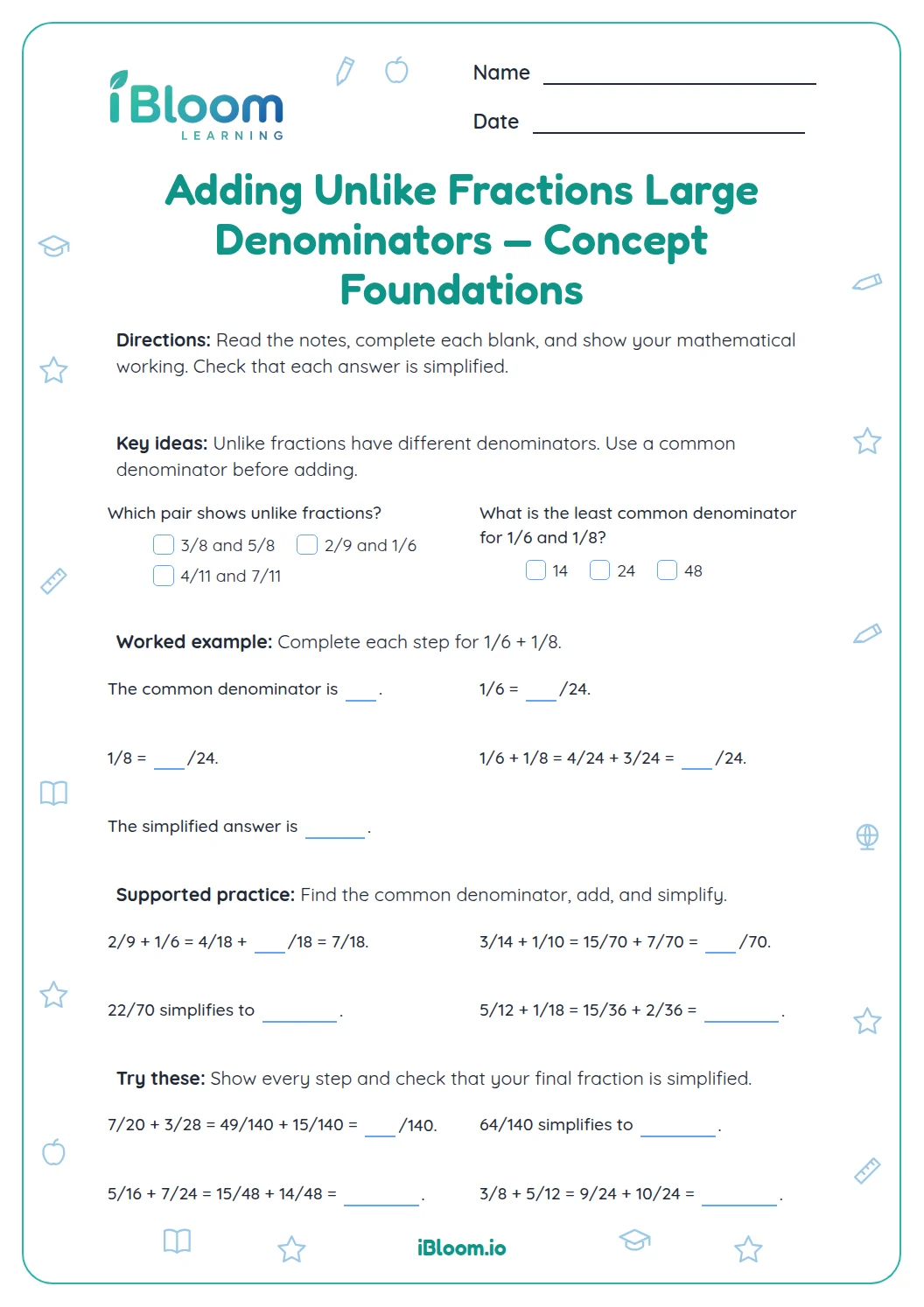
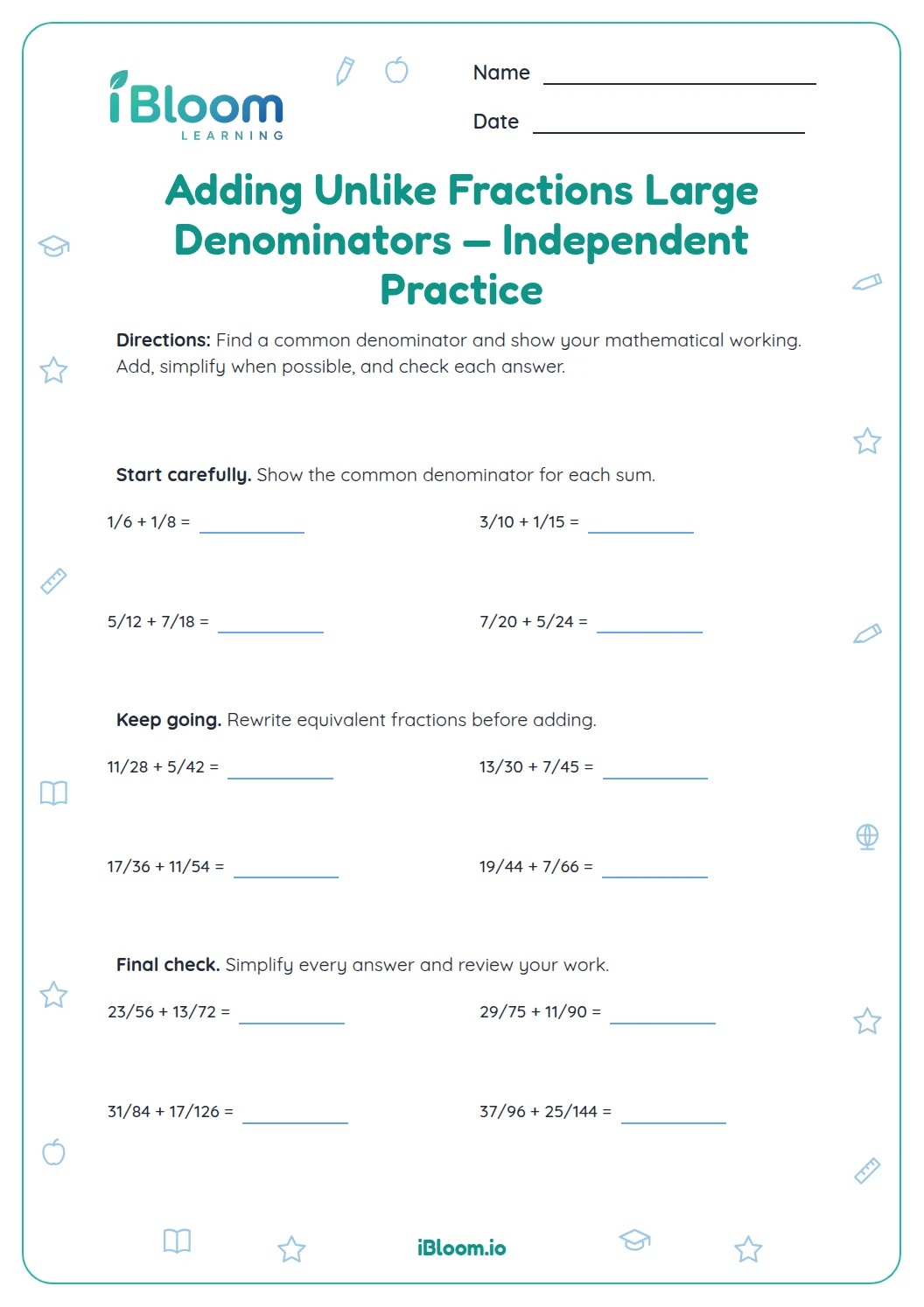
This Grade 6 worksheet practices adding fractions and mixed numbers, including sums with like and unlike denominators. Students simplify results, find an unknown addend, solve short measurement stories, and compare two expressions. A few subtraction items provide related mixed-number practice alongside the central addition skill.
When is a common denominator needed?
Fractions with the same denominator count equal-sized parts, so add their numerators and keep the denominator. With unlike denominators, rename the fractions using a common denominator first. Simplify the result when possible.
The worksheet also includes mixed numbers and a small number of subtraction items, so check the operation sign before calculating.
- Questions 1–13 build fraction and mixed-number computation.
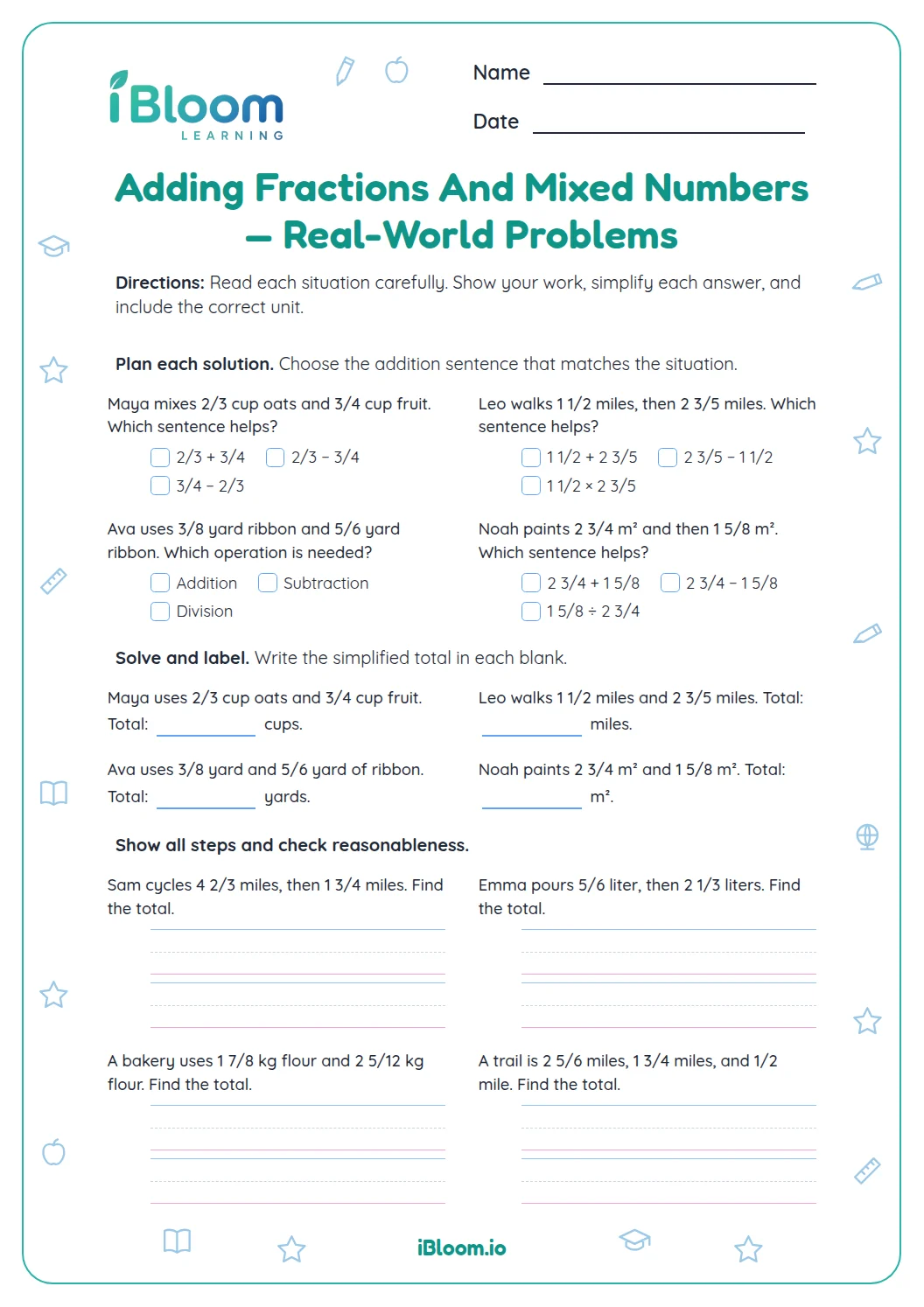
- Questions 14–16 apply operations in short stories.
- Questions 17–18 compare sums and explain an error.
How can students add unlike denominators?
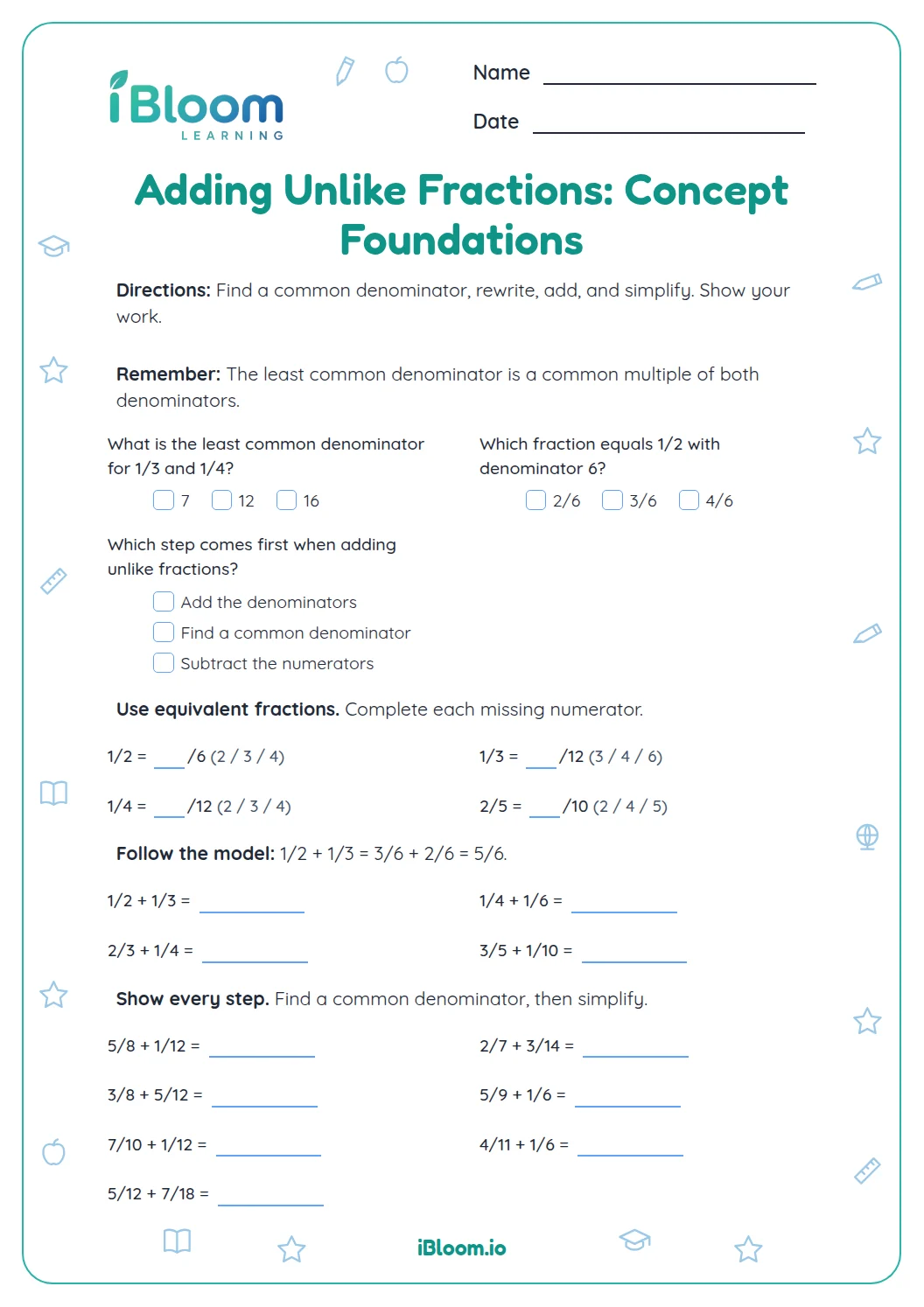
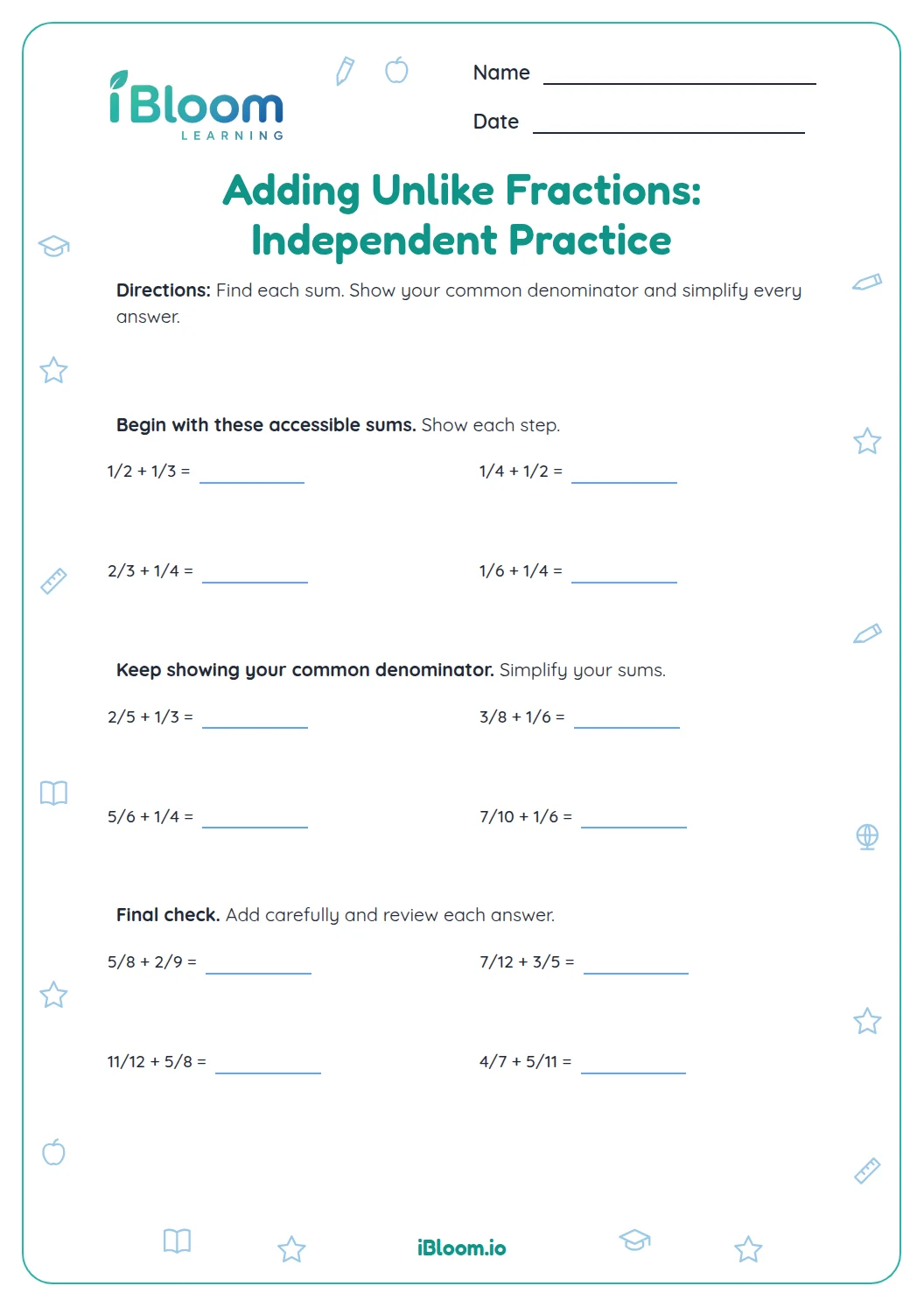
Use a common denominator to describe equal-sized parts. Then add the numerators and simplify if the result can be reduced.
- 12/5 + 1/3 = 6/15 + 5/15 = 11/15.
What changes when adding mixed numbers?
Add the fractional parts and whole-number parts, regrouping if the fraction reaches one whole. A common denominator may be needed for the fractional parts. Reduce the final answer when possible.
How do the word problems use fractions?
The stories ask students to combine or compare fractional amounts of distance, ribbon, or recipe ingredients. Keep the unit from the question in the final answer.
How to use this worksheet
- 1Identify whether the item asks you to add, subtract, or find an unknown addend.
- 2For unlike denominators, choose a common denominator.
- 3Rename each fraction and combine the numerators.
- 4Regroup mixed numbers and simplify the result.
- 5In a story, include the correct unit and check the answer with the key.
Common mistakes and fixes
The mistake
Adding denominators along with numerators.
The fix
Rename the fractions with a common denominator, then add only the numerators.
The mistake
Forgetting to regroup an improper fractional part.
The fix
Trade each complete group of fractional parts for one whole.
The mistake
Dropping a unit from a story answer.
The fix
Carry miles, feet, or cups from the question into the final answer.
What to practice next
Make more practice
Further reading
Questions parents and teachers ask
How many questions are on this worksheet?
There are 18 questions. They include fraction and mixed-number calculations, an unknown addend, three short story problems, a comparison of two expressions, and an explanation of a denominator error. The answer key is provided separately. Keep the operation sign in view for each item.
Do students need common denominators?
Yes, for sums or differences with unlike denominators. Rename the fractions as equivalent fractions with a shared denominator, then operate on the numerators. Keep the shared denominator and simplify the result when possible. A shared denominator makes the fractional units equal in size.
Does the page include mixed numbers?
Yes. Students add and subtract mixed numbers, including problems where fractional parts need a common denominator or regrouping. The story questions also use mixed-number measurements, and their answers should include the named unit. Check that the resulting fraction names the same amount.
Why should fraction answers be simplified?
A simplified fraction names the same amount using the smallest whole-number numerator and denominator possible. After computing, check whether both numbers share a factor. The worksheet directions ask students to simplify when possible. This also helps catch an answer larger or smaller than expected.
Are subtraction problems included too?
A small number of subtraction items appear as related mixed-number practice. The central focus remains addition: most questions ask students to add fractions or mixed numbers, apply a sum, compare sums, or explain how fraction addition works. These items reinforce the addition practice across the page.
Is an answer key included?
Yes. A separate answer key gives answers for all 18 questions, including model wording for the explanation item. Use it after working through the problems and check the calculation steps whenever a result differs. Use the key to check the calculations after attempting each problem.