






About this worksheet
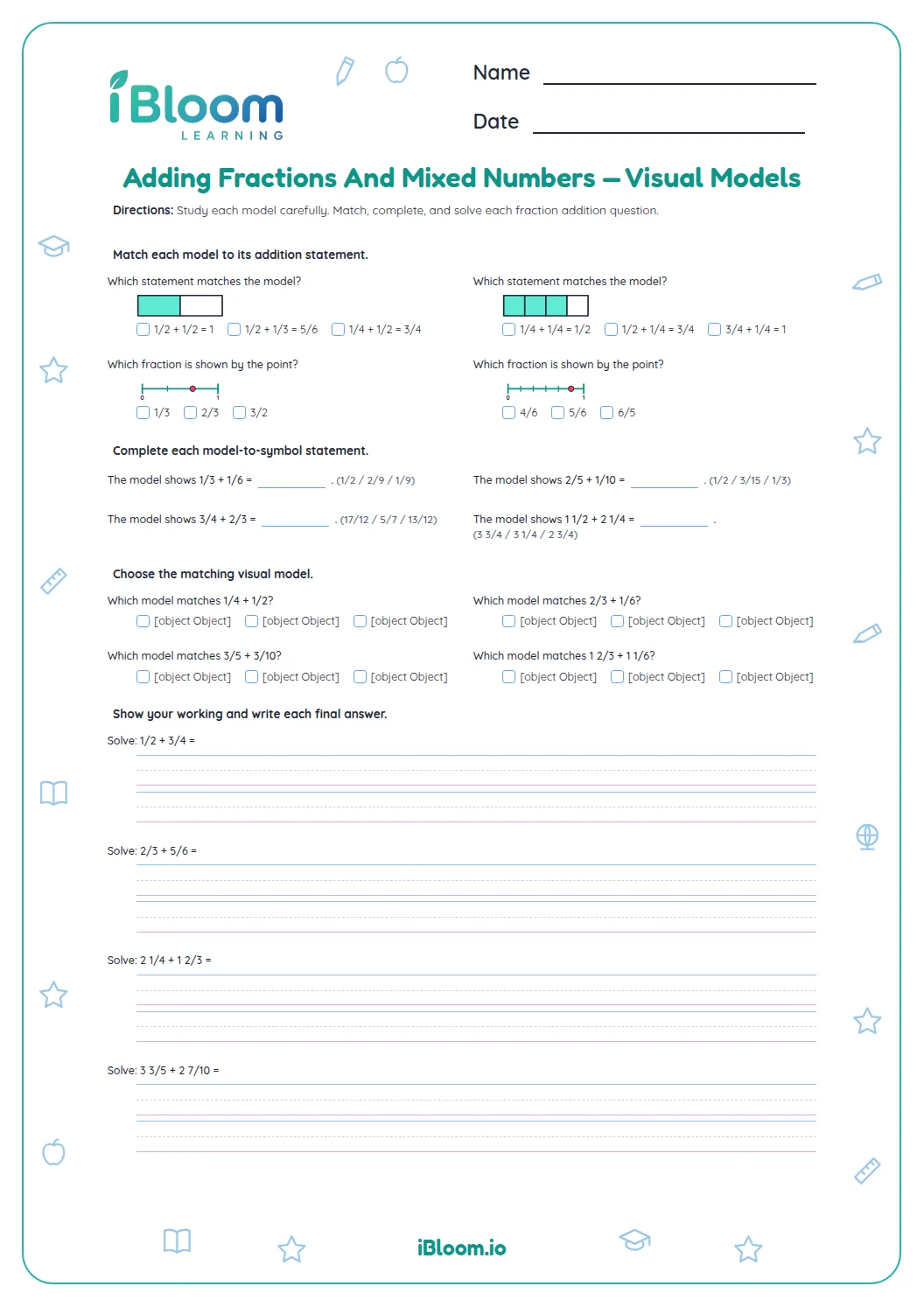
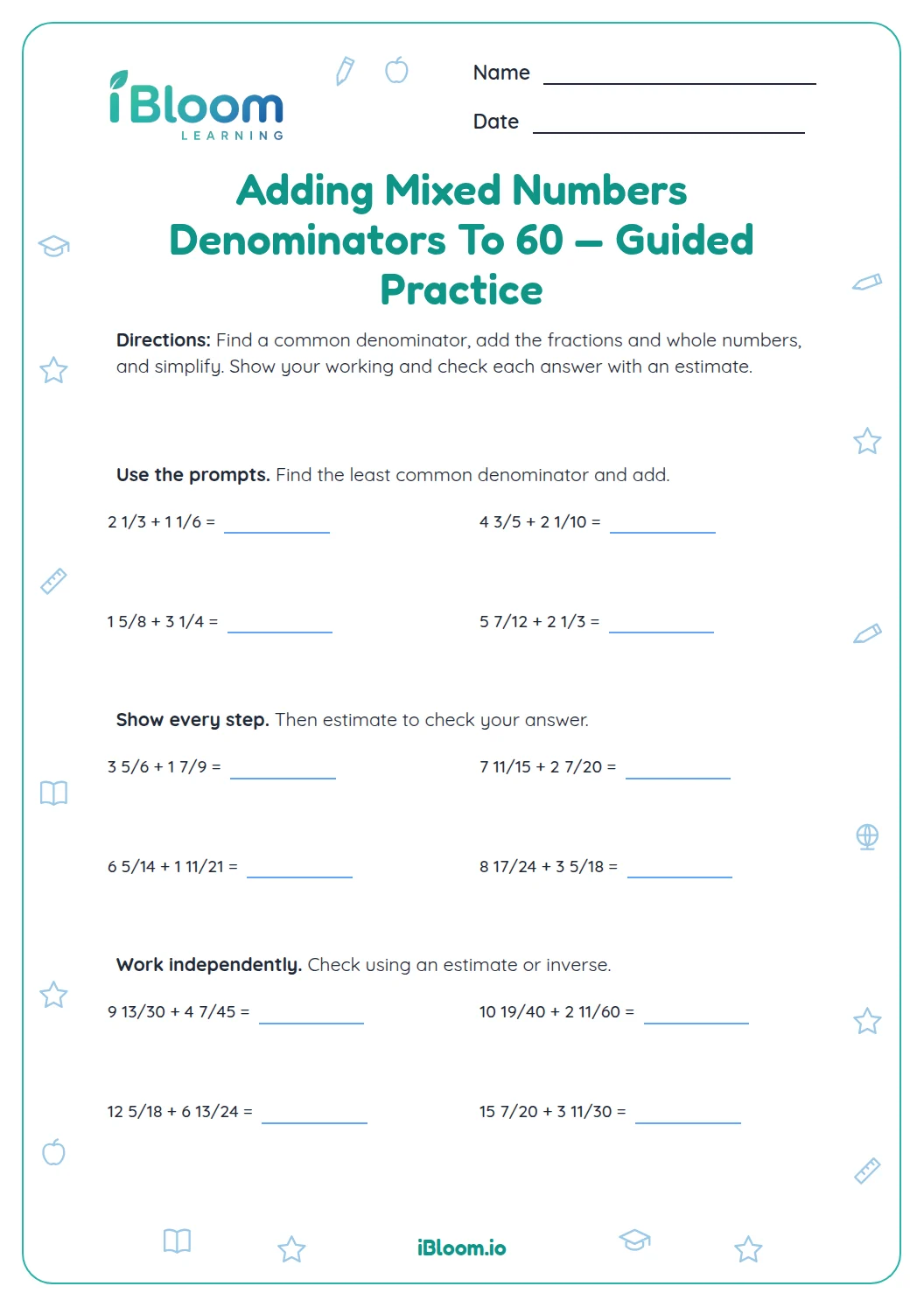
This free Grade 6 printable gives students 16 problems adding fractions with unlike denominators, including three fraction-bar models and mixed-number sums. Learners rename fractions with a common denominator, add the numerators, and simplify when needed. The separate answer key shows each result. It practices CCSS 5.NF.A.1.
Aligned to 5.NF.A.1
Why do unlike fractions need equivalent forms?
The denominator names the size of the parts. In question 3, fourths and thirds become twelfths: 3/4 = 9/12 and 2/3 = 8/12, so the sum is 17/12.
- 13/4 + 2/3 = 9/12 + 8/12 = 17/12
How can a visual model support the calculation?
A model can show the total, while equivalent fractions explain why the pieces can be combined. In question 1, 1/4 is 2/8, so 3/8 + 2/8 = 5/8.
- 1Question 1: 3/8 + 1/4 = 3/8 + 2/8 = 5/8
When should a sum become a mixed number?
When the numerator is larger than the denominator, group one whole and keep the leftover fraction. Question 15 gives 18/12, or 1 6/12, which simplifies to 1 1/2.
How to use this worksheet
- 1Read the denominators and choose a shared multiple.
- 2Rename each fraction with that denominator.
- 3Add the numerators and keep the common denominator.
- 4Use a fraction bar to check the total when a model is provided.
- 5Simplify the result or write a mixed number when the sum is greater than one.
Common mistakes and quick fixes
The mistake
Adding denominators along with numerators.
The fix
Rename both fractions with a common denominator; add only the numerators.
The mistake
Changing only one fraction to an equivalent form.
The fix
Check that each fraction has the same denominator before adding.
The mistake
Leaving a reducible result.
The fix
Look for a common factor in the numerator and denominator after adding.
Common Core alignment
This worksheet practices the following grade-level skill.
Rename unlike fractions with a common denominator before adding and simplifying.
On this sheet: Rename unlike fractions with a common denominator before adding and simplifying.
Show the official wordingHide the official wording
Add and subtract fractions with unlike denominators (including mixed numbers) by replacing given fractions with equivalent fractions in such a way as to produce an equivalent sum or difference of fractions with like denominators.
What to practice next
Make more practice
Further reading
Questions parents and teachers ask
What is the first step for adding unlike fractions?
Find a common denominator so both fractions describe equal-size pieces. In question 3, twelfths work for fourths and thirds: 3/4 becomes 9/12 and 2/3 becomes 8/12. Then add the numerators and keep the denominator. The same process works for the other sums on the page.
Why can’t the denominators be added?
A denominator names the size of the parts. Adding 3/4 and 2/3 combines fourths with thirds, which are different sizes. Rename them as twelfths first: 9/12 + 8/12 = 17/12. Now the pieces are equal in size. Equivalent fractions keep the value unchanged while matching the piece size.
Should an answer be an improper fraction or a mixed number?
Follow the format printed in the problem when it gives a denominator. For open sums, a simplified improper fraction or equivalent mixed number can show the same value. For example, 17/12 is also 1 5/12. Reduce only after the addition is complete.
How do you simplify a fraction sum?
Look for a common factor in the numerator and denominator after adding. In question 15, 3/4 + 5/6 = 19/12, which is already in simplest form; it can also be written as 1 7/12. Check the arithmetic before converting. Reduction preserves the value of the fraction.
What do the fraction bars help a learner notice?
The bars show a total in equal partitions, so students can see how a sum relates to the shaded amount. Question 1 combines 3/8 and 1/4, with the quarter renamed as 2/8. The combined amount is 5/8. This keeps the answer exact and easy to compare with the key.