





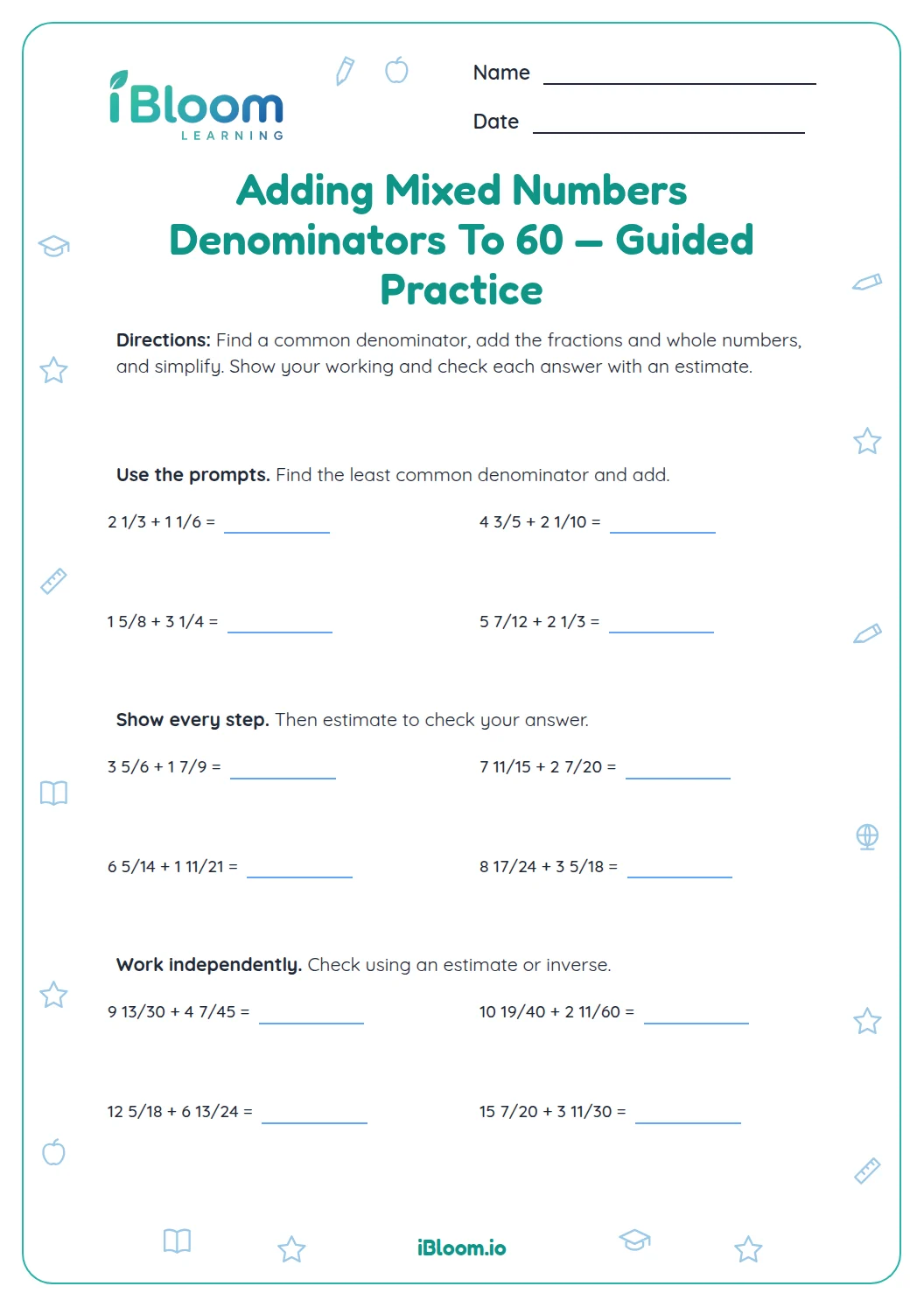

About this worksheet
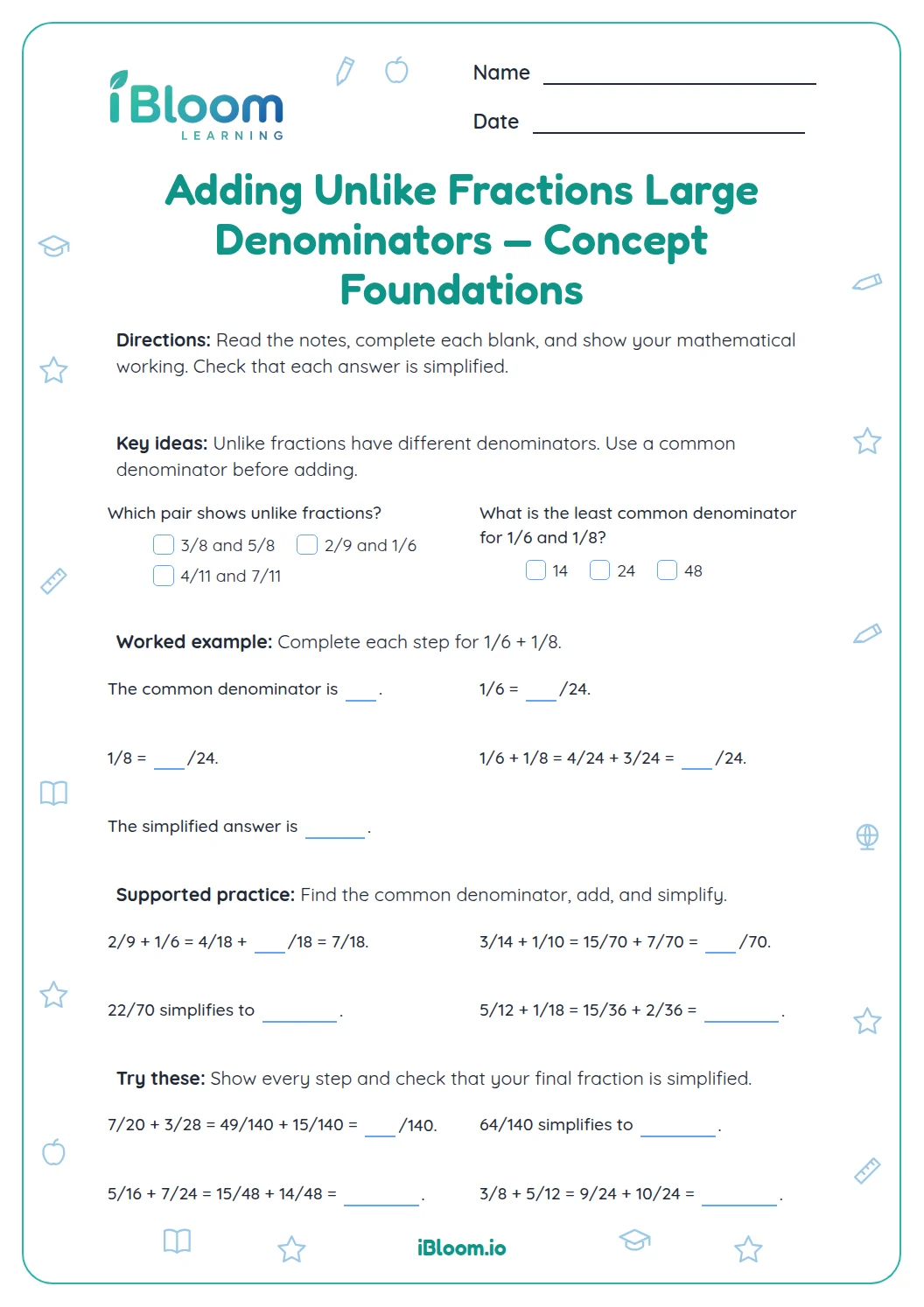
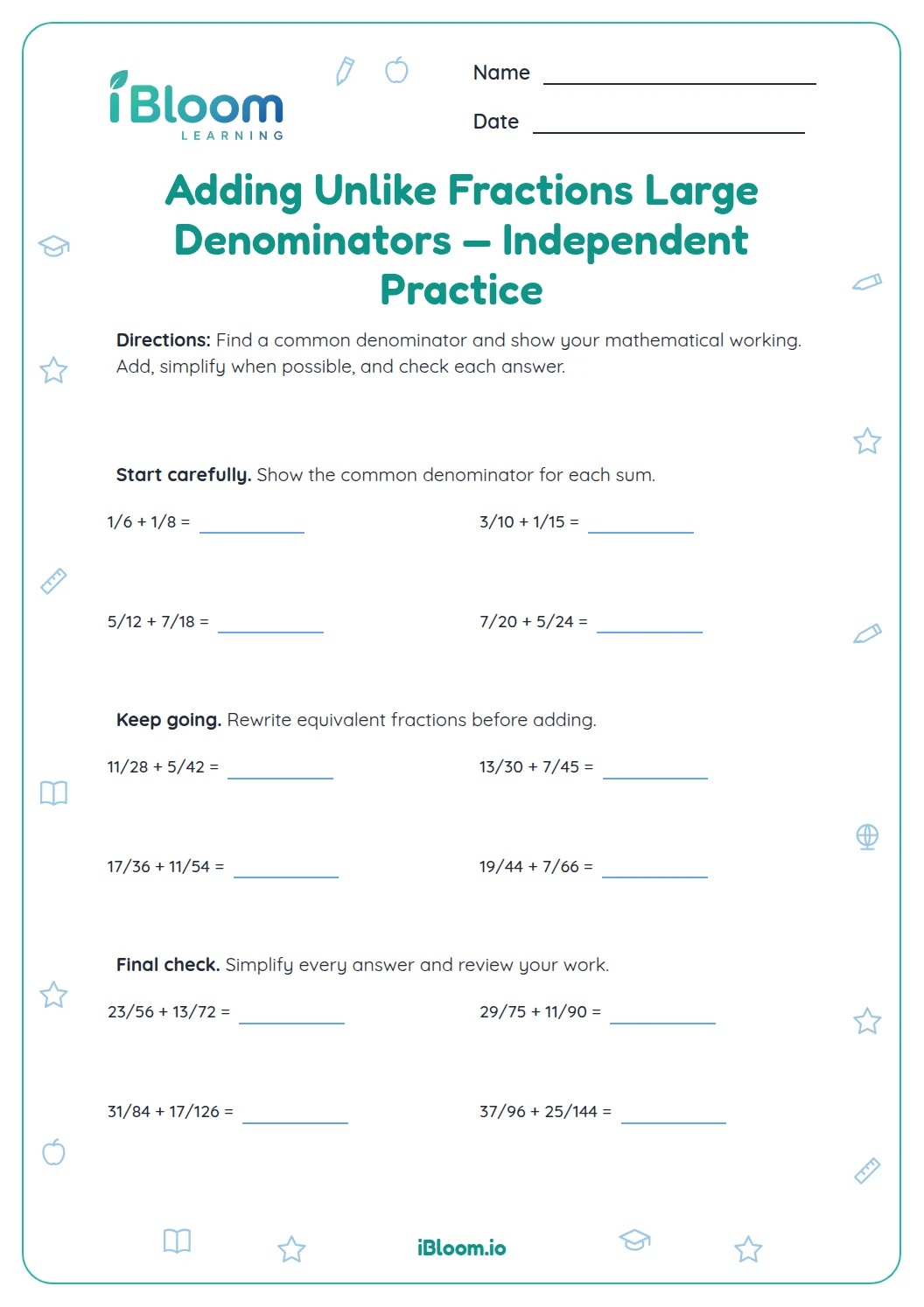
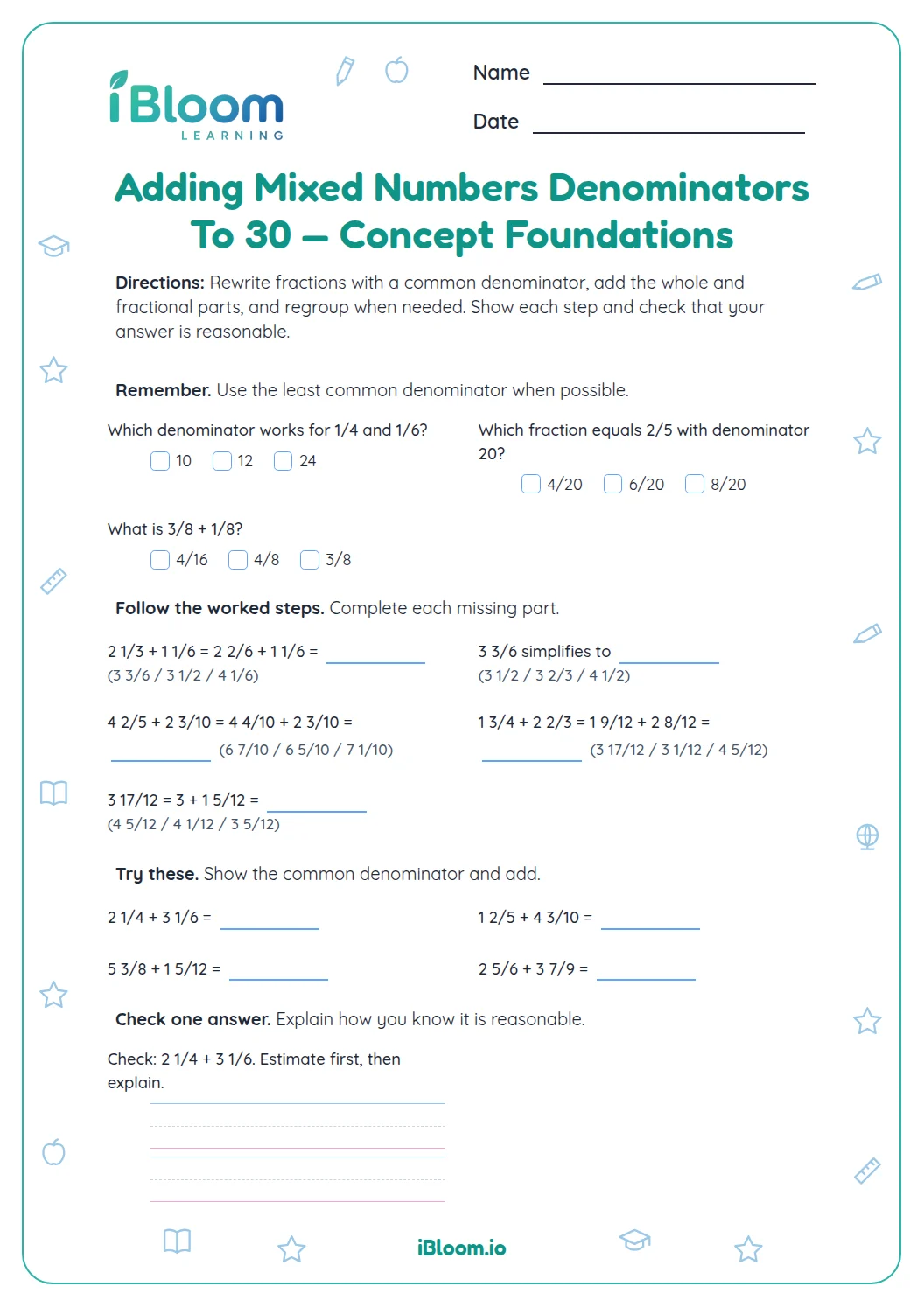
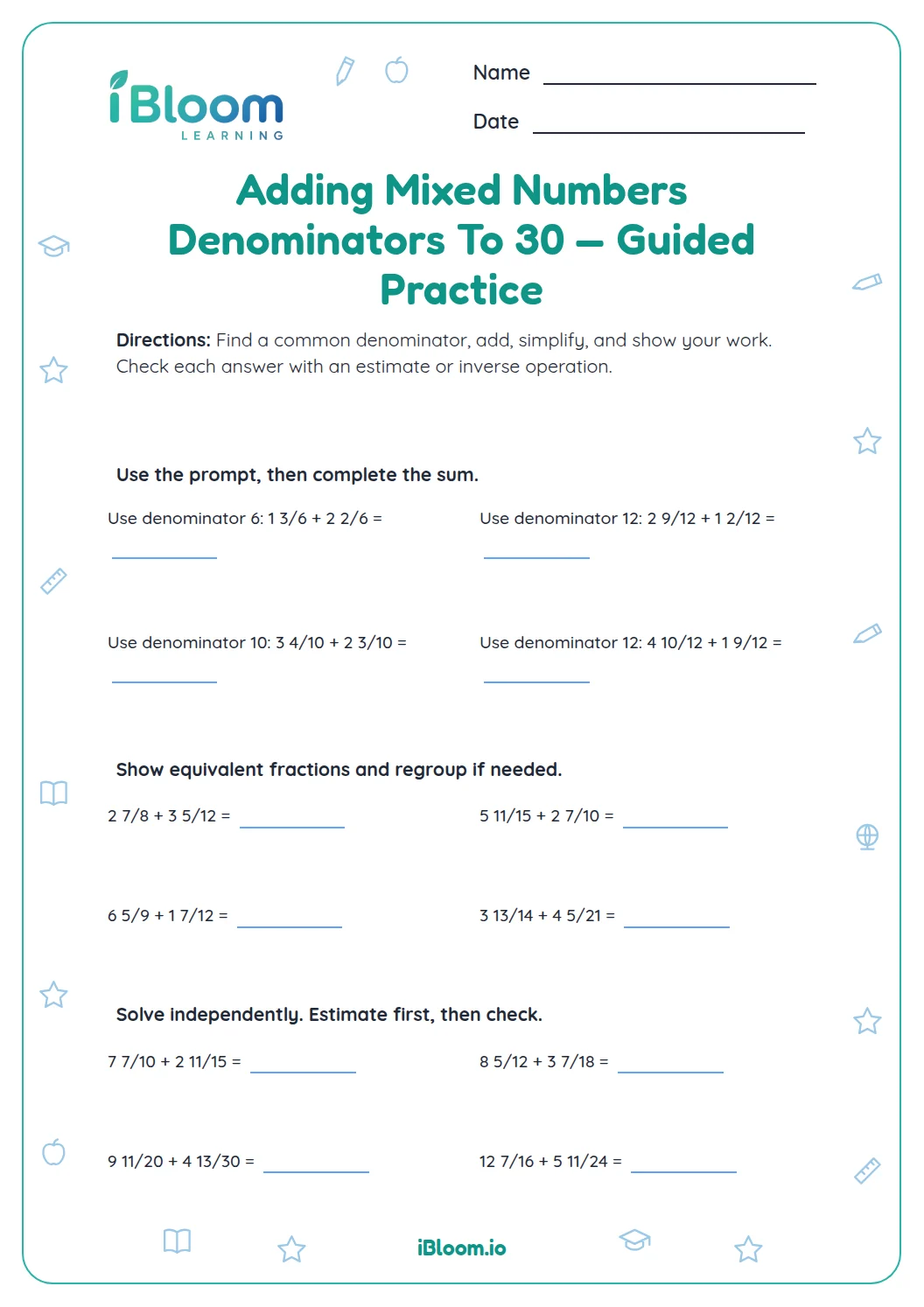
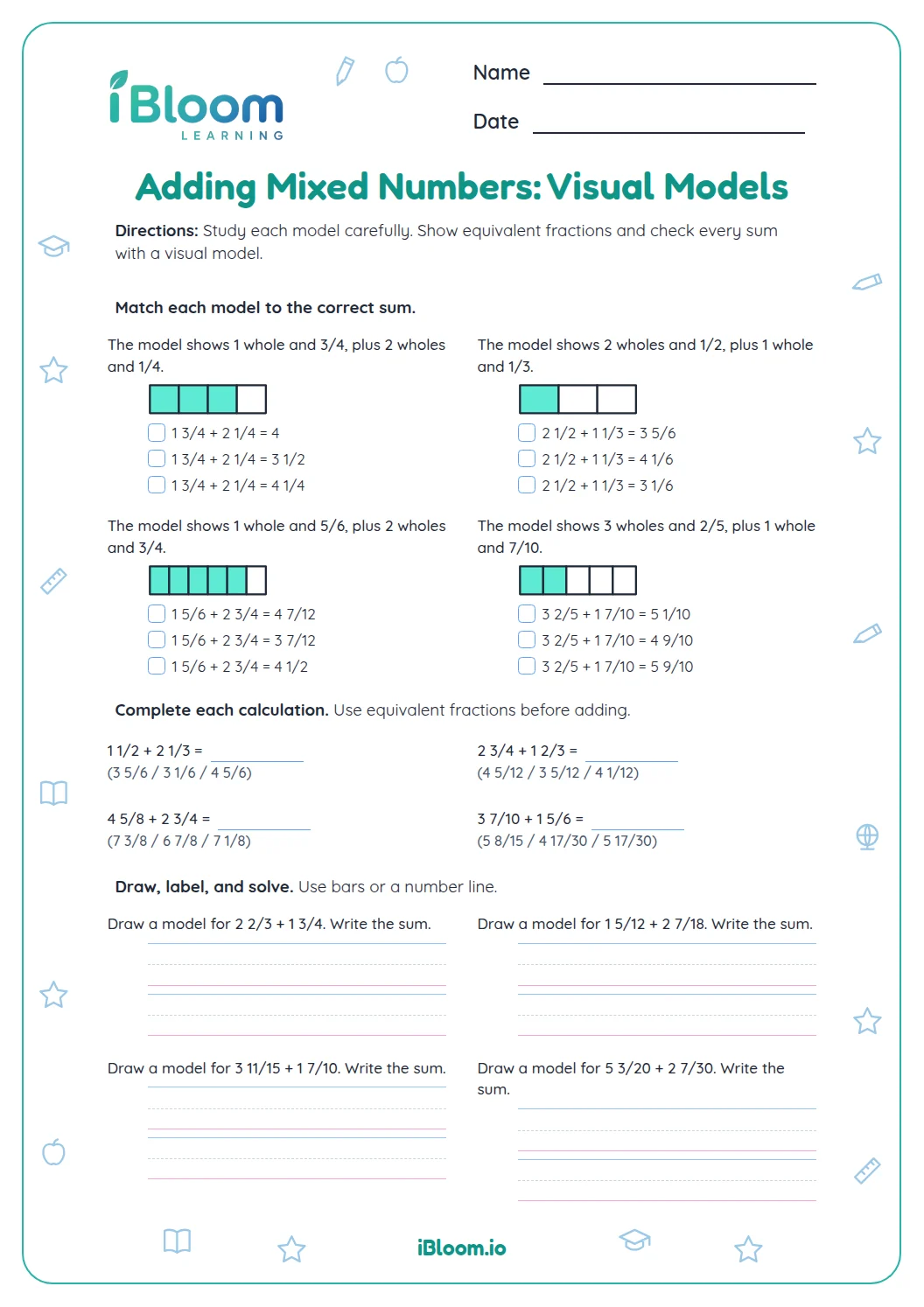
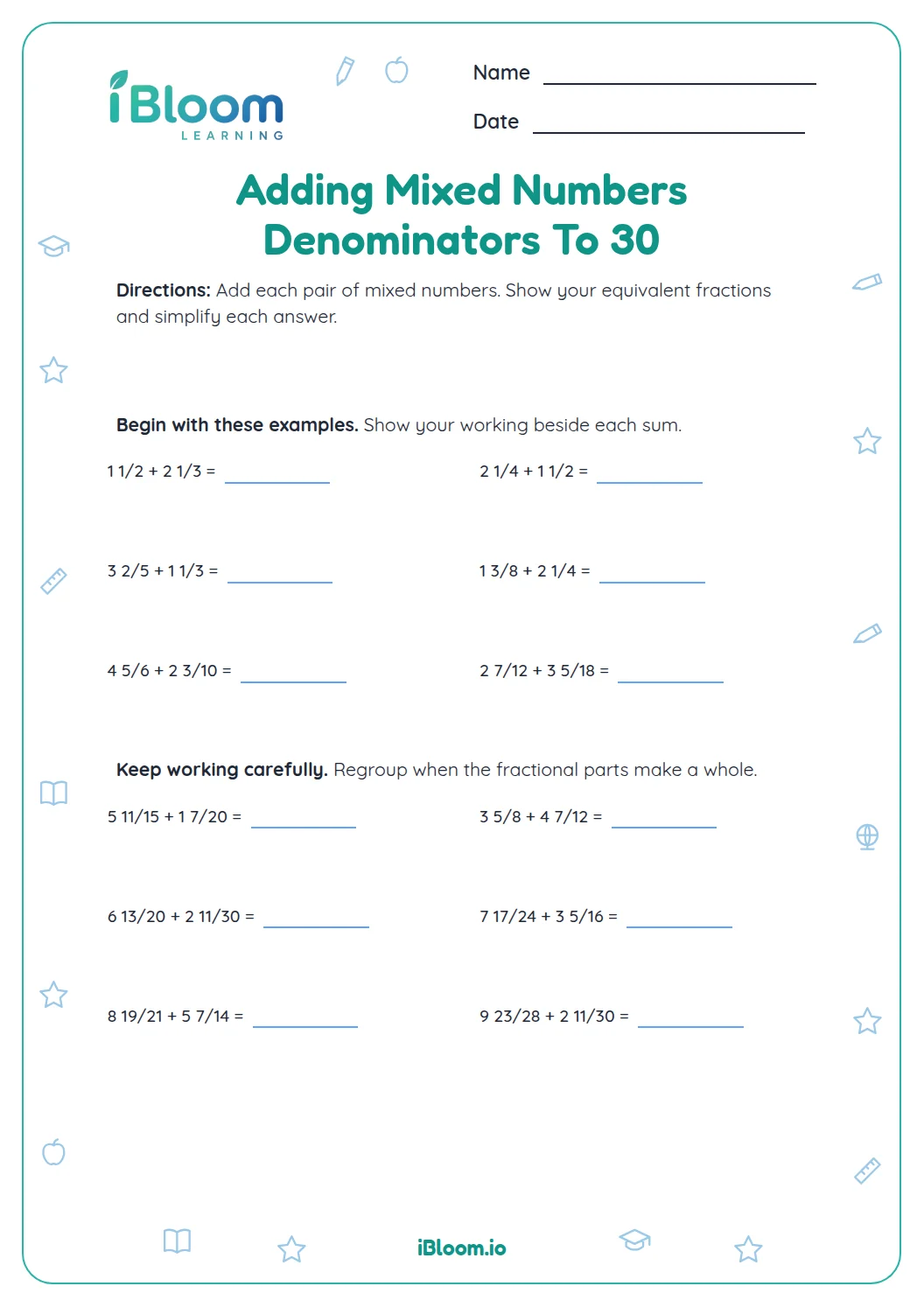
This free printable Grade 6 worksheet gives practice adding and subtracting unlike fractions with large denominators. Students begin with five fraction calculations, then solve ten measurement stories involving length, distance, volume, and area. The answer key shows results with units. The work builds on renaming fractions with common denominators, as described in CCSS 5.NF.A.1.
Aligned to 5.NF.A.1
How do you add or subtract unlike fractions?
Find a denominator that both fractions can use, then rename each fraction without changing its value. Add or subtract the numerators and simplify if possible.
For example, 3/8 + 5/12 becomes 9/24 + 10/24 = 19/24. The common denominator lets you add parts of the same size.
- 13/8 + 5/12
- 2Common denominator: 24
- 39/24 + 10/24 = 19/24
- 4Answer: 19/24
How do the story problems use fractions?
Part B includes adding and subtracting fraction amounts in familiar measurements. An addition story combines portions; a subtraction story asks what remains. Each answer needs its unit as well as its value.
What kinds of questions are included?
Part A has five direct calculations with unlike denominators. Part B has ten measurement stories, including recipes, distances, and lengths. Answers appear in a separate two-page key.
How to use this worksheet
- 1Read whether the situation combines amounts or asks what remains.
- 2Choose a common denominator that works for both fractions.
- 3Rename each fraction as an equivalent fraction.
- 4Add or subtract the numerators and keep the common denominator.
- 5Simplify when possible and include the measurement unit.
Common mistakes and quick fixes
The mistake
Adding the denominators along with the numerators.
The fix
Use equivalent fractions with a common denominator; only the numerators are combined.
The mistake
Using a common denominator but not renaming both fractions.
The fix
Multiply numerator and denominator by the same number so the fraction's value stays the same.
The mistake
Leaving off the unit in a story answer.
The fix
Reread the question and attach gallons, meters, miles, cups or liters to the result.
Common Core alignment
This worksheet gives practice with the following Common Core standard.
Add and subtract fractions with unlike denominators by making equivalent fractions with like denominators.
On this sheet: The questions repeatedly ask students to rewrite unlike fractions as equivalent fractions with a shared denominator before adding or subtracting.
Show the official wordingHide the official wording
Add and subtract fractions with unlike denominators (including mixed numbers) by replacing given fractions with equivalent fractions in such a way as to produce an equivalent sum or difference of fractions with like denominators. For example, 2/3 + 5/4 = 8/12 + 15/12 = 23/12. (In general, a/b + c/d = (ad + bc)/bd.)
What to practice next
Make more practice
Further reading
Questions parents and teachers ask
Why do fractions need a common denominator?
The denominator names the size of the parts. Converting both fractions to the same part size lets you combine or compare like units, such as 9/24 + 10/24 = 19/24. The original values stay the same because each fraction is renamed equivalently.
How do I solve 3/8 + 5/12?
Use 24 as the common denominator. Rename 3/8 as 9/24 and 5/12 as 10/24, then add to get 19/24. This example follows the same steps students use for the direct calculations before applying the method to measurement stories.
When should a student simplify an answer?
After adding or subtracting, check whether the numerator and denominator share a factor. For example, 6/8 simplifies to 3/4. Some answers on this sheet are already in simplest form, so the student can leave those values as they are.
Why do the story answers need units?
A number alone does not say what was measured. The problems ask about gallons, meters, miles, cups, liters and acres, so writing the unit connects the fraction answer to the situation. Check that the unit in the answer matches the quantity in the question.
How many practice questions are included?
There are 15 questions in two parts: five unlike-fraction calculations and ten measurement stories. The separate answer key gives the results with units where needed, so students can check their fraction work and the quantity they found in each situation.