





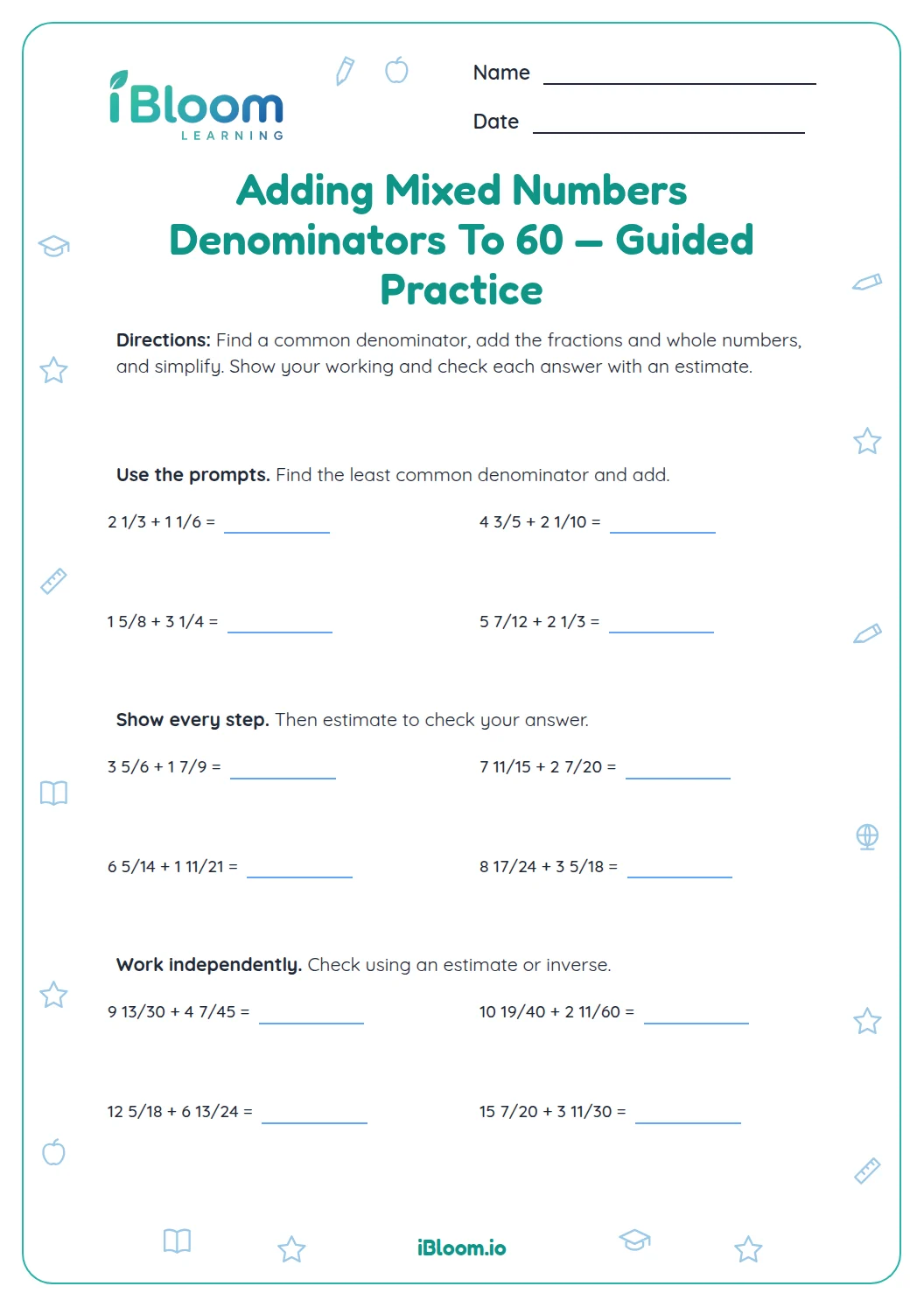

About this worksheet
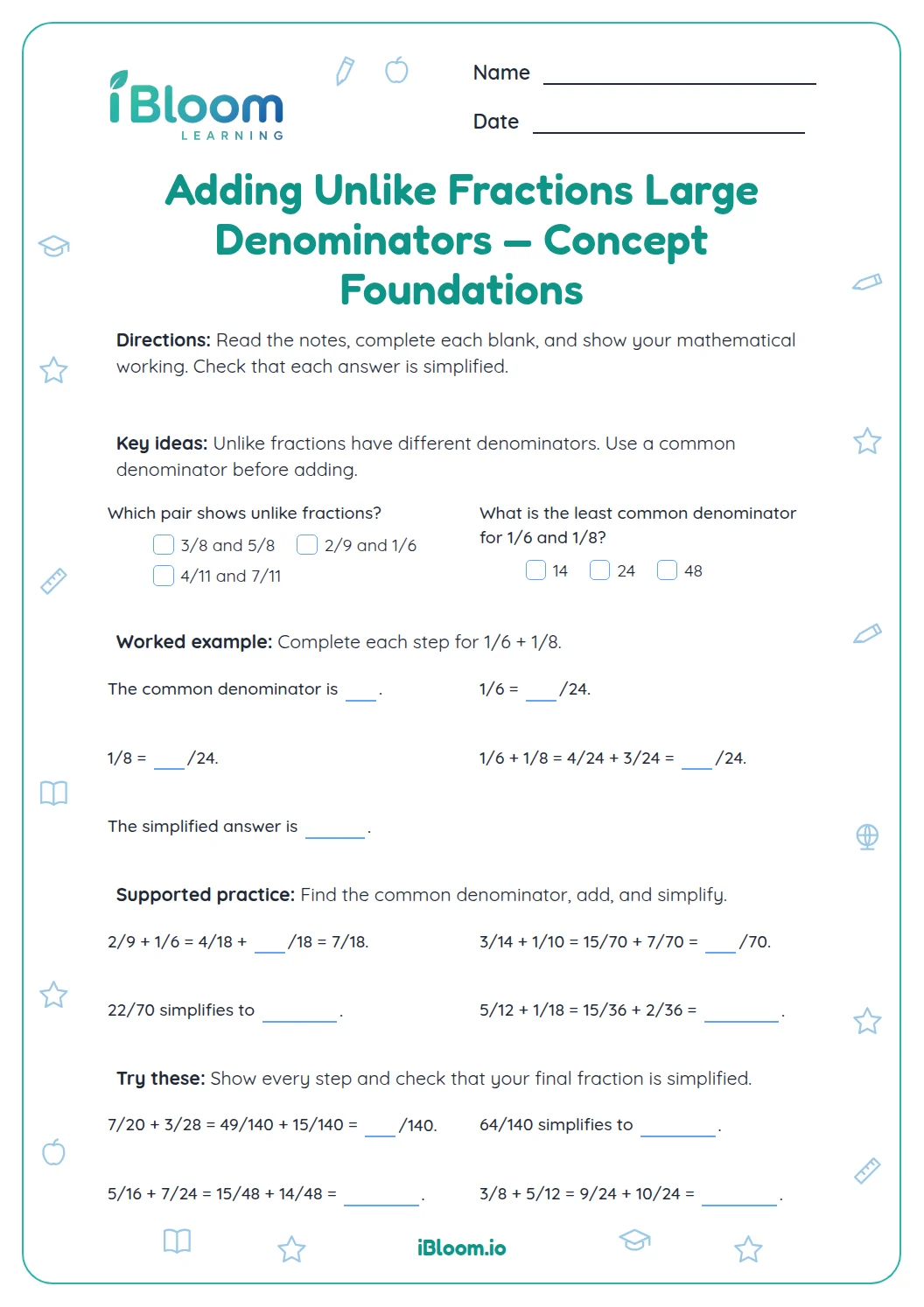
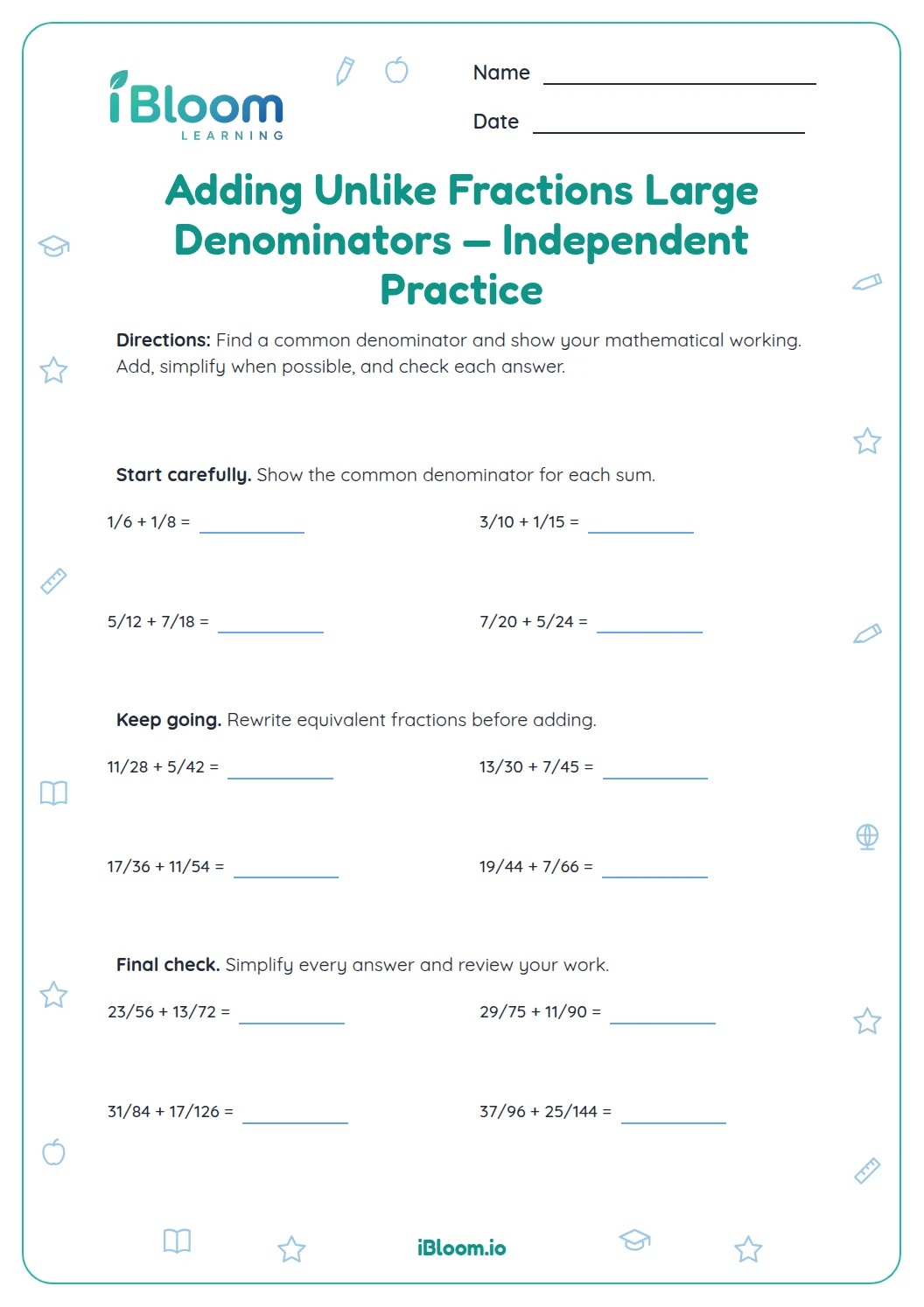
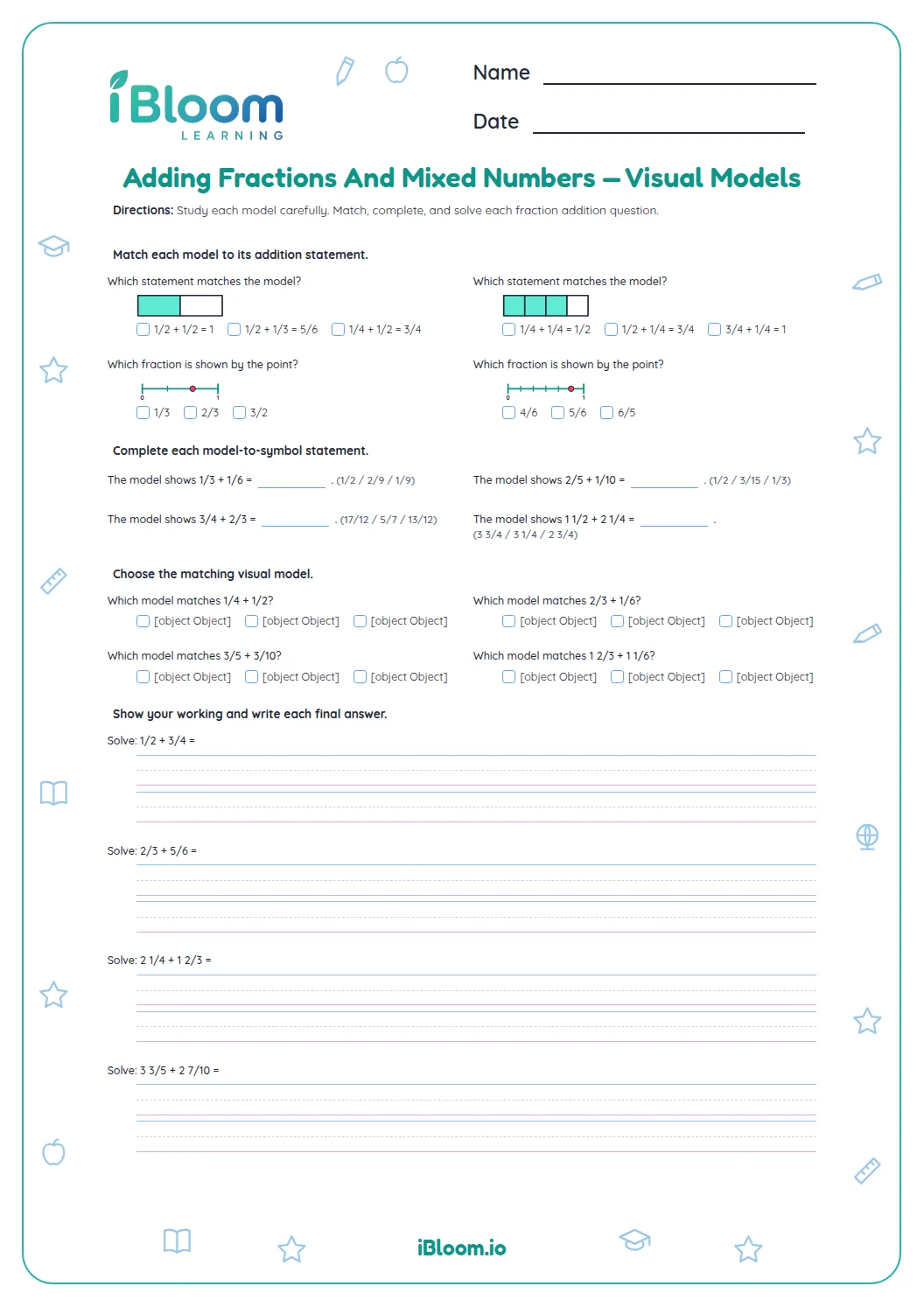
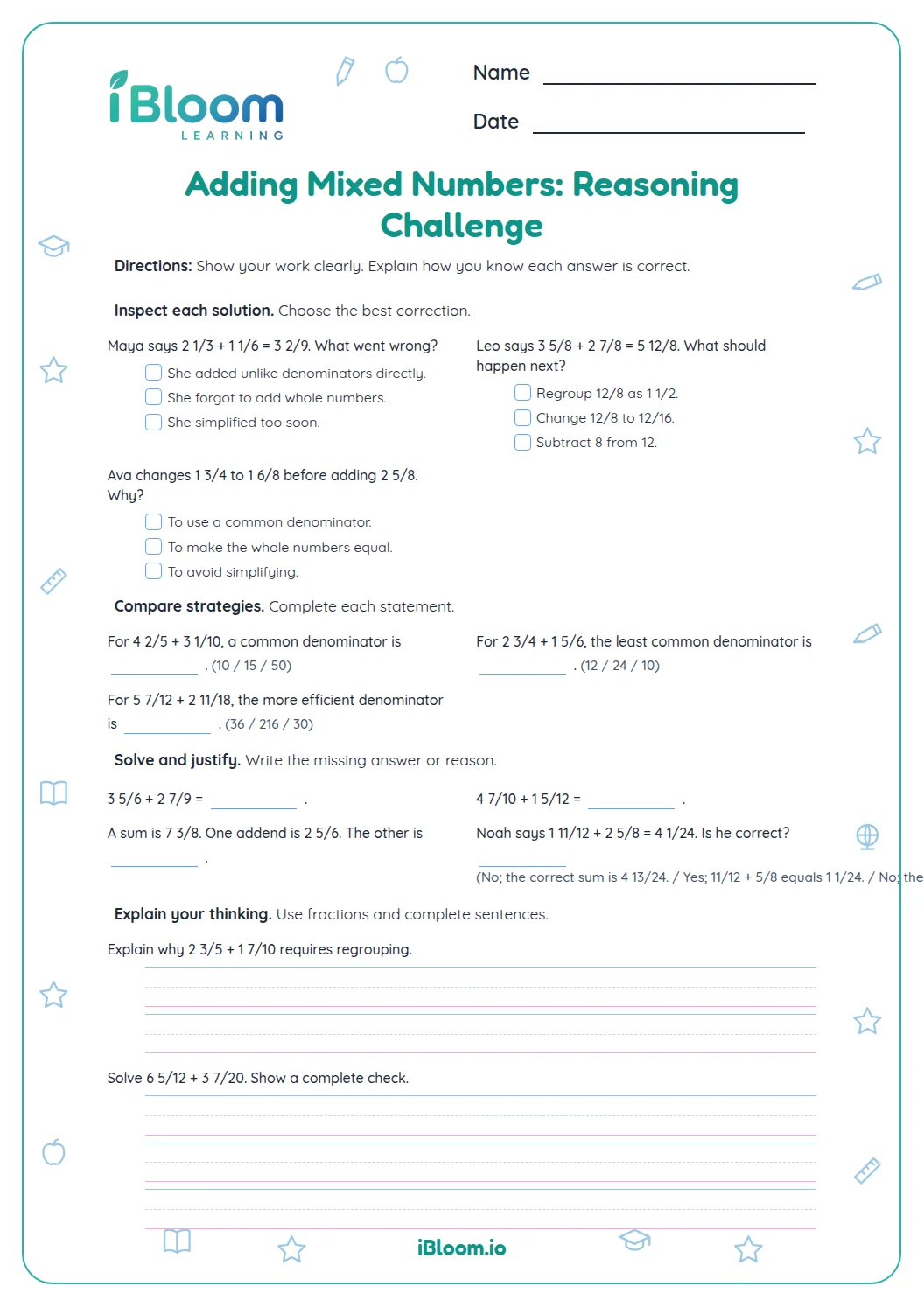
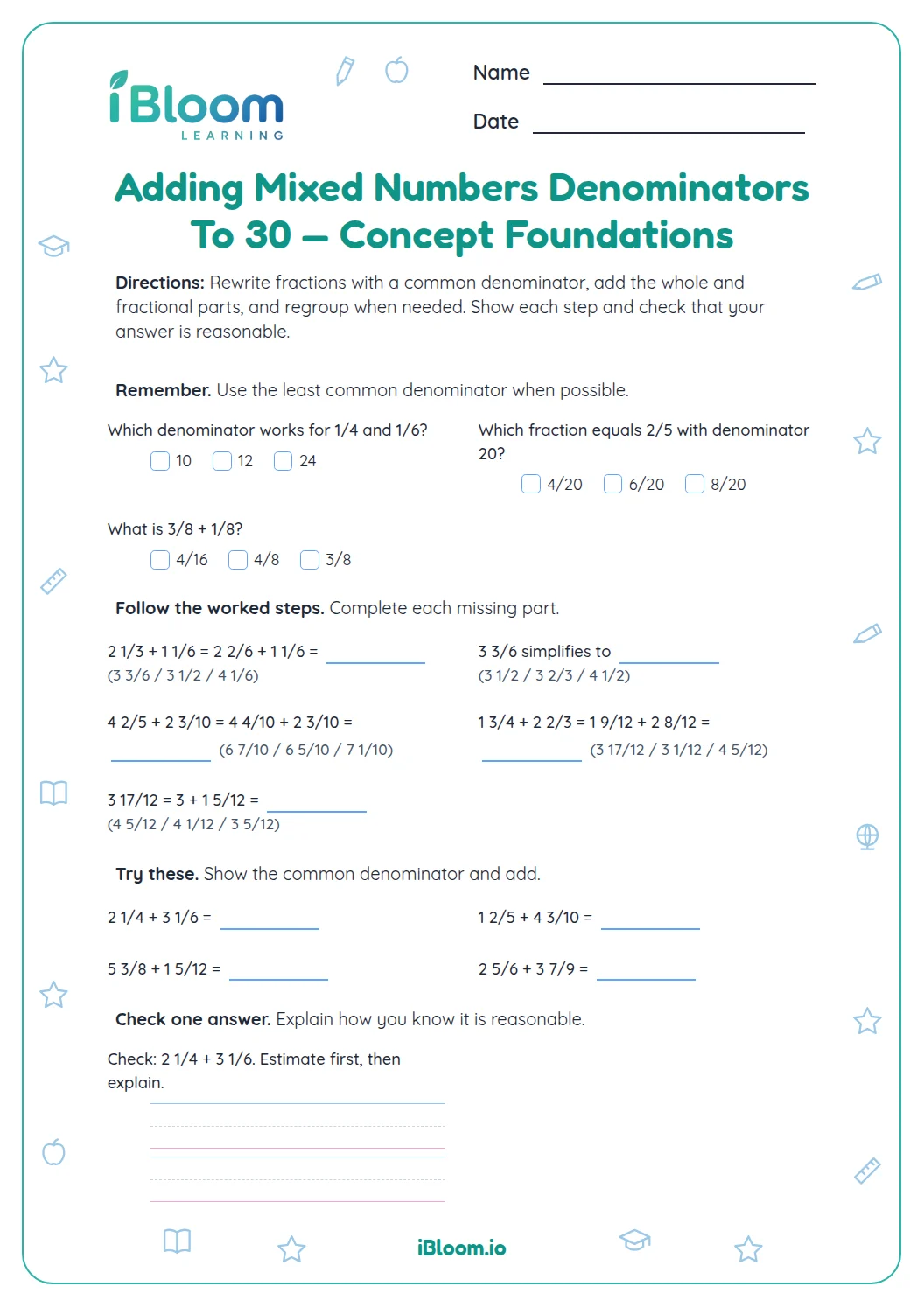
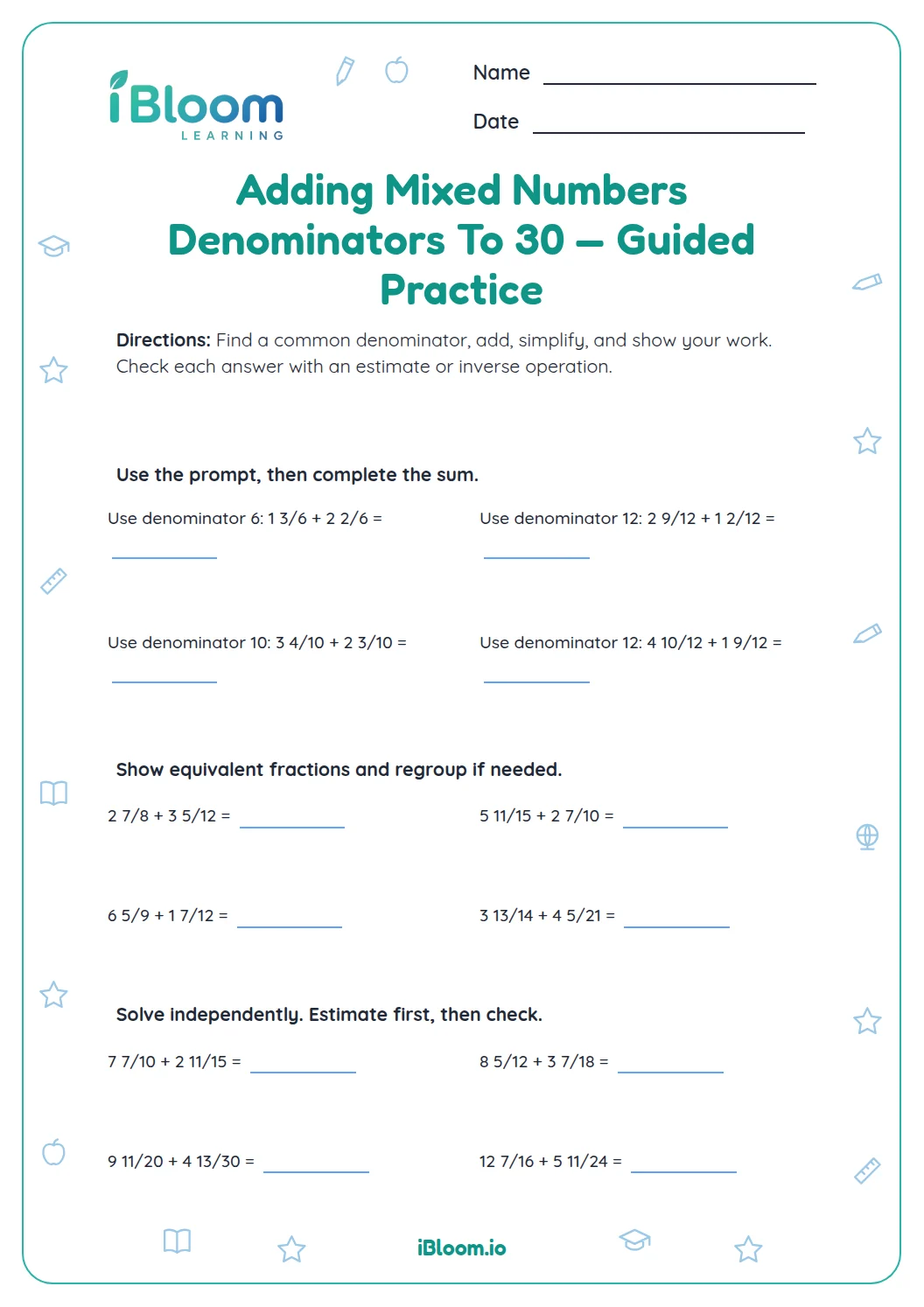
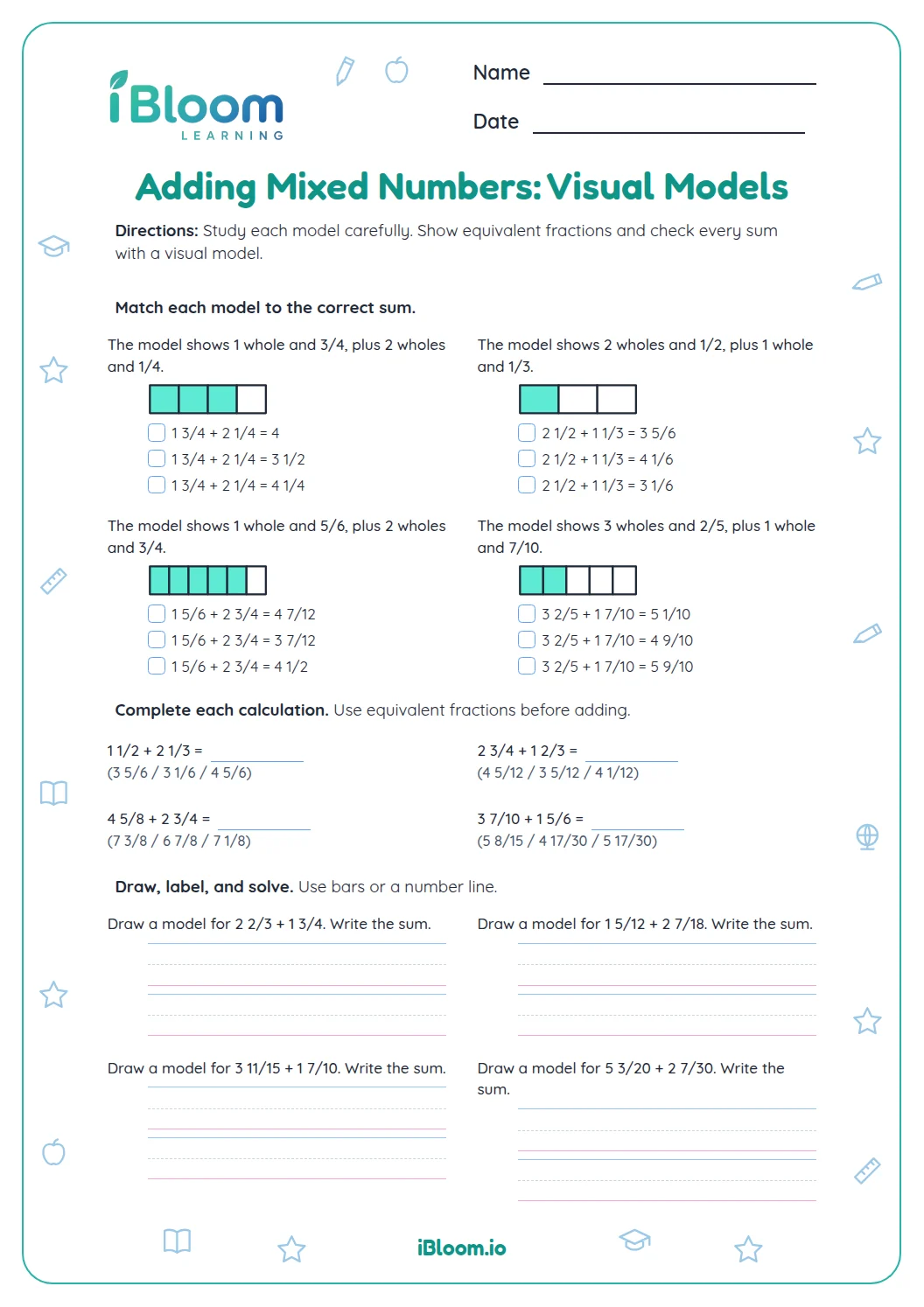
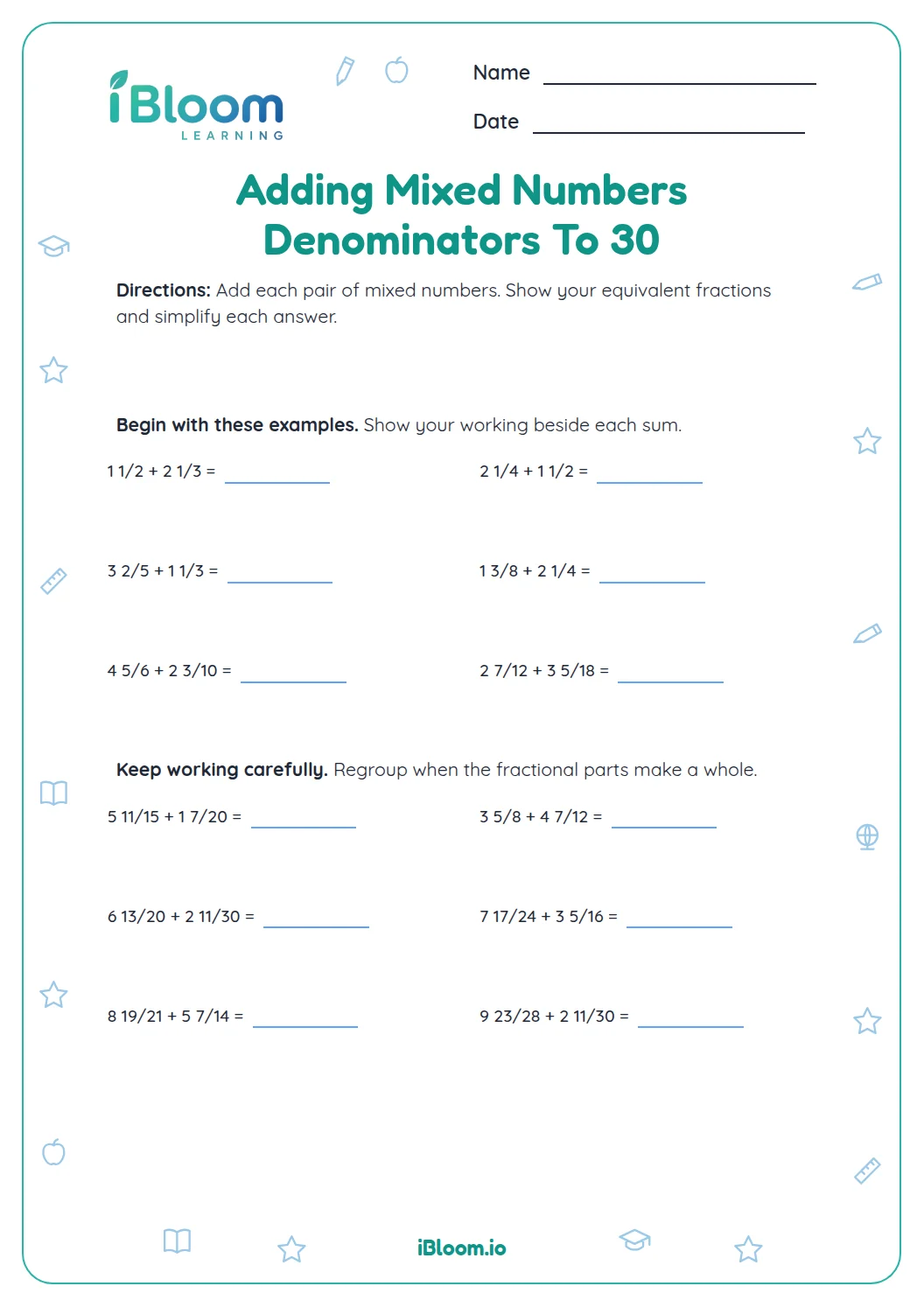
This Grade 6 printable practices adding and subtracting fractions with unlike denominators such as 18, 24, 30, and 36. Students rewrite fractions as equivalent fractions, simplify, and check whether results make sense. The 18 questions include mixed numbers and short applications, with a separate answer key. The operations align with CCSS 5.NF.A.1.
Aligned to 5.NF.A.1
How do you add unlike fractions?
Choose a common denominator, rewrite both fractions, and add the numerators. For question 1, the least common denominator of 12 and 18 is 36. Thus 5/12 + 7/18 = 15/36 + 14/36 = 29/36.
- 1LCM(12, 18) = 36
- 25/12 = 15/36; 7/18 = 14/36
- 315/36 + 14/36 = 29/36
What changes when subtracting?
The common-denominator step is the same, but subtract the numerators. For 13/20 − 7/30, use 60: 39/60 − 14/60 = 25/60, then simplify to 5/12.
How can you check whether an answer is reasonable?
Estimate each fraction using benchmarks such as 0, 1/2, and 1. A sum should be larger than either positive addend. For a difference, check that the answer is smaller than the starting amount. Reduce the final fraction when possible.
How to use this worksheet
- 1List the denominators and choose a common multiple.
- 2Rewrite each fraction as an equivalent fraction.
- 3Add or subtract only the numerators.
- 4Simplify the result or write it as a mixed number.
- 5Estimate to check whether the result is a reasonable size.
- 6Use the answer key to check each calculation.
Common mistakes and quick fixes
The mistake
Adding denominators as well as numerators.
The fix
Use equivalent fractions with one shared denominator, then combine only the numerators.
The mistake
Using the product of denominators when a smaller common denominator works.
The fix
Find the least common multiple to keep the numbers manageable.
The mistake
Forgetting to simplify the final fraction.
The fix
Look for a common factor in the numerator and denominator.
Common Core alignment
Students rename fractions with common denominators and add or subtract accurately.
Rename unlike fractions with like denominators before operating.
On this sheet: Every calculation requires equivalent fractions with a common denominator to add or subtract.
Show the official wordingHide the official wording
Add and subtract fractions with unlike denominators (including mixed numbers) by replacing given fractions with equivalent fractions in such a way as to produce an equivalent sum or difference of fractions with like denominators. For example, 2/3 + 5/4 = 8/12 + 15/12 = 23/12. (In general, a/b + c/d = (ad + bc)/bd.)
What to practice next
Make more practice
Further reading
Questions parents and teachers ask
How do you add fractions with unlike denominators?
Find a common denominator, rewrite each fraction as an equivalent fraction, and then add the numerators. For example, 5/12 + 7/18 becomes 15/36 + 14/36 = 29/36. Write the common denominator above the calculation so each equivalent fraction can be checked.
How do you subtract fractions with unlike denominators?
First rename both fractions with the same denominator. Then subtract the numerators and keep that denominator. Simplify the result when possible, and regroup a mixed number if the fractional part is too small. A benchmark estimate helps show whether the sum or difference is reasonable.
What makes these denominators large?
The practice includes denominators such as 18, 24, 30, and 36, so students must choose a common denominator thoughtfully. Some pairs share a useful multiple, which helps avoid multiplying denominators unnecessarily. Keep the denominator unchanged after renaming, then simplify only the final fraction.
How many problems are on the sheet?
The worksheet includes 18 questions in three parts: equivalent-fraction setup, addition and subtraction, then error checks and applied problems. A separate answer key gives the simplified answers. For a mixed number, compare the fractional parts before deciding whether to regroup.
Should answers always be simplified?
Yes. Reduce a fraction by dividing its numerator and denominator by the same factor. If the result is greater than one, write it as a mixed number when the question asks for a simplified answer. The question asks for exact fraction work, so avoid rounding intermediate values.
How can students check an answer?
Estimate first, then use the opposite operation or a common denominator to check. A sum should be larger than either addend, and subtracting a positive fraction should make the starting amount smaller. Check the result with the opposite operation when a missing number is requested.