



About this worksheet
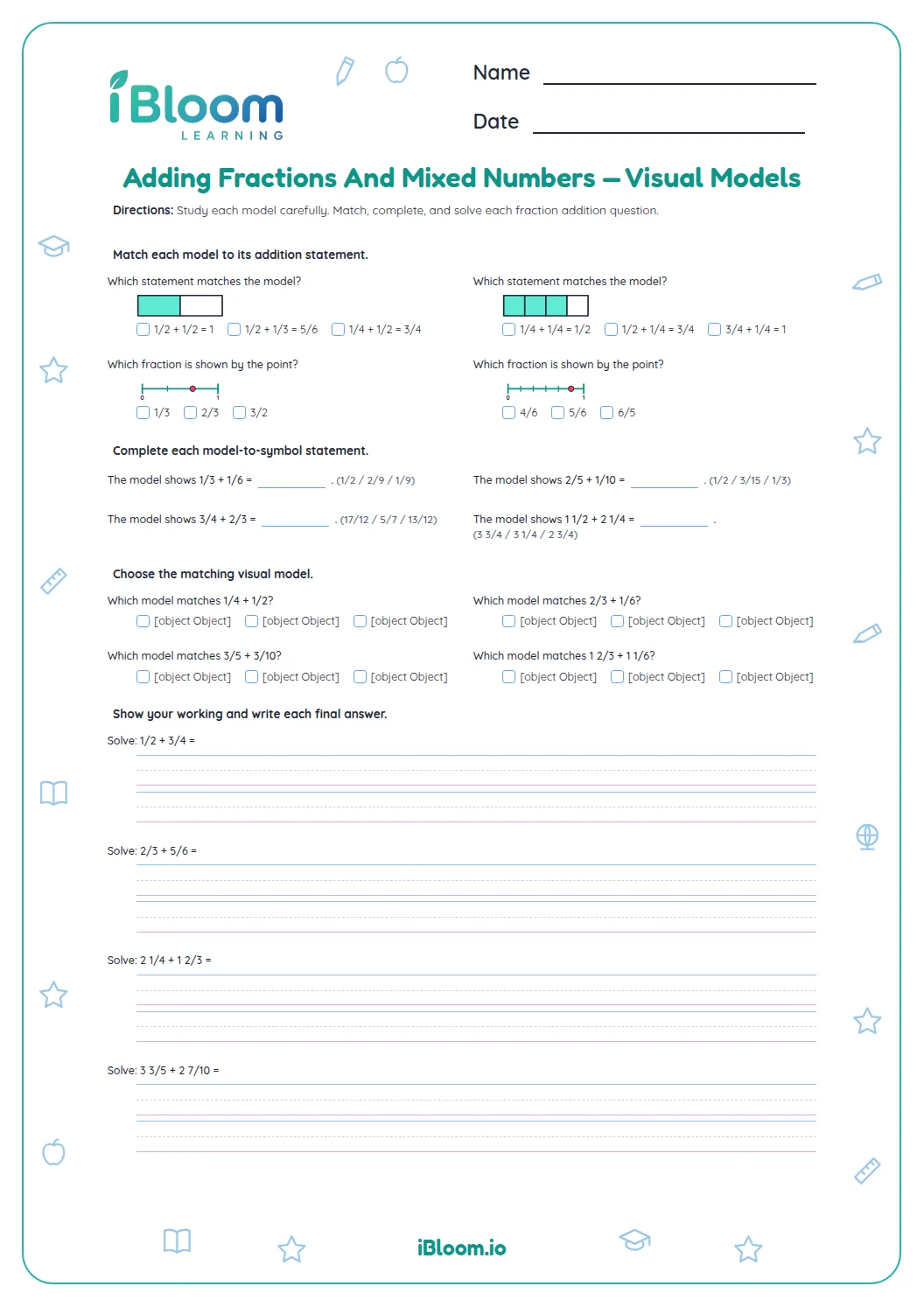
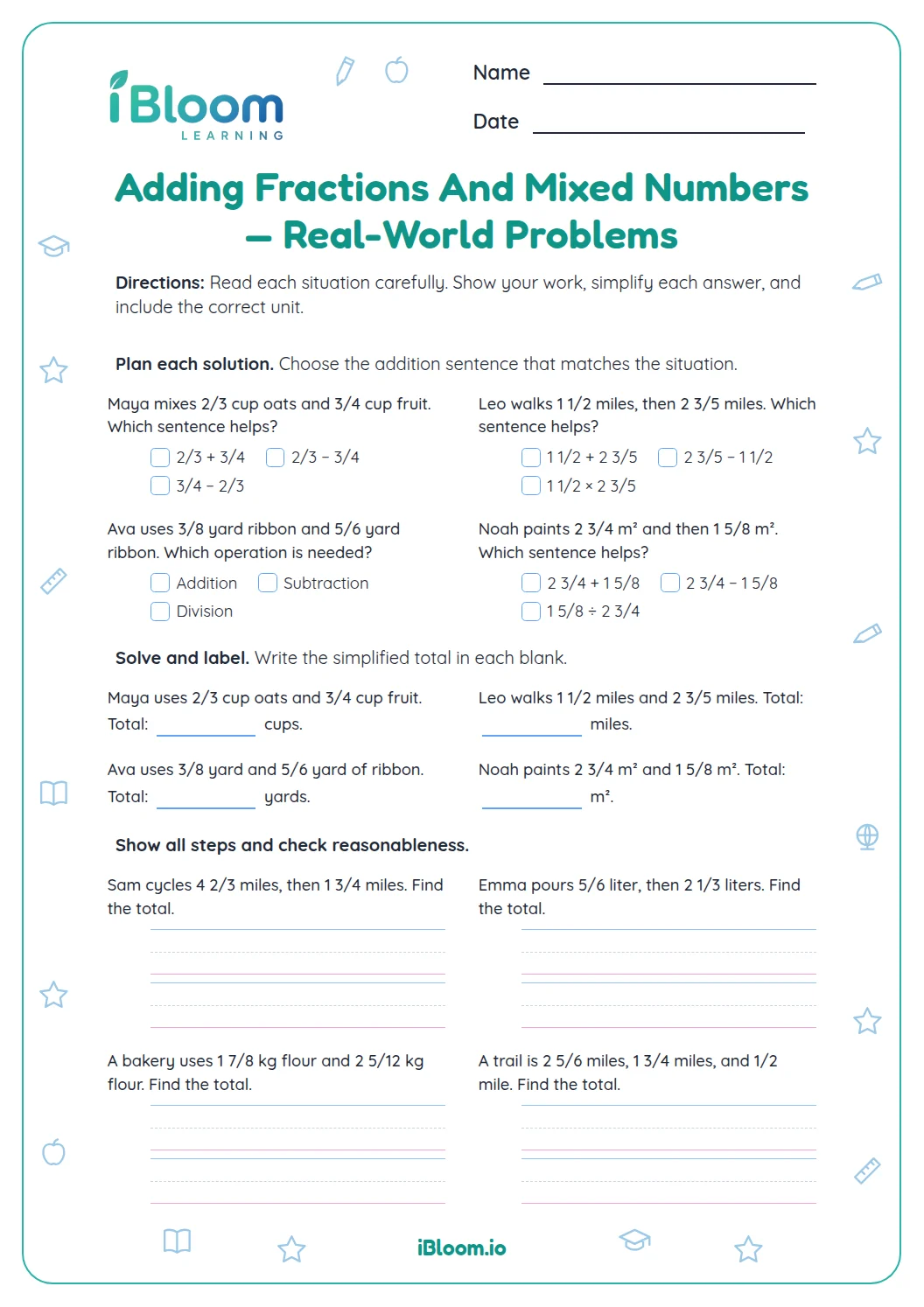
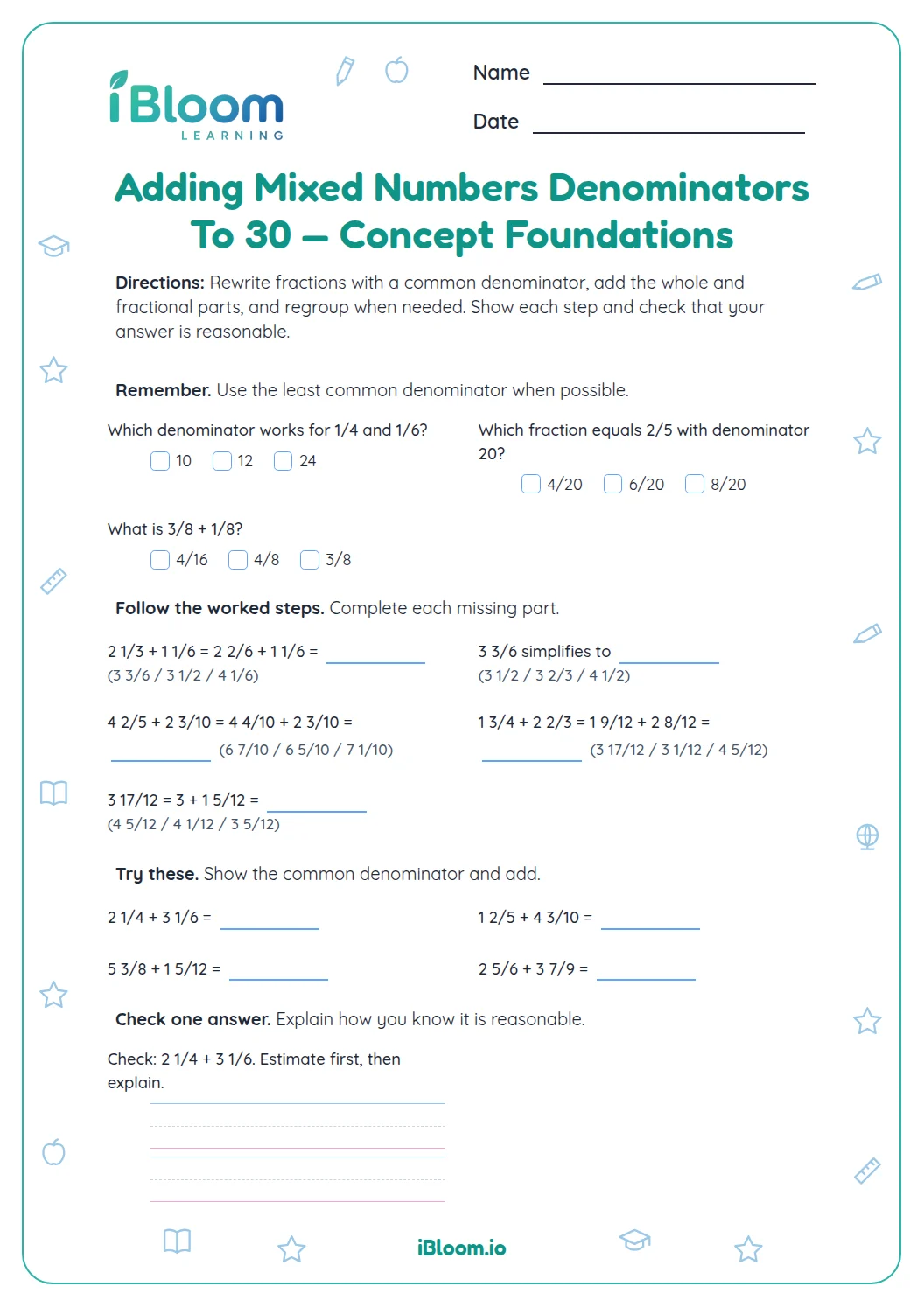
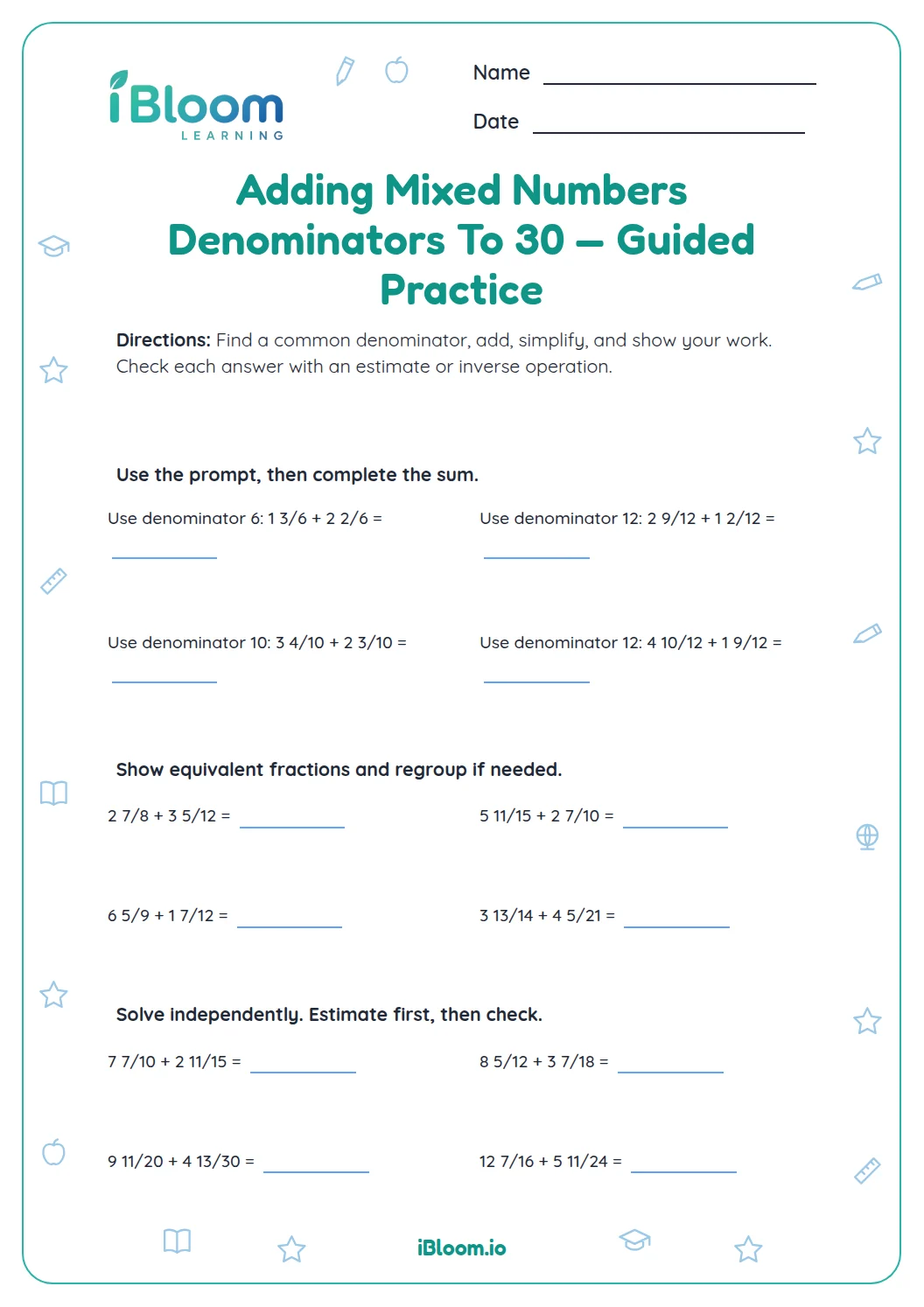
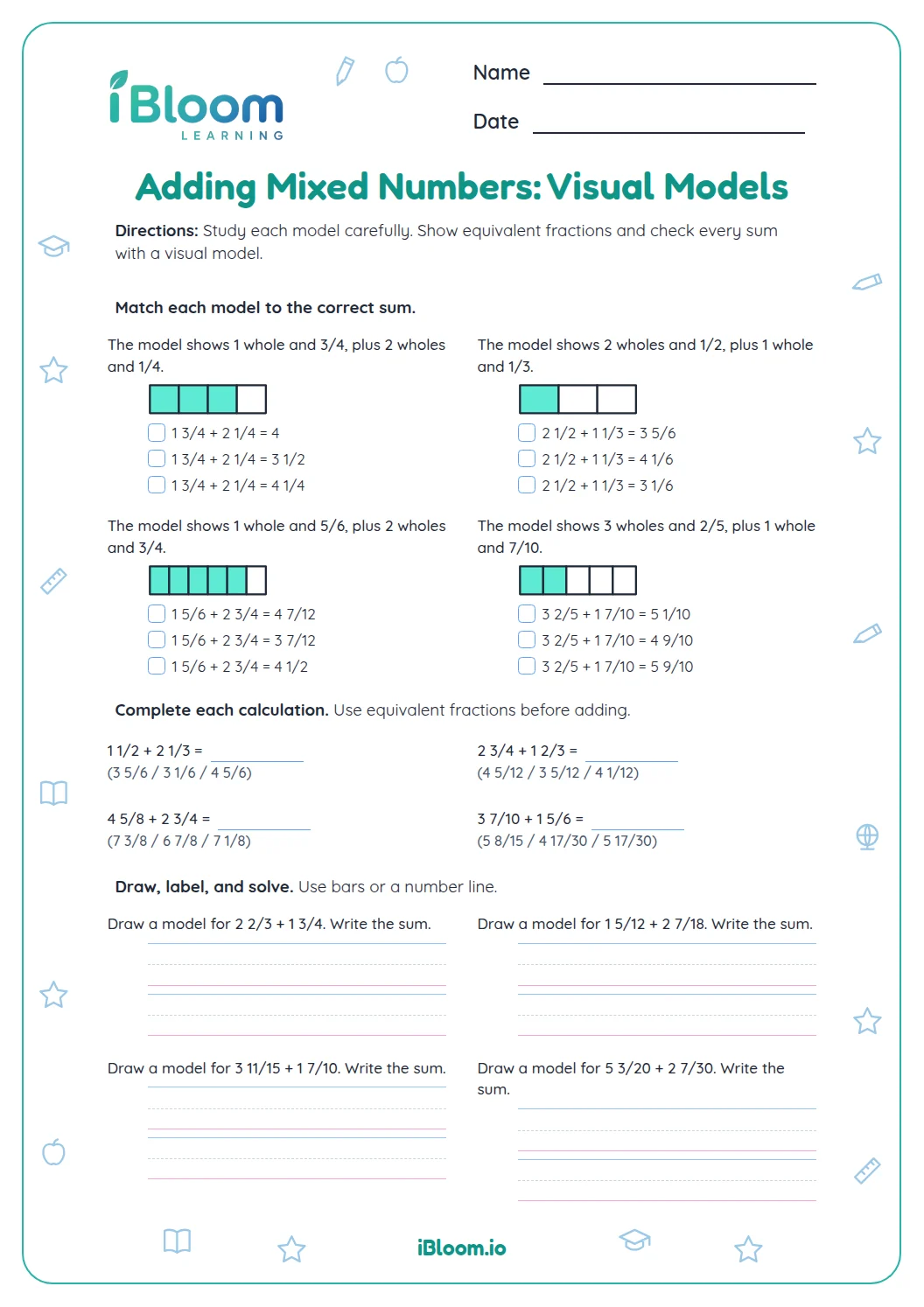
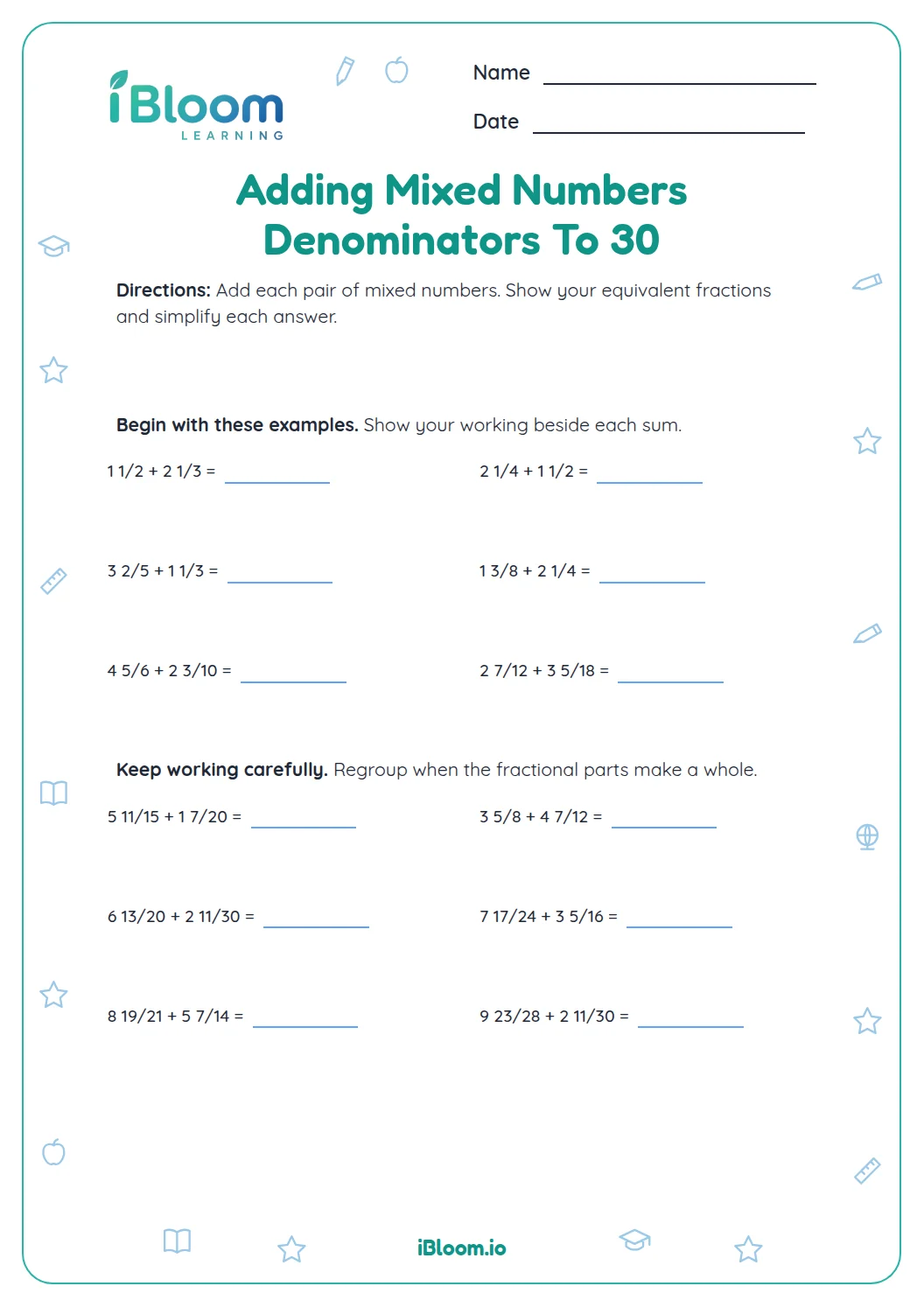
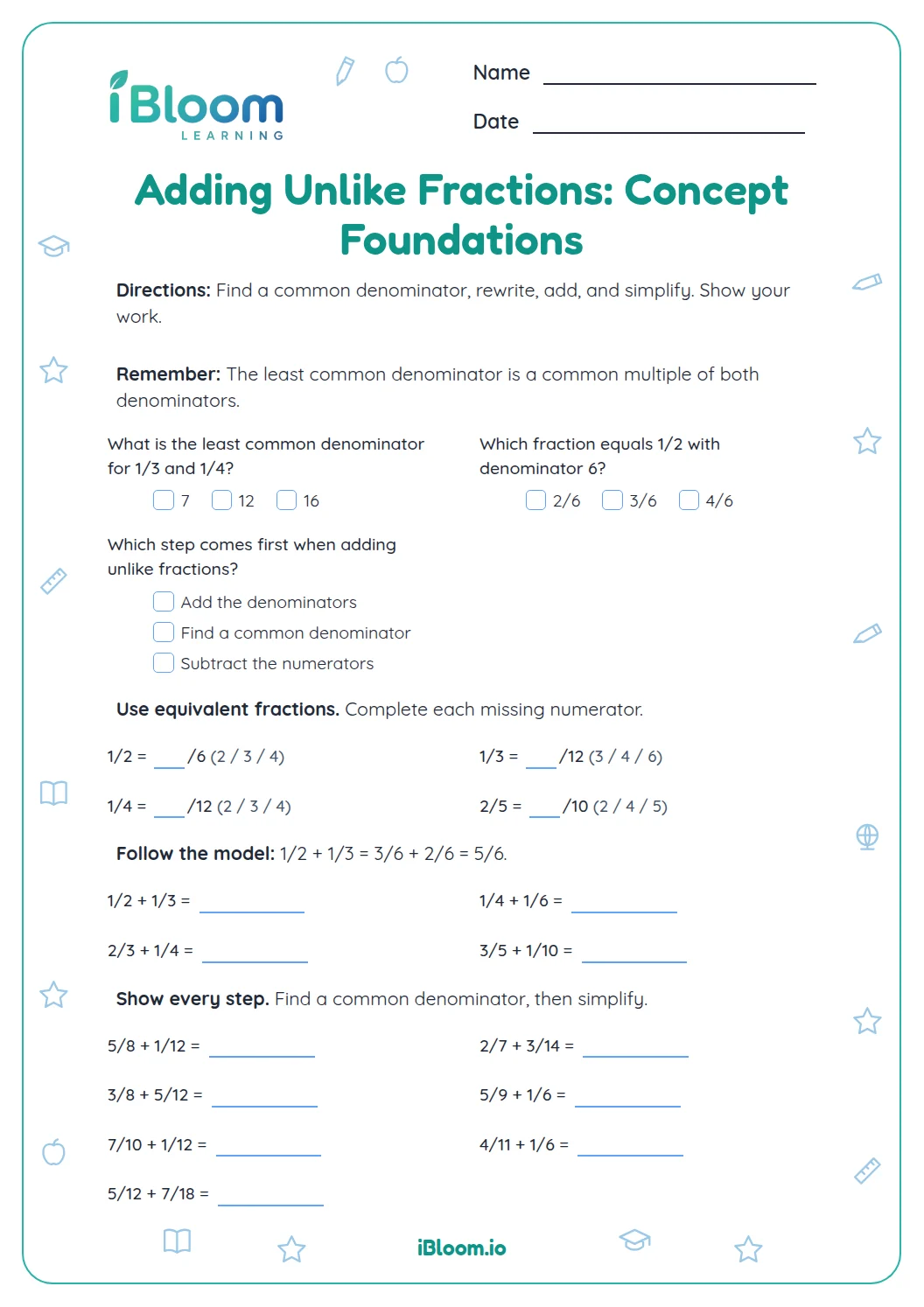
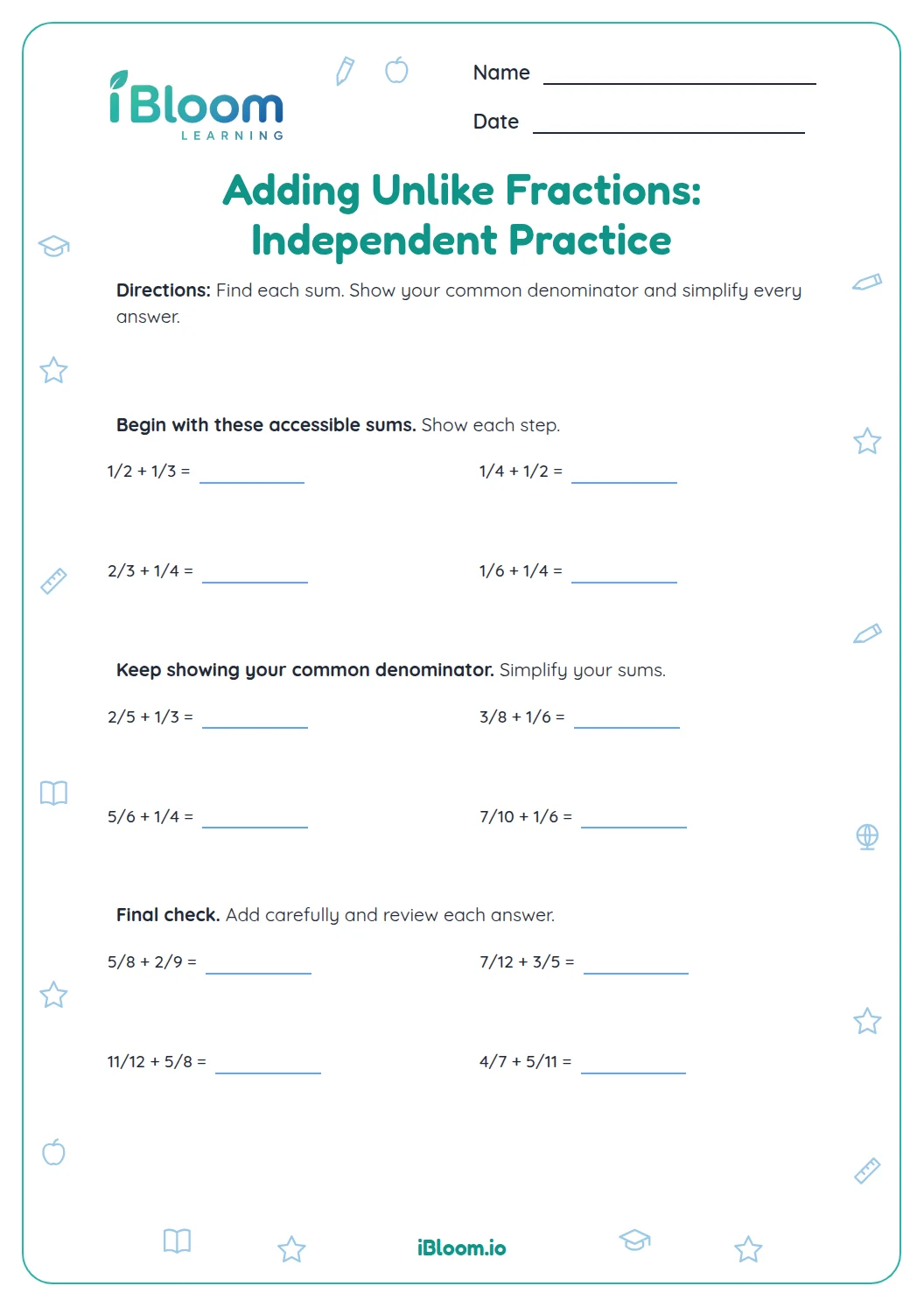
This Grade 6 reasoning challenge practices addition and subtraction with fractions and mixed numbers. Students choose common denominators, simplify computations, solve same-whole measurement stories, and correct a common denominator error. The 14 questions include short calculations, word problems with workspace, and written reasoning, with a separate answer key. The work aligns to Common Core 5.NF.A.1 and 5.NF.A.2, which describe equivalent fraction strategies and fraction word problems.
Aligned to 5.NF.A.1 and 5.NF.A.2
Why do fractions need a common denominator?
The denominator names the size of the parts. Add or subtract only after the parts are the same size. Multiplying numerator and denominator by the same number renames a fraction without changing its value.
- 11/3 + 1/6 = 2/6 + 1/6 = 3/6 = 1/2.
How do you add or subtract mixed numbers?
Keep the whole-number and fractional amounts organized. If subtracting leaves a negative fraction, regroup one whole as a fraction with the same denominator.
- 14 1/6 − 2 5/6 = 3 7/6 − 2 5/6 = 1 2/6 = 1 1/3.
How can you check a fraction story answer?
Write the operation the story describes, keep the same unit and whole, and estimate before calculating. If a sum is larger than 1, it should agree with the sizes of the addends.
How to use this worksheet
- 1Estimate each answer before calculating.
- 2Find a common denominator using equivalent fractions.
- 3For mixed numbers, align whole amounts and fraction parts.
- 4Write an equation for each story and keep the measurement unit.
- 5Use the estimate to test whether the exact answer is reasonable.
What should students check?
The mistake
Mistake: adding denominators.
The fix
Rename both fractions with equal-size parts, then add numerators.
The mistake
Mistake: treating 1/4 as larger than 1/3 because 4 is bigger.
The fix
Compare the size of the parts, not just denominator digits.
The mistake
Mistake: losing a whole while regrouping.
The fix
Rename that whole in the common denominator before subtracting.
Common Core alignment
The questions give students direct practice with the listed skill.
Use equivalent fractions to add and subtract unlike denominators and mixed numbers.
On this sheet: Parts A and B convert to common denominators and compute sums and differences, including mixed numbers.
Show the official wordingHide the official wording
Add and subtract fractions with unlike denominators (including mixed numbers) by replacing given fractions with equivalent fractions in such a way as to produce an equivalent sum or difference of fractions with like denominators.
Solve fraction addition and subtraction word problems and assess answer reasonableness.
On this sheet: Part C models same-whole measurements with equations; Part D asks students to detect an incorrect sum.
Show the official wordingHide the official wording
Solve word problems involving addition and subtraction of fractions referring to the same whole, including cases of unlike denominators, e.g., by using visual fraction models or equations to represent the problem. Use benchmark fractions and number sense of fractions to estimate mentally and assess the reasonableness of answers.
What to practice next
Make more practice
Further reading
Questions parents and teachers ask
Why do fractions need a common denominator?
A denominator names the size of the parts. To combine fractions, rename them as equal-size parts first. For example, thirds and sixths can both be written in sixths, so 1/3 + 1/6 becomes 2/6 + 1/6. This keeps the calculation connected to the amount described in the prompt.
How do you add or subtract mixed numbers?
Work with the whole-number amounts and fractional amounts, using a common denominator for the fractions. If a subtraction leaves too few fractional parts, regroup one whole into the denominator’s number of parts before subtracting. Scale the numerator and denominator by the same factor when renaming.
How can a student check a fraction word problem?
Write an equation that matches the story, keep the unit with the answer, and estimate before solving. If the result is a sum, compare it with the size of both addends; if it is a difference, check that it is smaller than the starting amount.
Does the answer key accept equivalent fractions?
Yes. A fraction answer can be written in an equivalent form, though the final result should be simplified when possible. For example, 3/6 and 1/2 name the same amount, and 1/2 is the simplified form. The numerator and denominator must be scaled by the same factor.
What skills are practiced in this challenge?
Students find common denominators, add and subtract unlike fractions and mixed numbers, solve measurement stories, estimate, and correct an incorrect sum. The sequence moves from selecting a strategy to calculating and checking whether an answer makes sense. Check by estimating whether the result is larger or smaller than one.