



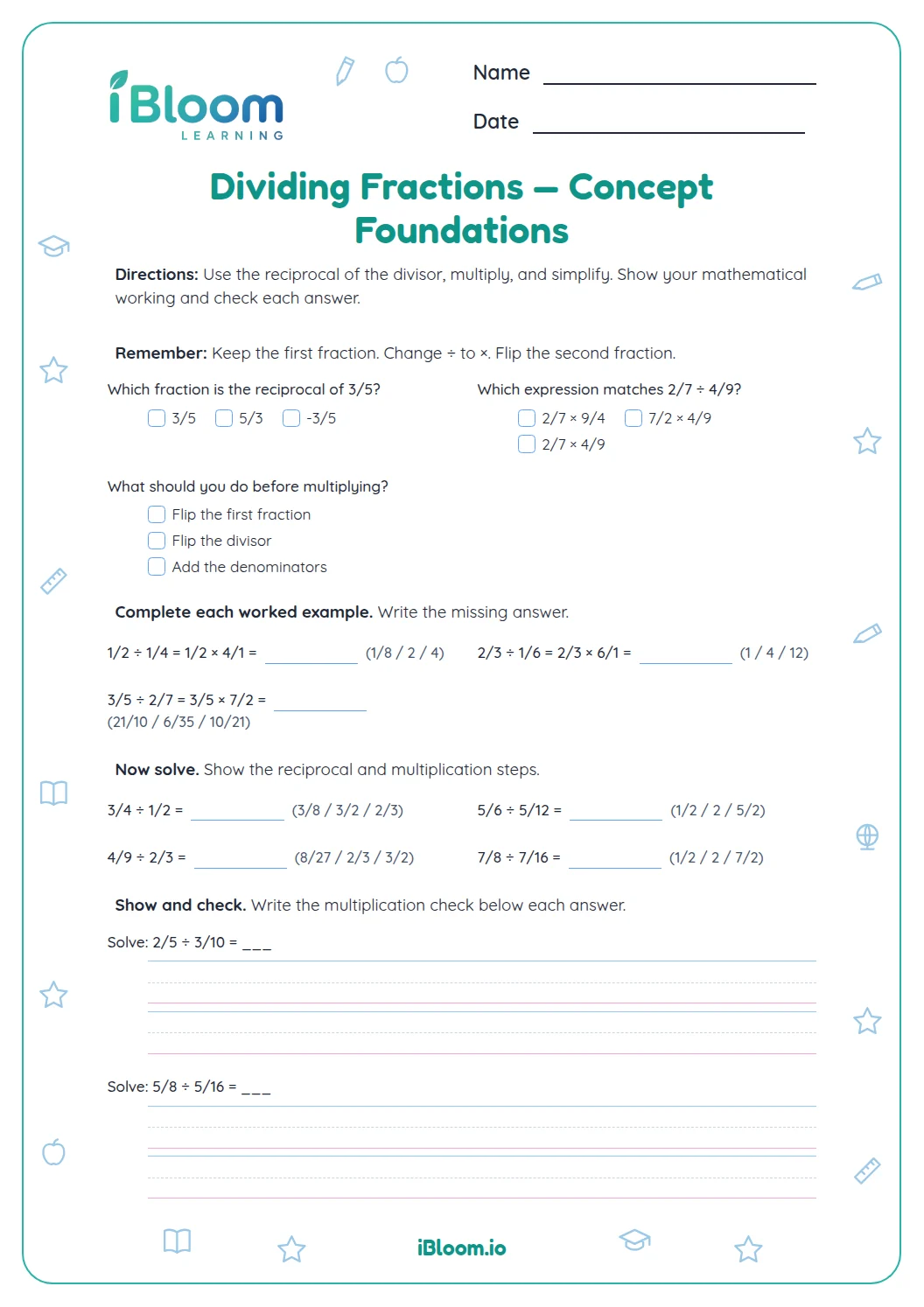

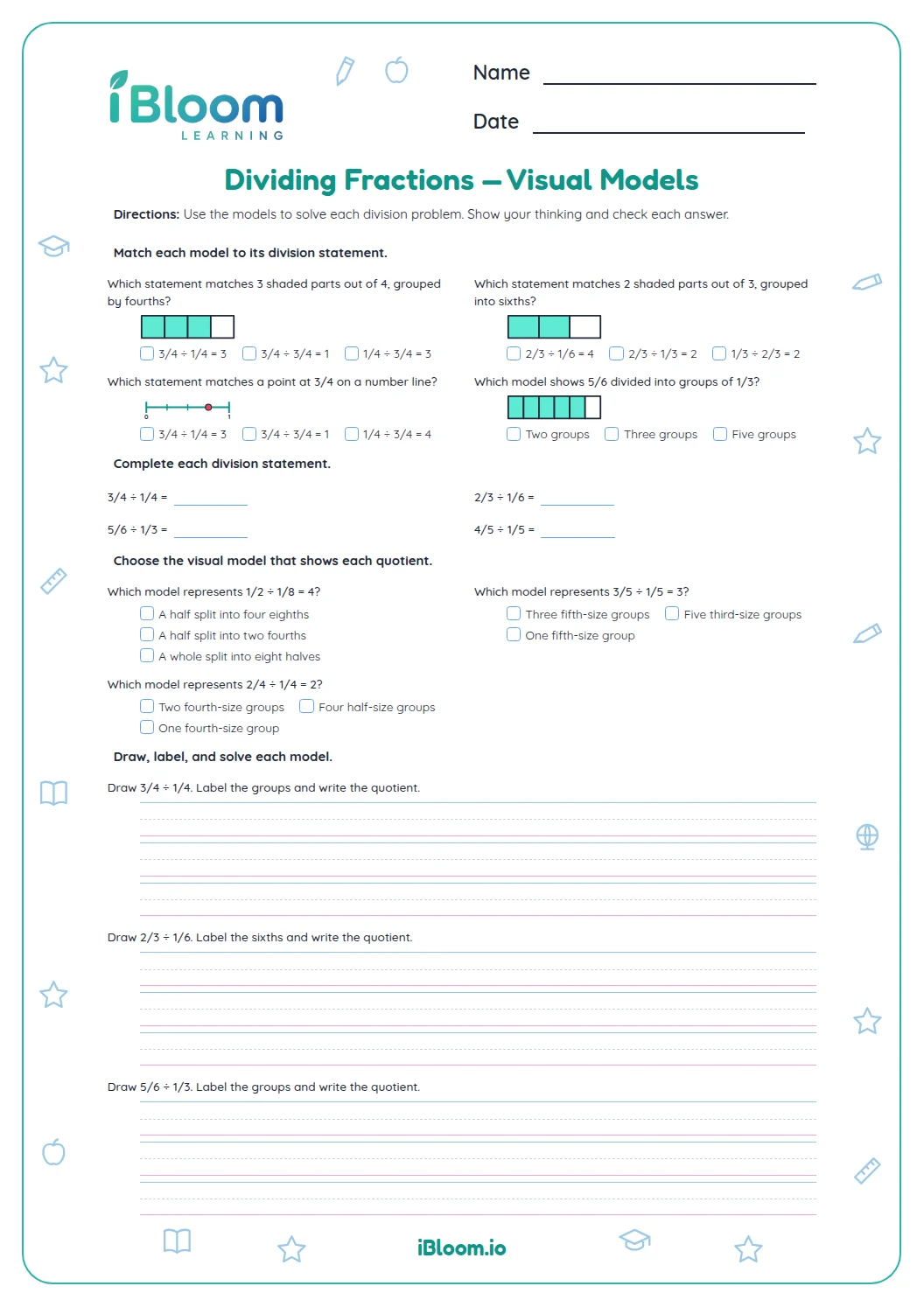

About this worksheet
Use the shaded bars to connect a fraction of a fraction with multiplication. Then multiply, simplify, and apply the same idea to measurements and recipes.
Aligned to 5.NF.B.4
What does a fraction of a fraction mean?
A fraction can describe part of an amount that is already fractional. In 1/2 × 3/4, half of three fourths is 3/8. The shaded bars above the first five problems show the product as a fraction of one whole.
Part A uses these bars to check fraction products; the other questions build on the same multiplication rule.
- 11/2 × 3/4
- 2Multiply numerators and denominators: 1 × 3 = 3 and 2 × 4 = 8.
- 3The product is 3/8, matching the shaded bar.
How do you multiply and simplify?
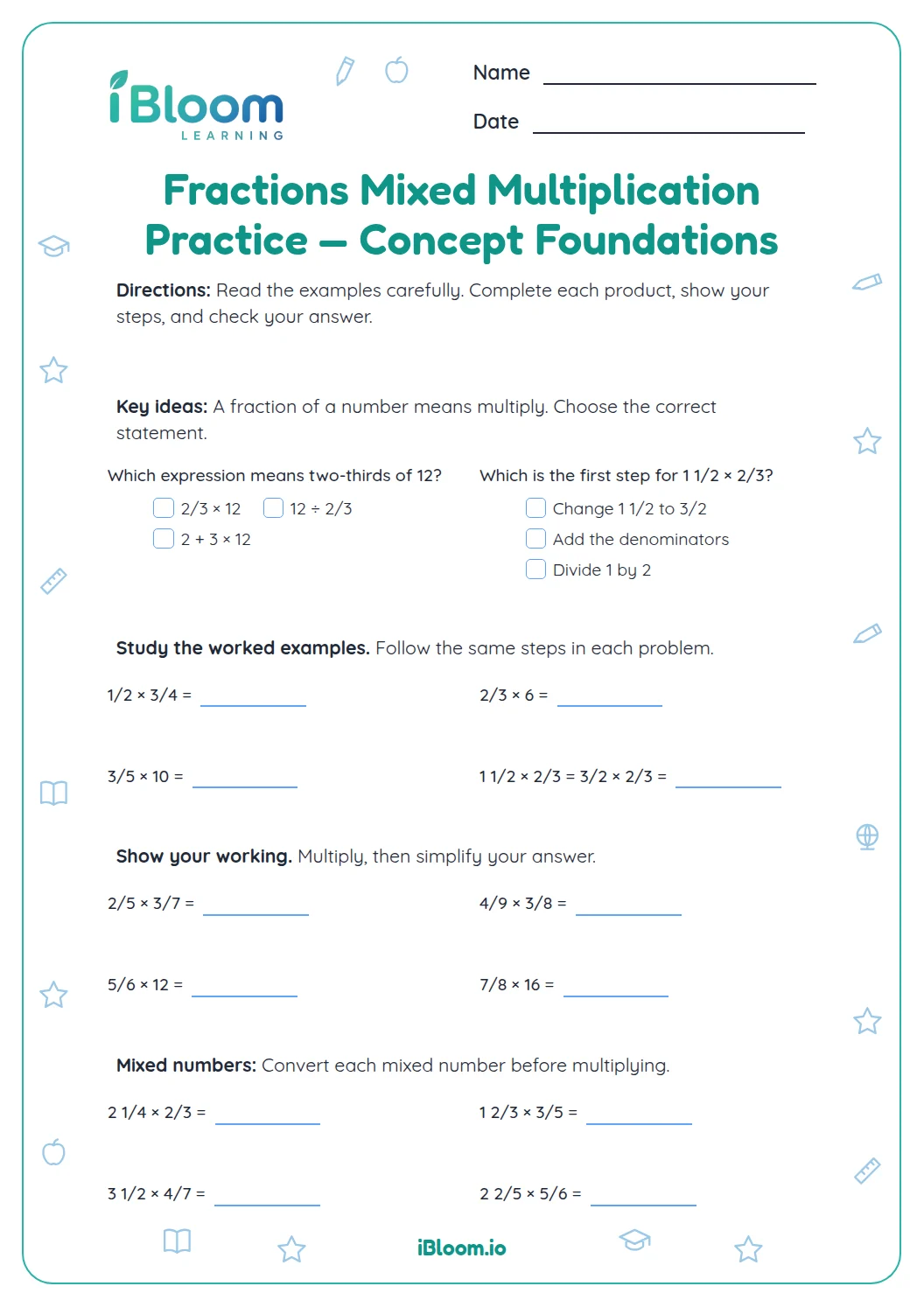
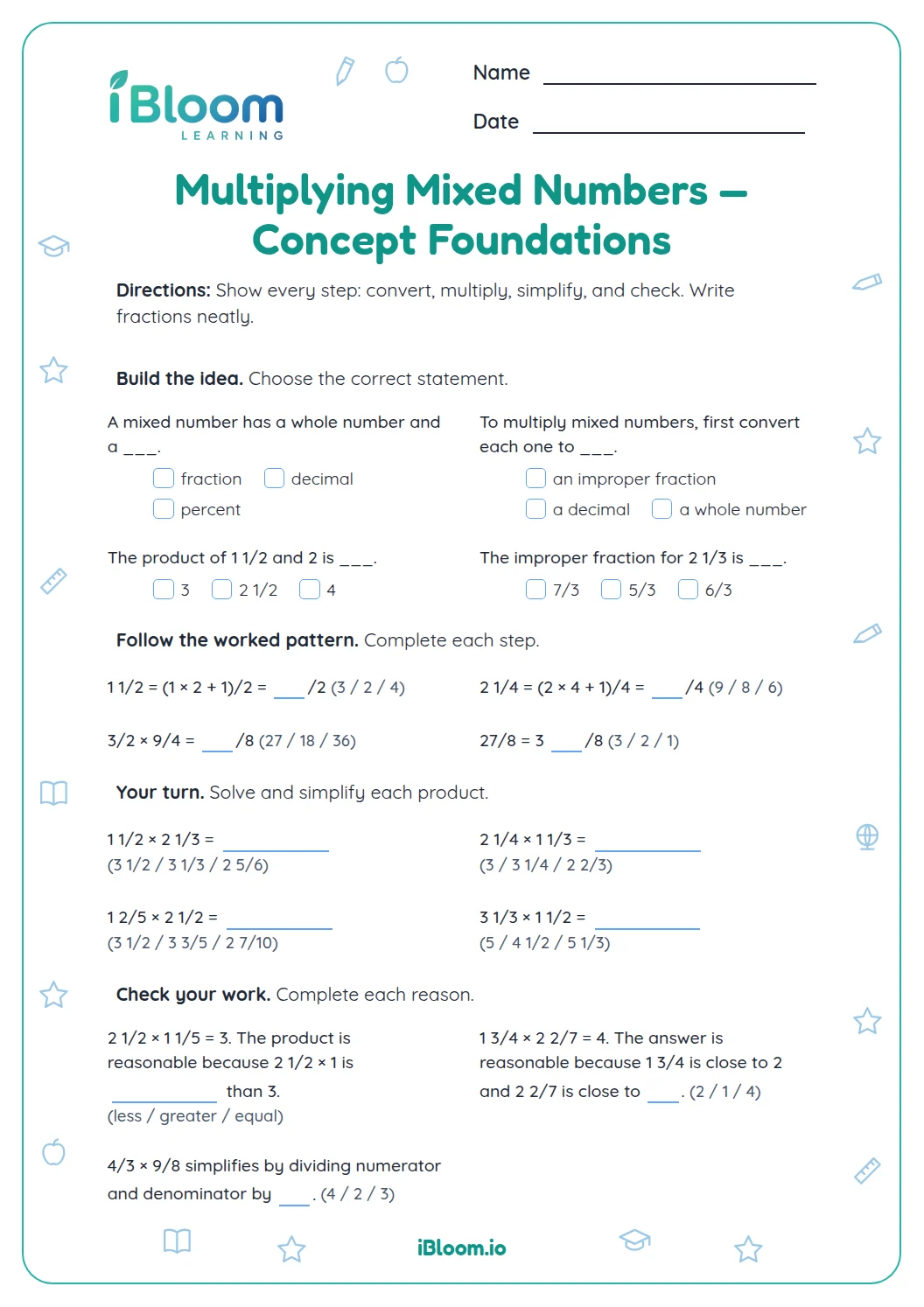
Multiply the numerators and the denominators. For 2/3 × 3/4, multiply to get 6/12, then simplify to 1/2. Convert a mixed number to an improper fraction before multiplying.
Where does fraction multiplication appear?
Part C applies the same operation to lengths and recipe amounts. Write a multiplication equation, calculate the product, and keep the unit from the situation.
A reliable solution path
- 1Rewrite any mixed number as an improper fraction.
- 2Multiply the numerators and denominators.
- 3Cancel common factors or simplify the product.
- 4For a story problem, check that the result is a sensible part of the original amount.
- 5Include the requested measurement unit.
Common fraction multiplication errors
The mistake
Adding the numerators and denominators.
The fix
For multiplication, multiply across: numerator times numerator and denominator times denominator.
The mistake
Leaving an improper fraction unsimplified.
The fix
Reduce common factors before multiplying or simplify the product afterward.
Curriculum alignment
Multiply fractions and apply the operation to measurement situations.
On this sheet:
Show the official wordingHide the official wording
Apply and extend previous understandings of multiplication to multiply a fraction or whole number by a fraction.
What to practice next
Make more practice
Further reading
Questions parents and teachers ask
What does “of” mean in these problems?
In fraction problems, “of” signals multiplication. For example, 2/3 of 3/4 is written 2/3 × 3/4. Multiply the numerators and denominators, then simplify if needed. The first five bars show the resulting fraction of one whole. The shading checks the computed answer.
Should mixed numbers be converted first?
Yes. Rewrite a mixed number as an improper fraction before multiplying. For example, 1 1/2 becomes 3/2. Then multiply and simplify. Questions 6, 7, 10, 13, and 14 include mixed-number factors or amounts for this practice. The answer key lists these products in simplest form.
Why can a product be smaller than both factors?
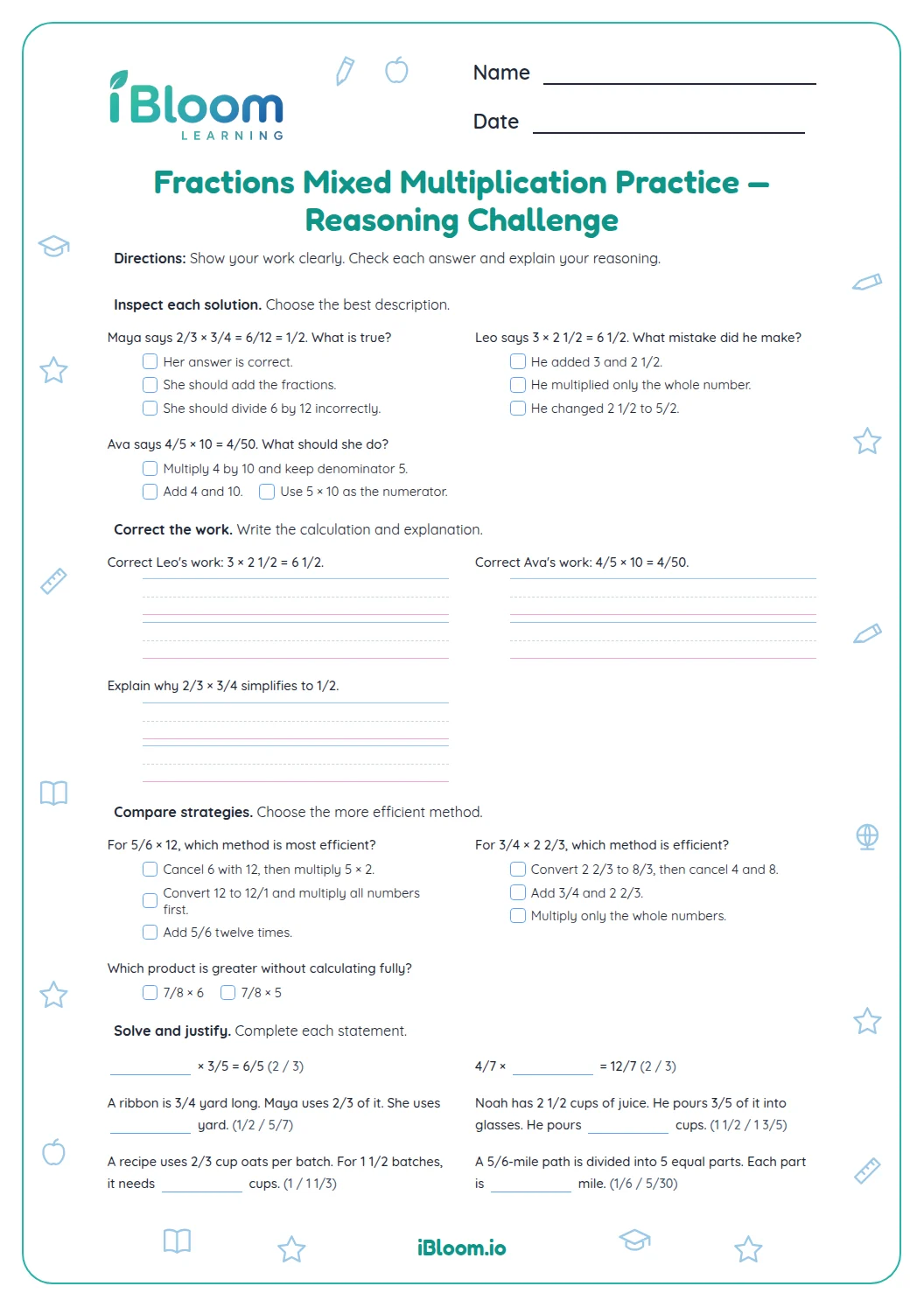
When you multiply a positive amount by a fraction less than 1, you are finding only part of that amount. For instance, 2/3 of 3/4 is 1/2, which is less than 3/4. Question 15 asks learners to explain this relationship.
How should units appear in a story answer?
Keep the unit from the situation in the answer. Question 11 asks how many yards of ribbon Maya uses, so the answer is 1/2 yard. The key also gives cups, miles, and feet for the recipe and measurement questions.
What do the fraction bars represent?
Each bar is divided into equal parts and shaded to show the product in simplified form. For example, question 1 shows 3 of 8 parts shaded, or 3/8. The drawing is a check on the multiplication result, not a second factor diagram.