




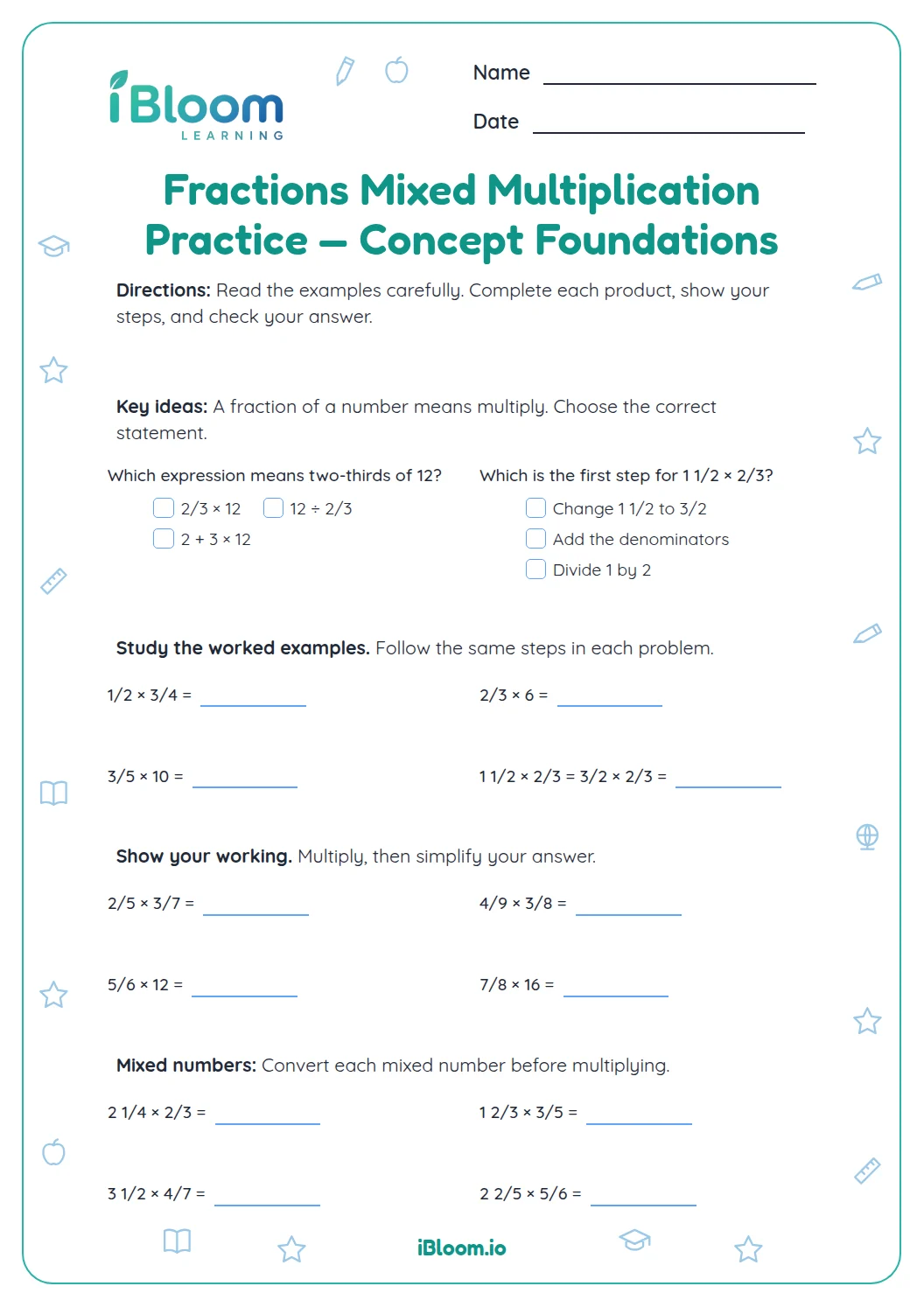

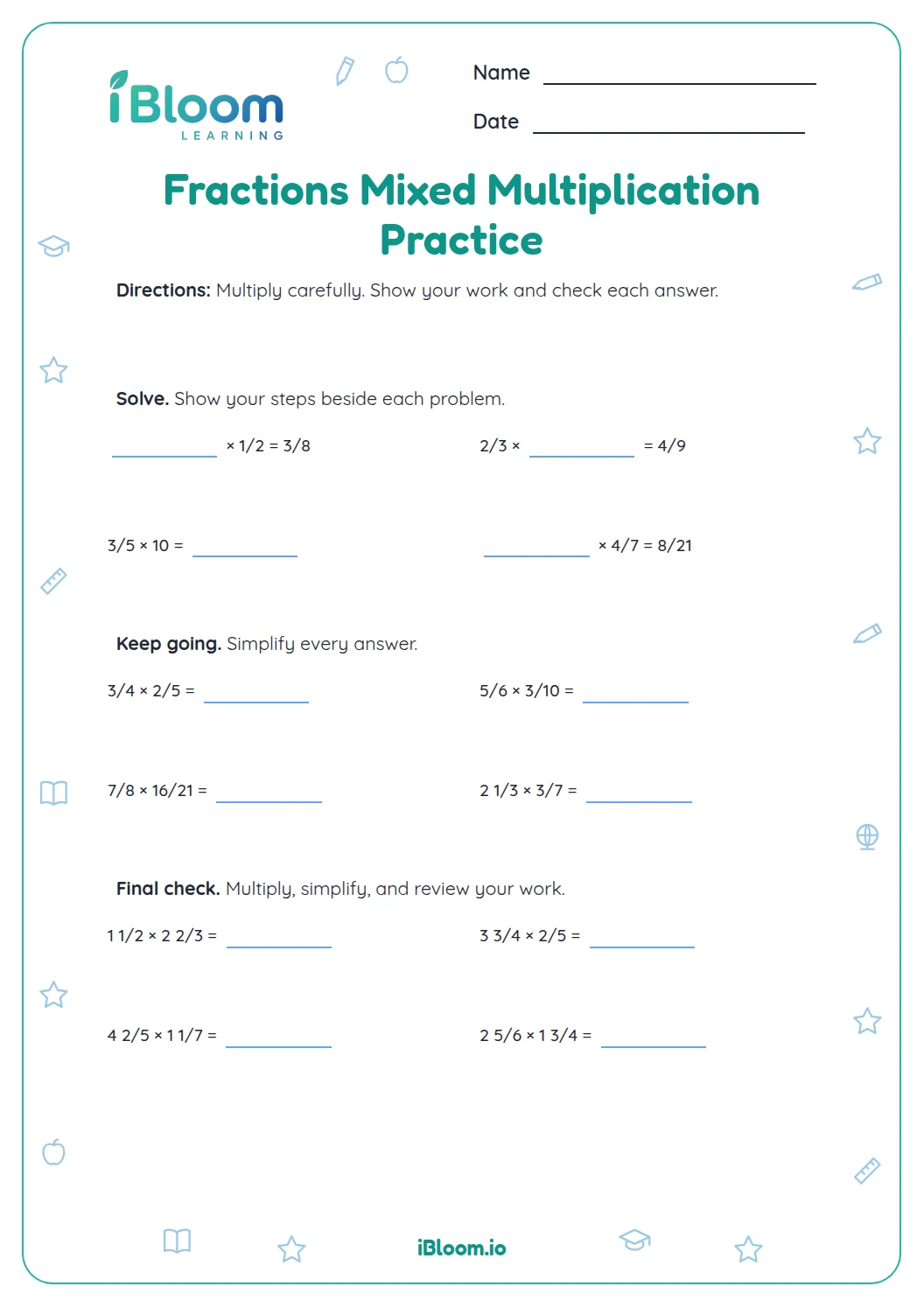


About this worksheet
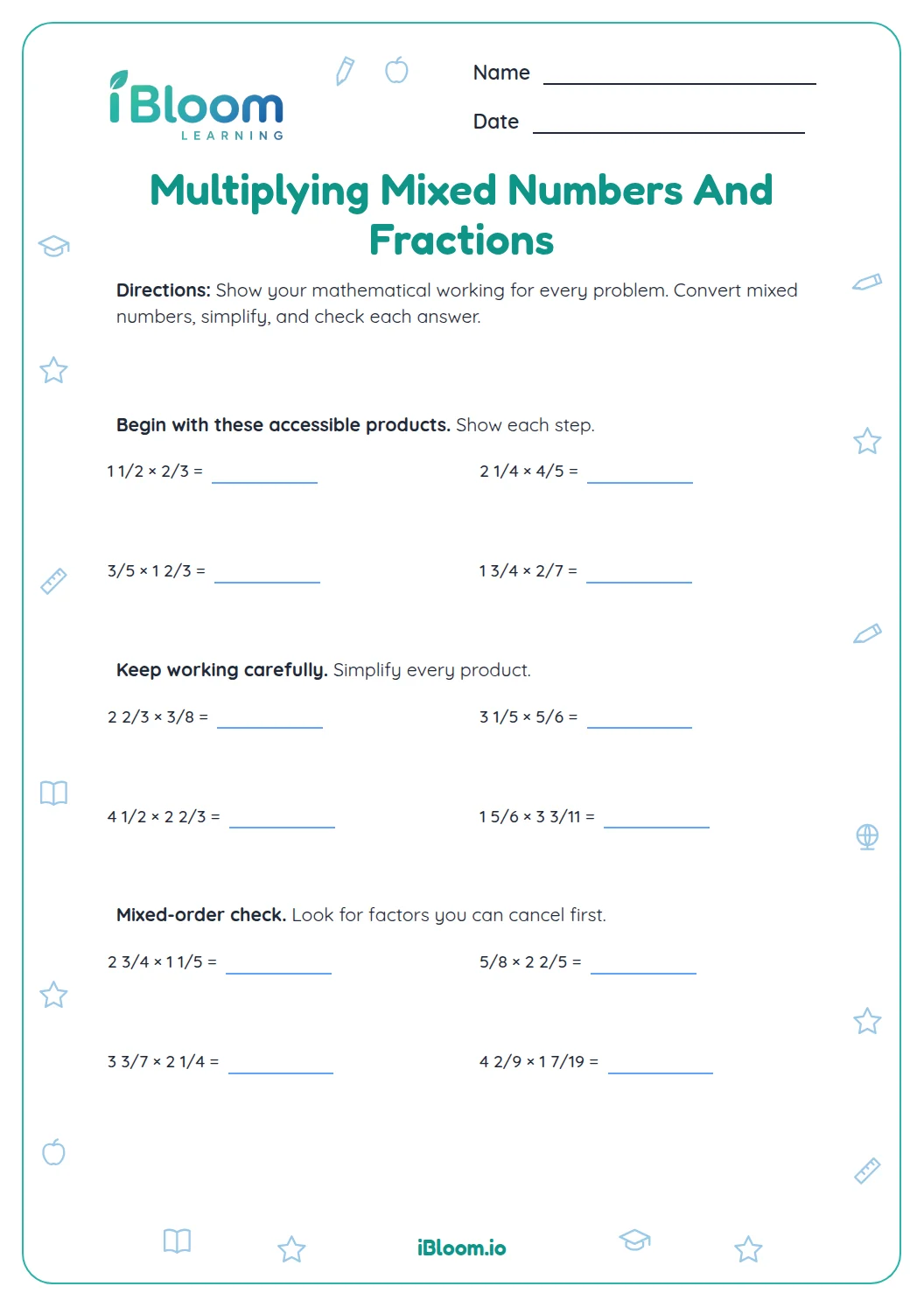
This free printable worksheet gives Grade 6 students 12 independent practice questions on multiplying mixed numbers. Part A gives six products with halves, thirds, fourths, fifths and sevenths. Part B adds four products with mixed-number answers and opportunities to simplify factors. Part C asks students to find a rectangular mat’s area and the amount of flour for a larger recipe. Students convert mixed numbers to improper fractions, multiply and simplify. The work practices Common Core 5.NF.B.4 and 5.NF.B.6. A separate answer key supplies simplified results for checking the calculations.
Aligned to 5.NF.B.4 and 5.NF.B.6
Why convert both mixed numbers first?
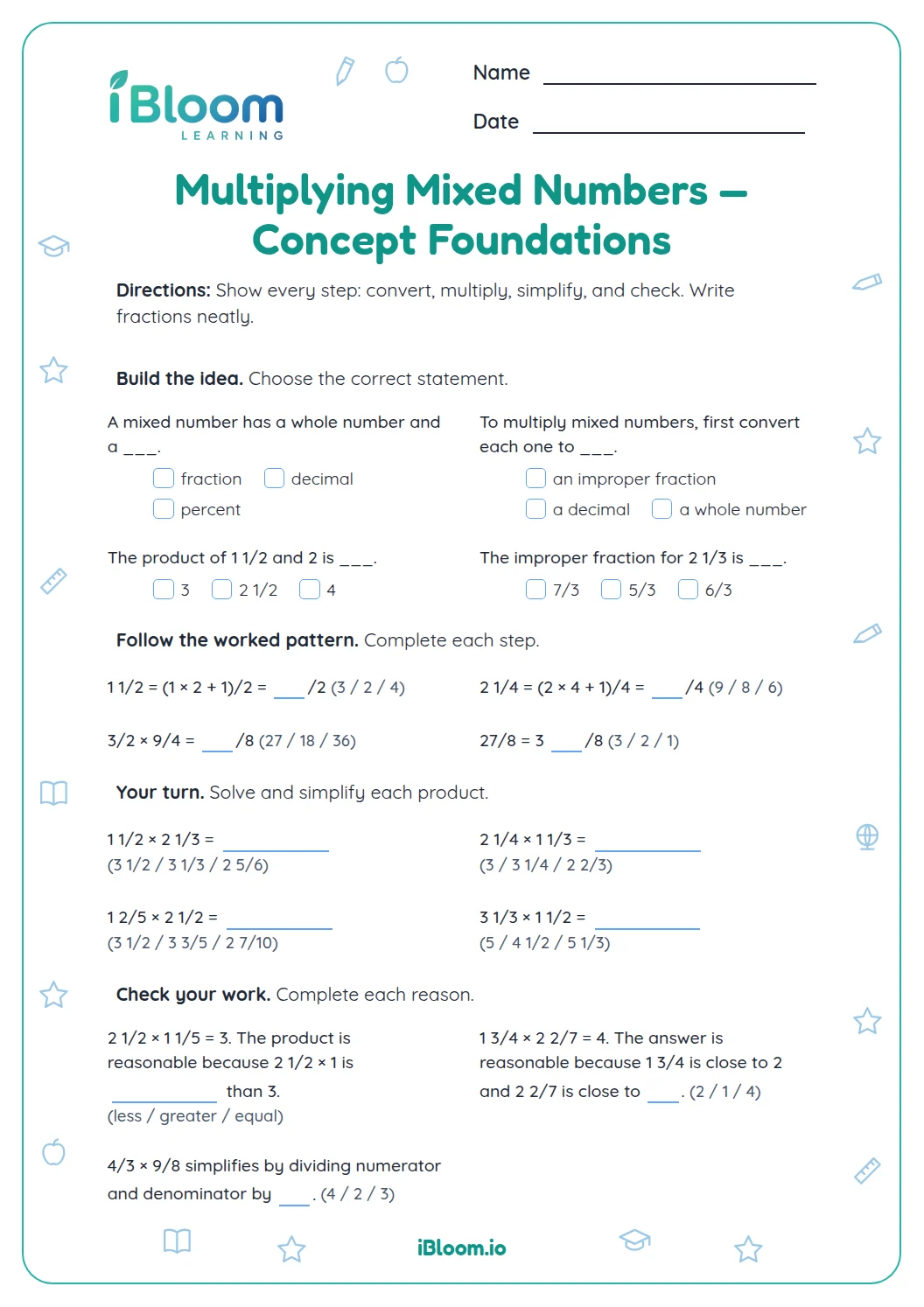
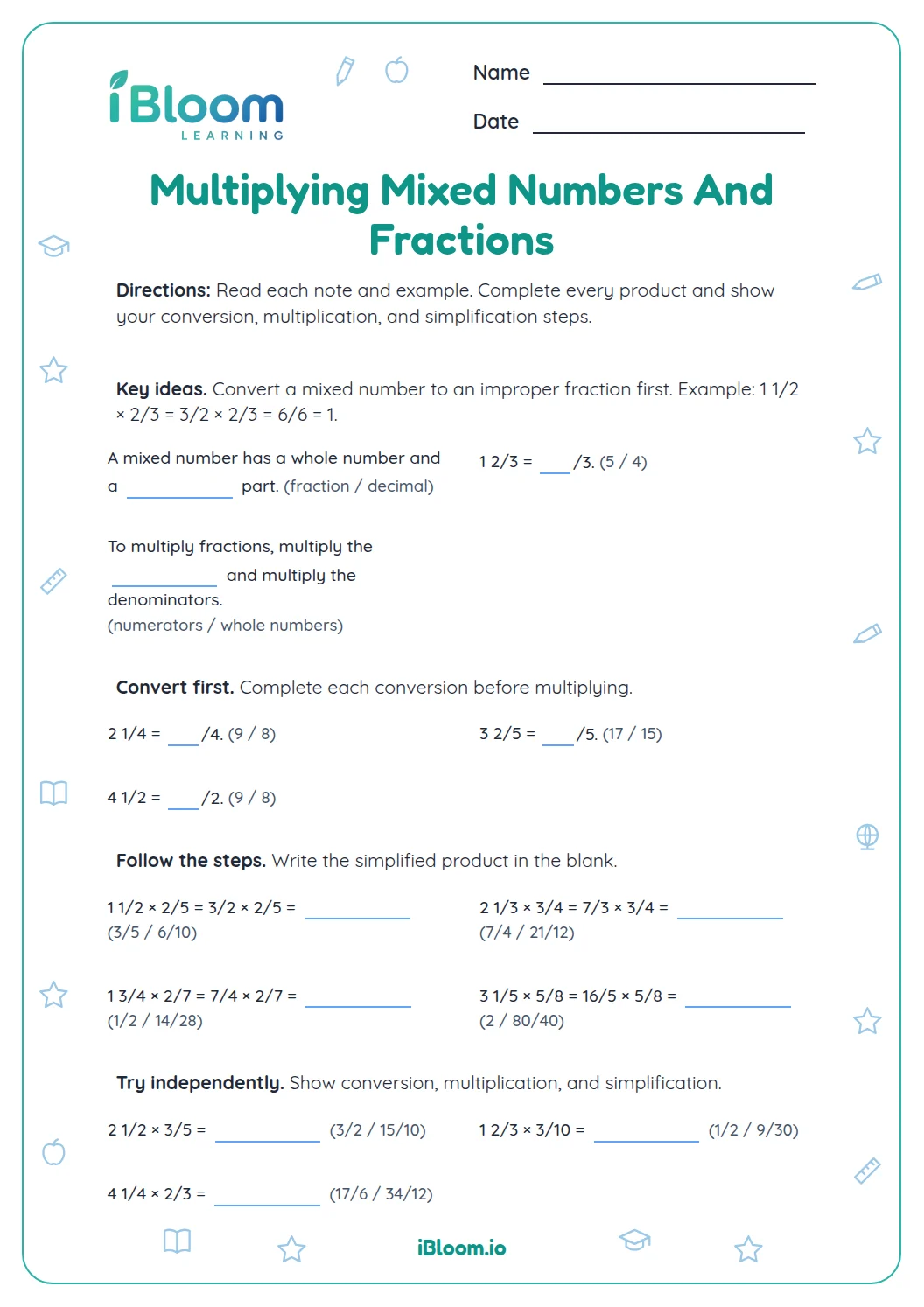
A mixed number is a whole number plus a fraction. Converting combines those parts into one numerator so that the entire quantity is multiplied. Multiply the whole number by the denominator, add the numerator, and keep the denominator.
In question 2, 2 1/4 becomes 9/4 and 1 1/3 becomes 4/3. Multiplying only the whole parts and only the fractional parts would leave out products needed for the full answer.
- 12 1/4 × 1 1/3
- 22 1/4 = 9/4 and 1 1/3 = 4/3
- 39/4 × 4/3 = 36/12
- 436/12 = 3
When can students simplify the factors?
After conversion, a numerator and a denominator can be divided by the same common factor. This keeps the product equivalent and makes the multiplication smaller. For question 9, 4 2/5 × 1 3/4 becomes 22/5 × 7/4; dividing 22 and 4 by 2 gives 11/5 × 7/2.
The result is 77/10, or 7 7/10. Students can also multiply first and then reduce. The worksheet asks for simplified whole-number or mixed-number answers, so the final fraction should have no common factor greater than 1.
How do the two word problems use mixed-number multiplication?
For the mat, multiply length by width and label the answer in square feet. For the recipe, multiply cups per batch by the number of batches and label the answer in cups. Writing the equation before calculating makes the role of each quantity clear.
All factors on this sheet are greater than 1. The product should therefore exceed either factor. This size check can reveal an error such as reversing one factor or failing to include the whole-number parts.
How to use this worksheet
- 1Rewrite both mixed numbers as improper fractions in the working space.
- 2Check each conversion by dividing its numerator by its denominator.
- 3Simplify a numerator and a denominator by a common factor when useful.
- 4Multiply numerators and denominators, then write a simplified whole or mixed number.
- 5Write units for the mat and recipe problems and compare each product with its factors.
- 6Use the answer key to check results, then revisit the first step where an incorrect calculation changed.
Mistakes to notice and fix
The mistake
Multiplying only whole parts and fractional parts: 2 1/4 × 1 1/3 = 2 1/12.
The fix
Convert to 9/4 × 4/3 so the full quantities are multiplied; the product is 3.
The mistake
Changing 2 3/4 to 5/4.
The fix
Multiply 2 by 4 before adding 3: the numerator is 11, so the fraction is 11/4.
The mistake
Flipping the second fraction as if the problem were division.
The fix
The operation is multiplication: keep both fractions in their converted form and multiply across.
Common Core alignment
Multiply mixed numbers by expressing each factor as a fraction.
On this sheet: The numerical products use improper-fraction equivalents of mixed-number factors.
Show the official wordingHide the official wording
Apply and extend previous understandings of multiplication to multiply a fraction or whole number by a fraction.
Use mixed-number multiplication to solve area and recipe problems.
On this sheet: Part C represents a mat’s area and recipe quantities with multiplication equations.
Show the official wordingHide the official wording
Solve real world problems involving multiplication of fractions and mixed numbers, e.g., by using visual fraction models or equations to represent the problem.
What to practice next
Make more practice
Further reading
Questions parents and teachers ask
What should students know before starting?
Students should be able to convert a mixed number to an improper fraction, multiply fractions and simplify a fraction. This sheet combines those skills in every numerical problem. If a conversion is uncertain, pause to check it first; a correct multiplication cannot repair an incorrect starting fraction.
Do students need common denominators to multiply?
No, students can multiply fractions with different denominators directly. In question 2, 9/4 × 4/3 becomes 36/12, which equals 3. A common denominator is useful for adding or subtracting fractions, but here students multiply the numerators together and the denominators together after converting both mixed numbers.
Must students simplify before multiplying?
Students may simplify before multiplying or reduce the product afterward. Both methods give the same value when done correctly. For 22/5 × 7/4 in question 9, reducing 22 and 4 by 2 makes the multiplication smaller. The final answer is 77/10, written as 7 7/10.
How should students label the word-problem answers?
Use square feet for the rectangular mat’s area and cups for the flour. Multiplying 2 1/2 feet by 1 3/4 feet gives 4 3/8 square feet. Multiplying 1 1/2 cups per batch by 2 1/3 batches gives 3 1/2 cups of flour for the recipe.
Does the answer key show simplified mixed numbers?
Yes, the key gives simplified mixed-number answers or whole numbers when the product is exact, plus units for the two applications. Students should still keep their written calculations. If an answer differs, compare the improper-fraction conversions and multiplication before checking the final reduction and mixed-number conversion.