





About this worksheet
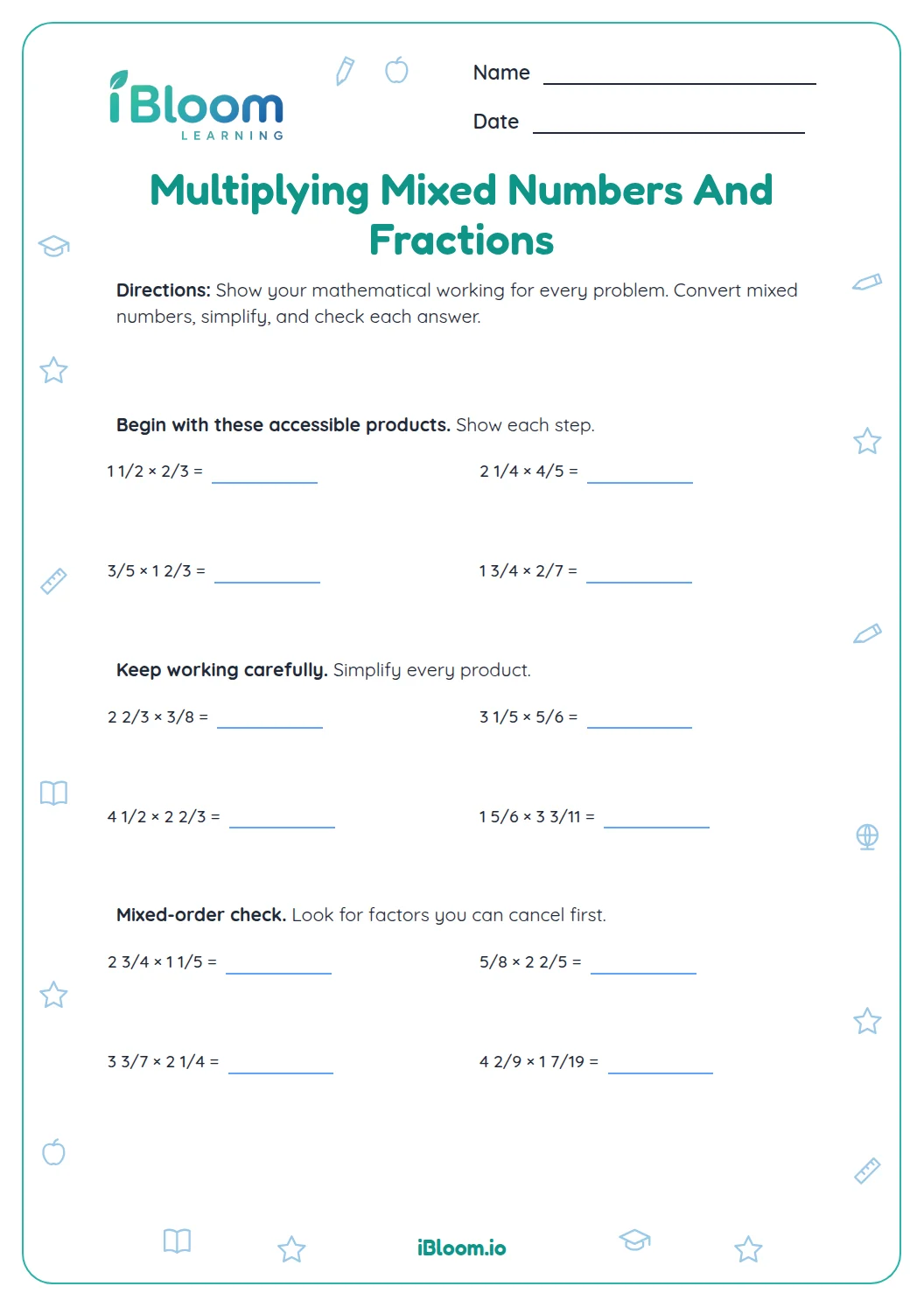
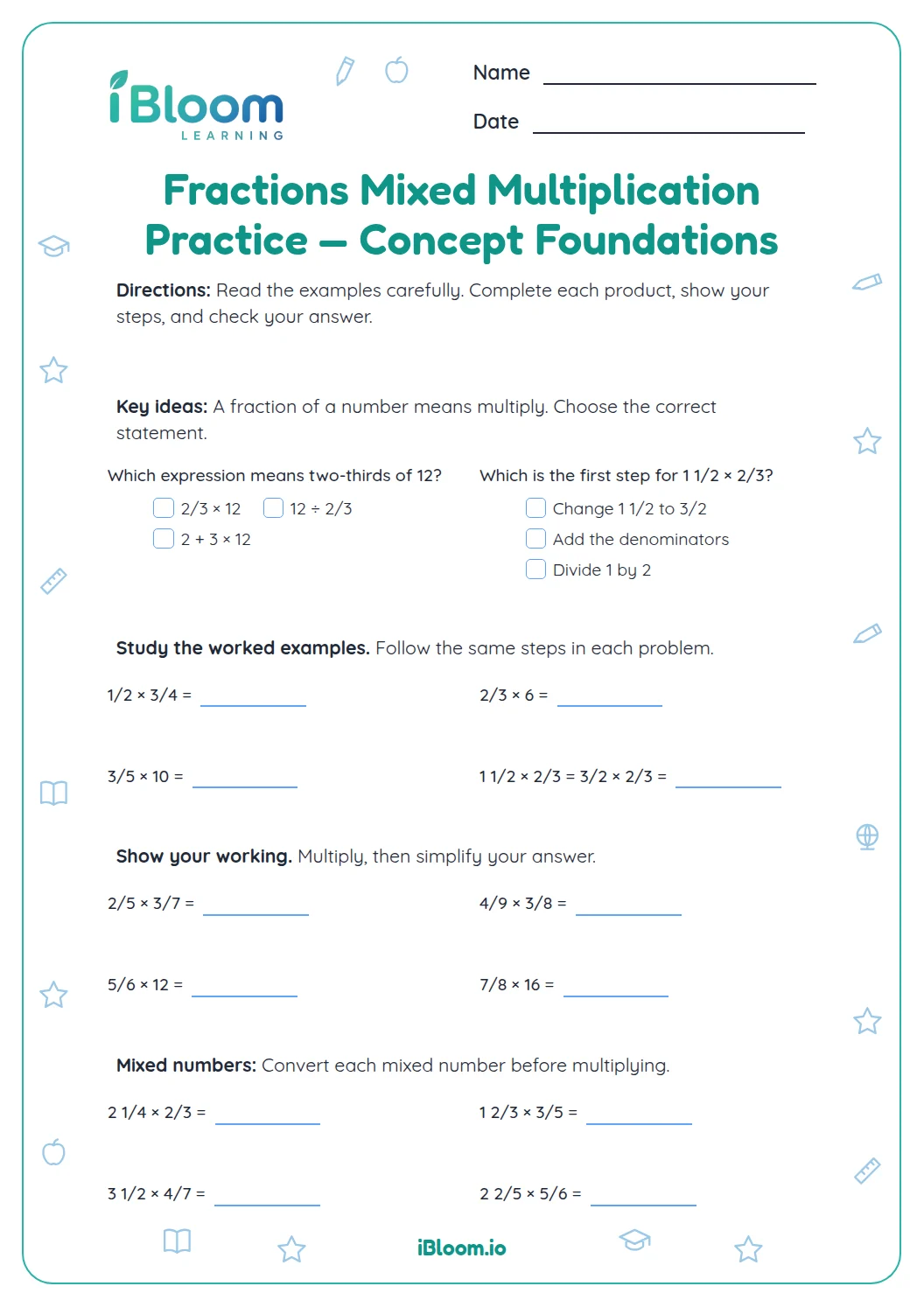
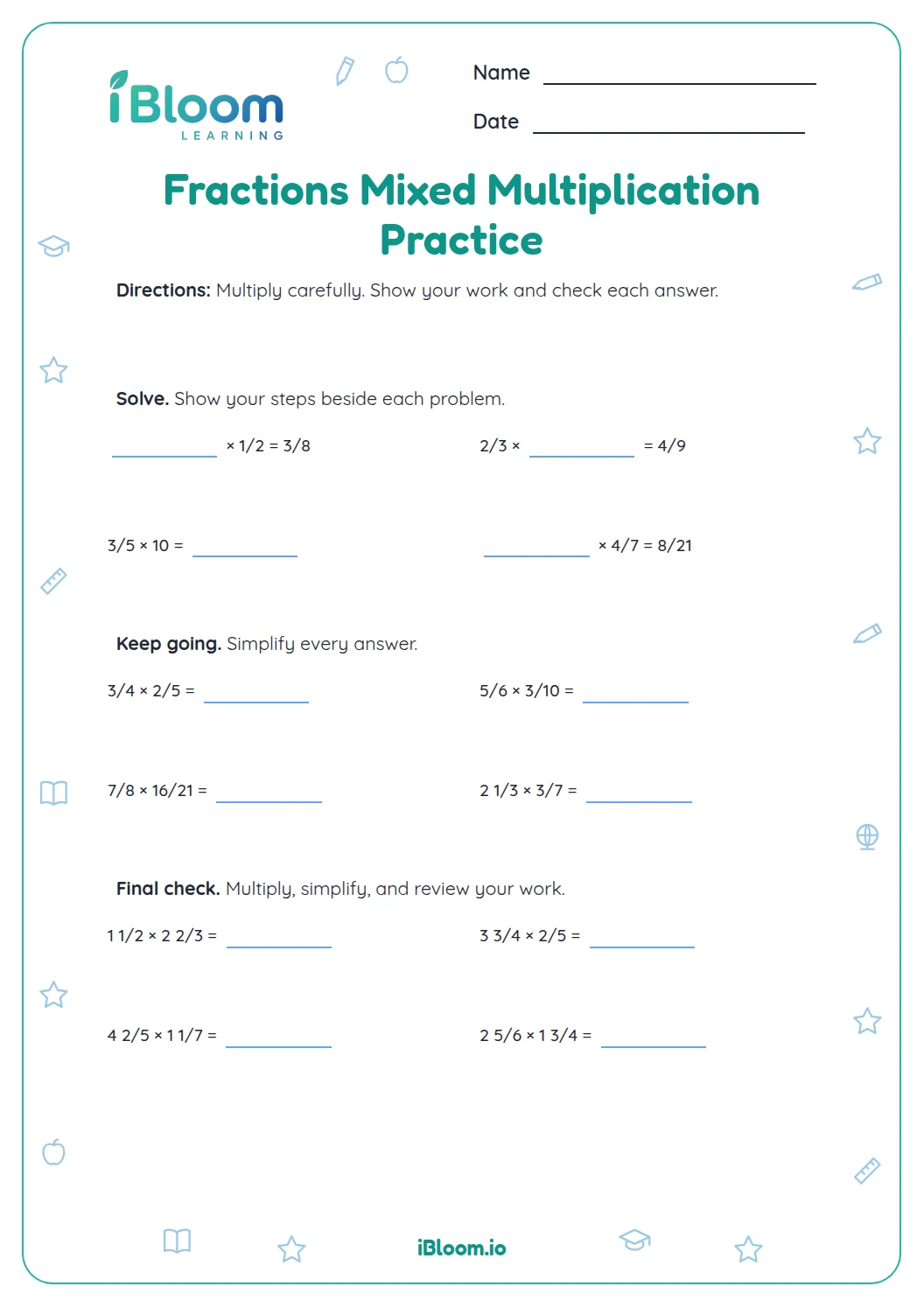
Students model repeated equal amounts with multiplication, convert mixed numbers to improper fractions, multiply, and simplify. Every context supplies a whole-number number of equal groups and asks for a quantity with units.
Aligned to 5.NF.B.4
How do you multiply a mixed number by a whole number?
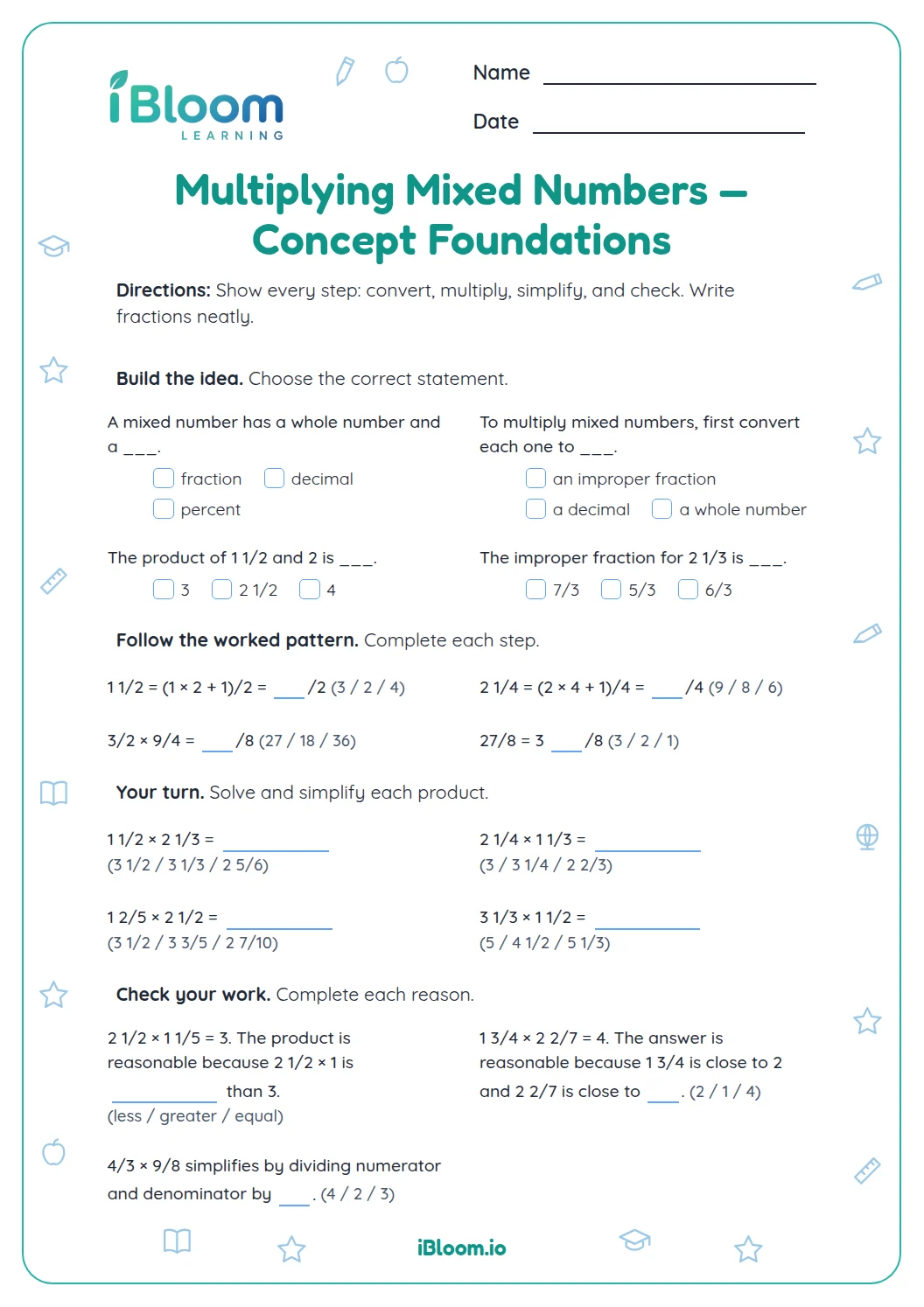
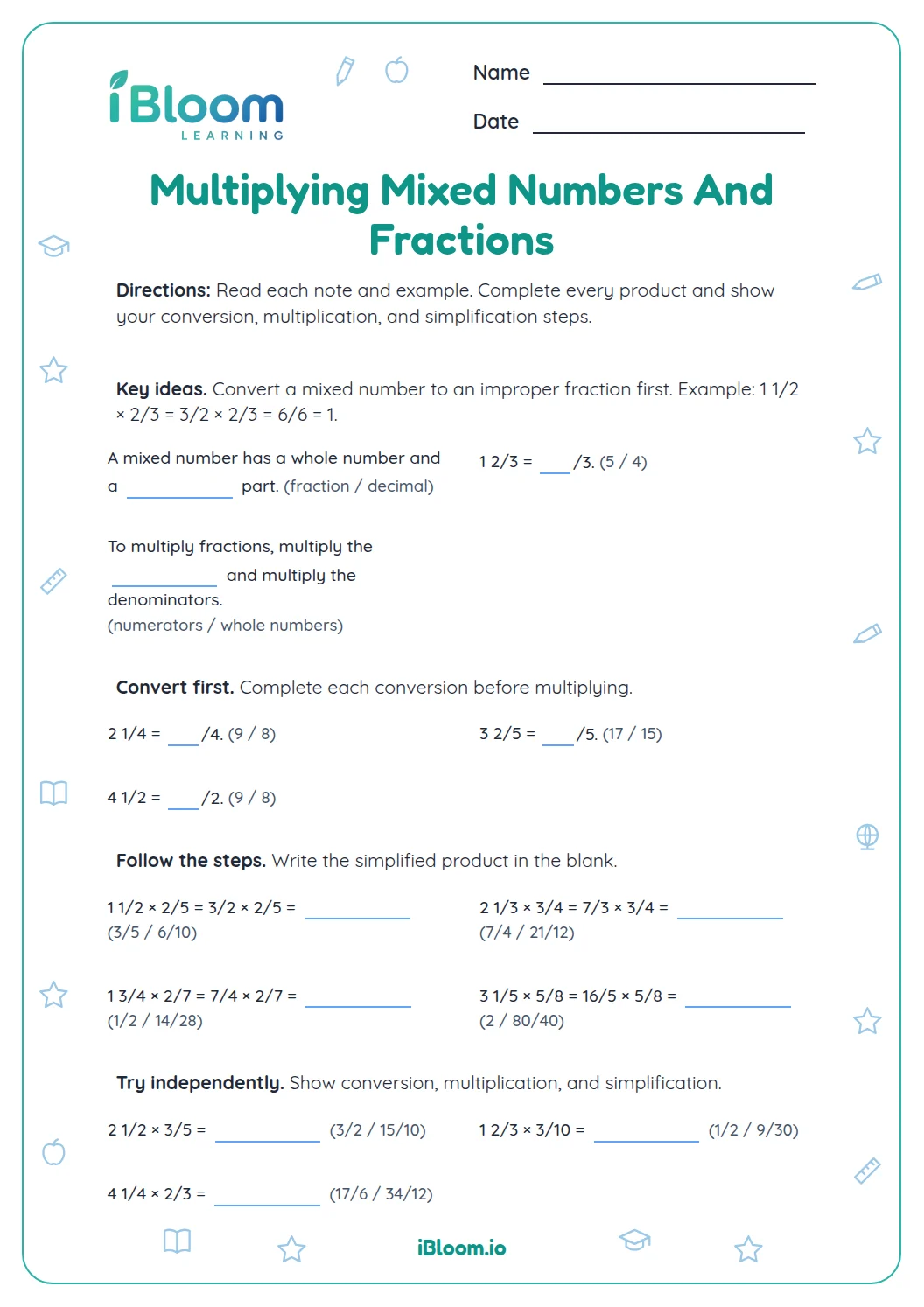
Convert the mixed number to an improper fraction, multiply by the whole number, and simplify. For 2 1/2 cups for 3 batches, 2 1/2 = 5/2, and 5/2 × 3 = 15/2 = 7 1/2 cups.
Keep the unit in the final answer. The number tells how much; the unit tells what is being measured.
Read the situation before calculating
Each question describes the same amount repeated a whole number of times. Underline the amount for one group and the number of groups, write a multiplication equation, then check whether the result is reasonable.
How to use this worksheet
- 1Read each prompt carefully.
- 2Show a step when the question asks you to explain or solve.
- 3Use the answer key to check your work.
Common mistakes and quick fixes
The mistake
Rushing past a prompt detail or symbol can lead to a mismatched response.
The fix
Reread the complete question and check that the response answers exactly what it asks.
The mistake
A computation or sentence may look finished before it has been checked.
The fix
Use the answer key to verify each result and revise any response that needs it.
Common Core alignment
This worksheet practices the standards listed below through focused grade-level work.
Multiply fractions and whole numbers.
On this sheet: Students multiply mixed numbers by whole numbers by rewriting the mixed number as a fraction and using fraction multiplication.
Show the official wordingHide the official wording
Apply and extend previous understandings of multiplication to multiply a fraction or whole number by a fraction.
What to practice next
Make more practice
Further reading
Questions parents and teachers ask
How do you multiply a mixed number by a whole number?
First rewrite the mixed number as an improper fraction. Multiply its numerator by the whole number, keep the denominator, then simplify. For example, 2 1/2 times 3 becomes 5/2 times 3, or 15/2, which is 7 1/2. Include the unit in the final answer.
Why does each answer need a unit?
The unit names what the number measures, such as cups, miles, or meters. A complete answer should include that unit so readers know whether the result is a distance, capacity, length, or another quantity. Check that the unit stays consistent with the situation.
What should students show in the work space?
Write a multiplication equation, convert the mixed number, multiply, and simplify. Showing these steps makes it easier to find an arithmetic error and helps explain why the final quantity makes sense in the situation. A short check can confirm the product is reasonable.
Are answers always mixed numbers?
Some products simplify to whole numbers, while others remain mixed numbers. The answer key gives simplified results with the correct units; equivalent values are acceptable when they are simplified and labeled. Read the question again to make sure the answer describes the total amount requested.
How many problems are on the worksheet?
There are 16 word problems across two parts. Each asks students to multiply a mixed number by a whole-number group and give the result in the unit named in the question. The separate answer key shows a calculation and accepts equivalent simplified answers when they include the correct unit.