






About this worksheet
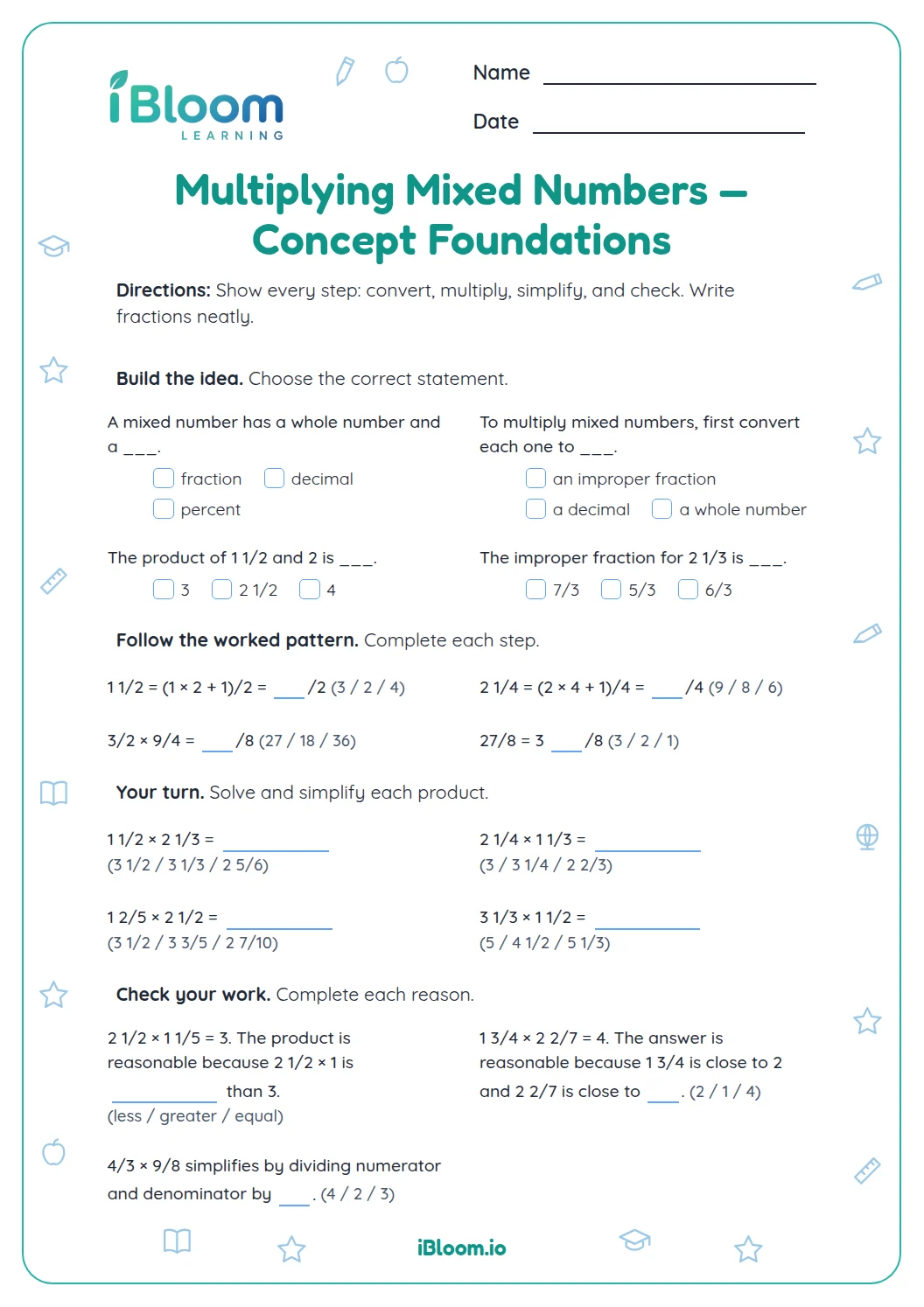
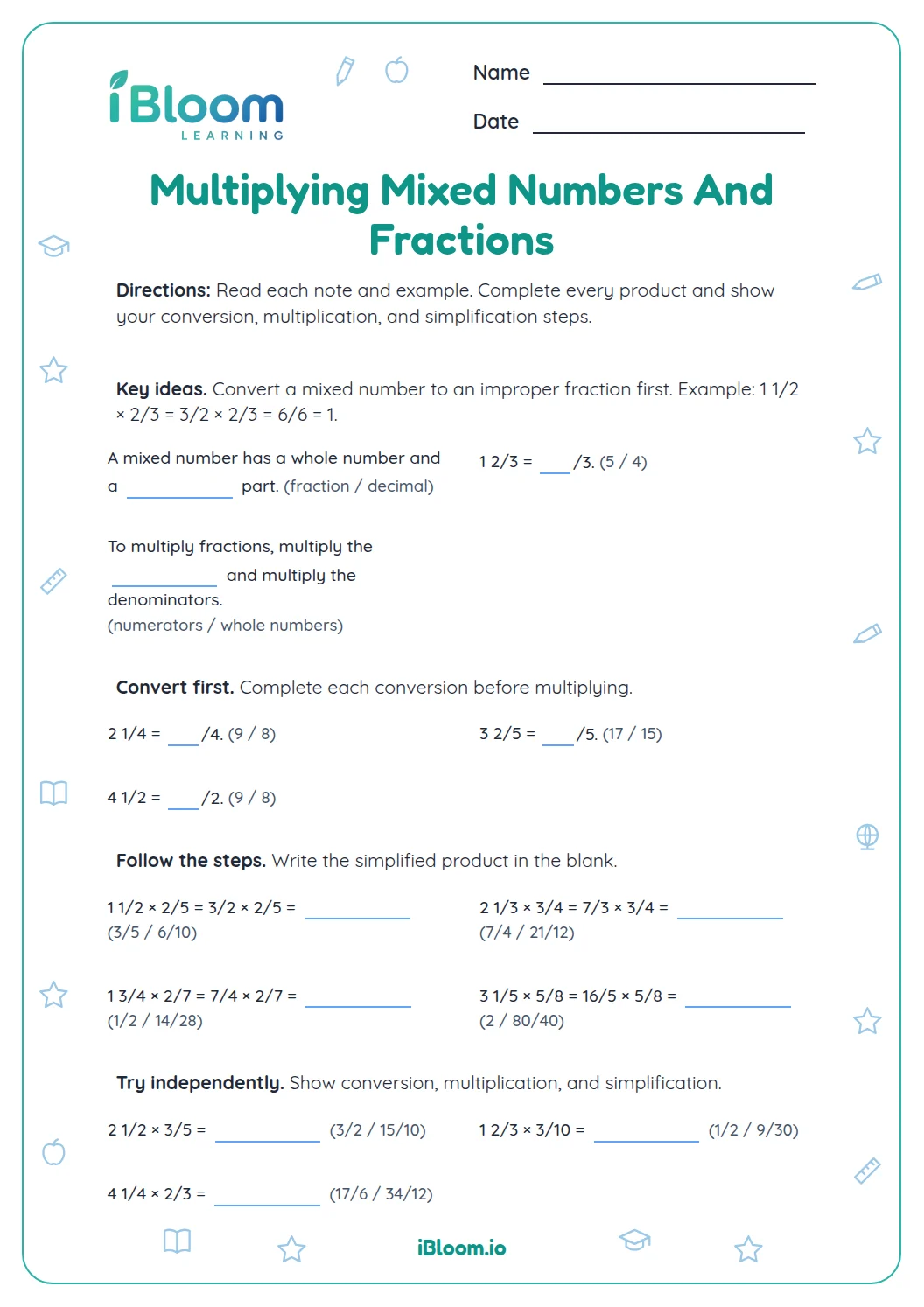
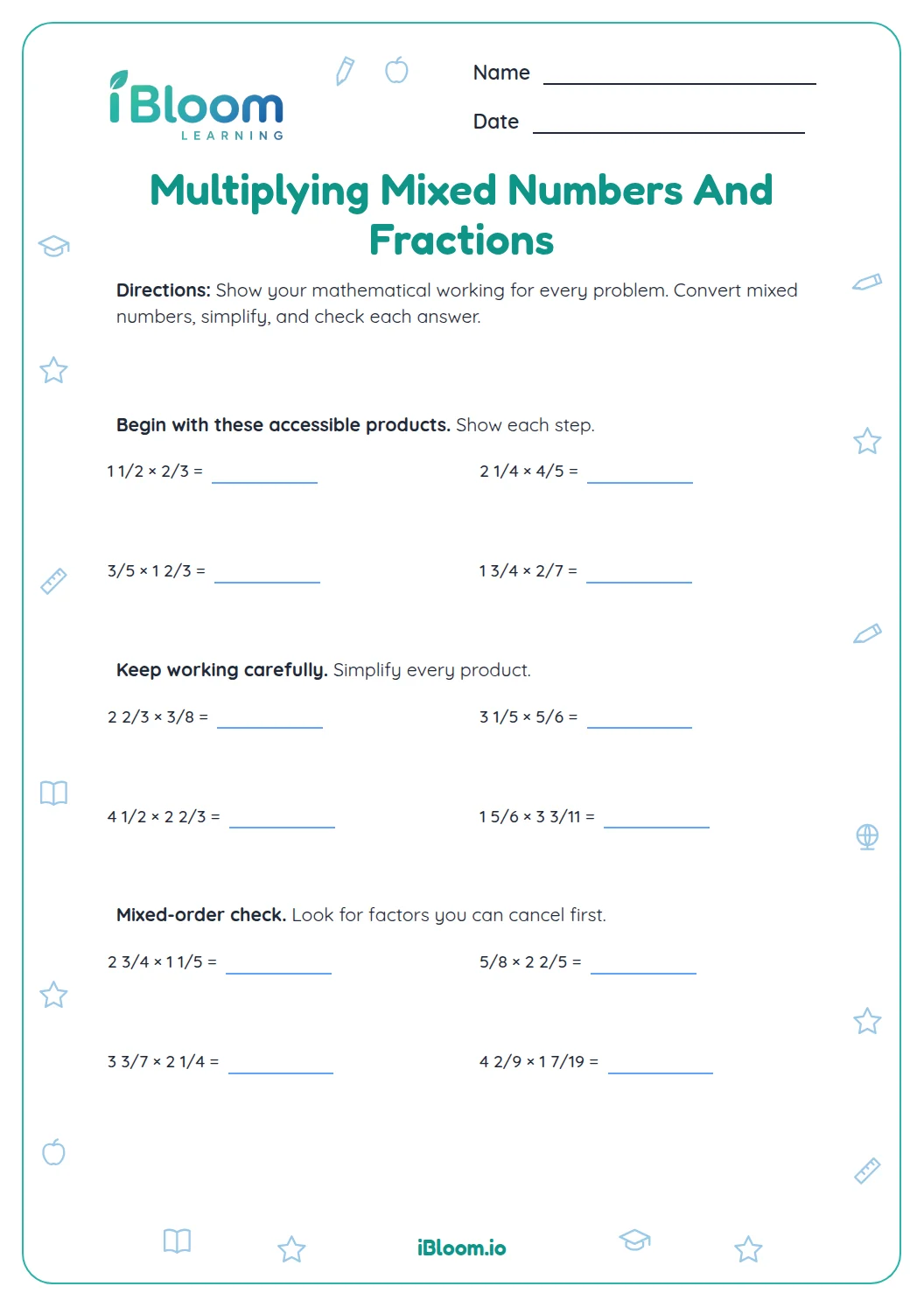
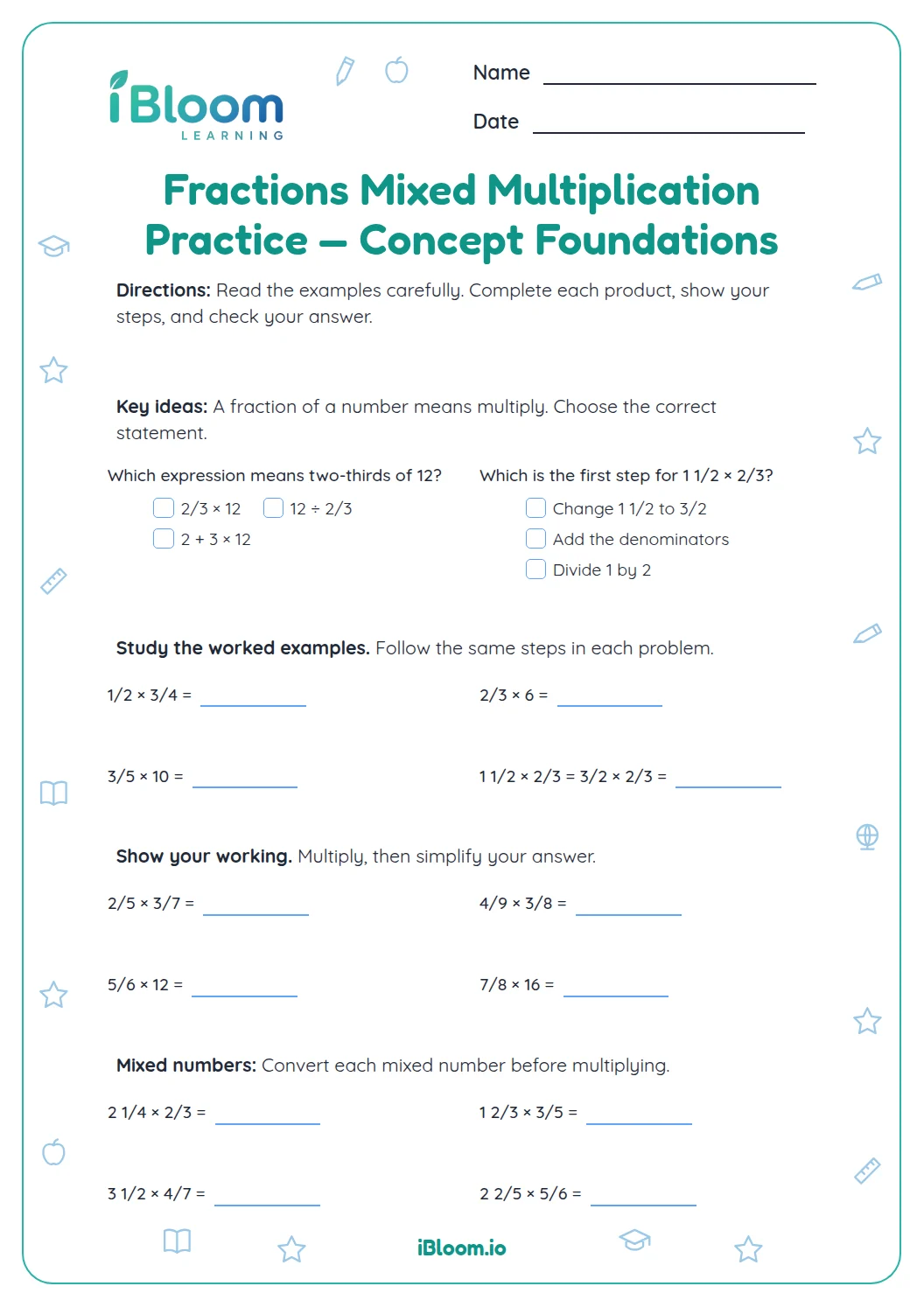
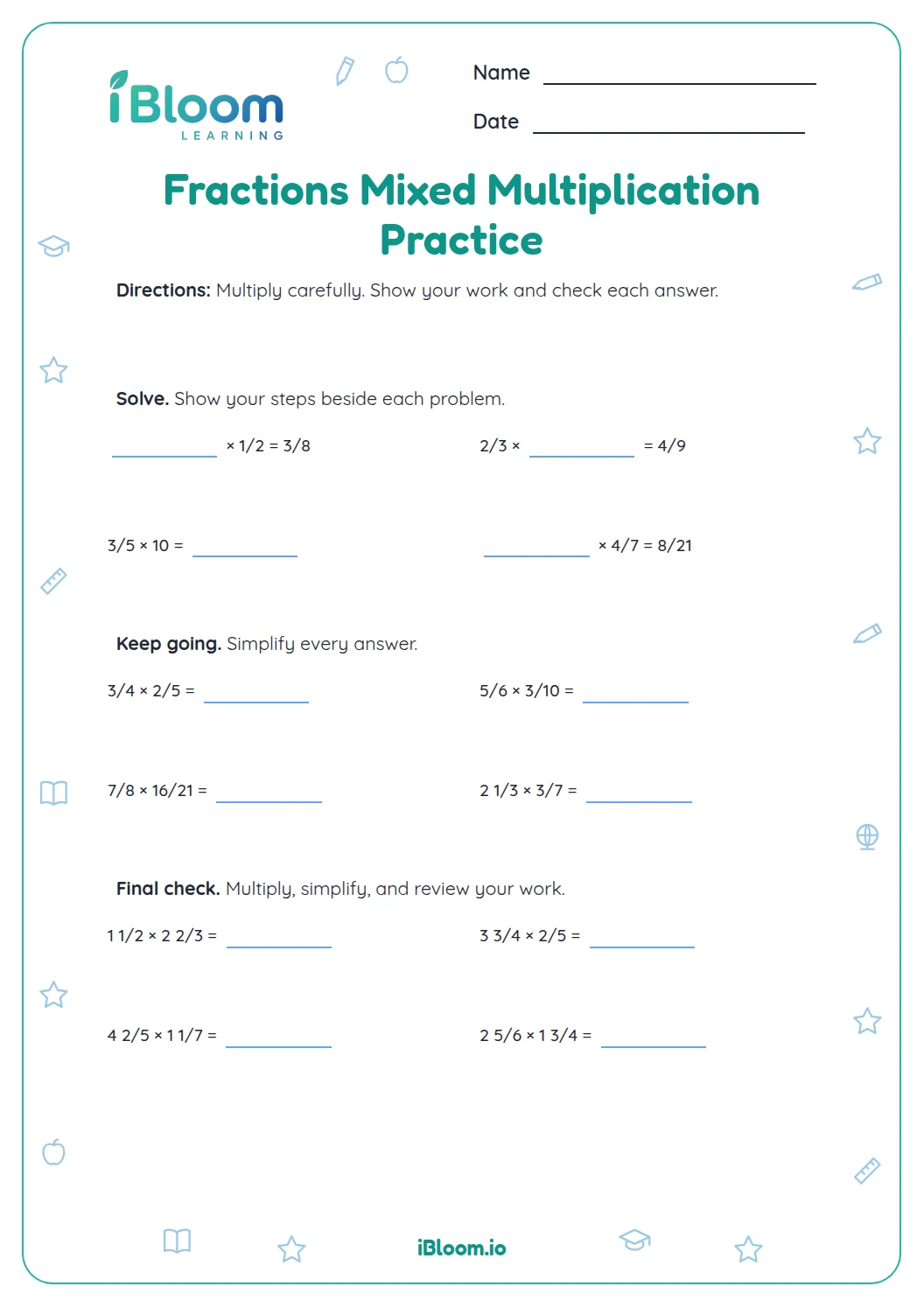
This Grade 6 worksheet practices multiplying mixed numbers by fractions or other mixed numbers. Seven product questions pair a fraction-bar model with a mixed-number factor; students rename factors as improper fractions, multiply, and simplify. The 16 questions and a separate answer key are included.
Aligned to 5.NF.B.4
How do the fraction bars support multiplication?
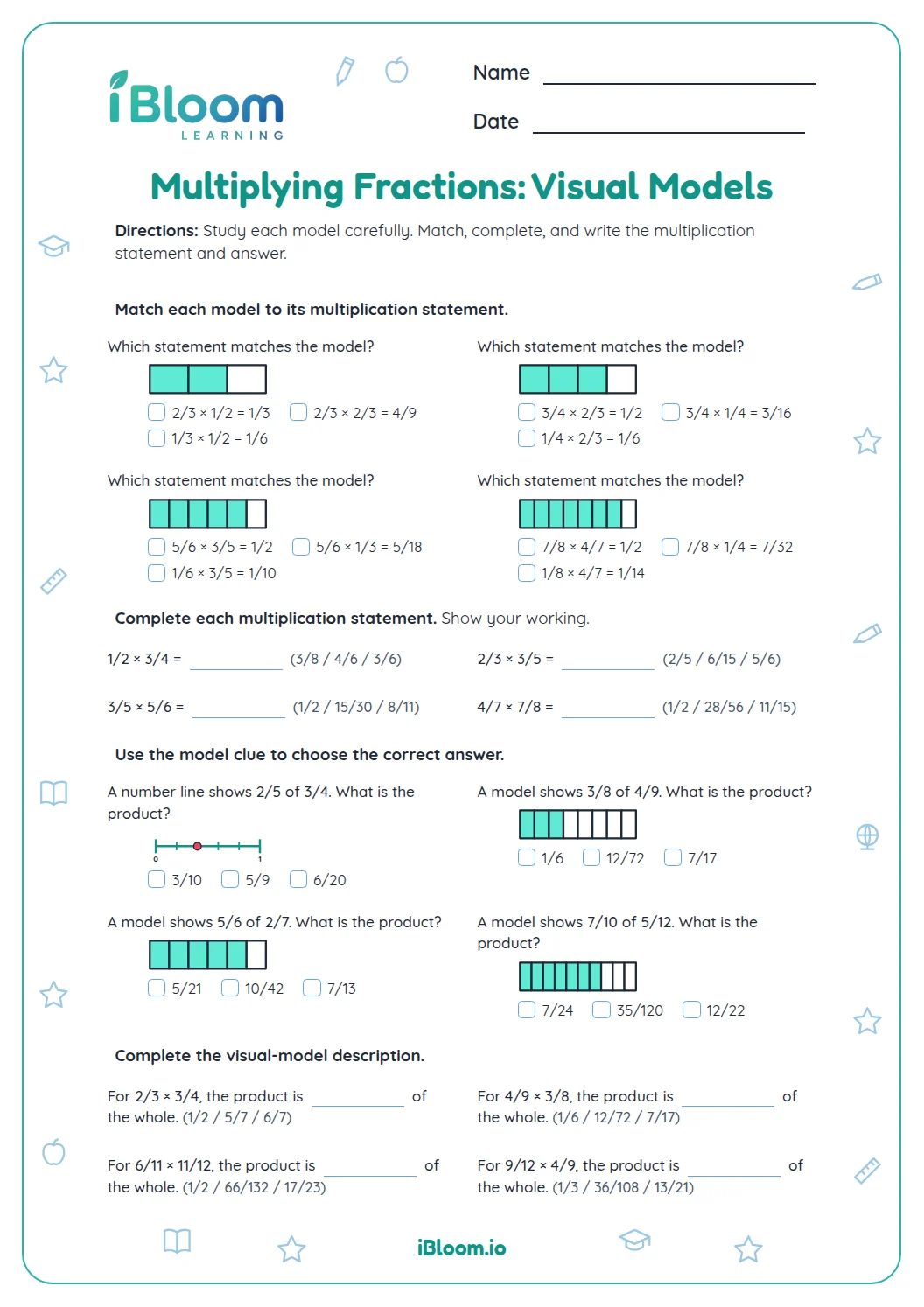
Fraction-bar models show the mixed-number factor as whole bars and a fractional part. In question 1, the bars show one whole and two thirds, so the factor is 1 2/3. Rename it as 5/3 before multiplying by 3/5.
- 11 2/3 × 3/5
- 25/3 × 3/5 = 15/15 = 1
How do you rename a mixed number?
Multiply the whole number by the denominator and add the numerator. For 1 2/3, (1 × 3) + 2 = 5, so 1 2/3 = 5/3. Keep the denominator unchanged.
How do you simplify the product?
Multiply the numerators and denominators, then reduce the fraction. For 5/3 × 3/5, the product is 15/15, or 1. Reduce or cancel common factors when that makes the arithmetic simpler.
What practice is included?
Seven product questions connect a fraction-bar model with a mixed-number factor. The other nine questions provide more practice multiplying mixed numbers by fractions or mixed numbers.
How to multiply mixed numbers
- 1Read the bar to identify the whole and fractional parts.
- 2Rename each mixed number as an improper fraction.
- 3Multiply numerators and multiply denominators.
- 4Simplify the product or write it as a mixed number.
- 5Check that the product size makes sense for the factors.
Common mistakes and quick fixes
The mistake
Adding the whole number to the numerator when renaming.
The fix
Multiply the whole number by the denominator, then add the numerator.
The mistake
Multiplying only the numerators.
The fix
Multiply denominators too, or cancel common factors first.
The mistake
Leaving a reducible product.
The fix
Find a common factor in the numerator and denominator.
Common Core alignment
This worksheet gives focused practice with 5.NF.B.4.
Use multiply mixed numbers to show the reasoning in each item.
On this sheet: The questions ask learners to apply multiply mixed numbers throughout the sheet.
Show the official wordingHide the official wording
Apply and extend previous understandings of multiplication to multiply a fraction or whole number by a fraction.
What to practice next
Make more practice
Further reading
Questions parents and teachers ask
What does the fraction bar show?
The bars show a mixed-number factor as complete wholes plus a fractional part. In question 1, one full bar and two of three parts represent 1 2/3. Students rename that factor before multiplying by the other fraction. The model makes the whole and fractional parts easy to see.
How do you change a mixed number into an improper fraction?
Multiply the whole number by the denominator and add the numerator; keep the same denominator. For 1 2/3, 1 × 3 + 2 = 5, so it becomes 5/3. Repeat for each mixed-number factor. This conversion works because the denominator names the size of each fractional part.
Should students simplify the product?
Yes. Multiply the fractions, then reduce the result and write it as a mixed number when it is greater than one and not a whole number. The answer key uses simplified products for all 16 questions. A reduced answer names the same amount with no common factor left in both terms.
How many questions have models?
Seven of the 16 product questions include a fraction bar that represents a mixed-number factor. The other nine continue the same multiplication skill without a model, so students can apply the conversion and simplification steps independently. The remaining problems use the same steps independently.
How long does this worksheet take?
Allow about 25 minutes for the two worksheet pages. Students can take extra time on the modeled questions to connect the shaded wholes and parts to an improper fraction before completing the remaining products. The later items use the same fraction-conversion steps without a bar next to the expression.